

On this page
- Hour Requirements From Private to Commercial
- The rows that decide your timeline
- How to Move From Private to Commercial Step by Step
- Tests, Ratings and Medicals to Clear First
- Written exams and their prerequisites
- Medicals and when to schedule them
- The standard you're tested against
- Accelerated Routes and What Each One Trades Off
- Four questions that pick the route
- Realistic Timelines for Each Pace of Training
- The cost side of the same arithmetic
- The gap after the certificate
- Confirm Your Route Before Booking the First Lesson
- Questions to ask any school, including this one
250 flight hours is the figure every future airline pilot learns first, and it's the most misread number in flight training. The total comes from 14 CFR 61.129, which sets the aeronautical experience for a commercial airplane certificate at 250 hours of flight time as a pilot, including at least 100 hours as pilot in command and 50 hours of cross-country time inside that pilot-in-command total. The regulation is specific about the kind of hours, not just the count.
What follows is the private pilot to commercial pilot pathway treated as a series of FAA gates rather than a calendar. The arithmetic stays yours to rerun every month: hours still needed, divided by the hours you fly each week, gives the weeks to plan around.
Hour Requirements From Private to Commercial
A private pilot certificate for airplane single-engine starts at 40 hours of total flight time under 14 CFR 61.109: 20 hours of flight training with an authorized instructor, 10 hours of solo flight, and at least 3 hours of cross-country instruction. The solo requirement is more specific than the count suggests. It has to include 5 hours of solo cross-country and one solo cross-country flight of at least 150 nautical miles total distance, with full-stop landings at three points and one leg longer than 50 nautical miles.
The private pilot eligibility rules in 61.103 also set 17 as the minimum age for an airplane rating, alongside the English proficiency, knowledge test, endorsement and practical test requirements. Commercial applicants move that floor to 18.
| Requirement | Private pilot (61.109) | Commercial pilot (61.129) |
|---|---|---|
| Total flight time | 40 hours | 250 hours |
| Instruction or commercial training | 20 hours dual instruction | 20 hours commercial training |
| Solo flight | 10 hours | No separate solo minimum, since the 100-hour PIC total covers it |
| Pilot-in-command time | 10 hours solo, which logs as PIC | 100 hours |
| Cross-country | 3 hours of instruction and 5 hours solo, including one solo flight of at least 150 nm with full-stop landings at three points | 50 hours cross-country as PIC, plus a 300 nm flight with three landings |
| Instrument training | Covered inside the 20 hours of dual training | 10 hours |
| Complex or technically advanced airplane | None required | 10 hours (single-engine pathway) |
| Minimum age | 17 | 18 |
The rows that decide your timeline
Cross-country time is where most students underestimate the work. The private certificate asks for a few instructional and solo hours plus one 150-nautical-mile flight. The commercial certificate asks for 50 hours of cross-country as pilot in command, which is a different order of commitment: real trips, unfamiliar airports, fuel planning, and weather decisions you can't rehearse in the pattern.
Complex time catches the second group. If your school has one complex airplane and six students who each need 10 hours in it, your slot competes with everyone else's. Book those hours in the first half of commercial training, not the last month.
Total hours are the least useful number to track on its own. 250 is an eligibility threshold, not evidence that you can hold altitude within tolerance through a chandelle while talking to approach control.
Practical rule: subtract your current logbook totals from each row in the table. What's left is your real syllabus, and it's more specific than "another 150 hours".
If you want the endorsement and hour rules in one place before you plan anything, our guide to flight training requirements lays them out.
How to Move From Private to Commercial Step by Step
The logbook gap sets the workload, but the order of training affects how efficiently you close it. Build each stage around the skills and experience the next one depends on.
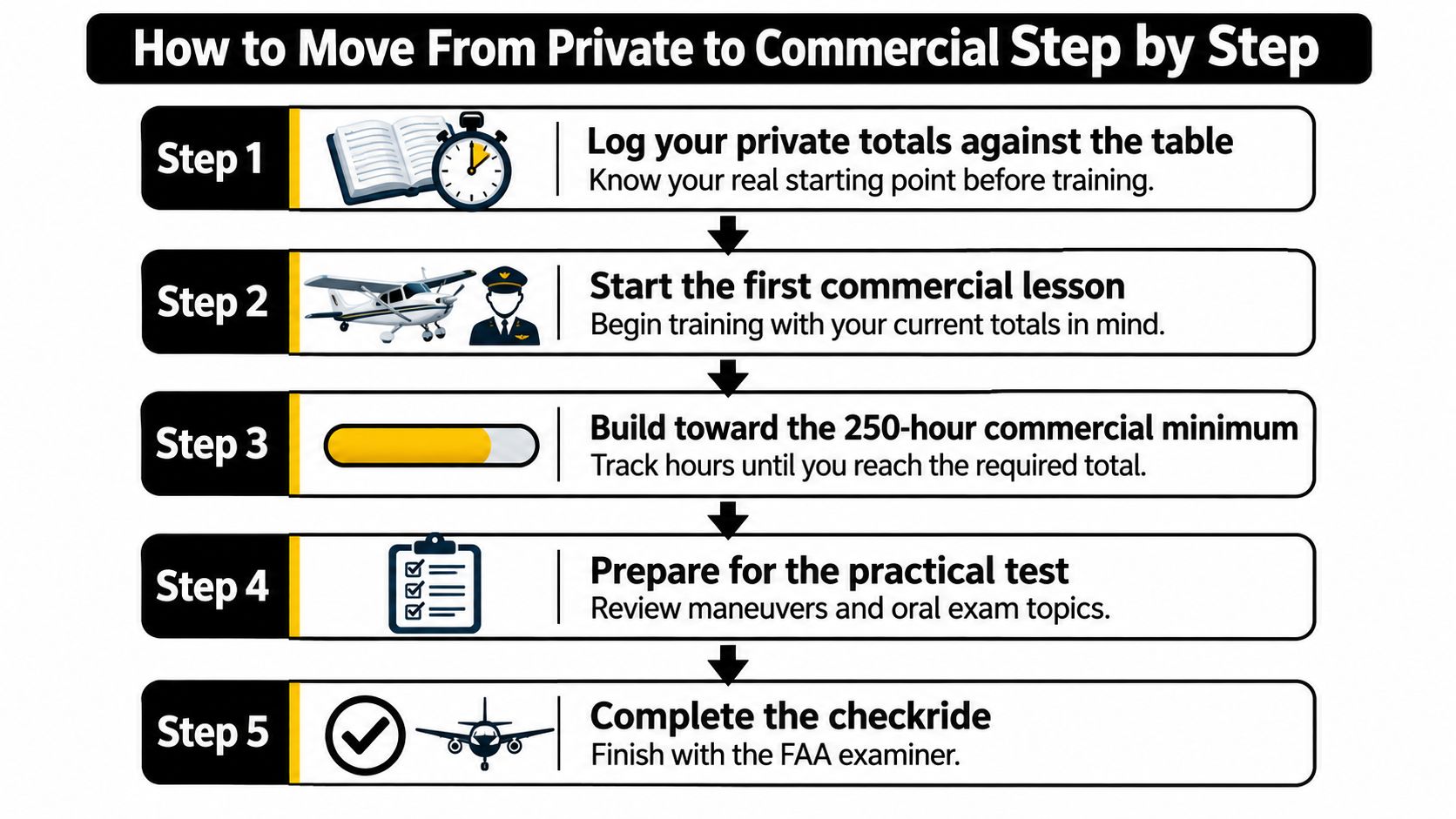
Reconcile the logbook. Export your totals and compare them with the table above. Check for duplicate entries, missing landings, and hours recorded in the wrong category before planning the remaining training.
Start instrument work early. A stable scan takes practice to develop, and commercial flying requires you to control the airplane while managing attention and workload.
Make commercial maneuvers repeatable. Chandelles, lazy eights, steep spirals, and eights on pylons test energy management, wind correction, and coordination. Aim to fly each maneuver within the required tolerances across successive lessons, not just once after a briefing.
Plan pilot-in-command and cross-country time deliberately. The commercial benchmark in the commercial pilot regulations in Part 61 includes a cross-country flight of at least 300 nautical miles, with landings at three points and one segment at least 250 nautical miles from departure. Choose a route that gives you practice planning a real trip, including unfamiliar airports, fuel, and weather.
Schedule the required instrument and airplane experience early. Use the table above to identify these hours and check when the aircraft you need will be available.
Track knowledge-test and endorsement requirements alongside flight training. The next section covers the exams, ratings, and medicals to clear before the practical test.
Use stage checks to find specific gaps. For example, a weak partial-panel scan can require another lesson focused on instrument control before you advance. Addressing it at a stage check gives you time to correct the problem; finding it during the practical test can mean a discontinuance and another examiner appointment.
Book the examiner when your performance is consistent. You should meet Airman Certification Standards tolerances across consecutive sessions, explain regulations and aircraft systems without prompting, and recognize and correct your own deviations. AOPA's checkride guidance describes this kind of preparation.
Use a stage check to identify a specific weakness, such as lazy eights flown eight knots too fast, then retest that task after focused practice.
Close each stage with evidence. Confirm that required entries are logged, tasks can be flown without prompting, and corrected weak areas have been retested. Label completed modules clearly in your training records so you and your instructor share the same picture of your progress.
Tests, Ratings and Medicals to Clear First
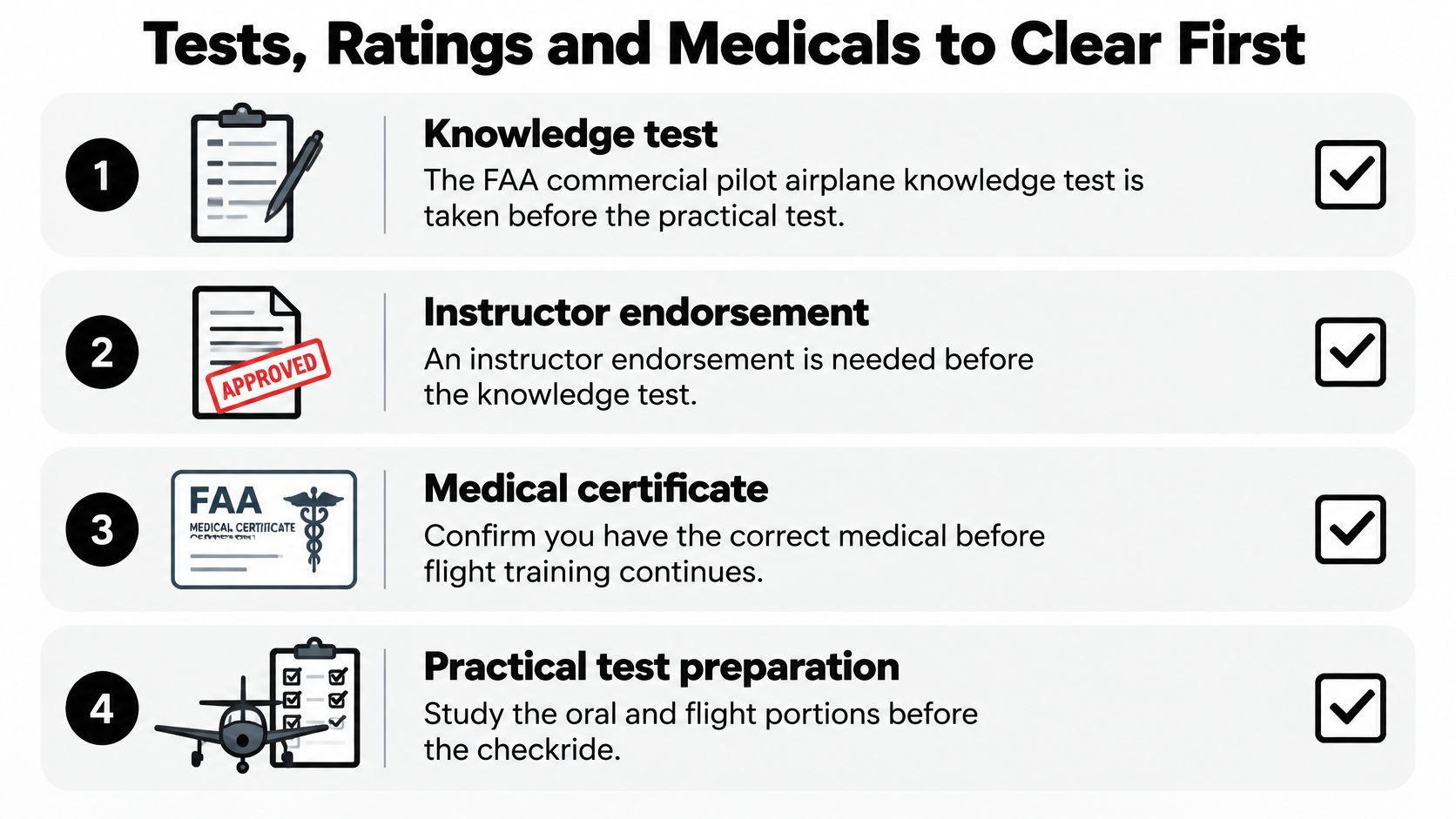
Commercial eligibility depends on more than flight hours. You also need the right knowledge tests, ratings, endorsements, and medical certificate for the privileges you plan to exercise.
Written exams and their prerequisites
The commercial pilot airplane knowledge test must be passed before the practical test, and an instructor must endorse you to take it. The instrument rating has a separate knowledge test. Plan both around your training: passing the written exams early leaves time to apply that knowledge in the airplane before the checkride.
Medicals and when to schedule them
A third-class medical certificate from an aviation medical examiner is required before flying solo. You can take a discovery flight and your first lessons before obtaining one. See the guide to FAA medical certificate classes for an explanation of what each class permits.
To exercise commercial pilot privileges, you generally need a second-class medical. Schedule the exam with enough time to address any issues before your practical test.
The standard you're tested against
The Commercial Pilot Airplane Airman Certification Standards, FAA-S-ACS-7B, set the practical-test standards. Use the current version from the FAA Airman Certification Standards page.
Decide when to complete the instrument rating before booking the commercial checkride. An unrestricted commercial airplane certificate requires an instrument rating, held already or obtained concurrently. If you defer it, understand the operating limits that apply.
Before scheduling the practical test, confirm these items:
- Knowledge tests passed: commercial airplane, and instrument if that rating is part of your plan.
- Medical certificate: current and appropriate for the privileges you intend to exercise.
- Training documented: required endorsements and applicable instrument and complex-airplane training recorded.
- ACS in hand: prepare to the current FAA-S-ACS-7B.
- Instrument rating timing set: completed, concurrent with commercial training, or deferred with the associated limits understood.
Accelerated Routes and What Each One Trades Off
A Part 141 program can reduce the commercial-pilot flight-time requirement from 250 hours to 190. The FAA's commercial pilot licensing guidance explains the eligibility requirement. The certificate is the same; the lower threshold means fewer hours are required for that certificate.
Those 190 hours establish regulatory eligibility. Airlines may require substantially more experience, often 1,000, 2,000 or more flight hours, according to the same FAA guidance. Reaching the commercial certificate sooner does not close that gap. Paid instructing can build flight time after certification.
| Factor | Part 61 (standard) | Part 141 (approved program) |
|---|---|---|
| Minimum commercial experience | 250 hours | 190 hours |
| Curriculum | Set between student and instructor | FAA-approved structured curriculum |
| Scheduling | Lesson by lesson; you set the pace | Follows the approved program structure |
| Best fit | Part-time or mixed schedules | Full-time students who want a fixed syllabus |
| Cost pattern | Pay per lesson | Priced by the approved program; confirm the total in writing |
Four questions that pick the route
- How many hours are already in your logbook? At 180 hours, much of the required experience is already logged. Ask how the school will credit it before choosing a program designed for students starting from zero.
- How much flexibility do you need? Structured programs require consistent availability. Shift work and caregiving can make that schedule difficult to maintain, and missed lessons can mean additional review flying.
- Do you learn better with a fixed sequence or a negotiated one? A set syllabus lays out what comes next. A more flexible plan lets the instructor adapt lessons to what you have already learned.
- Do you plan to instruct? Instructor work can add flight time after certification. Compare routes by how soon they prepare you to teach, as well as by their calendar and cost.
A structured program shortens the calendar when you can fly consistently. Gaps between lessons add review, increasing both the time and cost of training. The fast-track pilot training guide explains what an intensive schedule can compress and what still takes practice. Choose a rhythm you can sustain for six months.
Realistic Timelines for Each Pace of Training
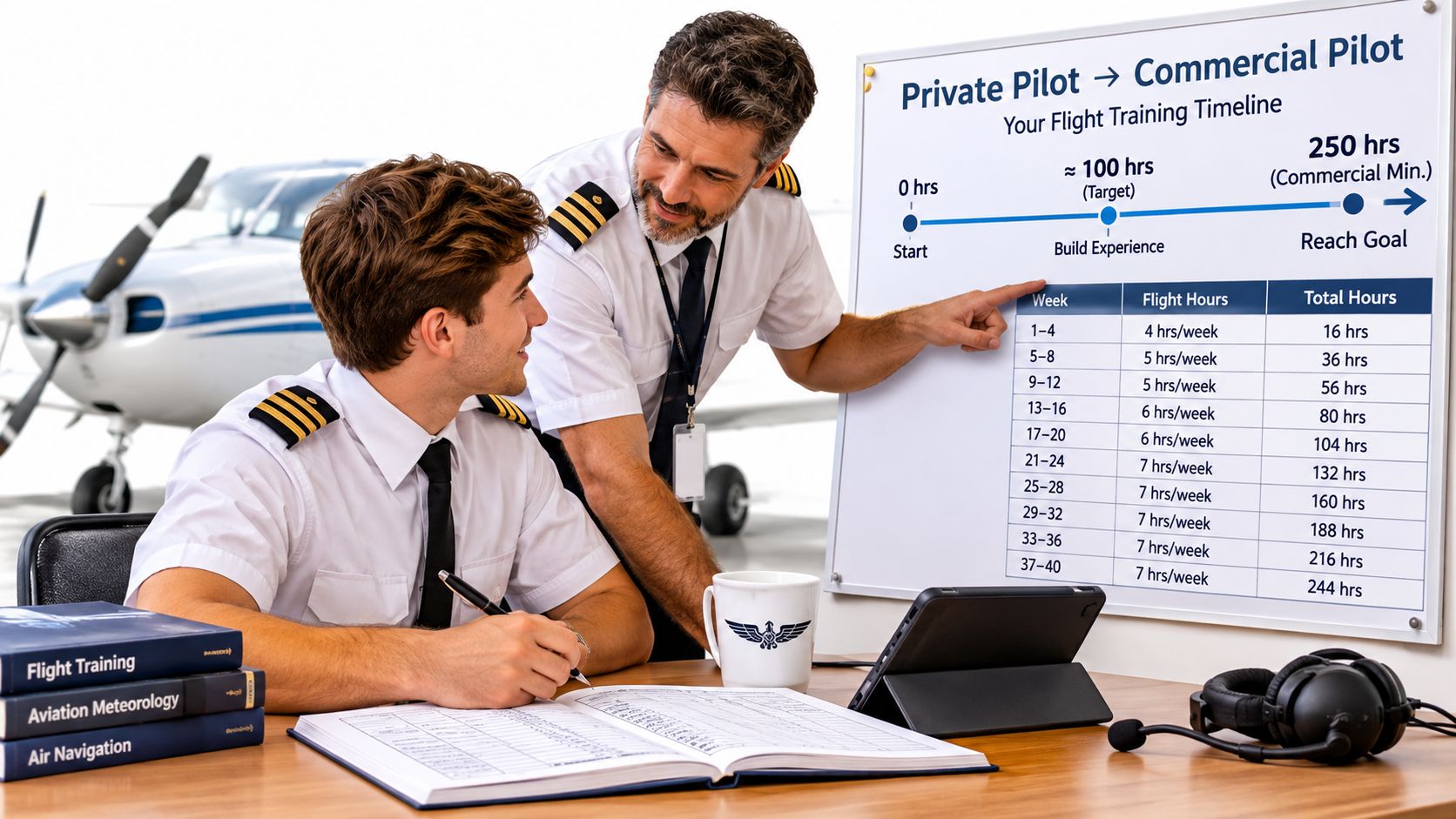
The honest way to plan the calendar is to divide, not estimate. Start from the commercial minimum counted from zero flight time, 250 hours, and divide by the hours you fly in a week.
| Pace | Flying per week | Weeks to 250 hours | Cost basis |
|---|---|---|---|
| Two lessons a week | about 3 hours | about 83 weeks, roughly 19 months | hours × your local aircraft and instructor rate |
| Three lessons a week | about 5 hours | about 50 weeks, roughly 11 months | hours × your local aircraft and instructor rate |
| Full time, four flights a week | about 10 hours | about 25 weeks, roughly 6 months | hours × your local aircraft and instructor rate |
| Full time, five days a week | about 15 hours | about 17 weeks, roughly 4 months | hours × your local aircraft and instructor rate |
Those are flying hours only. Weather, ground school, examiner availability and the gaps that appear whenever life interrupts a schedule all push the calendar past the number in that column. Treat the third column as a floor you can plan against, not a promise.
The cost side of the same arithmetic
Cost is total hours multiplied by your school's aircraft and instructor rate, plus the knowledge test fee, the medical exam and the examiner's fee. Fill in your own local rates rather than trusting a published national average, because the spread between schools is larger than most buyers expect. One detail worth understanding before you compare quotes: a dual hour charges the aircraft rate plus the instructor rate, while a solo hour charges the aircraft rate alone, which is why time-building flights cost less per hour than training flights.
The gap after the certificate
The commercial certificate is a midpoint, not a finish line, for airline work. Serving as an airline first officer generally means progressing to an Airline Transport Pilot certificate, whose standard requirement is 1,500 total hours, including 200 hours of cross-country time, and the Bureau of Labor Statistics occupational outlook projects 7% employment growth for airline and commercial pilots from 2025 to 2035, with about 16,400 openings each year. Restricted ATP pathways tied to approved aviation degree programs and military training can lower the threshold to 1,250 or 1,000 hours, but the pilot stays restricted until the full requirement is met.
A commercial certificate earned at the 250-hour Part 61 minimum therefore leaves roughly 1,250 hours to the standard threshold. That number, not the 250, is the one that shapes a career plan.
Rerun the arithmetic: hours still needed, divided by the hours you reliably fly each week, gives the weeks to plan around. Recalculate monthly with what you actually flew, not what you intended to fly.
Our guide to how long flight school takes breaks the same math down stage by stage.
Confirm Your Route Before Booking the First Lesson
A discovery flight is one hour, requires no prior experience, and gives you a chance to meet an instructor, walk around the airplane with a checklist card, and take the controls in the air.

If you already hold a private certificate and want to train through instructor ratings, CFII's Career Track covers six certificates and ratings, 282 hours, and one-on-one instruction for $89,000, with a target of about nine months full time. Financing is available for the full amount. Before committing, check how the schedule fits your work and personal obligations.
Questions to ask any school, including this one
- How old is the airplane you'll fly most? Ask how the school maintains its aircraft, too.
- How many students share each airplane? Aircraft availability affects how consistently you can fly.
- What is instructor turnover like? Ask how the school handles training continuity if your instructor changes.
- What is the total price in writing, and what is excluded? Get a written breakdown of tuition, examiner fees, and test fees.
- Is the course Part 61 or Part 141? Ask how the training structure and applicable hour requirements differ.
- Can you fly before committing? Ask about a discovery flight or introductory lesson.
Set your route around the hours you still need after earning the commercial certificate. Then divide those hours by the number of hours you can realistically fly each week. Recalculate as your logbook grows; a schedule based on actual flying is more useful than one based on your target pace.
For tuition planning, review this guide to aviation financing. Before booking, write down your current hours, the hours required for your next certificate, and your realistic weekly flying time. That gives you a timeline you can update as training progresses.
CFII offers training in Southern California, including a discovery flight for prospective students.
Planning to fly for a living?
See what the path from zero to a pilot career looks like, what it costs and how long it takes.
Learn to fly in Riverside
We train at Riverside Municipal Airport in modern airplanes with a parachute built in. Start with a one hour discovery flight, no experience needed.