

On this page
- What Fast Track Pilot Training Really Means
- How the Certificate Ladder Shapes Accelerated Training
- How the ladder works
- Why the 1,500-hour benchmark matters
- Timelines and Hour Requirements You Should Expect
- The private pilot baseline
- Building a realistic calendar
- How Simulator Time and Scheduling Intensity Affect Progress
- Weighing the Pros and Cons of Accelerated Training
- Evaluating Program Examples and Fixed-Price Pathways
- Pricing questions
- Competency questions
- Choosing Your Next Step Toward CFII
You've started searching flight schools, and the timelines don't seem to agree. One program promises a quick route from zero experience to instructor qualifications; another suggests training will take much longer. Before you compare calendars or tuition, it helps to know what “fast” can change and what it can't.
Fast-track training can reduce gaps between lessons and organize the certificate sequence into a full-time plan. It can't remove FAA requirements, guarantee that every lesson goes to plan, or promise a job when you graduate. The useful question isn't just how quickly you can earn certificates. It's whether a program's schedule adds up against the required experience, real training needs, and your path after graduation.
What Fast Track Pilot Training Really Means
A newcomer who wants to fly for a living may picture a direct route: study full time, earn the required certificates, and move into an airline cockpit. Fast-track pilot training makes the training portion more structured and intensive, but it doesn't make that whole career journey a single uninterrupted course.
In practice, “fast” usually means fewer long breaks between lessons, a connected syllabus, planned study, and regular feedback from an instructor. If you fly only occasionally, you may spend time refreshing skills from the previous lesson. A full-time schedule can keep procedures and concepts fresh, provided you're rested enough to learn and the aircraft, instructor, and weather cooperate.
The legal and skill standards don't get lower because the calendar is compressed. You still need to meet the FAA requirements for each certificate and rating, demonstrate the necessary skills, and prepare for practical tests. The difference is how a program organizes your time, not what counts as competent flying.
Practical rule: Treat every advertised timeline as a proposal to test, not a result the school can guarantee.
"Fast" can also mean different things. One program may describe the time to complete initial certificates; another may include instructor ratings; a third may imply airline readiness, even though students still need to build experience after training. Ask what the endpoint is, and what happens between that endpoint and the job you want.
This path can suit a student starting with no flight time, a pilot who already holds a private certificate, or a career changer able to dedicate substantial time to training. It may be a poor fit if work, family, finances, or fatigue make a full-time schedule difficult to sustain.
By the end of your comparison, you should be able to check a timeline against FAA rules, distinguish certificate completion from airline eligibility, and judge whether the training structure fits your life. Those are better measures than speed alone.
How the Certificate Ladder Shapes Accelerated Training
A student starting with no flight time may finish one lesson able to hold altitude and make turns, yet still need months of practice before earning each certificate. The certificate ladder builds those skills in sequence. Accelerated training can organize the steps closely, but proficiency at each stage still matters.
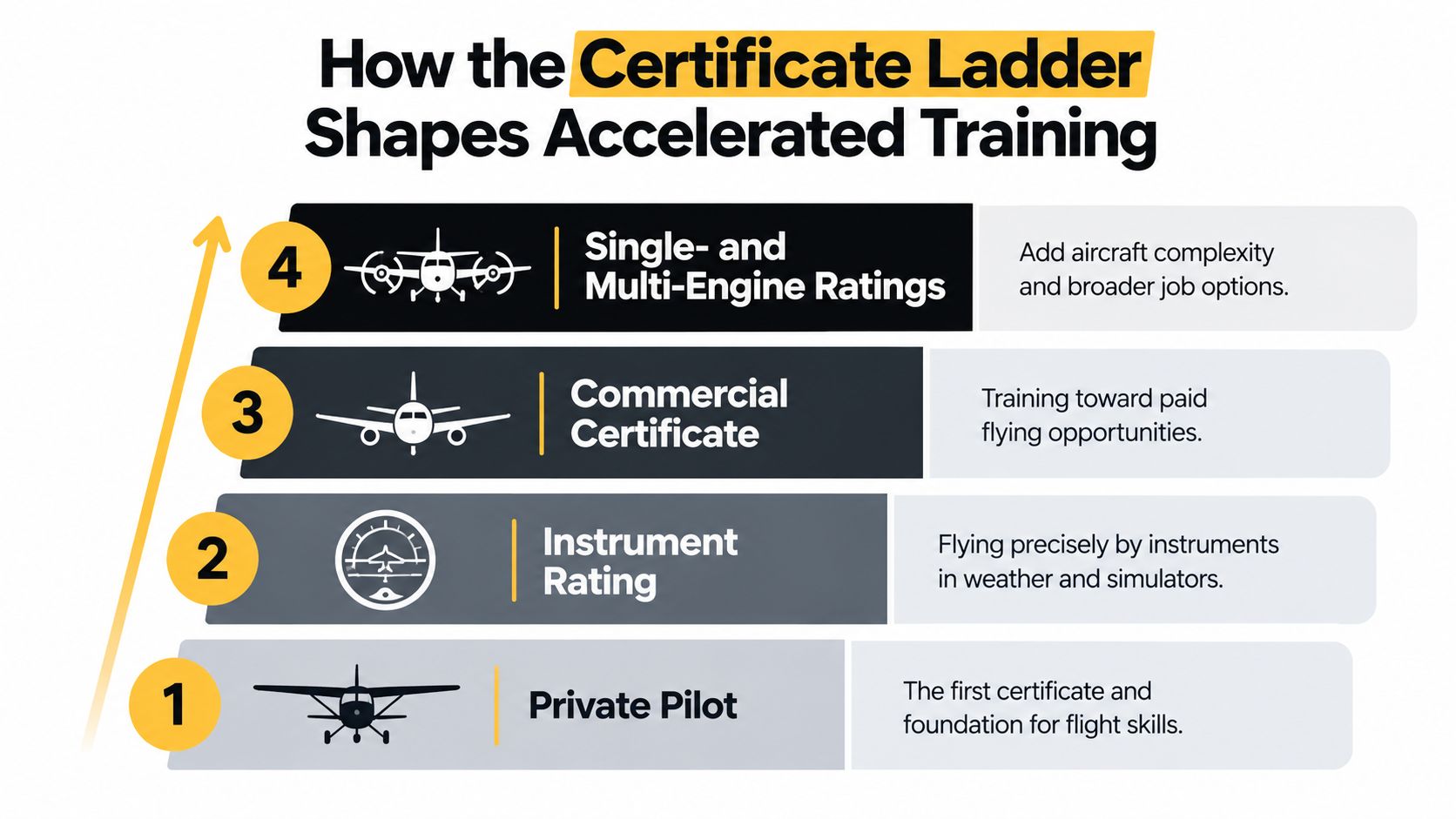
How the ladder works
The private pilot certificate establishes the foundation: aircraft control, navigation, communication, and sound decisions. An instrument rating adds the ability to fly by reference to cockpit instruments when visual references are limited. Each stage builds on the last, much like learning to read a map before planning a longer route.
A commercial pilot certificate allows a pilot to fly for compensation within applicable rules. A multi-engine rating qualifies the pilot to operate aircraft with more than one engine. CFI and CFII certificates qualify pilots to teach, and flight instruction is one common way to build experience after training. See this overview of pilot certification training and the order of certificates.
Commercial eligibility depends on the kinds of flight experience a student logs, not just the total. For an airplane single-engine rating, 14 CFR § 61.129 generally requires at least 250 hours of pilot flight time, along with specified pilot-in-command, cross-country, aircraft, and training experience. Those categories shape the route: two students with the same total hours may not have completed the same requirements.
Why the 1,500-hour benchmark matters
Finishing instructor qualifications does not mean a pilot is ready for every airline job. For many aspiring U.S. airline pilots, building experience comes after initial training. Following the 2009 Colgan Air Flight 3407 crash, legislation established a higher experience threshold for the unrestricted Airline Transport Pilot certificate. The standard benchmark is 1,500 flight hours, with exceptions for certain qualifying military pilots and graduates of specified aviation programs, as described by the Government Accountability Office.
That distinction helps test an accelerated program's promise: check which certificates it includes, what experience categories it prepares students to complete, and what work may remain before they meet their career goal. A program can take a student from zero experience to flight instructor, but building the hours needed for later roles remains a separate stage.
Timelines and Hour Requirements You Should Expect
A student may meet the legal minimum for one certificate and still need more training to demonstrate consistent skill. For a private pilot certificate, the FAA minimum is 40 flight hours, including at least 20 hours with an authorized instructor and 10 hours of solo flight training, along with specified cross-country, night, and instrument experience. The FAA reports that students without a hearing impairment average approximately 75 hours to complete private-pilot certification.
That difference matters when you assess a fast-track schedule. A calendar based on minimum hours can leave little room for weather delays, extra practice, stage checks, or checkride preparation. Each person's pace varies.
The private pilot baseline
Use hour benchmarks to test a program's assumptions, not to predict your own finish date. Ask what happens if you need more practice before moving to the next certificate, and whether the quoted schedule includes that time.
| Milestone | Hour benchmark | What to check |
|---|---|---|
| Private pilot certificate | 40-hour regulatory minimum; approximately 75-hour FAA student average | Does the schedule allow for training beyond the minimum? |
| Commercial airplane single-engine certificate | Generally at least 250 hours, with specific experience categories | Does the plan account for the required types of experience, not only total hours? |
| Unrestricted Airline Transport Pilot certificate | Generally 1,500 hours, subject to specified exceptions | What experience-building work follows instructor training? |
A total-hour target is only part of the picture. Commercial certification includes specific experience categories, while airline eligibility involves experience-building after initial training. As noted earlier, earning instructor qualifications does not remove the later flight-hour requirements for many airline pathways.
Building a realistic calendar
Ask the school to show how its syllabus fits into a calendar: training days, study time, stage checks, and checkride preparation. Then ask how weather cancellations and rescheduling affect the expected finish date. A tightly scheduled plan depends on lessons taking place and on having enough time to absorb each skill.
For example, compare the promised completion date with the assumptions behind it. Does the estimate treat minimum hours as typical? Are stage checks and extra practice accounted for? For a separate breakdown of expenses, read this guide to the cost to get a commercial pilot license.
Treat a finish date as an estimate, not a guarantee. Ask what could extend the timeline and whether your budget can accommodate additional training.
How Simulator Time and Scheduling Intensity Affect Progress
A student practicing an instrument approach in a simulator can repeat the procedure, pause, and correct a mistake before trying again. That makes the simulator useful for building specific skills, but it does not replace learning to handle an airplane.
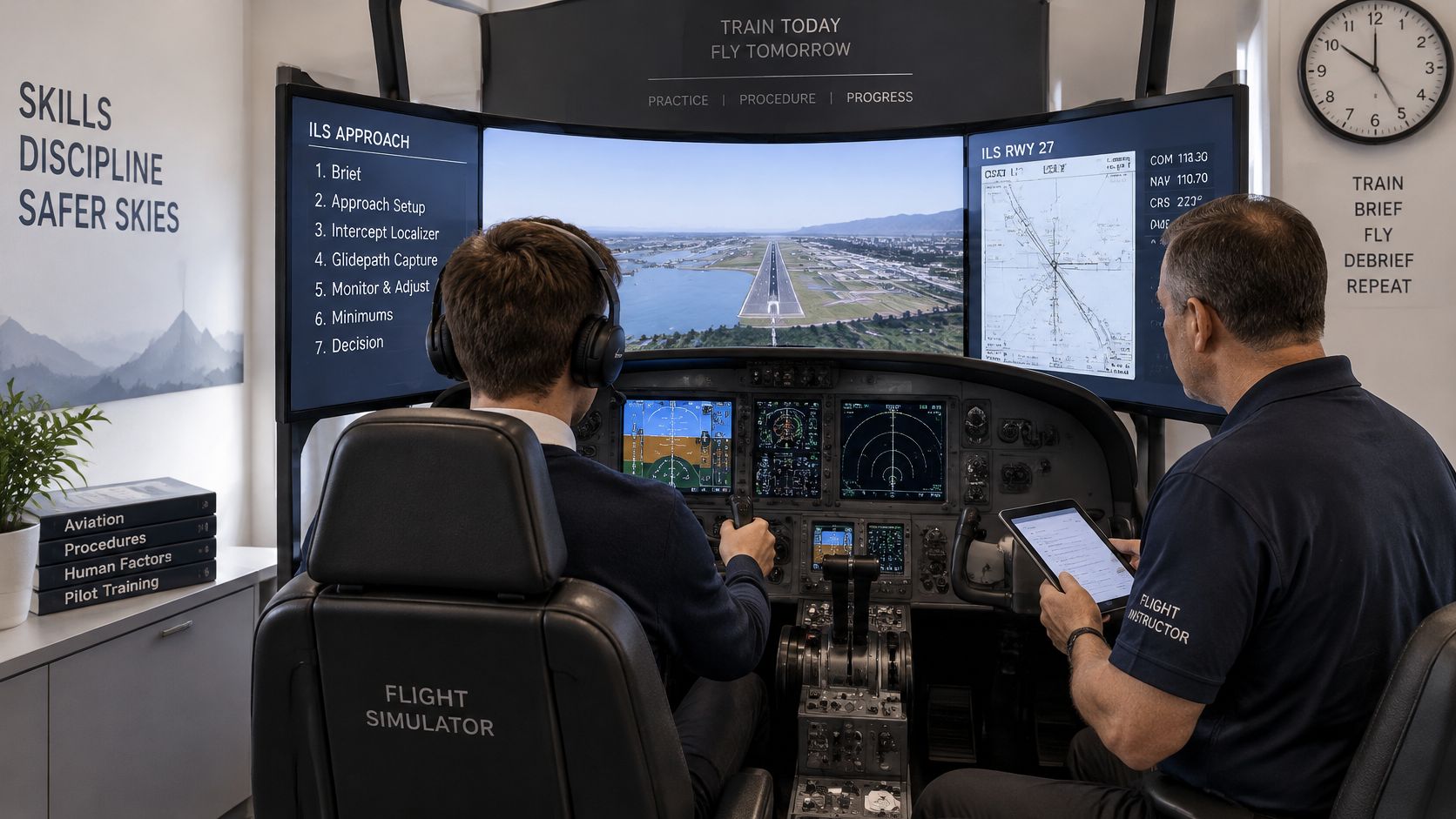
Takeoffs, landings, and aircraft handling require time in an airplane. Simulator credit toward FAA experience requirements depends on the device and the specific rule. For example, a particular multiengine Airline Transport Pilot requirement allows up to 25 hours in a full-flight simulator representing a multiengine airplane toward a 50-hour requirement, under specified training-program conditions. A generic device does not automatically qualify for that credit, according to FAA guidance. Ask the school to demonstrate how a simulator session maps to a specific training objective and FAA requirement. For more on the differences between devices and their uses, see this guide to aircraft flight simulation.
The schedule matters, too. A student flying two or three times a week has more time between lessons than someone training daily. Frequent practice can help keep procedures fresh, while study and rest give new skills time to settle. Weather, aircraft and instructor availability, and fatigue can all affect how consistently lessons take place.
Before enrolling, ask how the school balances simulator sessions with aircraft lessons and what happens when a scheduled flight is canceled. A simulator can reinforce a procedure, but proficiency still needs to be demonstrated in the right setting. Check whether the proposed timeline leaves room to repeat skills until you can perform them reliably, not just until the calendar says it is time to move on.
Weighing the Pros and Cons of Accelerated Training
A student who finishes instructor training during a hiring slowdown may still need several years of experience-building before an airline job is within reach. That possibility belongs in any decision about an accelerated schedule.
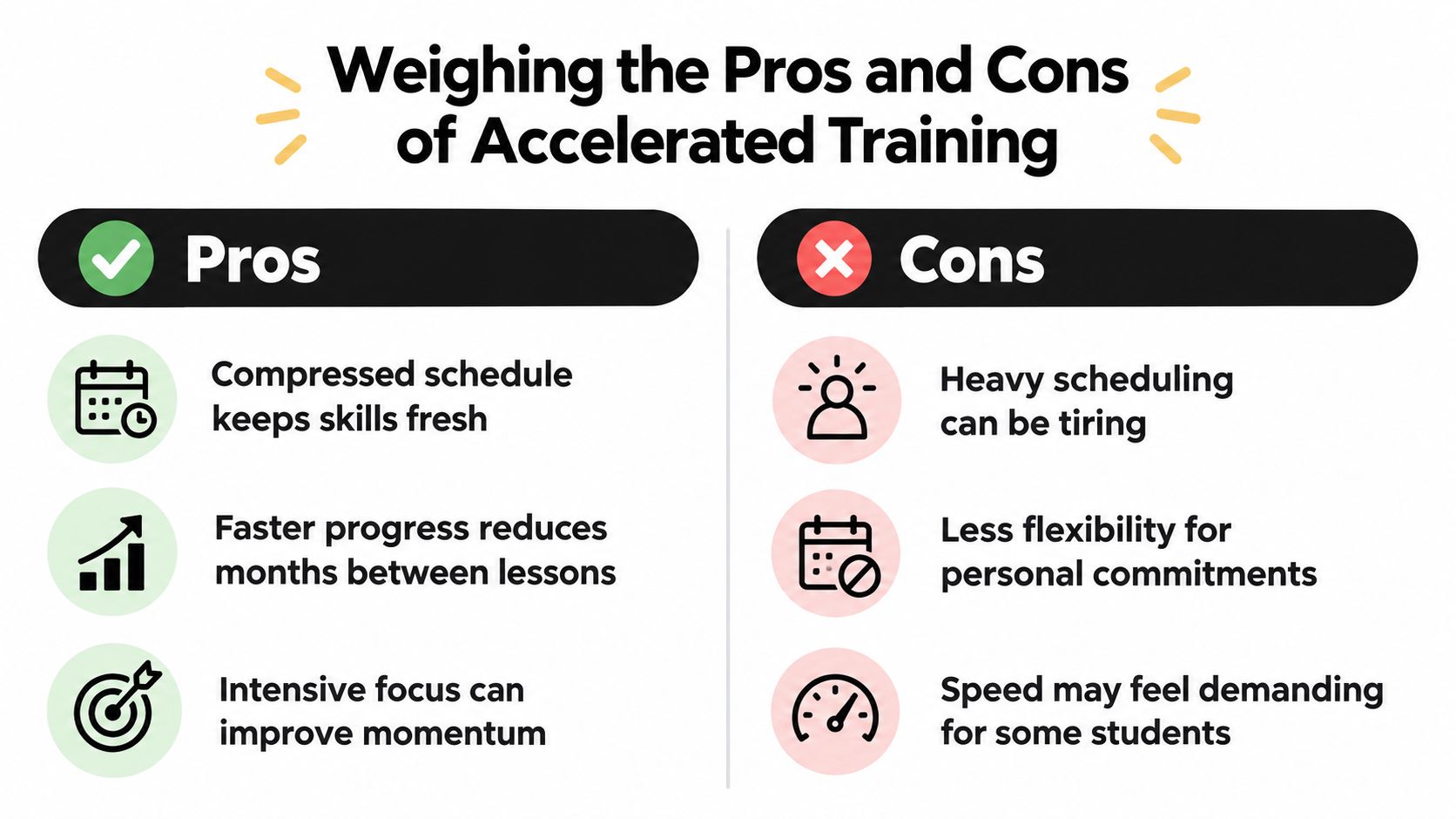
Frequent lessons can help you retain procedures and keep skills fresh. A structured syllabus also makes each next goal clear, and finishing sooner may let you begin building flight experience earlier. The trade-off is a demanding routine, less flexibility for work or family, and no guarantee of a job after graduation.
| Potential advantages | Potential drawbacks |
|---|---|
| More continuity: Frequent lessons can help keep recently learned skills fresh. | Greater intensity: A packed routine can be tiring and leave less room for outside commitments. |
| Clear progression: A structured syllabus makes the next training goal easier to see. | Less scheduling flexibility: Full-time training can be difficult to combine with work or family obligations. |
| Earlier experience-building: Finishing instructor training sooner may let you start the next stage sooner. | No automatic airline placement: Hiring conditions may change while you build experience. |
Hiring can vary from year to year. U.S. major airlines hired 2,190 pilots in the first half of 2025, after the unusually high hiring pace of 2022–2023 had cooled. Industry commentary described roughly 4,000–5,000 major-airline hires as a normal strong year, according to this account of how airline pilot demand has normalized.
Long-term forecasts and near-term hiring conditions measure different things. Boeing's 2025–2044 outlook projects demand for 660,000 new pilots globally over that period. Industry projections also warn that pilot supply may outpace demand in parts of the decade, so graduates should plan for several experience-building years rather than assume an immediate hiring window.
The goal of fast training is steady progress, not rushed judgment. Ask how instructors assess your decisions about weather, airspace, and risk, and what happens if you need more practice. Consider whether your finances and personal commitments can support a longer path to an airline job.
Evaluating Program Examples and Fixed-Price Pathways
A fixed-price pathway can clarify the planned training scope, but the price alone does not show what is included. Compare the written terms: one program may cover instruction and specified simulator time, while another may charge separately for items you expected to be included.
Pricing questions
Ask the school to walk you through these details:
- What does the price cover? Check whether aircraft, instructor time, simulator sessions, exams, checkride preparation, and study materials are included.
- What costs extra? Review exclusions and find out how additional training is billed if you need more time.
- How are hours counted? Separate airplane time from simulator time, and check how each applies to the certificates and ratings you're pursuing.
- What affects the schedule? Ask how the school handles weather cancellations, aircraft availability, instructor changes, and rescheduling.
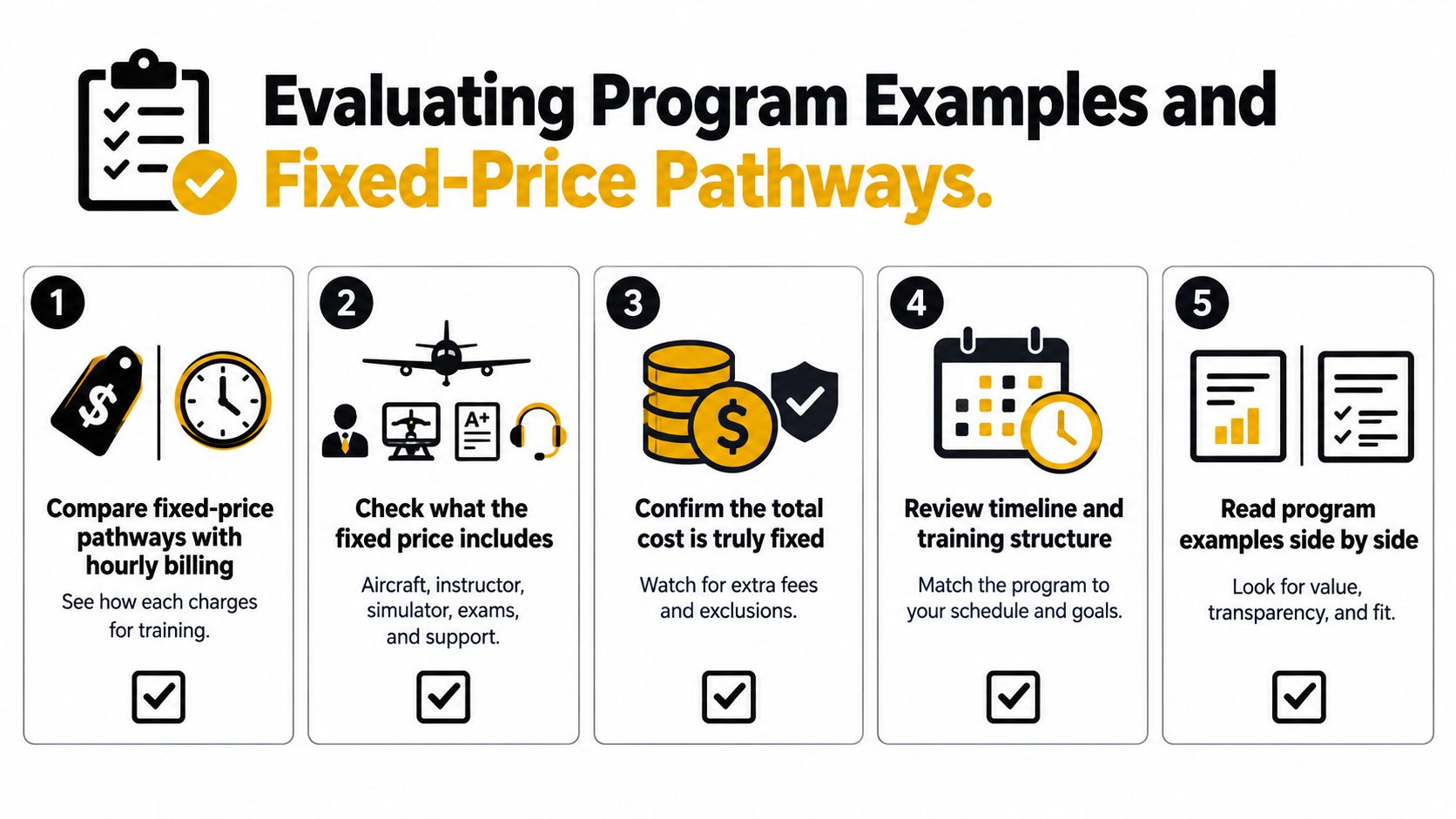
Hourly billing means the total can rise as training continues. A fixed price makes the agreed scope easier to review, but neither payment model proves that a syllabus builds proficiency. Read the exclusions and ask what happens if you need extra practice.
Competency questions
A compressed syllabus should have clear standards for advancing. For example, a student should show stable approaches, a disciplined instrument scan, sound automation use, and good judgment about weather and airspace. The goal is to understand why a maneuver or decision is appropriate, not only to repeat control inputs.
The FAA's instructor-training guidance emphasizes practical risk-management tools pilots can apply in their own operations. Ask how instructors assess those skills, record progress, and plan additional practice when a student needs it.
Employability also calls for specific questions: Does the school track job outcomes by occupation? Do graduates tend to stay in the local hiring area? Have former students used flight-instructing experience to build the hours and skills employers request? These answers help distinguish a training timeline from a realistic path into paid flying.
Before enrolling, ask what happens after a stage-check failure, how extra practice is arranged, and whether instructor changes are possible. Review the program's flight training courses to see how courses fit into a certificate path.
Choosing Your Next Step Toward CFII
If you want a full-time route from no flight experience to instructor qualifications, CFII's Career Track offers a defined option to assess. It takes about nine months from zero time to CFII and multi-engine ratings, with six certificates and ratings, 282 total hours, and a fixed $89,000 tuition. The training includes 204 single-engine hours, 25 multi-engine hours, and 53 simulator hours, as well as one-on-one instruction. It's based in Southern California, with training in Riverside, Long Beach, and Corona.
You can review the Career Track program to compare its published scope and timeline with the regulatory and competency checks discussed above. The program's schedule is a plan to evaluate, not a guarantee that every student will finish on the same date or move directly into an airline job.
If you haven't flown yet, CFII also offers a one-hour discovery flight that requires no experience. It's the first lesson: you meet the instructor, preflight the airplane together, and take the controls in the air. That's a practical way to find out whether flying feels right before committing to a longer course of training.
For a broader overview of flight-school formats, see this guide to a flight academy. Your next step can be simple: compare the published timeline and checklist in this article with the program details, then book a discovery flight if you haven't flown or review the Career Track if you're ready to consider a full pathway.
CFII offers a fixed-price, full-time Career Track from zero experience to CFII and multi-engine ratings, along with a discovery flight for people who haven't flown yet. Compare the training scope and timeline with your goals, then visit CFII to decide which next step fits.
Planning to fly for a living?
See what the path from zero to a pilot career looks like, what it costs and how long it takes.
Learn to fly in Riverside
We train at Riverside Municipal Airport in factory-new airplanes with a parachute built in. Start with a one hour discovery flight, no experience needed.