

On this page
- Flight School Length by Training Model
- Typical Duration by Training Model
- The Hour Rules Behind Each Certificate
- The Private Pilot Minimum
- Hours Alone Don't Earn the Certificate
- Choosing Between Accelerated, Part-Time and Modular Training
- Questions That Decide the Fit
- What Stretches or Shortens Your Timeline
- What Stretches Training
- What Shortens Training
- Hour Thresholds From Certificate to Airline Cockpit
- Hour Thresholds by Milestone
- Example Timelines From Zero Time to Career-Ready
- The Weekend Hobby Pilot
- The Full-Time Career Student
- The Career Changer Building Time
- Confirm Your Timeline Before You Enroll
Nine months of flight training can take you from your first lesson to a flight instructor certificate, with 282 hours logged along the way. The calendar that matters for an airline job stretches much further. Flight school has two phases, and planning for only the first one leads almost everyone to the wrong expectations. A student who budgets twelve months, passes every checkride on schedule, then asks an airline recruiter about hiring discovers that building time runs for years afterward. Here is the short answer to the question of how long flight school takes: the certificates take months, the hours take longer.
Flight School Length by Training Model
Divide the FAA hour minimum for a certificate by the hours you log in a week and you get the shortest calendar the rules permit. Three hours a week extends a private pilot course into months. Four or five flying days a week reduces the same hour count into weeks. Nothing about the syllabus changes between those two students. Only the number of lessons on the calendar does.
That arithmetic explains why flight schools sell training three ways. Accelerated training means flying most days toward a fixed finish date, treating flight school like a job. Part-time training means lessons fitted around work or school, paid lesson by lesson. Modular training means earning one certificate at a time, with pauses between stages while you save money or rearrange your life. Each model answers the same question differently: how many hours can you put on the calendar this month?
Typical Duration by Training Model
| Training model | Typical weekly pace | Private pilot | Commercial with instructor ratings |
|---|---|---|---|
| Accelerated full-time | Flying most days of the week | Several weeks to a few months | Roughly 6 to 12 months |
| Part-time | Two or three lessons per week | About 4 to 6 months | More than 12 months, set by lessons per week |
| Modular, self-paced | Irregular, set by the student | Several months plus any pauses you take | The sum of each certificate block plus pauses between them |
Read every cell as time on a calendar. A private pilot course carries the same hour requirements whether you finish it in six weeks or spread it across a year, and weekly frequency decides which of those you get. The part-time row is where most working adults land. Two or three lessons a week keeps skills sharp enough to progress while leaving room for a job, and the four-to-six-month range reflects how often weather and work travel bump a lesson to the following week.
Modular training hides a cost the other two rows don't show. Each pause between certificates restarts more than the clock. Recency lapses, skills soften, and a two-month break between private and instrument adds two months to the total before you fly a single new lesson. The row reads as a sum because that is exactly what it is.
How to read the table: Pick the weekly pace you can sustain for months, then read across that row. The row you can hold is the row that predicts your finish date.
One caution on the accelerated row. Flying most days only works if you can study between lessons, rest properly, and arrive prepared. A pace you abandon after three weeks leaves you further behind than a moderate pace you keep for six months.
The Hour Rules Behind Each Certificate
Flight school doesn't run on a fixed school term. It runs on flight-hour and proficiency requirements set by the Federal Aviation Administration, and you progress when you meet both.
The Private Pilot Minimum
Under the rules in the FAA hourly requirements guide, an airplane private pilot applicant must log at least 40 hours, including 20 hours of instructor-led flight training and 10 hours of solo training. Inside that total you also need 3 hours of cross-country flight, 3 hours of night flight, and 3 hours of instrument-reference training. Students at an FAA-approved pilot school may qualify with 35 hours instead of 40.
Those numbers are a legal floor, not a typical finish line. Weather scrubs lessons, airplanes go into maintenance, instructors get booked out, and checkride preparation takes extra flights. Most students log more than the minimum before they're ready, which is normal and not a sign of failure.
Hours Alone Don't Earn the Certificate
Reaching 40 hours doesn't make you a private pilot. You must also pass the FAA knowledge examination and the practical test, the checkride, where an examiner watches you fly and questions your judgment. A student can hit every hour minimum and still need weeks of polish before an instructor will sign them off for that test.
Think of it this way. The hours make you eligible to test. Your proficiency decides when you test, and proficiency builds faster when lessons come close together. That's why two students with identical logbooks can finish months apart.
For career students, the private certificate is only stage one. Instrument, commercial, instructor, and often multi-engine training follow, and each stage carries its own experience rules. You can map the full sequence in this overview of flight training requirements before you commit to a start date.
Treat 40 hours as the floor for your first certificate, not the finish line for a career pathway. Anyone quoting you only the minimum is quoting you the shortest possible version of the truth.
Ground study runs alongside all of this. The knowledge exam covers weather, regulations, navigation, and aerodynamics, and students who leave studying until the end often sit ready to fly but not ready to test.
Choosing Between Accelerated, Part-Time and Modular Training
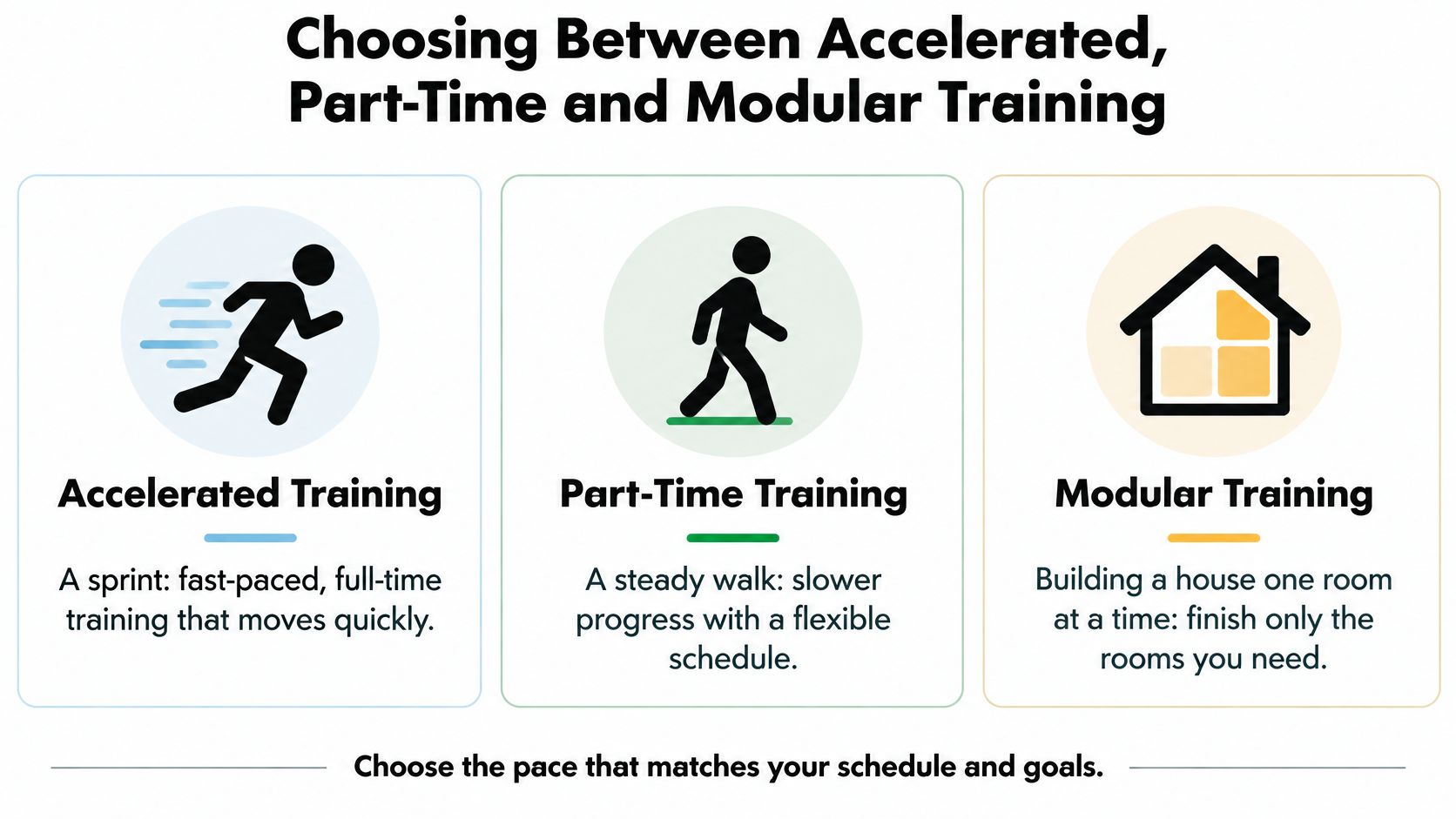
A simple analogy helps. Accelerated training is a sprint, intense and over quickly. Part-time training is a steady walk, slower but sustainable alongside a job. Modular training is building a house one room at a time, finishing only the rooms you need, when you can afford them.
Accelerated suits people who can fly most days and live near the training base, or relocate to it. Part-time suits people working full time who can protect two or three lesson slots a week. Modular suits people who need real pauses between certificates for money, work, or family reasons.
Questions That Decide the Fit
- Weekly availability: How many half-days can you protect every week, not just this month?
- Relocation: Are you willing to move near the base to cut commute and weather losses?
- Job urgency: How soon do you need to be earning as a pilot?
- Cost of delay: What does every extra month of training cost you in lost career earnings?
You'll also choose between Part 61 and Part 141 programs. Part 61 is the flexible rulebook most independent instructors use, while Part 141 schools follow an FAA-approved syllabus that can reduce some hour minimums. The trade-offs are laid out in this guide to Part 61 versus Part 141 training.
We recommend asking every flight school, including us, about airplane age, students per airplane, instructor turnover, total price in writing, Part 61 versus Part 141 status, and whether you can fly before committing. A school that answers those questions plainly is telling you something important about how it'll treat your schedule.
Match the model to the weekly hours you can really keep for six months. That's the whole decision.
What Stretches or Shortens Your Timeline
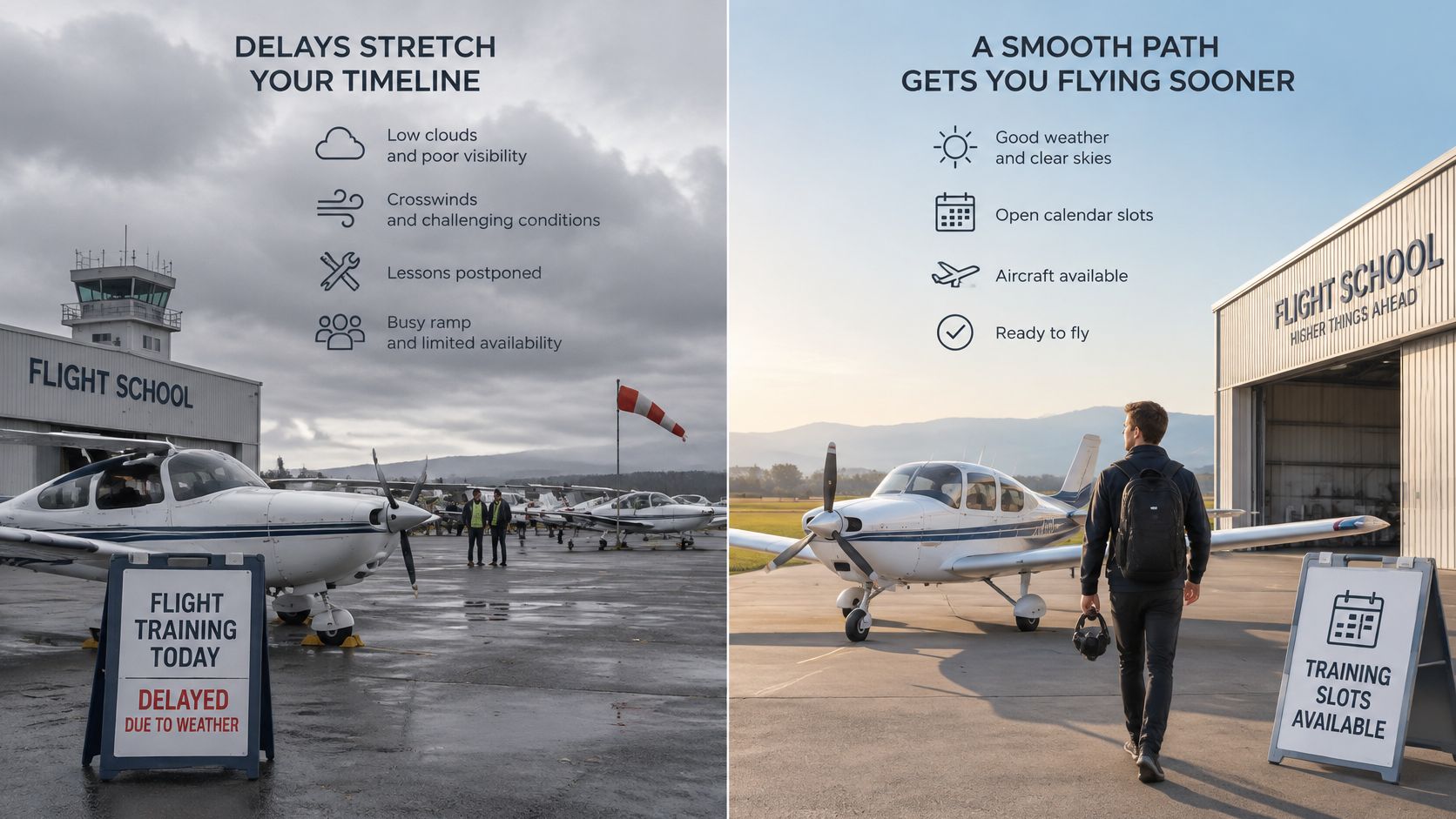
Your finish date moves for predictable reasons. Most delays aren't bad luck, they're scheduling physics.
What Stretches Training
- Weather: Low ceilings and strong crosswinds cancel lessons, especially early solo training.
- Aircraft availability: Busy bases with too few airplanes turn into booking lotteries.
- Instructor turnover: A new instructor needs lessons to learn where you left off.
- Checkride scheduling: FAA examiners book out, and you wait with your skills cooling.
- Gaps in flying: Breaks longer than about a week force relearning before new learning.
That last one costs more than students expect. Say you take two weeks off after finally landing consistently. Your first lesson back rebuilds your landing picture, and your second gets you where you were. A two-week gap just cost you two lessons and bought no progress.
What Shortens Training
- Consecutive days: Flying back to back keeps yesterday's lesson warm.
- Book ahead: Reserve the next lesson before you leave the airport.
- Study in parallel: Do written exam prep alongside flying, not after it.
- Plan instrument work early: Schedule instrument lessons into the calendar from the start.
Approved simulators can also keep training moving on grounded days, and this explainer on FAA-approved flight simulators covers what simulator time can and can't count toward.
Don't forget the medical. A third-class FAA medical certificate from an aviation medical examiner is required before you fly solo, but your discovery flight and first lessons can happen before you get one. Book the medical early anyway, because a surprise deferral discovered at solo time stalls everything.
Before enrolling, audit your own schedule. Count your real weekly slots, your commute, your exam study time, and your backup plan for cancelled days. If the math doesn't work on paper, it won't work at the airport.
Hour Thresholds From Certificate to Airline Cockpit
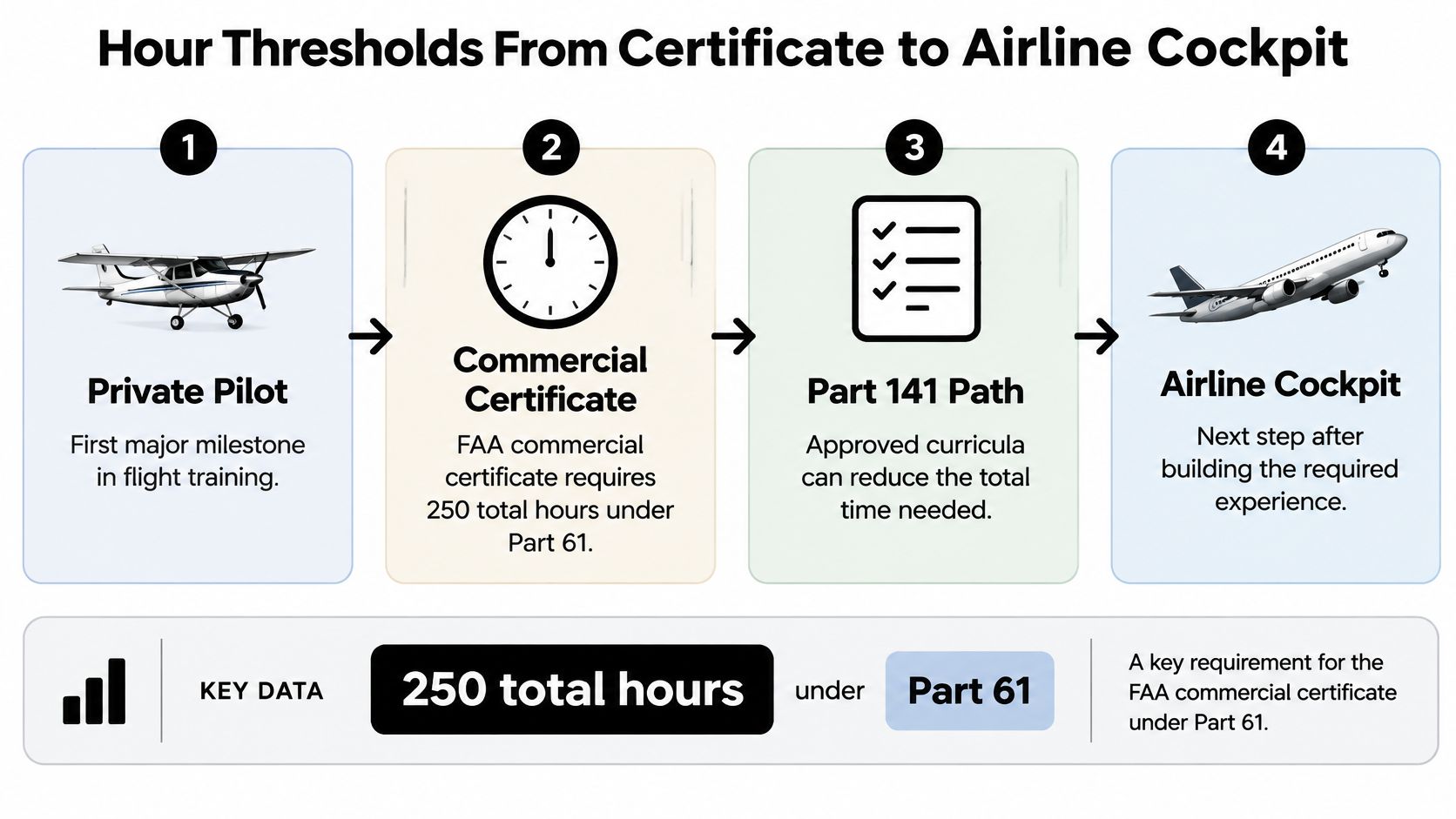
The commercial certificate works like a learner's permit for paid flying. Airline hiring minimums work like a job posting. Under FAA commercial pilot certificate guidance, a commercial applicant needs 250 total flight hours. Each airline sets its own hiring minimum, and those minimums sit well above the certificate number. That gap is the time-building phase, a second calendar that often runs longer than training itself.
Hour Thresholds by Milestone
| Milestone | Hours required | Rule or source |
|---|---|---|
| Instrument rating, airplane | 40 hours of instrument time, including 15 hours of instructor training | 14 CFR 61.65 |
| Commercial certificate, Part 61 | 250 total hours | FAA commercial requirements |
| Commercial with instrument rating, approved Part 141 course | 150 hours | FAA airline transport pilot guidance |
| Restricted airline transport privileges, approved collegiate program | 1,000 or 1,250 hours | FAA airline transport pilot guidance |
| Unrestricted airline transport pilot certificate | 1,500 hours | FAA airline transport pilot guidance |
The instrument rating requires 40 hours of actual or simulated instrument time under 14 CFR 61.65 as explained by the FAA. At least 15 of those hours must be instrument flight training from an authorized instructor. Private pilot instrument-reference time can count toward the 40, but it does not automatically satisfy the 15-hour instructor rule. Accelerated schedules still need dedicated instrument lessons.
Per FAA airline transport pilot guidance, an unrestricted airline transport pilot certificate generally requires 1,500 hours of pilot time. Qualifying graduates of certain approved collegiate programs may get restricted privileges at 1,000 or 1,250 hours. The same guidance notes that approved Part 141 curricula can cut the commercial with instrument minimum to 150 hours.
Most pilots bridge the gap between a commercial certificate and airline eligibility by instructing or doing other paid flying. You are employed, logging pilot-in-command time, and sharpening the judgment airlines screen for. That is why the airline timeline runs past graduation day. Plan for the first milestone that matches your target job. Regional and major airline paths both run through the same certificates, but their hour totals and hiring bars differ by employer.
Example Timelines From Zero Time to Career-Ready
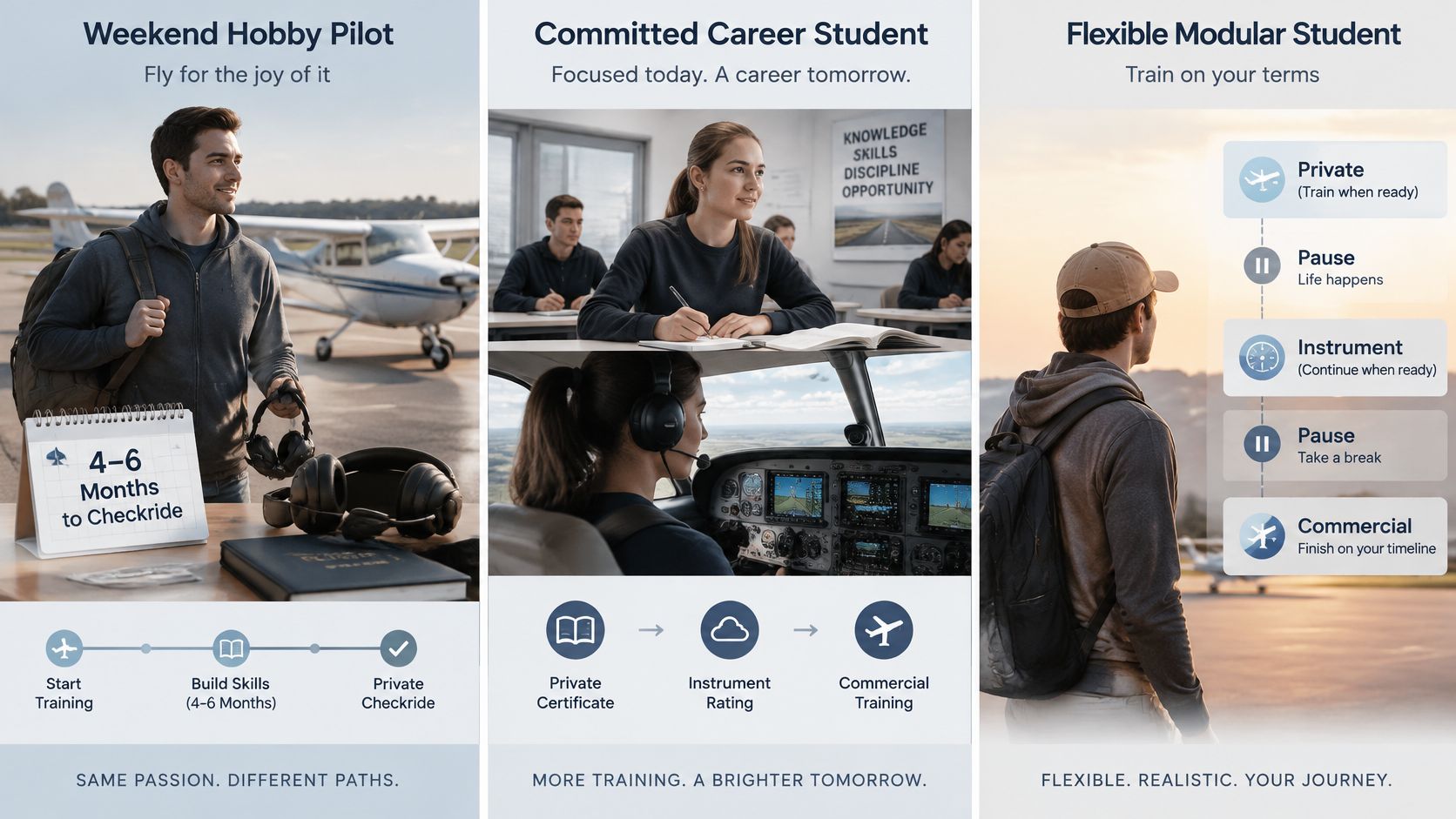
Three students starting the same week can finish in completely different seasons. Watch where their calendars split.
The Weekend Hobby Pilot
Say a student flies two or three lessons a week around a full-time job. First solo comes after the early maneuver and landing lessons settle in, cross-country and night flights follow, and the private checkride lands in about four to six months. This student can stop there, fly for fun, and add an instrument rating later if the interest grows. Nothing about this pace is behind schedule, because the goal was never a job.
The Full-Time Career Student
A career student in an integrated program flies most days, studies for written exams alongside flight lessons, and takes each checkride as soon as that stage is ready. In a program structured like our Career Track, that runs about nine months from zero time to flight instructor-instrument and multi-engine, with 282 total hours logged by month nine. The milestone order stays the same, first solo, private certificate, instrument, commercial, then instructor ratings, but the gaps between milestones shrink because lessons sit close together. This breakdown of fast-track pilot training shows how that daily rhythm is organized.
The video below walks through what that kind of full-time training calendar looks like week to week.
The Career Changer Building Time
The third student finishes training, earns instructor ratings, and then teaches new students to build hours toward airline thresholds. From first lesson to an airline cockpit, this path commonly runs two to four years, depending on how quickly instructing hours accumulate each month. Student demand, weather, and aircraft availability all set that pace, which is why honest schools quote the training phase precisely and the time-building phase as a range.
All three calendars contain the same certificates. They differ in weekly pace and in how much hour-building follows graduation, and those two variables explain nearly every timeline you'll be quoted.
Confirm Your Timeline Before You Enroll
Every school hands you a brochure with a calendar on it. The useful work starts when you ask what happens to that calendar in the week your instructor leaves for an airline, the airplane goes in for maintenance, or an examiner books out three weeks. A timeline that holds only in perfect conditions is a sales document.
Three decisions settle most of the uncertainty, and they go in order.
- Choose your weekly pace. Pick the lesson frequency you can sustain for six months straight and match it to the duration table. That row is your calendar, and it is the one to budget against.
- Test the commitment in the air. Book a discovery flight, a first flight with an instructor before any money is committed. You walk around the airplane together with a checklist card, then take the controls in the air. No prior experience is needed, and the FAA medical certificate can wait until solo.
- Check the hour thresholds for your goal. Flying for fun stops at the private certificate. An airline career keeps counting past the certificates to the hours airlines expect, a second phase that begins after training ends.
This guide on how to choose a flight school covers the fuller comparison once your pace and goal are set.
When you sit down with a school, including this one, ask the same questions: the average age of the training airplanes, how many students share each aircraft, how often instructors leave, the total price in writing, whether the program runs under Part 61 or Part 141, and whether you can fly a lesson before committing to anything. Those answers predict your finish date more reliably than any advertised duration. Then ask the question most students forget: what happens to your schedule if your work hours change mid-program? A school that can move your daily block without resetting your progress is worth more than one quoting a shorter calendar.
If a zero-to-instructor path fits your answers, you can judge our Career Track against your own math. It runs at a fixed $89,000 tuition. Stop for any reason before roughly 20 hours of flight time and the First Milestone Guarantee means you pay only for logged time at $200 per flight hour, with the rest refunded.
If you're ready to stop guessing at timelines and start flying on one, visit CFII to see how the Career Track is structured and what it costs, in writing. Haven't flown yet? Book a discovery flight first, sit in the left seat, and find out in one hour whether this career feels like yours.
Planning to fly for a living?
See what the path from zero to a pilot career looks like, what it costs and how long it takes.
Learn to fly in Riverside
We train at Riverside Municipal Airport in modern airplanes with a parachute built in. Start with a one hour discovery flight, no experience needed.