

On this page
- Medical Class Quick Reference at a Glance
- The Most Common Misreading of Each Row
- What Each Medical Class Lets You Fly
- First Class and ATP Pilot in Command Privileges
- Second Class and Commercial Privileges
- Third Class, Private Flying, and Instructing
- Holding More Than the Minimum
- How Long Each Class Stays Valid by Age
- Examined at 39 Versus Examined at 40
- Second Class and the Step Down
- Choosing the Class Before Accelerated Training
- Why an Early First Class Exam Is Risk Control
- A Checklist Before You Pay
- Deferrals and Denials Through Review and Appeal
- The Steps in Order
- Treat the Deadlines as Project Milestones
- Special Issuance for Initially Disqualifying Conditions
- How the Process Runs
- Three Actions to Take This Week
- BasicMed and the Class You Still Need
- What to Use Instead
- Confirm Your Medical Class Before You Commit to a Timeline
- The Four Step Plan
Why would you spend tens of thousands of dollars learning to fly for an airline before checking whether you can pass the medical exam an airline captain has to pass? That's the gap most new students miss. FAA medical certificate classes aren't just paperwork you sort out before your first solo. For a career pilot, the class you apply for, and when you apply for it, is a financial risk decision. Get the timing wrong and a delayed application can sit between you and a course you've already paid for.
One principle runs through everything that follows. The class you need follows the privileges you're exercising on that flight, not the title printed on your pilot certificate.
Medical Class Quick Reference at a Glance
The FAA issues three medical certificate classes: first, second, and third. The FAA Guide for Aviation Medical Examiners describes the privileges associated with each class. Use the table to find your row, nothing more.
| Class | Privileges it covers | Valid if under 40 | Valid if 40 or older |
|---|---|---|---|
| First class | ATP pilot-in-command privileges and certain Part 121 airline operations | 12 calendar months | 6 calendar months |
| Second class | Commercial pilot privileges, including many airline first-officer duties | 12 calendar months at second class, then up to 24 more months at third class | Same as under 40 |
| Third class | Private, student and recreational flying, and flight instructor duties as pilot in command | 60 calendar months | 24 calendar months |
The Most Common Misreading of Each Row
- First class: Holding this medical does not qualify you for an airline job by itself. It covers the medical standard for ATP pilot-in-command privileges. You still need the ATP certificate, ratings, experience, and an employer's qualifications.
- Second class: When second-class privileges expire, the certificate may still support third-class privileges for a further period. That can allow private flying even when commercial privileges are no longer available.
- Third class: This class covers more than hobby flying. It is the minimum medical class for a student pilot before a first solo and for a flight instructor acting as pilot in command.
A private pilot may obtain a first-class certificate even though third class covers private flying. A lower medical class, however, limits a pilot with a higher certificate to the privileges that medical supports.
Before booking training, write down the privilege your first course or job will require and check the matching row. The validity periods are calendar months, not a simple count of days.
What Each Medical Class Lets You Fly
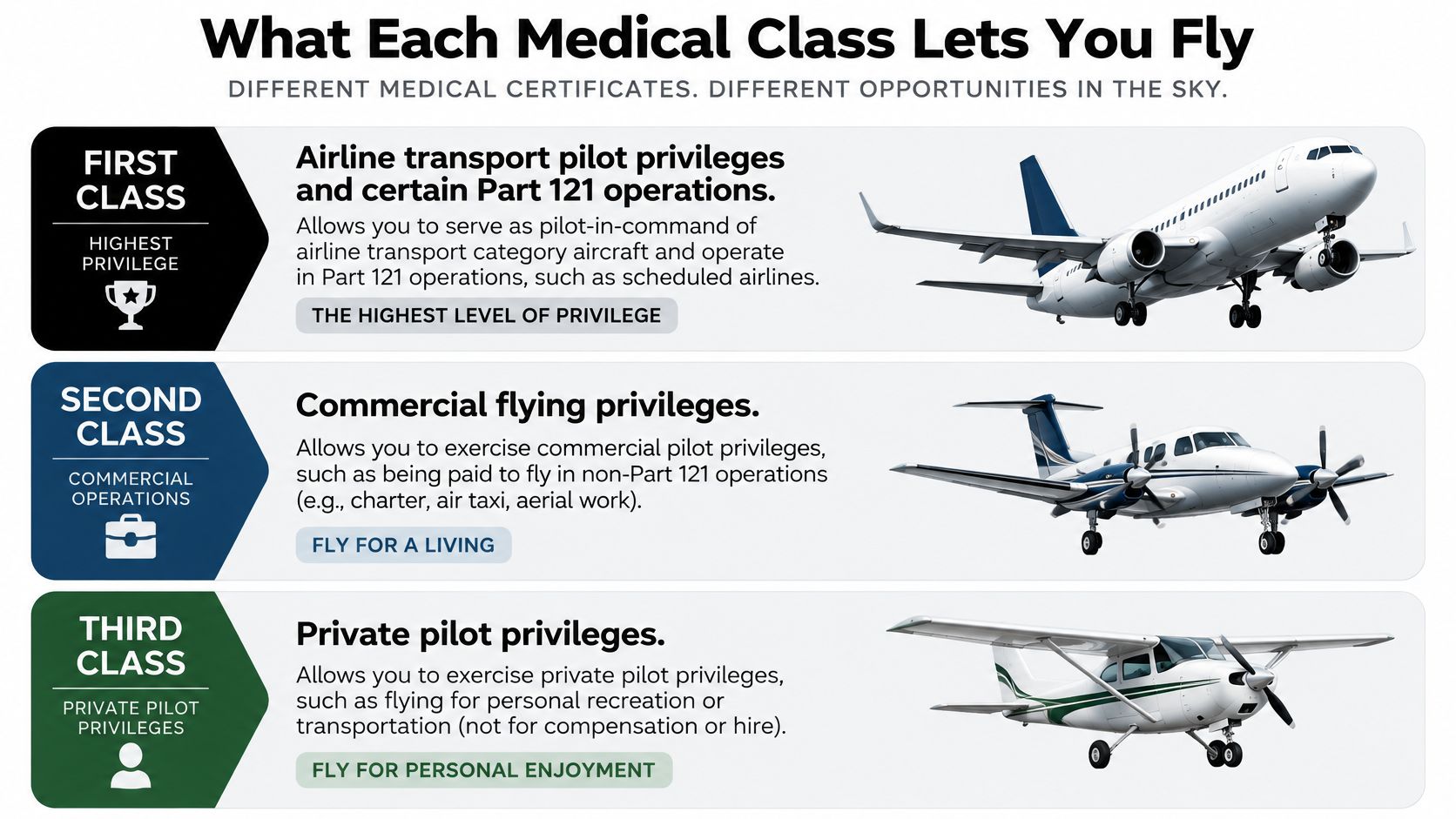
Under 14 CFR 61.23, the medical class you need depends on the flight privilege you exercise. An ATP certificate, for example, does not determine which medical class a particular flight requires. The privilege being used does.
First Class and ATP Pilot in Command Privileges
A first-class medical is required to exercise ATP pilot-in-command privileges. On an airline schedule, the captain acting as pilot in command needs that class. A second- or third-class medical does not cover those privileges.
The ATP certificate and medical certificate serve different purposes. The ATP certificate shows that you hold the pilot qualifications; the first-class medical shows that you meet the medical standard for exercising ATP pilot-in-command privileges. Both are needed for that role.
Second Class and Commercial Privileges
At least a second-class medical is required to exercise commercial-pilot privileges in an aircraft other than a balloon or glider. A commercial pilot paid to fly passengers, cargo, or an aerial-work flight in an airplane is exercising those privileges. Many airline first-officer duties also fall within this category.
The exception for balloons and gliders matters because medical requirements follow the privilege and aircraft involved. For commercial flying in an airplane, use second class as the minimum.
Third Class, Private Flying, and Instructing
Private-pilot privileges generally require at least a third-class medical. For a student, that includes a first solo. It also covers a private pilot flying friends for fun.
Flight instructors need at least a third-class medical when exercising instructor privileges while acting as pilot in command or serving as a required flight crewmember. A CFI acting as pilot in command on a dual-instruction flight needs at least third class. The instructor is paid, but the medical requirement for that role is third class.
Holding More Than the Minimum
You may hold a higher medical class than a flight requires. A private pilot can obtain a first-class certificate, but the medical alone does not grant ATP privileges. It shows whether the pilot meets that medical standard.
Consider an ATP certificate holder with only a third-class medical. That pilot may exercise private-pilot privileges, which the lower medical class supports. When planning training or a career path, match the medical class to the privileges the next stage requires.
Match the flight to the privilege. Check which privilege you will exercise, then confirm that your medical class supports it.
To keep pilot qualifications distinct from medical privileges, review the different types of pilot certificates and licenses. One determines what you are qualified to do as a pilot; the other determines which privileges your medical certificate supports.
How Long Each Class Stays Valid by Age
A medical certificate can keep supporting lower-class privileges after its higher-class privileges end. That step-down matters when you plan training or work around a certificate's expiration.
Examined at 39 Versus Examined at 40
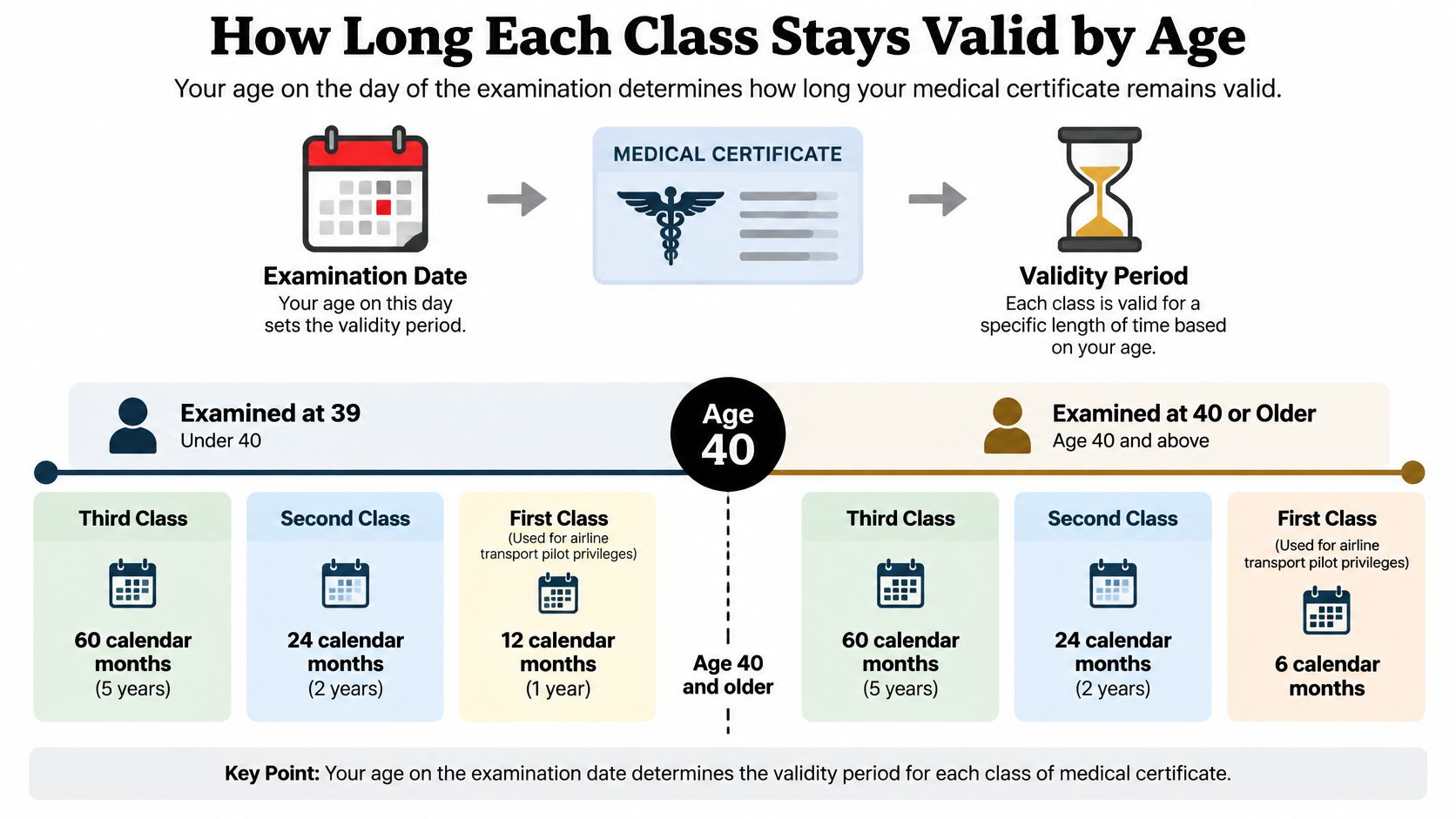
The difference between these examples affects how long particular privileges remain available. A certificate examined at 39 can support a longer period of first-class privileges for ATP operations and third-class privileges than one examined at 40. If you are approaching 40, consider that timing when planning the exam and the training schedule that follows.
Second Class and the Step Down
Second-class privileges generally last 12 calendar months, regardless of age. After they end, the certificate can continue to support third-class privileges for an additional 24 months. In practical terms, privileges tied to paid flying may end while private flying privileges remain available.
The FAA's July 24, 2008 final rule extended third-class validity for applicants under 40 from 36 to 60 calendar months (FAA final rule). That history explains why some pilots may still refer to a three-year third-class period.
For accelerated training, track the dates that affect your planned privileges, not just the certificate's overall expiration. A first-class certificate may step down while you are still training, so check which privileges will apply at each milestone before setting a schedule.
Choosing the Class Before Accelerated Training
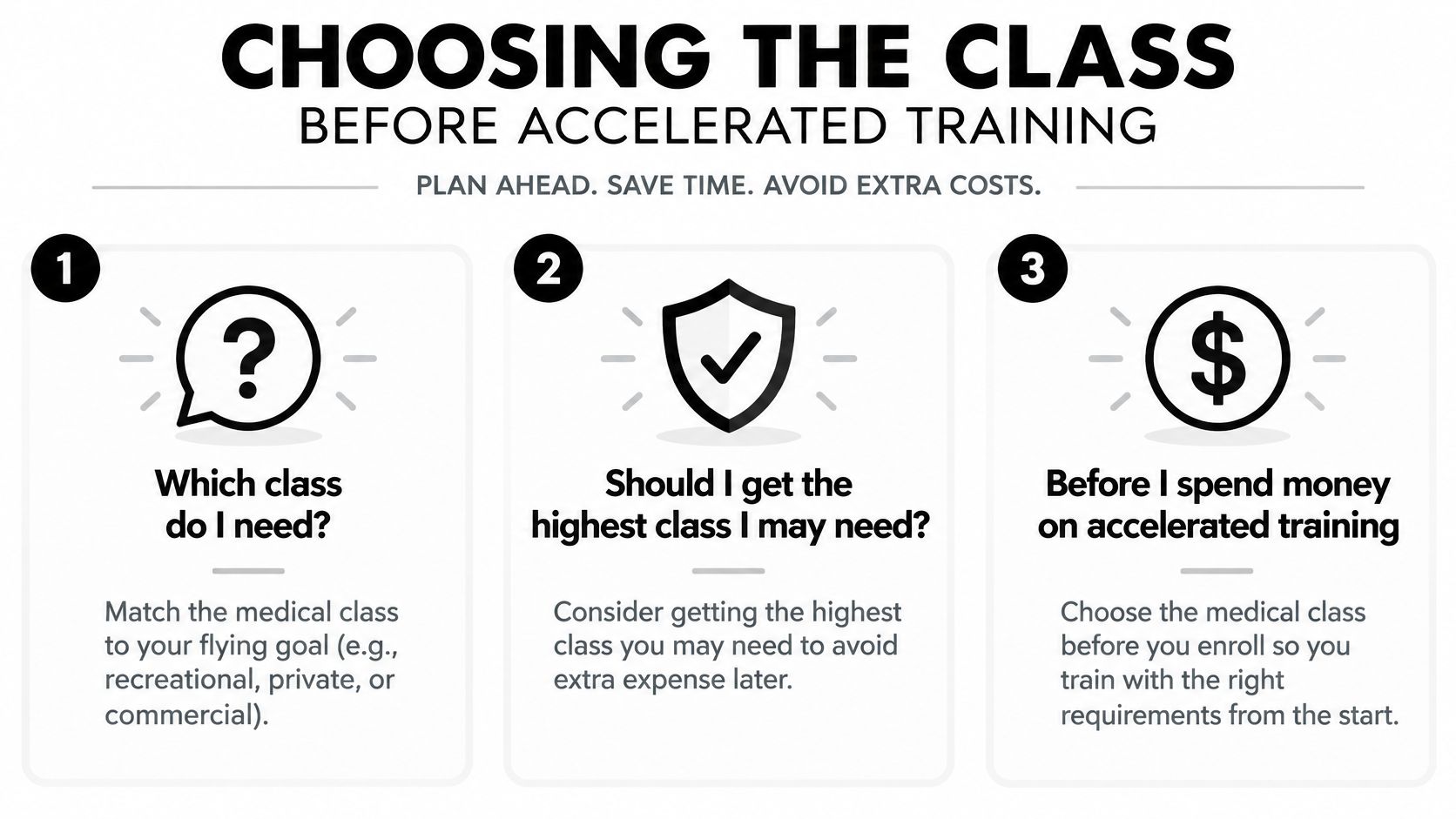
If you plan to train for an airline career, when should you find out whether you can qualify for a first-class medical? The FAA allows applicants to apply for any medical class if they meet its standards, while the required class depends on the privileges they plan to exercise. For someone considering an accelerated program, applying for the highest class likely to be needed before paying tuition can help reveal medical barriers while there is still time to adjust the plan.
A discovery flight and first lessons can happen before you obtain a medical certificate. You need a third-class certificate from an aviation medical examiner before flying solo. That gives you room to explore training, while making the timing of a medical exam an important decision before committing to a career-focused schedule.
Why an Early First Class Exam Is Risk Control
A first-class medical tells you whether you meet the FAA's standards for ATP privileges at the time of the examination. For a career student, checking that eligibility before substantial training expenditure can make the medical exam part of the enrollment decision.
If your medical history may require additional documentation or affect eligibility, learning that before enrollment leaves more time to gather records and consider your options. Waiting until months of accelerated training are underway can put your schedule and career plans at risk.
The timing matters because private-pilot training may proceed under third-class privileges, while a career goal may eventually require first-class privileges. You could be able to continue some training while facing a delay to the career outcome you planned for.
Apply for the highest class your career path is likely to require while the result can still inform your training decision.
Our guide to accelerated flight training explains how a fixed schedule can make preparation before enrollment valuable. A medical delay during a program may affect more than flight lessons, including the timing of housing, financing, and cohort scheduling.
A Checklist Before You Pay
- Check your age on the exam date: Age affects certificate validity, so consider timing if you are near an age threshold.
- Work backward from your career goal: Identify the privileges your intended career requires, then plan when to apply for the relevant medical class.
- Review your medical history: Past conditions, surgeries, or medications may mean you need records or guidance before an examination.
- Decide when to apply: If your goal eventually requires first-class privileges, consider applying before paying for a fixed-schedule program.
Deferrals and Denials Through Review and Appeal
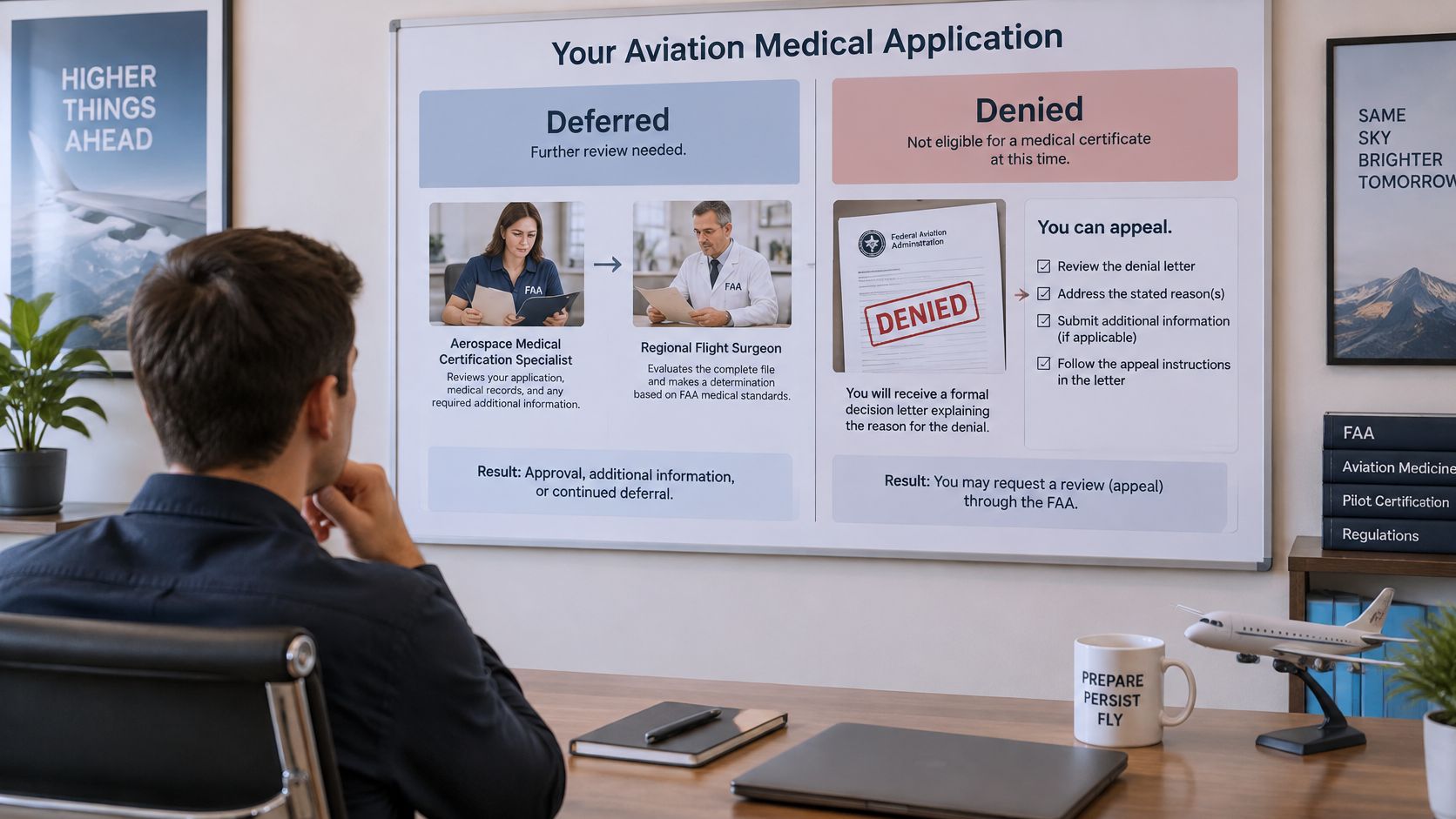
After an aviation medical exam, the FAA may need to review your application before deciding whether to issue a certificate. A deferral means the Aviation Medical Examiner (AME) could not issue it during the appointment and has sent the case for further review. The FAA's explanation of the medical appeal process describes review by the Aerospace Medical Certification Division or a regional flight surgeon, followed, in some denial cases, by reconsideration or appeals to the Federal Air Surgeon and the NTSB.
That review may require specialist reports, treatment records, or testing. Even if the FAA eventually issues a certificate, waiting for a decision can affect a training schedule built around a fixed start date.
The Steps in Order
- Ask the AME what may be required: Before leaving the appointment, find out which records the FAA is likely to request. Knowing this early can help you prepare a complete response.
- Keep copies of everything: Save each record you submit and note when you sent it. If the FAA asks for more information, you can see what is already in the file.
- Confirm the outcome: Ask whether the application was deferred or denied. The distinction determines which process applies.
- If denied, check the reconsideration deadline: The FAA's appeal-process guidance says applicants generally have 30 days to request reconsideration.
- Identify the medical basis: Find out whether the decision involves a specifically disqualifying condition. That can affect which appeal route is available.
- If a final FAA denial stands, check the NTSB deadline: The FAA's appeal-process guidance states that an applicant may petition the NTSB within 60 days after a final FAA denial of an unrestricted certificate.
The medical basis matters. Before deciding what to do after a denial, clarify which route applies to your case.
Treat the Deadlines as Project Milestones
The guide to working with an aviation medical examiner explains how to prepare for the appointment. If you receive a decision, record the relevant deadlines and the date they fall. An appeal window can pass while you are gathering paperwork.
Keep training dates flexible until you know the outcome. A delayed decision can disrupt a planned start, even when the eventual answer is favorable. Applying early gives you more room to address a review without committing money to a schedule that may need to change.
Special Issuance for Initially Disqualifying Conditions
A medical condition that initially prevents certification may still qualify for a Special Issuance under 14 CFR § 67.401. The FAA's Special Issuance guidance for aviation medical examiners explains that this process applies to certain conditions when an applicant does not meet the criteria in the applicable disposition table or certification worksheet.
Those tables and worksheets set out standard paths for common conditions. When a case does not fit those criteria, the FAA reviews the applicant's individual circumstances. As a result, two pilots with the same diagnosis may have different certification outcomes.
How the Process Runs
The FAA may request additional medical records, testing, or other documents. It may also defer the case to the Aerospace Medical Certification Division or a Regional Flight Surgeon for review. A flight school cannot speed up that FAA review.
If the FAA grants an Authorization for Special Issuance, an aviation medical examiner may reissue a certificate after you meet the authorization's specific requirements and remain otherwise qualified. Read those requirements closely: the authorization identifies the evidence you must provide, and similar evidence may not be enough.
Special Issuance can involve a shorter renewal cycle and extra conditions. For example, an authorization may require updated specialist reports before renewal. That adds recurring appointments to your training schedule, so plan for them rather than waiting until a renewal is due.
Three Actions to Take This Week
- Gather specialist records early: Request them before the FAA asks, since treating offices may take time to provide records.
- Ask how long the authorization lasts: Add renewal dates and any repeat testing to your training calendar.
- Check class coverage stage by stage: Confirm that the authorization supports the medical class needed for each stage of your training and employment.
BasicMed and the Class You Still Need
BasicMed confuses new pilots because it sits next to the three classes in conversation. It isn't a fourth class. Under 14 CFR Part 68, BasicMed can cover many non-commercial private flights, but it doesn't replace the medical classes that paid flying requires. If you're comparing lighter certification paths, our article on the sport pilot license shows another route that sits outside the class system, with its own limits.
Start with what BasicMed can't do for a career student. It does not provide the first-class medical required for ATP pilot-in-command privileges. It does not provide the second-class medical required for commercial privileges in most airplanes. Any plan that ends in paid flying runs through the class system, not around it.
What to Use Instead
- For solo and private privileges: Use at least a third-class medical for a student pilot's first solo, for private-pilot privileges, and for a flight instructor acting as pilot in command or as a required crewmember, unless you already hold a higher class.
- For paid flying: Use at least second class before exercising commercial privileges, apart from the balloon or glider operations the rule exempts.
- For airline captain duties: Use first class before exercising ATP pilot-in-command privileges.
Keep one more distinction in view. The medical that lets a school stage proceed isn't always the medical a later job requires. Training can move forward on third class while an airline seat still needs first class, and an employer can add its own requirements on top of 14 CFR 61.23. Meeting the regulation is the floor, not always the finish line.
For a professional track, BasicMed is the wrong planning tool. Obtain the class your next paid privilege needs, and consider first class early so any deferral surfaces before a fixed course start rather than during it.
Confirm Your Medical Class Before You Commit to a Timeline
Turn everything into dates. Start by writing down your age on the examination date and the class each planned stage requires. If you haven't flown yet, you don't have to wait for paperwork to begin. A discovery flight is lesson one, where you meet your instructor, preflight the airplane together, and take the controls in the air, with no prior experience needed. That flight and your first lessons can happen before any medical is issued.
Next, ask your AME which records the FAA may require, and ask before you commit to a fixed timeline. A third-class medical from an aviation medical examiner is required before flying solo, so the exam can't drift indefinitely. But there's a wide, useful gap between starting lessons and soloing, and that gap is where smart students do their medical homework.
The Four Step Plan
- Write it down: Your exam-day age and the class for each stage, on one page.
- Fly first if you're new: Start with the discovery flight while your medical planning gets underway.
- Ask the AME early: Identify records and likely questions before money and dates are locked.
- Commit after issuance: Once the class you need is in hand, fix your program schedule around real dates.
Our rundown of flight training requirements places the medical alongside the other prerequisites you'll clear in the same period. When you're ready to look at a full pathway, the Career Track is a fixed $89,000 tuition program running about nine months from zero time to CFII and multi-engine, with 282 total hours and six certificates and ratings, based in Southern California at Riverside, Long Beach, and Corona.
Make one decision today. Which class will you obtain first, and on what date will you book the examination?
Your medical class decision is the first real risk check on the way to a flying career, and we'd rather help you make it before you've committed to a schedule than after. At CFII, you can start with a discovery flight while your medical is in motion, then step into a structured zero-to-CFII pathway with your class, dates, and plan already aligned. Pick your examination date this week, then come fly lesson one with us in Southern California.
Planning to fly for a living?
See what the path from zero to a pilot career looks like, what it costs and how long it takes.
Learn to fly in Riverside
We train at Riverside Municipal Airport in modern airplanes with a parachute built in. Start with a one hour discovery flight, no experience needed.