
On this page
- What FAA Approval Really Means for a Flight School
- What the certificate actually covers
- Part 61 Versus Part 141 Training Paths
- How to Verify a School's FAA Status and Credentials
- Start with the certificate and TSpecs
- Ask what is actually approved
- Evaluating Training Quality Beyond the Certificate
- Ask for the syllabus-to-logbook reconciliation
- Watch how they measure performance
- Questions that expose weak programs
- Time Building and Instructor Hire Options After Certification
- Look past the certificate stack
- Read the hour split like a forecast
- Southern California Considerations for Career Pilots
- Decision Checklist and Questions to Ask Schools
- Verification
- Training quality
- Logistics
You're probably comparing faa approved flight schools after a few late nights, a half-finished spreadsheet, and one big question, “How do I know which school is real, and which one is just good at marketing?” That's the right question. A certificate on the wall matters, but it's only the starting point.
If you want a career cockpit, treat FAA approval like a process-control benchmark. Then audit the syllabus, the stage checks, the pass-rate history, and the school's actual ability to move students through training without excuses. That's how you separate a serious program from a brochure.
What FAA Approval Really Means for a Flight School
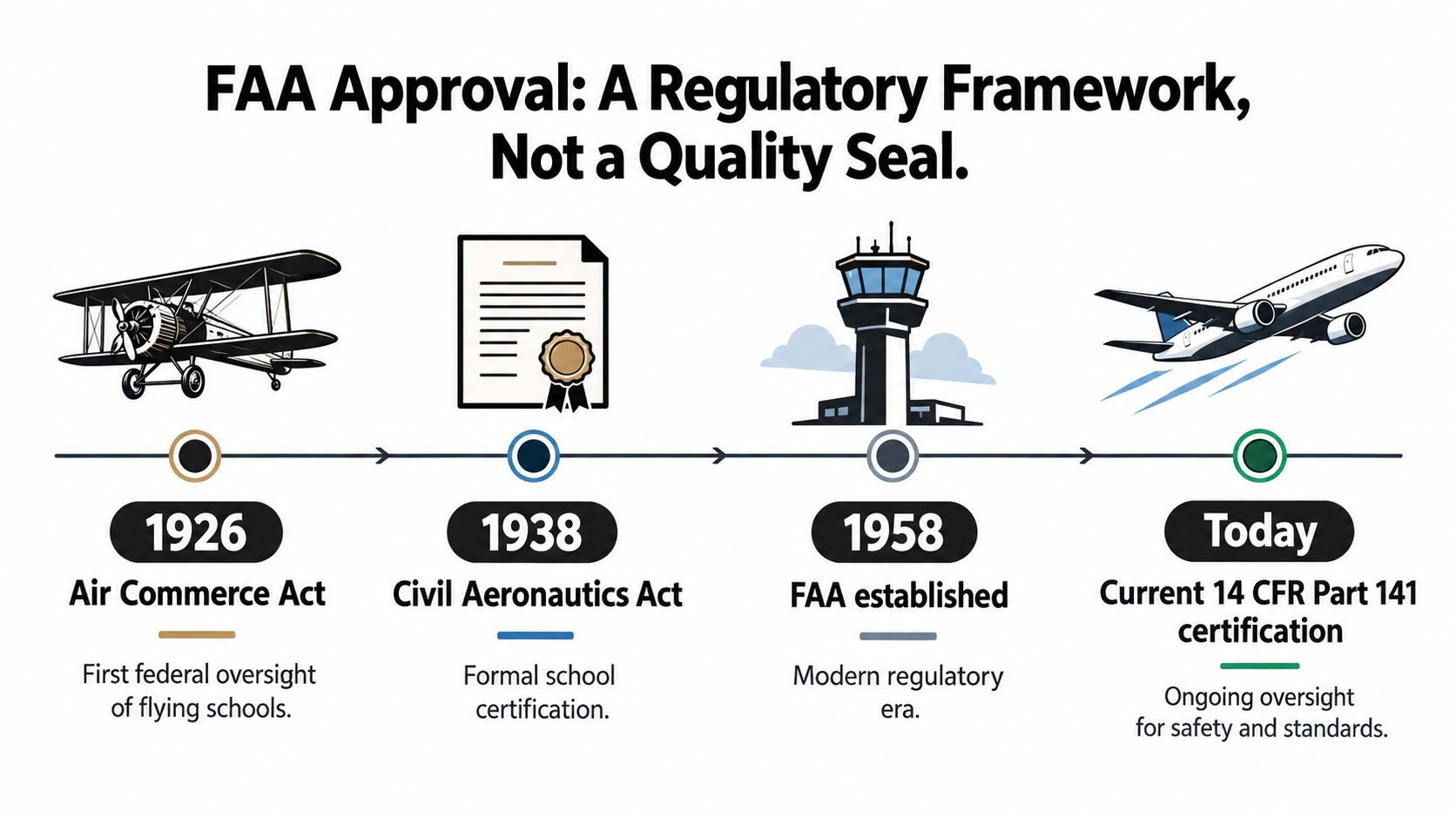
A certificate on the wall does not tell you much by itself. FAA approval is a regulatory framework that controls how training is designed, documented, and supervised. Federal oversight of flying schools traces back to the Air Commerce Act of 1926, which led to flying-school rules in 1929, and the FAA's predecessor later established the “Flying School” rating in 1940 (FAA historical material).
What the certificate actually covers
Under 14 CFR Part 141, a school must use an FAA-approved, structured syllabus and maintain defined standards for instructors, aircraft, facilities, training aids, and oversight (14 CFR Part 141). That is a different operation from a casual training business that rents airplanes and assigns students to whichever instructor is available.
The FAA certification process runs through five phases, pre-application, formal application, document compliance, demonstration and inspection, and certification (FAA pilot schools page). A school gets its Air Agency Certificate and training specifications only after it clears those gates.
Practical rule: approval tells you the school passed an FAA process. It does not tell you whether the school is organized, efficient, or student-friendly.
The part many applicants miss is simple. Approval is the entry ticket, not the finish line. A school can be fully approved and still be a weak choice if it runs poor scheduling, loose stage control, or a disjointed syllabus. The true test is whether the program moves students through training without guesswork.
Use approval as a baseline, then inspect how the school manages progress. Ask how it handles stage checks, how it documents minimums, and how often students need extra remediation before moving on. If you want a quick overview of how certification and training fit together, see this pilot certification and training guide.
Part 61 Versus Part 141 Training Paths
A student choosing between Part 61 and Part 141 is really choosing between two training systems. Part 61 gives the instructor more room to adjust pacing and sequence. Part 141 runs on a formal syllabus, stage checks, and tighter school-level control over how training progresses.
For a career-track student, the difference shows up fast.
Under 14 CFR § 61.129, an airplane single-engine commercial applicant generally needs at least 250 hours of flight time as a pilot, including 100 hours in powered aircraft and 50 hours in airplanes. The rule also calls for cross-country, night, instrument, and test-prep experience, including a cross-country flight of at least 300 nautical miles with landings at three points and one leg at least 250 nautical miles from the departure point.
A Part 141 commercial airplane course can be structured around 120 hours of training, including 55 hours of flight training, 10 hours of instrument training, and 10 hours of solo or supervised pilot-in-command flight (Appendix I to Part 141). That is the tradeoff. Part 141 reduces aeronautical experience requirements for certain certificates because the school is running a controlled system, not a loose collection of lessons.
For airline-bound students, structure usually wins. A flexible schedule feels easier at the start, but it often creates delays later because pacing slips and accountability weakens.
Use this filter.
- Choose Part 61 if you need a flexible schedule, plan to train at an uneven pace, or are not committing to a full-time career push.
- Choose Part 141 if you want a defined sequence, regular stage checks, and a school built to move a cohort through completion.
- Choose neither based on the brochure alone. Confirm that the course you want is approved in the form being sold, not just described that way by admissions.
A serious applicant should also ask how the school measures progress inside the system. How are stage checks used? What minimums must be documented before a student moves ahead? How often do students need remediation before they advance? Those questions tell you whether the school treats approval as process control or just wall decoration.
For a career pilot with limited time, Part 141 is usually the better backbone. It makes training measurable, and measurable training is what keeps students moving.
How to Verify a School's FAA Status and Credentials
A polished homepage does not prove anything. Verify the school's paperwork.
Start with the certificate and TSpecs
Begin with the school's FAA Air Agency Certificate and make sure it is current. Then read the Training Specifications, or TSpecs, because that is where the approved courses are listed. If the school sells a career track, confirm that the track is an approved course, not a loose package of ratings dressed up as one.
The FAA checks facilities, equipment, and personnel, so approval is a process-control standard, not a logo contest (FAA pilot school certification guidance). A school cannot assume every airplane, simulator, instructor, or training site is covered just because the brand appears on the website.
Ask what is actually approved
Use the certificate as a filter. If a school has a main base in one city and a satellite location in another, do not assume the satellite shares the same approval scope. A private pilot course may be approved at one base, while a commercial course or a specific training path may not be.
Audit move: ask for the certificate, the TSpecs, and the exact course name in writing. If they hesitate, you have already learned something useful.
A serious applicant should also verify that the advertised Career Track or equivalent pathway is one FAA-approved course, not a patchwork of individual lessons stitched together after the fact. That matters because the actual approval scope controls what the school can legally promise and supervise.
Ask for the paperwork first, not the sales pitch. That is the difference between a school that can train you and a school that can only advertise at you.
Evaluating Training Quality Beyond the Certificate
FAA approval gets you in the door. The question is whether the school runs a tight training operation or just displays paperwork.
Two schools can both be approved, and one can still produce cleaner student outcomes because it treats training like a controlled process.
Ask for the syllabus-to-logbook reconciliation
Ask for a syllabus-to-logbook reconciliation. Aircraft time, simulator time, required instrument work, solo and pilot-in-command hours, stage checks, and end-of-course testing should line up cleanly on paper. If they do not, the school is leaning on vague promises.
Part 141 training has to follow approved course items, and simulator credit is limited in specific contexts. For some additional-category commercial courses, a simulator or flight-training device may satisfy no more than 16.5 training hours, with the device portion limited to 11 hours (Appendix I to Part 141). If the school talks about simulator time, ask exactly where that time counts and where it does not.
Watch how they measure performance
The school should be able to show stage control, not just optimism. FAA rules require at least one satisfactorily completed stage within each training period of no more than 90 days, and they prohibit graduation or recommendation until the approved-course requirements are finished.
That is the operational test. Good schools document it, enforce it, and use it to catch weak students early. Weak schools talk about flexibility and hope the details stay buried.
The clearest outside benchmark is pass-rate history. An established Part 141 school seeking a full certificate must have graduated at least 10 people from approved courses and maintain an 80% or higher first-attempt pass rate. Schools seeking examining authority face a stricter 90% first-attempt standard plus at least 24 consecutive months holding the relevant rating (14 CFR Part 141 Subpart A).
That is not bureaucratic noise. It tells you whether the school's process works.
Questions that expose weak programs
- Syllabus discipline: “Show me how your syllabus maps to logbooks, stage checks, and end-of-course testing.”
- Fleet readiness: “How often do aircraft go unavailable, and what is your backup plan when they do?”
- Exam coordination: “Who schedules checkrides, and how do you avoid delay when weather or examiner availability changes?”
- Outcome evidence: “What is your most recent course-specific first-attempt practical-test rate, and how many graduates is that based on?”
If the school cannot talk about both, keep walking, and compare how a structured flight academy documents stage control and pass rates.
The point is simple. FAA approval confirms compliance. Training quality shows up in outcomes and operational consistency.
Time Building and Instructor Hire Options After Certification
A certificate gets you in the door. Time building determines whether you ever reach airline eligibility.

Under 14 CFR § 61.159, an airplane-category ATP applicant generally needs 1,500 total pilot hours, including 500 hours of cross-country time, 100 hours of night flight, and 50 hours in the airplane class sought (§ 61.159). The rule also allows up to 25 hours in an approved full-flight simulator to count toward the applicable experience requirement when completed as part of an approved Part 121, 135, 141, or 142 course under § 61.159.
That hour split is not a footnote. It tells you whether a school is building a usable career path or just handing out ratings.
Look past the certificate stack
After graduation, the usual path is simple: earn instructing credentials, then build hours as a CFI while staying in the same training system. Some schools line up paid instructing work for new instructors. Others leave graduates to sort it out alone.
The difference matters because what happens after flight school is part of the product. If the school has no plan for what happens after flight school, you may finish with certificates and no efficient route to the next logbook target.
Read the hour split like a forecast
A program that shows a clear mix of airplane time, simulator time, and instructor progression is telling you how the next phase works. A program that hides the split is asking you to trust a wall certificate instead of a training system.
For readers who want a structured zero-to-CFII path, CFII's Career Track is a fixed $89,000 tuition path that takes about nine months from zero time to CFII and multi-engine, with 282 total hours and six certificates and ratings. That is an example of how a school can present the full pipeline, not just the first rating.
Ask one blunt question before you commit, “How do your graduates keep moving?” If the answer is vague, the school has not solved the hardest part of the career path.
Southern California Considerations for Career Pilots
Southern California can be a strong place to train if you want frequent exposure to busy airspace and a schedule that keeps moving. The region around LAX, Long Beach, Ontario, and Riverside gives students more real-world radio work and traffic management than many quieter markets.
That advantage only helps if the school runs like a training system, not a brochure. If a program uses Riverside, Long Beach, and Corona as separate bases, ask how aircraft, instructors, and dispatch stay coordinated from one location to the next. If the answer is vague, the operation is probably spread too thin.
Housing and commute details matter just as much. A school can look efficient on paper and still drain your training rhythm if you are driving too far, paying the wrong deposit terms, or trying to keep an early lesson slot from across town. If you are relocating, get those answers before you commit.
Use how to become a pilot in California as a practical reference for the state-specific side of the decision, then check whether the school can support the airline path under 14 CFR § 61.129 as described earlier. Nearby airport variety helps, but only if the school's scheduling and dispatching let you use it.
Southern California rewards discipline. A school with weak coordination wastes good weather, good airspace, and your time.
Decision Checklist and Questions to Ask Schools
A shiny certificate on the wall does not prove a school runs a tight training system. Walk in with a checklist of flight-training courses to compare, not hope.
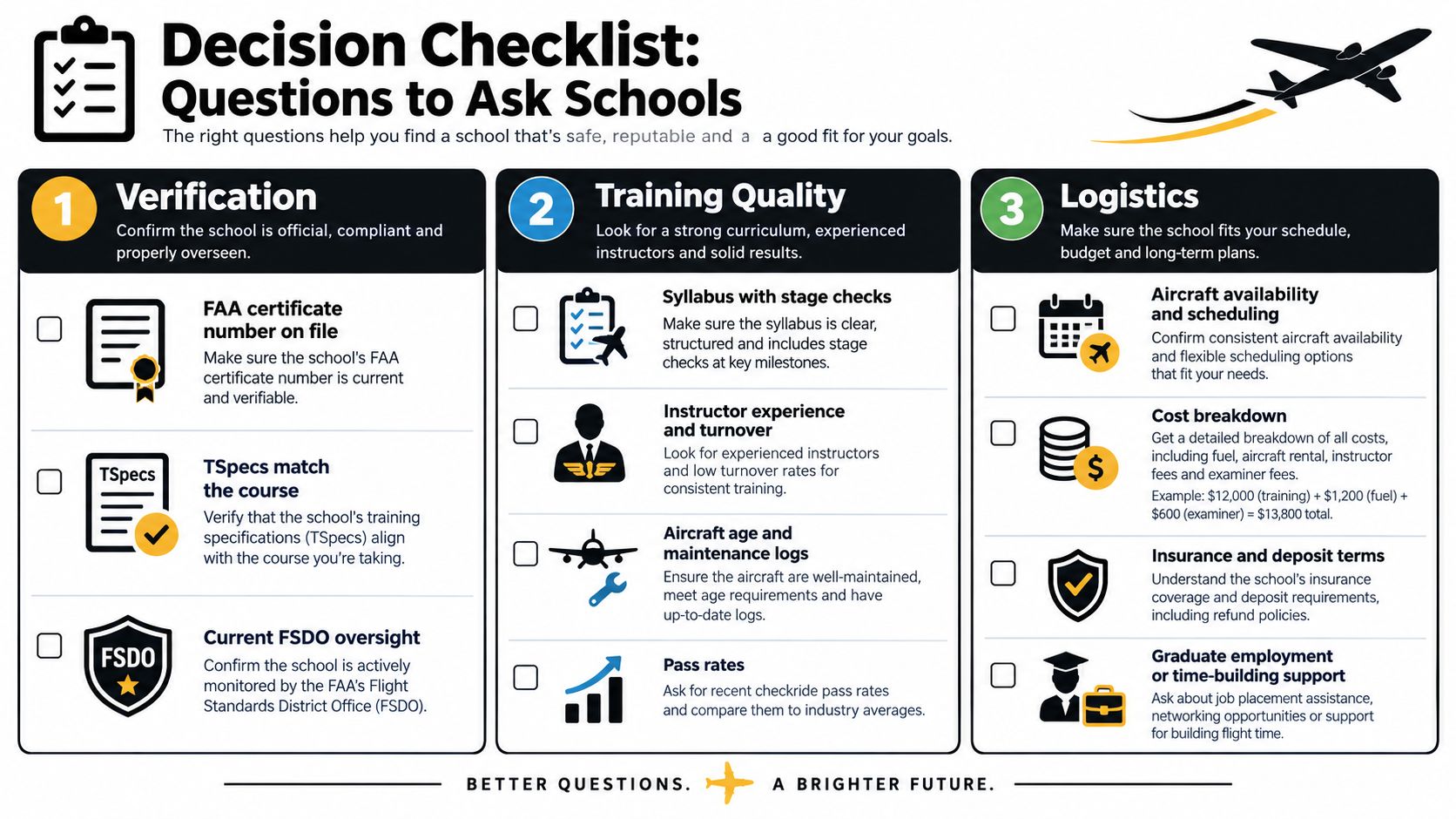
Verification
- FAA certificate on file: Ask to see the current Air Agency Certificate.
- TSpecs match the course: Confirm the exact program you're buying is listed in the training specifications.
- Oversight is active: Ask which local FAA office oversees the school and whether the course is currently active.
Training quality
- Syllabus with stage checks: Ask how progress is measured and what happens when a stage check is unsatisfactory.
- Instructor experience and turnover: Ask how instructors are trained, evaluated, and retained.
- Aircraft and maintenance records: Ask for aircraft availability patterns and maintenance visibility, not just fleet photos.
- Pass-rate evidence: Ask for the most recent course-specific first-attempt practical-test rate, the number of graduates, average training hours to completion, aircraft availability, instructor turnover, and the proportion of graduates who become instructors.
Logistics
- Scheduling reality: Ask how far out aircraft and instructors are booked.
- Cost clarity: Ask what's included, what isn't, and where exam fees or fuel charges appear.
- Housing and deposit terms: If you're relocating, get the terms in writing.
- Time-building support: Ask what happens after the last checkride and how graduates keep logging hours.
If you have not flown before, start with a discovery flight. If you are ready for a structured zero-to-CFII path, look for a school that explains the full system, not just the sales pitch. A strong program will show you the syllabus, stage checks, dispatch rhythm, and how graduates move into the next rating or into instructing. CFII is one place to compare that kind of structure against the checklist above.
Planning to fly for a living?
See what the path from zero to a pilot career looks like, what it costs and how long it takes.
Learn to fly in Riverside
We train at Riverside Municipal Airport in factory-new airplanes with a parachute built in. Start with a one hour discovery flight, no experience needed.