On this page
- Setting Realistic Hour Expectations
- What a believable hour estimate sounds like
- Structuring a High-Frequency Daily Cadence
- Build the day around one main learning objective
- Keep the training load professional
- Leveraging Simulators and Stage Checks
- Use the simulator for the tasks that benefit most
- Stage checks stop false progress
- Front-Loading the Written Exam and Ground School
- Study before the solo pressure builds
- Managing Financial Risk and Scope Creep
- Fixed price versus hourly billing
- Connecting the Private Pilot Milestone to Airline Goals
- Don't confuse completion with time building
Most advice on accelerated flight training private pilot says the same thing, fly every day. That sounds disciplined, but it misses the core problem. If the schedule is sloppy, the student gets tired, the training gaps widen, and the checkride moves further away even while the Hobbs meter keeps turning.
A fast private pilot path works when the operation is organized around continuity, recovery, and accountability. The legal minimum is not the finish line, and a compressed calendar only helps if the lessons stack in the right order, the weak areas get fixed fast, and the money risk stays visible from day one.
Setting Realistic Hour Expectations
The first thing a serious student should drop is the idea that 40 hours is a realistic target. Under FAA rules, that is the legal minimum for an airplane private pilot certificate, with at least 20 hours with an authorized instructor, 10 hours of solo flight, plus 3 hours of cross-country, 3 hours of night, and 3 hours of instrument training (FAA hourly requirements). The FAA also reports that the average private-pilot graduate logs about 75 hours, and approved schools may reduce the formal minimum to 35 hours, which is why the training bill usually runs well past the minimum (FAA training statistics).
A fast private pilot path is not about touching the minimum and rushing to the checkride. It is about holding performance steady while the hours climb, because retraining the same maneuver is where accelerated schedules start to slip. Ask the school for its median hours-to-checkride over the last 20 private students, not its best case.
Practical rule: Judge a program by how it handles the hours above minimum, not by how loudly it repeats the minimum.
What a believable hour estimate sounds like
A believable estimate leaves room for the learning curve, weather interruptions, and a corrective lesson after a weak sortie. If a student is new to aviation, the school should explain how it protects continuity when a maneuver degrades, rather than pretending every lesson lands cleanly.
That first conversation should cover the training system, not just the finish date. If the program cannot explain how it preserves skill retention under a compressed schedule, the plan is fragile. For newcomers, flight training for beginners gives useful context before the clock starts running.
Structuring a High-Frequency Daily Cadence
A good fast-track day is built like a workday, not a marathon. The student shows up mentally fresh, gets a clear ground objective, flies with a defined goal, then reviews the errors before they harden into habits. If you stack too much in one block, concentration drops and the airplane becomes a place where mistakes get repeated instead of corrected.
Build the day around one main learning objective
Morning ground instruction works best when it prepares the exact maneuver set for the flight. If the lesson is steep turns, radio calls, and pattern work, the ground session should cover sight pictures, callouts, and the errors that typically show up in those tasks. The student walks to the aircraft already knowing what “good” looks like.
Afternoon flight blocks are where the repetition happens, but repetition only helps if the student is still mentally available. A fatigued pilot forgets checklist discipline, chases small errors, and absorbs less from the instructor. Evening debriefs should be short, specific, and honest, with the logbook, lesson notes, and next-day plan reviewed while the flight is still fresh.
Keep the training load professional
The fastest students usually treat the program like a job. They eat, sleep, and study on schedule, and they keep the day from turning into an unstructured grind. That doesn't mean flying nonstop. It means aligning ground, simulator, and airplane time so each block supports the next one.
A structured day also gives the instructor room to catch drift early. If yesterday's landing work was weak, today's ground review can target flare timing and sight picture before the airplane leaves the ramp. That is how high-frequency training stays efficient instead of just intense.
Leveraging Simulators and Stage Checks
Weather and maintenance don't just delay a lesson, they break momentum. In a compressed pipeline, a grounded aircraft can wipe out the rhythm that keeps skills sharp, especially if the student was just starting to string maneuvers together. That's where simulator time and stage checks matter.
A grounded day doesn't have to be a lost day if the syllabus is built to absorb it.
Use the simulator for the tasks that benefit most
A certified simulator is useful when the goal is precision repetition, not seat time for its own sake. Instrument scan, emergency procedures, radio flow, checklist habit, and cockpit organization are all good simulator targets because the student can repeat them without paying for fuel or burning real aircraft availability. The point is to rehearse until the sequence becomes automatic.
That matters even in private pilot training, because skill fades when the gaps between lessons grow. A simulator session during a maintenance delay can preserve the flow of the syllabus and keep the next aircraft lesson focused on polish instead of relearning basics. Schools that use simulators well don't treat them as filler, they use them to protect continuity.
Stage checks stop false progress
A stage check is an objective gate, not a morale exercise. It asks whether the student meets the standard before moving forward. That's important in accelerated training because logging time can create a dangerous illusion of readiness.
If a student is not performing to standard, the stage check should slow the sequence down before the problem reaches the checkride. The checkride process rewards consistency, not near-misses, and a school that advances students too early is setting them up for expensive remediation. Good instructors use these gates to separate real proficiency from accumulated hours.
The best use of a bad-weather day is simple, review, simulate, correct. If the operation can't do that, the schedule is too brittle for full-time training.
Front-Loading the Written Exam and Ground School
The written exam needs to come early. In an accelerated pipeline, pushing it behind the flying creates a bottleneck right when the student needs steady momentum. If aeronautical knowledge lags behind stick-and-rudder skill, the airplane keeps advancing while ground work falls behind.
The FAA's 2023 knowledge-test statistics show a 90.30% pass rate for the Private Pilot Airplane knowledge exam, while the same FAA report also lists an 82.05% figure in a different summary row for a different measure (FAA 2023 test statistics). Treat those numbers separately. They do not describe the same population or the same outcome, and that is exactly why a school should care about clean, timely completion rather than a neat headline.
Study before the solo pressure builds
The right sequence is straightforward. Start written-study rhythm on day one, set a baseline early, and find weak areas before the flight syllabus stacks on more material. If weather, airspace, or regulations are shaky in the student's head, every later lesson takes longer because the instructor has to patch knowledge gaps in real time.
Practical rule: If the written exam is still hanging around while solo prep is starting, the student is already behind.
Ground school works best when it stays tied to the aircraft lesson. A maneuver in the air should connect to a concept on the ground, and that concept should be tested before it gets stale. That keeps accelerated training efficient without turning it into memorization without context.
The FAA's own historical research on certificated training courses also shows that private-pilot training completion has been vulnerable to attrition, with a 67% successful-course-completion rate reported for private-pilot training, compared with 83% for instrument courses (FAA 2023 test statistics). That does not mean students fail because they lack motivation. It means the pipeline has choke points, and the written exam is one of them.
Managing Financial Risk and Scope Creep
An accelerated timeline only saves money when the student keeps pace. Once the schedule slips, every extra lesson, repeat maneuver, and weather cancellation turns into more hourly cost. The central question is not whether the sticker price looks lower on paper. It is whether the program stays predictable when training gets messy.
Industry analysis says roughly 20–30% of students in Part 61 or Part 141 private-pilot programs do not complete training, and the typical private-pilot student needs about 60–70 flight hours rather than the regulatory minimum (industry analysis). The same analysis points to $200–$300 for each additional hour and says students who need more than 20% extra training face a materially higher cost-related dropout risk. That is the financial pressure point in compressed training. Miss pace, and the bill rises fast.
Fixed price versus hourly billing
| Feature | Fixed-Tuition Career Track | Hourly Pay-As-You-Go |
|---|---|---|
| Budget visibility | Costs are easier to plan because the structure is set in advance | Costs can expand each time the student needs extra instruction |
| Handling weak areas | Remediation is easier to absorb when the syllabus and exclusions are clear | Every extra lesson can raise the bill immediately |
| Training interruptions | Better fit when the school includes recovery planning and scheduling support | More vulnerable to weather delays, repeats, and inconsistent pacing |
| Student risk | Lower uncertainty if the program discloses what's included and what isn't | Higher uncertainty when costs keep adding up lesson by lesson |
A fixed-price structure does not remove the need for discipline. It only keeps scope creep from becoming a second problem on top of slow progress. Career-track students need that clarity, because the budget pressure shows up quickly when performance slips.
Compare the fixed-price structure against the course catalog at flight training courses before you commit. One option in this category is CFII, which offers an accelerated, fixed-price Career Track with structured scheduling, study resources, and coordinated checkrides. The point is simple, the student should see the financial shape of the program before the daily grind starts.
Connecting the Private Pilot Milestone to Airline Goals
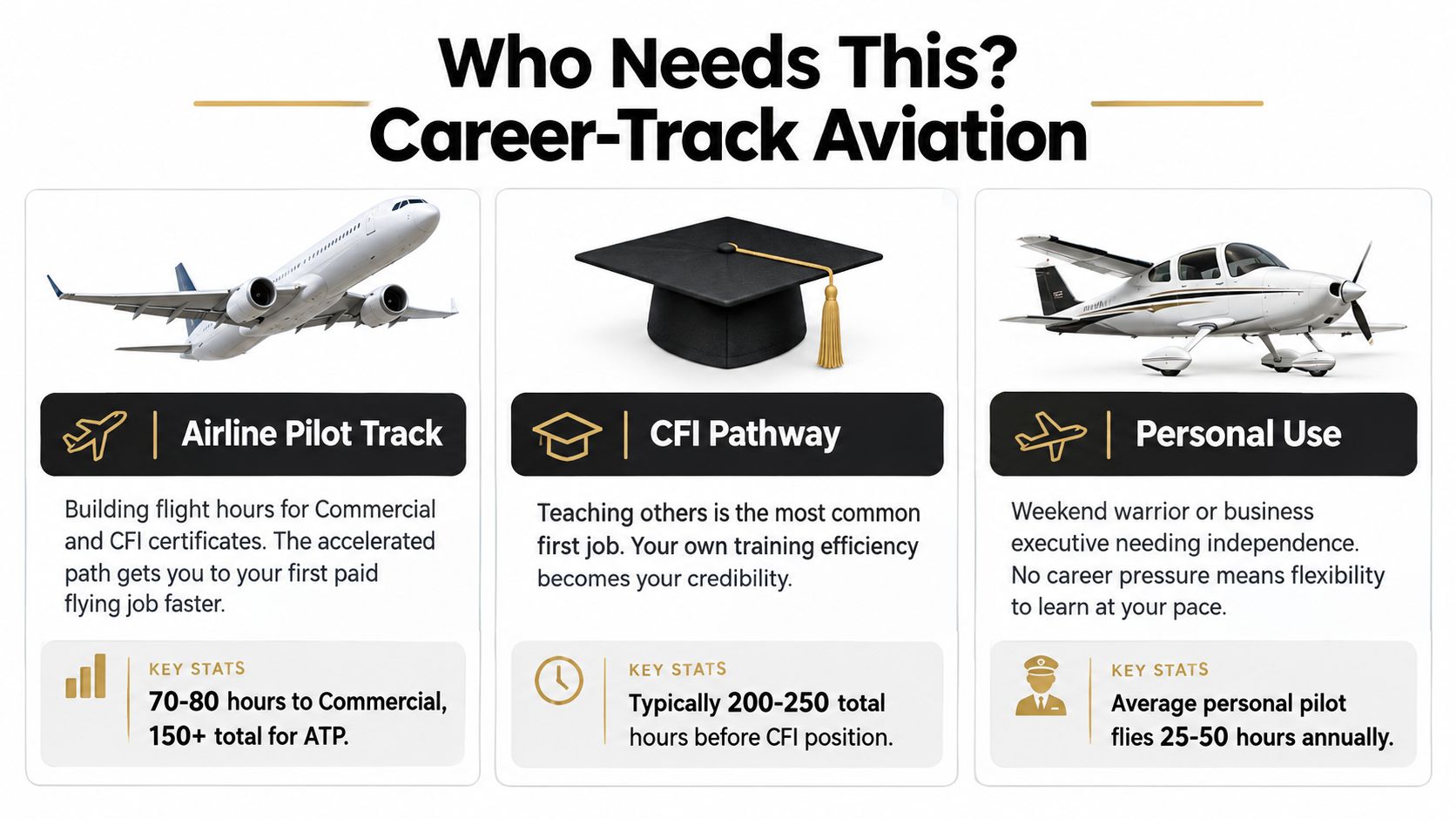
Private pilot is the first real gate in a longer professional path. For a career-track student, the certificate matters because it opens the way to the next ratings, the next standards, and eventually the next job. That's the point of doing the work fast without rushing it, you want a clean launch into instrument, commercial, and instructor training, not a restart.
Boeing's 2025 Pilot and Technician Outlook projects that commercial aviation worldwide will require 660,000 new pilots between 2025 and 2044, alongside 710,000 maintenance technicians and 1,000,000 cabin-crew members, for a combined projection of nearly 2.4 million new aviation professionals over two decades (Boeing 2025 outlook). That forecast is global and aimed at commercial aviation, not private students specifically, but it explains why structured training pathways matter. The private certificate is where the pipeline begins.
Don't confuse completion with time building
Finishing a certificate does not mean you're ready for the airline right away. It means you've crossed the first milestone and can now work through the ratings and experience chain that follows. A school should be honest about what it can support after the private certificate, because the difference between earning a rating and building the right hours is where many students lose momentum.
That's also why instructor pathways matter so much. The person who finishes training still needs a realistic path to paid flying, and the school's ability to coordinate that path is worth more than a flashy marketing promise. The more transparent the operation is about scheduling, examiner access, and progression, the less likely the student is to stall between ratings.
If you want a private-pilot plan that's built for real-world pace, not brochure pace, start with a program that shows you the day-to-day structure, the recovery plan, and the financial edges before you commit. Visit CFII to review a Career Track built around fixed pricing, coordinated checkrides, and the kind of scheduling discipline accelerated training actually needs.
Planning to fly for a living?
See what the path from zero to a pilot career looks like, what it costs and how long it takes.
Learn to fly in Riverside
We train at Riverside Municipal Airport in factory-new airplanes with a parachute built in. Start with a one hour discovery flight, no experience needed.