

On this page
- What Becoming a Pilot Actually Looks Like
- The journey is a pipeline, not a single course
- The two planning problems people ignore
- The FAA Certificate Ladder in Order
- Student pilot, then private pilot
- Instrument, commercial, multi-engine, instructor, CFII
- Get Your Medical Before You Spend a Dollar
- Medical eligibility is the first real career decision
- What a medical-first workflow looks like
- Choosing Between Accelerated and Pay-As-You-Go Training
- Accelerated training gives you predictability
- Pay-as-you-go gives you flexibility, but it spreads the pain out
- What Becoming a Pilot Actually Costs
- Build a budget that includes more than tuition
- Financing structure matters as much as price
- Building the Hours the Airlines Actually Require
- The airline gate is experience, not enthusiasm
- Use the time-building path intentionally
- Your 18-to-24-Month Decision Framework
- What to do next based on where you are
- Quick FAQ
You're probably sitting there with the same question most future pilots have, just phrased in a more expensive way. Should you spend money on lessons now, or should you first figure out whether the medical, the ratings, and the hours are even realistic for you?
That's the right order to think about it. How to become a pilot is not one big training event, it's a staged FAA pipeline with two traps that catch people early, medical eligibility and the post-certificate time-building bottleneck. If you ignore either one, you can end up spending a lot and still being nowhere near airline employability.
What Becoming a Pilot Actually Looks Like
A lot of people start with the fantasy version. They picture a few good months of training, a license, and then a cockpit seat. The actual path is slower, more expensive, and far more practical. That is exactly why it works.
The journey is a pipeline, not a single course
The FAA path runs through distinct stages: student pilot, Private Pilot Certificate, Instrument Rating, Commercial Pilot Certificate, multi-engine rating, and finally the Airline Transport Pilot certificate. Each step serves a different job. Private training proves you can control the airplane safely, the instrument rating proves you can fly by procedure when weather or visibility gets ugly, commercial privileges open the door to compensated flying, and the ATP is what airlines care about at the end of the road FAA and BLS pathway summary.
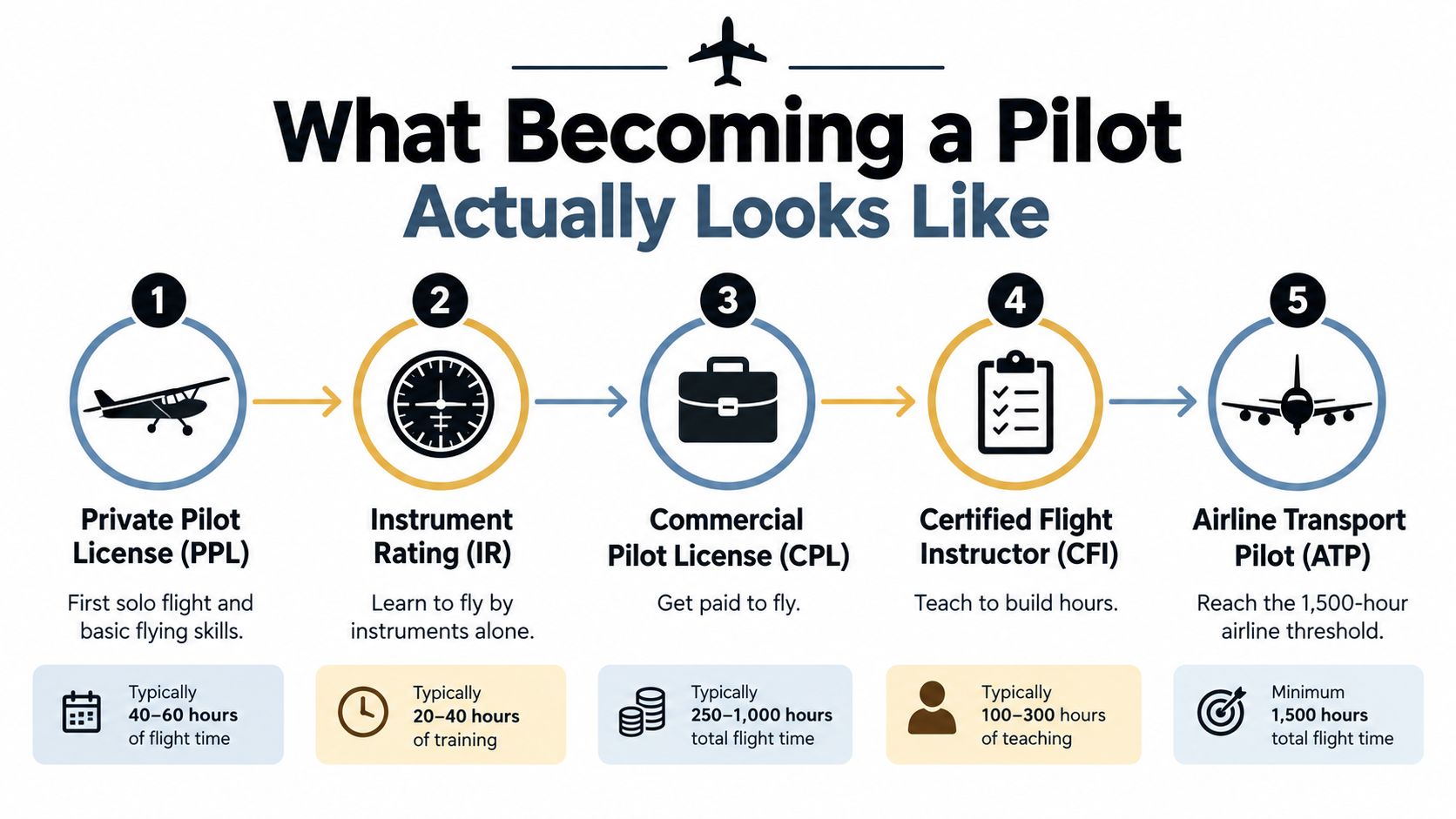
The mistake I see constantly is treating the private certificate like the finish line. The private certificate is only the first proof that you can learn the process, absorb corrections, and pass a practical test. If you are serious about a flying career, you should already be planning your instrument work and your time-building strategy before you solo.
Practical rule: don't ask, “How fast can I get a license?” Ask, “What is the shortest path that still gets me to airline-eligible hours without wasting money?”
The two planning problems people ignore
First, the medical. The FAA recommends getting a medical certificate before you spend heavily on training, and a medical is required before solo flight. See the FAA's medical certification guidance.
Second, the hours. Professional flying is not just about earning certificates, it is about accumulating the right kind of logged experience after the certificates are done. That post-certificate time-building phase is where a lot of students get stuck, and it is where budgets get tested.
If you are comparing schools, do not get distracted by slogans. Look at what the program does for the whole pipeline. A structured path like the CFII career track overview makes sense for someone who wants a clear route from zero time to advanced ratings, while a discovery flight is the smarter first move if you have never sat in the left seat and do not yet know whether the career fits your life.
The FAA Certificate Ladder in Order
Start with the FAA sequence, not the sales pitch. The order matters because each rating opens the next one and each step solves a different problem in the training and hiring path.
Student pilot, then private pilot
You start at the student stage. Before the practical test for a private airplane certificate, an applicant must be at least 17, be able to read, speak, write, and understand English, and have an authorized instructor endorsement for the knowledge test under 14 CFR § 61.103 FAA private pilot eligibility.
The minimum aeronautical experience for an airplane single-engine private pilot certificate is 40 hours under 14 CFR § 61.109, including 20 hours of flight training from an authorized instructor and 10 hours of solo flight training FAA private pilot minimums. That total also includes required cross-country, night, and practical-test preparation time. Treat it as a floor, not a promise. In real training, students finish when they are consistently ready, not when the clock says they should be.
Instrument, commercial, multi-engine, instructor, CFII
After the private certificate, the next move is the Instrument Rating. Professional flying depends on procedures, weather judgment, navigation discipline, and the ability to manage the airplane when outside references disappear. If you delay it, you slow your own progression.
Then comes the Commercial Pilot Certificate. That certificate is the legal bridge to compensated flying, but it still does not make you airline-ready. From there, most aspiring career pilots add a multi-engine rating, then a Certified Flight Instructor certificate, and later CFII so they can teach instrument students and keep building time in a way that counts toward the airline track.
Bottom line: every step should make you more employable, not just more certified.
The smartest students understand the ladder early and train in that order. They do not collect ratings randomly. They build the sequence with the next job in mind, not just the next checkride.
Get Your Medical Before You Spend a Dollar
Many aspiring pilots waste money by training first and treating the FAA medical like paperwork. That order is backward.
Medical eligibility is the first real career decision
A private pilot generally operates under a third-class medical, a commercial pilot generally needs a second-class medical, and airline-transport-pilot pilot-in-command privileges require a first-class medical. The FAA's medical certification guidance spells out those class requirements and notes that medical certification itself has no minimum or maximum age, even though pilot-certificate and operational age rules still apply FAA medical certification guidance.
So the target is not the easiest medical you can get today. It is the medical you will need when you reach the airline stage. Aim too low now, and you may run into paperwork, history, or timing problems when they are hardest to absorb.
What a medical-first workflow looks like
Start with the career endpoint you want. If the goal is airlines, talk to an aviation medical examiner before you commit to a long training bill. Your family doctor does not replace that process. Prior diagnoses, medication history, vision issues, or substance-related records can trigger special issuance or extra documentation instead of a quick approval.
Use a simple order:
- Pick the endpoint first: private flying, commercial flying, or the airline track.
- Get the right medical class early: before soloing or making a large training commitment.
- Plan for documentation if needed: budget time for records, not just the exam fee.
- Treat deferral differently from denial: a delay is not the same as permanent ineligibility.
If you want to avoid a bad financial surprise, read the FAA medical overview before you enroll anywhere. The point is to find obstacles before they become sunk cost.
Choosing Between Accelerated and Pay-As-You-Go Training
Choose the training model the way you would choose a runway, based on conditions, not preference. If your money is tight, your schedule changes week to week, or you are still unsure about the medical and certificate path, pay-as-you-go gives you room. If you have already cleared the eligibility questions and can fund a concentrated stretch of training, accelerated study is the cleaner move.
Accelerated training gives you predictability
Accelerated training works for students who want the calendar controlled and the sequence fixed. CFII's Career Track is one example, with fixed $89,000 tuition, about nine months from zero time to CFII and multi-engine, and 282 total hours CFII Career Track. That structure removes a lot of guesswork. You know the endpoint, the pacing, and the cost basis up front.
That matters because pilot training fails in the same few places over and over: people underestimate how long it takes, or they assume they can stretch the process without friction. They cannot. A defined program forces progress, which is why it suits students who are ready to treat training like a full-time job.
Read the accelerated flight training overview if you want a clearer picture of how a concentrated track is organized.
Pay-as-you-go gives you flexibility, but it spreads the pain out
Pay-as-you-go fits students who need to keep working, handle family obligations, or avoid a large upfront commitment. That flexibility comes with a trade-off. Progress depends on weather, aircraft availability, instructor turnover, checkride slots, and your own availability. Every one of those can slow you down.
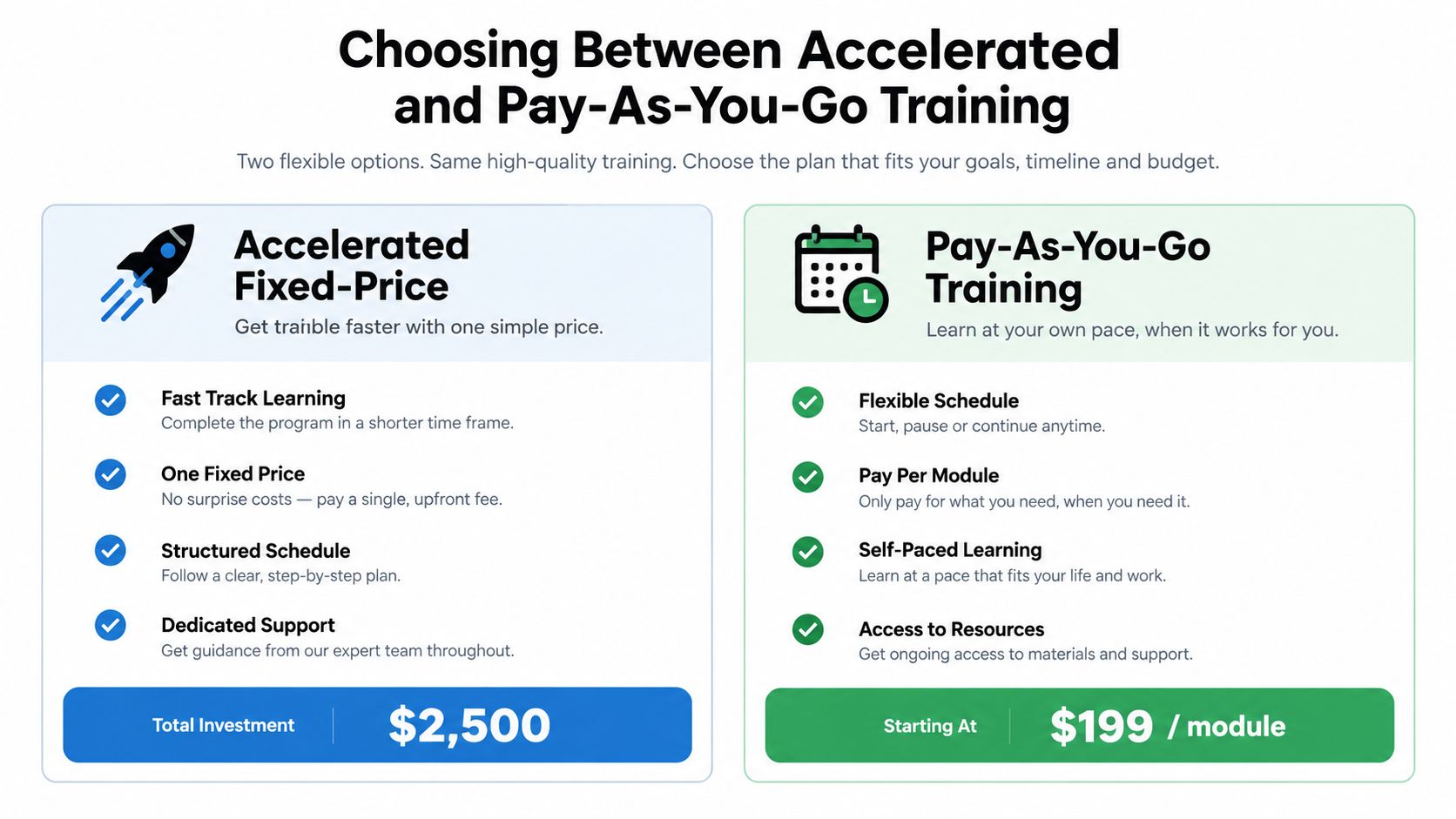
If your training fund cannot cover nine months of concentrated tuition plus living costs, pay-as-you-go is the honest choice, not the slower one. It is the better option for students who need cash flow protection more than schedule control.
What Becoming a Pilot Actually Costs
Sticker price is only the first line item. Your full budget also includes living expenses, delay risk, retest risk, and how you finance the training.
Build a budget that includes more than tuition
Start with tuition, then add housing, meals, transportation, examiner fees, medical costs, and room for retakes. If you're training in Southern California, furnished shared student housing near the Riverside base is listed at $1,300 per month CFII housing information. That matters because your burn rate does not stop when you finish a lesson. It keeps going every month you stay in training.
Training also costs money when nobody sends you a bill for the delay. A pushed checkride can stretch your finish date and add another month of housing or living expenses. The same thing happens when aircraft availability slips or you lose time because you were not ready for the written or the oral.
Budget for delay, not just flight time. Students who ignore that line item are usually the ones who run short halfway through training.
Financing structure matters as much as price
If you need financing, ask how the school handles deferrals, what the loan covers, and what happens if you finish late. The school's financing information says that Stratus Financial offers 12-month payment deferral, considers factors beyond typical FICO metrics, and has no prepayment penalties.
That structure can preserve cash while you stay enrolled.
Ask every school these questions before you sign anything:
- What exactly is included: flights, simulator time, study materials, stage checks, checkride coordination?
- What costs extra: examiner fees, retests, housing, written exam fees, and repeated training?
- How are delays handled: weather, aircraft maintenance, and examiner availability?
- What financing terms apply: deferral, repayment timing, and prepayment rules?
- What happens if I need more time: calendar extensions and added living costs?
- What support do you provide after graduation: scheduling, instructor placement, or just a handshake?
Use the flight training cost guide to pressure-test your assumptions, then compare the full cost of attendance, not just the headline tuition.
Building the Hours the Airlines Actually Require
This is the part most beginner articles skip, and it is where a lot of students run into financial trouble. A certificate gets you started. Airline eligibility is a separate problem.
The airline gate is experience, not enthusiasm
The ATP path generally requires 1,500 total pilot hours FAA ATP guidance. The FAA also recognizes restricted ATP pathways for some qualifying degree holders, including 1,000 hours for certain bachelor's-degree graduates and 1,250 hours for certain associate-degree pathways or qualifying bachelor's-degree pathways FAA ATP guidance. Those are real exceptions, but they still demand serious time in the logbook.
That is why so many new commercial pilots move into flight instruction. Instruction turns skill into logged time and gives you paid experience while you work toward airline eligibility. Instruction is the core time-building strategy for most new commercial pilots, not a fallback.
Use the time-building path intentionally
A structured add-on can make that transition easier to plan. The article on ATP-CTP and airline transition requirements is useful once you are already thinking about the airline end of the pipeline, because the bottleneck after certification is still hours.
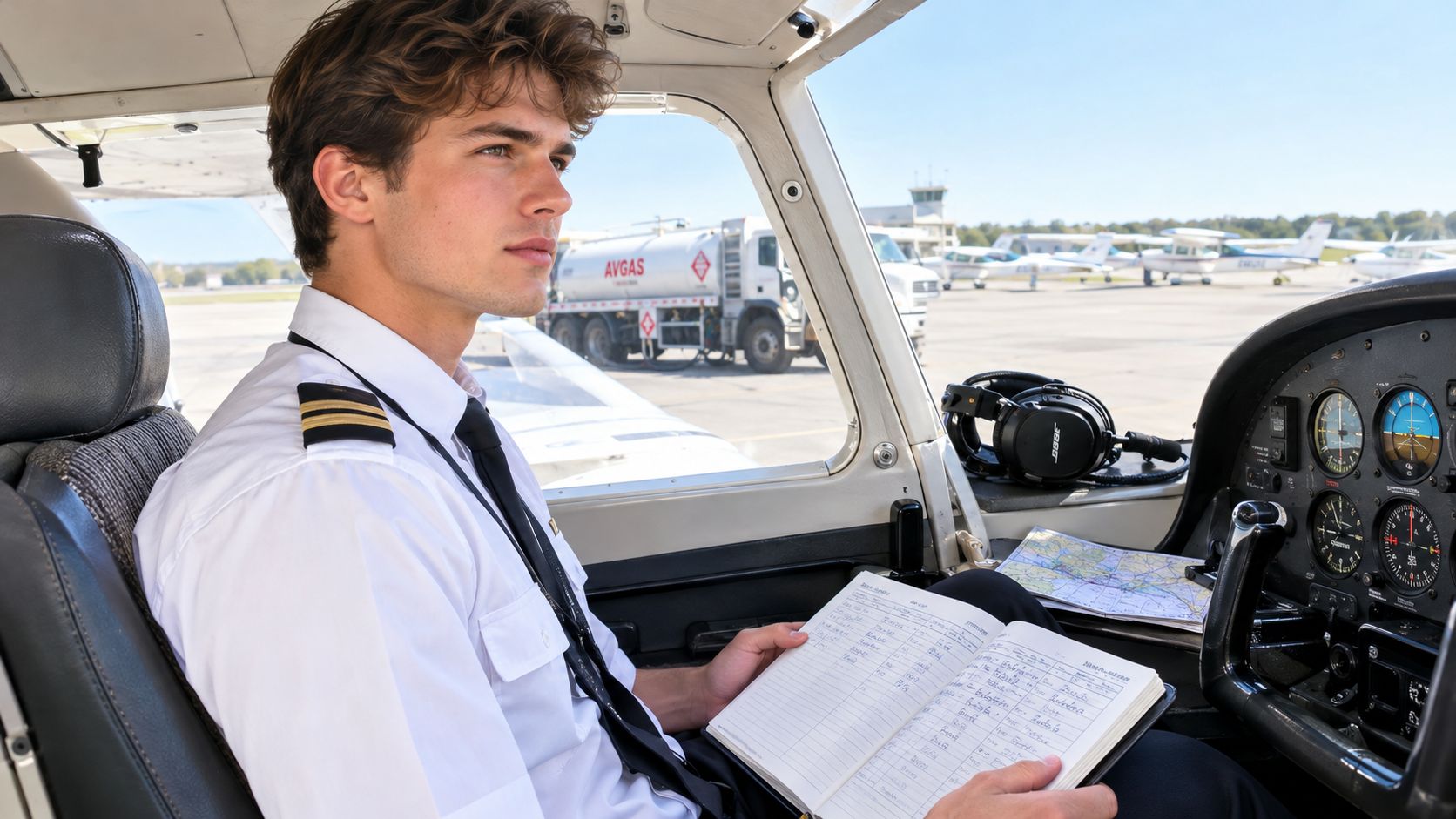
The point is not the exact number on day one. The point is whether your post-certificate plan produces usable, airline-relevant time. If it does not, you will spend months trying to create momentum that should have been built into the plan from the beginning.
Your 18-to-24-Month Decision Framework
Treat this as a sequence of decisions, not a vague stretch of time. First, get your medical sorted, then choose the training path that fits your budget and your tolerance for structure. After that, the question is whether your plan creates the certificates, employment eligibility, and loggable hours you need without wasting money.
What to do next based on where you are
If you have zero flight time, start with medical eligibility before you commit serious cash. If you already know you want an airline career and want a direct route to advanced ratings, a program like CFII's Career Track, with its zero-to-CFII structure, fixed tuition, and Southern California bases, is a sensible next step CFII Career Track. If you have never flown and are still testing the idea, a discovery flight is the lowest-friction way to find out whether the cockpit suits you.
The honest timeline from first lesson to airline cockpit usually spans two to four years, because the time-building stage is genuine. Students who ignore that bottleneck end up paying for delays they should have planned around from the start.
Quick FAQ
When should I get the medical? Before you spend serious money, and definitely before solo flight. FAA medical guidance
How old do I need to be? A private airplane applicant must be at least 17 under 14 CFR § 61.103. The ATP generally requires you to be at least 23 FAA private pilot eligibility, FAA ATP guidance
What does the cost look like? Tuition is only part of it. Add housing, living costs, examiner fees, medical costs, and delay risk.
What if I fail a checkride? Treat it as a training event, not a career-ending event. Fix the weak area, get the corrective instruction, and go back prepared.
Planning to fly for a living?
See what the path from zero to a pilot career looks like, what it costs and how long it takes.
Learn to fly in Riverside
We train at Riverside Municipal Airport in factory-new airplanes with a parachute built in. Start with a one hour discovery flight, no experience needed.
