

On this page
- The Staged Path from First Flight to Airline Seat
- What the path looks like in the cockpit
- Understanding the Private Pilot Certificate Requirements
- What those 40 hours are made of
- What your instructor is signing off on
- Adding the Instrument Rating to Your Certificates
- How device time fits into the training
- Why planning matters before the checkride
- Commercial and Instructor Certificates Side by Side
- What the commercial certificate requires
- Why instructor ratings fit naturally after commercial
- Why the Hour Gap Between Commercial and ATP Matters
- Why the ATP standard changes the whole plan
- Why instructors became the bridge
- Putting It All Together as a Career-Track Sequence
- Why the sequence matters more than the label
- A sample path for a zero-time student
- Choosing an Accelerated Program That Fits Your Situation
- What to look for before you enroll
- Why Southern California can help the process
- Your Next Step in Pilot Certification Training
Pilot certification training in the United States follows a staged progression from 40 hours for the private pilot certificate to 250 hours for the commercial pilot certificate and 1,500 hours for the unrestricted ATP. Most aspiring career pilots need advanced ratings and instructor certificates to bridge that gap.
You might be sitting in a small airplane for your first solo, or still trying to figure out whether you're ready to start at all. The path ahead can look like one long ladder, but FAA rules break it into separate steps with very different privileges, logbook requirements, and time-building realities.
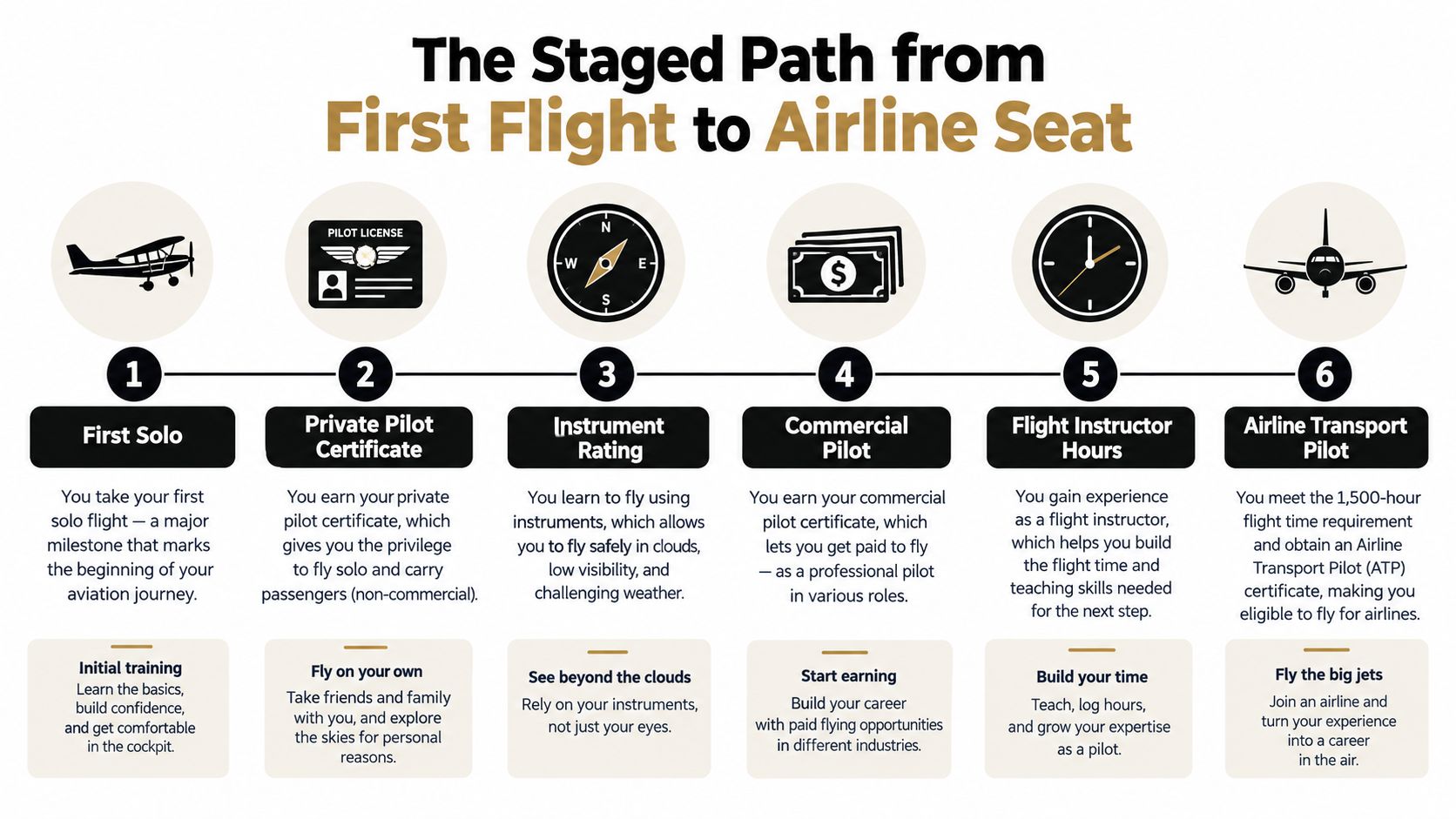
The Staged Path from First Flight to Airline Seat
A first solo is exciting because it feels like freedom, but it's only the beginning of the regulatory climb. From there, the FAA pathway moves through the Private Pilot Certificate, then the Instrument Rating, then the Commercial Pilot Certificate, and finally the Airline Transport Pilot certificate for airline-level eligibility. That sequence matters because each stage opens up a new kind of flying, but none of them automatically gets you to the next one.
What the path looks like in the cockpit
Think of the journey like this. At first, you're learning to control the airplane and make safe decisions with an instructor beside you. Then you earn the private certificate, which opens the door to carrying passengers, but only in the ways the rules allow.
After that, the instrument rating changes how you can operate when the weather stops being cooperative. The commercial certificate lets you be paid for flying, but that still isn't the same thing as being airline-eligible. For that, the ATP standard sits much higher, which is why pilot certification training is really a pipeline, not a finish line.
Practical rule: if a school talks only about “getting licensed,” ask which license, which rating, and how the hours will be logged afterward.
For a beginner-friendly overview, this introduction to flight training for beginners is a useful starting point before you commit to a full path.
Understanding the Private Pilot Certificate Requirements
The private pilot certificate is the first formal gate in the system. Under 14 CFR Part 61, Subpart E, you need aeronautical knowledge, flight training, aeronautical experience, and logbook endorsement before you can take the practical test (FAA AC 61-65F). For an airplane applicant, FAA guidance sets the minimum at 40 flight hours, with 20 hours of flight instruction and 10 hours of solo flight (14 CFR § 61.109).
What those 40 hours are made of
Those 40 hours are not a single block of general time in the air. The rule breaks them into parts, including three hours of cross-country flight, three hours of night flight, and three hours of instrument training (14 CFR § 61.109(a)(1)-(2)). Each piece shows a different kind of readiness. Cross-country work proves you can manage a route beyond the local practice area, night flight tests your judgment in a less forgiving environment, and instrument time starts building the habit of staying precise when outside visual cues are limited.
That is why the private certificate is more than stick-and-rudder skill. The FAA expects you to show judgment, planning, and the ability to fly without constant correction.
What your instructor is signing off on
Before the practical test, an authorized instructor must endorse your logbook and confirm that you have completed the required training and are ready to pass (FAA AC 61-65F). The endorsement is not a formality. If the instructor sees weak spots in consistency or decision-making, the test waits until those gaps are closed.
Your logbook is part of your legal record, not a scrapbook. Treat every entry as if it may be reviewed later, because it often will be.
The private certificate gives you access, but it does not remove the learning curve. It is the point where you stop being a student under tight limits and start carrying real responsibility.
Adding the Instrument Rating to Your Certificates
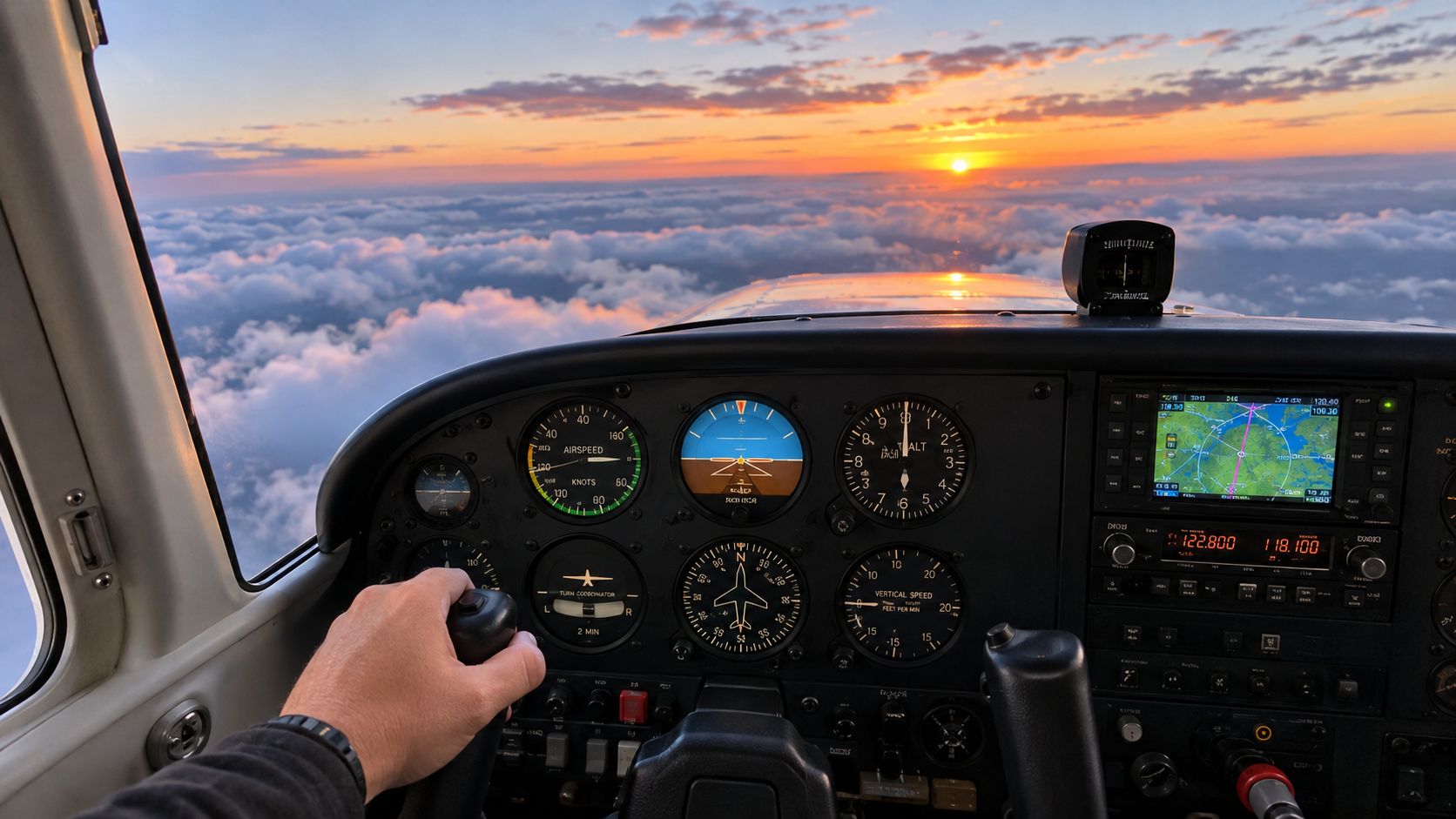
A pilot on a clear day can still be grounded by a lower ceiling a few miles ahead. The instrument rating solves that problem by training you to fly by reference to the instruments when visibility drops or clouds close in, and the FAA requires training in instrument flying, navigation, approaches, and emergency procedures under 14 CFR § 61.65 (eCFR 61.65). For a student who wants to build a career, that matters because it widens the weather window you can legally and safely work in.
How device time fits into the training
Instrument students often get tripped up by simulator time. FAA guidance allows simulator or flight-training-device time only when an authorized instructor provides it, and the credit depends on the approval basis. Under FAA Order 8710.3E-C12 (FAA Order 8710.3E-C12), up to 20 hours may count in some cases, up to 30 hours under Part 142, and a PC-based aviation training device is limited to 10 hours of that allowance.
The practical point is simple: device hours are not interchangeable. A logbook entry counts only when the device, the syllabus, and the instructor authority all match the requirement being credited. A solid instrument syllabus uses the device for work that benefits from repetition, then reserves airplane time for tasks that must be flown in the aircraft. this instrument-rating course outline shows how that split can be organized in a training sequence.
Why planning matters before the checkride
The regulation also allows up to 45 hours of cross-country pilot-in-command instrument time with an authorized instructor to count toward the instrument-rating experience requirement (14 CFR § 61.65(d)(1)). That makes early planning important. A faster path is not always the one with the most simulator time. It is the one where every hour is credited the right way, so the training supports the checkride instead of forcing repairs at the end.
Commercial and Instructor Certificates Side by Side
A student who is comparing commercial and instructor training often sees two certificates that sit close together in the syllabus but do different work in the regulations. The commercial pilot certificate is the step that allows paid flying, while instructor certificates let you teach and often help you keep building time for the next rating. Under 14 CFR Part 61, Subpart F, the commercial airplane applicant must meet specific aeronautical experience requirements and show preparation for the practical test (eCFR Part 61 Subpart F).
What the commercial certificate requires
FAA guidance says an airplane commercial applicant must hold, or earn at the same time, the appropriate instrument rating. The rule also calls for at least 3 hours of training in the applicable single-engine airplane with an authorized instructor for practical test preparation within the preceding 2 calendar months (14 CFR § 61.129(a)(4)). That recency requirement surprises many students who let the training gap grow too wide before the checkride. The regulation is doing the same job a final simulator session does before a line check, it makes sure the skills are still current when the examiner sees them.
The commercial certificate is not just a more advanced private certificate. It asks for tighter precision in maneuvers, procedures, and decision-making under pressure. If you have only flown privately, the shift is real because the standard changes from safe enjoyment to professional consistency.
Why instructor ratings fit naturally after commercial
To pursue an airplane flight-instructor certificate or an instrument-instructor rating, an applicant generally must hold either a commercial pilot certificate or an airline transport pilot certificate with the appropriate category and class (FAA AC 61-65H). For an airplane instructor rating, FAA guidance also requires an instrument-airplane rating or instrument privileges, plus the authorized-instructor logbook endorsement required by 14 CFR § 61.185 for the ground and flight training, and for showing readiness for the practical test (FAA AC 61-65H, eCFR Part 61 Subpart F).
A career-minded student often reaches instructor training soon after the commercial certificate because it changes the economics of flying. The certificate lets you stay active in the system, teach others, and keep your own skills moving while you build toward the next credential.
Why the Hour Gap Between Commercial and ATP Matters
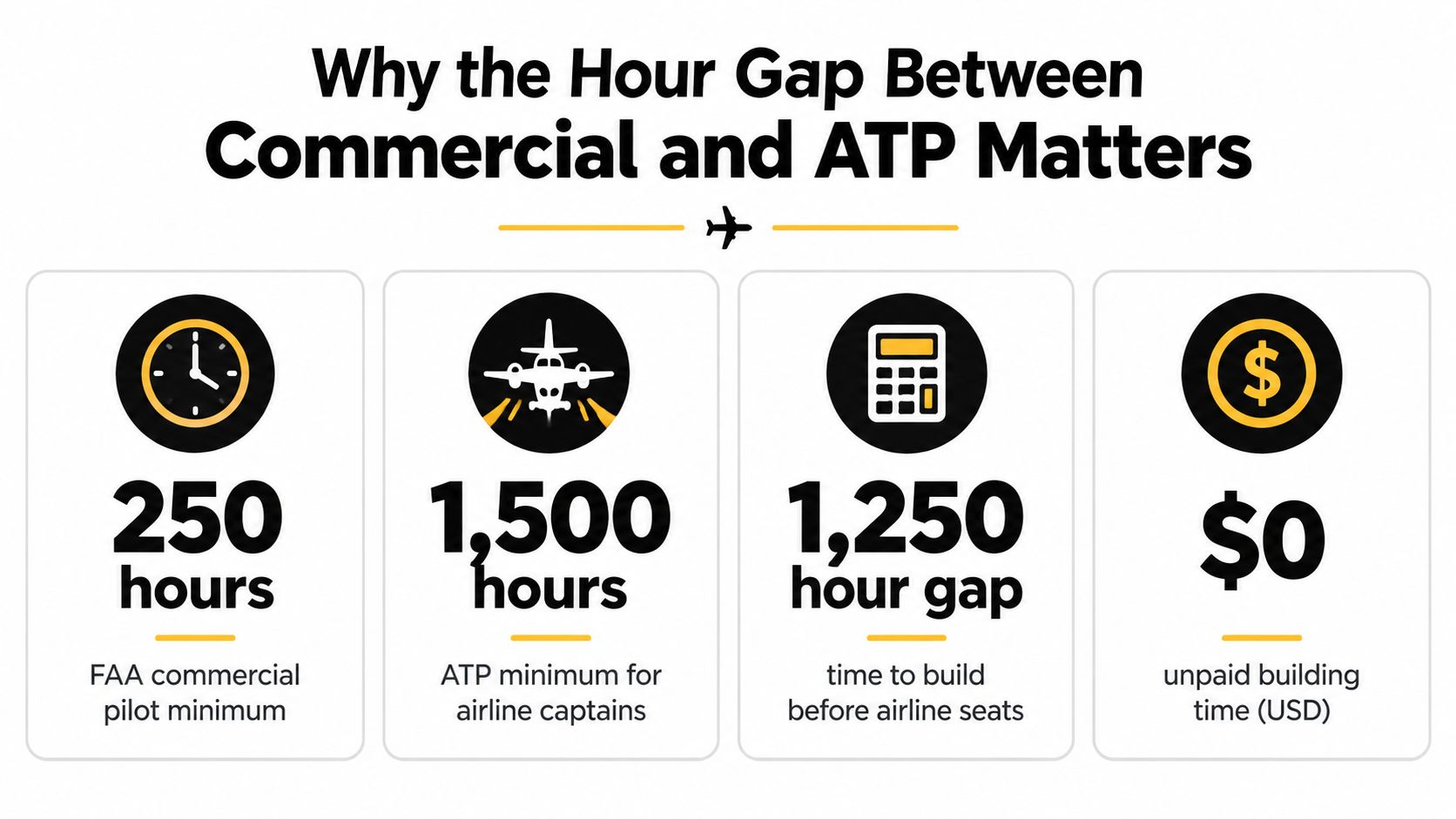
The first surprise for many students is simple: the commercial minimum is far below the airline minimum. The FAA commercial pilot certificate starts at 250 total flight hours, while the unrestricted ATP normally requires 1,500 total pilot hours (FAA ATP training page, FAA final rule). That leaves about 1,250 additional hours to build after commercial certification, and that gap shapes a large part of pilot certification training.
Why the ATP standard changes the whole plan
The ATP is more than a total-hour target. The rule also includes experience categories such as 500 hours of cross-country time, 100 hours of night flight, and 50 hours in the airplane class for which the rating is sought (FAA final rule). That is why a student can spend plenty of time in the air and still fall short of the legal mix needed later. Hours matter, but the kind of hours matters too.
Airlines may also look for experience above the commercial minimum, sometimes in the 1,000, 2,000, or more flight hours range, depending on hiring needs and market conditions. The ATP standard sets the legal floor. Airline hiring can raise the bar.
Why instructors became the bridge
Instructor ratings matter because they give new commercial pilots a legal way to keep flying while they build time. Teaching creates logged, structured experience, and it keeps a pilot active in the system instead of waiting on the sidelines. That is why the traditional pipeline often moves from commercial training into flight instruction before airline eligibility.
For the airline side of the pathway, ATP and CTP requirements explained here helps connect the experience rules to the training sequence.
Putting It All Together as a Career-Track Sequence
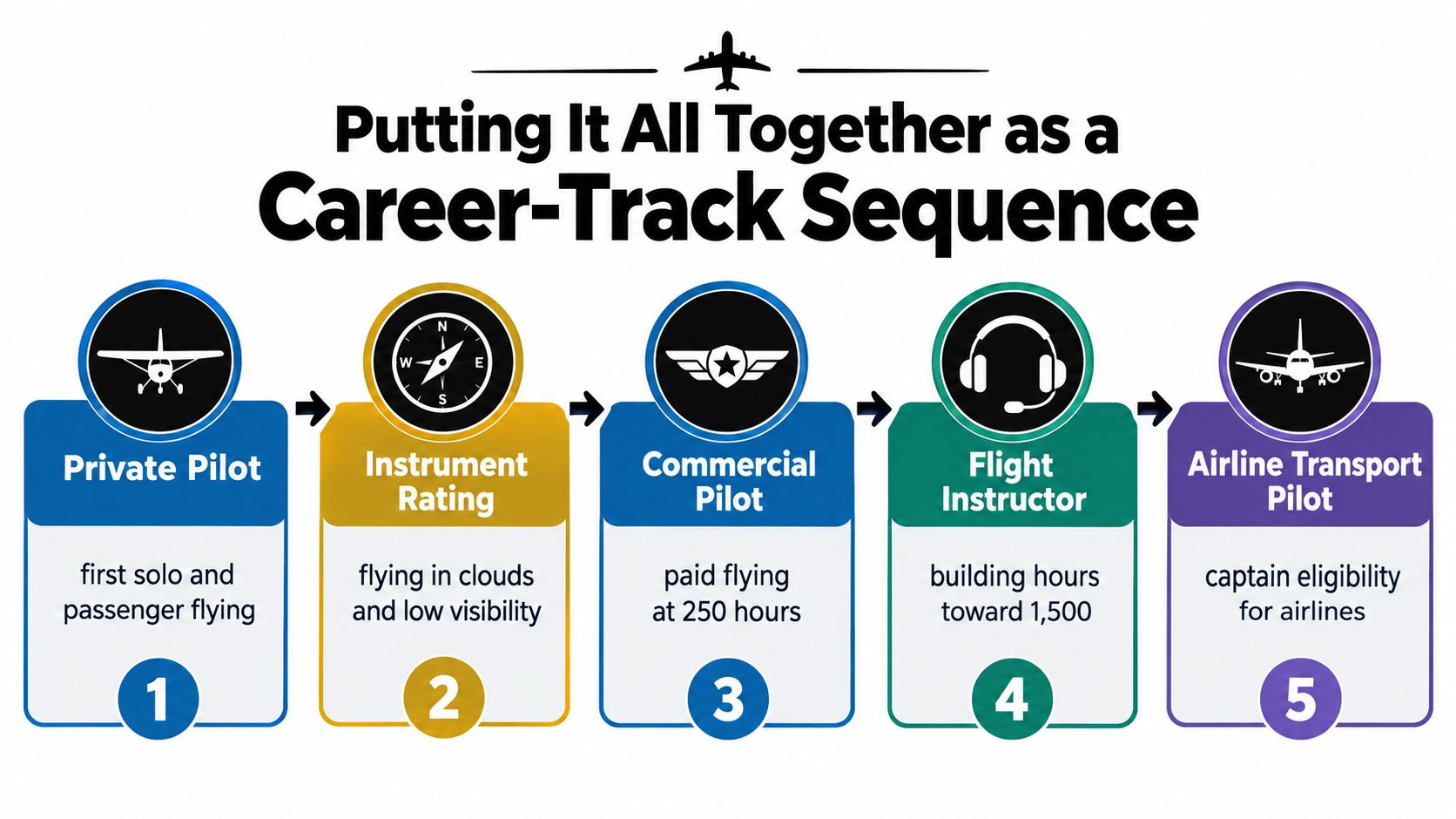
The cleanest career sequence is easier to see when you line the stages up in order. A student starts with the Private Pilot Certificate, adds the Instrument Rating, earns the Commercial Pilot Certificate in single-engine aircraft, moves into multi-engine training, then adds Certified Flight Instructor and Certified Flight Instructor–Instrument privileges. Each step builds on the one before it, and each step opens a new legal role in the airplane.
Why the sequence matters more than the label
The value of the sequence is that it matches how the FAA thinks about qualifications. A certificate says what you're legally allowed to do. A rating changes the conditions or aircraft types you can fly. A logbook shows whether you've earned the experience to move forward. If one of those pieces is missing, the next step can stall.
That's why structured training programs often work better than piecemeal planning. Students need test prep, stage checks, documented time, and examiner timing to line up at the right moments, or the path slows down even when the flying itself is going well.
A sample path for a zero-time student
A first-time student usually benefits from a plan that ties study, flying, and checkrides together instead of treating them like separate projects. One example of that model is CFII's Career Track, which is described as a fixed $89,000 pathway in Southern California that runs from zero time to CFII and multi-engine in about nine months.
That kind of structure matters because the regulatory architecture isn't forgiving. If you lose track of endorsements, category/class time, or the order of ratings, you don't just lose momentum, you can lose months.
Choosing an Accelerated Program That Fits Your Situation
An accelerated program makes sense when you care about two things at once, speed and predictability. That's especially important in pilot certification training because the cost of a delayed checkride, a weather cancellation, or a scheduling gap can be more disruptive than the advertised tuition. A fixed-price path reduces the risk of watching the bill grow while the calendar stretches.
What to look for before you enroll
A serious program should make its schedule, aircraft access, and exam flow easy to understand. If you can't see how instruction, simulator time, written tests, and practical tests connect, you're being asked to trust a process you can't verify.
- Fixed pricing: You should know what the tuition covers and what it doesn't.
- Accelerated scheduling: Training should be organized to keep momentum, not reset it every few weeks.
- Financing clarity: You need to know how payments work during training, especially if you're carrying debt.
- Checkride coordination: Examiner scheduling should be part of the plan, not an afterthought.
Why Southern California can help the process
Year-round flying conditions and complex airspace can give students a steady training rhythm if the operation is organized well. That doesn't replace study or skill, but it does reduce some of the interruption that slows progress elsewhere. This overview of accelerated private-pilot training is a useful reference if you're comparing structured training formats.
If you're evaluating a full career program, look for the parts that keep the training moving when real life gets messy. That's usually where the difference between an advertised path and a completed path shows up.
Your Next Step in Pilot Certification Training
If you've never flown before, the smartest first move is a discovery flight. It lets you feel the controls, hear the radio work, and decide whether the cockpit is a place you want to spend the next several months or years.
If you've already soloed, or you hold a private certificate and know you want a career, the next question is whether your training path is built to carry you all the way through CFII and multi-engine. A fixed, structured program can remove a lot of the guesswork around hours, sequencing, and scheduling.
Start with the step that matches your current reality. Beginners need a first flight, committed students need a full plan.
A discovery flight is the right move if you're still testing the waters. A full career-track enrollment makes more sense if you're ready to turn the FAA sequence into a real timeline instead of a loose intention.
CFII offers an accelerated, fixed-price Career Track that takes students from zero time through CFII and multi-engine training in about nine months, with the structure, study support, and scheduling needed to keep the pipeline moving. If you're ready to see how that fits your goals, visit CFII and compare the path to where you are now, whether that's your first flight or your next certificate.
Planning to fly for a living?
See what the path from zero to a pilot career looks like, what it costs and how long it takes.
Learn to fly in Riverside
We train at Riverside Municipal Airport in factory-new airplanes with a parachute built in. Start with a one hour discovery flight, no experience needed.