
On this page
- What Aspiring Pilots Are Really Deciding
- Separate the destination from the training purchase
- What a Pilot Training Program Actually Is
- What each stage adds
- Structure and regulatory authority aren't the same thing
- Accelerated vs Modular Program Models
- Accelerated vs Modular Program Comparison
- Simulator hours need their own accounting
- Step-by-Step Timeline and Milestones
- Early training builds independent judgment
- Advanced training must match the correct experience rule
- Cost and Financing Expectations
- Build scenarios rather than a single budget
- Deferred payments still require a repayment plan
- What to Look for in a Flight School
- Inspect how lessons actually happen
- Verify support at the bottlenecks
- A Sample Nine-Month CFII Career Track Pathway
- Read the calendar as a working plan
- Graduation begins another experience-building phase
- Next Steps for Applicants
- Complete the checks before committing funds
You're looking at flight-school websites after work, trying to picture how you'd get from your current routine to a professional cockpit. The certificates sound impressive, but you still need answers to practical questions: Can you keep your job? What does the tuition cover? And when training ends, are you ready for an airline, or just ready for the next stage?
What Aspiring Pilots Are Really Deciding
Choosing a pilot training program means choosing how you'll learn, how you'll pay, and how you'll handle interruptions. It isn't a decision about which airport has the nicest airplanes.
Consider a career changer who hasn't flown yet. Leaving work for full-time training might allow concentrated study, but it also means arranging living expenses without relying on immediate aviation income. Keeping the job and training around it protects cash flow, but requires consistent room for lessons, preparation, and rescheduling.
Neither choice is automatically more responsible. The sensible choice is the one you can sustain when a lesson takes longer than expected or a practical test moves.
Separate the destination from the training purchase
A professional cockpit is the destination. Initial training is the preparation that makes later experience possible.
A career-focused program can organize flying lessons, ground study, instructor preparation, and practical tests into a coherent sequence. It should also explain what remains after graduation, rather than letting an applicant assume that the final certificate equals airline eligibility.
Before discussing enrollment, write down your constraints:
- Availability: Can you attend regularly and study outside scheduled lessons?
- Financial runway: Can you cover training and living expenses without depending on an unconfirmed job?
- Location: Are you prepared to relocate, or must training fit around your current home?
- Learning needs: Do you prefer a tightly scheduled course or more flexibility between stages?
Instructor's perspective: Buy a training plan you can explain back to someone else, including what happens when progress slows.
You don't need aviation knowledge to ask good questions. Ask the school to show how a typical lesson becomes a completed stage, how that stage becomes a certificate, and how the resulting experience supports your next career step.
The certificate list tells you what the school intends to deliver. The syllabus tells you how it intends to get you there.
What a Pilot Training Program Actually Is
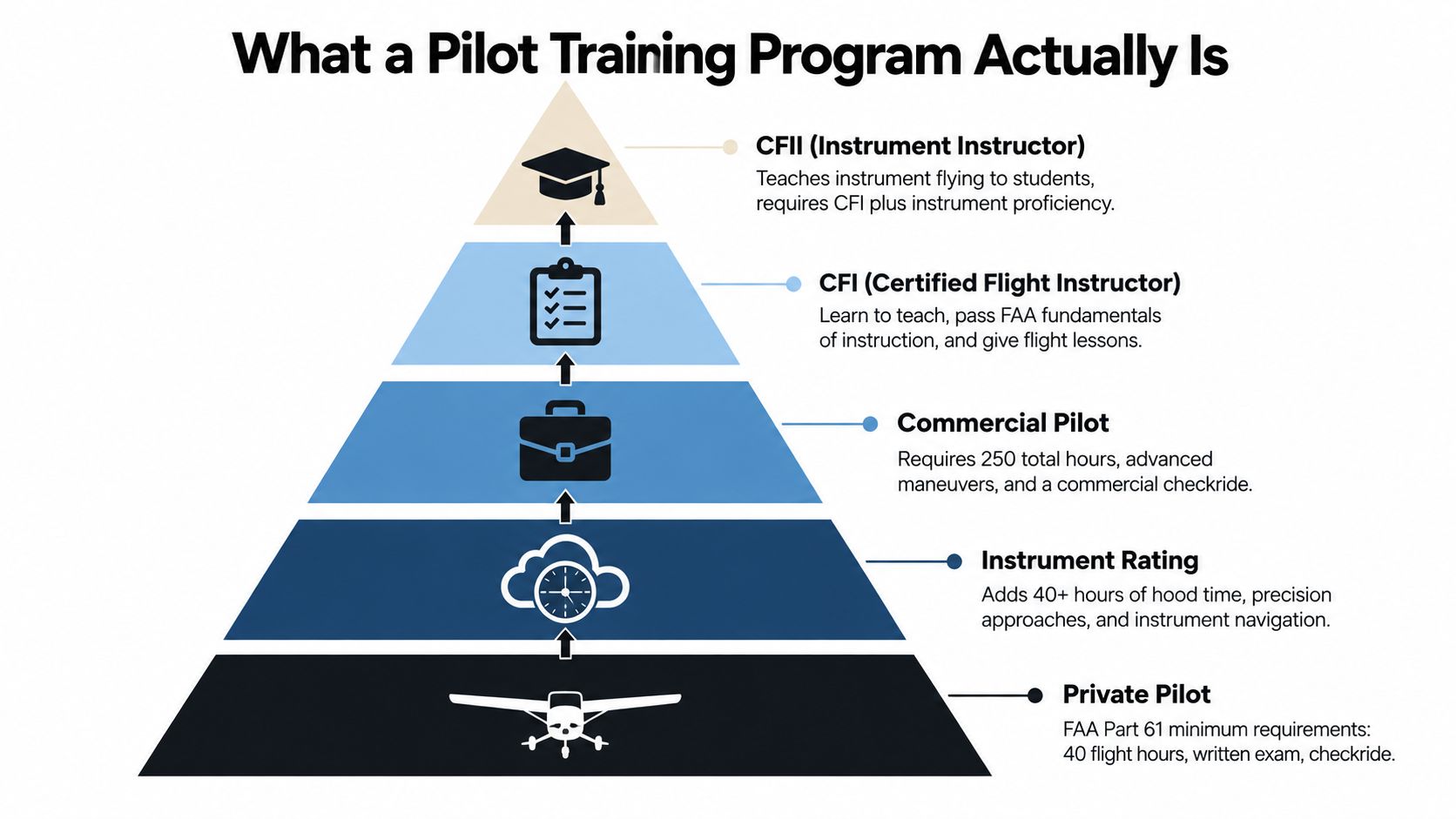
A pilot training program combines ground instruction, flight instruction, practice, assessments, and certification preparation. A career track connects those activities across several qualifications instead of treating each as an unrelated purchase.
Start with an important vocabulary correction: Private Pilot is a certificate, not a rating. Under the Part 61 framework, earning it involves the applicable training and experience, instructor endorsements, and knowledge and practical testing. Don't treat an advertised minimum as a promise that you'll be ready at precisely that point.
A driver's-license progression is a useful analogy: first learn to operate safely, then add specialized skills, professional privileges, and eventually teaching qualifications. Aviation follows a similar learning progression, although its certificates and ratings have their own legal requirements.
The visual ladder helps organize those building blocks; it shouldn't replace the school's regulatory checklist.
What each stage adds
- Private Pilot: Aircraft control, navigation, communication, and judgment form the foundation.
- Instrument Rating: You learn to manage flight by reference to instruments, including procedures and workload.
- Commercial Pilot: You develop professional-level precision and satisfy the relevant commercial experience requirements.
- Multi-engine qualification: You add aircraft-specific skills and learn to manage the demands of additional engines.
- CFI and CFII: You learn to teach flying, then instrument flying. Performing a maneuver and explaining it to a struggling student are different skills.
Structure and regulatory authority aren't the same thing
Part 61 centers on the applicable individual certification requirements and permits flexible training arrangements. Part 141 uses an approved school curriculum. A Part 61 course can still be highly structured, while an approved curriculum doesn't remove the need for individual proficiency.
Ask which authority governs each course, not just which label appears on the website. The flight academy overview offers another way to consider how training can be organized.
A well-designed program connects stages deliberately. Instrument habits should carry into commercial flying, and instructor preparation should build on the judgment developed throughout the course.
Accelerated vs Modular Program Models
Accelerated training concentrates your attention on flying and studying. Modular training lets you complete qualifications as your schedule and funds permit. The useful comparison is not fast versus slow, but concentrated commitment versus adjustable pacing.
Accelerated vs Modular Program Comparison
| Attribute | Accelerated Fixed-Price | Modular Pay-As-You-Go |
|---|---|---|
| Schedule | Concentrated training with planned progression | Lessons arranged around availability |
| Payment structure | Defined tuition scope under an agreement | Charges accumulate as training occurs |
| Study demands | Preparation must keep pace with the course | More control over study timing |
| Disruption exposure | Delays can affect a tightly planned sequence | Gaps may require refresher work |
| Best personal fit | Applicants able to prioritize training | Applicants balancing work or other obligations |
| Essential verification | Included hours, exclusions, and delay policy | Rates, lesson continuity, and completion estimates |
An accelerated course may suit someone who can relocate and protect study time. A modular course may suit someone whose employment pays for training, provided they can maintain continuity. The Part 61 flight school guide can help you examine the flexible-training framework without assuming that flexibility means an absent syllabus.
Simulator hours need their own accounting
Under 14 CFR § 61.65, instrument applicants generally need 40 hours of actual or simulated instrument time, including 15 hours with an authorized instrument instructor. Simulator or flight-training-device credit is capped at 20 hours outside a Part 142 program, or 30 hours under Part 142, subject to the applicable requirements.
For approved commercial courses, Part 141 Appendix D limits full-flight-simulator substitution to 30% of required flight-training hours and flight-training-device credit to 20%, with combined credit capped at 30%. It also requires 10 hours of specified instrument training, including at least five hours in a single-engine airplane.
Those limits don't mean additional simulator practice is wasted. Repeating approaches, holds, and abnormal procedures can be valuable even when a session doesn't satisfy a certification requirement.
A simulator session can improve your flying without adding legally creditable experience to the requirement you're trying to meet.
Ask for a device-specific credit matrix identifying the device approval, lesson objective, instructor involvement, and permitted credit. The applicable authorization or qualification documentation matters, as does whether required equipment is functioning.
Whether you train full-time or between work shifts, the school should distinguish aircraft flight time, simulator exposure, and credit applied to each qualification.
Step-by-Step Timeline and Milestones
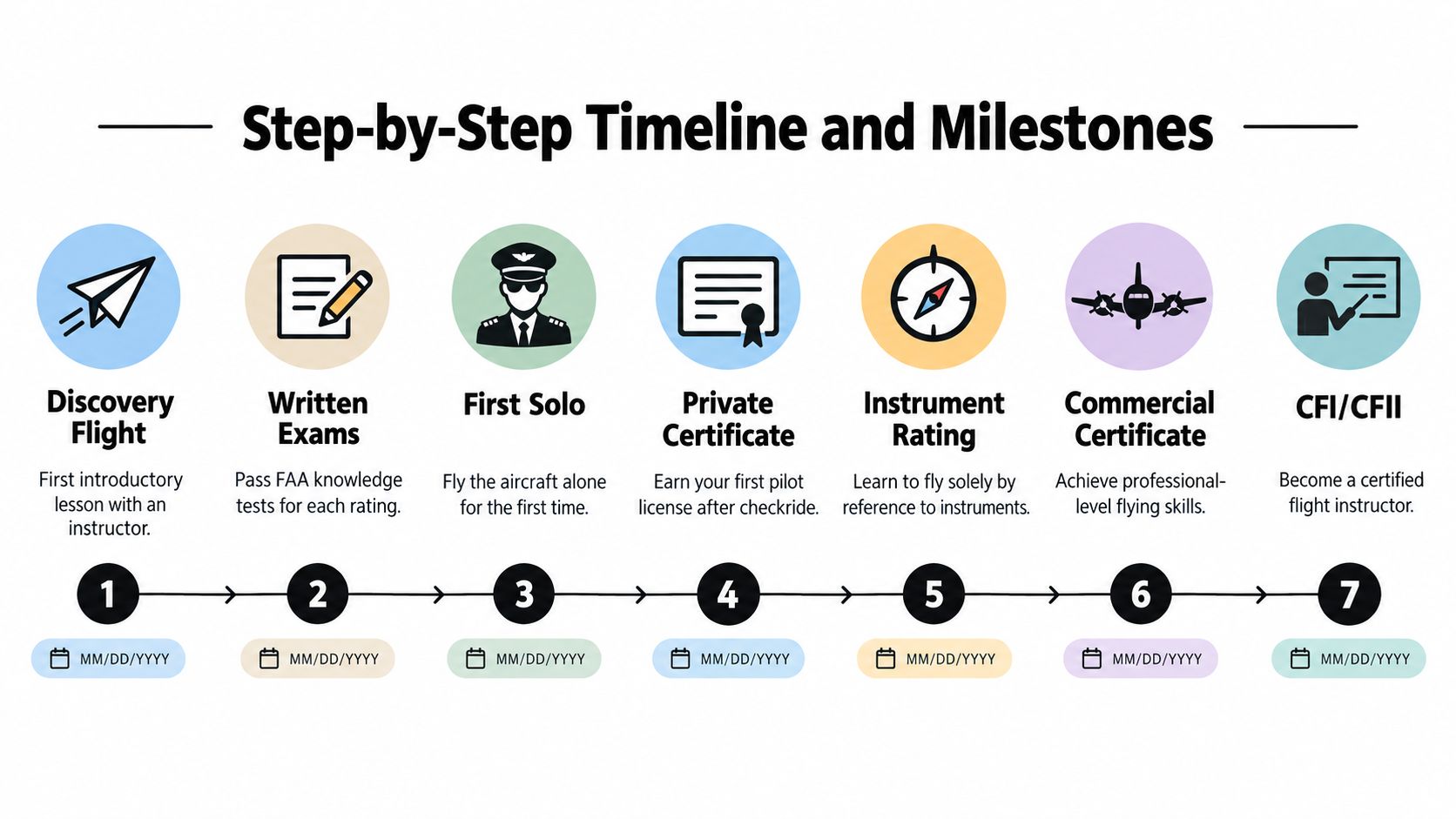
A training calendar should show a sequence of readiness decisions, not merely dates beside certificates. Instructors can plan lessons and assessments, but they shouldn't advance a student solely because the calendar says it's time.
Use the milestone diagram as an orientation aid. Your actual syllabus should identify the training, endorsements, experience, and tests required at each gate.
Early training builds independent judgment
Begin with an introductory flight. Notice how you respond to the cockpit environment, instructor feedback, and the preparation surrounding the flight. Enjoying the view is different from enjoying the work of learning.
Ground study and knowledge-test preparation accompany flight training. Ask when the school expects tests to be completed and how it checks understanding before recommending you for them.
First solo is a proficiency milestone, not a universal hour target. Under Part 61, it depends on the applicable training and instructor authorization. Your syllabus should explain the pre-solo assessment, endorsement process, and operating limitations, rather than promising solo on a particular day.
The private-certificate stage then brings the broader foundation together. Ask what the school uses to determine practical-test readiness and how it handles a student who needs additional work.
Advanced training must match the correct experience rule
Instrument training follows with a dedicated experience audit using the aircraft and device-credit distinctions discussed earlier. Require a clear record of instrument instruction, qualifying practice, and remaining requirements before the practical test.
For an airplane single-engine commercial certificate, 14 CFR § 61.129(a) generally requires 250 hours as a pilot, including 100 hours in powered aircraft, with 50 in airplanes. It also requires 100 hours of pilot-in-command time, including 50 in airplanes, and 50 hours of cross-country pilot-in-command time, including 10 in airplanes, alongside specified training and solo or supervised operations.
The same regulation provides a 190-hour alternative for an approved Part 142 commercial course, unless the FAA approves fewer hours. That exception doesn't automatically apply to an accelerated program.
Multi-engine training and instructor qualifications then add distinct skills and assessments. The pilot certification training guide provides a useful companion for understanding the qualification sequence.
Ask for a month-by-month schedule that marks training blocks, readiness checks, practical-test windows, and contingency time. Treat those months as planning targets. Completing CFII doesn't itself establish eligibility for ATP knowledge testing or airline employment.
Cost and Financing Expectations
Tuition is not the same as total financial exposure. Your budget must account for the cost of reaching the next paid flying opportunity, including the possibility that training takes longer than planned.
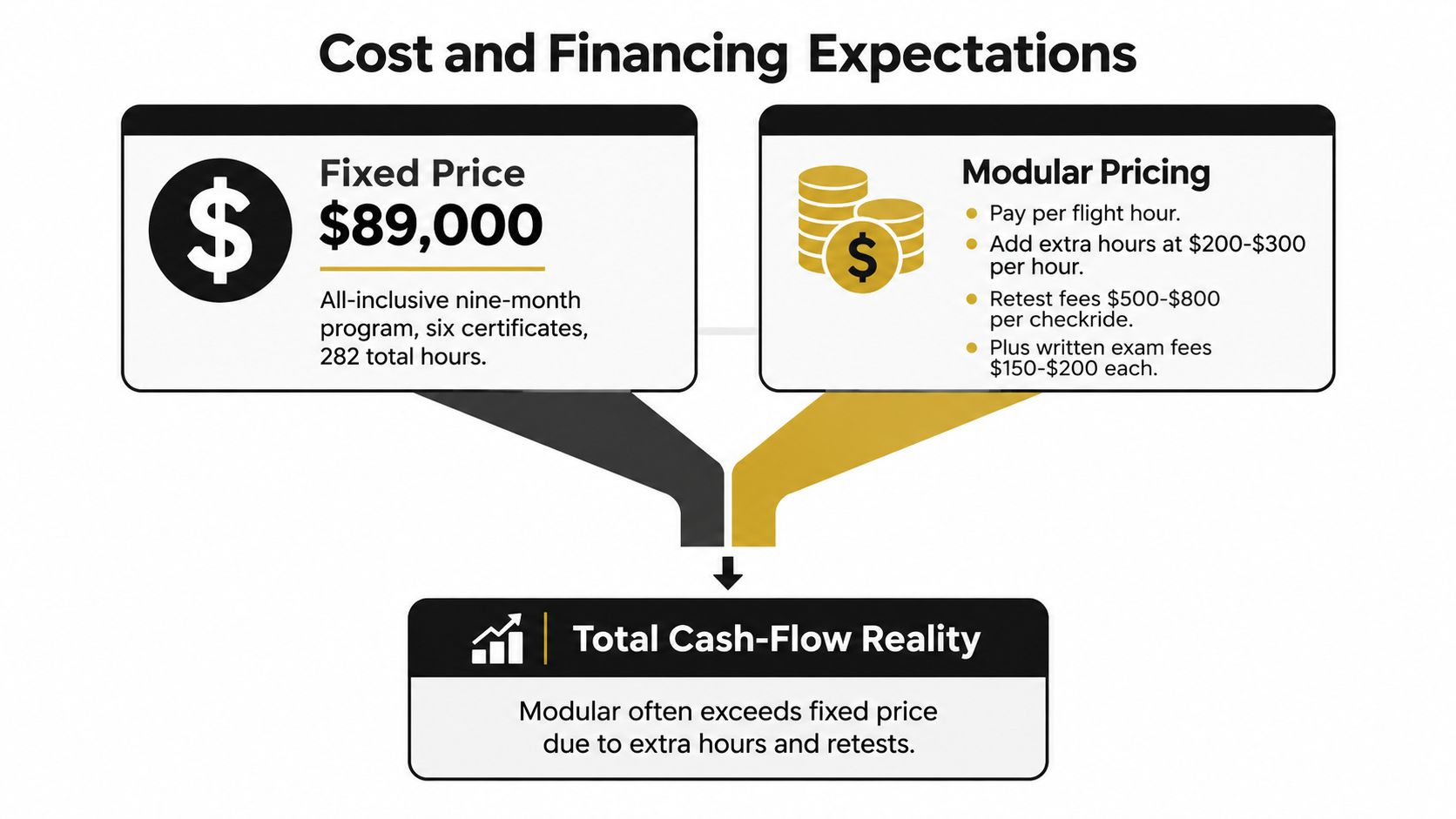
Published estimates place zero-to-airline training broadly at $80,000 to $150,000 or more, while federal student aid is generally unavailable at non-Title-IV flight schools, according to this flight-training cost overview. That broad estimate isn't a quote for your course, and different endpoints make headline comparisons unreliable.
This visual illustrates the pricing structures. Treat its fee examples and inclusion labels as illustrative, not as a current quotation or proof that tuition includes every expense.
Build scenarios rather than a single budget
Ask the school to help you calculate these alternatives using its actual written rates:
| Scenario | Training assumption | Financial questions |
|---|---|---|
| Planned completion | Progress follows the proposed syllabus | What tuition and living expenses must be funded? |
| Additional training | More aircraft or instructor time is needed | Is that time included, and what triggers extra billing? |
| Delayed practical tests | Training finishes before testing is available | What are the housing and proficiency-maintenance costs? |
For every scenario, record cash due during training, expected borrowing at completion, and the resulting payment obligation. Include medical certification, examiner charges, retests, travel, equipment, and housing where applicable.
The guide to flying-lesson costs can help you frame the itemized questions behind a tuition comparison.
Deferred payments still require a repayment plan
Private aviation financing may offer deferred payments, but deferral doesn't necessarily mean interest stops accruing. Ask the lender about eligibility, interest during training, fees, repayment timing, and what happens if graduation or employment is delayed.
Don't build the repayment plan around an instructor position you haven't secured. Request financing pre-qualification before committing, then compare the loan terms with a conservative income assumption.
Budget safeguard: Have the school identify exclusions in writing before you compare its fixed price with an hourly estimate.
A lower initial quote can become more expensive after extra training and prolonged living costs. Conversely, fixed tuition may provide predictability without covering every personal or third-party expense. The contract, not the label, determines your exposure.
What to Look for in a Flight School
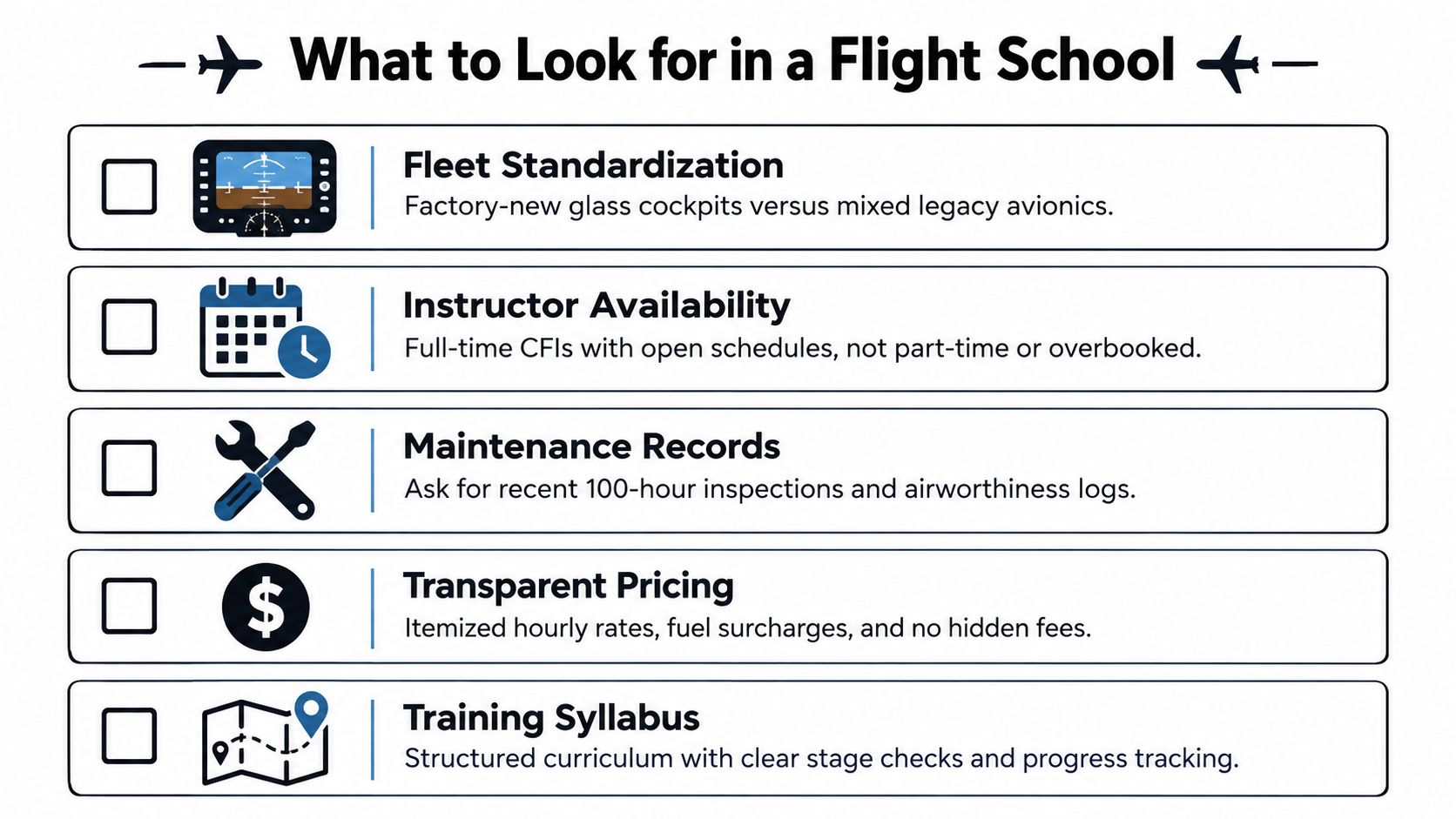
A school tour should produce evidence you can review afterward. Attractive aircraft and confident sales answers aren't substitutes for a syllabus, scheduling explanation, and clear agreement.
Use this checklist to organize the conversation, then ask for the documents behind each answer.
Inspect how lessons actually happen
- Fleet consistency: Ask whether students move between substantially different cockpit layouts. Factory-new glass cockpits and mixed legacy avionics involve different familiarization demands; neither description alone proves instructional quality.
- Instructor continuity: Find out who teaches you, whether instruction is individual or grouped, and who covers absences. Ask how instructors communicate progress when responsibility changes.
- Maintenance and availability: Request an explanation of inspection tracking, discrepancy reporting, and aircraft substitutions. Find out what happens to your schedule when an aircraft is unavailable.
Equipment configuration also matters. Under 14 CFR § 91.109(a), aircraft used for instruction generally need fully functioning dual controls. The narrow throwover-control-wheel exception concerns qualifying instrument instruction and isn't a general substitute for a beginner's dual-control aircraft.
Verify support at the bottlenecks
Ask who coordinates practical tests and how the school handles cancellations or retakes. A pilot-supply analysis discussing checkride availability cites a 2025 academic study reporting a five-week average wait, with 91% of responding schools identifying availability as an operational problem. That's a reason to request a contingency plan, not a prediction of your own wait.
Also examine the less visible support:
- Learning resources: Review lesson preparation, written-test support, stage checks, and progress records.
- Simulator documentation: Request the approval and credit matrix described earlier, not merely a device specification sheet.
- Living arrangements: Confirm housing availability, commute requirements, deposits, and cancellation terms.
- Career preparation: Ask whether logbook review, résumé assistance, or interview practice is available, and distinguish support from employment promises.
The FAA-approved flight school guide can help you prepare approval-related questions.
Before leaving, ask to see a sample student progress report. You should be able to understand what has been completed, what needs improvement, and what the instructor plans next.
A Sample Nine-Month CFII Career Track Pathway
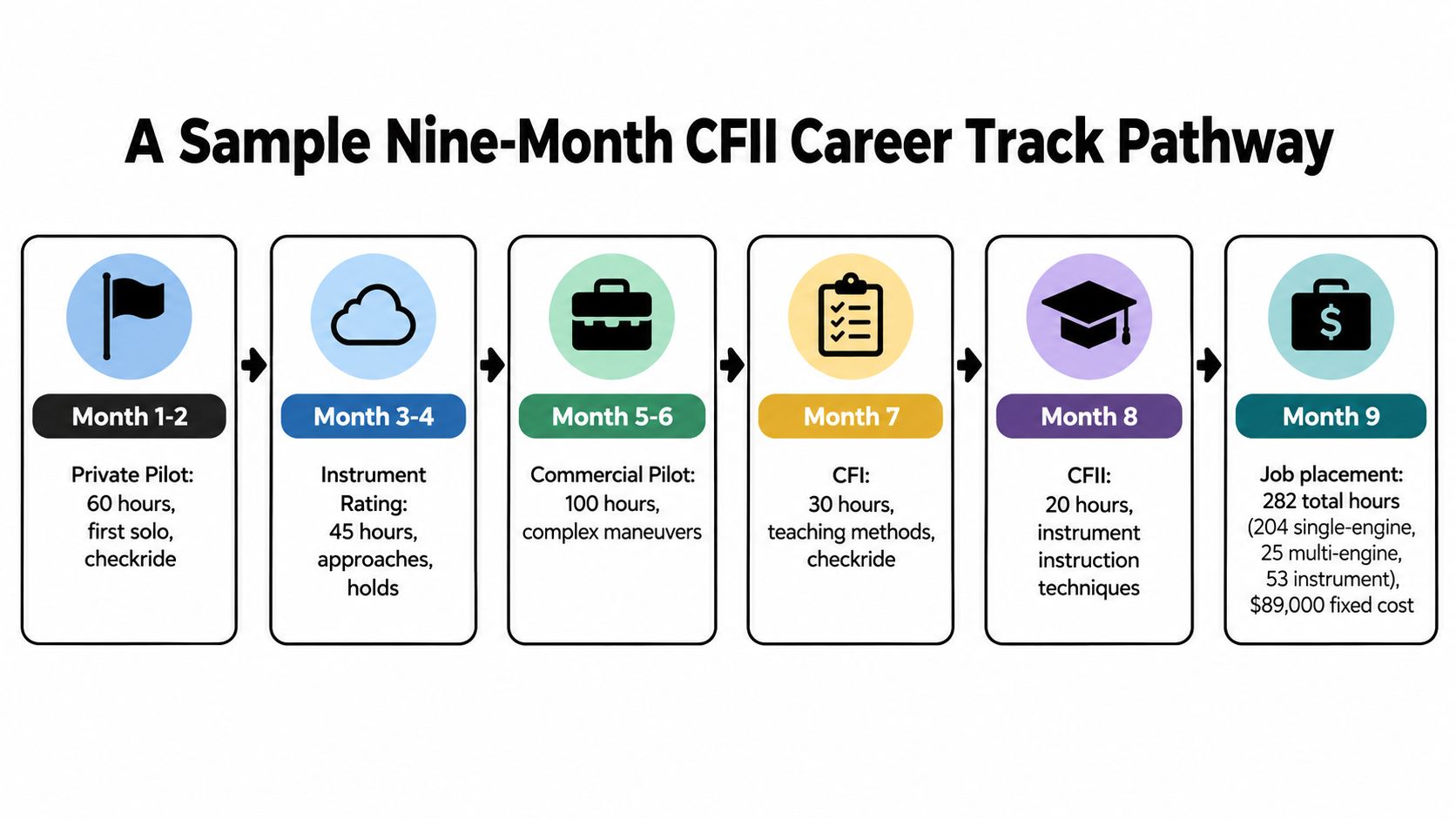
For a concrete accelerated example, CFII's Career Track offers fixed $89,000 tuition, about nine months from zero time to CFII and multi-engine, 282 total hours, and six certificates and ratings, based in Southern California at Riverside, Long Beach, and Corona, as described in the Career Track overview.
The pathway graphic provides a broad picture of progression. Its detailed stage allocations and job-placement label shouldn't be treated as confirmed contractual terms or a hiring promise; request the current syllabus and agreement.
Read the calendar as a working plan
Early training should emphasize aircraft handling, preparation, and independent decision-making. The middle phase should develop instrument procedures and commercial proficiency. Later training should shift toward teaching, explaining errors, and evaluating another person's performance.
On an ordinary training day, expect preparation before the flight, focused objectives during it, and a debrief afterward. The important question isn't whether you flew, but whether you met the lesson standard and know what to prepare next.
Ask where practical tests fit into that rhythm. Also request the current breakdown of aircraft and simulator experience, with an explanation of which hours satisfy each requirement.
This video accompanies the pathway overview.
Graduation begins another experience-building phase
The Airline Safety and Federal Aviation Administration Extension Act of 2010 directed the FAA to require airline first officers to hold an ATP certificate. The FAA's ATP rule summary explains that applicants generally need to be at least 23 years old and have 1,500 total flight hours, alongside a commercial certificate with an instrument rating and ATP knowledge and practical tests; restricted-privilege pathways apply to certain applicants.
Initial career training therefore solves a qualification problem, not the entire airline-experience problem. Before enrolling, ask how you'll pursue paid flying, maintain instrument proficiency, document relevant experience, and support yourself while building hours.
Next Steps for Applicants
Start by confirming that you enjoy the learning process, not just the idea of the career. If you haven't flown, schedule a discovery flight and ask what preparation and documentation you need beforehand.
Complete the checks before committing funds
- Medical suitability: Arrange an appropriate FAA medical evaluation early. Discuss first- or second-class certification and your career goals with an aviation medical examiner before making substantial commitments.
- Financial readiness: Seek financing pre-qualification and build a living-expense reserve. Review repayment obligations without assuming immediate instructing income.
- Program verification: Request the current course overview, syllabus, hour-credit breakdown, tuition exclusions, and policies for additional training or delays.
Security eligibility is a separate prerequisite. Under 49 CFR Part 1552, a provider may not provide flight training or equipment access until it establishes that the individual is a U.S. citizen, U.S. national, Department of Defense endorsee, or a candidate with a valid TSA-accepted security-threat assessment determination.
If you're not a U.S. citizen or national, ask which documentation and assessment process applies before scheduling training access. Don't assume admission to a school completes that requirement.
Your immediate goal is a documented decision: career fit, medical suitability, financing capacity, and a syllabus you understand. Those checks let you commit with realistic expectations rather than relying on the headline timeline.
CFII offers a Southern California Career Track from zero experience through CFII and multi-engine qualifications. Visit CFII to request the current program details and discuss how its syllabus, tuition scope, and training schedule fit your career plan.
Planning to fly for a living?
See what the path from zero to a pilot career looks like, what it costs and how long it takes.
Learn to fly in Riverside
We train at Riverside Municipal Airport in factory-new airplanes with a parachute built in. Start with a one hour discovery flight, no experience needed.