

On this page
- What a Flight Academy Actually Is
- Certificates and Ratings You Will Earn
- The first three steps are about control and range
- Instructor ratings are separate qualifications
- Program Structure and a Realistic Timeline
- What a sane weekly cadence looks like
- What It Costs and What Financing Looks Like
- Fixed tuition is only useful if the exclusions are clear
- How to Evaluate Any Flight Academy You Are Considering
- Start with the aircraft and the syllabus
- Examiner access and student support tell you how the operation really works
- From Academy Graduate to Airline-Ready Pilot
- Common Pitfalls Before You Pay Any Deposit
- The usual traps are all operational, not theoretical
- Financing and relocation need a separate budget
- Your Next Steps and Common Questions
You're probably at the same point most future pilots hit first. You've got a browser full of glossy promises, every school says it can get you from zero to airline-ready, and none of it tells you what happens when the weather slips, the checkride gets pushed, or the timeline starts costing more than the brochure suggested. A good flight academy doesn't just sell you hours, it gives you a structured route from first lesson to the certificates, ratings, and logbook entries that matter.
What a Flight Academy Actually Is
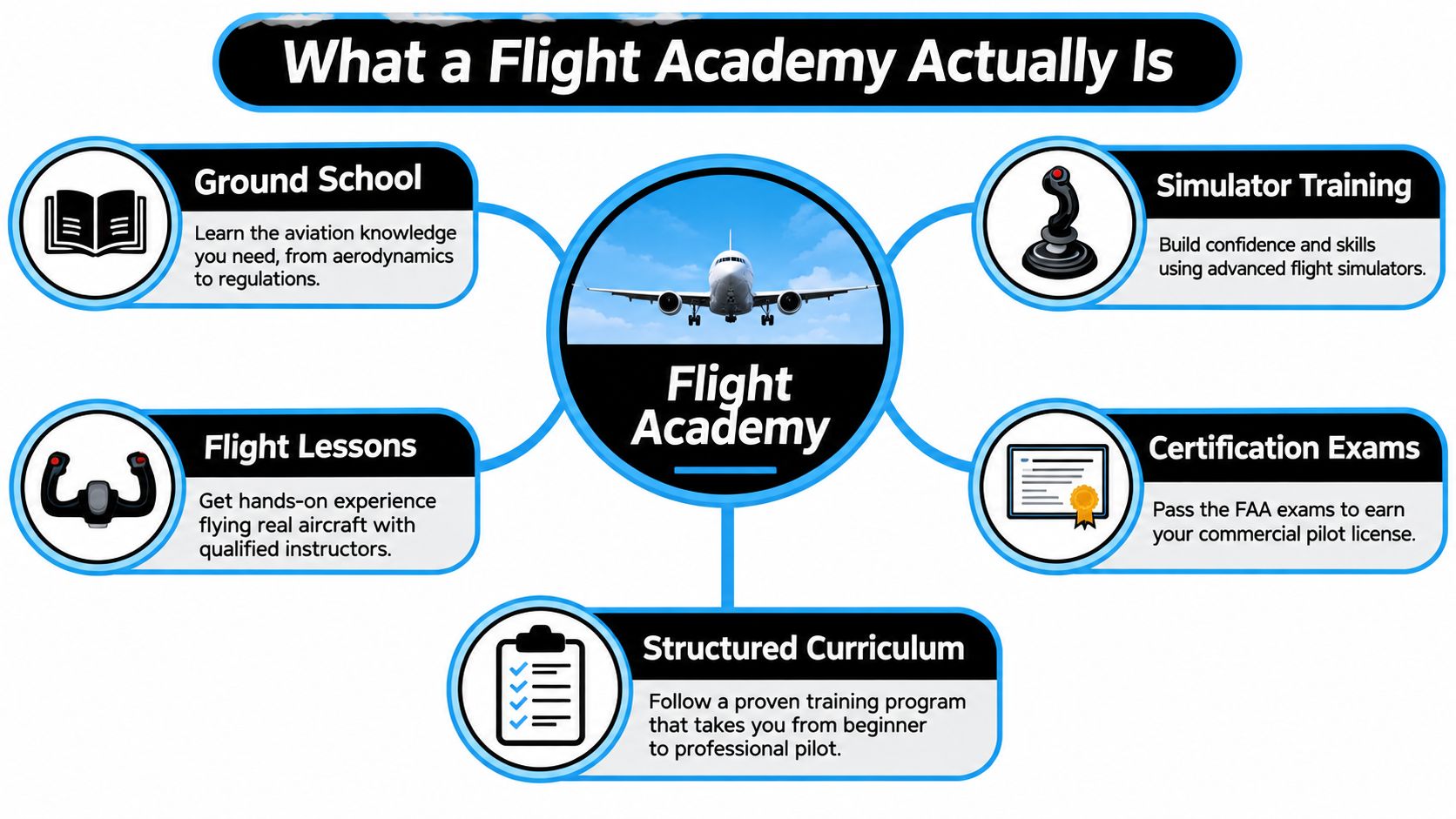
A real flight academy is a bundled training system. It combines ground school, simulator work, flight lessons, certification prep, and checkride coordination into one sequenced program, so you're not building your own path from scratch. That's the key difference from a loose hour-selling operation, where the student is effectively responsible for stitching the syllabus together and deciding when to move forward.
The distinction matters because the business model shapes your experience. In a true academy, training is organized around a curriculum, a progression standard, and an internal pace. In a more traditional flight school, you may still get excellent instruction, but the program often behaves more like a menu, you buy time, schedule lessons, and figure out the order with your instructor.
Practical rule: If the provider can't show you a written syllabus, stage checks, and the sequence of certificates you'll earn, you're probably looking at a school that rents time, not an academy that manages a path.
That's why marketing language can be slippery. A website can say “accelerated,” “career track,” or “professional program” without proving that the training is integrated. Ask for the syllabus document, the progression checkpoints, and a sample weekly schedule. If all you get is a vague promise about “lots of flying,” that's not a system, it's a sales pitch.
For a basic overview of the difference, the cleaner explanation is on CFII's pilot school article. It's worth reading before you start comparing price tags, because the label on the homepage means less than the way the operation is run.
Certificates and Ratings You Will Earn
A career-track academy should move you through a sequence, not a pile of disconnected milestones. At minimum, you want a path from private pilot to instrument, then commercial, then instructor credentials. CFII's published career track includes Private Pilot, Instrument Rating, Commercial Pilot in single- and multi-engine land, Certified Flight Instructor, and Certified Flight Instructor Instrument, which is the right order for someone who wants to build a flying career rather than stop at recreation.
The first three steps are about control and range
The Private Pilot Certificate gets you started. It proves you can fly safely as the pilot in command under basic operating rules, and it gives you the foundation for everything that comes next. The Instrument Rating is where the training becomes serious, because you're learning to rely on instruments and procedures when outside visual references disappear.
The Commercial Pilot Certificate is the point where the FAA's experience framework matters most. Under 14 CFR 61.129, the standard Part 61 route requires 250 hours of aeronautical experience, with specific amounts of pilot-in-command, cross-country, night, instrument, and practical-test preparation time. For an airplane multiengine commercial rating, the FAA material identifies at least 250 hours of pilot flight time and a specific 10 hours in a multiengine airplane flown solo or as pilot in command with an authorized instructor while performing the applicable commercial-airplane areas of operation (FAA commercial-pilot experience rules).
Instructor ratings are separate qualifications
A lot of students think the instructor step is automatic once commercial is done. It isn't. Under 14 CFR 61.183, a flight instructor applicant has to meet age, English-language, certificate, knowledge-test, endorsement, and practical-test requirements before teaching anyone (FAA instructor eligibility rules). That's before you even get to the CFII, which adds instrument-instruction authority and another layer of testing.
A commercial certificate says you're eligible for advanced flying. A CFI or CFII says you're eligible to teach it, and that's a different standard.
If you're evaluating a career program, ask whether it prepares you for each certificate as a separate finish line. A good academy doesn't blur those boundaries. It teaches for the commercial ride, then for the instructor ride, then for the instrument-instructor add-on. For a beginner-friendly breakdown of how those steps fit together, the pilot certification training guide is the right companion piece.
Program Structure and a Realistic Timeline
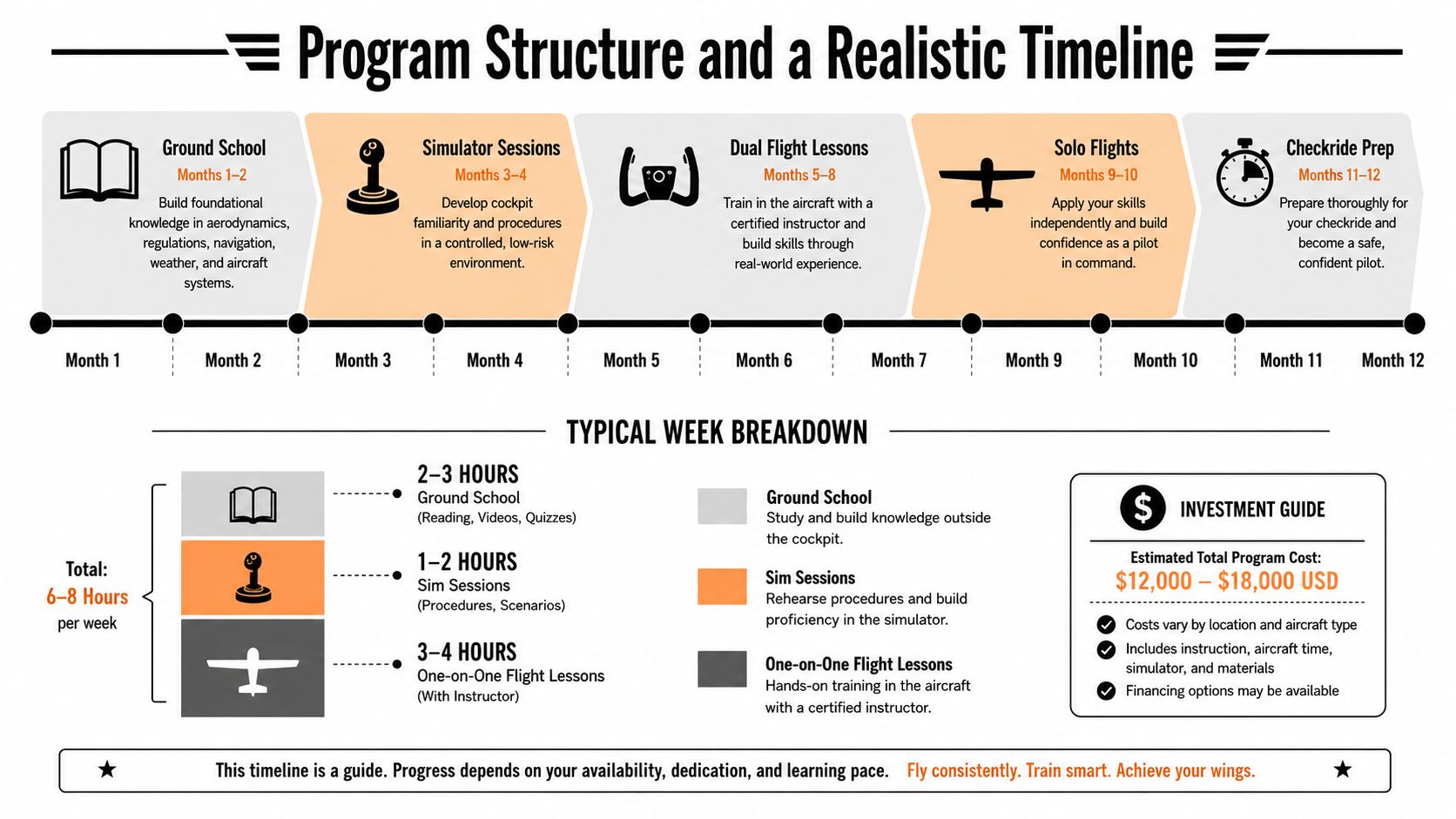
A strong academy runs on rhythm. Ground lessons set up the next flying block, simulator sessions reinforce procedures, and one-on-one flight instruction turns theory into habit. That pacing matters because weather, maintenance, examiner availability, and student readiness all collide in daily operations.
CFII's Career Track is a straightforward example of an organized program. It's built as an about nine-month route from zero time to CFII and multi-engine, with 282 total hours by month nine, broken into 204 single-engine, 25 multi-engine, and 53 simulator hours. It's based across Riverside, Long Beach, and Corona in Southern California, which gives the operation multiple bases rather than a single bottlenecked location.
The structure is meant to be individualized, but not chaotic. “One-on-one” means your instructor is scheduling around your readiness, not around a giant lecture cohort. That's useful because different students need different amounts of repetition before a stage check, even if they're all moving through the same overall syllabus.
The program model also helps with checkrides, which is where a lot of students get stuck. Stage checks are internal progress gates. FAA checkrides are the external test with the examiner. Those are not the same thing, and schools that treat them like they are usually have students who are surprised when a ride gets delayed.
What a sane weekly cadence looks like
- Ground school blocks: Used to cover procedures, limitations, regulations, and written-test prep before the cockpit session.
- Simulator sessions: Used to rehearse instrument scans, emergencies, and abnormal procedures without burning aircraft time.
- Flight lessons: Used for the handling work, the visual cues, and the workload that simulators can't fully reproduce.
- Stage checks: Used to confirm you're ready to move forward before the formal FAA ride.
The important part is that the timeline is a target, not a promise. A school can have a disciplined schedule and still get pushed by weather, aircraft rotation, or examiner capacity. That's why the question isn't only “How fast can I finish?” It's “How does the program absorb delay without derailing the whole path?” For a deeper look at pace and structure, the accelerated flight training article is useful.
What It Costs and What Financing Looks Like
The first number that matters is the published tuition, not the marketing headline. CFII's Career Track lists a fixed $89,000 tuition, and that should be the anchor for your budget. If a school won't state its total clearly, it's hiding the part that bites later.
Fixed tuition is only useful if the exclusions are clear
A sane enrollment agreement should tell you what's included and what isn't. For CFII, the published package includes one-on-one flight and ground instruction, the training portal, stage checks, written exam prep, and checkride scheduling. It excludes items such as medical exams, TSA fees, and personal housing deposits. That split matters because students often budget for tuition and then get surprised by everything around it.
The housing piece deserves its own line item. CFII lists student housing near the Riverside base at $1,300 per month in furnished shared apartments. If you're relocating, that's not a side note, it's a core part of the cash plan.
| Category | Usually included | Usually separate |
|---|---|---|
| Core flight and ground instruction | Yes | No |
| Training portal and study resources | Yes | No |
| Stage checks and written-test prep | Yes | No |
| Checkride scheduling coordination | Yes | No |
| Medical exam | No | Yes |
| TSA fees | No | Yes |
| Housing deposit | No | Yes |
There's also an optional path for students who want to keep building after the academy phase. The “Work with us” add-on is listed at $15,000 and combines a 25-hour instructor bootcamp with 175 guaranteed paid instructing hours at $30 per hour, pushing total flight time to at least 480 hours by month 18. That changes the economics because it turns time-building into an earned path instead of an open-ended scramble.
Financing needs to be read with the same discipline. CFII says it works through Stratus Financial, offers 12-month payment deferral, and says the lender may consider applicants beyond typical FICO metrics. That doesn't make the math disappear, it just changes when the payments start. Read the deferral terms carefully and total the full eighteen-month picture, not just the first month's outlay. For a fuller breakdown of cost categories, the flight training cost article is the right place to sanity-check your assumptions.
How to Evaluate Any Flight Academy You Are Considering
Don't ask whether an academy sounds good. Ask whether it can prove the parts that affect your progress. A polished sales page means nothing if the fleet is inconsistent, the instructors keep turning over, or the examiner pipeline is clogged.
Start with the aircraft and the syllabus
Ask what aircraft you'll train in, how standardized the fleet is, and whether the avionics setup is consistent from airplane to airplane. A good answer sounds specific, because consistency reduces retraining. A weak answer sounds like, “We have plenty of flying available.” Plenty of flying is not the same thing as repeatable training.
Then ask for the syllabus and stage-check standards. You want to see a real progression, not a loose promise that your instructor will “figure it out.” If the school can show you lesson flow, maneuver standards, and written-test prep inside a portal or course system, that's a sign they know how to manage outcomes instead of improvising them.
Examiner access and student support tell you how the operation really works
Checkride coordination is where many schools reveal their weak spots. Ask how examiner scheduling is handled, how long students usually wait, and who owns the rescheduling problem if weather or examiner availability interrupts a ride. If the answer is vague, expect delays.
Support services matter too. Housing, logbook reviews, resume prep, and interview prep all affect whether you can stay on track after a setback. CFII's model, with one-on-one instruction, coordinated examiner scheduling, and a standardized fleet, is the kind of operational answer that shows discipline. If an academy can't explain its support structure in plain English, it probably doesn't have one.
Ask for documents before you sign: the enrollment agreement, the stage-check standards, a sample weekly schedule, the refund and retest terms, and the housing policy if relocation is involved.
For a broader checklist of training formats and delivery styles, the flight training courses guide is worth comparing against any pitch you hear on a tour.
From Academy Graduate to Airline-Ready Pilot
Graduating from an academy is not the same thing as being airline-ready. It means you've finished the training phase. The next stage is time building, and that's where the gap sits between a certificate and a career.
The FAA's standard ATP pathway sits at 1,500 hours total time under 14 CFR 61.159, with specific experience categories layered on top of that total (FAA final rule material). That's the number that matters when you start thinking about unrestricted airline eligibility. If you finish a zero-time-to-CFII program, you're not done. You're qualified to start accumulating the experience that the job market will inspect.
Boeing's 2025 Pilot and Technician Outlook projects that commercial aviation worldwide will need about 660,000 new pilots between 2025 and 2044 and nearly 2.4 million new aviation professionals overall in that period, with North America among the regions driving more than half of global personnel demand (Boeing outlook). That's a long-term demand signal, not a guarantee of immediate hiring for every graduate.
The hiring market can cool while the need for trained pilots still exists. In the first half of 2025, major U.S. airlines hired 2,190 pilots, which is far below the more than 12,000 hires recorded in both 2022 and 2023 (AOPA market update). That's exactly why the logbook matters. Instructor hours, multiengine exposure, instrument sharpness, and the quality of your records are what employers look at when the market isn't hiring in a panic.
Common Pitfalls Before You Pay Any Deposit
The expensive mistakes are predictable. Students don't usually fail because they can't fly. They fail because they sign too early, assume too much, and don't ask what happens when the calendar slips.
The usual traps are all operational, not theoretical
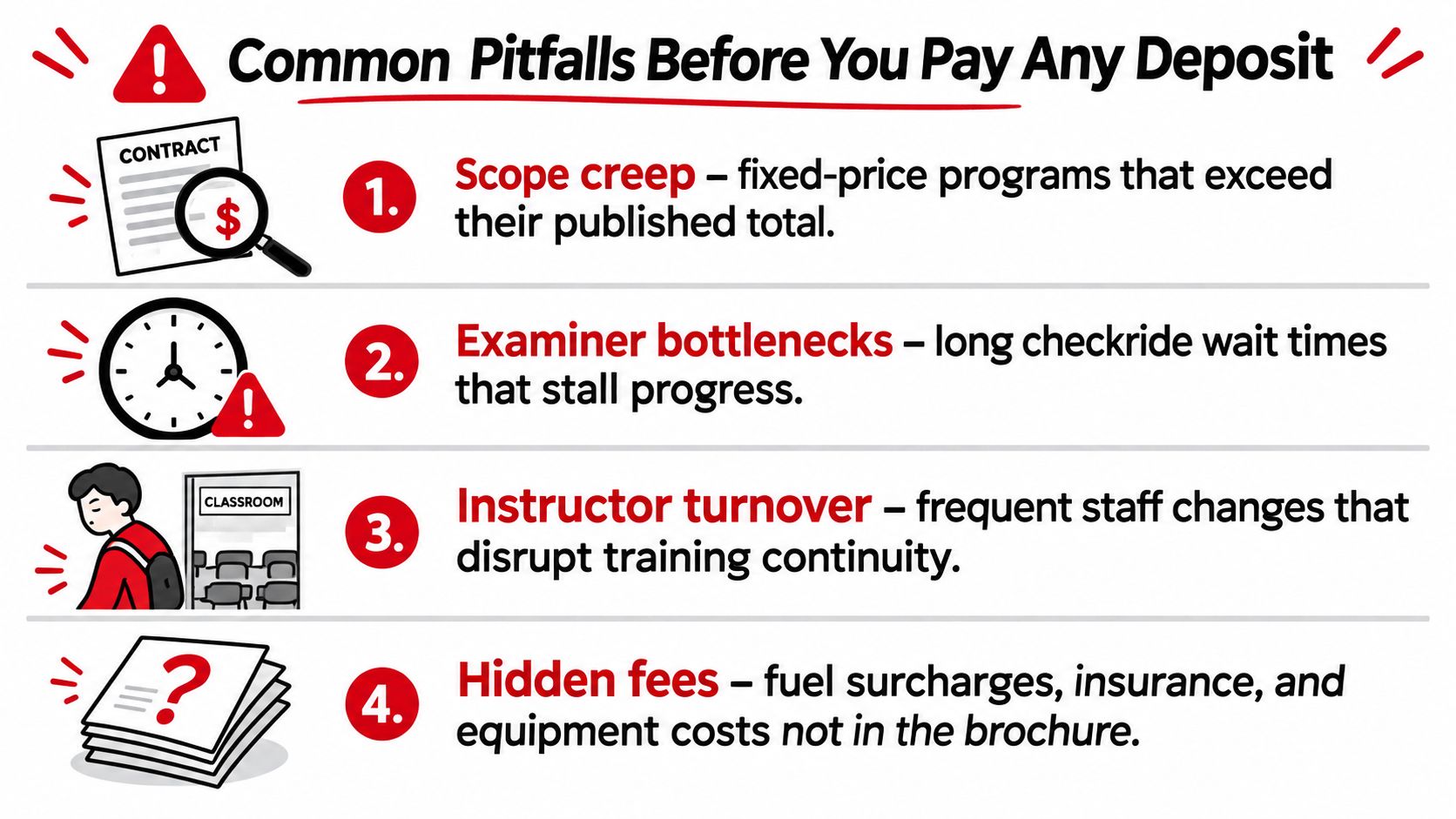
Scope creep is the first one. A fixed-price program loses value if the school adds fees for retests, aircraft swaps, or required materials that should have been disclosed up front. If the contract isn't explicit, assume you'll pay more than the brochure suggested.
Examiner bottlenecks are next. Many schools can train you to readiness faster than they can get you a ride. If a program doesn't explain who schedules checkrides and what happens when a ride gets delayed, your “accelerated” timeline can stretch in a hurry.
Financing and relocation need a separate budget
Deferral is not free money. If your payments start later, that just means you need to understand the future cash flow before you borrow. Ask whether interest accrues during the deferral period, what the monthly obligation becomes after the deferral ends, and whether the loan has prepayment restrictions.
Relocation is another overlooked cost. Moving to a training base is not just about airfare and a suitcase. It means deposits, food, transportation, and the friction of living somewhere new while trying to stay current. A known housing rate is much easier to plan around than a market-rate lease that can move while you're in the middle of training.
If a school says a certain number of hours is “guaranteed,” ask whether that guarantee depends on instructor availability, aircraft availability, or insurance terms. If the answer isn't written down, it isn't a guarantee.
Before you pay anything, ask for the cancellation policy, retest terms, housing terms, and the exact list of exclusions. If the agreement is thin, walk away. The cheapest school on paper is usually the most expensive one once delays, duplicate lessons, and surprise costs start stacking up.
Your Next Steps and Common Questions
If you have never flown, start with a discovery flight. Do not pay for a full training path until you have sat in the cockpit and confirmed the pace, workload, and environment fit you. If you already know you want the full zero-to-CFII route, review the program details and compare the syllabus, schedule, and exclusions with your own budget.
The questions at this stage are usually straightforward. How long does the regional-airline path really take? Long enough that you should treat training, time building, and hiring as separate stages, not one clean finish line. Do you still need a college degree? For some hiring paths, yes, and you should check the current requirements of the employers you care about before you assume otherwise.
What happens if you bust a checkride mid-program? Get the retest policy, the rescheduling process, and the cost of additional training in writing before you commit. Are U.S. citizens and international students treated differently? Admissions, financing, and documentation can differ, so you need that answered in writing before you pay a deposit.
Choose the academy that gets you to the certificates, hours, and habits that still matter when the market tightens. Boeing's long-range pilot demand forecast is real, but the school you choose decides whether you are building a career or just collecting ratings.
CFII offers a fixed-price, zero-to-CFII career track built around one-on-one instruction, structured scheduling, and a clear hour-building path. If you want a program that connects training to the actual airline timeline instead of pretending those are the same thing, visit CFII and review the Career Track in detail.
Planning to fly for a living?
See what the path from zero to a pilot career looks like, what it costs and how long it takes.
Learn to fly in Riverside
We train at Riverside Municipal Airport in factory-new airplanes with a parachute built in. Start with a one hour discovery flight, no experience needed.