On this page
- What Most Aspiring Pilots Will Pay
- Inside the Hourly Rate
- What Moves the Number Up or Down
- Three Sample Budgets From Private to Career
- PPL only
- PPL to commercial
- Accelerated career track
- Matching the $89,000 Career Track to Line-Item Reality
- Financing, Housing, and Building Hours Afterward
- Five Costs Most Students Underestimate
- What to Do Before You Send Any Money
Flying lessons usually cost $170 to $270 an hour, and a realistic private-pilot budget lands around $6,000 to $20,000 or more. The FAA's legal floor is 40 flight hours for a private pilot certificate under Part 61, but most students finish closer to 50 to 60 hours, so the bill is usually driven by completion time, not the minimum. (FAA private pilot hour requirements, AOPA private-pilot cost guidance)
That's the part most hopeful pilots miss. Flying lessons aren't priced like a tidy package, they're priced like a risk transfer problem. If you need extra hours, hit weather delays, or repeat a test, you pay for the overrun unless your program is built to absorb it.
What Most Aspiring Pilots Will Pay
If you want the blunt answer to how much are flying lessons, start here: a private certificate is rarely a simple 40-hour purchase. The FAA sets 40 flight hours as the legal minimum in the traditional Part 61 path, including 20 hours with an instructor and 10 hours of solo flight. That minimum is the floor, not the finish line. (FAA private pilot hour requirements)
Most students go past the floor. AOPA's estimate of about 50 to 60 hours is the smarter planning number, and that is why the budget climbs fast. If training is billed by the hour, a student who finishes at 55 hours buys more airplane time, more instructor time, and more calendar time than someone who lands at 40.
The question is not whether you can pay for one lesson. It is what the final bill looks like if you need extra hours, a retest, and a few weeks lost to weather or scheduling. If you are comparing schools, judge the expected finish price, not the advertised entry price.
Practical rule: judge a school on the price to finish, not the price to start.
A cheap hourly rate can still cost more if the school drags training out or leaves aircraft sitting idle half the month. A higher rate can be the better deal if it gets you through the syllabus with fewer repeat lessons and fewer gaps between flights.
Inside the Hourly Rate
A flight lesson bill is never one number. The airplane is only the first line item, and the rest can add up fast. Hampton University's 2025 to 2026 pricing sheet lists a Cessna 172 at $180 per aircraft hour, single-engine instruction at $65 per hour, simulator use at $85 per hour, and ground instruction at $65 per hour. That puts one hour of dual flight at about $245 before anything else gets added. (Hampton University flight-training pricing)
The math gets serious quickly. 40 dual hours alone would run about $9,800, and that still leaves out solo aircraft rental, exams, the checkride, books, and medical costs. The same sheet lists a Piper Arrow at $205 per hour and a Piper Seminole at $345 per hour, which is why advanced training climbs much faster than beginners expect.
Read any quote the same way. If a school says “$X per hour,” ask what that hour includes. If it leaves out instructor time, fuel, simulator use, ground instruction, written tests, medicals, headset, or checkride fees, the headline price is incomplete.
| Typical 2026 Line-Item Rates in U.S. Flight Training | Typical Range (USD/hr) | Part of the Bill |
|---|---|---|
| Wet trainer aircraft rental | $120 to $200 | Airplane time |
| Flight instructor | $50 to $70 | Dual instruction |
| Ground instruction | $40 to $80+ | Classroom and prep |
| Simulator time | $60 to $100 | Training substitute or supplement |
| Higher-performance twin or complex aircraft | $300 to $400+ | Advanced aircraft time |
| Combined trainer plus school instructor | $170 to $270 | Common hourly training rate |
That is why a low airplane rate does not automatically save money. A school with a weaker schedule or long gaps between lessons can cost more by stretching training out and forcing you to repeat work.
What Moves the Number Up or Down
Three things usually move the total more than the posted hourly rate does, location, aircraft type, and the student's pace. Instructor availability decides whether those first three help you or hurt you. If you pay for a lesson every few weeks instead of flying regularly, your total climbs because you spend paid time re-learning what you lost.
Training location matters because weather and airspace shape the calendar. A student training in Southern California can usually stay more consistent than someone stuck with winter shutdowns and long weather delays. Fewer interruptions mean fewer repeat lessons and less wasted momentum.
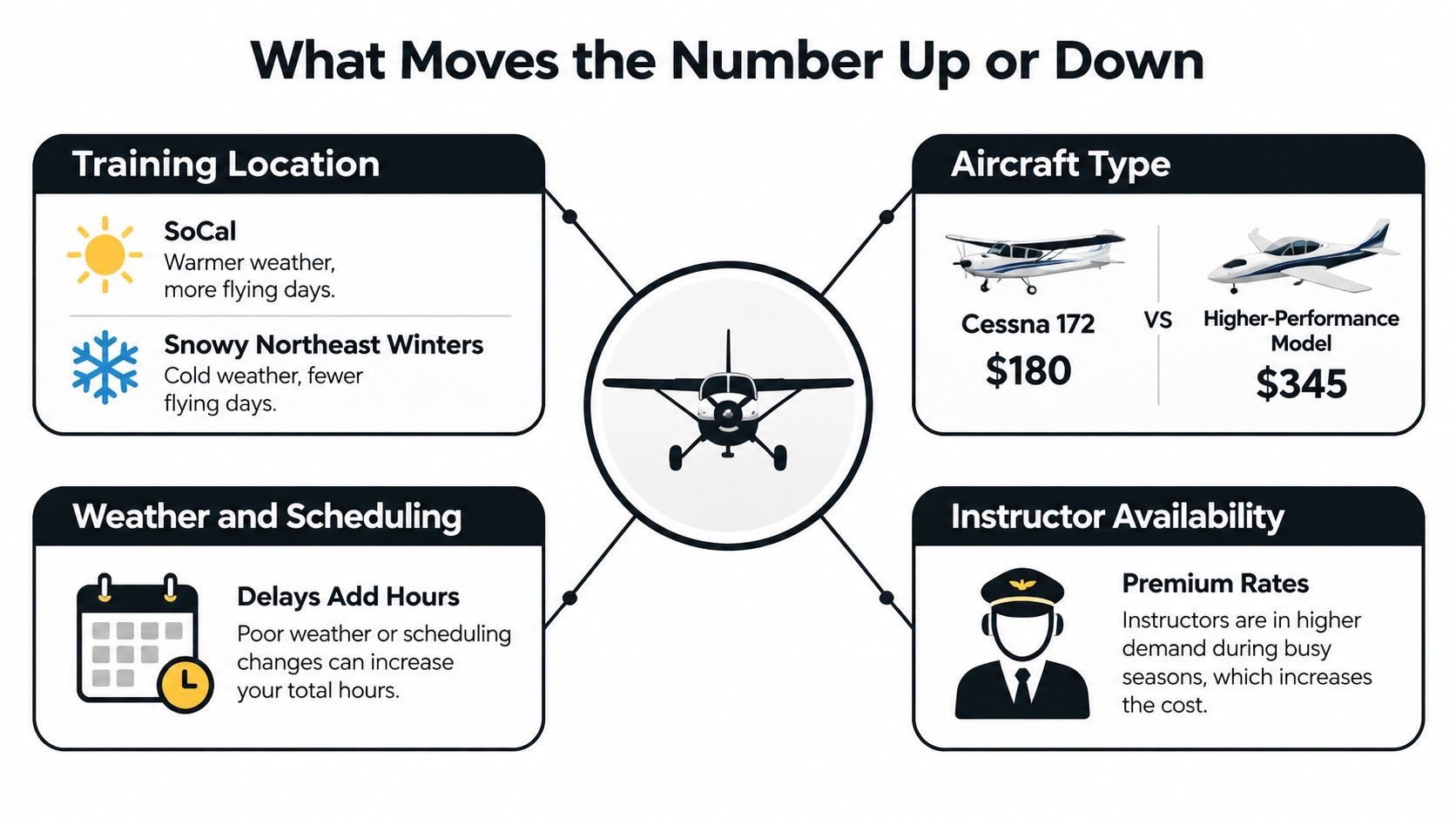
Aircraft type is the easiest lever to understand. The gap between a basic trainer and a twin is roughly double the cost of every repeated lesson in a multi-engine syllabus. For a private certificate, do not pay advanced-aircraft pricing unless the syllabus requires it. As noted earlier in the university pricing sheet, higher-performance aircraft push the bill up fast.
Rule of thumb: the most expensive school is the one that keeps you training slowly.
Instructor availability matters more than people admit. A busy instructor can be fine if lessons keep moving, but long gaps turn the calendar into part of the bill. The student who finishes steadily almost always pays less than the student who keeps restarting.
Three Sample Budgets From Private to Career
A private certificate alone usually lands in the $6,000 to $20,000 or more band, with a practical budget near $10,000 to $15,000. That spread is the risk you are paying to manage: hourly billing exposes you to extra lessons, while a fixed-price structure shifts some of that overruns risk to the school.
PPL only
This path fits recreational flying or an early test of whether aviation is the right commitment. The bill is usually driven by aircraft rental, instruction, and the extra time that shows up when skill building takes longer than expected.
PPL to commercial
A commercial path changes the math fast. Under 14 CFR §61.129(a), a commercial airplane single-engine applicant generally needs at least 250 hours of flight time, with specific cross-country, night, and instrument experience. That adds a much larger hour-building burden, so the budget rises well beyond a private certificate. A clear overview of the training path is laid out in how to become a pilot.
Accelerated career track
A fixed-tuition career program is for students who want to cap billing surprises. A Career Track can cost $89,000 fixed tuition, take about nine months, and deliver 282 total hours plus six certificates and ratings in Southern California. That is a package, not a loose pile of lessons, and it is built to keep overruns from landing on the student.
| Sample Budgets by Training Pathway | Certificates Earned | Realistic Total Cost | Typical Length |
|---|---|---|---|
| Private pilot only | Private pilot certificate | $6,000 to $20,000 or more | Variable |
| Private to commercial | Private, instrument, commercial | Often $40,000 to $70,000 across several years | Multi-year |
| Accelerated career track | Six certificates and ratings through CFII and multi-engine | $89,000 fixed tuition | About nine months |
The practical lesson is simple. If you compare paths, you are comparing different levels of risk allocation, not just different hourly rates. The private certificate is the lowest entry point, the commercial path is a longer bill with more required time, and the fixed-tuition track trades flexibility for cost control.
Matching the $89,000 Career Track to Line-Item Reality
A fixed tuition only makes sense if you know what it buys. The $89,000 Career Track includes 282 total hours by month nine, made up of 204 single-engine hours, 25 multi-engine hours, and 53 simulator hours, along with six certificates and ratings in Southern California. That is a package, not a loose pile of lessons. For a closer look at the structure, see the flight academy overview. (Career Track program details)
The line-item translation is simple. If you priced those hours separately, you would pay for airplane time, instructor time, simulator time, and the support infrastructure around them. The point of a fixed fee is not that every line item is cheap, it is that the school absorbs the overrun risk instead of pushing it back onto you.
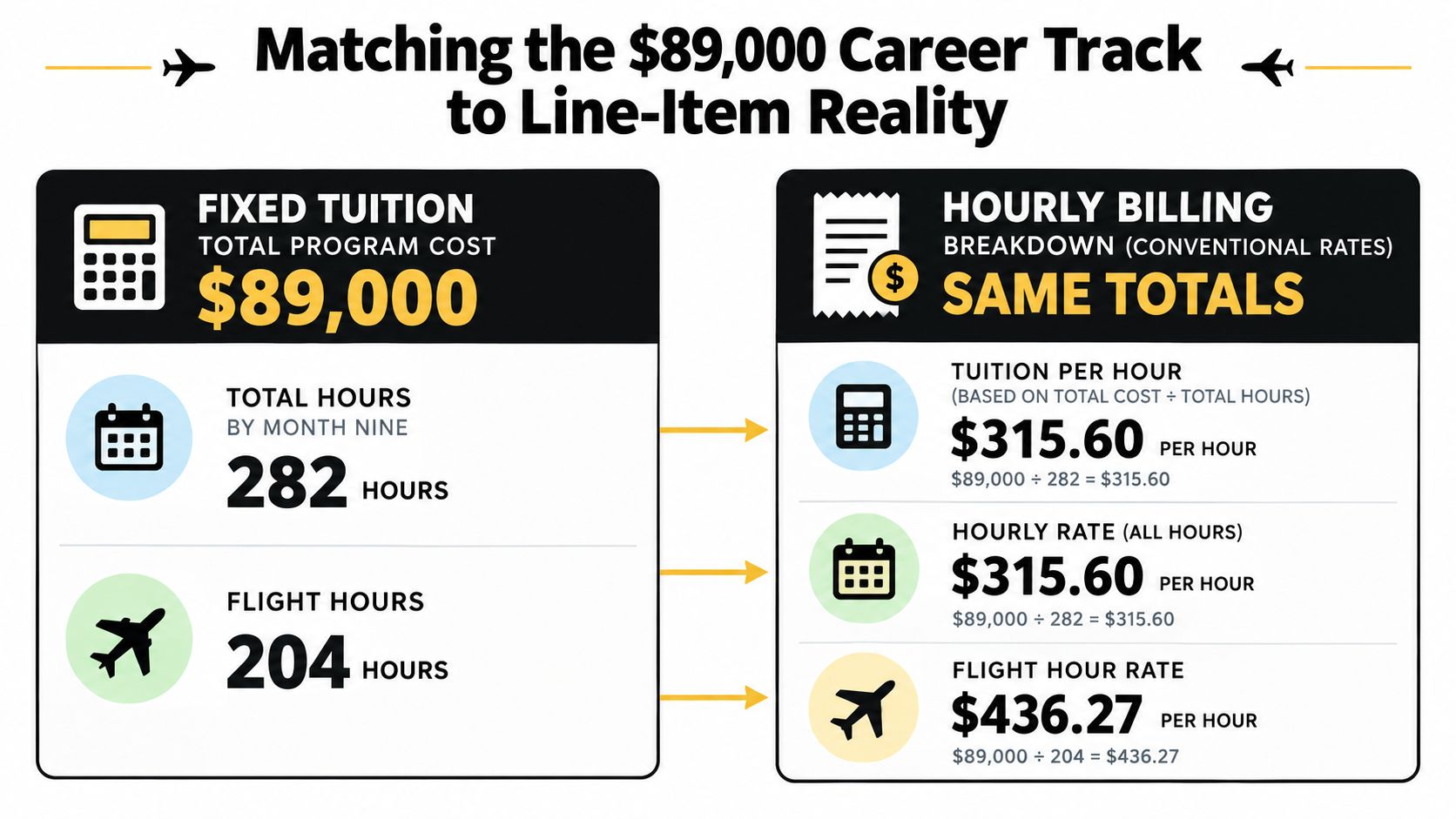
A useful way to read a fixed-price program is to ask what would happen if the same training were billed conventionally. Instructor time, simulator time, checkride coordination, written-test prep, and study materials all carry real value even when they are not itemized as separate hourly charges to you. If a program bundles them, the bundle only works if the included hours and exclusions are clear.
That is why this is a risk-allocation question, not just a tuition question. The deciding question is whether you want to buy hours one by one or lock in a known total and let the school manage the variance.
A student pays more attention to weather, retests, and slow proficiency when every extra hour comes straight out of pocket. A fixed price gives the school the incentive to keep you moving because the school, not you, eats the overruns.
Financing, Housing, and Building Hours Afterward
Tuition is only one cash flow. If you want a training plan that works, you need the monthly plumbing around it, financing, housing, and what happens after the initial certificates are done. The Work with us add-on is also part of that picture, because it turns post-training time building into a paid pathway instead of another open-ended expense.
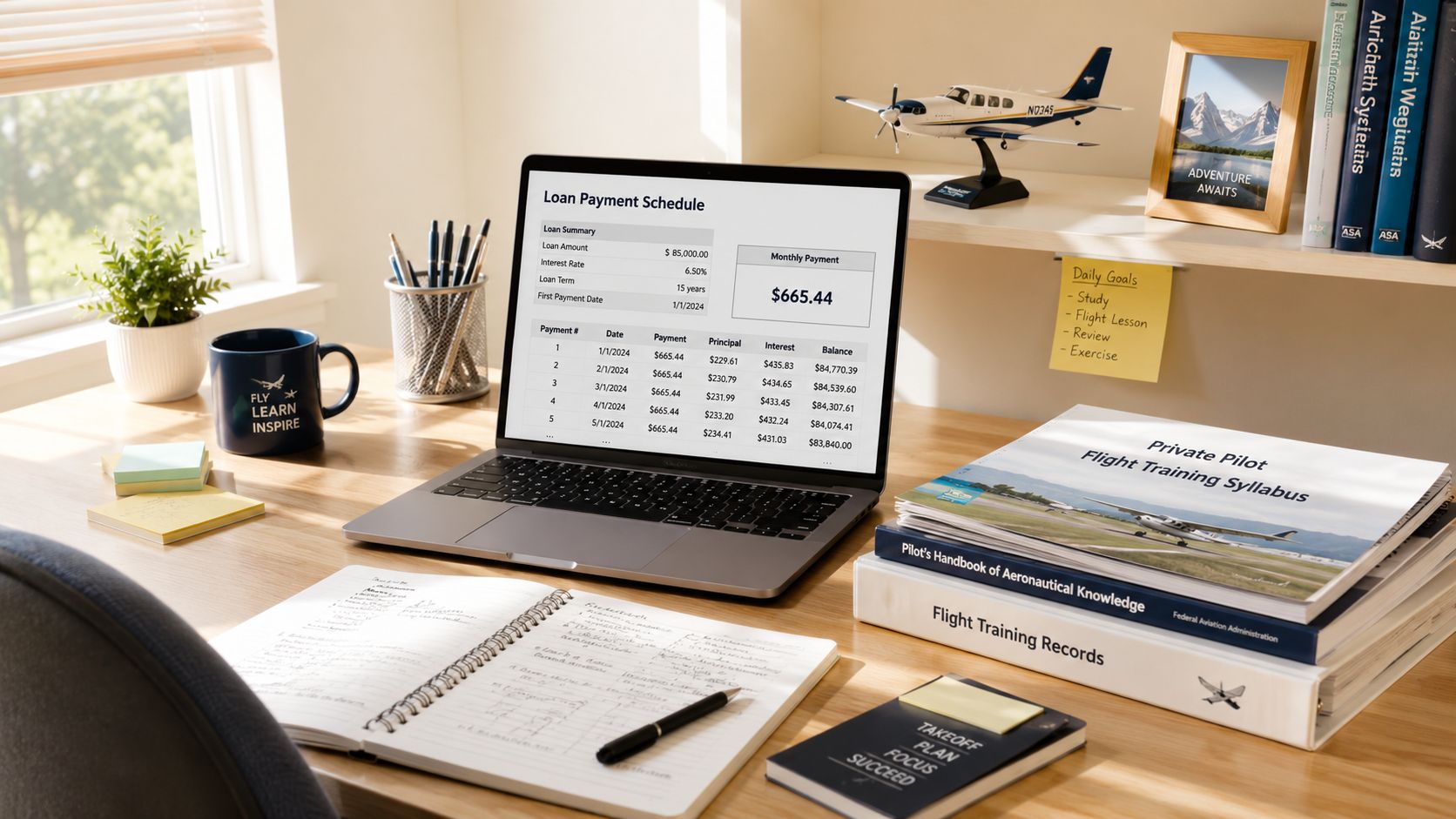
One practical piece is financing. Stratus Financial offers 12-month payment deferral and underwriting that looks beyond standard FICO metrics, which matters if you're trying to start training without draining all your savings up front. That kind of structure makes a fixed tuition feel like a monthly obligation instead of a giant check on day one. For payment planning details, see how to pay for flight school.
Housing matters too. Optional furnished student housing near the Riverside flight line is listed at $1,300 per month, which is exactly the kind of recurring cost students forget when they focus only on lesson rates. If you are relocating, budget the roof over your head with the same seriousness as the airplane time.
The post-training hours matter just as much. The optional $15,000 add-on includes a 25-hour instructor bootcamp plus 175 guaranteed paid instructing hours at $30 per hour, bringing the cumulative total to at least 480 hours by month 18. If your long-term goal is airline eligibility, those hours are not an afterthought, they are part of the plan.
Keep the math honest. Tuition, housing, and time building are one budget, not three separate surprises.
That is also why a school's price structure should be judged as a system. A lower tuition with no path to paid hours can leave you stuck later. A clearer package can cost more on paper and still be easier to live with.
Five Costs Most Students Underestimate
The cheapest hourly rate is not always the cheapest education. The expenses that sting are usually the ones that show up late, after the student has already mentally committed to the program. The FAA also says you can start lessons before you have a student-pilot certificate or medical certificate, but you need the required medical and student-pilot credentials before solo privileges, so delaying the medical can create avoidable sunk cost if you're aiming for a professional path. (FAA pilot certificate FAQ)
Here are the five line items that catch people off guard:
- Medical certificate: get it early, because introductory flying can start before it, but later privileges can't.
- Checkride and examiner fees: these hit at the end, when you're most eager to finish.
- Retest costs: if a practical test gets discontinued or repeated, the bill can jump.
- Gear: headset and basic flight kit purchases often land around the point where students thought they were “almost done.”
- Weather and downtime: calendar delays stretch the training, which stretches the total cost.
The FAA specifically recommends that students planning commercial aviation seek the highest class of medical certificate they're likely to need as early as possible. That is not bureaucracy, it's risk control. A discovery flight can help you test the fit before you spend real money, but it doesn't replace the certification steps needed for solo and advanced training.
For a closer look at how simulators affect training efficiency and cost planning, see aircraft flight simulation. Simulators do not erase the bill, but they can change how much paid airplane time you need.
What to Do Before You Send Any Money
A low tuition quote can still become the expensive option if it shifts risk back to you. Start with a discovery flight if you have never flown, then decide whether the cockpit feels right before you commit real money. If you already know you want the career path, compare the school's pricing model, included items, and scheduling process, then verify the school's credentials with this guide to FAA-approved flight schools.
Before you pay anyone, ask three direct questions. Is the price fixed or hourly. What is included, and what is excluded. Who handles checkride scheduling, and what happens if the test date slips.
Use this filter when comparing schools:
- Pricing model: fixed tuition or pay-as-you-go.
- Included items: aircraft, instructor, simulator, ground, written tests, and checkride coordination.
- Scheduling process: how the school prevents avoidable gaps and test delays.
If a school cannot answer those questions clearly, keep your wallet closed. Mystery billing is where training budgets get wrecked.
For students who already know they want a structured professional path, compare the contract carefully before you commit. Fixed-price programs can cap your exposure to hourly overruns, but only if you know exactly what sits outside the package.
Planning to fly for a living?
See what the path from zero to a pilot career looks like, what it costs and how long it takes.
Learn to fly in Riverside
We train at Riverside Municipal Airport in factory-new airplanes with a parachute built in. Start with a one hour discovery flight, no experience needed.