
On this page
- The Pilot Shortage in Numbers
- What Each Number Measures
- Why the Shortage Is a Replacement Problem
- The Split That Explains Everything
- What This Means If You're Starting From Zero
- Regions Where Pilot Demand Concentrates
- Reading the North American Revision
- Three Questions for Any Region
- The Training Pipeline Behind the Gap
- Where Delay Enters the Sequence
- The Financing Bottleneck
- Building the 1,500 Hours Airlines Expect
- The Simulator Rule Most Students Get Wrong
- Why Ratings and Hours Are Two Separate Projects
- A Formula for Your Own Timeline
- Why Certified Pilots Still Struggle to Get Hired
- Hiring Follows Deliveries, Not Forecasts
- The Shortage Is Segmented
- What to Measure Instead of a Vacancy Count
- Confirm Your Next Step Before You Commit
- Questions Worth Asking Any School, Ours Included
Boeing forecasts that global commercial aviation will need 674,000 new pilots over the 20 years through 2045, as part of a broader demand for more than 2.4 million aviation personnel, according to the company's outlook announcement. Flight school marketing pages may cite that figure to suggest strong career prospects, but it measures projected industry demand across two decades, not entry-level hiring.
For a new pilot, the distinction matters. Forecast demand depends on a training pipeline constrained by instructor, aircraft, examiner, and financing capacity. A large long-term requirement can coexist with a wait for a first job if training and hiring do not align with the timing and location of openings.
The forecasts answer how many pilots the industry may need over time. They do not show when a newly qualified pilot will be hired.
The Pilot Shortage in Numbers
Published forecasts count different things, so their totals are not directly interchangeable. The table separates global demand estimates from regional shortfall estimates and identifies the time frame each one covers.
| Source | Estimate | Time frame | Scope |
|---|---|---|---|
| Boeing 2025 Pilot and Technician Outlook | 660,000 new pilots | 2025 to 2044 | Worldwide commercial aviation |
| Boeing 2026 Pilot and Technician Outlook | 674,000 new commercial pilots | 20 years through 2045 | Worldwide commercial aviation |
| CAE 2025 Aviation Talent Forecast | 300,000 new pilots | By 2034 | Commercial and business aviation |
| ICAO training report | 160,000 pilots | 20-year potential global shortfall | Global, with training capacity constraints outside North America |
| Oliver Wyman, January 2023 | About 17,000 pilots | 2032 | North America |
| Oliver Wyman, October 2023 | About 13,300 pilots | 2032 | North America, 23 percent below the earlier estimate |
Boeing's figure is a requirement count, and it does not list open jobs. It estimates how many pilots the global commercial fleet will need over a long period, including to replace people who leave. That demand is spread across many years, not concentrated in one hiring cycle.
What Each Number Measures
CAE estimates that commercial and business aviation will need 300,000 new pilots by 2034. Its shorter forecast window and broader aviation scope differ from Boeing's global commercial-aviation outlook. ICAO's 160,000 figure measures a potential shortfall against expected training output, rather than total demand.
The Oliver Wyman estimates focus on North America in 2032 and express a projected gap between pilot supply and demand. The later estimate was lower than the earlier one, showing that shortfall forecasts can change as assumptions about airline capacity, retirements, and training completion change. For a new pilot, a long-term demand total offers little precision about when a first job will open.
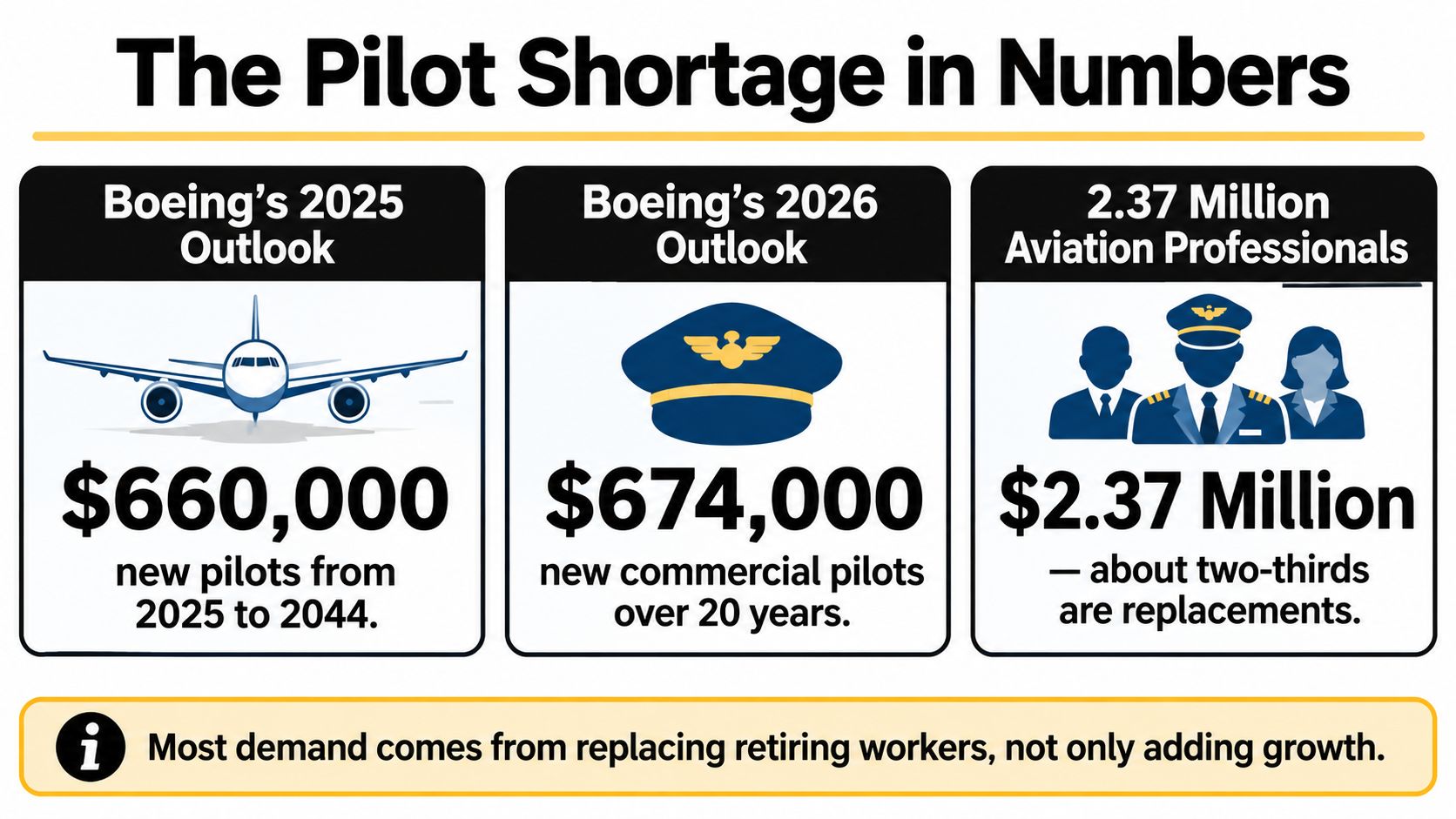
The figures describe different scales and measures. A 20-year demand forecast indicates sustained industry need, but it cannot predict which airline will have an entry-level vacancy when a new pilot earns a commercial certificate.
Certificate counts provide a separate measure from forecasts of future demand. The number of pilots who hold certificates is not the same as the number currently qualified and seeking paid work; see the breakdown of how many airline pilots hold certificates in the United States. Long-term demand and near-term employability answer different questions.
Why the Shortage Is a Replacement Problem
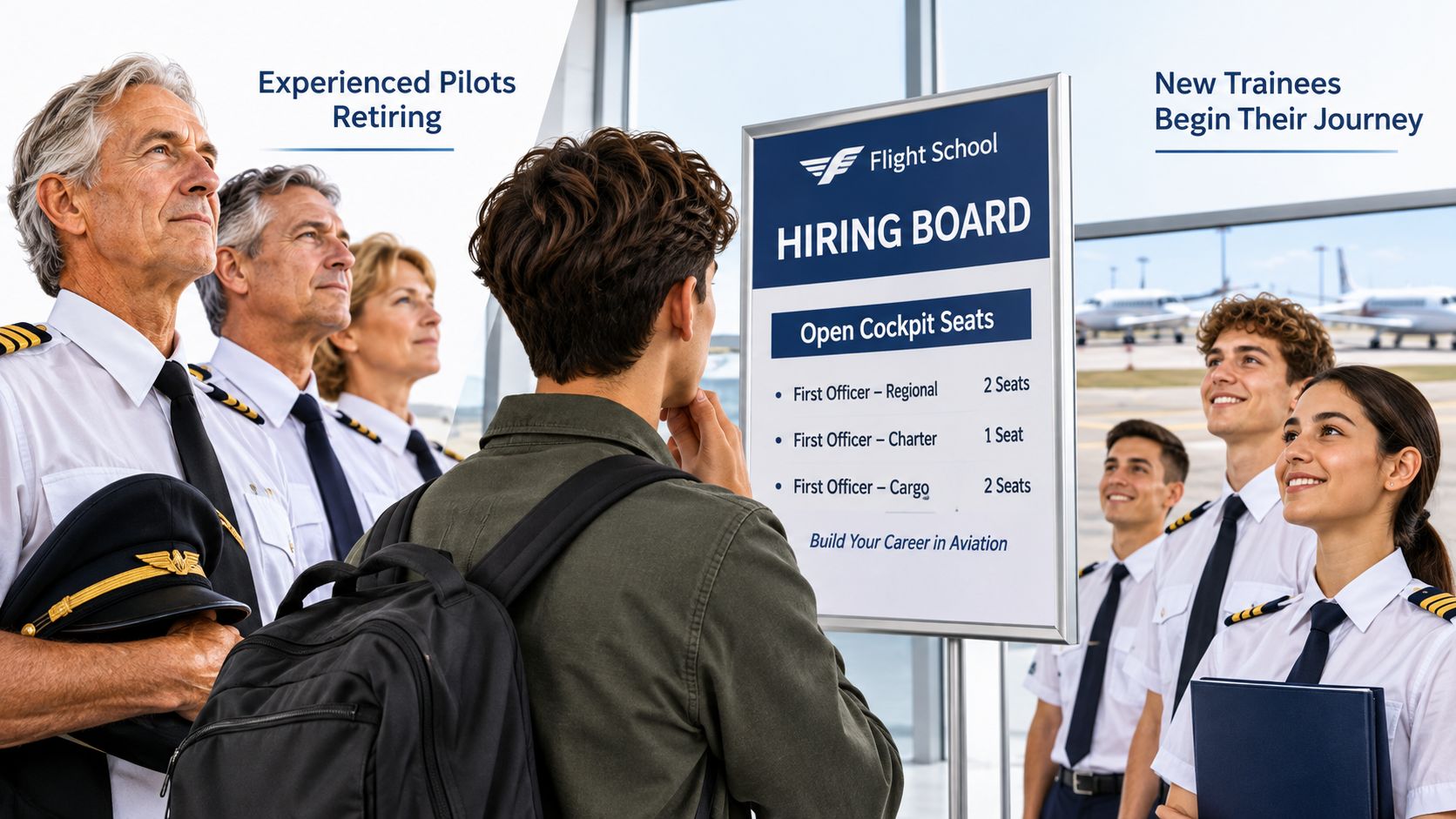
Retirements account for about two-thirds of the roughly 2.37 million aviation professionals needed worldwide, including pilots, technicians and cabin crew, according to Boeing's 2025 Pilot and Technician Outlook. The remaining third supports fleet and traffic growth. That mix explains why a shortage can persist even when airlines slow expansion: departures from the workforce continue to create hiring needs.
The Split That Explains Everything
Boeing projects a global requirement for 660,000 pilots between 2025 and 2044. That is a long-term workforce estimate, not a forecast of when individual airlines will hire or how many newly certified pilots will qualify for vacancies in a given year.
Replacement hiring and expansion hiring also respond differently to a downturn. Airlines may defer growth when travel demand softens, while still recruiting to replace pilots who leave. For someone training now, the distinction matters: a large replacement requirement supports ongoing demand, but does not guarantee an immediate job after certification.
Boeing identifies South Asia and Southeast Asia as the fastest-growing regions, with pilot staffing requirements expected to more than triple in its 2025 Pilot and Technician Outlook. Regional growth points to where future demand may concentrate, not necessarily where a newly qualified pilot can work.
What This Means If You're Starting From Zero
A long-term shortage does not remove the steps between a first lesson and a paid flying job. Training progress, checkride timing and access to aircraft all affect when a pilot becomes employable. A delay can push that date back, even when airlines expect to need more pilots over time.
The practical measure is time-to-employability: the months between starting training and qualifying for paid flying work. Forecasts describe the scale and composition of future demand; they cannot promise when a particular pilot will find a vacancy.
Regions Where Pilot Demand Concentrates
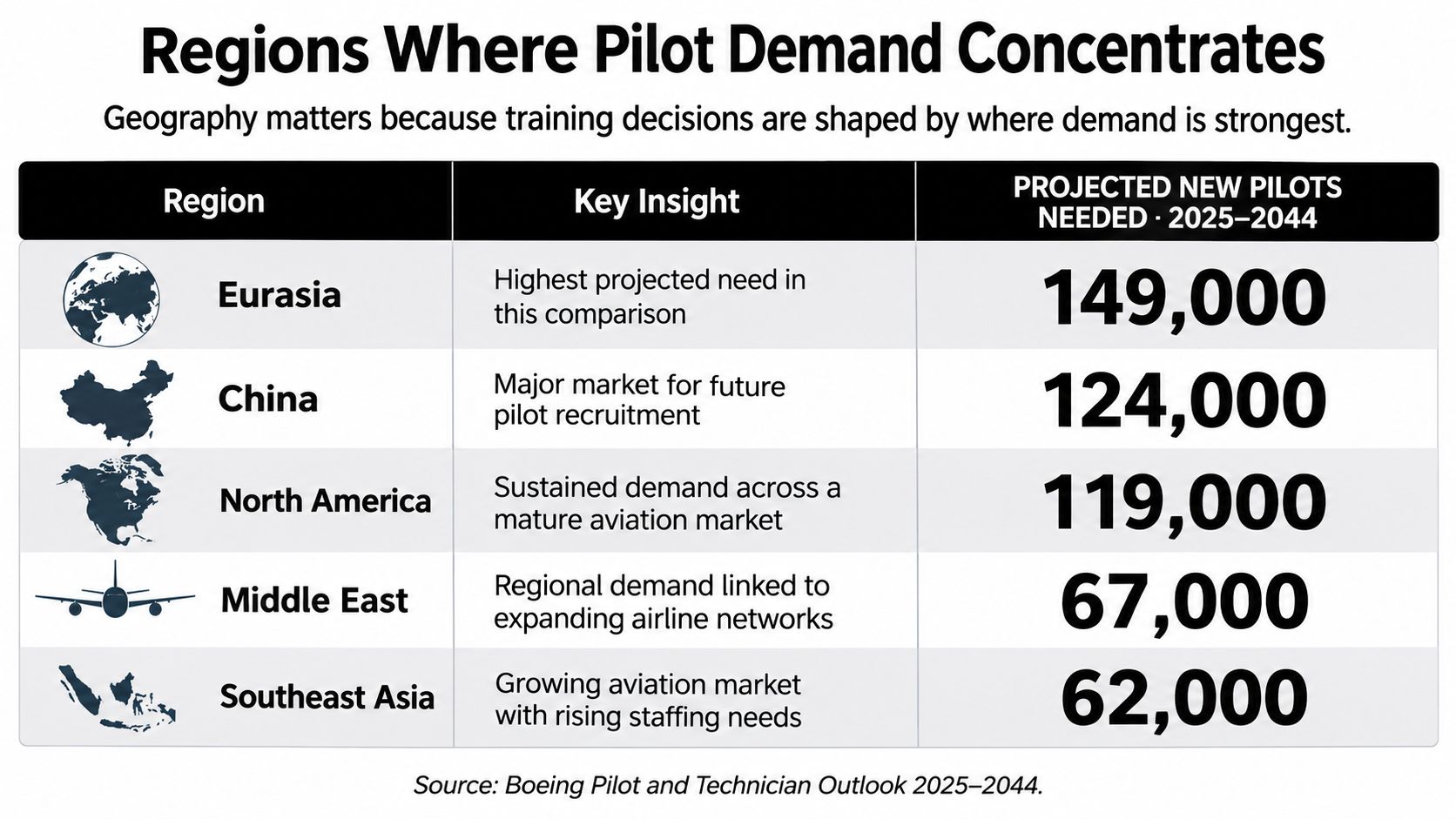
Boeing projects 149,000 new pilots for Eurasia and 124,000 for China over 2025 to 2044. Its 2025 Pilot and Technician Outlook also estimates 119,000 for North America, 67,000 for the Middle East, 62,000 for Southeast Asia, and 45,000 for South Asia.
| Region | Projected new pilots | Period |
|---|---|---|
| Eurasia | 149,000 | 2025 to 2044 |
| China | 124,000 | 2025 to 2044 |
| North America | 119,000 | 2025 to 2044 |
| Middle East | 67,000 | 2025 to 2044 |
| Southeast Asia | 62,000 | 2025 to 2044 |
| South Asia | 45,000 | 2025 to 2044 |
These regional totals describe long-term demand across broad markets, not the number of openings available to newly certified pilots. A large forecast can coexist with a high experience threshold at individual airlines, and demand in a region does not establish that a graduate can work there. Licensing and work-authorization rules also vary by country.
Reading the North American Revision
Regional projections change as assumptions about airline capacity, retirements, pandemic recovery, and training completion rates change. Oliver Wyman's October 2023 analysis projected a North American shortage of approximately 13,300 pilots in 2032, 23 percent below its earlier estimate of just under 17,300. Even a reduced projected gap indicates a mismatch between available pilots and airline requirements, not a promise of immediate hiring for each new certificate holder.
Three Questions for Any Region
Before treating a regional total as a personal opportunity, check the hiring conditions that apply to you:
- Where does the employer hire? A carrier may operate across a region but recruit through a specific cadet scheme, ab initio program, or experience threshold. Check the carrier's posted hiring requirements before relying on a regional forecast.
- Is the market domestic or international? Hiring in another country may require license conversion, medical approval, and work authorization.
- Which licensing path applies to you? Training in one country does not automatically transfer to another. Confirm conversion requirements before committing to a training location.
The Training Pipeline Behind the Gap
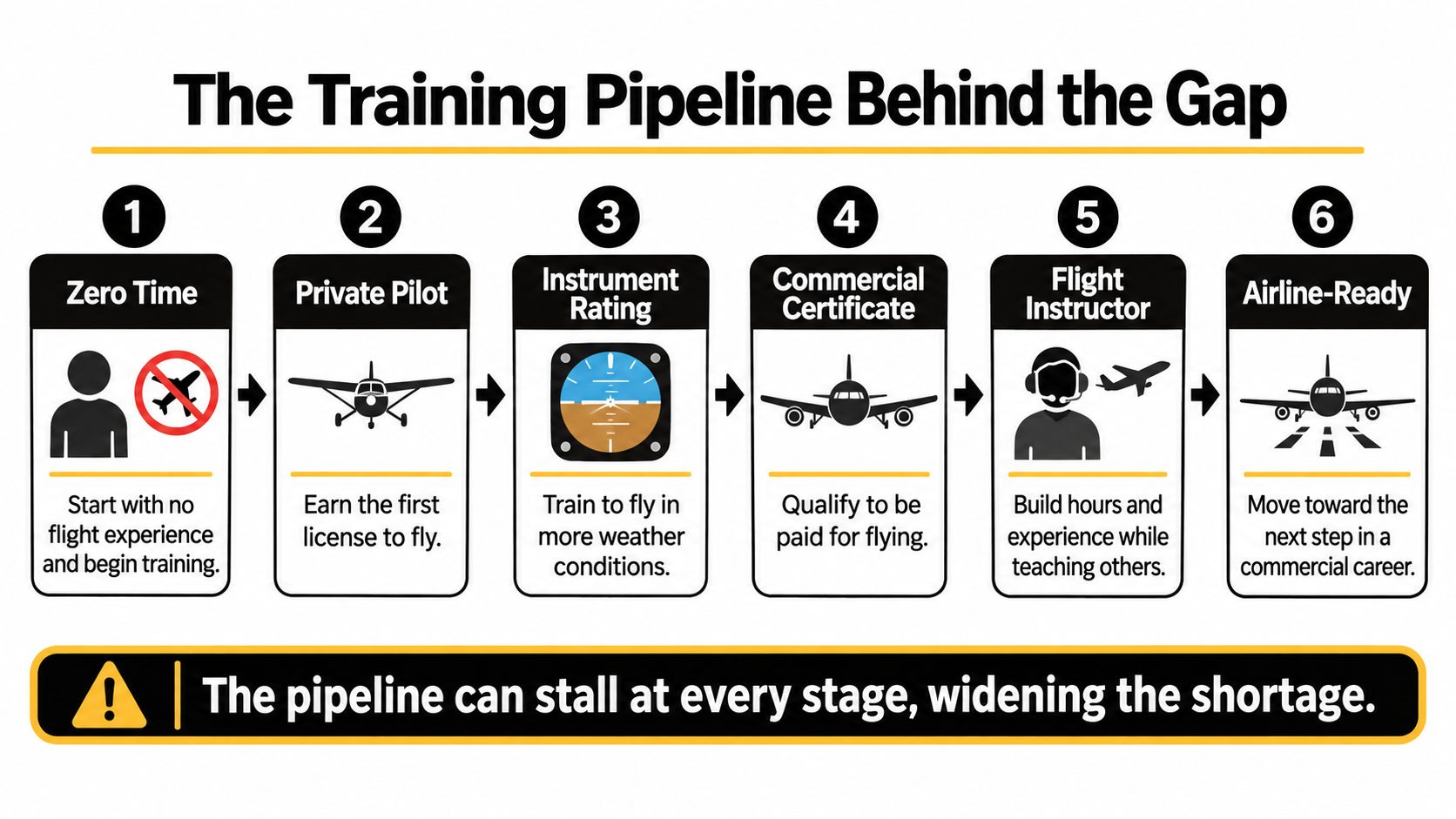
Picture a student who starts with zero hours and wants an airline seat. The path runs from first lesson to private pilot, then instrument rating, commercial certificate and flight instructor certification, then paid instructing, then a first officer job. Each stage depends on the one before it, and a stall early compounds late.
That chain is where the shortage lives. ICAO's training report reports a potential 20-year global shortfall of 160,000 pilots, alongside shortages of 360,000 maintenance personnel and 40,000 air traffic controllers, and states that outside North America current training capacity is generally insufficient to produce the hundreds of thousands of aviation professionals required.
Where Delay Enters the Sequence
Walk the stages in order and the bottlenecks appear:
- Zero time to private pilot. Weather, aircraft availability and your own study pace set the floor. Nothing downstream can start until this finishes.
- Instrument rating. This is the most technically demanding block for many students, and a delay here postpones everything after it.
- Commercial certificate. The rating that makes you hirable also depends on logged hours and aircraft access, both of which compete with every other student on the schedule.
- Flight instructor certification. Instructor eligibility follows the commercial certificate, so a slip at step three pushes this back too.
- Paid instructing. Hours accumulate fastest here for many students, and a school's ability to fill your schedule decides your pace.
- Regional first officer seat. Reached when your hours, recency and interview preparation clear a carrier's threshold.
The compounding is the part people underestimate. ICAO's analysis describes the mechanism plainly: an instrument or commercial rating delay postpones instructor eligibility, and delayed instructor entry slows the hour building of the students behind you. Instructor availability, aircraft and simulator utilization, examiner capacity, financing and the time required to progress through multiple licenses all feed the same constraint.
A shortage of instructors becomes a shortage of pilots two years later. That's not a metaphor, it's the sequence.
More recruitment doesn't fix this on its own. Standardized operations, high-utilization simulators and coordinated examiner scheduling add real capacity, and graduates who become instructors add capacity instead of only consuming it. That's the reasoning behind a structured flight instructor course that produces teachers, not just certificate holders.
The Financing Bottleneck
Cost is a capacity problem too. Recent AOPA reporting on airline hiring and training costs estimates that progressing from private pilot through commercial pilot and flight instructor qualifications in the United States typically costs roughly $75,000 to $100,000, even without a college degree, and identifies cost as a major determinant of who enters the pipeline and when.
A funding gap stalls the sequence exactly the way a weather week does. Plan financing alongside the schedule, and track three numbers from your first month: months elapsed between stages, inactive days per month, and the share of planned flying that happens. If any of the three drifts, you have found your bottleneck before it costs you a year.
Building the 1,500 Hours Airlines Expect
For the standard, unrestricted airline transport pilot certificate in the airplane category, 14 CFR § 61.159 sets a 1,500-hour total-time requirement, with specific minimums for several types of flying.
| Requirement under 14 CFR § 61.159 | Minimum hours | Notes |
|---|---|---|
| Total pilot time | 1,500 | Standard unrestricted ATP, airplane category |
| Cross-country flight time | 500 | Counts toward the 1,500 total |
| Night flight time | 100 | Counts toward the 1,500 total |
| Airplane class for the rating sought | 50 | Counts toward the 1,500 total |
| Instrument flight time | 75 | Subject to the regulation's conditions |
| Full-flight simulator time | Up to 25 | Only in approved Part 121, 135, 141 or 142 courses; flight training devices and aviation training devices do not count |
The Simulator Rule Most Students Get Wrong
The simulator allowance is narrow. Up to 25 hours in a qualifying full-flight simulator may count toward the total, but only as part of an approved Part 121, 135, 141 or 142 course. A flight training device or aviation training device does not meet this specific requirement.
Other ATP routes, including certificates with restricted privileges, have different hour totals in defined cases. Check the applicable regulation before using a different requirement to estimate your training timeline or budget.
Why Ratings and Hours Are Two Separate Projects
A commercial certificate does not, by itself, bring a pilot to the 1,500-hour threshold. Professional training generally involves earning advanced ratings, then building the remaining flight time. Flight instruction is one common way to build hours while continuing to develop skills relevant to airline flying.
Multi-engine experience can affect which jobs are open to you, so plan how to build it alongside the rest of your time. Multi-engine time-building options can help you understand how that experience fits into the broader hour-building phase.
A Formula for Your Own Timeline
Divide the hours you still need by the number of hours you can realistically fly each month. At 300 hours, for example, you need 1,200 more to reach 1,500. Flying 60 hours a month would put that arithmetic estimate at 20 months, before accounting for interruptions.
Treat the result as a planning estimate, not a promise. Aircraft access, instructor availability and weather all affect how much flying a program can sustain. Ask any school how many hours per month its students fly in month four, not just month one.
Why Certified Pilots Still Struggle to Get Hired
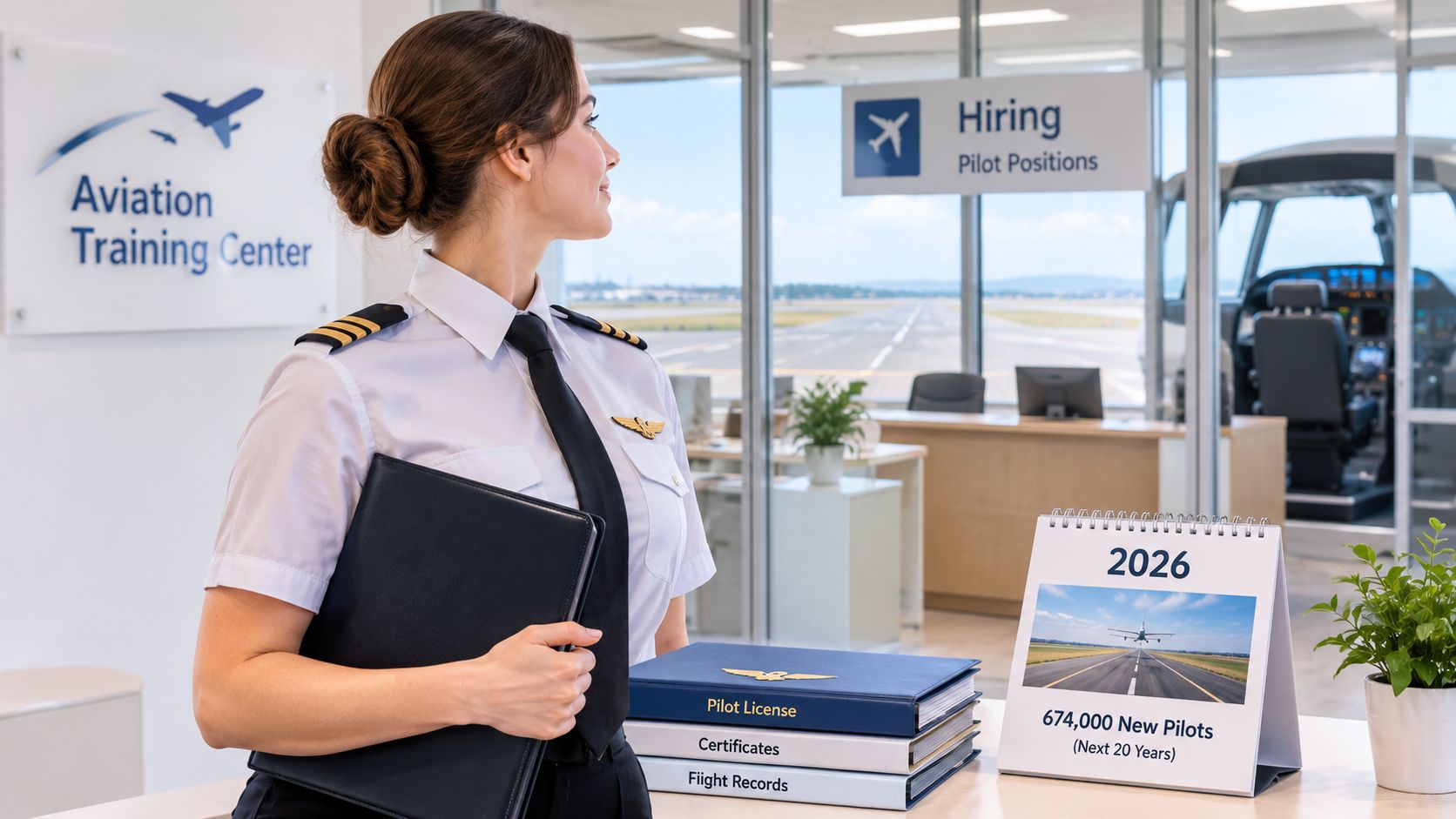
Boeing projects demand for 674,000 new commercial pilots globally over 20 years, but that forecast does not mean a newly certified pilot can immediately get an airline job. Its 2026 Pilot and Technician Outlook describes a long-term need, not a hiring schedule for entry-level applicants.
The distinction matters: future demand can be strong while near-term openings remain limited.
Hiring Follows Deliveries, Not Forecasts
Airlines often expand hiring as their fleets grow, and fleet growth depends on aircraft deliveries. Boeing's outlook identifies deliveries, fleet growth, fuel costs, regional economics, insurance requirements, and demand for experienced or type-rated crews as factors affecting hiring. A recent analysis cited in that outlook reports deliveries were about 5,600 aircraft below the pre-pandemic trend and the global order backlog reached 18,100 aircraft in May 2026. Boeing's 2026 Pilot and Technician Outlook links those figures to delays that can postpone recruitment even when long-term demand remains strong.
That timing mismatch can leave airlines short of experienced captains while offering few first officer seats. If aircraft deliveries are delayed, the new positions those aircraft would support may be delayed too.
A commercial certificate gets your application read. Logged hours, recency and proof of readiness help determine whether an employer responds.
The Shortage Is Segmented
Pilot demand varies by experience, aircraft type, location and timing. An operator recruiting for a widebody fleet and one filling a first officer seat on a domestic turboprop face different hiring needs.
For an applicant, the certificate is only one part of the profile. Employers may also consider logged hours, recent flying, multi-engine experience, logbook quality and interview readiness. A job advertisement requiring a commercial certificate and 500 hours makes the distinction clear: the certificate meets a stated qualification, while the experience and current instrument record help an employer assess readiness.
What to Measure Instead of a Vacancy Count
A global vacancy forecast is a poor personal planning metric. Focus instead on the time and conditions required to reach the next hiring threshold, including the hours and qualifications specified by the jobs you plan to pursue.
That shifts attention from headline demand to the steps between certification and employability. A plan for an airline pilot career should account for both the experience employers request and the hiring cycle that determines when positions open.
Confirm Your Next Step Before You Commit
The first step should cost one hour, not tens of thousands of dollars. A discovery flight requires no experience and answers a question no article can: whether you enjoy controlling an aircraft in rough air. Do that before you finance anything.
If the answer is yes and you want a full zero-to-CFII path, the Career Track at CFII's program page is structured as one package: a fixed $89,000 tuition, about nine months from zero time to certificated flight instructor and multi-engine, 282 total hours, and six certificates and ratings, run out of Riverside, Long Beach and Corona in Southern California.
If you're still comparing options, this guide to the best pilot training programs lays out what separates a school that finishes you on schedule from one that leaves you waiting on aircraft and examiners.
Questions Worth Asking Any School, Ours Included
We recommend asking every flight school, including CFII, the same list before you sign:
- Airplane age and condition. Older airframes mean more maintenance days, and maintenance days are your tuition calendar slipping.
- Students per airplane. The ratio tells you how often you'll fly in month five.
- Instructor turnover. Instructors leave for airlines. Ask how the school replaces them mid-course.
- Total price in writing. Including examiner fees, study materials, gear and anything excluded from the headline number.
- Part 61 or Part 141. The regulatory framework affects structure, records and sometimes minimum hours.
- Whether you can fly before committing. A school that won't put you in an airplane for an hour before a deposit is telling you something.
Training doesn't guarantee employment, income or any particular outcome, and no honest school will promise otherwise. Your decision should rest on three things you can measure: the timeline, the total cost, and whether the program fits how you learn.
CFII trains pilots from zero experience through flight instructor and multi-engine ratings on a fixed, published timeline, so you can plan around a schedule instead of discovering the cost as you go. If you're weighing a career change or you've just started researching, start with a discovery flight and see how the aircraft feels before you commit to a decade-long plan. The forecasts say the industry needs pilots for the next 20 years; the useful question is whether you can get through the pipeline on a timeline that puts you in the hiring pool when the seats open.
Planning to fly for a living?
See what the path from zero to a pilot career looks like, what it costs and how long it takes.
Learn to fly in Riverside
We train at Riverside Municipal Airport in modern airplanes with a parachute built in. Start with a one hour discovery flight, no experience needed.