

On this page
- Quick Picks by Training Goal and Starting Point
- Five Starting Points Tested Against the Table
- FAA Hour Minimums Behind Every Certificate
- What Each Floor Actually Means
- Ranking Program Types by Career Goal
- Criteria That Separate Strong Programs from Brochures
- The Seven Checks
- Where Delays Hide in a Published Timeline
- Five Delays to Price In
- Accelerated Career Tracks Compared With Flexible Training
- The Hiring Stress Test
- Choose Your Program and Book a Discovery Flight
The popular advice is to pick the best pilot training programs by the lowest tuition or the shortest calendar. I would not start there. Tuition tells you what you'll pay to start. It doesn't tell you whether airplanes, instructors, and examiners will be available when you're ready, or whether the hours in the package get you anywhere near a paid flying job.
Judge a program by throughput, delay risk, and hiring-cycle exposure. Throughput means students finish certificates on schedule. Delay risk means you know who absorbs the cost when weather, maintenance, or a checkride backlog intervenes. Hiring-cycle exposure means your plan still works if airline hiring slows the year you graduate. A cheap program that stalls for months is expensive. A fast program that leaves you without a way to build hours is unfinished.
Quick Picks by Training Goal and Starting Point
No single program wins for everyone. The right choice depends on the certificate you need next, how many hours a week you can train, and whether you already have flight time. Start with the structures, then test yourself against them.
| Program type | How it is structured | Certificates typically earned | Best fit |
|---|---|---|---|
| Part 61 flexible flight school | Lesson by lesson, scheduled around you | Private and any ratings you add | Hobby pilots and anyone paying as they go |
| Part 141 approved school | FAA-approved syllabus with stage checks | Private, instrument, commercial and instructor, depending on the course | Students who want a set schedule and structured progression |
| Integrated career track | Zero-time to instructor pathway in one fixed-length program | Often private, instrument, commercial, multi-engine, CFI and CFII | Career changers who want the most structured route to airline eligibility |
| University aviation degree | Multi-year degree with flight training built in | Certificates plus a bachelor's degree | Students who want a degree and may qualify for a Restricted ATP |
| Military pilot training | Selected through military service | Military pilot wings and a service commitment | Candidates who are willing to serve |
The core split is simple. Part 61 lets you set your own lesson pace with an instructor. Part 141 runs an FAA-approved syllabus with a fixed course outline and stage checks at set points. Neither label guarantees quality, but they tell you who controls the calendar and how progress gets verified. If you're unsure what each certificate allows you to do, read up on the types of pilot licenses and what each one permits before comparing prices.
Five Starting Points Tested Against the Table
1. Zero-time career changer with savings. An integrated career track fits if the fixed price and full-time timeline fit your budget and you can train without working alongside it. Your one check is the hiring stress test. Ask what you're qualified to do the month you finish, and how you'll earn and log hours if airlines aren't hiring that year. If the answer is instructing, confirm the instructor certificates are included, not sold as an add-on later.
2. Hobby pilot paying lesson by lesson. A Part 61 school fits because you control spending and pace. Hobby students taking two or three lessons per week typically reach the private pilot checkride in four to six months, paying lesson by lesson. Your check is consistency. One lesson every two weeks means you spend the first part of each flight relearning the last one, and the total cost creeps up even though each individual lesson feels cheap.
3. Private pilot adding instrument, commercial, or instructor ratings. A Part 141 course gives you structured progression with stage checks, which suits pilots who already know they learn better against fixed milestones. Your check is credit for time already logged. Bring your logbook and get, in writing, which of your existing hours count toward the course and which lessons you'll repeat for standardization.
4. Prospective instructor who wants paid hours. The certificate alone isn't the asset. The asset is paid, loggable instructing time after it. Your check is blunt. Confirm the instructing hours are paid, confirm they're loggable toward higher certificates, and ask how many students an instructor there carries. A CFI certificate with no students assigned builds no time.
5. Student who needs financing or relocation. Any row of the table can work, but the financing decides whether you finish. Your check covers three things before you sign. Get the financing terms and any deferral options in writing, price housing near the training base for the full program length, and confirm what happens to your payments if training pauses. Relocating for better weather and aircraft availability can be rational, but only if rent doesn't consume the savings.
Practical rule: Pick the row that matches your next certificate and your weekly availability first. Compare prices only between programs in the same row.
Treat this table as a starting point, not a verdict. A program that fits your starting point still has to survive scrutiny on hours, delays, and what happens when hiring cools.
FAA Hour Minimums Behind Every Certificate
Every advertised hour total is measured against a regulatory floor. If you don't know the floors, you can't tell whether a package is generous, bare minimum, or short of what you'll need.
| Certificate | Minimum total time | Key hour requirements | Rule |
|---|---|---|---|
| Private pilot, airplane | 40 hours | 20 with instructor, 10 solo, 3 cross-country instruction, 3 night, 10 full-stop landings | 14 CFR 61.109 |
| Commercial pilot, single-engine | 250 hours | 100 powered, 50 in airplanes, 100 pilot-in-command, 50 pilot-in-command cross-country | 14 CFR 61.129 |
| Airline Transport Pilot, standard | 1,500 hours | 500 cross-country, 100 night, 50 in the class, up to 25 simulator hours counted | 14 CFR 61.159 |
| Restricted ATP, degree pathways | 1,000 or 1,250 hours | Restricted privileges until the full experience level is reached | FAA-approved aviation degree programs |
Before any solo time counts, you need a student pilot certificate under 14 CFR 61.83 and a medical certificate under 14 CFR 61.23. Book the medical exam early. Students stall their whole schedule by discovering a medical issue the week they were supposed to solo, and some conditions take time to clear. The full sequence of certificates, tests, and paperwork is laid out in the flight training requirements from first lesson to checkride.
What Each Floor Actually Means
The private certificate is the entry point. Under 14 CFR § 61.109 on the Electronic Code of Federal Regulations, an airplane single-engine private pilot applicant needs at least 40 hours of flight time, including 20 hours with an authorized instructor and 10 hours of solo flight training. That same rule requires 3 hours of cross-country instruction, 3 hours of night training with 10 full-stop landings, and a solo 150-nautical-mile cross-country with full-stop landings at three points. Forty is a legal minimum, not a promise. Most students need more, so ask any school what its students typically log, not what the regulation allows.
The commercial certificate is where flying becomes paid work, and the jump is large. Under 14 CFR § 61.129 on the Electronic Code of Federal Regulations, a single-engine commercial applicant generally needs 250 hours as a pilot, including 100 hours of pilot-in-command time. A private-only package therefore leaves most of the commercial hours still to fly and pay for.
The airline floor is higher still. Under 14 CFR § 61.159 on the Electronic Code of Federal Regulations, the standard Airline Transport Pilot certificate requires 1,500 total hours, including 500 hours of cross-country, 100 hours of night, and 50 hours in the airplane class. That rule lets up to 25 hours of qualifying full-flight-simulator training count only inside an approved Part 121, 135, 141, or 142 course, so simulator time outside an approved course doesn't close the gap. Graduates of FAA-approved aviation degree programs can qualify for a Restricted ATP at 1,000 or 1,250 hours, as the FAA Airline Transport Pilot page explains, but they keep restricted privileges until reaching the full experience level.
That produces the key test for any package. A program ending at a commercial certificate hasn't delivered airline eligibility. Ask two numbers. How many loggable hours does the program itself produce, and how many hours do you still need to find afterward, doing what, paid by whom?
Ranking Program Types by Career Goal
For a commercial career, compare training routes by how quickly they produce usable certificates and hours, and how much schedule or hiring risk you carry. A short published timeline helps only if aircraft, instructors, and checkrides keep pace.
1. Integrated career track. Choose this route if you're starting from zero and want a defined path through instructor certificates. CFII's Career Track costs $89,000 and takes about nine months full time, with six certificates and ratings, 282 hours of training, and instruction included. That gives you a clear completion target; you still need to plan for the time and cost of building hours afterward.
2. University aviation degree. A degree program fits students who value a bachelor's credential alongside flight training. Some FAA-approved aviation degree programs can qualify graduates for a Restricted ATP at a lower hour threshold, though restricted privileges apply until the full experience requirement is met. The trade-off is a longer route to the job market. Choose it for the degree as well as the flight training, not solely to reduce time-building.
3. Part 141 approved school. This can suit students who want a structured course without buying a full career package. The schedule is less adaptable, so check that the school's pace fits your work and family commitments.
4. Part 61 flexible school. Pay-as-you-go training can work well for hobby pilots or students who need control over lesson timing and spending. For a career goal, the student must keep the sequence moving and coordinate instructor availability. Without that consistency, the calendar can stretch.
5. Military training. Consider this path if you're willing to serve and want military flight training. Selection is competitive, and the service commitment shapes where you live and what you fly for years.
For a hobby pilot, degree seeker, or student unable to train full time, the best fit may be a different row. Rank programs against your goal, available training time, and tolerance for delays.
Criteria That Separate Strong Programs from Brochures
Brochures list what's included. They rarely list capacity. The visual below summarizes the criteria to run against every school on your shortlist.
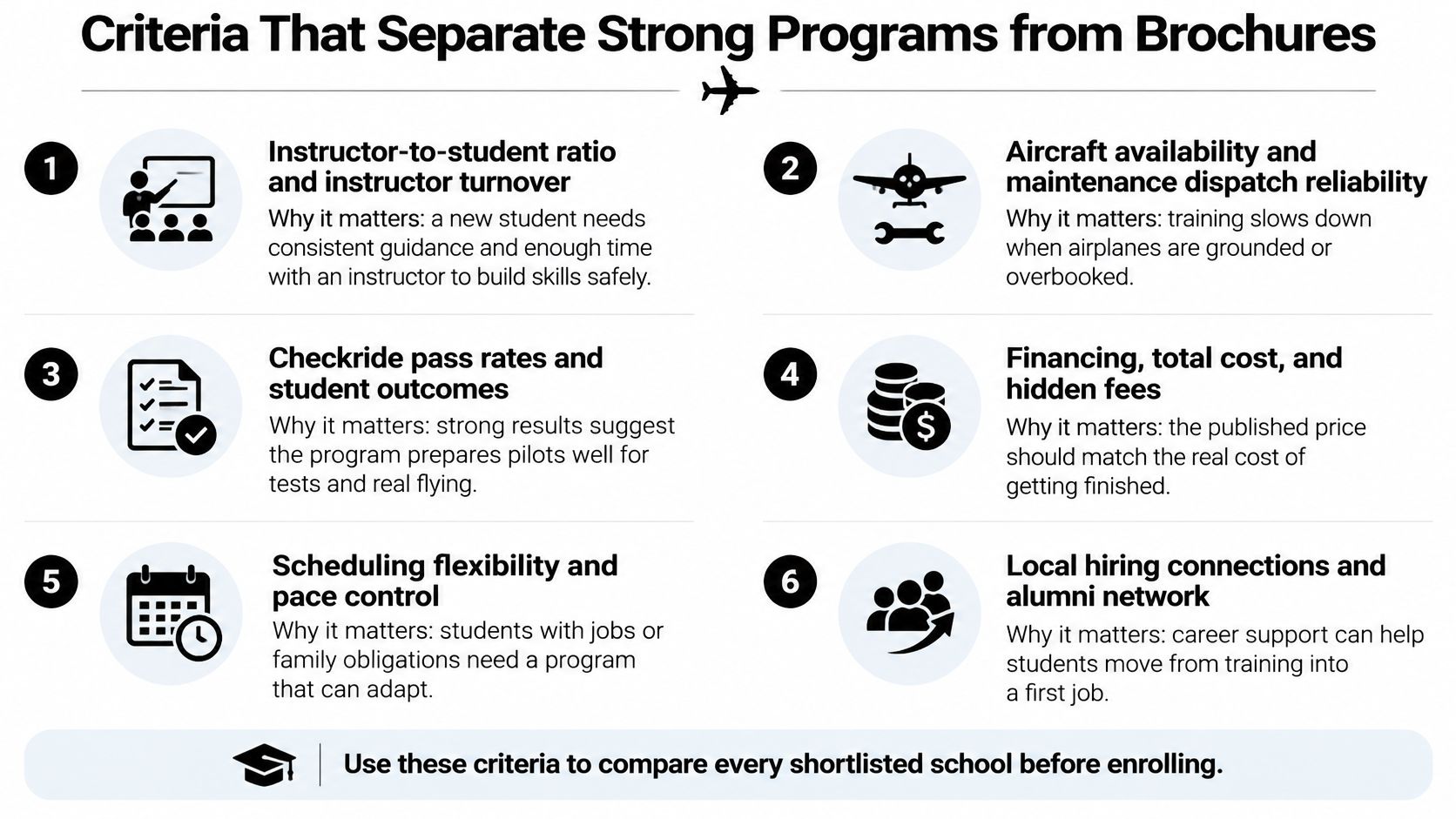
Capacity matters because the industry can't train pilots as fast as it needs them. The ICAO forecasting document puts the most likely requirement at approximately 52,506 newly trained airline pilots annually against infrastructure that can produce about 44,360, an annual shortfall of roughly 8,146 pilots. When training capacity is scarce, a school's ability to finish students on time is worth more than a small tuition advantage, because every stalled month delays your entire hour-building phase.
The Seven Checks
- Instructor ratio and turnover. Ask students per instructor and how often students change instructors, because a new instructor every few months resets your progress while you re-demonstrate skills.
- Aircraft per student and fleet. Ask airplane age, students per airplane, and whether cockpits are glass, because overbooked or frequently grounded airplanes stretch every certificate.
- Simulator allocation. Simulator hours should be logged separately from aircraft hours and identified by device and training objective, so you know what's loggable and what skill each session builds.
- Cohort completion data. Ask the share of students reaching commercial and instructor certificates on schedule and the average extra hours beyond syllabus targets, because averages expose what testimonials hide.
- Checkride lead time. Ask how examiners are scheduled and how long students wait, because a finished student waiting weeks for a checkride pays living costs while skills decay.
- Price in writing. Get the total price, exclusions, financing terms, and the cost of a failed knowledge test or checkride on paper, because retests and excluded items are where budgets break.
- Fly before committing. Take a discovery flight and walk the hangar first, because one lesson reveals instructor fit and aircraft condition better than any tour script.
We recommend asking every flight school these same questions about airplane age, students per airplane, instructor turnover, total price in writing, Part 61 versus Part 141, and whether you can fly before committing. Comparing written answers side by side is also the fairest way to read flight school reviews without being swayed by outliers, since one unhappy or delighted student tells you little about a cohort. The short video below walks through what strong answers sound like.
Ask for cohort data rather than testimonials. If a school can't tell you its stage-check completion rates, average calendar time between certificates, or documented examiner availability, its accelerated calendar may just shift costs into unscheduled extra training you'll fund later.
A brochure shows what was scheduled. Cohort data shows what students actually logged.
Where Delays Hide in a Published Timeline
A fixed price doesn't prove a fixed timeline. That assumption breaks more training budgets than tuition does. Price covers flying. The calendar is set by bottlenecks that most comparisons never mention.
The 2025 Redbird survey reported by AVweb found pilot-training costs had stabilized after averaging 16% annual increases from 2020–2023, with median private-pilot training cost at about $14,000 and completion averaging roughly six months. The same report flagged pilot-examiner availability, insurance and maintenance costs, and limited training-aircraft availability as ongoing challenges, and 63% of independent instructors said they were using customer aircraft for training. When even instructors depend on borrowed airplanes, aircraft access is not a detail. It's the schedule.
Five Delays to Price In
- Examiner availability. You can't take a checkride until a designated pilot examiner has a slot, and in busy regions that wait runs weeks after you're signed off.
- Aircraft access and maintenance. Airplanes come offline for inspections and repairs. If the fleet is small, one grounded airplane displaces every student behind it.
- Retests. A failed knowledge test or checkride means remedial training, a new endorsement, another examiner fee, and another wait for a slot.
- Weather and seasonal backlogs. Regions with poor winter weather compress training into good months, so aircraft and examiners back up exactly when everyone wants them.
- Instructor changes. When your instructor leaves for an airline job, the replacement spends lessons verifying where you are, and you pay for that overlap.
Estimate each delay the same way. Take your weekly living costs plus any income you're giving up while training full time. Multiply by the expected delay in weeks. Then add tuition you've already paid that sits idle during the wait, because money spent on lessons you can't yet convert into a certificate carries its own financing cost. A four-week checkride wait for a full-time student who left a job isn't a minor inconvenience. It's a month of rent and lost wages with zero hours logged.
So ask three questions before enrolling. Which delays does the school absorb, for instance by scheduling examiners itself or keeping spare aircraft capacity? Which costs stay excluded from the published price when a delay hits? And does the advertised timeline reflect typical completion data from recent cohorts, or an ideal-case schedule that assumes no weather, no maintenance, and a first-attempt pass on every test?
Accelerated Career Tracks Compared With Flexible Training
The central trade-off is when you pay and how much control you retain over your pace. An accelerated track concentrates training into a defined period; flexible Part 61 training lets you spread lessons around work and budget. Compare the endpoint and the likely time to reach it, not tuition alone.
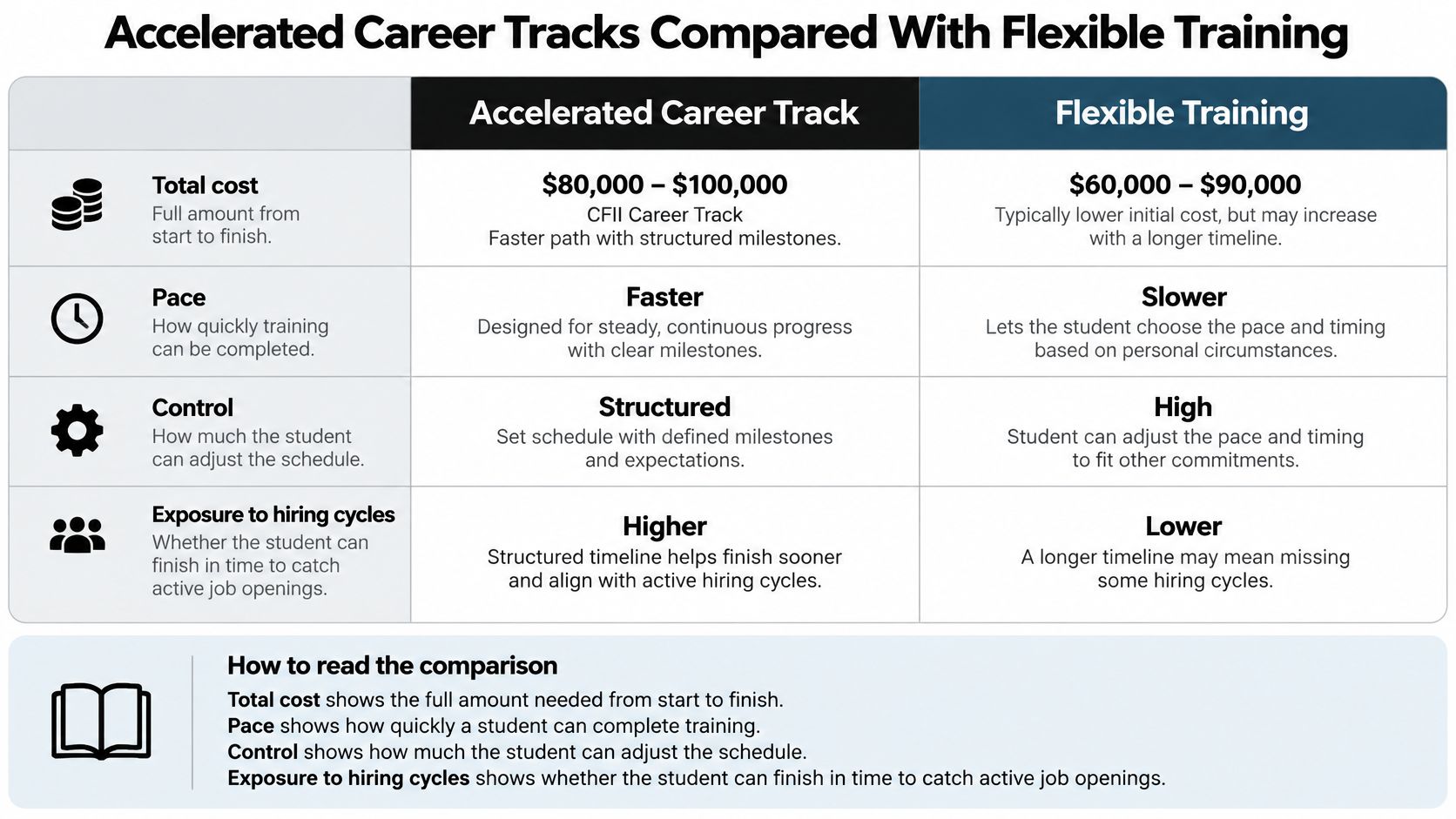
| Factor | Accelerated career track | Flexible Part 61 training |
|---|---|---|
| Tuition model | Fixed program price | Paid lesson by lesson; total depends on the certificates pursued |
| Pace | Scheduled full-time progression | Set by your availability and training frequency |
| Hour package | Defined hours for the program | No fixed package; hours accumulate lesson by lesson |
| Hiring-pause exposure | A planned finish date may coincide with a hiring slowdown | Spending can be paced, but training may still be underway when hiring picks up |
For a concrete example of the accelerated model, CFII's Career Track takes students from zero experience to flight instructor in about nine months. The fast-track pilot training sequence shows how a full-time schedule is organized. The trade-off is concentrated commitment: training takes priority, while costs and living expenses continue on a tight timeline.
Flexible training spreads that commitment. You can keep a job and pay as lessons happen, but pauses extend the calendar and longer gaps can make it harder to retain skills. Track the cost to the same endpoint in both models. A private-pilot-only price cannot be compared directly with a zero-to-instructor program.
The Hiring Stress Test
Hiring conditions can change faster than a training plan. The U.S. Government Accountability Office report records that nine U.S. airlines hired about 22,600 pilots in 2022–2023, then just over 4,000 in 2024, with part of the slowdown attributed to aircraft-delivery delays. The same broad period saw pilot certifications grow about 10% from 2017–2024, according to the report. More new pilots pursuing fewer airline openings can affect how long graduates wait to reach an airline job.
An accelerated student may finish with instructor certificates and build experience instructing while airline hiring is slow. The practical question is whether instructing income can cover loan payments and living costs during that wait. A flexible student may carry less debt at a given point, yet still be completing commercial training when hiring resumes.
Choose the timing risk you can afford. Full-time training requires enough financial room to complete the program and manage the period afterward. Flexible training limits the pace of spending, but can delay reaching the qualifications needed to compete for airline jobs.
Choose Your Program and Book a Discovery Flight
Start with the next concrete decision: whether the training schedule and costs fit your life now. Use the earlier hour-minimums section to identify your certificate target, then set a realistic weekly flying schedule and monthly budget.
Apply the criteria and delay stress test from the earlier sections to the programs you are considering. Before committing, ask about the terms that remain unclear and get the total price and exclusions in writing.
A discovery flight is your first lesson with an instructor. You meet, preflight the airplane together, and take the controls in the air; no prior experience is needed. Review what a discovery flight costs and includes before booking so you know what the first lesson covers.
If you have not flown, book a discovery flight in Southern California and assess the instructor, aircraft, and how you feel at the controls. If you are considering a professional path, review the CFII Career Track from zero experience to CFII and confirm exactly what its tuition includes before enrolling.
No program can guarantee an airline job or a particular hiring outcome. A school can provide training and help you build qualifications, but airlines set their own hiring standards and timing. Choose a program whose schedule and financial terms you can sustain, then book the first lesson when you are ready.
For a professional goal, CFII offers a fixed-price Career Track in Southern California, as well as discovery flights for new students. Review the program details and book a discovery flight to begin.
Planning to fly for a living?
See what the path from zero to a pilot career looks like, what it costs and how long it takes.
Learn to fly in Riverside
We train at Riverside Municipal Airport in modern airplanes with a parachute built in. Start with a one hour discovery flight, no experience needed.