

On this page
- The Current State of U.S. Airline Pilots
- Why the employment count is useful
- Workforce Growth Trajectory and Trends
- Reading the sequence correctly
- What the trend means for entrants
- Understanding Labor Statistics Methodology
- A three-step way to interpret the figures
- Future Projections and Demand Outlook
- Growth versus replacement demand
- What candidates should do with a projection
- What the Numbers Mean for Your Career Path
- Turning market evidence into a personal plan
- Making Informed Decisions with Data
- Read the market
- Audit the pathway
- Stress-test the investment
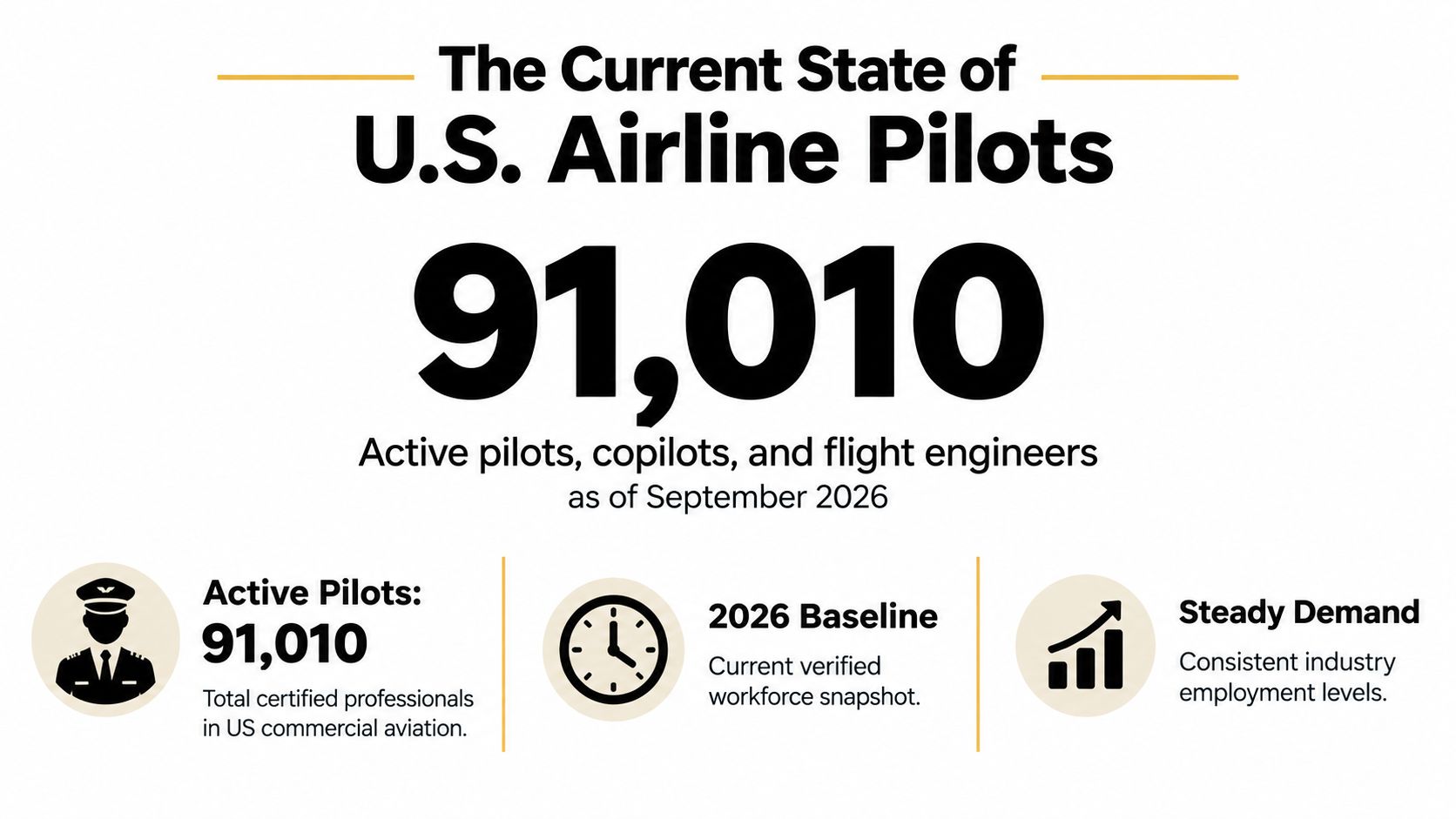
As of September 2026, the United States has 91,010 airline pilots, copilots, and flight engineers working in air transportation. That is the clearest current answer to how many airline pilots are in the US, although it measures active jobs rather than everyone who holds a pilot certificate.
That distinction changes how you should read the headline number. A certificate count can include people who fly recreationally, work outside scheduled airlines, or no longer participate actively in aviation. The employment figure is narrower. It describes people attached to an occupation in the air transportation sector, which makes it more useful for understanding the professional market that aspiring airline pilots are trying to enter.
The number also offers a practical signal for career planning. The U.S. airline cockpit is a large labor market, but becoming part of it requires a sequence of ratings, logged experience, instructor work, and carefully managed training costs. Workforce data can show whether the destination is substantial and whether demand is expanding, but it can't replace a realistic plan for reaching the required qualifications.
The Current State of U.S. Airline Pilots
The latest BLS industry snapshot records 91,010 airline pilots, copilots, and flight engineers in September 2026. The Bureau of Labor Statistics air transportation snapshot counts people employed in that occupation within the air transportation sector, giving career researchers a more relevant baseline than a broad count of every licensed pilot in the country.
The figure matters because “airline pilot” is often used loosely. A private pilot, a flight instructor, a corporate pilot, and an airline first officer may all be pilots, but they don't occupy the same labor market. The BLS count focuses on the professional occupation associated with airline and air transportation employment.
Why the employment count is useful
For an aspiring pilot, the number provides context in three ways:
- It defines the market: You're looking at a substantial professional occupation, not a tiny specialist niche.
- It separates jobs from licenses: The count reflects people working in the sector at the time of the snapshot, rather than everyone who has ever earned a certificate.
- It creates a planning baseline: Future projections can be compared with an established workforce instead of viewed in isolation.
The count doesn't mean that 91,010 people are available for immediate hiring. Some are experienced captains, some are copilots, and some are flight engineers. Employment data also doesn't show how many people are in training, how many are changing employers, or how many openings exist at a particular airline.
Practical rule: Treat the workforce figure as evidence of market scale, not as a promise of an individual job offer.
That is why the answer to “how many airline pilots in the US” should be the start of a career analysis, not the end. The stronger question is whether the occupation has maintained its scale and whether projected employment gives new entrants room to progress.
Workforce Growth Trajectory and Trends
The historical record points to expansion rather than a collapse in professional airline employment. BLS occupational estimates show 84,520 jobs in May 2019, 89,580 in May 2022, and 93,670 in May 2023, according to the BLS occupational employment data for airline pilots, copilots, and flight engineers.
Taken together, those observations show a workforce that grew through the pandemic era and reached a recent high in the available occupational estimates. The change from 2019 to 2023 was about 10.8%, calculated from the BLS figures. That isn't a straight-line forecast, but it does challenge the assumption that the professional pilot workforce contracted permanently during the disruption to air travel.
Reading the sequence correctly
The numbers describe a trajectory, not a guaranteed annual increase:
| BLS reference point | Reported employment |
|---|---|
| May 2019 | 84,520 jobs |
| May 2022 | 89,580 jobs |
| May 2023 | 93,670 jobs |
The later industry snapshot of 91,010 workers in September 2026 sits slightly below the May 2023 occupational estimate. That difference shouldn't be treated automatically as a reversal. The observations use different reference periods and reporting contexts, so they aren't a perfectly uniform monthly series.
The more defensible conclusion is that employment remained near the low-90-thousand range in the mid-2020s. For a student deciding whether to begin training, that stability matters more than extracting a dramatic short-term growth story from separate BLS snapshots.
What the trend means for entrants
A growing or stable occupation can still be difficult to enter. Airlines need qualified pilots, not just people who have started private flight training. Candidates must progress through the certificate and rating system, accumulate experience, meet employer standards, and compete for positions that vary by airline and market conditions.
The trend therefore supports a measured decision. It suggests that professional aviation has retained meaningful scale, while the individual pathway remains demanding. Before committing to a program, review the ATP and CTP requirements and map each training milestone against the experience needed for later airline applications.
Workforce growth improves the setting for a career decision, but preparation determines whether you can participate in that market.
Understanding Labor Statistics Methodology
The most important methodological point is simple: a job count is not a pilot-certificate count. BLS employment data measures people working in a defined occupation and industry. It doesn't attempt to count every person who holds a private, commercial, or airline transport pilot certificate.
That distinction prevents a common analytical error. Someone may hold a pilot certificate but work in another sector, fly only for personal purposes, have retired from airline employment, or no longer fly regularly. None of those situations should be assumed to represent an active airline cockpit job.
A three-step way to interpret the figures
First, identify the unit. The relevant unit in the current BLS industry snapshot is employed people in air transportation. The occupational estimates are expressed as jobs, which describes employment positions rather than a census of certificates.
Second, check the reference date. September 2026, May 2023, and other dates describe conditions at different points in time. Comparing them can reveal direction, but it shouldn't be presented as if every observation came from an identical monthly survey.
Third, define the population. “Airline pilots, copilots, and flight engineers” is a specific occupational group. It doesn't include every instructor, charter pilot, corporate pilot, student pilot, or recreational aviator in the United States.
This method produces a narrower but more useful answer for career readers. If you're asking how many people hold pilot licenses, an employment snapshot won't answer the question. If you're asking how large the professional airline labor market is, the BLS occupation is a much closer fit.
The distinction also explains why a certificate milestone shouldn't be confused with employability. A new pilot can hold an important license and still need additional ratings, experience, and employer-specific qualifications before becoming competitive for airline work.
Future Projections and Demand Outlook
The BLS outlook provides a forward-looking benchmark. It estimates 104,600 airline pilot, copilot, and flight engineer jobs in 2025, with projected employment of 113,300 jobs by 2035. The BLS Occupational Outlook Handbook page for airline and commercial pilots describes the decade as producing a net gain of roughly 8,700 airline-pilot jobs, driven primarily by replacement demand and modest growth in scheduled air service.
These figures should be read as projections, not guarantees. A projection describes the direction BLS expects under its labor-market assumptions. It doesn't promise that every trained pilot will receive an offer, that hiring will remain equally strong each year, or that every new position will be located where a candidate wants to live.
Growth versus replacement demand
The most useful insight is that future opportunities don't depend only on new airline growth. Replacement demand can create openings when existing workers leave the occupation, even when total industry expansion is moderate. For candidates, that means the labor market can need new entrants without expanding dramatically in every year.
| Question | What the BLS outlook indicates |
|---|---|
| Is the occupation expected to expand? | Yes, projected employment is higher by 2035 |
| How large is the projected net gain? | Roughly 8,700 jobs |
| What is the main source of demand? | Replacement demand, with modest scheduled-service growth |
| Does the projection guarantee hiring? | No, it describes an aggregate outlook |
The projected 113,300 jobs in 2035 also places the current workforce in context. The profession isn't merely replacing a handful of specialists. BLS expects a larger occupational base over the projection period, although the path from training to airline employment still depends on qualifications and timing.
What candidates should do with a projection
Use the outlook to test a plan, not to justify skipping due diligence. A candidate should ask whether the training provider can explain the full sequence from initial certificate through instructor ratings and time building. They should also examine the price structure, the pace of training, checkride coordination, aircraft access, and the availability of paid instructing work.
A healthy demand outlook rewards preparation because qualified candidates can position themselves before they reach the airline application stage. It doesn't remove the need for disciplined logbook management, written-test preparation, checkride readiness, and a realistic financial runway.
What the Numbers Mean for Your Career Path
A workforce of this scale and a positive long-term projection create an opportunity, but they don't shorten the training sequence by themselves. A zero-time student still has to build competence in stages, earn the relevant certificates and ratings, and gain the experience that turns training into a professional candidacy.
Consider a structured pathway rather than a single flight-school milestone. The Career Track described by the publisher combines private, instrument, commercial, multi-engine, CFI, and CFII training into an accelerated program. Its published structure reaches 282 total hours by month nine, including 204 single-engine hours, 25 multi-engine hours, and 53 simulator hours, with an optional work arrangement that includes 175 paid instructing hours at $30 per hour. Those program details are available through the commercial pilot training pathway.

Turning market evidence into a personal plan
A student evaluating an accelerated program should separate four decisions:
- Training scope: Confirm which certificates, ratings, simulator sessions, and logged hours are included.
- Time to instruction: Determine when the program expects a graduate to qualify for CFI or CFII work.
- Cost control: Check what the fixed tuition includes and which expenses remain outside it.
- Experience building: Ask how the school supports the transition from student to paid instructor.
The objective is not just to finish lessons quickly. The objective is to reach each milestone with the knowledge, proficiency, and documentation needed for the next one. A predictable schedule can help, but only if the student maintains readiness for stage checks and practical tests.
The current labor data also changes how you should evaluate delays. A checkride bottleneck, inconsistent aircraft access, or an unclear instructor-hiring process can extend the path without adding equivalent career value. Coordinated scheduling, individualized progress tracking, and a digital logbook don't guarantee an airline position, but they address operational risks that students can evaluate before enrolling.
This video offers another perspective on the training and career pathway:
The practical conclusion is encouraging but conditional. A large professional workforce and projected job growth make aviation worth serious consideration. They don't make training automatic, and they don't turn a low-quality plan into a viable one.
Making Informed Decisions with Data
The answer to how many airline pilots are in the US becomes useful only when you connect it to decisions you can control. The BLS workforce snapshot establishes the profession's scale. The historical series shows resilience across several reference points. The outlook indicates that employment is projected to rise, with replacement demand doing much of the work behind that expansion.
That evidence supports a three-part decision framework.
Read the market
Start with the occupation, not the marketing promise. Confirm whether a claim refers to airline jobs, all commercial pilots, active certificate holders, or a broader aviation population. A precise definition tells you whether the number actually answers your question.
The BLS data supports a positive but measured view. The profession has remained near its recent scale, and projected employment is higher in the longer term. That doesn't eliminate competition or regional differences, but it does provide a rational basis for researching a professional pilot pathway.
Audit the pathway
Next, list every milestone between your current position and the role you want. Include certificates, ratings, multi-engine experience, instructor qualifications, logged hours, medical requirements, written tests, practical tests, and application preparation.
A program's headline duration matters less than its included outcomes. Ask whether the published tuition includes the training components you need, whether checkrides are coordinated, how progress is tracked, and what happens after graduation. For a detailed financial checklist, compare those items with the cost of pilot training guide.
Stress-test the investment
Finally, test the plan against delays and changing conditions. A sound budget should account for the possibility that weather, maintenance, examiner availability, or additional practice may affect the schedule. A sound career plan should also explain how you'll build experience after earning your initial ratings.
Decision standard: Choose a pathway you can explain in milestones, costs, experience-building steps, and fallback options.
The data doesn't tell you whether you personally should become an airline pilot. It does tell you that the occupation is large enough to analyze seriously, has shown sustained scale, and is projected to expand over the longer term. Your responsibility is to match that market evidence with a training plan that is transparent, achievable, and financially durable.
Use the published figures as a filter. Reject programs that blur jobs and certificates, hide important cost assumptions, or offer no clear transition from advanced training to experience building. Favor programs that explain what you'll earn, what you'll log, what remains excluded, and how each milestone supports the next stage of your career.
CFII offers an accelerated, fixed-price pathway from zero experience through CFI and CFII training, with structured instruction, coordinated checkrides, modern aircraft, and an optional paid-instructing route for building experience. Review the program details and visit CFII to decide whether its Career Track fits your timeline, budget, and airline-career goals.
Planning to fly for a living?
See what the path from zero to a pilot career looks like, what it costs and how long it takes.
Learn to fly in Riverside
We train at Riverside Municipal Airport in factory-new airplanes with a parachute built in. Start with a one hour discovery flight, no experience needed.