
On this page
- Multi Engine Hours the Regulations Require
- Commercial multi-engine hours versus ATP hours
- Match the rule to your certification route
- How to Fly a Useful Multi Engine Sortie
- Brief the limits before starting
- Keep control ahead of checklist work
- Pathways from the Rating to Airline Minimums
- Progress through increasingly demanding work
- Where multi-engine and airline hours actually come from
- Hours Worth Buying and Hours to Skip
- Buy the flight that fixes a specific problem
- Don't buy a specialized employer's minimum blindly
- What Piston Time Does Not Prepare You For
- Practice the habits that carry forward
- Pick the Next Block and Start Logging
“Buy the cheapest twin time you can find” is incomplete advice. You can fill a logbook with multi-engine hours and still be short of the experience you need for your next certificate. You can also satisfy a regulatory requirement without becoming comfortable handling an engine failure.
The smarter approach to time building multi engine experience starts with a logbook audit, not a rental package. Separate the hours you can legally count, the skills you need to retain, and the requirements you'll face later in turbine training. If you haven't flown yet, understanding those differences will help you avoid buying advanced experience before you've built the foundation to use it.
Multi Engine Hours the Regulations Require
New pilots often mix up commercial certification and Airline Transport Pilot certification, or ATP. They're separate gates. The commercial airplane multi-engine requirements describe an initial certification route; the standard ATP route requires a much broader record of experience.
Commercial multi-engine hours versus ATP hours
| Requirement | Commercial multi-engine | ATP airplane multi-engine | Where it comes from |
|---|---|---|---|
| Total flight time | 250 hours, unless an approved reduced-hour path applies | 1,500 hours on the standard route | 14 CFR 61.129(b); 14 CFR 61.159 |
| Pilot in command | 100 hours, including 50 in airplanes and 50 cross-country, with at least 10 cross-country hours in airplanes | Specific PIC experience requirements also apply to the ATP application | 14 CFR 61.129(b); 14 CFR 61.159 |
| Cross-country | 50 hours within the PIC block, at least 10 in airplanes | 500 hours | 14 CFR 61.129(b); 14 CFR 61.159 |
| Night | 5 hours night VFR within the multi-engine solo or PIC-duties block, with 10 takeoffs and 10 landings at an airport with an operating control tower | 100 hours | 14 CFR 61.129(b)(4); 14 CFR 61.159 |
| Multi-engine time | 10 hours solo or 10 hours performing PIC duties with an authorized instructor, including a cross-country of at least 300 NM, landings at three points, and a segment extending at least 250 NM straight-line distance from departure | 50 hours in the class sought; up to 25 may be qualifying multi-engine full-flight-simulator time | 14 CFR 61.129(b)(4); 14 CFR 61.159 |
| Instrument and simulator | 10 hours of instrument training using a view-limiting device within 20 hours of commercial multi-engine training | Up to 25 hours in an approved full-flight simulator through an approved Part 121, 135, 141, or 142 program toward the applicable requirement | 14 CFR 61.129(b) training provisions; 14 CFR 61.159 |
| Checkride preparation and ATP CTP | 3 hours in a multi-engine airplane with an authorized instructor within the two calendar months preceding the practical test | ATP CTP before the multi-engine ATP knowledge test, separate from the total-time requirement | 14 CFR 61.129(b); FAA ATP CTP requirements |
The commercial total also includes 100 hours in powered aircraft, including 50 in airplanes, under the commercial regulation linked in the table. These are overlapping categories, not separate blocks you add together. A qualifying flight can contribute to total time, airplane time, PIC time, and cross-country experience simultaneously.
Match the rule to your certification route
An important distinction: these commercial figures describe the initial commercial airplane multi-engine route under 61.129(b). Don't assume that a pilot who already holds a commercial single-engine certificate must repeat that entire syllabus to add a multi-engine rating. Have your instructor identify the applicable additional-rating requirements before building a shopping list.
Likewise, performing PIC duties with an instructor isn't automatically the same as logging ordinary PIC time. The commercial provision authorizes a particular way of meeting that experience requirement. Your entries must accurately describe what you did and why it qualifies.
Use a dedicated review of pilot-in-command time before assigning experience to that column. Sitting in the left seat, paying for the airplane, or handling the controls doesn't independently settle every logging question.
Logbook rule: Identify the certificate, the applicable provision, and the experience category before booking the flight.
Simulator credit requires the same care. A device's usefulness for training doesn't establish its eligibility for ATP credit, and a school's advertised training total isn't automatically airplane flight time.
How to Fly a Useful Multi Engine Sortie
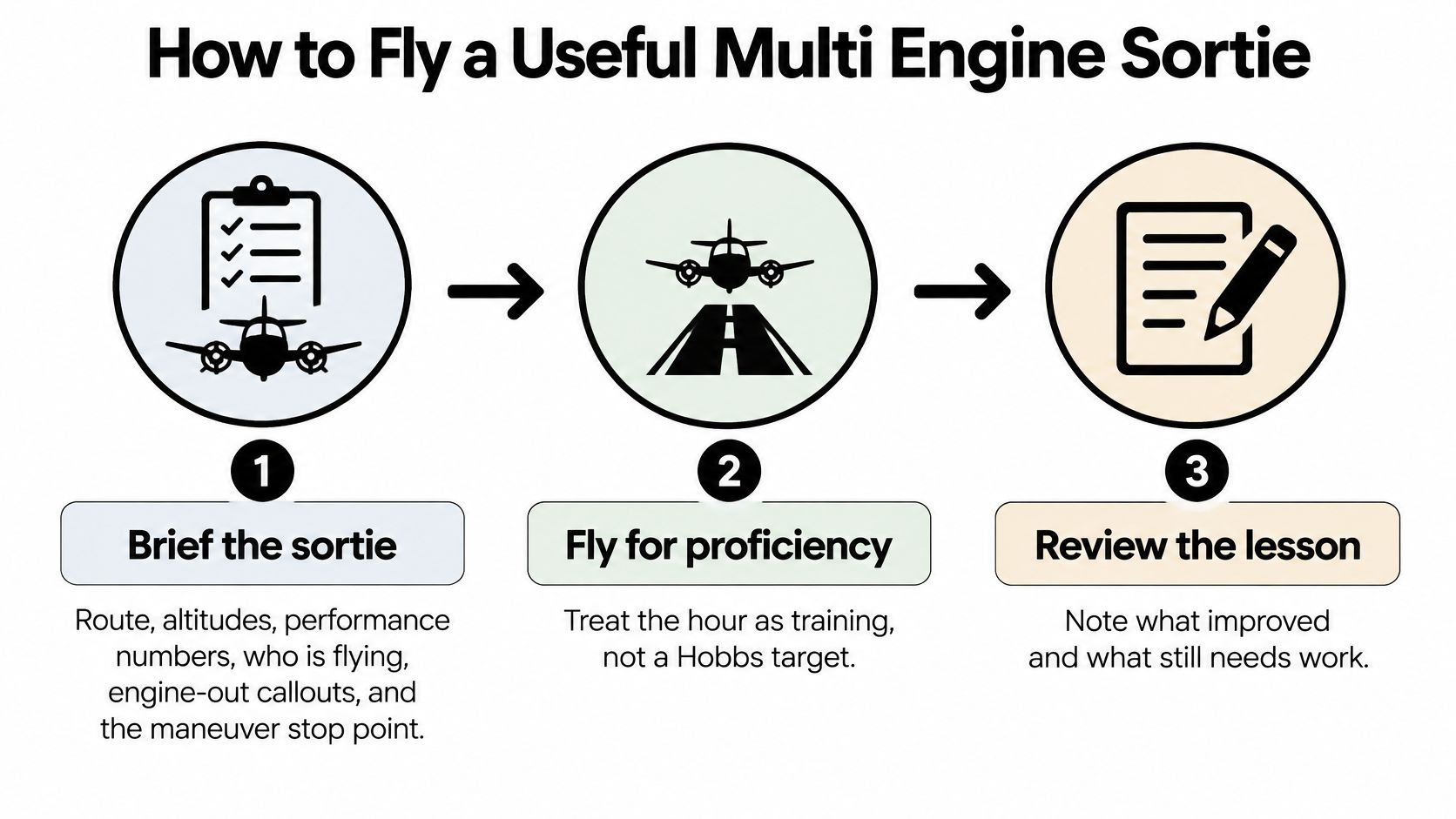
A useful sortie begins with a proficiency objective. “Practice recognizing asymmetric thrust while maintaining heading and airspeed” gives the instructor something to teach and the learner something to measure. “Add twin time” doesn't.
Brief the limits before starting
Agree on the flight. Brief the route, altitudes, weather, fuel reserves, performance calculations, and who will fly each segment. Establish engine-out callouts, how the instructor will introduce a simulation, and the conditions that end a maneuver. The learner shouldn't have to guess whether an unexpected power change is instructional or real.
Read the airplane's published speeds. The FAA Airplane Flying Handbook guidance describes minimum control speed, VMC, as the calibrated airspeed at which control can be maintained after the critical engine becomes inoperative, with no more than a 5-degree bank under the specified conditions. VMC is a controllability limit, not a speed to chase. It also isn't a promise that the airplane will climb.
Establish normal performance first. Fly a normal takeoff and departure before adding abnormal tasks. Notice the expected acceleration, control pressures, climb attitude, and engine indications. Without that baseline, a new multi-engine pilot may recognize a problem late or misread an ordinary instrument fluctuation.
Keep control ahead of checklist work
Introduce failures with a safety margin. Simulated failures belong under an authorized instructor's supervision, at suitable altitude and airspeed, using the airplane's procedures. Maintain a controllability margin above VMC. Low-altitude realism should come from briefing, carefully bounded scenarios, and suitable simulation, not deliberately creating a hazardous aircraft state.
Fly, identify, verify, then act. Maintain directional control and airspeed. Identify the affected engine using the aircraft's indications and approved procedure, verify before securing anything, and establish the published configuration and appropriate single-engine speed. Then manage navigation, communication, and checklist completion as workload permits.
Respect the performance loss. The FAA's multiengine handbook discussion explains that losing an engine removes approximately 50% of available power while reducing climb performance by roughly 80–90%. That's why hurried configuration changes and checklist fixation are dangerous. A correctly identified failure still becomes an emergency if the pilot lets airspeed decay.
Mix tasks instead of repeating the same drill. Include a normal navigation leg, an instrument approach or hold, a go-around, and a diversion when conditions permit. Keep fuel and weather reserves intact. The aim is to manage the airplane through changing demands, not remain permanently prepared for the instructor's next engine-out cue.
Debrief observable results. Compare recognition time, altitude loss, heading deviation, airspeed control, and checklist discipline. Record the lesson objective and useful details in the remarks, not just the duration. Decide what the next flight should correct.
For departure-specific preparation, study engine failure on takeoff with your instructor before attempting related scenarios. A cockpit emergency isn't the place to discover that you and the instructor expected different responses.
Pathways from the Rating to Airline Minimums
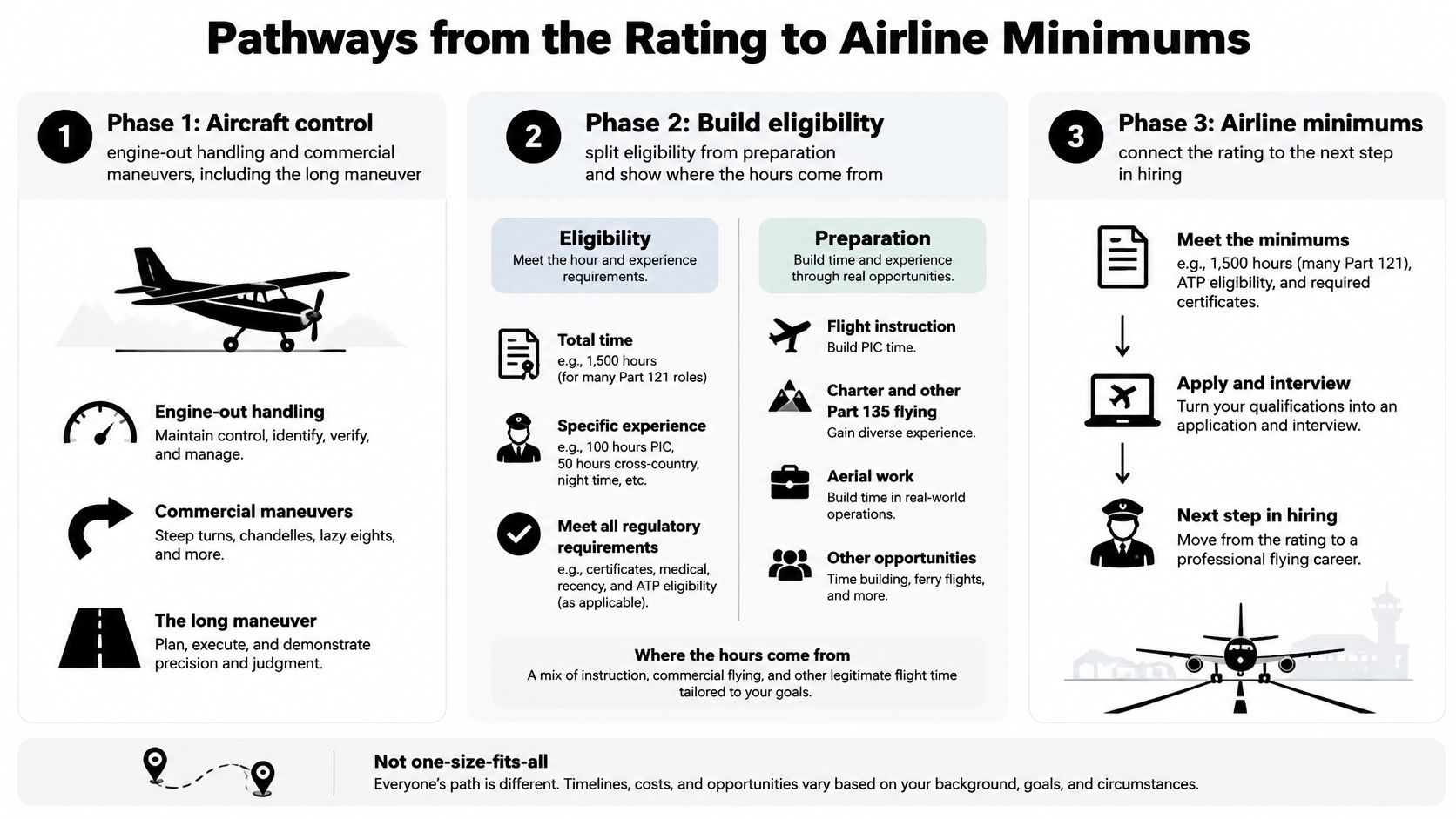
Eligibility and preparation need different plans. Eligibility means meeting the applicable experience requirements. Preparation means performing reliably when the route changes, an approach becomes unstable, or a system fails.
The FAA's pilot-certification guidance helps distinguish advanced certification requirements from initial training. A short commercial multi-engine course should be treated as the start of class-specific proficiency, not a substitute for the complete ATP pathway.
Progress through increasingly demanding work
Phase one is aircraft control. Build normal handling, asymmetric-flight control, and commercial maneuver proficiency. Where your certification route requires them, schedule the long cross-country and night tower work while the instructor is still organizing the experience around specific requirements.
Phase two is instrument workload. Practice departures, holds, approaches, missed approaches, and abnormal checklists. A learner who can handle an engine-out demonstration in an empty practice area may still struggle when asked to copy a clearance and configure for an approach.
Phase three is operational judgment. Fly cross-country legs with crew-style briefings, explicit task sharing, and repeated decisions to continue or go around. Include low-altitude decision scenarios using methods that preserve safety margins. Being comfortable at practice altitude doesn't establish readiness to choose a landing option near the ground.
Where multi-engine and airline hours actually come from
| Pathway | What it mainly builds | What can count | Limit |
|---|---|---|---|
| Commercial multi-engine course | Aircraft control, engine-out work, and applicable commercial experience tasks | Experience actually flown and documented under the applicable certification route | Earning the rating doesn't establish completion of ATP class experience |
| Instructing after CFI or CFII | Flight experience, planning, teaching, and operational decisions | Qualifying instructor time logged under 61.51 | Single-engine instruction doesn't build multi-engine time; twin students may be less available |
| PIC duties with an authorized instructor | The designated commercial experience block and its required tasks | Experience meeting the specific PIC-duties provision | It isn't permission to label every dual lesson as PIC |
| Approved full-flight simulator | Repeatable approaches, abnormal procedures, and eligible ATP experience | Credit within the applicable ATP limits through an approved program | A basic or unapproved device doesn't receive the same credit |
| ATP Certification Training Program | Academic preparation and turbine-simulator crew procedures | Completion of the prerequisite for the multi-engine ATP knowledge test | It doesn't replace the overall aeronautical-experience requirements |
Instructing can connect commercial certification to a much larger body of experience, but it isn't a guaranteed source of twin flying. An instrument instructor qualification also doesn't, by itself, authorize multi-engine instruction. Match the teaching privileges you hold to the aircraft and instruction involved.
Complete a phase when your decisions and aircraft control are consistent, not merely when the purchased block expires.
For longer-term planning, use an airline pilot career pathway to place ratings, instructor work, advanced training, and applications in sequence. Don't let the desire for multi-engine entries distract you from the experience your next actual step requires.
Hours Worth Buying and Hours to Skip
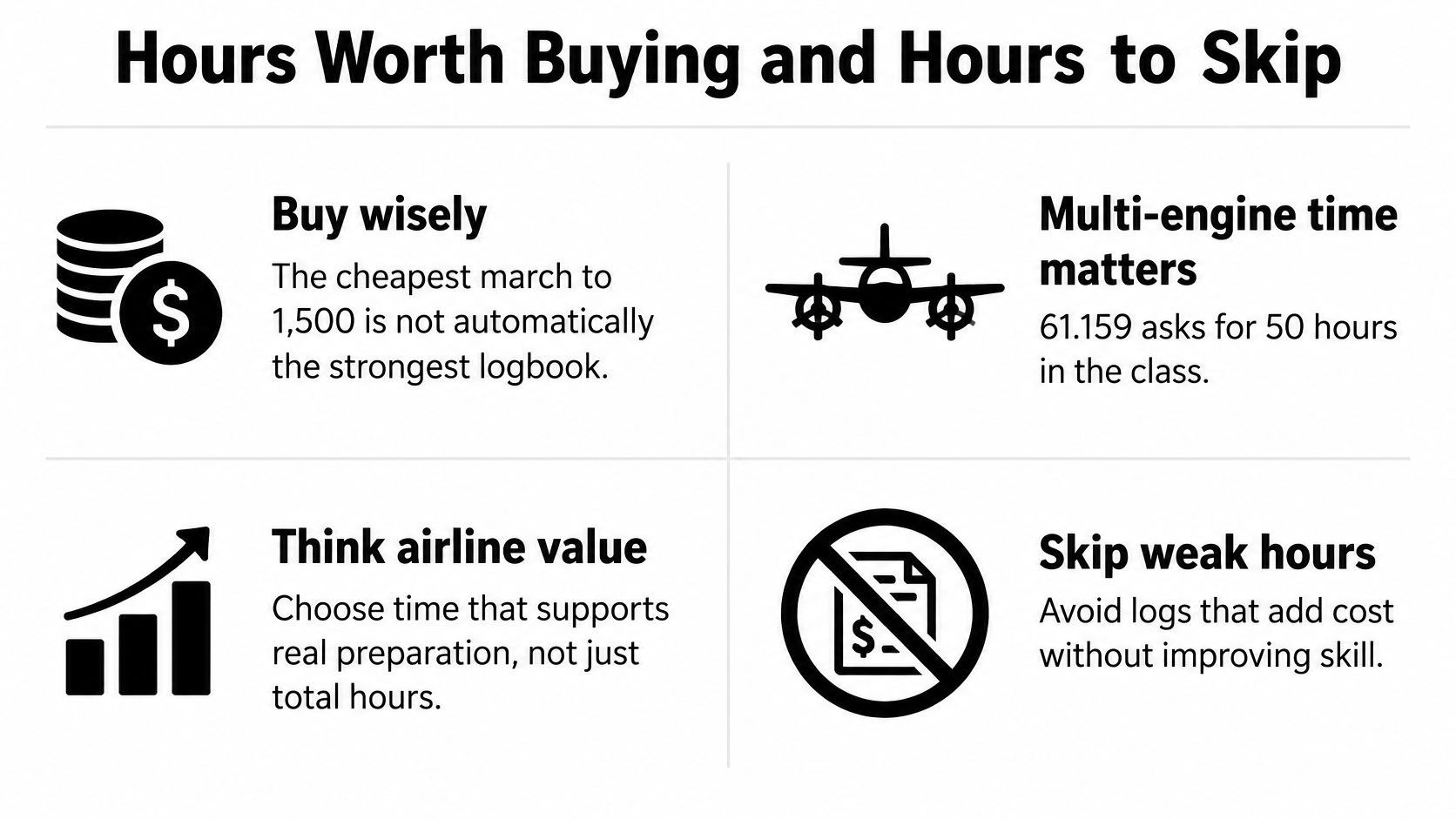
The cheapest march toward airline eligibility isn't automatically the strongest logbook. But buying expensive twin hours before identifying a shortage can be just as wasteful. Spend the next dollar on the empty column.
Under 14 CFR 61.159, the standard airplane ATP route requires 1,500 total hours and 50 hours in the class sought, alongside category-specific requirements. Multi-engine time matters, but it can't repair a shortage of qualifying PIC or cross-country experience merely by appearing in the same logbook.
Buy the flight that fixes a specific problem
Say you're comfortable handling the twin locally, but your logbook still lacks the cross-country experience needed for your application. Another familiar circuit may add class time without solving the limiting problem. A properly planned qualifying cross-country could develop navigation, fuel management, weather decisions, and the missing experience together.
Use this booking checklist:
- Fill a named requirement. Identify the exact experience category the flight will satisfy and confirm the planned route or tasks qualify.
- Restore a stale skill. Book instructor-led engine-out practice when recognition, control, or checklist execution has become hesitant.
- Support an approaching test. Preserve proficiency in the airplane and procedures you'll be evaluated on.
- Develop operational responsibility. Prefer a flight that requires planning and sound decisions over passive participation with an unclear logging basis.
- Reject duplication without purpose. Skip a repeat local flight when its only justification is making the multi-engine column larger.
Don't buy a specialized employer's minimum blindly
Employer requirements can be substantially higher than certification floors. A public-sector pilot posting, for example, paired 1,500 total hours, 250 PIC hours, and 500 multi-engine hours. That is a specialized hiring example, not a universal regional-airline standard or a reason for a beginner to purchase that much piston-twin time.
Before pursuing an employer-specific target, check whether the position fits your intended career stage. Turbine exposure, recent instrument work, documented responsibility, and the type of operation may be more relevant than another undifferentiated block in a light twin.
Useful class experience can help satisfy the ATP gate. A much larger block of aimless twin flying won't repair an otherwise incomplete application.
Keep a training budget beside the logbook audit. The practical question isn't whether you can afford the next flight, but whether it displaces a more important requirement. A plan for paying for pilot training should protect funds for completion, recency, and testing rather than allocate everything to the most impressive-looking aircraft category.
What Piston Time Does Not Prepare You For
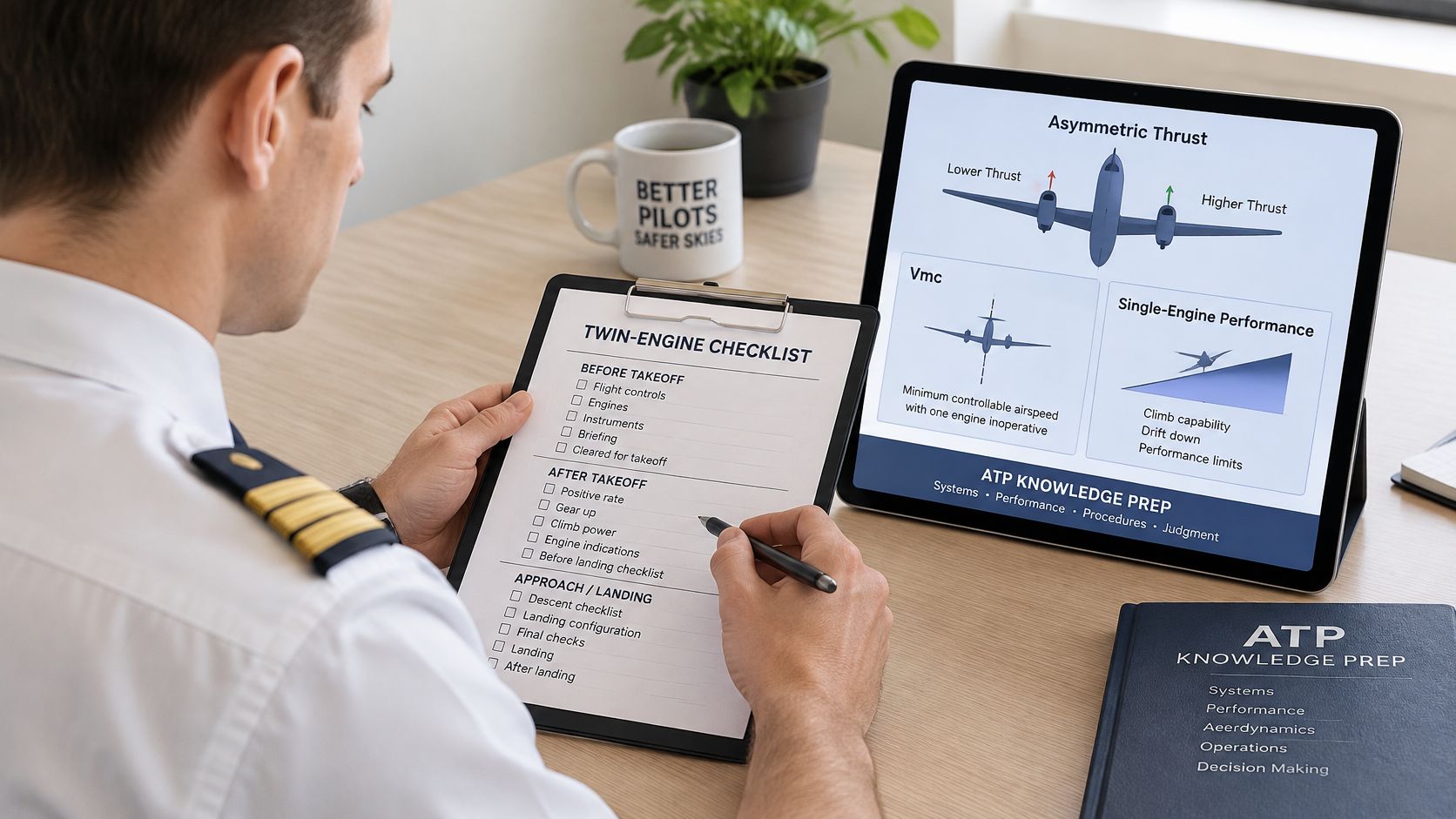
A piston twin builds a narrow set of skills. You learn to manage asymmetric thrust, respect minimum control speed, and calculate single engine climb performance. Those lessons transfer to any multi engine airplane. They do not equal preparation for turbine operations.
Turbine systems operate on different logic. Starts involve temperature limits and motoring times. Pressurization, bleed air, anti ice, and FADEC protections add layers a carbureted or fuel injected piston never shows you. A pilot comfortable with mixture levers and manual propeller controls still needs dedicated study on turbine limitations, abnormal indications, and automated system responses.
High altitude flight changes the rest of the picture. True airspeed rises while indicated margins shrink. Weather sits below you or at your level, and descent planning starts 100 miles out. Pressurized cruise, Mach effects, high altitude stalls, and reduced time of useful consciousness have no counterpart in a light twin flown at 6,000 feet.
Crew procedure is the third gap. Airline flying runs on briefings, standard callouts, monitored approaches, and a clear division of duties between pilot flying and pilot monitoring. Single pilot piston habits favor informal flow and self correction. That style breaks down in a two crew cockpit where verbal confirmation and checklist discipline control safety.
Hours in a piston twin sharpen control and build countable multi engine time. They leave turbine knowledge, high altitude performance, and crew coordination for later training. Use the guide to ATP CTP requirements to see where that later training begins and what it expects on day one.
Practice the habits that carry forward
Clear briefings carry forward. Accurate checklist use carries forward. Monitoring the other pilot, verifying selections before moving a control, and shedding low priority tasks when workload rises all carry forward. You can rehearse those habits on ordinary instrument flights today.
Keep recency matched to the next evaluation. For a multi engine checkride, stay sharp on engine failures, drag cleanup, and single engine approaches in the actual airplane. For a move into turbine training, study systems material and rehearse crew callouts so the new environment feels familiar.
Pick the Next Block and Start Logging
Pick the next block by what your logbook can prove. The largest package you can finance is a poor guide. A beginner needs to learn whether flying suits them. A certificated pilot needs a precise account of what remains unfinished before the next application or checkride.
Start with an honest inventory: total time, pilot-in-command time, multi-engine time, cross-country time, night time, instrument time, and simulator time. Separate hours that are countable from hours that built control. A block of twin time that never left the local area may satisfy a column, but it will not prepare you for a cross-country turbine environment or the ATP CTP gate later. The logbook should show both the quantity and the kind of work.
For readers seeking an integrated route, the Career Track has fixed tuition of $89,000, with multi-engine included, and takes about nine months from zero time to CFII and multi-engine. It includes 282 training hours: 204 single-engine, 25 multi-engine, and 53 simulator hours, plus one-on-one instruction. The six certificates and ratings are Private Pilot, Instrument, Commercial single-engine, Commercial multi-engine, Flight Instructor, and Instrument Instructor, with training based in Southern California at Riverside, Long Beach, and Corona.
Treat the 25 multi-engine hours as a foundation block. They should build control, systems knowledge, and single-engine handling in the twin. They are not a stand-in for the cross-country decision-making, crew coordination, or turbine training that comes later. The 53 simulator hours also need to be read for what they are: device time with specific credit rules, not airplane time.
If you already hold certificates, bring your logbook, endorsements, knowledge-test records, and a one-sentence objective to an instructor review. Ask for a written gap list. It should name the cross-country, night, instrument, or multi-engine experience your next certificate or application still requires, and the exit standard for each item. Then buy the smallest block that closes the gaps. That may be a few dual flights, a ground session, or a short multi-engine sequence. Buying a larger package before the gap list exists usually adds hours without adding a demonstrable skill.
Before you submit an application, financing request, or checkride packet, add up total time, PIC, multi-engine, cross-country, night, and instrument time separately. Reconcile the totals against the underlying entries while the instructor and flight records are still available. A discrepancy found during an application review is harder to fix than one found the week it happened.
The logbook, not the invoice, is the record an examiner and later employer will evaluate. Buy training that leaves you with both supportable entries and skills you can demonstrate.
CFII offers a structured path from zero experience through instructor and multi-engine training, so twin time sits within a complete certification plan rather than standing alone. Visit CFII to discuss your starting point and identify the training that belongs in your next logbook entry.
Planning to fly for a living?
See what the path from zero to a pilot career looks like, what it costs and how long it takes.
Learn to fly in Riverside
We train at Riverside Municipal Airport in modern airplanes with a parachute built in. Start with a one hour discovery flight, no experience needed.