
On this page
- What Pilot in Command Time Means
- Hands on the controls aren't the whole test
- Who May Log Pilot in Command Time
- Start with your qualification and actual role
- Instruction and supervision have their own conditions
- Acting as PIC Versus Logging PIC
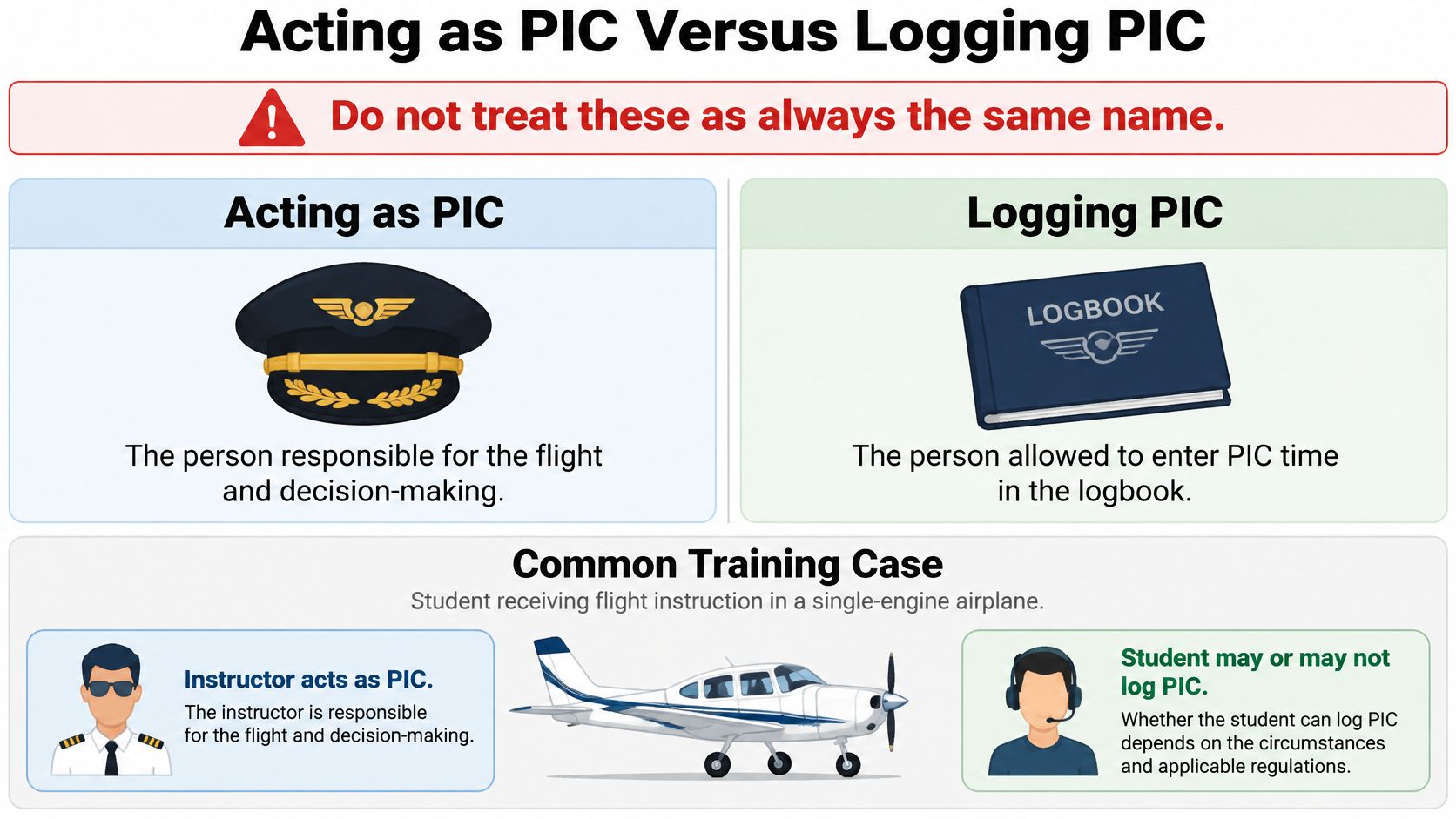
- Command and logging are separate questions
- Make the difference visible in the remarks
- SIC Time and PIC Under Supervision
- Commercial Certificate PIC Hour Rules
- A hypothetical logbook that still falls short
- Tag the entry before adding the totals
- Four Flights and What Each Pilot Logs
- Four flights, four logging decisions
- How Airlines Read PIC in a Logbook
- Show the basis in the entry
- Log Your First Hour the Right Way
Pilot in command time is a regulated logbook category under 14 CFR 61.51, not just time spent in an airplane. Acting as pilot in command and logging PIC time are different questions.
You might be getting ready for your first lesson, looking at an empty logbook and wondering which columns will start filling up. Your instructor lets you steer, climb, and turn, so it seems reasonable that the flight should count as command experience. Before you enter anything, separate what you did with the controls from the legal role you held.
What Pilot in Command Time Means
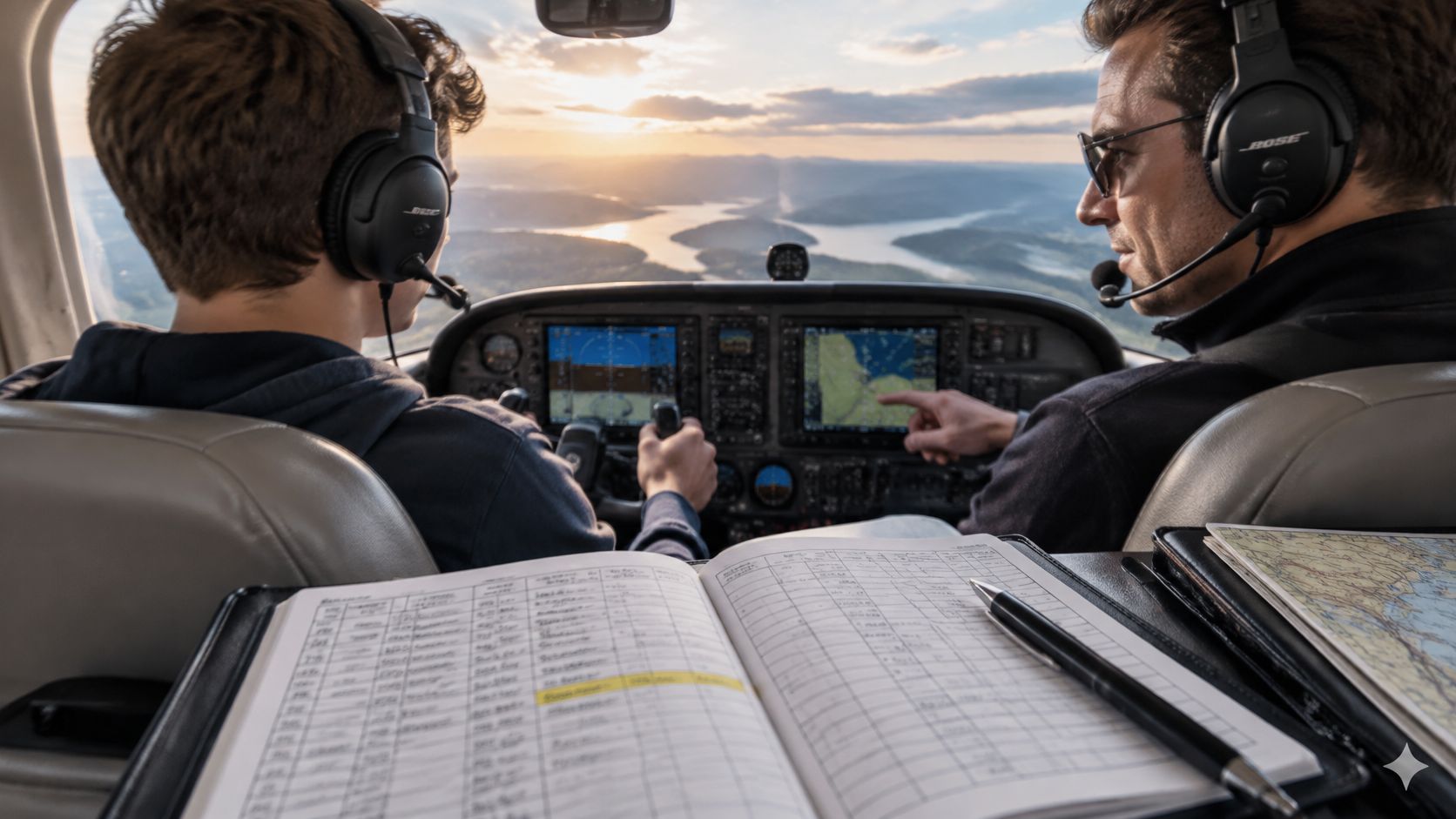
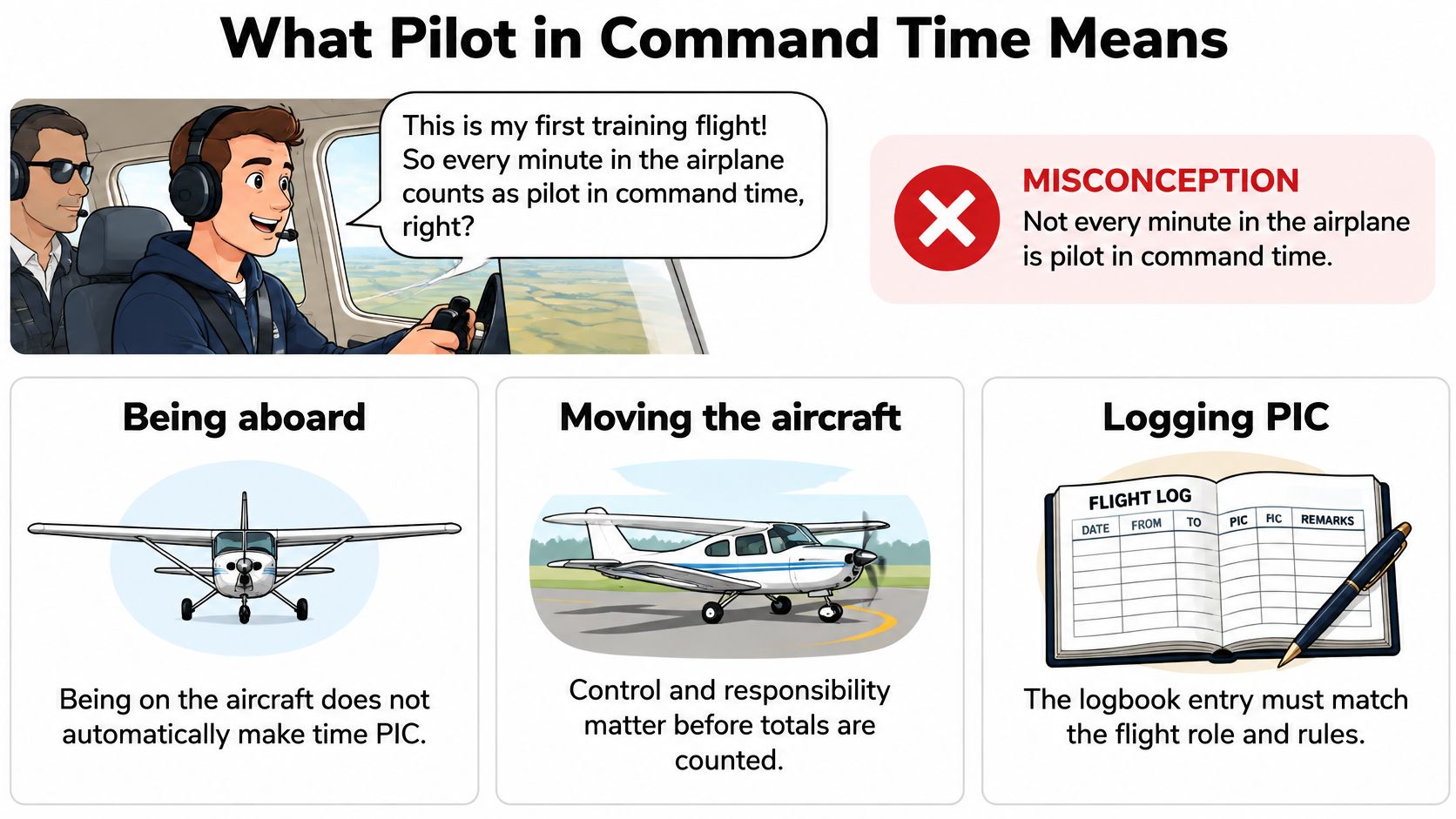
On your first training flight, you settle into the seat, put on a headset, and follow the instructor's directions. After takeoff, the instructor gives you the controls. You're flying the airplane, but that doesn't automatically make you its legal commander.
Under 14 CFR 1.1's definition of pilot in command, the PIC has final authority and responsibility for the operation and safety of the flight, is designated as PIC before or during the flight, and holds the appropriate category, class, and type rating when applicable. That definition concerns responsibility, not just whose hands are on the controls.
These are separate roles, even when they happen in the same cockpit.
Hands on the controls aren't the whole test
Think of a learner driver taking a lesson. Holding the steering wheel doesn't, by itself, transfer every legal responsibility from the instructor to the learner. In an airplane, you likewise need to distinguish being aboard, manipulating the controls, and being designated PIC.
Receiving instruction is another role. A pilot can receive instruction while also qualifying to log PIC, but a beginning student shouldn't assume that overlap applies.
- Being aboard: You occupy a seat, which alone creates no logging privilege.
- Flying: You manipulate the controls, which may support PIC logging if you meet the relevant qualifications.
- Commanding: You hold responsibility for the flight, including its safe conduct and compliance with operating rules.
Make that distinction before you start accumulating totals. Certificate applications, instructor employment, and airline applications use specific logbook categories, and an unsupported label can be difficult to explain later. The practical test is whether your flight fits a PIC logging provision.
Who May Log Pilot in Command Time
| Situation | Log PIC? | What must be true | Rule |
|---|---|---|---|
| Rated pilot is sole manipulator of the controls | Yes | Pilot holds the applicable aircraft rating or qualifying privileges | 14 CFR 61.51(e)(1)(i) |
| Rated pilot is the sole occupant | Yes | No other person is aboard | 14 CFR 61.51(e)(1)(ii) |
| Pilot is acting as PIC and more than one pilot is required | Yes | Type certificate or operating rule requires more than one pilot | 14 CFR 61.51(e)(1)(iii) |
| Commercial or ATP performs PIC duties under supervision | Yes, only if every condition is met | Proper certificate and rating, approved PIC training, and supervising-PIC logging and certification | 14 CFR 61.51(e)(1)(iv) |
| Certificated instructor serving as authorized instructor | Yes, for all that flight instruction time | Instructor is rated to act as PIC of that aircraft | 14 CFR 61.51(e)(3) |
| Student pilot on an airplane solo | Yes, solo only | Sole occupant, required solo endorsement, and training toward a certificate or rating | 14 CFR 61.51(e)(4) |
| Passenger, observer, or pilot meeting none of the rows above | No | Being aboard isn't a logging basis | 14 CFR 61.51 |
Match your flight to a row before entering PIC. 14 CFR 61.51 establishes these logging bases, with a substantially consistent framework across the 2011, 2016, and 2022 rule texts: qualification, control, and responsibility determine the entry.
Start with your qualification and actual role
The sole-manipulator provision applies to sport, recreational, private, commercial, and airline transport pilots within the rule's rating or privilege requirements. Say you hold a private airplane single-engine land rating and fly the controls of an appropriate airplane. Your basis is sole manipulator, not merely occupying the left seat.
The sole-occupant provision is separate. A certificated pilot flying alone can use that basis, while a student must satisfy the student-specific solo provision. Don't use the rated-pilot row to bypass a missing student endorsement.
The required-multiple-pilot row needs both facts: you're acting PIC, and the aircraft's certification or operating rule requires another pilot. Bringing a pilot friend along doesn't create that requirement.
Instruction and supervision have their own conditions
Supervised PIC isn't ordinary practice with someone experienced beside you. The commercial or airline transport pilot must meet the certificate, aircraft-rating, approved-training, and supervising-PIC documentation conditions.
An authorized instructor has a different basis. If rated to act as PIC of the aircraft, the instructor may log PIC for flight time spent providing authorized instruction. The flight instructor requirements help distinguish holding an instructor certificate from being qualified to provide the particular instruction.
For an airplane student, the solo row is narrow: sole occupant, proper endorsement, and training toward a certificate or rating. During a dual lesson, the student can't substitute substantial control time for those conditions.
Before entering PIC: Name the row, identify the qualification, and confirm the portion of the flight it covers.
A blank PIC column doesn't necessarily mean a blank flight entry. Keep legitimately loggable total time and training received even when PIC stays zero. A passenger or observer, however, shouldn't turn the ride into total pilot time either.
Acting as PIC Versus Logging PIC
A private pilot receiving instruction in an airplane for which the pilot is rated may manipulate the controls while the instructor agrees to act as PIC. During that flight, the private pilot may log PIC under the sole-manipulator provision in 61.51(e)(1)(i). The instructor may log PIC for the time spent providing authorized instruction under 61.51(e)(3). One flight, two separate logging bases, and one designated commander.
Command and logging are separate questions
The instructor remains the designated commander in this example, while both pilots may have valid PIC entries for the instructional time. Each pilot must meet their own basis under 61.51. The student's entry does not transfer the instructor's qualifications, or vice versa.
Now reverse the situation. A student who has not earned a private certificate flies most of a dual lesson, including the approach and landing. The student still cannot log that time as PIC under the student-solo provision: for an airplane student, that basis requires solo flight. The instructor may log PIC for the authorized instruction provided, if qualified to act as PIC.
Command identifies who is responsible for the flight. The logbook entry identifies which 61.51 provision supports the time.
A designated commander also needs a valid logging basis. For example, if a rated pilot manipulates the controls in a single-pilot airplane, the designated commander who is not instructing cannot rely on the designation alone to log PIC. The applicable provision must support that entry.
Make the difference visible in the remarks
Use the remarks field to record the training performed and, when relevant, who acted as PIC. In the first example, the rated pilot could note that the instructor acted as PIC while the pilot logged sole-manipulator time. This makes the reason for each PIC entry clear without treating the whole lesson as one person's PIC time.
If the instructor took the controls for part of the lesson, describe that portion accurately rather than labeling the entire flight the same way. Clear remarks help distinguish a student's ordinary dual instruction from a rated pilot's valid sole-manipulator entry.
Before signing, put the entry into one sentence: who commanded, what you did, and which 61.51 provision supports your PIC time. If those details do not fit together, review the entry with your instructor while the flight is fresh.
SIC Time and PIC Under Supervision
A second-in-command (SIC) is a qualified crew role with its own logging basis. Under 14 CFR 61.51(f), the pilot must be qualified and serve in a role that requires a second pilot. In a multi-crew operation, that requirement comes from the aircraft's type certificate or the rules governing the flight.
For example, a pilot assigned SIC duties on a flight that requires two pilots may log SIC time if qualified. Sitting beside a friend in a single-pilot trainer does not create that role. Neither does handling the radio, reading a checklist, or helping find an airport. Those tasks may support the flight, but they do not make the flight a required-crew operation.
| Role | Legal command | What can be logged | Where it usually appears |
|---|---|---|---|
| Second in command | The designated PIC retains final authority | SIC when qualified and serving in a required SIC role | Multi-crew operations |
| PIC under supervision | Supervising PIC retains command | PIC under the formal supervised-PIC provision | Approved supervised flying |
PIC under supervision under 61.51(e)(1)(iv) is a formal pathway for a qualified commercial or airline transport pilot performing PIC duties under supervision. The qualifications, program, and certification requirements are described in the previous section. For the logbook entry, keep the required certification with the record. A captain's compliment after a well-flown leg, or an informal agreement to practice command decisions, does not establish the required documentation.
For ordinary small-airplane instruction, record the lesson according to the roles and logging provisions that applied. In required multi-crew flying, identify whether you served as SIC or logged PIC under an approved supervised-PIC program. Keep the supporting certification with the entry rather than trying to reconstruct it when an application is due.
Aircraft crew roles also do not transfer automatically to simulator entries. The device, its approval, and the task performed determine what training credit may apply. Use the FAA-approved flight simulator guidance to understand why simulator training credit and aircraft PIC flight time are separate categories.
Maintain separate totals for total flight time, PIC, cross-country PIC, instrument, multi-engine, and SIC. Identify supervised PIC in its own field or remarks so a reviewer can distinguish it from solo or ordinary sole-manipulator flying. Clear records show what each hour represents and which logging basis supports it.
Commercial Certificate PIC Hour Rules
| Category | Minimum | What counts | Easy way to miss it |
|---|---|---|---|
| Total flight time as a pilot | 250 hours | Flight time as a pilot, subject to the regulation's details | Treating the grand total as the only requirement |
| Powered aircraft | 100 hours | At least 50 of those hours in airplanes | Failing to separate aircraft categories |
| PIC flight time | 100 hours | Time meeting a PIC logging provision | Calling ineligible student dual PIC |
| PIC in airplanes | 50 hours | The airplane portion of PIC time | Relying only on PIC in another aircraft category |
| Cross-country PIC | 50 hours | Includes at least 10 hours in airplanes | Counting local flying that doesn't meet the applicable definition |
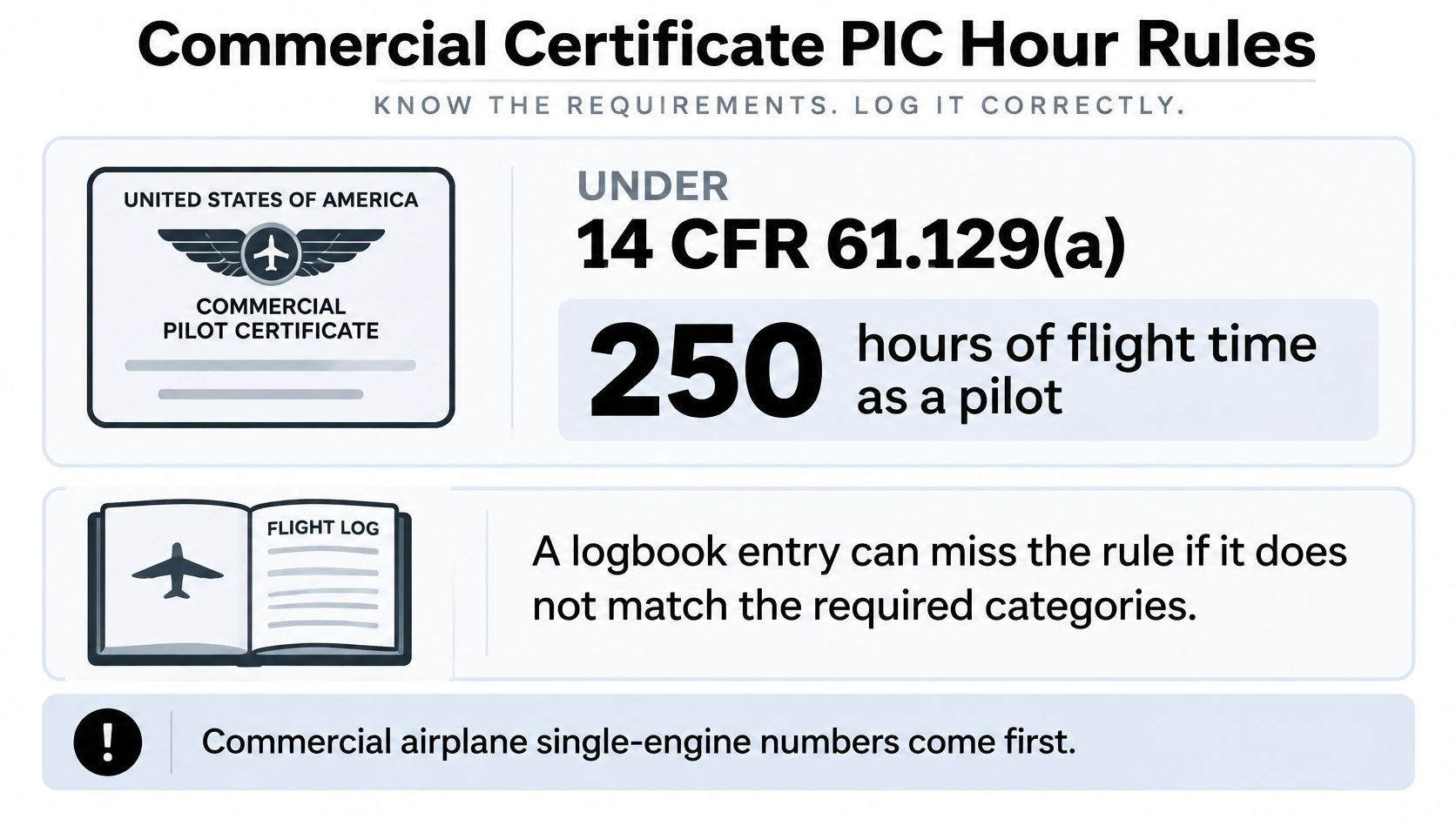
For an airplane single-engine commercial certificate, 14 CFR 61.129(a) sets the 250-hour total, 100-hour powered-aircraft, 100-hour PIC, and nested airplane and cross-country minimums shown above, subject to its specified alternatives and details.
These rows overlap, but they aren't substitutes. An eligible airplane cross-country flight can contribute to several relevant totals; local PIC cannot become cross-country merely because you need that category.
The certificate requires a properly sorted record, not just a sufficiently large final number.
A hypothetical logbook that still falls short
Suppose a pilot has 260 total hours, 70 PIC hours, and 30 cross-country PIC hours. That hypothetical pilot exceeds the overall flight-time minimum but remains 30 PIC hours and 20 cross-country PIC hours short.
Those shortages needn't require separate flights for every category. A properly planned, qualifying cross-country PIC flight can advance both PIC totals. But the pilot must still satisfy the airplane-specific portions and every other applicable requirement.
Planning habit: Choose the flight for the category you need, then verify that the completed flight actually qualified.
A large amount of dual before PIC eligibility won't solve the PIC shortage. Likewise, repeated local pattern practice can improve landings without filling a cross-country PIC requirement.
Tag the entry before adding the totals
Record category and class, whether the time qualifies as PIC, and whether it meets the cross-country definition applicable to the certificate sought. Don't classify every landing away from home as certificate-qualifying cross-country.
The regulation also contains training, solo or specified duties-of-PIC, and practical-test preparation requirements. This table sorts the principal flight-time categories; it isn't the entire commercial eligibility checklist.
For financial planning alongside the logbook review, the commercial pilot license cost guide addresses the training decision from a different angle. Paying for more flight time won't correct a category error unless the next flight earns the missing experience.
After shutdown, update total flight time, airplane PIC, and cross-country PIC separately. Check the entry against the aircraft and route while you still remember what happened, rather than discovering a missing category when preparing your application.
Four Flights and What Each Pilot Logs
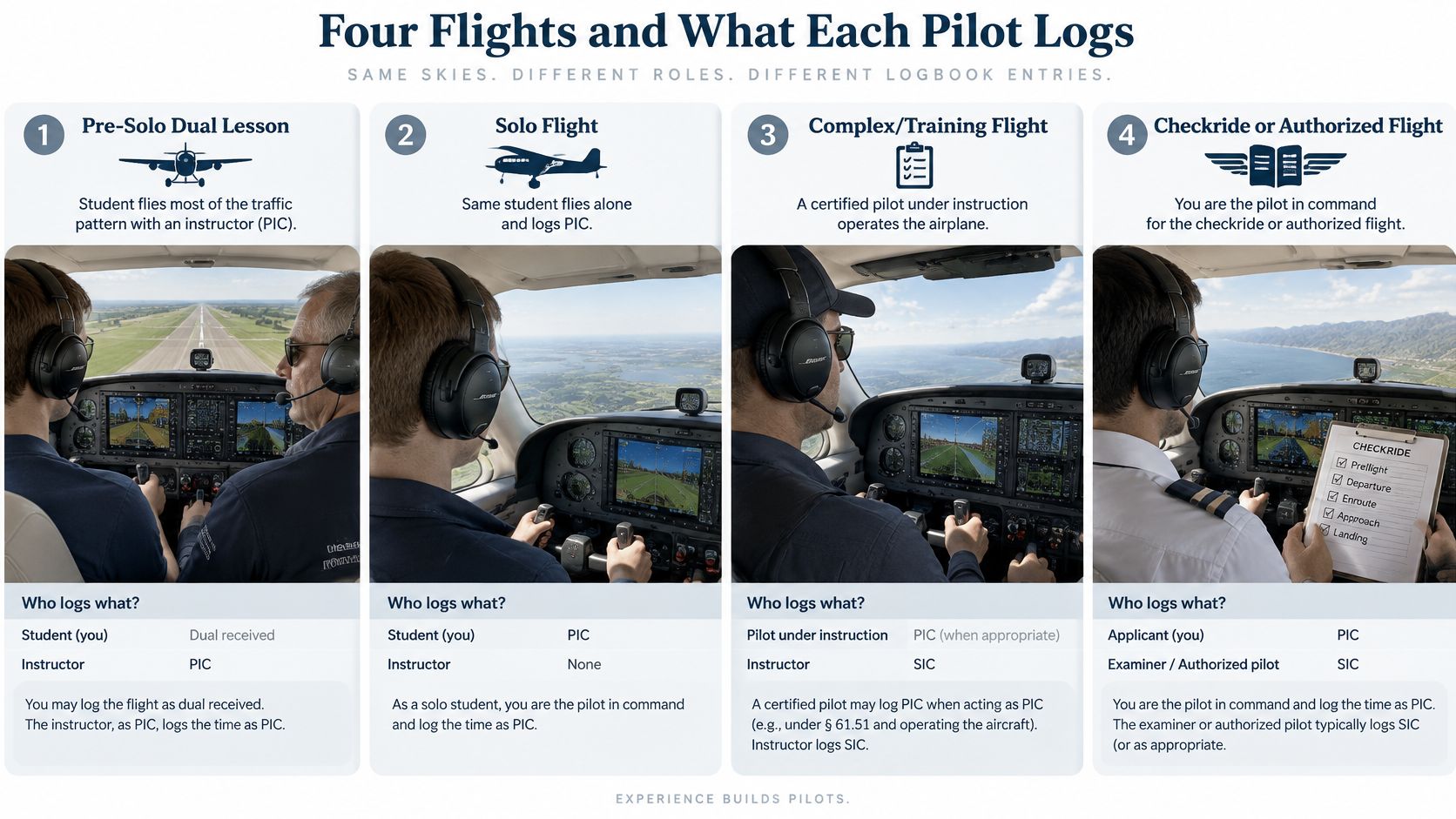
During one lesson, a student flies the pattern, then the instructor takes the controls to demonstrate a maneuver. The student is still receiving training, but the logbook entry depends on who is acting as PIC and which rule permits each person to log time. Acting as PIC and logging PIC answer different questions.
Four flights, four logging decisions
Pre-solo dual, including an instructor demonstration. A student flies most of the traffic pattern while an appropriately rated instructor gives instruction and acts as PIC. The student records total flight time and training received, not PIC. The instructor records instruction given and PIC under 61.51(e)(3). If the instructor takes the controls to demonstrate a maneuver, that does not change the student's entry: the lesson remains dual instruction, and the instructor's PIC basis remains the same.
First solo. After receiving the required endorsement, the student flies alone while training toward the private certificate. The student records total flight time, solo, and PIC under 61.51(e)(4). Keep the solo entry separate from any dual instruction before or after it. An instructor watching from the ground does not log the student's solo as the instructor's own flight time.
Local flight with a friend. A qualified private pilot acts as PIC and flies the controls throughout a local flight. That pilot records total flight time and PIC under the sole-manipulator provision, 61.51(e)(1)(i). The friend records no flight time just for occupying the other seat. Holding a certificate alone does not create a loggable role.
Simulated instrument flight with a safety pilot. One rated pilot flies under a view-limiting device as sole manipulator and may log PIC under 61.51(e)(1)(i), along with simulated instrument time for the qualifying portion. Under 91.109(b), the flight requires a qualified safety pilot. If that pilot agrees to act as PIC, the safety pilot may log PIC under 61.51(e)(1)(iii) for the portion requiring the additional pilot.
When the hood comes off, reassess the basis for each entry. Ordinary taxi, takeoff, and visual flying do not automatically give the safety pilot PIC or SIC time. In the remarks, identify the safety pilot and mark the simulated-instrument portion. The key distinction is visible here: a person can be acting as PIC for a portion, while another pilot may also log PIC under a separate 61.51 provision. Don't extend either entry beyond the portion its rule supports.
How Airlines Read PIC in a Logbook
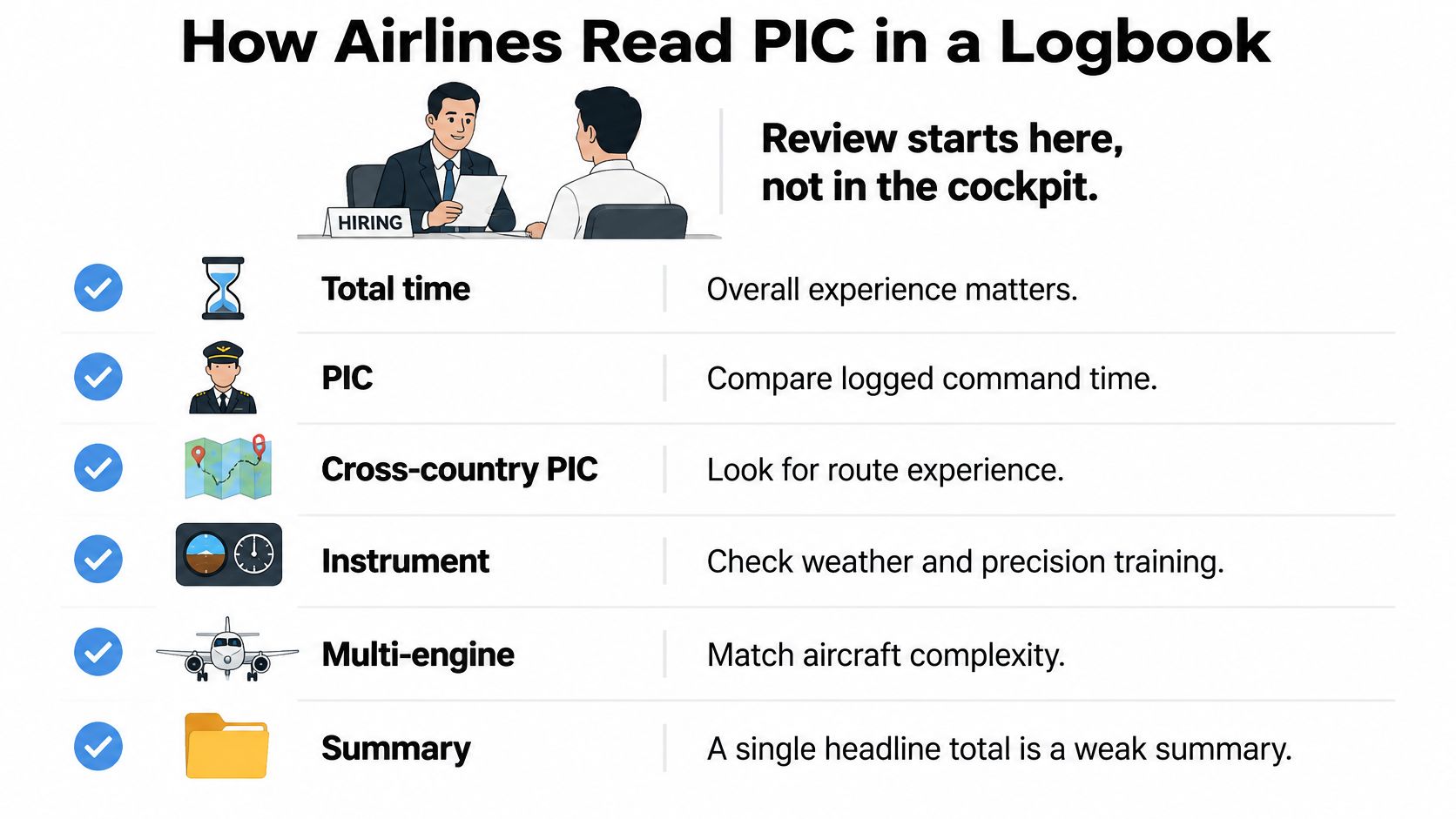
An airline reviewer comparing a logbook summary with its entries is checking whether each total has a clear basis. The summary may list total time, PIC, cross-country PIC, instrument, multi-engine, and supervised PIC separately. Each number should be traceable to entries that support that category.
The Bureau of Labor Statistics' airline and commercial pilot overview describes relevant qualification requirements that include at least 50 hours of cross-country flight time as PIC and at least 40 hours of instrument experience. These are different categories. A flight does not automatically qualify for every column just because it appears in the logbook.
A reviewer may check the summary against the individual records. If a pilot reports supervised PIC but the entries show only routes and aircraft registrations, the reviewer cannot see the training basis or the supervising PIC's certification. When the summary and entries disagree, the entries need to explain how the reported total was earned.
Show the basis in the entry
Consider a flight with an authorized instructor. An entry that identifies the instructor and records instruction received gives a reviewer a basis for accepting the training time. An entry that labels the same flight “PIC” without a qualifying basis does not become valid just because an instructor was aboard. The reviewer needs the logbook to support the category claimed, not merely describe the flight.
Before submitting an application, compare its requested categories with the entries that support them:
- PIC basis: Identify the applicable rule for each kind of PIC time reported.
- Cross-country classification: Check that the flight meets the definition relevant to the certificate or application.
- Instrument separation: Record instrument experience separately. Instrument training alone does not establish PIC time.
- Supervised-PIC records: Keep the certification and supporting records needed to substantiate the time.
The airline pilot career guide can help place logbook records in the context of a training plan. It does not replace the entries themselves.
Unsupported totals can prompt questions about eligibility, even when the flights took place. Keep the original records, correct errors transparently with appropriate guidance, and make each entry clear enough to show what the pilot did and why the time qualifies.
Log Your First Hour the Right Way
On a discovery flight, the instructor ordinarily acts as PIC while the student receives instruction. The student should expect to log eligible total flight time and dual received, not PIC time just for being at the controls. Acting as PIC and logging PIC are separate questions: the first asks who held responsibility for the flight; the second asks whether a provision of 14 CFR 61.51 allows the time to be recorded as PIC.
Use the flight details to choose the entry. If you are receiving instruction, record the training received and the flight time that qualifies. Add PIC only when your role and the applicable rule support it. A program's total training hours do not automatically count as aircraft PIC time.
CFII offers a discovery flight for a first flight, and its guide to pilot license types explains the certificates and ratings pilots may pursue.
Make the logbook entry while the lesson is clear. Follow this short sequence:
- Record the flight: Enter the qualifying flight time and describe the lesson.
- Check each category: For every column, identify the rule that allows the time to count there. If you received instruction, record it as dual received when applicable.
- Complete the record: Confirm that the description and any required instructor endorsement are present.
For example, an instructor-led discovery flight may support total flight time and dual received, while the instructor logs PIC. On a later solo, the student may log PIC when the applicable student-pilot requirements are met. The pilot's role in each flight, not the size of the total, determines what belongs in the PIC column.
Planning to fly for a living?
See what the path from zero to a pilot career looks like, what it costs and how long it takes.
Learn to fly in Riverside
We train at Riverside Municipal Airport in modern airplanes with a parachute built in. Start with a one hour discovery flight, no experience needed.