

On this page
- What Flight School Reviews Can and Cannot Tell You
- Read the school's response, too
- The Flight School Review Scorecard
- Weight the score for your goal
- Test the exit terms before entering
- Part 61 and Part 141 Credentials to Verify
- Verify the person teaching you
- Matching Review Evidence to Your Starting Point
- You've never flown
- You want to fly for enjoyment
- You already hold a private certificate
- You must relocate for career training
- Reading Reviews for Delays, Pauses and Completion Time
- Separate readiness from certification
- Read pause stories as continuity evidence
- Checking Program Hours Against Airline Minimums
- Compare the training endpoint with the career endpoint
- Confirm the Order of Questions Before You Enroll
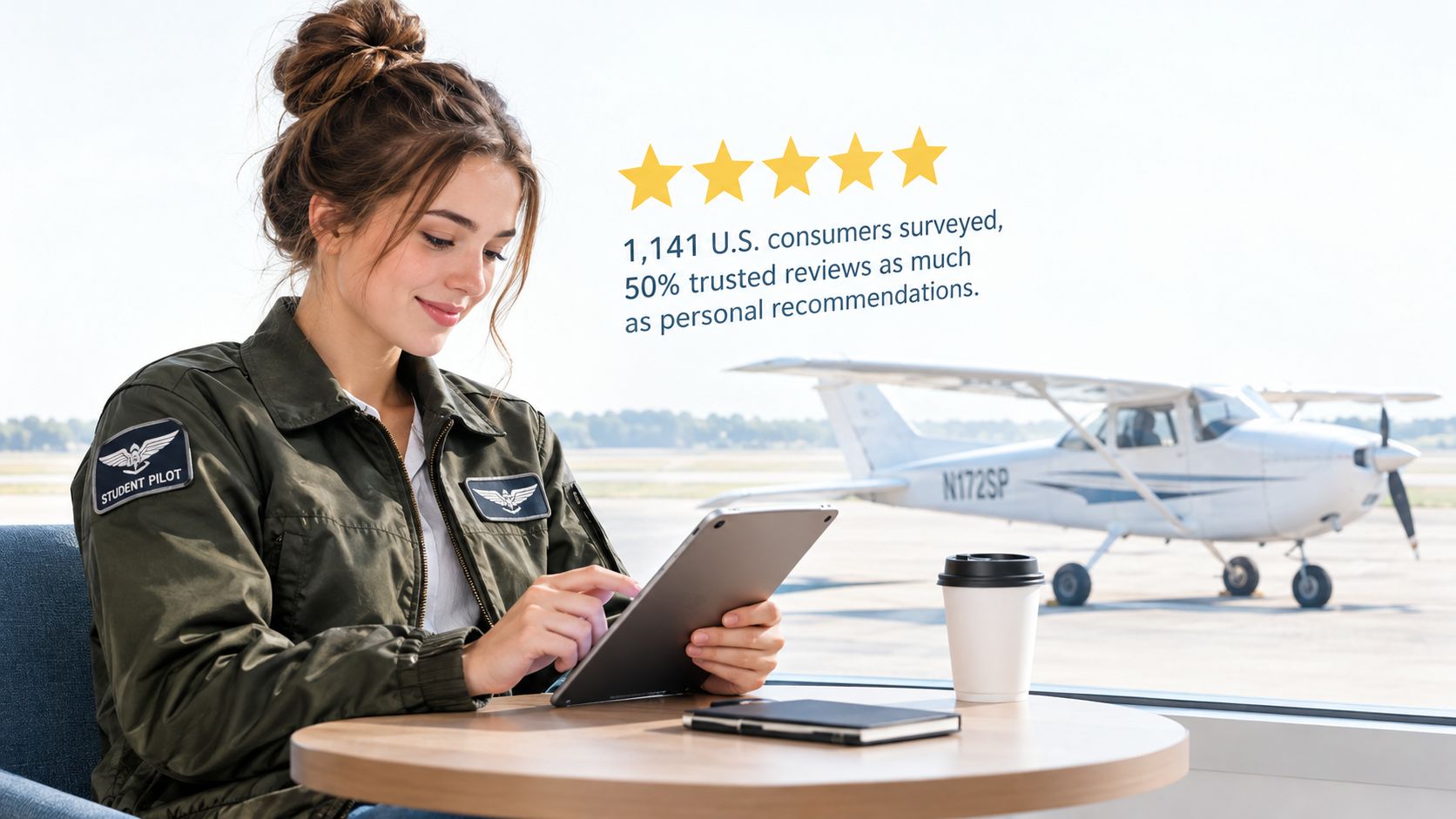
In BrightLocal's 2024 Local Consumer Review Survey of 1,141 U.S. consumers, 50% trusted online reviews about as much as personal recommendations, up 4 percentage points from the previous survey. That measures consumer trust, not whether flight-school claims are true. For an aspiring career pilot, the useful question isn't which school earns the warmest praise. It's which school can substantiate what students say.
What Flight School Reviews Can and Cannot Tell You
Flight training is a substantial commitment of money, time and attention. You're choosing instructors, aircraft access, scheduling practices and a safety culture, not just buying flight hours. Financing terms and the support available when progress stalls deserve the same scrutiny as cockpit photographs.
Flight school reviews reveal patterns. They don't establish audited averages. A graduate's enthusiastic account can describe a genuine success without showing what happened to students who paused, transferred or never reached a practical test.
Use these credibility tests before giving a review much weight:
- Specific detail: Look for the aircraft flown, training stage, month and explanation of what the instructor or school did.
- Recency: Separate current operating conditions from comments about instructors or aircraft that may no longer be there.
- A spread of experiences: Read accounts from beginners, advanced students and people who stopped, rather than relying on a cluster of nearly identical glowing posts.
The review itself is only part of the evidence. Your own visit gives you a chance to compare the description with the operation.
Read the school's response, too
A useful response to criticism addresses the issue: how reassignment works, where refund terms appear or how scheduling problems were resolved. Privacy may prevent a school from discussing an individual student, but it doesn't prevent explaining its policy.
A vague apology isn't proof of poor training. An aggressive response isn't evidence that the student was wrong.
Practical rule: Treat a review as a lead to investigate, not permission to skip verification.
Give any single account limited weight. Build your decision around operational evidence, regulatory credentials, your starting point, realistic timelines and the hours your career goal actually requires.
The Flight School Review Scorecard
Scorecard criteria and the evidence that confirms each
| Criterion | What a credible review describes | Evidence to request |
|---|---|---|
| Instructor quality | Specific teaching feedback and a consistent instructor across stages | Instructor roster, turnover rate, reassignment procedure |
| Aircraft availability | Aircraft available on booked days, with maintenance downtime explained | Fleet age, students per airplane, maintenance summary |
| Schedule reliability | Lessons happen as booked, and weather cancellations are recovered | Cancellation rate, make-up lesson policy |
| Checkride coordination | Tests scheduled promptly and examiner delays handled clearly | Median wait from checkride-ready to test, rescheduling policy |
| Cost predictability | Total spent matches the quoted price | Total price in writing, exclusions, examiner fees |
| Progress and completion | Students reach milestones at the stated pace | Median hours per certificate, share needing extra hours |
| Refund and pause policy | Students who paused or stopped report clear terms | Written refund terms, pause rules, charges when an aircraft or lesson is unavailable |
| Credentials and structure | Clear certificates and a logical training sequence | Part 61 or Part 141 status, applicable FAA approval basis |
Apply a 1-to-5 evidence score to each criterion. This is a comparison method, not a published school rating: the lowest score means an unsupported claim, the middle means documented policy with limited outcome evidence, and the highest means current records supported by consistent student accounts. Mark missing information separately rather than treating silence as proof of failure.
In AOPA's flight-training experience survey, educational quality accounted for nearly half of the overall assessment. That makes teaching quality central, but it doesn't make operational problems irrelevant. A review praising an instructor while describing repeated cancellations can indicate strong instruction inside an unreliable operation.
Weight the score for your goal
For career training, give instructor quality and measurable progress the greatest influence. If you must finish before returning to work or relocating again, scheduling and checkride coordination deserve greater weight.
We recommend asking every school, including CFII, about airplane age, students per airplane, instructor turnover, total price in writing, regulatory structure and whether you can fly before committing. Use the guide to choosing a flight school to organize those answers, but keep the supporting documents alongside your notes.
Test the exit terms before entering
Ask the school to calculate hypothetical withdrawal costs at hour 10 and hour 40, using its actual contract. Include completed training, administrative charges, unused funds and the refund deadline. These are comparison scenarios, not assumed refund entitlements.
Our First Milestone Guarantee allows students to discontinue for any reason before about 20 hours of flight time, paying only for logged flight time at $200 per flight hour, with additional payments refunded. Get the applicable written terms before paying.
Finally, don't award progress points because a reviewer liked the fleet. Attractive aircraft tell you nothing about whether that student completed stage checks, received useful feedback or finished the intended rating.
Part 61 and Part 141 Credentials to Verify
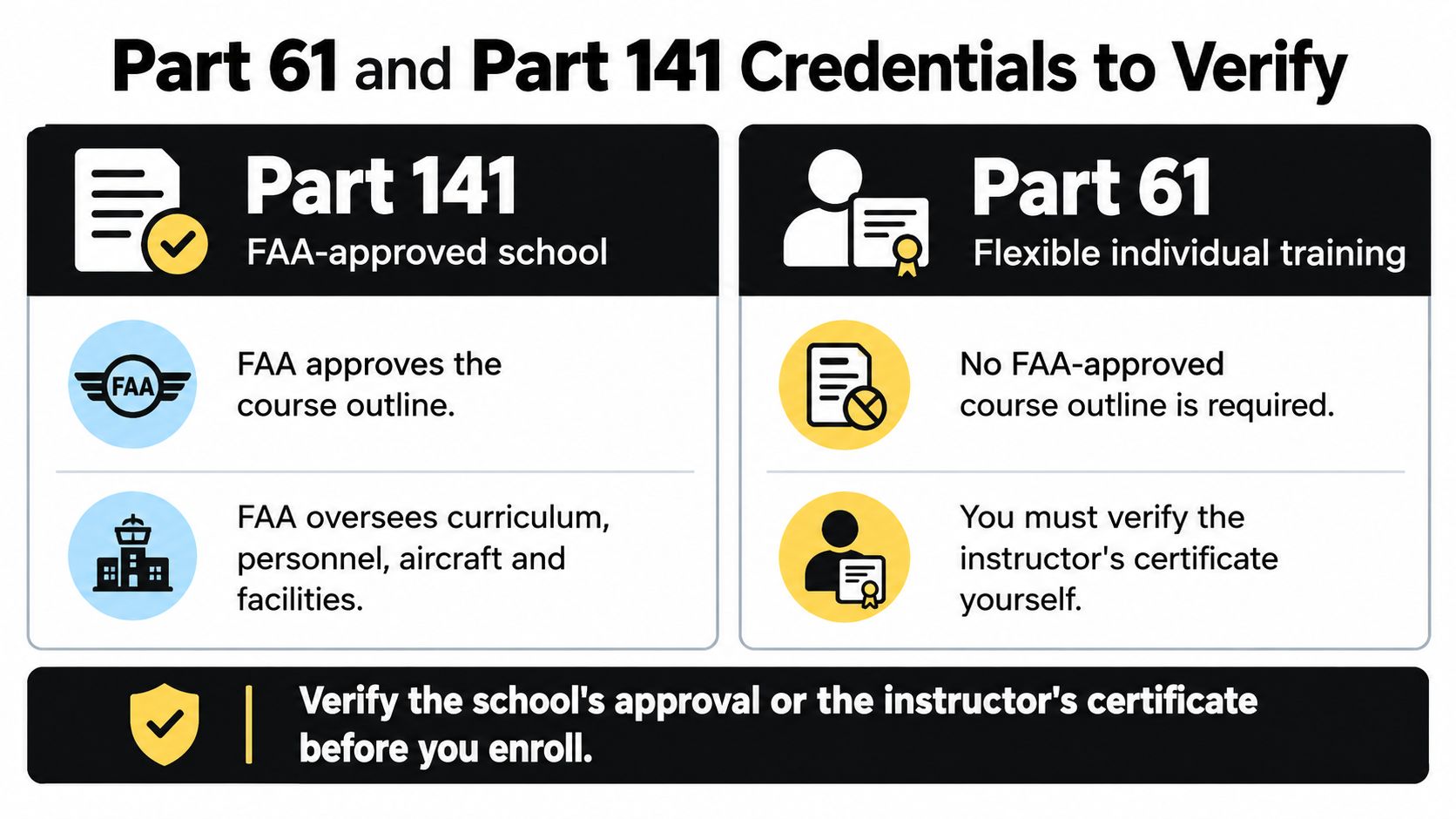
Part 61 and Part 141 describe regulatory structures, not quality rankings. Under Part 141, the FAA approves a school's course outline and oversees its curriculum, personnel, aircraft and facilities. Under Part 61, training doesn't require a school-wide FAA-approved course outline, so instructor qualifications and individual training records become especially important.
The FAA's Part 141 modernization overview describes this oversight and reports that approximately 77% of private-pilot training occurs outside Part 141. A school operating under Part 61 isn't outside FAA rules.
Part 61 and Part 141 at a glance
| Factor | Part 61 school | Part 141 school |
|---|---|---|
| Curriculum | Set by school or instructor, with flexibility | FAA-approved course outline followed under its approval |
| Oversight | Individual instructor and training records; no school-wide Part 141 approval | FAA oversees curriculum, personnel, aircraft and facilities |
| Share of U.S. private-pilot training | Majority of training | Minority of training |
| Review question to ask | Who signs off progress, and how are records kept? | Which approved course covers this rating, and is it current? |
| Credibility check | Logbook endorsements and training records | FAA approval documentation and examining authority status |
A review praising flexibility may describe a good Part 61 fit. A review praising standardized progression at a Part 141 school should match the approved course the student attended. Neither description proves that aircraft or instructors will be available when you need them.
Use the distinction below when asking for documentation.
Verify the person teaching you
Under 14 CFR 61.183, the FAA's AC 61-65K explains that flight instructor applicants need an appropriate commercial or airline transport pilot certificate, applicable instrument privileges, required training and practical-test endorsement, and at least 15 hours of pilot-in-command time in the appropriate category and class.
Those are applicant prerequisites, not proof that someone currently holds every instructor rating advertised. Ask to see the instructor certificate and relevant ratings, then confirm who will endorse your training.
Before enrollment:
- Verify the instructor: Check that the privileges match the instruction you'll receive.
- Verify the school: Obtain the regulatory basis and any claimed course approval.
- Verify your records: Establish how you'll retain logbook entries, endorsements and progress reports.
The Part 61 versus Part 141 explanation can help you frame those questions without confusing flexibility with a lack of standards.
Matching Review Evidence to Your Starting Point
You've never flown
Say you're changing careers but haven't sat at the controls. A discovery flight is a better first test than trying to interpret advanced-training testimonials. With us, it's lesson one: meet the instructor, walk around and preflight the airplane together, then take the controls in the air, with no prior experience needed.
Notice whether the instructor explains rather than rushes, invites questions and uses the checklist deliberately. Aircraft appearance matters less than how discrepancies and safety decisions are handled.
Deciding evidence: A patient, organized lesson and clear follow-up. Discount reviews that describe excitement without explaining the teaching.
You want to fly for enjoyment
A recreational student needs a workable rhythm, not pressure to match a career cohort. We offer private pilot lessons from John Wayne Airport for people learning to fly for fun.
Look for accounts from students who maintained training around work and family. A flexible booking system helps only if useful lesson slots remain available.
Deciding evidence: Sustainable scheduling and fair cancellation handling. Discount fast-completion claims from full-time students whose availability doesn't resemble yours.
A discovery lesson can also help experienced students assess an unfamiliar instructor and airplane.

You already hold a private certificate
You need reviews from students pursuing the next rating, not only beginners. Ask how the school evaluates previous training, identifies gaps and sequences instrument, commercial and instructor preparation.
We can tailor a discovery lesson for students with existing experience so they learn something new while becoming familiar with our aircraft.
Deciding evidence: A written assessment and a coherent rating sequence. Discount any suggestion that instructor privileges follow automatically from private certification.
You must relocate for career training
Your exposure includes rent, transportation and time away from employment. Read for what happened after weather disruptions or an instructor departure, not just whether the hangar looked professional.
For a complete starting-from-zero route, review the Career Track program, then compare its scope with your available time and budget.
Deciding evidence: Recoverable schedules, documented milestones and an affordable contingency plan. Discount testimonials that omit interruptions and living costs.
Reading Reviews for Delays, Pauses and Completion Time
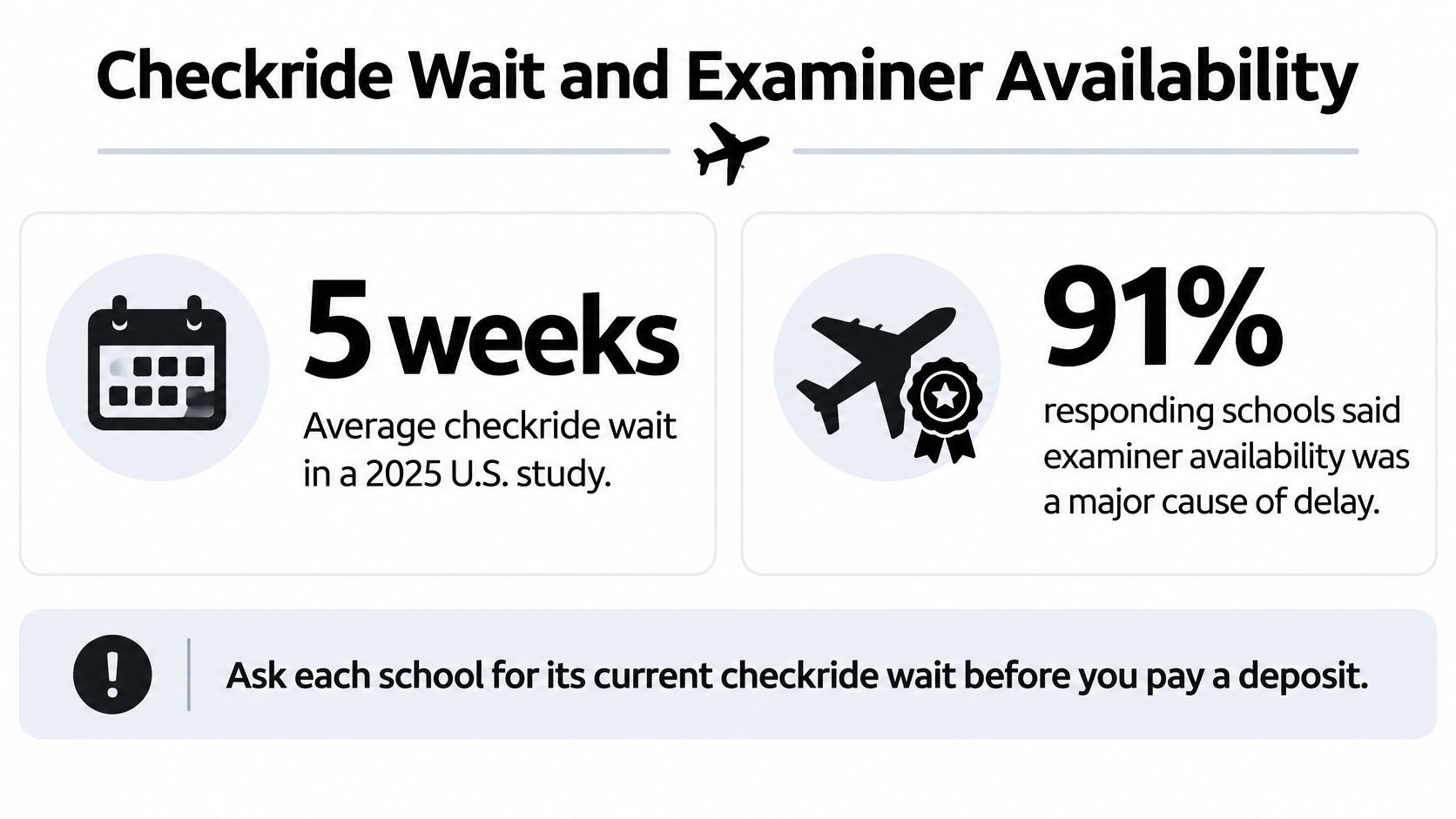
A checkride-ready student can still wait weeks to test. A 2025 study of U.S. flight schools found an average reported checkride wait of five weeks, and 91% of responding schools identified examiner availability as an operational problem. Reviews that praise instruction without describing the wait between readiness and testing leave a major gap.
Timeline benchmarks to test a review's claims against
| Benchmark | Figure | What it tells you |
|---|---|---|
| Median time to private pilot certificate, 2023 | 24 weeks, down from 30 weeks in 2020, according to Redbird's 2024 survey | A surveyed completion benchmark, not a promise for an individual student |
| Average checkride wait after becoming ready | About five weeks, according to the 2025 study of U.S. flight schools | Ask for the school's current median by rating |
| Schools reporting examiner availability as a problem | 91%, according to the 2025 study of U.S. flight schools | Ask how the school handles examiner availability |
| Career Track, zero time to CFII and multi-engine | About nine months | A stated program timeline, not a guarantee of certificate issuance dates |
Separate readiness from certification
Start by asking: What is the median wait for a private pilot checkride at this school? Then ask for the date a student became checkride-ready, the first scheduled test date and the eventual completion date. Ask how often examiners cancel and what costs students face to maintain proficiency during a wait.
An advertised program duration may include more than instructional time. Ask whether it includes expected testing waits, and what happens if the schedule slips. This guide to accelerated pilot training helps distinguish a faster syllabus from a predictable calendar.
A school can prepare students efficiently and still face examiner delays. Judge its teaching pace and its response to the wait.
Read pause stories as continuity evidence
An FAA Safety presentation based on a student-pilot survey identifies cost, scheduling conflicts, instructor turnover and aircraft maintenance as recurring barriers to completion. Ask how the school tracks interruptions, how long students typically pause, and how a replacement instructor receives their training records.
Hobby students taking two or three lessons weekly typically reach the private pilot checkride in four to six months, paying lesson by lesson. That pace provides context for recreational training, not an accelerated career program.
Before paying, request the payment schedule, financing terms and policy for prepaid balances. Compare the full cost of training, including review flights and additional instruction if interruptions slow progress. A lower hourly rate can still mean a higher total bill when more lessons are needed to complete the certificate.
Checking Program Hours Against Airline Minimums
Airline experience requirements give flight-school reviews a useful reality check. The FAA's commercial pilot certificate guidance gives a general Part 61 minimum of 250 total flight hours for a commercial pilot certificate. Under 14 CFR 61.159, the standard airplane ATP experience benchmark is 1,500 total hours, with additional requirements for cross-country, night and airplane-class experience.
Hours serve different purposes. Airplane time, simulator time, cross-country experience and time in a particular aircraft class are not interchangeable, so compare the program's hour breakdown with the requirement each hour is meant to satisfy.
Hour and certificate benchmarks behind program claims
| Milestone or rule | Requirement or figure | Source |
|---|---|---|
| Commercial pilot certificate, general minimum | 250 total flight hours | FAA commercial pilot certificate guidance |
| Standard airplane ATP experience | 1,500 total hours, including 500 cross-country, 100 night and 50 in the airplane class sought | 14 CFR 61.159 |
| Qualifying full-flight simulator credit for the class-specific requirement | Up to 25 hours | 14 CFR 61.159 |
| Flight training devices and aviation training devices for that class-specific requirement | Not accepted for that specific requirement | 14 CFR 61.159 |
| CFII Career Track total hours | 282: 204 single-engine, 25 multi-engine, 53 simulator | Program details |
The simulator rule is specific to the class-related requirement. It does not mean that only the stated simulator credit can ever apply toward total ATP experience, or that every advertised simulator hour qualifies for every certificate requirement. Ask the school to identify the simulator or device, its approval basis and the regulatory credit claimed for each part of the training.
Compare the training endpoint with the career endpoint
CFII's Career Track is a zero-experience program with fixed $89,000 tuition, planned to reach CFII and multi-engine qualifications in about nine months. It includes 282 total hours and six certificates and ratings: Private Pilot, Instrument Rating, Commercial single-engine, Commercial multi-engine, CFI and CFII. CFII trains in Southern California, including at Riverside, Long Beach and Corona.
A training endpoint is not the same as airline eligibility, and the program alone does not close that gap. A program ending at commercial certification can be a legitimate training option, while still requiring a separate plan for building airline experience. Read graduate reviews for concrete evidence of:
- What they earned: Confirm the certificates and ratings, rather than relying on a broad “career-ready” description.
- What counted: Check how aircraft and simulator time are classified for the relevant requirements.
- What followed: Look for a realistic time-building plan, without assuming employment.
The airline pilot career overview explains the longer pathway. Don't subtract a program's advertised total from an airline threshold and treat the remainder as your only remaining qualification.
Confirm the Order of Questions Before You Enroll
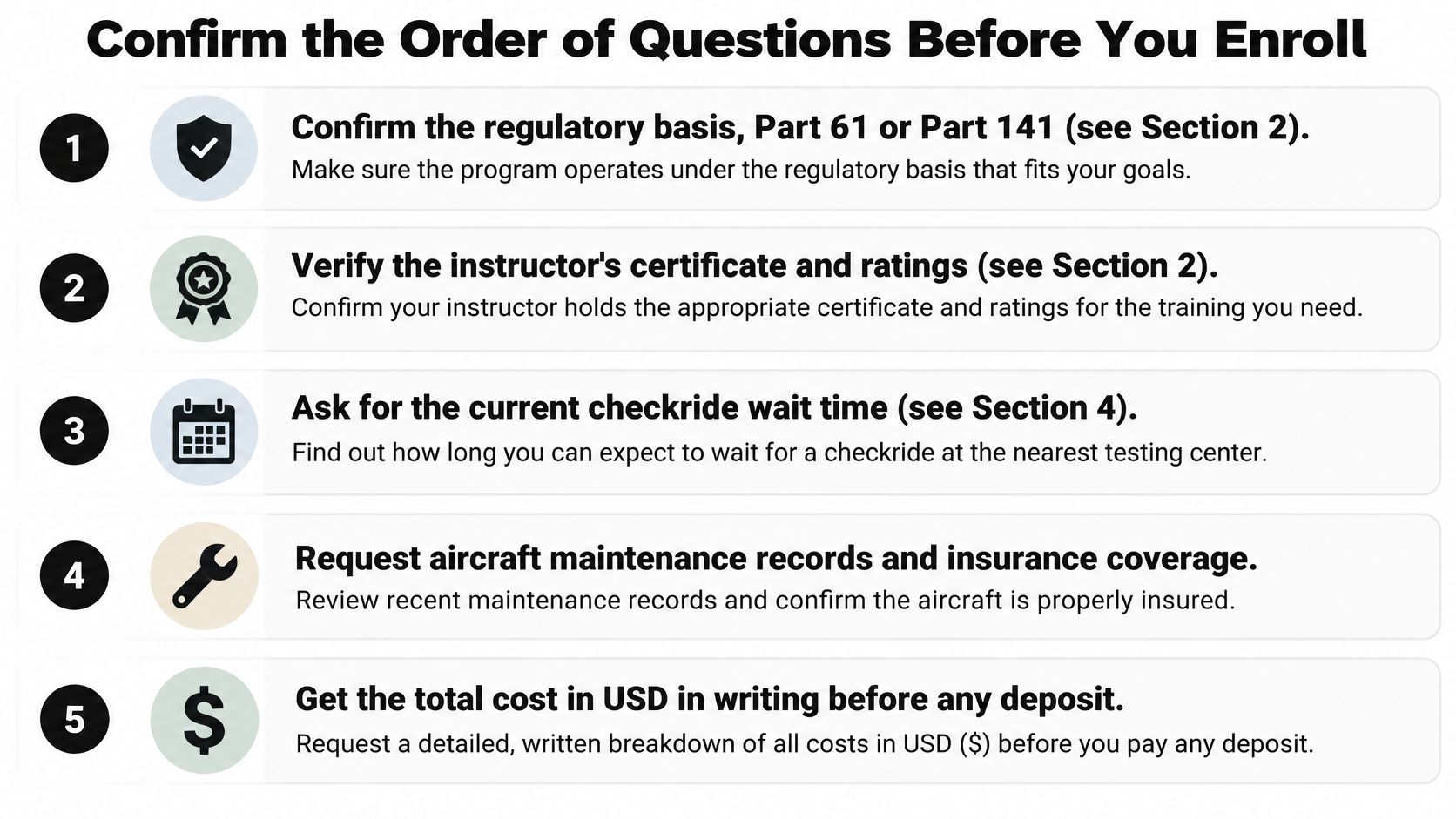
A school that will not put its full price and terms in writing has not given you enough information to sign. Ask for written answers to every open question, attach them to the enrollment agreement, and postpone payment if the answers remain incomplete. Use this guide to FAA-approved flight schools to clarify what an approval claim does and does not cover.
Then decide what you need resolved before committing:
- If the total price is unclear, request a written breakdown of tuition, exclusions, fees, payment dates, financing obligations, and living costs. Compare that document with the agreement, not just a sales conversation.
- If completion timing depends on checkrides, ask who schedules them, what the current readiness-to-test wait is, and who pays for extra preparation or rescheduling. If the school cannot explain the process, treat the finish date as uncertain.
- If you may pause or leave, get the refund calculation, payment timing, and treatment of canceled lessons or unavailable aircraft in writing. Do not rely on a verbal assurance.
- If the program's endpoint is vague, ask what certificates, ratings, and hours the stated price includes, then decide whether that endpoint fits your career plan.
- If you still have unanswered questions, hold off on signing. Visit the school, meet instructors, and see whether their explanations match the written terms.
CFII invites prospective students to walk the Riverside hangar, sit in a cockpit, and meet instructors before committing. Discovery flights and private pilot lessons leave from John Wayne Airport; students can take an instructor-led first flight before deciding whether to enroll.
CFII offers discovery flights and a Career Track for students starting without flight experience. Visit CFII to arrange a first flight or discuss the career program. Use your written answers to decide whether the terms fit before you commit.
Planning to fly for a living?
See what the path from zero to a pilot career looks like, what it costs and how long it takes.
Learn to fly in Riverside
We train at Riverside Municipal Airport in factory-new airplanes with a parachute built in. Start with a one hour discovery flight, no experience needed.