

On this page
- The Hidden Realities of Flight Training Timelines
- The checkride is an operational dependency
- Mapping the Core Pilot Certificates and Ratings
- Private Pilot
- Instrument Rating
- Commercial Pilot and instructor certificates
- Understanding Regulatory Hour Requirements and Simulator Limits
- What simulator time does well
- Commercial experience comes in separate buckets
- Comparing Accelerated Career Tracks to Local Flight Schools
- Choose based on the failure you can afford
- Bridging the Gap to 1500 Hours and Airline Eligibility
- Paid instructing changes the cash-flow model
- Industry demand doesn't remove the bottleneck
- Critical Questions to Ask Before Enrolling
- Ask about money
- Ask about capacity
- Ask about the career bridge
- A Realistic Month-by-Month Training Timeline
- Months one through three
- Months four through six
- Months seven through nine
The most popular advice about flight training courses is also the least useful: compare the advertised price, choose the shortest timeline, and trust the school to get you to the airlines. That approach ignores the operational problems that decide whether you finish on schedule, whether your logged hours satisfy FAA rules, and whether you can earn money after graduation.
A career-changing student isn't buying lessons alone. You're buying aircraft access, instructor continuity, simulator credit, checkride coordination, logbook accuracy, and a realistic route into paid instructing. The right program makes those dependencies visible before you sign. The wrong one leaves you paying for delays while its brochure continues to promise speed.
The Hidden Realities of Flight Training Timelines
A published timeline means very little if the operation behind it is thin. Schools advertise speed. What controls your finish date is aircraft uptime, instructor stability, stage-check availability, and checkride access. If one of those breaks, your “accelerated” program turns into expensive waiting.
Maintenance delays are the obvious problem, but they are not the one that catches career changers off guard. Instructor turnover can force a handoff in the middle of training, and every handoff costs time because the new instructor has to verify where you really are, not where the schedule said you would be. Weather does the same thing. A week of cancellations is not just a lost week. It creates a backlog that keeps hitting you after the skies clear.
The biggest bottleneck is often the one schools mention last.
The checkride is an operational dependency
If a school cannot get applicants in front of examiners on time, its headline timeline is marketing, not planning. The Designated Pilot Examiner shortage is a real operational risk. Plane & Pilot's report on the DPE shortage says only about 29% of qualified DPE applicants were appointed over the preceding five years, and roughly 200 examiners conduct half of all tests. That concentration creates delays, especially when weather, maintenance, or examiner availability collide in the same region.
Those delays have a direct cost. You may need refresher flights to stay sharp, extra instruction to stay checkride-ready, added housing if you relocated for training, and continued loan or living expenses while no certificate is being issued. That is how a program with a competitive sticker price becomes the more expensive option.
Ask a blunt question: who schedules the checkride, how early it is requested, what happens if the examiner cancels, and how the school keeps you current until the new date. “We'll help” is not an answer. You want a repeatable process, named responsibility, and a record of getting students tested without long drift.
Practical rule: Judge the school's checkride pipeline before you judge its advertised completion date.
Do the same with enrollment claims. A school can be full and still be poorly staffed. It can bring in new students faster than it can move trained applicants into certificates. If someone waves national FAA counts around to prove demand or success, ask what those numbers mean inside that school's own operation, and ask for recent completion flow, instructor retention, and aircraft availability in plain English.
Before you enroll, require a written contingency policy for aircraft downtime, instructor reassignment, weather interruptions, and examiner delays. It should say what happens to your place in line, what training gets repeated, and which costs stay yours.
If you need a plain-language overview of the sequence, start with this guide to becoming a pilot in the USA. Then get specific. A low advertised price only matters if the school is honest about delays, simulator use, repeat lessons, and the actual timeline to paid flying after training.
Mapping the Core Pilot Certificates and Ratings
Flight schools love to collapse the path into a clean sales line. Real training does not work that way. Each certificate adds a specific set of privileges, limits, and costs, and each step can expose a different operational problem if the school is weak on scheduling, maintenance, or instructor continuity.
The usual sequence runs from student pilot training to Private Pilot, Instrument Rating, Commercial Pilot, then CFI and CFII. Pilots headed for airline transport later add the Airline Transport Pilot certificate, or ATP. What matters is not the label on the brochure. It is what you are legally allowed to do after each checkride, what time you can log next, and whether the next stage puts you closer to paid flying or just deeper into debt.
Private Pilot
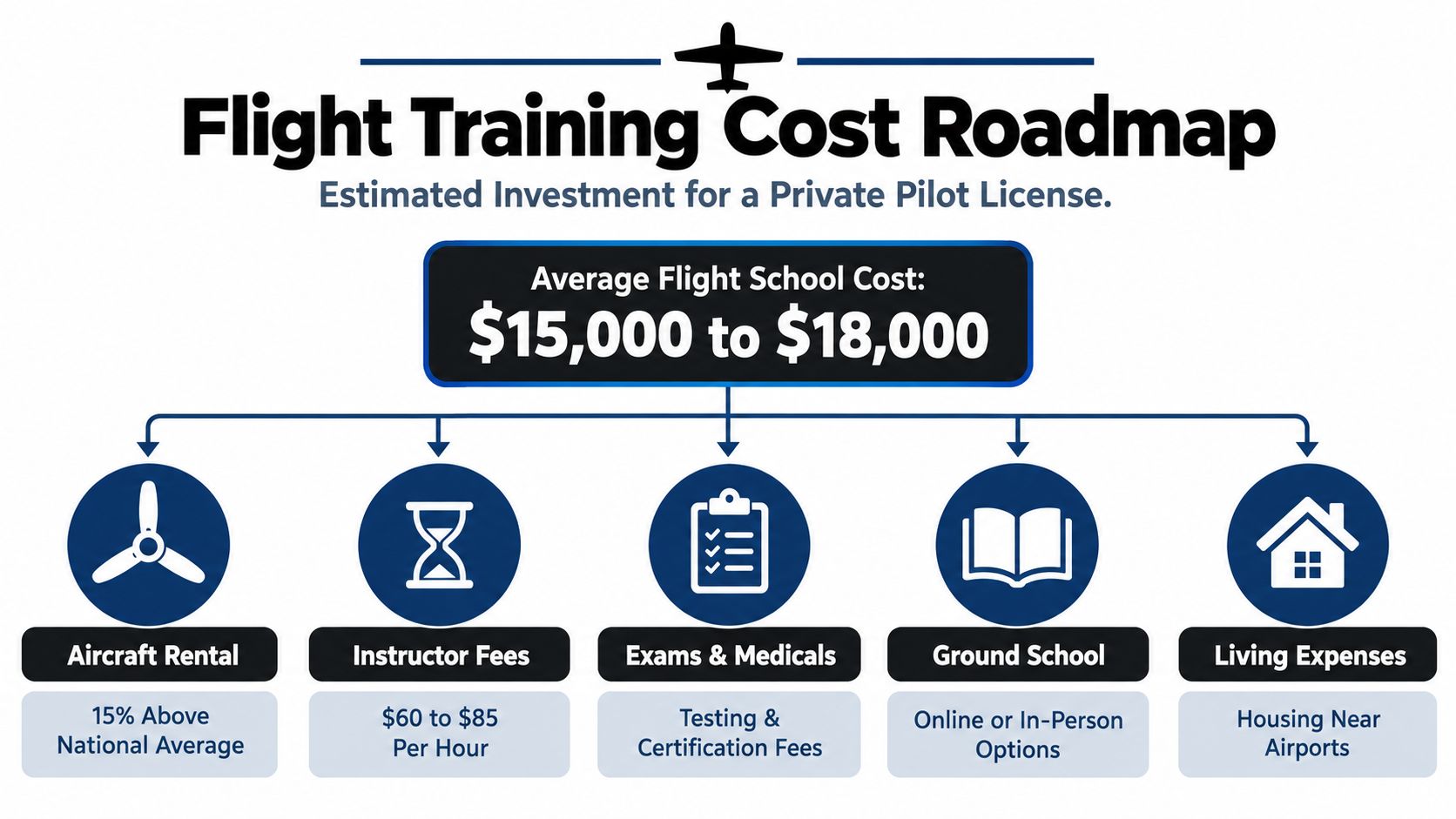
The Private Pilot certificate is the base layer. You learn aircraft control, radio communication, takeoffs and landings, emergency procedures, navigation, weather decision-making, and solo operations. You can carry passengers and fly for personal use, but you generally cannot use that certificate as the basis for compensation.
Career changers need to treat that limit seriously. A private certificate proves you can begin operating safely. It does not create income, and it does not protect you from the training bottlenecks that show up later. If a school sells private training as the hard part and treats everything after it like a formality, walk away.
Your private syllabus should also prepare you for what comes next. Ask whether students leave private training with disciplined checklist use, organized cross-country planning, and radio habits that hold up under instrument workload. If those basics are sloppy now, instrument and commercial training get expensive fast.
Instrument Rating
The Instrument Rating teaches you to control the aircraft by reference to instruments when outside visual references are unavailable. It builds scan discipline, instrument interpretation, radio procedures, navigation programming, abnormal-attitude recovery, and workload management. It also reveals whether a school can run structured training instead of random lesson hopping.
This rating changes how you think, not just what you can log. You learn to stay ahead of the airplane, brief with precision, and make earlier decisions. That matters because poor instrument habits are expensive to fix, especially when simulator sessions, aircraft lessons, and checkride prep are not sequenced well. For a closer look at the training flow, read this instrument rating training guide.
Commercial Pilot and instructor certificates
The Commercial Pilot certificate allows qualifying compensated operations, subject to the applicable rules and limitations. It demands tighter aircraft control, better judgment, and more consistency than private training. It still does not make you airline ready, and schools that blur that distinction are selling aspiration instead of reality.
The Certified Flight Instructor certificate changes the math. You may be able to build time while teaching instead of paying for every hour yourself, and you sharpen the communication and risk-management habits employers value. The CFII, or instrument instructor certificate, expands the instruction you can give and can make you more useful to a busy school.
A serious career track should spell out each certificate, the aircraft category and class used, the checkride tied to it, and the likely job available after it. If a program compresses all of that into “zero to airline,” ask what certificate you hold at each stage, what work that certificate permits, and how the next step gets paid for.
Understanding Regulatory Hour Requirements and Simulator Limits
A logbook total can look impressive and still leave you short for a checkride. FAA rules count specific categories of experience, so your school must track more than total flight time.
Under 14 CFR 61.65, an FAA-approved aviation training device can replace only part of the instrument-time requirement. The permitted substitution is up to 10 hours in a basic aviation training device or up to 20 hours in an advanced aviation training device, provided an authorized instructor conducts the session and the approved training tasks are completed (14 CFR 61.65). A simulator session doesn't become legally creditable merely because the device is advanced.
What simulator time does well
Simulator work is valuable when the lesson has a defined purpose. It can develop instrument scan, navigation setup, workload management, and abnormal-attitude recovery without using an aircraft for every repetition. It also lets an instructor pause, reset, and repeat a procedure in a controlled environment.
But the school should label each session accurately. The logbook needs the approved device category, instructor supervision, applicable task, and credited time. FAA guidance also requires the visual system to be configured for instrument meteorological conditions and the pilot to control the aircraft solely by instrument reference for simulated instrument time in an aviation training device to be loggable.
The simulator is a training tool, not a regulatory loophole.
Commercial experience comes in separate buckets
For an airplane single-engine commercial certificate, 14 CFR 61.129 generally requires at least 250 hours of total pilot flight time, including 100 hours of pilot-in-command time, 50 hours in airplanes, and 50 hours of cross-country flight. The rule also specifies commercial-level training categories, including instrument work with a view-limiting device and training in a qualifying complex, turbine-powered, technically advanced airplane, or approved combination (14 CFR 61.129).
The regulation also requires 3 hours of instructor training in the applicable airplane within the preceding 2 calendar months before the commercial practical test. That recent-preparation requirement can catch students who finish the syllabus but wait too long for an examiner.
Your digital logbook should display separate counters for total time, PIC, cross-country, instrument, aircraft category and class, and advanced-aircraft training. If the school shows only one headline number, it isn't giving you enough information to judge readiness.
Comparing Accelerated Career Tracks to Local Flight Schools
A local pay-as-you-go school and an accelerated career track solve different problems. The local option suits students who need flexibility, already have access to income and transportation, or are flying for personal reasons. The structured option suits a career changer who needs concentrated training, coordinated milestones, and a clear transition into instructing.
Don't confuse flexibility with efficiency. A local school may let you pause during busy work periods, but every pause can create additional review, currency work, and scheduling friction. An accelerated program may reduce those gaps, but relocation, intensive study, and fixed financial commitments demand more discipline.
| Feature | Local Pay-As-You-Go School | Accelerated Career Track |
|---|---|---|
| Scheduling | Flexible, often dependent on aircraft and instructor availability | Planned around a structured syllabus and individual daily schedule |
| Cost control | Payments track actual usage, but repeat lessons and delays can expand the total | Fixed pricing can improve predictability if exclusions are explicit |
| Fleet | May include varied aircraft and avionics | Often uses a standardized fleet and common cockpit systems |
| Checkrides | Student may coordinate directly with an examiner | School may manage examiner scheduling and readiness gates |
| Simulator use | Availability and regulatory credit vary by facility | Lessons can be integrated into the syllabus with logged credit tracked |
| Career transition | Graduate must usually find the next opportunity independently | Program may connect training completion with instructor hiring or paid hours |
Choose based on the failure you can afford
A hobbyist should not pay for a career structure they won't use. A career student should not choose a casual schedule because the hourly rate looks lower. Compare the entire operating model, including maintenance substitutions, instructor continuity, checkride coordination, housing, financing, and the period after graduation.
Fixed price also doesn't mean unlimited service. Read the exclusions. Determine whether extra training, examiner fees, medical costs, repeat tests, living expenses, and delays are included or billed separately. The useful question isn't “Which course costs less?” It's “Which course makes the risks visible and gives me control over the risks I can't eliminate?”
Bridging the Gap to 1500 Hours and Airline Eligibility
Finishing commercial and instructor training doesn't put you at the airline threshold. Under the FAA framework, most first officers at U.S. Part 121 airlines generally need an ATP certificate, which normally requires at least 1,500 hours of total flight time. The FAA implemented this requirement in 2013 after the Colgan Air Flight 3407 crash and also established the ATP-CTP pathway, which requires structured academic and simulator training before the ATP knowledge test.
That creates a large post-training problem. You need a legitimate way to accumulate experience, and the most practical route for many professional pilots is instructing. A school that helps you earn CFI and CFII certificates but offers no credible path to paid teaching has solved only the first half of the career equation.
Paid instructing changes the cash-flow model
Ask whether the job offer is guaranteed, conditional, or merely a promise to introduce you to employers. Ask about hourly pay, minimum hours, vacancy requirements, performance standards, and the time between passing the checkride and receiving students. The number of flight-instructor certificates issued nationally doesn't prove that every certificate holder has employment or enough students to build hours.
Build a monthly cash-flow model through the first 12 to 18 months. Include housing, food, transportation, loan payments, medical and currency costs, possible checkride delays, and the income you can realistically expect from instructing. Don't count unpaid availability as paid flight time.
A serious program should show how its graduates move from training into work, not just hand you a certificate and wish you luck. This guide to becoming a flying instructor can help you understand the role, but the school must disclose its own hiring process and obligations.
Industry demand doesn't remove the bottleneck
Boeing's 2025 Pilot and Technician Outlook, covering 2025 through 2044, projects a worldwide need for approximately 660,000 new pilots. It also projects demand for 710,000 maintenance technicians and 1,000,000 cabin-crew members, nearly 2.4 million aviation professionals altogether (Boeing's 2025 outlook). Boeing attributes the need to fleet growth and replacement hiring, with about two-thirds replacing attrition and about one-third supporting fleet expansion.
Those projections support continued demand, but they don't guarantee your first paid instructing position. Your immediate advantage comes from a school with aircraft access, students, instructor scheduling, and a transparent employment pathway.
Critical Questions to Ask Before Enrolling
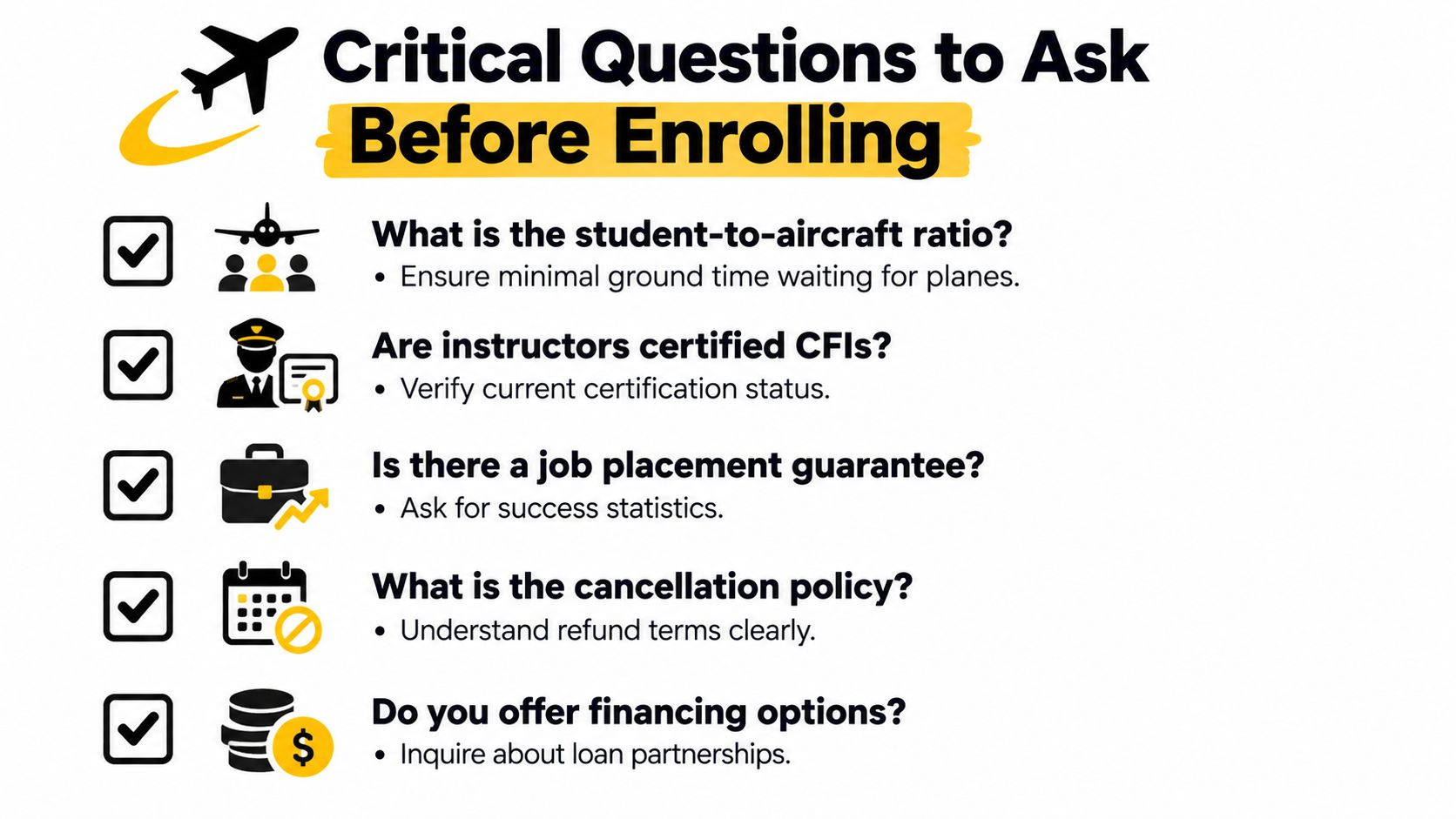
Admissions staff should answer operational questions without reaching for vague promises. If the response isn't written into the enrollment agreement or a published policy, treat it as an assumption, not a benefit.
Ask about money
Start with the phrase “fixed price.” Then ask what it excludes. Get written answers about aircraft and instructor overages, repeat lessons, checkride fees, medical certification, written tests, examiner cancellations, housing, transportation, simulator sessions, and currency flights.
Also ask when payment is due and what happens if you withdraw, pause, fail a stage check, or can't continue for medical reasons. A low initial quote can become expensive when every operational interruption is billed separately.
Ask about capacity
Request the student-to-aircraft and student-to-instructor ratios. Ask how many aircraft are currently serviceable, how maintenance substitutions work, and how quickly the school reassigns an instructor who leaves.
Then ask for actual completion timelines, not target timelines. The school should explain how it handles weather, maintenance, instructor absences, and examiner availability without shifting all delay costs onto you.
Ask about the career bridge
Use this checklist during the interview:
- Employment terms: Is instructing guaranteed, conditional, or encouraged? Ask for the written criteria.
- Paid-hour assumptions: What hourly rate and minimum availability does the school use in its cash-flow model?
- Checkride history: How does the school track practical-test outcomes, reschedules, and repeat preparation?
- Logbook control: Who verifies that PIC, cross-country, instrument, and advanced-aircraft categories are complete?
- Financing exposure: What happens to payments if training takes longer than planned?
Finally, speak with current students and recent graduates without an admissions representative present. Ask how often lessons are canceled, how long they waited for checkrides, and whether the promised next job actually existed when they finished.
A Realistic Month-by-Month Training Timeline
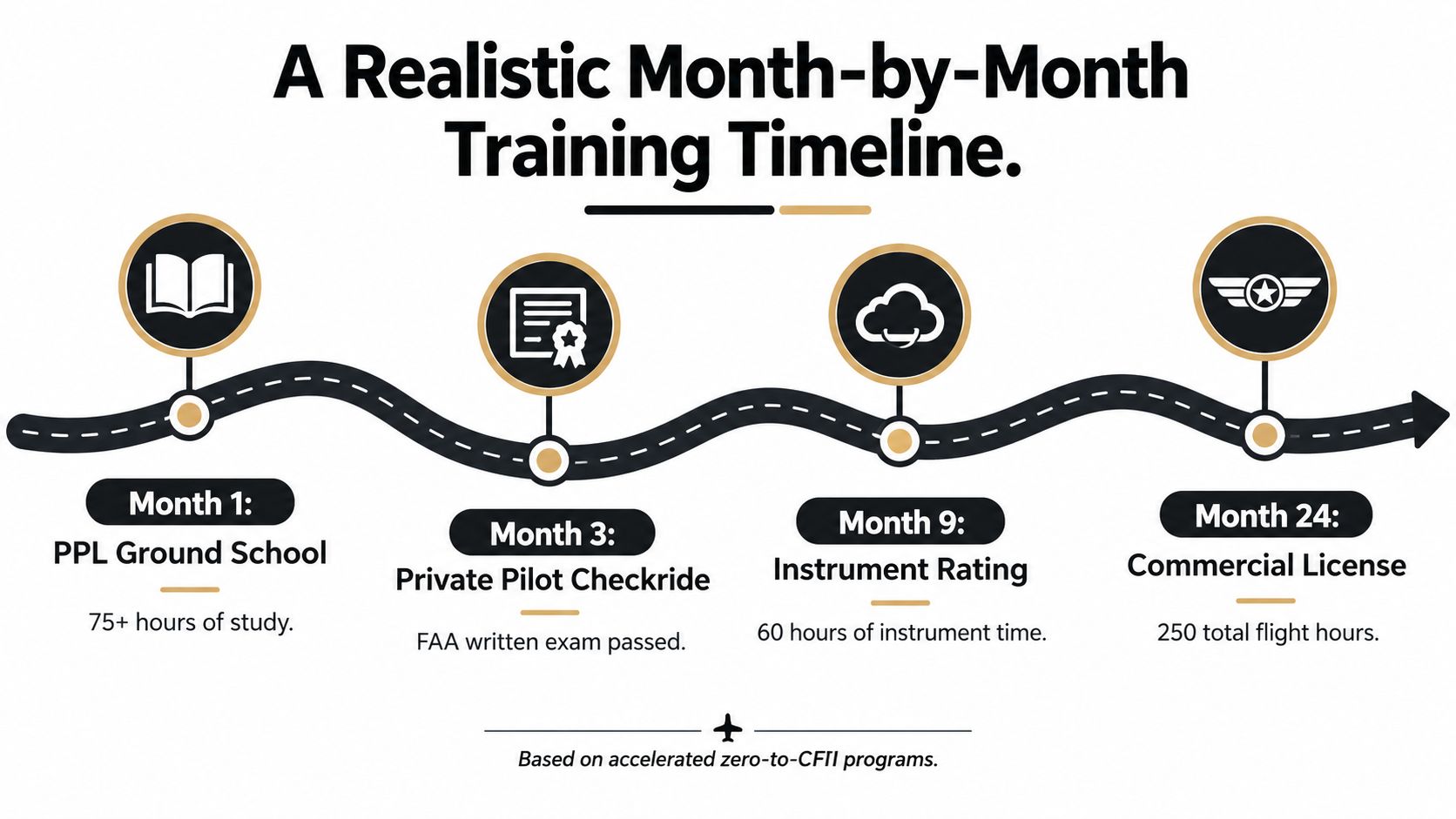
A nine-month accelerated program is demanding, not magical. The calendar below is a planning example based on the milestones shown in the supplied timeline graphic, not a guaranteed FAA schedule. Weather, maintenance, instructor availability, academic progress, and examiner access can move every stage.
Months one through three
Month one is ground school, aircraft familiarization, basic maneuvers, radio work, takeoffs, landings, emergency procedures, and the first solo preparation. The student studies outside scheduled lessons and must learn procedures well enough to perform them consistently, not merely recognize them on a quiz.
Month two should combine solo consolidation with cross-country planning, night operations, and continued written-test preparation. Instructors should use stage checks to catch weak areas before the practical-test phase, because discovering a foundational problem after the checkride is scheduled wastes both money and examiner access.
Month three culminates in private-pilot practical-test preparation. The supplied timeline identifies the private checkride milestone and FAA written-exam completion, but an actual student may need additional practice if weather, aircraft availability, or examiner scheduling interrupts the sequence.
Months four through six
Instrument training brings a heavier academic workload. The student learns procedures, approaches, navigation, weather interpretation, radio communications, and instrument emergency responses. Simulator sessions can provide efficient repetition, but the school must track the legal credit separately from proficiency work.
Commercial training then demands precision and disciplined experience tracking. The student works through commercial maneuvers, cross-country requirements, PIC experience, instrument tasks, and qualifying advanced-aircraft training. A high total doesn't compensate for a missing category.
Months seven through nine
The final phase usually combines commercial completion with CFI and CFII preparation. Instructor training isn't just another checkride. You must explain procedures, diagnose errors, manage risk, and teach consistently while meeting the applicable standards.
The timeline graphic identifies an instrument milestone at month nine and a commercial milestone at month 24, alongside figures for instrument time and total flight hours. Treat those labels as an illustrative roadmap rather than a promise that every accelerated program follows the same sequence. Your school should provide its own syllabus, stage gates, aircraft allocation, simulator-credit map, and contingency schedule in writing.
The final decision should rest on operational evidence. Choose the flight training course that shows how it protects your schedule, validates your logbook, manages checkrides, and moves you toward paid instructing. Then ask for every assumption in writing before you commit your money and your career timeline.
CFII offers an accelerated, fixed-price Career Track from zero experience through private, instrument, commercial, CFI, CFII, and multi-engine training, with one-on-one instruction, simulator sessions, study resources, and coordinated checkrides. If you want to compare that structured model with your own timeline and financial plan, visit CFII and review the program details before enrolling.
Planning to fly for a living?
See what the path from zero to a pilot career looks like, what it costs and how long it takes.
Learn to fly in Riverside
We train at Riverside Municipal Airport in factory-new airplanes with a parachute built in. Start with a one hour discovery flight, no experience needed.