
On this page
- What Accelerated Flight Training Actually Delivers
- The pipeline matters more than the slogan
- The History and Logic of Compressed Training
- Why fixed stages improve throughput
- Acceleration increases intensity, not necessarily omission
- How the Daily Schedule and Progression Work
- A productive training day
- Simulator time needs a credit map
- Accelerated Programs Versus Traditional Paths
- What fixed pricing can and can't solve
- From Graduation to Airline Eligibility
- Track categories, not just the headline total
- Speed versus Completion: What the Data Shows
- What support looks like in practice
- How to Choose a Quality Accelerated Provider
A student can move from zero experience to a CFII rating in as little as nine months through a fixed-price, full-time program. The result depends less on flying faster than on following a tightly managed pipeline that connects certificates, aircraft time, study, stage checks, and checkrides without avoidable gaps.
That sounds counterintuitive because the fastest path isn't always the most successful one. A compressed schedule can improve retention and reduce the drift that causes part-time students to repeat lessons, but it can also expose weak preparation quickly. The practical question is not, “How fast can I finish?” It's, “What structure keeps me progressing when weather, finances, failed stage checks, or difficult lessons interrupt the plan?”
What Accelerated Flight Training Actually Delivers
Zero to CFII in about nine months is a meaningful promise, but it describes a training system, not a shortcut. A full-time student typically moves through Private Pilot, Instrument, Commercial, multi-engine, CFI, and CFII training in a connected sequence. Each certificate supplies skills and knowledge used in the next stage, so the student isn't repeatedly restarting after long breaks.
Consider two students beginning with no flight experience. One trains whenever work, family, aircraft availability, and instructor schedules allow. The other treats training as a full-time occupation, follows a daily syllabus, studies between lessons, and receives scheduled feedback. Both may eventually earn the same certificates. The second student has a better chance of preserving momentum because the program removes many decisions that otherwise consume weeks or months.

The pipeline matters more than the slogan
A sound accelerated flight training program coordinates four moving parts:
- Daily availability: The student reserves enough time for aircraft lessons, simulator work, ground instruction, self-study, and recovery from weather disruptions.
- Sequential ratings: Private, Instrument, Commercial, CFI, and CFII lessons follow a deliberate order instead of being booked as isolated events.
- Continuous evaluation: Instructors use stage checks, written-test preparation, and logbook reviews to identify weaknesses before a practical test.
- Operational support: Aircraft maintenance, examiner scheduling, study materials, and progress tracking must work together.
The outcome isn't just a rating printed on a certificate. A professional pathway should produce a pilot who can explain decisions, manage workload, teach procedures, and continue building experience responsibly. Speed has value because it reduces idle time and helps students reach paid instructing sooner, but competency remains the operating standard.
Practical rule: A fixed finish date is useful only when the school also defines what happens if a student falls behind.
The strongest programs publish their assumptions. They explain which training hours are included, what can delay completion, how remediation works, and whether the quoted timeline applies to a prepared full-time student or to every enrollee. That transparency turns an attractive promise into a plan a student can evaluate.
The History and Logic of Compressed Training
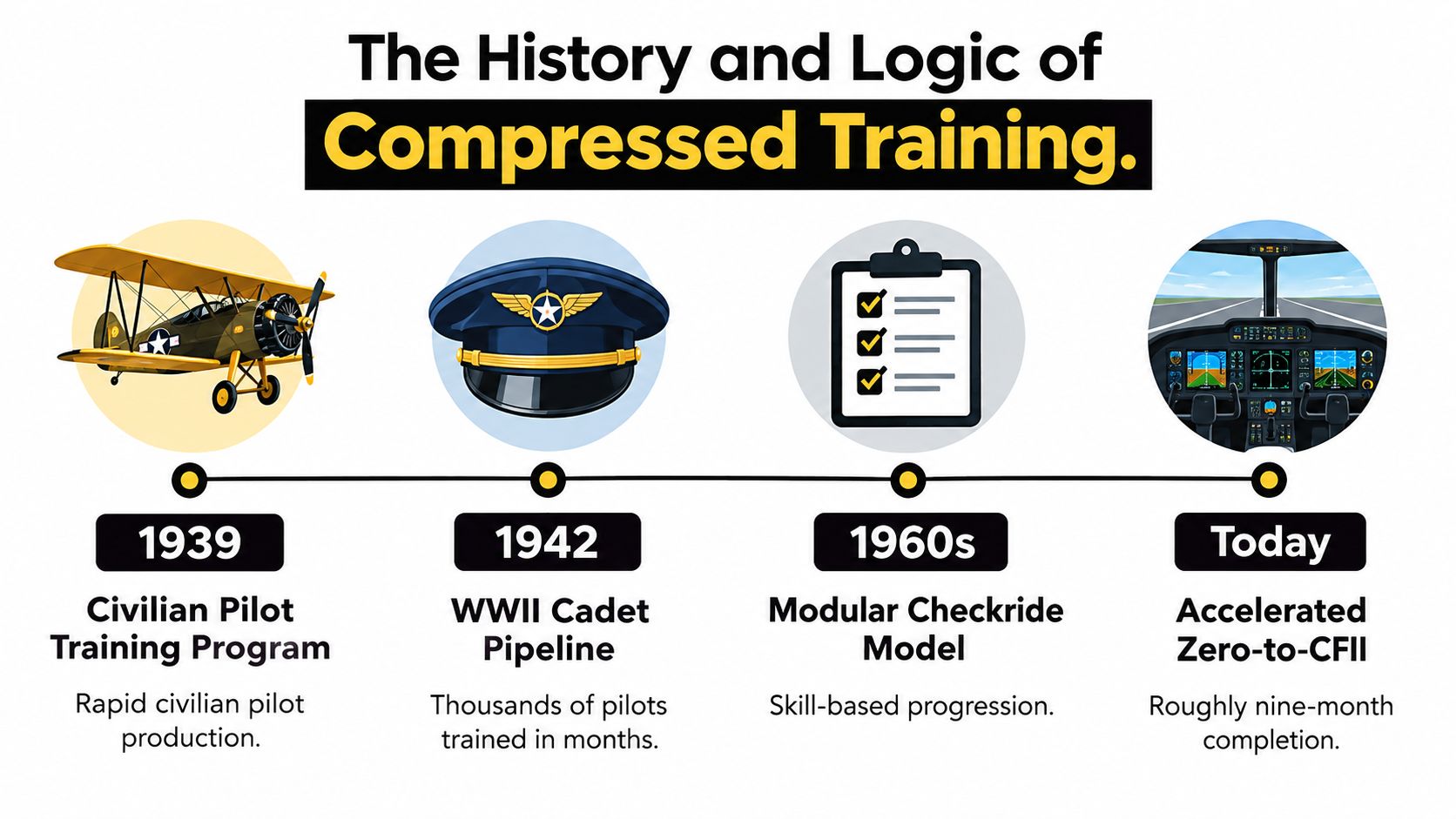
Accelerated flight training has a clear historical precedent. Before the Second World War, U.S. Army Air Corps pilot production was extremely small. During the economic depression, advanced-training graduates fell to 184 in 1937, as documented by the National Museum of the United States Air Force history of prewar flight training.
The wartime response did not merely involve scheduling more lessons. It established a standardized, sequential production pipeline that compressed preparation into nine months. The model used three months of primary training, three months of basic training, and three months of advanced training. Students received 65 flying hours in primary, 75 hours in basic, and 75 hours in advanced training, for 215 total flight hours, according to the same museum record.
Why fixed stages improve throughput
The historical lesson is organizational. A loosely paced student may spend one lesson on aircraft handling, then wait, forget some of the skill, and spend the next lesson rebuilding it. A fixed pipeline keeps the learner moving from elementary control to more demanding operational tasks while recent instruction remains available in working memory.
The sequence also makes resource planning possible. A school can assign aircraft, instructors, classrooms, simulators, and evaluators around known stages instead of treating every lesson as an independent booking. That reduces the administrative gaps that make training feel open-ended.
A modern military example reinforces the point. The U.S. Air Force's experimental Accelerated Path to Wings program graduated students in about seven months and used a two-phase structure centered on a single T-1 Jayhawk aircraft type. The Air Force account of the XPW program describes an approach built around concentrated participation, standardized equipment, proficiency checks, and one coordinated curriculum.
Acceleration increases intensity, not necessarily omission
The mistake is to equate compression with cutting content. The historical model shows that acceleration can come from concentrating full-time effort and organizing training into predictable stages. A civilian student still needs aircraft handling, navigation, instrument procedures, regulations, emergency responses, teaching technique, and evaluation preparation.
What changes is the gap between those activities. Instead of leaving a rating dormant while life intervenes, the student practices, studies, receives feedback, and applies the correction while the lesson remains fresh. That design can improve continuity, but only if the school has enough aircraft and instructors to protect the schedule.
The essential logic is simple: standardize the syllabus, keep students active, measure proficiency, and remove avoidable queues. A program that advertises speed without controlling those variables is offering a calendar, not acceleration.
How the Daily Schedule and Progression Work
A full-time student shouldn't arrive at the airport asking what to do that day. The schedule should already connect weather, lesson objectives, aircraft availability, simulator work, and ground preparation. That structure gives instructors a way to spot a weak skill early and assign targeted practice instead of allowing the student to drift.
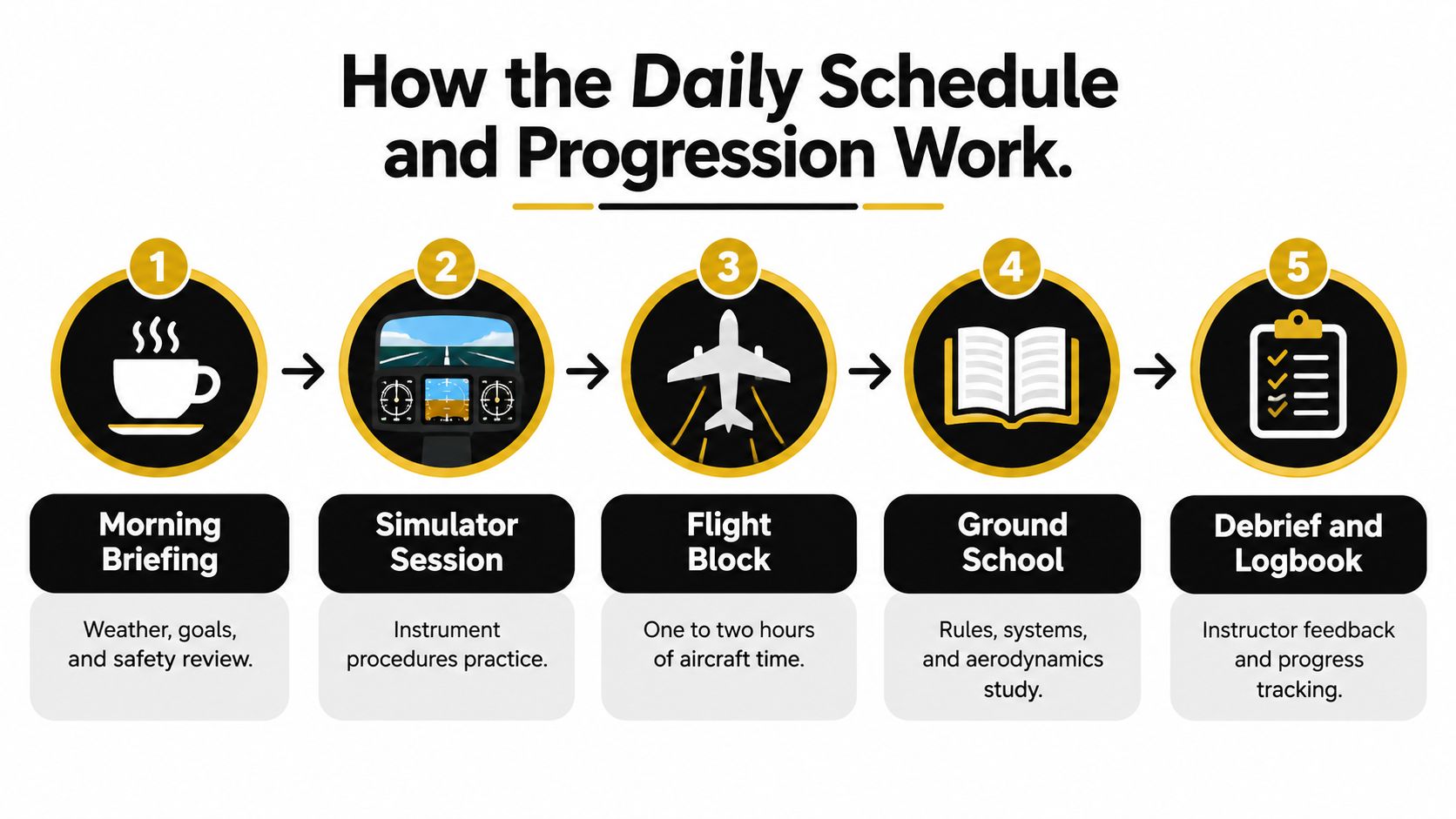
A representative day may begin with a weather and safety briefing, continue with a simulator session or aircraft block, and end with ground study and a formal debrief. The exact order changes with the syllabus and conditions, but the principle stays consistent: every activity must support the next proficiency milestone.
A productive training day
- Morning briefing: Review weather, aircraft status, personal readiness, and the lesson goal. A student who can't state the objective before engine start is beginning behind schedule.
- Simulator session: Rehearse instrument procedures, cockpit flows, radio work, and abnormal situations in a controlled environment.
- Aircraft block: Apply the skill where real aerodynamic feedback, visual references, workload, and operational judgment matter.
- Ground school: Connect regulations, systems, aerodynamics, performance, and decision-making to the flight just completed.
- Debrief and logbook: Record what was demonstrated, what needs correction, and what evidence will allow the instructor to advance the student.
The progression may move from Private Pilot fundamentals into instrument procedures, then Commercial standards and instructor training. The student should know the next gate, the evidence required to pass it, and the remediation plan if performance falls short. A useful instrument rating course syllabus should show how knowledge, procedures, and flight tasks build together rather than presenting a list of disconnected lessons.
Simulator time needs a credit map
Simulation is powerful, but training value and regulatory credit aren't identical. Under 14 CFR §61.109, a private-pilot applicant generally receives credit for only 2.5 hours of simulator or flight-training-device time toward the required flight-training time. An FAA-approved Part 142 course can increase that allowance to 5 hours, as set out in the private-pilot aeronautical experience regulation.
For commercial-pilot experience under §61.129, up to 50 hours in an appropriate full-flight simulator or flight-training device may be credited through an authorized instructor, subject to the applicable regulatory pathway. The instructor must identify the device approval, the lesson purpose, the certificate category, and the correct logbook treatment.
A good schedule reserves simulation for repetition and scenario work, then uses aircraft sorties for skills that depend on real cues and judgment. A high simulator proportion can't automatically replace airplane time, satisfy every certificate requirement, or create logged experience that the regulation doesn't recognize.
Accelerated Programs Versus Traditional Paths
The choice isn't between a serious program and an unserious one. It's between different ways of managing time, money, attention, and risk. A pay-as-you-go school may suit a student with a demanding job, while a full-time fixed-price pathway may suit someone ready to relocate and treat training as the primary occupation.
Traditional training often feels flexible at enrollment. The student books lessons around other commitments and pays as training occurs. That flexibility becomes a weakness when aircraft maintenance, instructor changes, weather, personal obligations, or exam scheduling create long gaps. Skills then require refreshing, and the student may lose visibility into the remaining cost.
A college aviation pathway can provide academic structure, campus resources, and a broader educational experience. It may also include institutional requirements that don't match a student's preferred pace. The right comparison isn't only tuition. It includes living costs, opportunity cost, financing terms, interruptions, extra training after repeated gaps, and the time before paid instructing begins.
| Training Path | Typical Duration | Estimated Cost |
|---|---|---|
| Accelerated fixed-price program | About nine months to CFII | Fixed program price, with inclusions and exclusions defined by the provider |
| Traditional pay-as-you-go training | Open-ended and dependent on availability | Variable as lessons, aircraft, exams, and additional training accumulate |
| Four-year college aviation degree | Multi-year academic pathway | Institution-specific tuition, fees, housing, and aviation charges |
The table deliberately avoids pretending that one number applies to every school. Costs vary by aircraft, region, syllabus, certificate target, housing, testing, and the amount of additional training a student needs. A flight training course comparison should therefore begin with a complete scope of work, not a headline tuition figure.
What fixed pricing can and can't solve
A fixed price can reduce uncertainty when the provider states exactly what it covers. Ask whether aircraft rental, instructor time, simulator sessions, written-test preparation, stage checks, checkride preparation, examiner fees, and retesting are included. Ask what happens when a student needs remediation or when weather pushes the schedule beyond the planned completion window.
Full-time training also has a financial trade-off. The student may reach instructor training earlier, but the upfront commitment can be harder to manage than spreading lessons over a longer period. Financing, housing, and living expenses belong in the same decision as tuition.
A predictable price is valuable, but predictable scope is more important.
The traditional path isn't automatically inferior. It can work well for disciplined students who maintain regular lessons, study consistently, and have enough flexibility to protect continuity. The accelerated path works when the student can sustain the schedule and the provider can sustain the infrastructure.
From Graduation to Airline Eligibility
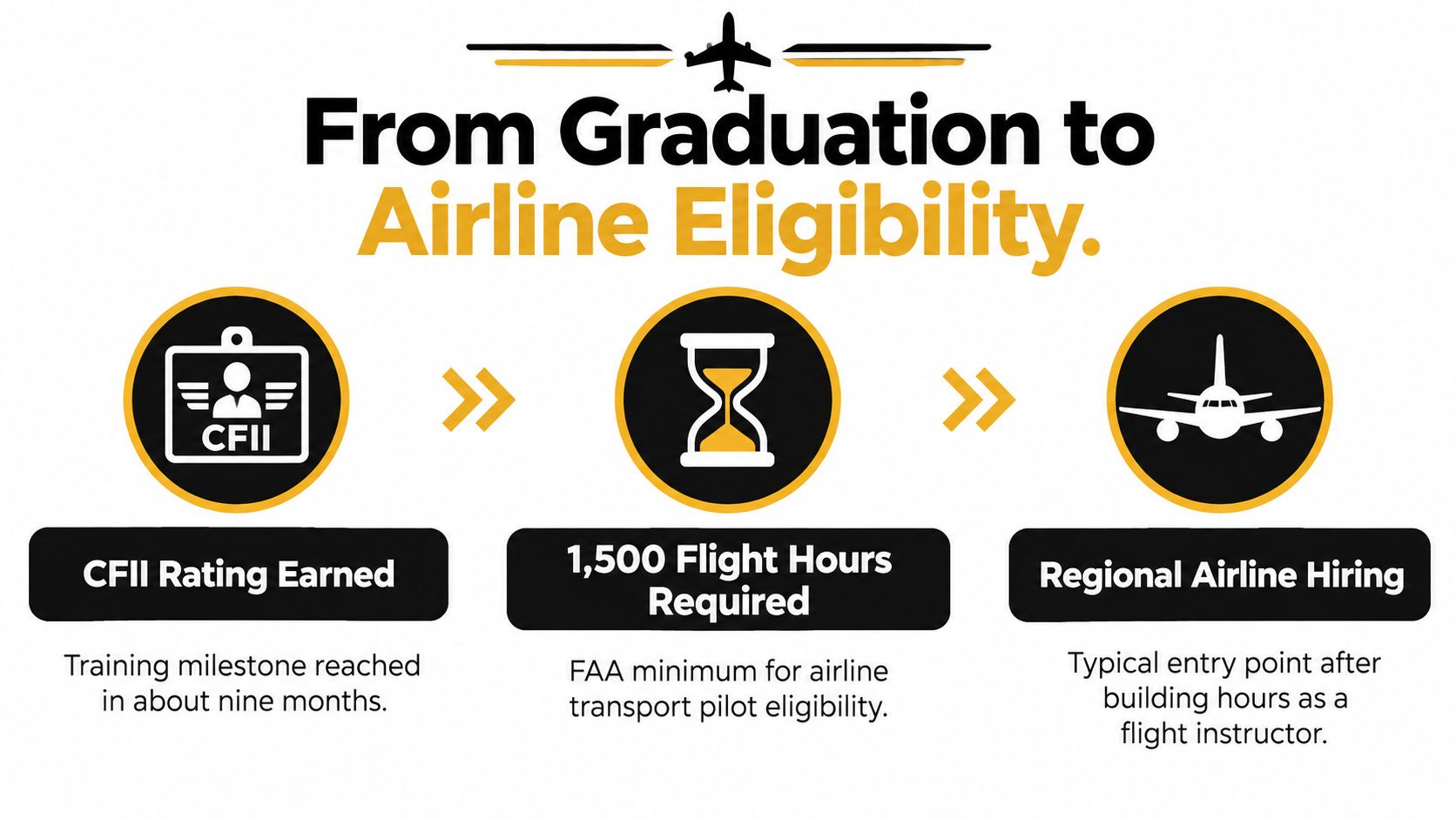
A CFII rating starts the employment phase. It does not shorten the ATP hour rule. For airplane-category ATP eligibility, the standard path still requires 1,500 total pilot hours, including 500 hours of cross-country time, 100 hours of night flight, and 75 hours of instrument experience, as specified in the electronic Code of Federal Regulations ATP eligibility rules and explained in this overview of ATP and CTP requirements.
That is why accelerated training has to be judged as a pipeline, not a finish line. The value of a fixed training schedule is that it gets a student to the instructor stage sooner and with less drift than an open-ended lesson calendar. The trade-off is simple. Graduation only matters if the next step is available, with airplanes to fly, students to teach, and enough standardization that the instructor can keep building time instead of waiting around for scattered assignments.
Track categories, not just the headline total
Pilots often hit a big hour number and still come up short in a required bucket. A useful hour-building plan tracks the logbook by category from day one:
- Total time: The full pilot-hour count.
- Cross-country: Time that meets the applicable cross-country definition.
- Night: Qualifying night experience.
- Instrument: Actual or otherwise creditable instrument time.
- Aircraft category and class: Single-engine and multi-engine experience.
- Instructional time: Work that supports instructor employment and shows sustained teaching activity.
Career plans break down in the middle, not at the beginning. I see it when a graduate earns the instructor ratings on schedule, then enters an hour-building job with weak dispatch reliability, thin student demand, or limited access to aircraft. Acceleration solves the training calendar. It does not solve the structure of employment after training unless the school has built that path deliberately.
Long-range demand still matters. Boeing's 2025 Commercial Market Outlook projects demand for 660,000 new pilots globally over 20 years and notes continued pressure on flight-training scheduling as hiring growth increases demand. That supports the case for organized pipelines, but it does not promise an airline class date for any individual graduate.
Hiring also moves in cycles. A practical plan accounts for expansion periods and slower periods, plus living costs, financing payments, medical setbacks, checkride delays, and the possibility of using other aviation work while hours accumulate.
The credible promise is narrower and more useful: a documented route from training completion to paid instruction, then from paid instruction to the experience categories required for airline eligibility.
Speed versus Completion: What the Data Shows
Acceleration works when it replaces open-ended scheduling with a fixed training pipeline that a student can sustain. It fails when the calendar is faster than the student's cash flow, study habits, health, transportation, or ability to recover from a weak week. I have seen both outcomes. The difference is usually not motivation. It is whether the program's structure matches the student's real constraints.
One industry analysis reports that structured, funded programs often see 20% to 30% dropout rates, and that EAA Ray Aviation Scholarship participants have reported about an 81% completion rate. That same analysis of why student pilots quit also warns against treating the familiar 70% to 80% dropout figure as a universal rule, because it traces back to older research. That is a useful caution. Completion depends heavily on program design, funding, and the support wrapped around the schedule.
What support looks like in practice
Ask hard questions before you enroll, because a compressed program has very little room for vague answers.
- Falling behind: What weekly standard triggers intervention, and who builds the recovery plan?
- Failed stage check: How does the school remediate weak maneuvers or knowledge gaps before the next evaluation?
- Weather disruption: Is there enough recovery capacity in the schedule, or does one bad stretch break the timeline?
- Financial stress: Can a student pause without creating a bigger training problem, and what charges continue during that pause?
- Instructor continuity: Who takes over if the primary instructor is unavailable?
A slightly slower pipeline with clear intervention points often produces better completion than a more aggressive calendar with no margin. Speed only helps when lessons turn into retained skill on schedule. If rushed training leads to retraining, repeated checkrides, or withdrawal, the advertised shortcut becomes the longer and more expensive path.
The right measure of acceleration is the shortest reliable path to competent, employable instruction.
How to Choose a Quality Accelerated Provider
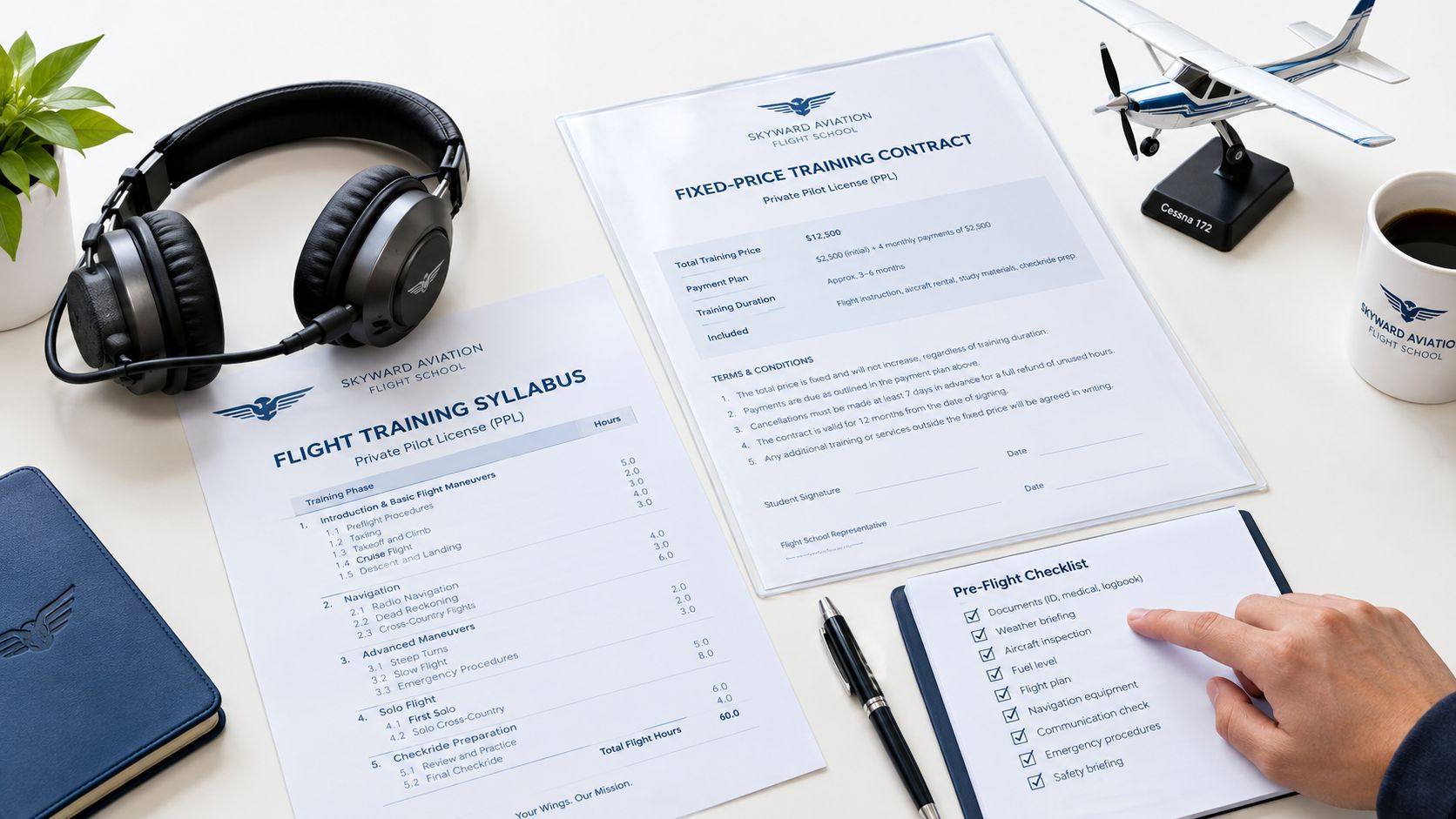
Start with the contract, not the promotional timeline. A credible provider should show the syllabus, certificate sequence, included hours, simulator treatment, examiner process, retest policy, weather policy, and every meaningful exclusion in plain language.
Then inspect the operating system behind the promise:
- Progress tracking: Look for stage standards, digital records, written-test preparation, and scheduled instructor reviews.
- Aircraft consistency: Ask about fleet age, avionics standardization, maintenance control, and backup aircraft access.
- Checkride coordination: Confirm who contacts examiners and how the school handles a scheduling bottleneck.
- Remediation: Require a written process for extra training after a failed stage check or practical test.
- Career transition: Ask how the provider supports logbook review, résumé preparation, instructor standardization, and paid hour building.
- Student logistics: Evaluate housing, transportation, financing terms, and the time required to remain available at the airport.
A modern glass cockpit can support consistent procedures, but equipment alone won't create a competent pilot. One-on-one instruction, clear feedback, and an honest response to setbacks matter more than the appearance of the fleet.
CFII offers one example of this model, with a fixed-price Career Track from zero experience through CFI, CFII, and multi-engine training in about nine months, plus coordinated checkrides, structured study resources, and an optional paid-instructing pathway. Prospective students should compare those features with competing programs and verify the current terms directly before making a financial commitment.
The best decision is the one that matches your available time, learning pace, finances, medical situation, and tolerance for relocation. Ask for a written month-by-month plan, a fallback plan, and a clear definition of success before you sign.
If you want a structured route from zero experience to CFII with coordinated training, modern aircraft, and a defined transition into hour building, review the Career Track details at CFII. Compare the included training, support policies, and post-graduation options carefully, then speak with the school about whether its accelerated schedule fits your goals and resources.
Planning to fly for a living?
See what the path from zero to a pilot career looks like, what it costs and how long it takes.
Learn to fly in Riverside
We train at Riverside Municipal Airport in factory-new airplanes with a parachute built in. Start with a one hour discovery flight, no experience needed.