
On this page
- What Aircraft Flying Training Actually Involves
- The qualifications build on each other
- Rules and technique serve different purposes
- How a Flight Training Syllabus Is Structured
- Connect preparation, practice, and review
- Standardization makes progress visible
- Private Pilot Training and What the Hour Minimums Mean
- Minimum time isn't a completion forecast
- Track readiness rather than chasing a total
- Instrument Rating and the Rules for Simulator Time
- Understand the Rules for Simulator Credit
- Use Simulation for Deliberate Repetition
- Commercial Pilot Training and Multi-Engine Additions
- Audit the categories inside the total
- Learn the airplane with an engine unavailable
- Instructor Certificates and the 1500-Hour Airline Rule
- Why teaching becomes the bridge
- Airline qualification has additional conditions
- How to Choose the Right Flight Training Program
- Questions to Ask Every Flight School
- Compare the cost of reaching readiness
- Your First Step into Aircraft Flying Training
- Arrive with questions and leave with a plan
You've been looking at flight-school websites, comparing prices, and wondering how someone goes from never touching the controls to flying professionally. The certificate names blur together, and the advertised timelines don't explain what happens between finishing school and qualifying for an airline cockpit.
The most useful way to understand aircraft flying training is to separate three things: learning the skills, meeting the legal requirements, and building the experience needed for your intended job. They overlap, but they aren't interchangeable.
What Aircraft Flying Training Actually Involves
The instructor hands you the controls, asks you to look toward the horizon, and helps you hold the airplane level. You make a small correction and watch the airplane respond. That first experience is approachable, even though the professional pathway ahead involves much more than aircraft handling.
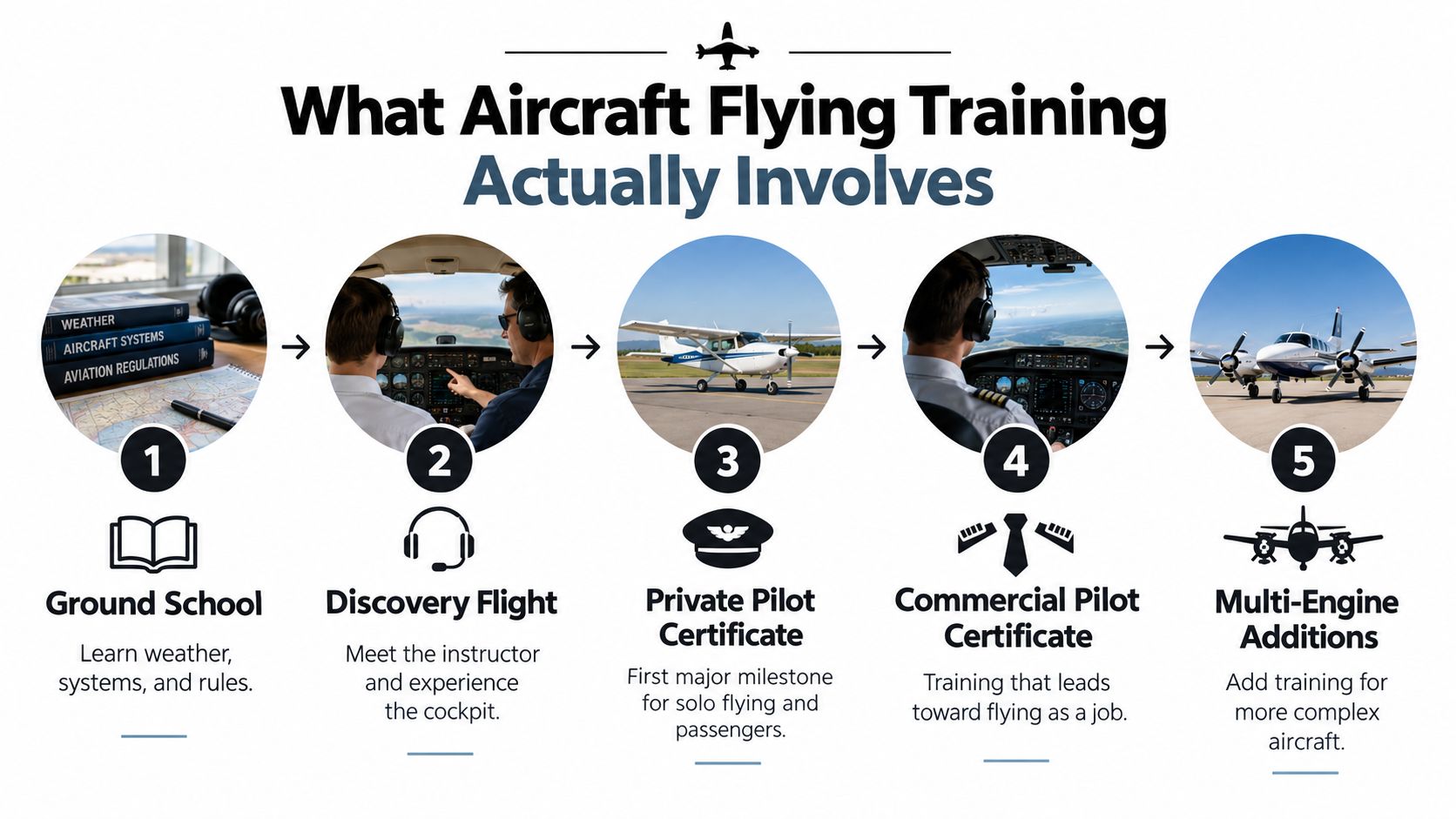
Aircraft flying training is a sequence of qualifications, not a single course. Ground study, flight instruction, supervised practice, and evaluations work together throughout that sequence. You're learning to make decisions as well as move the controls.
The qualifications build on each other
Your private pilot certificate establishes the foundation: controlling the airplane, navigating, communicating, and recognizing when conditions exceed your capabilities. The instrument rating adds procedures and decision-making for flying by reference to instruments.
Commercial training develops greater precision and professional judgment. Instructor training then asks you to explain those skills, recognize another pilot's mistakes, and teach effective corrections.
Certificates and ratings have their own training and testing requirements, but don't assume every addition requires a separate knowledge test. Your instructor should identify the requirements for the particular qualification you're pursuing.
The broad progression looks like this, although instrument and instructor training add important stages beyond this simplified overview.
Rules and technique serve different purposes
The federal aviation regulations establish legal requirements. The FAA's Airplane Flying Handbook explains flying techniques and provides a common instructional foundation. Neither replaces aircraft-specific procedures or your instructor's guidance.
For example, learning a landing maneuver isn't just about reproducing control movements. You also need to recognize an unstable approach, decide whether to discontinue it, and understand why that decision matters.
Treat each certificate as permission to keep learning within new privileges, not proof that you've encountered every situation.
That distinction becomes especially important when your goal is paid flying. Completing training establishes qualifications. Developing judgment continues throughout your career.
How a Flight Training Syllabus Is Structured
A useful syllabus tells you what you're learning, how you'll practice it, and what satisfactory performance looks like. It shouldn't read like a list of flights with no explanation of why they're in that order.
Consider a lesson on takeoffs. The objective isn't merely to leave the runway. You'll prepare the airplane, assess conditions, maintain directional control, establish the appropriate climb, and recognize circumstances that require a different decision.
Connect preparation, practice, and review
A coherent lesson sequence brings several activities together:
- Ground preparation introduces the procedures and underlying principles before you enter the cockpit.
- Flight practice gives you opportunities to apply them with instructor guidance.
- Debriefing identifies what met the standard and what needs more work.
- Progress checks reveal gaps before you reach the practical test.
A Part 61 training approach allows more flexibility in organizing instruction. A Part 141 school uses an FAA-approved curriculum with more prescribed structure. Neither label, by itself, tells you whether your instructor will prepare well or provide useful feedback.
Stage checks help separate familiarity from dependable performance. You might execute a maneuver well after repeated coaching but struggle when another instructor changes the setup. Finding that gap during training is more useful than discovering it during a checkride.
Standardization makes progress visible
At CFII, our training follows the FAA's Airplane Flying Handbook, which describes checklists as foundational to pilot standardization and flight deck safety. That principle matters because students need repeatable procedures rather than a different method every lesson.
A checklist doesn't replace understanding. It helps you verify that you've completed the required actions, including when you're distracted.
Look for a training record that connects lesson objectives, instructor comments, knowledge preparation, and logged experience. A portal with lessons, quizzes, and a digital logbook can make that information easier to follow, but the important question is whether you understand your status.
Before leaving a debrief, you should know what to study, what to practice next, and what must improve before you advance.
Private Pilot Training and What the Hour Minimums Mean
A student can meet the minimum flight-time requirement and still need more practice before being ready for a practical test. Private pilot training builds the skills behind safe, independent flight: aircraft control, navigation, takeoffs and landings, emergency procedures, and sound judgment.
The private certificate allows you to fly solo and carry passengers within its privileges and limitations. It does not authorize paid flying. That requires a commercial certificate, covered in Section 5.
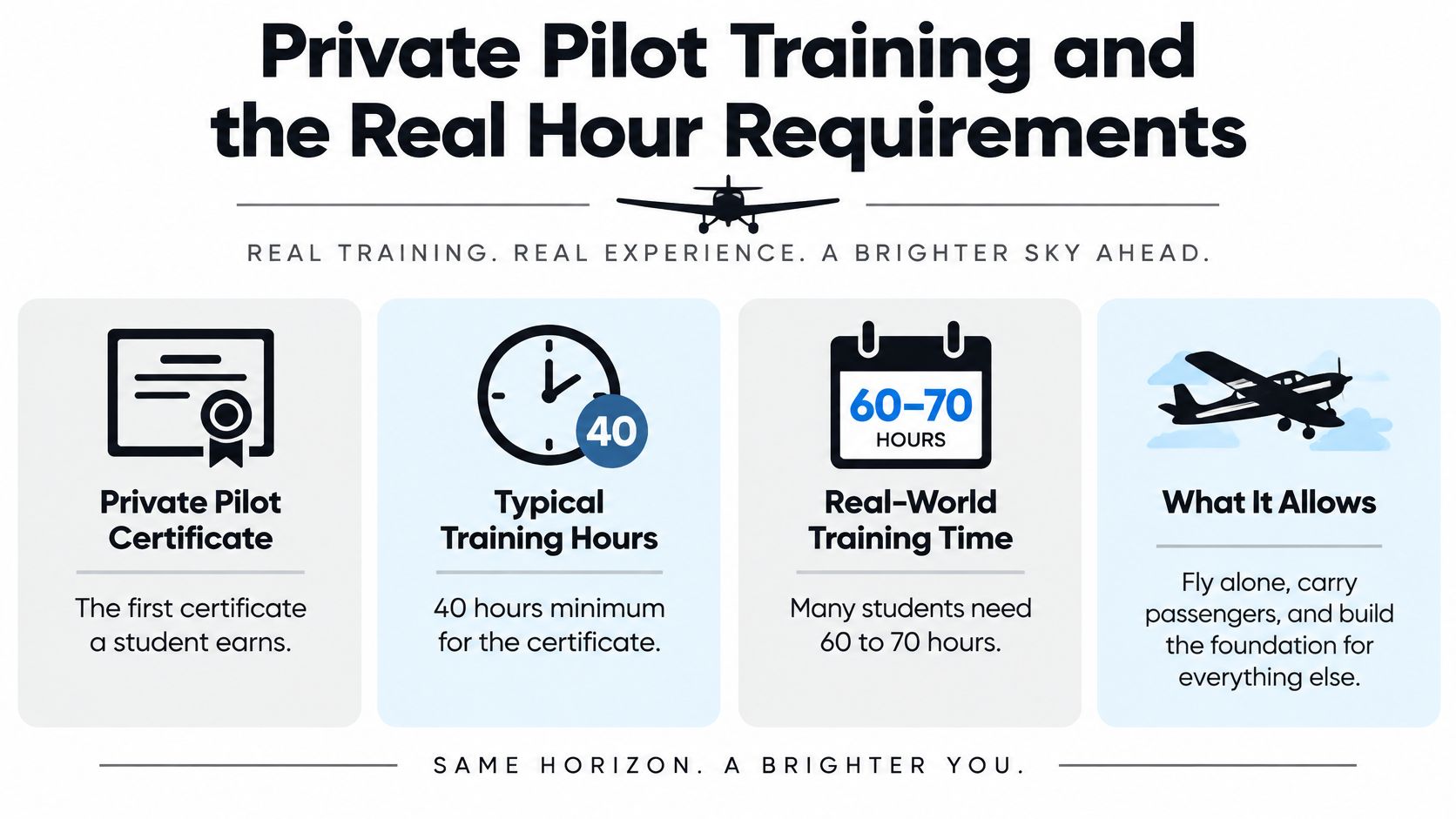
The FAA's minimums are eligibility thresholds, not completion forecasts.
Minimum time isn't a completion forecast
The FAA sets minimum private-pilot training requirements at 40 hours, or 35 hours at an approved school. Its private-pilot flight-time guidance reports that most students need approximately 60–75 hours to qualify. Use that range for planning rather than the narrower estimate shown in the infographic.
Planning rule: The regulatory minimum establishes when you may be eligible to take the practical test. Your demonstrated proficiency determines whether you're ready.
Weather cancellations can break up practice, and maintenance can make an airplane unavailable. If your instructor changes, the new instructor may need to assess your skills before training continues. Preparation on the ground matters as well. Reviewing the previous lesson before arriving helps keep flight time focused on practice rather than repeating explanations.
Track readiness rather than chasing a total
A third-class FAA medical certificate from an aviation medical examiner is required before flying solo. You can take a discovery flight and initial lessons before obtaining one. If you're considering a career in aviation, address medical eligibility early so you can make informed plans.
For more on what to expect from private flight lessons, review the training process before your first lesson.
Ask your instructor to show you your current stage-check results. They help pinpoint what you can perform consistently and what still needs work. Track solo readiness, stage-check results, repeated maneuvers, and knowledge-test progress. If landings are giving you trouble, ask which part needs correction, such as the approach, alignment, or flare, rather than scheduling more hours.
Before agreeing to a fixed price, check what happens if you need additional training to meet proficiency standards. A clear agreement explains what is included and how extra training is handled, without assuming every student progresses at the same pace.
Instrument Rating and the Rules for Simulator Time
A student practicing an instrument approach may find that cockpit setup takes attention away from holding altitude and course. Instrument training builds the ability to control an airplane by reference to instruments when outside visual references are unavailable. It also teaches when conditions and personal proficiency make a flight unsuitable.
An instrument rating does not make every weather condition acceptable. Before a flight, pilots still assess the airplane's capabilities, their proficiency, the procedures available, and the conditions.
Understand the Rules for Simulator Credit
The credit allowed for simulator training depends on the device, instructor, and training completed. The limits below come from 14 CFR 61.65's instrument-rating requirements:
- Basic aviation training device: A maximum of 10 hours may be credited under the applicable authorization (14 CFR 61.65).
- Advanced aviation training device: The corresponding limit is 20 hours.
- Full flight simulator or flight training device: Generally, up to 20 hours may count. An exception permits up to 30 hours when training is completed under an approved Part 142 course.
These allowances are not automatically added together. The applicable rule and device authorization must fit the training recorded in your logbook.
Before a session, ask what you'll practice and how the time will be logged. A realistic-looking cockpit alone does not establish that the session qualifies for credit. Our guide to FAA-approved flight simulators explains how device categories relate to regulatory credit.
Use Simulation for Deliberate Repetition
Suppose you lose time configuring the airplane during an instrument approach. In a simulator, an instructor can reset the scenario, giving you another chance to manage the same workload. This is useful practice, not a substitute for meeting the applicable training and recordkeeping requirements.
Simulation supports focused repetition of approaches, holds, abnormal procedures, and instrument scanning. You can work on a specific procedure or decision without spending the whole lesson returning to the same point in the exercise.
Aircraft lessons add real handling, traffic, changing conditions, and experience operating in actual airspace. A well-designed syllabus uses each setting for the tasks it teaches best.
Simulator training is legitimate. What matters is whether the device, instruction, tasks, and training records satisfy the requirements for the credit you intend to claim.
Commercial Pilot Training and Multi-Engine Additions
A pilot may meet the commercial experience requirements and still need more training to demonstrate the precision and judgment expected for commercial flying. The commercial certificate is a professional qualification that authorizes paid flying in specific operations; it does not authorize every paid operation.
Total flight time alone does not establish eligibility. Your logbook must document the experience categories required by 14 CFR 61.129(a).
Audit the categories inside the total
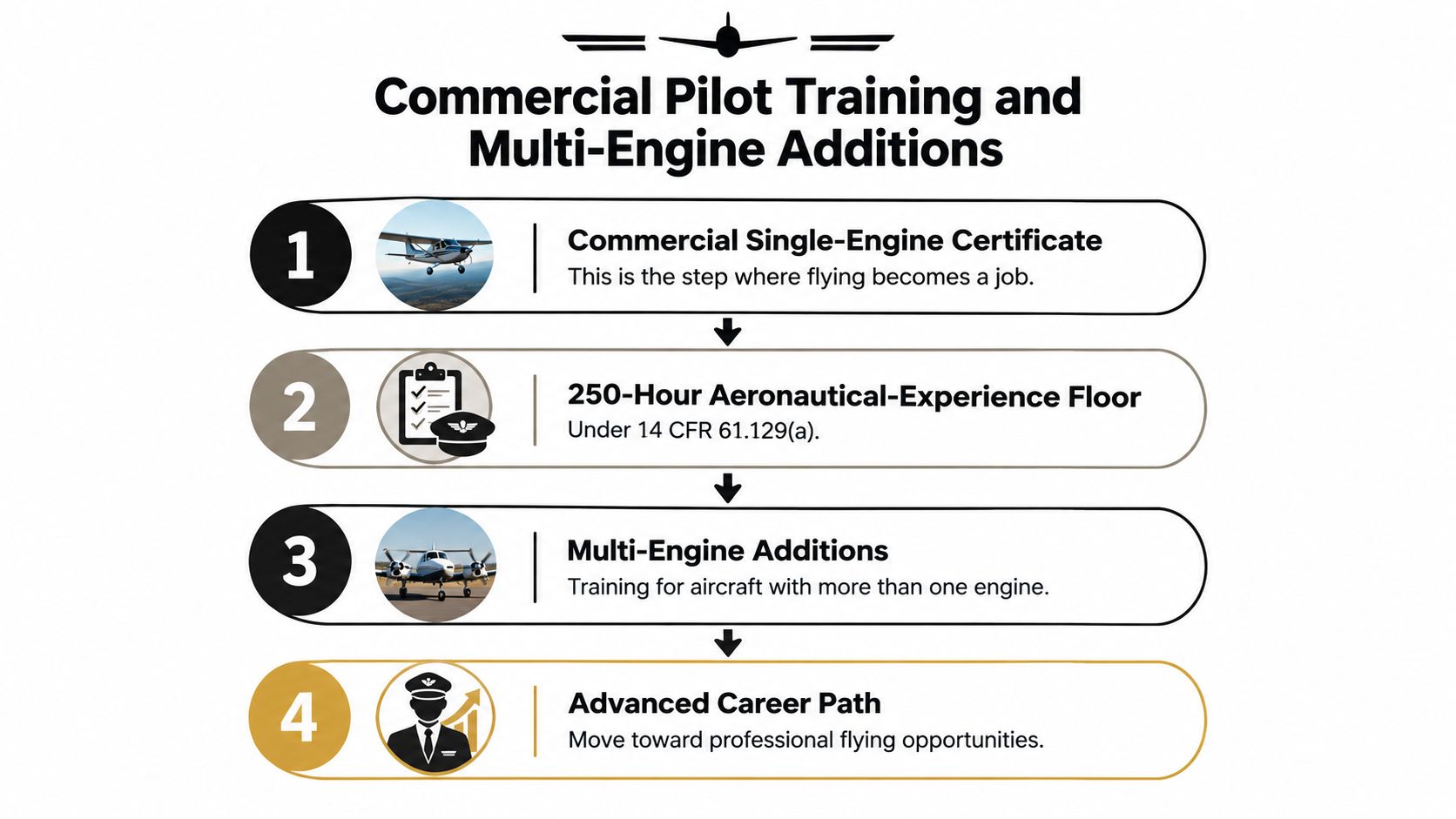
For a commercial single-engine airplane certificate, the regulation sets a 250-hour floor and specifies experience within that total:
- Aircraft experience: At least 100 hours in powered aircraft, including 50 hours in airplanes.
- Pilot-in-command experience: At least 100 hours, including 50 hours of cross-country flight, of which at least 10 hours must be in airplanes.
- Commercial-area training: At least 20 hours, including 10 hours of instrument training using a view-limiting device.
- Qualifying cross-country experience: A flight of at least 300 nautical miles, with landings at three points, including a point at least 250 nautical miles from departure.
- Night experience: The applicable requirement includes 10 takeoffs and 10 landings at an airport with an operating control tower.
These requirements are categories within the total, not separate blocks to add together. For example, qualifying cross-country flight can count toward both the pilot-in-command and cross-country experience requirements, provided it meets the conditions for each. Log the time once, then verify that it satisfies both categories.
The image below places commercial and multi-engine training in the broader progression toward professional flying.
Learn the airplane with an engine unavailable
Multi-engine training develops more than a second-engine checklist. You learn asymmetric thrust, single-engine performance, and the procedures for handling an airplane when its engines produce unequal thrust.
An engine problem can affect directional control and climb performance at the same time. You need to recognize the change, maintain control, and carry out the procedure for that aircraft. Our guide to multi-engine training explains the skills involved.
A commercial training plan needs both a logbook audit and a proficiency plan. Meeting an experience requirement makes you eligible to test; it does not prove that you can perform the required tasks to standard. FAA minimums are thresholds, not reliable forecasts of how long training will take.
Instructor Certificates and the 1500-Hour Airline Rule
The commercial certificate and airline eligibility answer different questions. One establishes commercial pilot privileges. The other requires additional qualifications and experience appropriate to airline operations.
For a standard ATP applicant, the FAA specifies an age minimum of 23, a commercial pilot certificate with an instrument rating, successful knowledge and practical tests, and at least 1,500 hours of total pilot time, as outlined in its Airline Transport Pilot certification guidance.
The airline experience threshold isn't the requirement for earning your first commercial certificate. It belongs to a later qualification.
Why teaching becomes the bridge
A certificated flight instructor, or CFI, teaches students to fly. A flight instructor with an instrument rating, commonly called a CFII, adds the instructional qualification associated with instrument training.
Instructor training changes the task. You must explain why a maneuver works, spot an error early, and choose a correction that helps the student understand rather than just copy you.
Teaching commonly provides a way to accumulate experience after initial professional training. That's why instructor qualifications belong in a career plan as a bridge, not merely as extra certificates at graduation.
An instructor credential doesn't guarantee employment or a particular pace of hour building. Your actual progress depends on obtaining suitable work and having students and aircraft available.
Airline qualification has additional conditions
The FAA recognizes restricted-privileges ATP pathways for certain graduates of authorized aviation-degree programs. Eligible pilots may serve as copilots before meeting the unrestricted experience requirement, with the restriction remaining until the required experience is obtained.
Applicants pursuing an airplane multiengine ATP must also complete ATP CTP before the knowledge test. Appropriate type-rating and first-class medical requirements also matter for the airline pathway, as described in the FAA's air-carrier pilot qualification materials.
Our guide to how to become an airline pilot places those milestones in context.
When comparing training timelines, identify exactly where the clock stops. Finishing initial certificates and instructor qualifications is a different milestone from becoming eligible for unrestricted airline service. A useful career plan shows both, without treating the period between them as automatic.
How to Choose the Right Flight Training Program
Compare schools by asking how they'll keep your training moving when ordinary disruptions occur. A polished schedule is useful, but it doesn't explain what happens when an airplane needs maintenance or an instructor leaves.
A student-pilot training-continuity presentation identifies cost, scheduling conflicts, instructor turnover, and aircraft maintenance among barriers to completion. Those are practical enrollment questions, not minor administrative details.
Questions to Ask Every Flight School
We recommend asking every school, including ours, these questions.
| Question | What a Strong Answer Looks Like |
|---|---|
| How old are the airplanes? | Clear information about aircraft condition, maintenance arrangements, and equipment consistency, not age alone. |
| How many students share each airplane? | An explanation of scheduling capacity and what happens when an aircraft becomes unavailable. |
| What is instructor turnover like? | A continuity plan, accessible training records, and a defined instructor-handoff process. |
| Is the total price in writing? | Written inclusions, exclusions, additional-training terms, and pause or withdrawal conditions. |
| Is training under Part 61 or Part 141? | A clear explanation of the applicable curriculum and how progress is evaluated. |
| Can I fly before committing? | An opportunity to experience instruction and discuss expectations before a major commitment. |
| How are practical tests arranged? | A realistic account of examiner availability and how delays affect scheduling and expenses. |
We also invite prospective students to walk the hangar, sit in a cockpit, and meet the instructors before committing. Our guide to how to choose a flight school can support that conversation.
Compare the cost of reaching readiness
A lower advertised tuition can become more expensive if interruptions extend housing costs or financing charges. A fixed price is useful only when its scope and completion assumptions are clear.
Also distinguish logged time from experience relevant to the next role. Training quality, proficiency, and the categories in your logbook matter alongside the total.
We publish a fixed $89,000 tuition for our Career Track, with 282 total hours and six certificates and ratings, progressing from zero time to CFII and multi-engine in about nine months. The pathway is based in Southern California, including Riverside, Long Beach, and Corona.
Treat that as a defined training milestone, not a hiring promise or an airline-eligibility date.
Your First Step into Aircraft Flying Training
Your first action doesn't need to be signing a full training agreement. Start by finding out how you respond to the airplane, the workload, and the instructor's way of teaching.
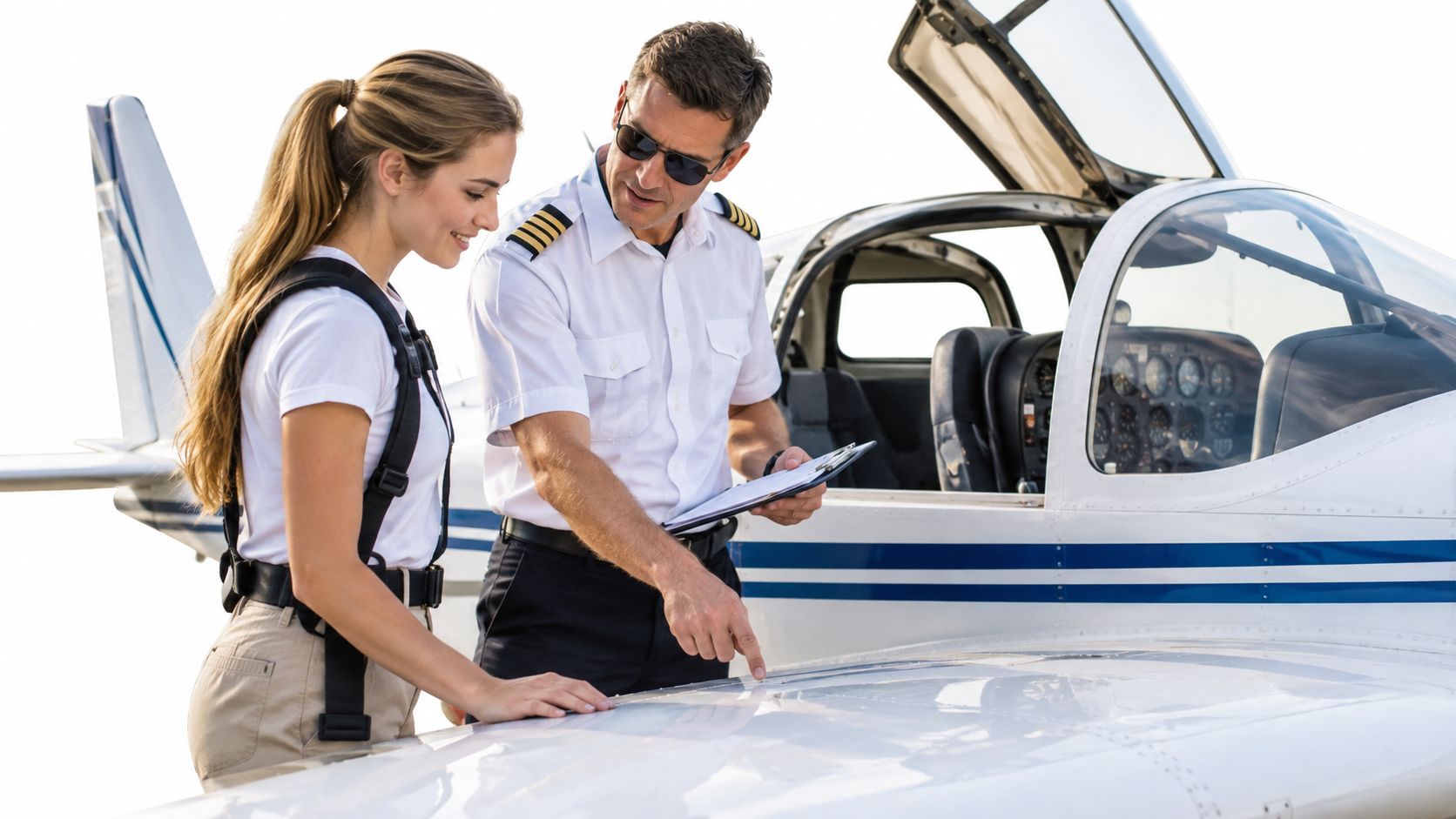
A discovery flight is lesson one. You meet the instructor, preflight the airplane together, and take the controls in the air with guidance. No prior flight experience is needed.
The learning starts beside the airplane, before the engine starts.
Arrive with questions and leave with a plan
Our discovery lesson begins with a walk around the airplane alongside an instructor and a checklist card. You'll start connecting the parts you can see with the checks pilots perform before flight.
You don't need to delay this introductory experience while arranging the medical discussed earlier. If you already have flying experience, we can tailor the lesson so you learn something new while getting familiar with the aircraft.
Afterward, use the school-comparison questions to discuss the practical side of training:
- Your availability: Explain work, family, and travel commitments.
- Your preparation: Find out what to study before the next lesson.
- Your decision: Identify what you still need to understand before enrolling.
We offer Riverside hangar tours and a flight with an instructor after signing up. You can book a discovery flight to experience instruction before making a larger commitment.
If you're already ready to evaluate a complete professional-training pathway, review the zero-to-CFII Career Track against your goals, funding, and availability.
At CFII, we offer introductory flights and a structured pathway from zero experience through instructor qualifications and multi-engine training. Visit us to arrange your first flight, meet the instructors, and discuss what your route from beginner to professional pilot would involve.
Planning to fly for a living?
See what the path from zero to a pilot career looks like, what it costs and how long it takes.
Learn to fly in Riverside
We train at Riverside Municipal Airport in factory-new airplanes with a parachute built in. Start with a one hour discovery flight, no experience needed.