

On this page
- Why IFR and VFR Matter Before You Fly
- The moment the view changes
- Understanding the Two Operating Frameworks
- What Each Framework Asks You to Watch
- Weather Minimums That Decide Which Rules Apply
- How you use the table on a real route
- Equipment Required for IFR Flight
- What has to be in the airplane
- What you tell the system, then what you may launch in
- Training Implications and the Path to an Instrument Rating
- What the accident record keeps showing
- Rating, Currency, and What Lessons Build Skill
- Choosing Between IFR and VFR in Practice
- Special VFR is not a back door into IFR
- When the clearance stays IFR and the window looks VFR
- Choosing Your Next Step After Learning IFR and VFR
You're looking at a cross-country you planned last night, and the sky along the route looks softer than it did at dawn. Haze is filling the valleys. A coastal layer is sliding inland. You don't have much flight time yet, so the question isn't a test item. It's whether you can still see enough to fly.
That question is what IFR and VFR are about. One set of rules keeps a flight legal only while you can see. The other keeps it structured when you can't. The difference shows up in weather choices, in the airplane, and in the training you still have ahead.
Why IFR and VFR Matter Before You Fly
A student with a short cross-country on the board watches the coast go gray. The departure airport is still clear. The route isn't. Morning lessons inland are less likely to be lost to that layer, because Riverside sits away from the beach, but a shoreline leg can still meet it before the turnaround. The student isn't asking for an acronym. The student is asking whether the flight can continue once the horizon starts to fade.
Visual flight rules and instrument flight rules are the two frameworks civil aviation uses for that moment. They aren't labels you memorize for a written exam and then set aside. They shape which weather you may launch into, what the airplane must carry, and which clearances you need before you move.
The moment the view changes
Most new pilots start in the visual system. Airlines and much of business flying live in the instrument system. The overlap is the risky part. You can depart with a clear view and later meet weather that takes that view away. If you aren't rated, current, and practiced for instrument flight, you lose the references you were using to keep the airplane upright.
A legal departure and a safe arrival aren't the same decision. The second one gets made again every time the sky changes.
You'll use the same scene through the rest of this lesson. First, what each framework asks you to rely on. Then the weather numbers, the equipment, the training that makes instrument flight real, and the calls that should send you back to the airport. None of that is abstract once you're the person holding the flight plan.
Understanding the Two Operating Frameworks
A VFR flight can begin with a clear horizon and reach weather that hides it. At that point, the pilot needs to know what information the flight relies on and whether the pilot and airplane are prepared to continue under instrument rules.
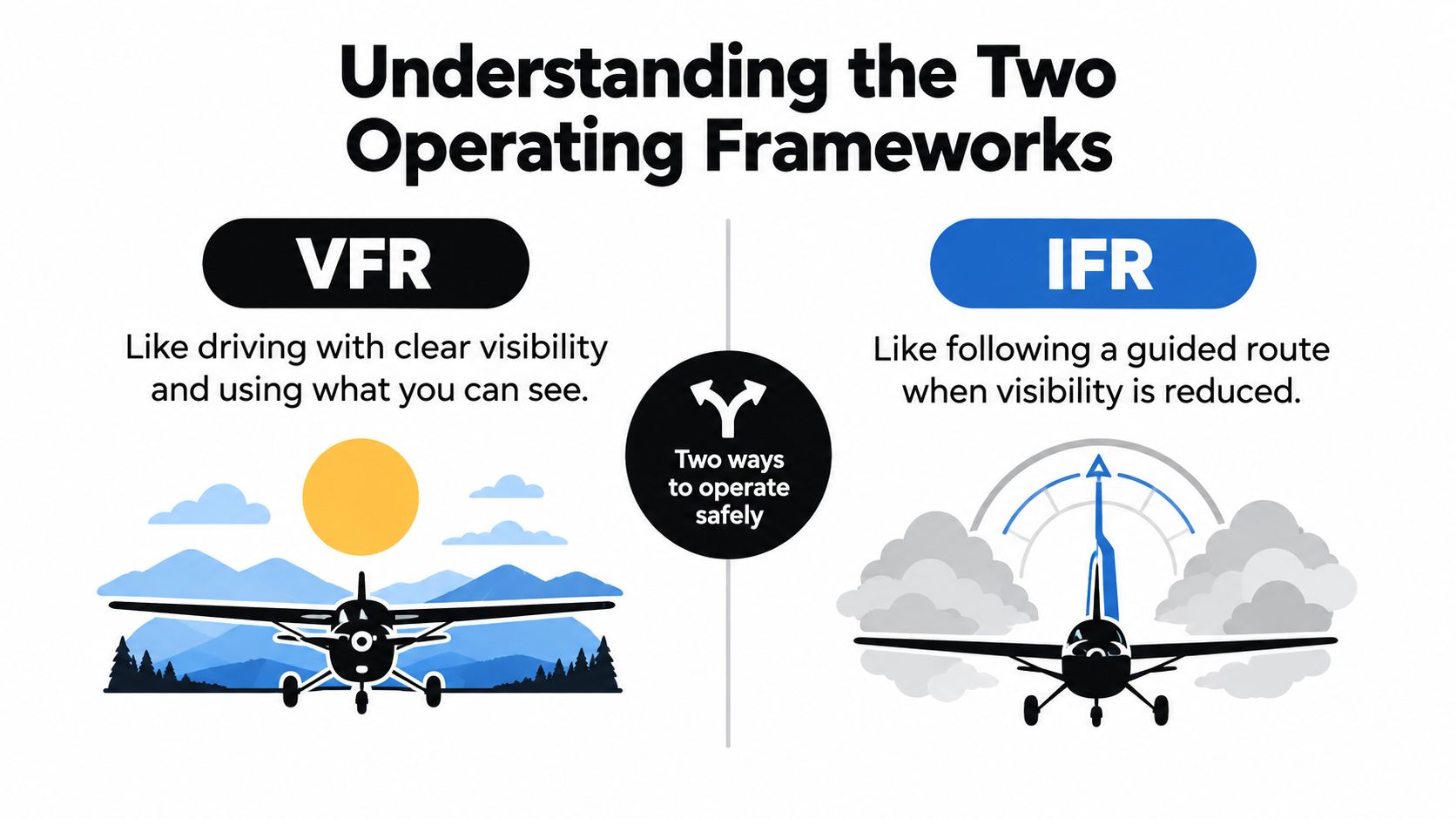
Under VFR, the pilot uses outside visual references to control the airplane, determine the flight path, and watch for other traffic. The flight must take place in visual meteorological conditions, meaning the weather meets the prescribed VFR minimums. The FAA pilot/controller glossary defines VFR as rules for flight under visual conditions and also uses the term for weather at or above the prescribed minimums. This guide to visual flight rules explains how those rules apply in day-to-day flying.
IFR is a way to fly when the outside view cannot be trusted. The pilot uses instruments, an air traffic control clearance, published routes, and instrument procedures. An IFR clearance sets an authorized path and altitudes, while the pilot remains responsible for controlling the airplane. This framework supports flying when visibility is limited, including airline and business aviation operations.
What Each Framework Asks You to Watch
- Outside picture under VFR: The pilot uses visible references for attitude, navigation, and traffic awareness. If the horizon disappears, those references are lost, even when the engine and radios work normally.
- Cleared path under IFR: The pilot follows an ATC clearance and published procedures. The route and altitudes provide structure when outside visual references are unavailable.
- The transition between them: A flight may leave VFR conditions and encounter instrument meteorological conditions (IMC), where visual references are inadequate. Continuing safely requires an instrument-rated, current, and proficient pilot, along with an airplane equipped for the clearance.
Historical figures underline the risk at that transition. For 1990 through 1997, VFR flight into IMC accounted for 2.5% of U.S. general aviation accidents and 11% of fatalities. For 1975 through 1986, those events accounted for about 4% of accidents, 16.7% of fatal accidents, and 19% of fatalities. No source link for these figures is available here, so they should not be treated as independently verified.
The key distinction is what the pilot can rely on. VFR depends on seeing enough to meet the rules and maintain visual references. IFR depends on the airplane's instruments, the pilot's training, and the clearance and procedures guiding the flight.
Weather Minimums That Decide Which Rules Apply
VFR weather minimums depend on airspace and altitude, not on whether the sky looks pretty from the ramp. A thin cloud deck over Class C can end a visual flight that would still be legal in a different slice of sky.
The basic VFR weather minimums in §91.155 set flight visibility and cloud clearance. These are legal floors. They aren't a promise that the route is comfortable or easy to escape.
| Airspace | Flight visibility | Cloud clearance |
|---|---|---|
| Class B | 3 statute miles | Clear of clouds |
| Class C and Class D | 3 statute miles | 500 ft below, 1,000 ft above, 2,000 ft horizontal |
| Class E below 10,000 ft MSL | 3 statute miles | 500 ft below, 1,000 ft above, 2,000 ft horizontal |
| Class E at or above 10,000 ft MSL | 5 statute miles | 1,000 ft below, 1,000 ft above, 1 statute mile horizontal |
| Class G, certain low-altitude day | 1 statute mile | Clear of clouds |
| Class G at night, in the usual case | 3 statute miles | 500 ft below, 1,000 ft above, 2,000 ft horizontal |
How you use the table on a real route
Start with the airspace you'll enter, not the airspace over the home airport. A flight that stays in Class D needs 3 statute miles and the 500-1,000-2,000 cloud box. The same flight, if it climbs into Class E at or above 10,000 feet MSL, needs 5 miles and a wider box. Class G looks more forgiving in some daytime cases, down to 1 mile and clear of clouds, then tightens at night toward 3 miles and the standard cloud distances.
Check the forecast against each segment. If the cloud bases will leave you without the required feet below the clouds, you don't "squeeze it." You change altitude, change route, or don't go VFR.
The FAA also describes broader weather bands that pilots use when they talk about the forecast, not only the airspace box. In 14 CFR part 91, standard VFR conditions are tied to a ceiling above 3,000 feet AGL and visibility above 5 miles. IFR conditions are a ceiling below 1,000 feet AGL and/or visibility below 3 miles. The band between those pictures is where judgment gets tested. Marginal VFR can still be legal in some airspace and still be a poor plan if you have no instrument option.
Controlled-airspace IFR isn't a silent upgrade. It takes an IFR flight plan and an ATC clearance. Reading IFR minimums beside the VFR table keeps the two questions separate. Can I remain visual and legal, or do I need a clearance and a procedure?
Legal VFR means you meet the visibility and cloud rules for that airspace. Prudent VFR means you still have a way out if the forecast is wrong.
Equipment Required for IFR Flight
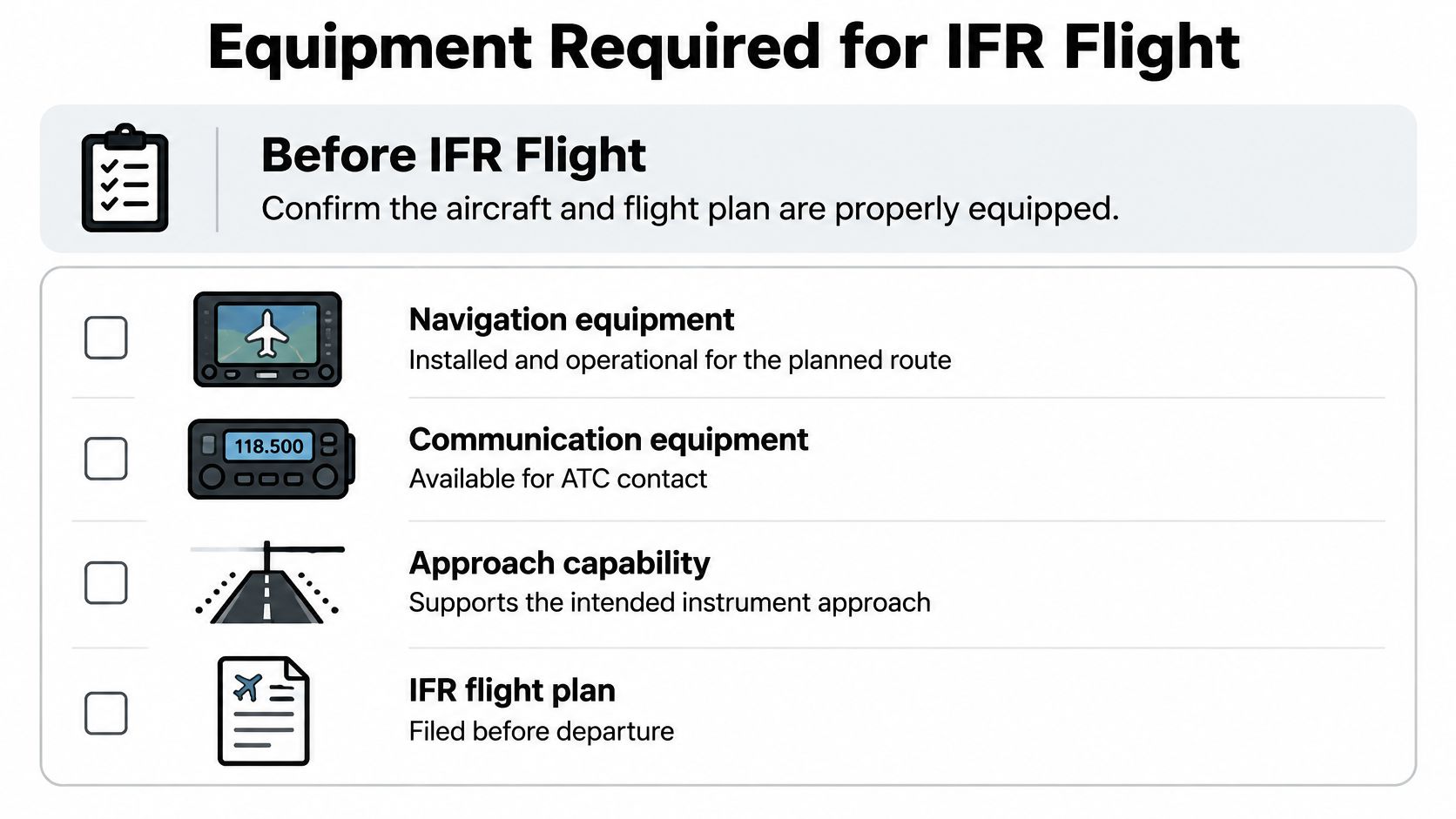
Suppose a VFR flight is underway and the weather starts closing in. Changing to IFR requires more than choosing a different set of rules. The pilot needs the right rating and clearance, and the airplane must have functioning equipment that meets the requirements. Under 14 CFR §91.205(d), IFR flights need the listed instruments and equipment in addition to what VFR requires. Read the equipment list in §91.205 as a preflight check against the airplane's actual equipment.
What has to be in the airplane
Start with the equipment that keeps the airplane's position and attitude understandable without outside visual cues. The required list includes two-way communication and navigation equipment suitable for the route, a gyroscopic rate-of-turn indicator, a slip-skid indicator, and a sensitive altimeter that can be set to the current barometric pressure. It also calls for a clock showing hours, minutes, and seconds, a gyroscopic pitch-and-bank indicator (the attitude indicator, or artificial horizon), a gyroscopic direction indicator or equivalent, and a generator or alternator with enough capacity.
Route suitability is easy to overlook. Having navigation equipment does not mean it can support every route or procedure. Before filing, check that the equipment works, that charts or databases are current, and that required inspections are in order for the flight. A glass cockpit displays attitude and navigation information on screens. CFII's airplanes have glass cockpits, while the equipment rules still require the relevant functions to work.
What you tell the system, then what you may launch in
The FAA's Aeronautical Information Manual recommends listing operable navigation, communication, and surveillance equipment, with the appropriate qualifiers, on the flight plan. That information helps ATC determine whether the airplane's equipment fits the route. Once cleared, the pilot follows the clearance and published procedure, using instruments to maintain a safe path when terrain, obstacles, and other traffic are not visible.
Takeoff and approach limits matter at the same decision point. Under the IFR takeoff visibility minimums in 14 CFR §91.175, unless airport-specific Part 97 minimums apply, a civil airplane with two engines or fewer generally needs at least 1 statute mile of visibility for an IFR takeoff. An airplane with more than two engines generally needs one-half statute mile. For an approach, follow the published procedure and the landing minimums set by the controlling authority. The decision altitude or height and the required visibility or runway visual range determine whether you may continue. The operating rule for approach minimums sets the limits; a runway that appears close is not a reason to go below them.
Before departure, check that the required instruments work, the radios and navigation equipment suit the route, and the flight plan accurately identifies the equipment. Then confirm that the weather meets the takeoff and approach requirements.
Training Implications and the Path to an Instrument Rating
A VFR flight can begin with a clear horizon and meet lowering clouds along the route. At that point, the pilot's judgment, training, and ability to fly by instruments all matter. The instrument rating is a trained skill set, not protection from bad weather.

What the accident record keeps showing
VFR flight into instrument meteorological conditions (IMC), where pilots cannot rely on outside visual references, remains a serious accident pattern. An NTSB-based review of 111 fatal VFR-into-IMC accidents from 2008 through 2020 found that more than 70% happened en route, 77% of the pilots were not instrument-rated, 52% had fewer than 500 total hours, and 57% had fewer than 20 hours of instrument flight. In a separate Alaska operator sample covered by the same material, 75% of events occurred during daylight. The risk is not limited to night flights or remote areas.
These findings point to the value of practicing instrument skills before weather closes in. Once a flight is en route, the departure airport may be far behind. A practiced instrument scan, the orderly movement of attention across the instruments, gives the pilot a skill to rely on when outside references fade.
Rating, Currency, and What Lessons Build Skill
Instrument training builds the ability to hold altitude and heading by reference to instruments, brief and fly an approach, and manage an ATC clearance without rushing. It also develops weather judgment, helping pilots recognize when a visual flight is approaching conditions that exceed their training. An instrument rating course syllabus lays out how lessons progress from basic attitude control to instrument approaches, rather than treating the rating as a single checkride.
A rating and recent practice are different measures. A pilot may meet the legal requirements to act as instrument-rated and still feel rusty with a partial-panel scan, meaning flight with some instruments unavailable, or with a missed approach. Regular practice helps keep those skills usable.
For pilots pursuing a career, the instrument rating connects private-pilot visual flying with later commercial training. It provides a method for making a deliberate choice as conditions change: turn back, divert, or continue only when the flight remains within the pilot's ability.
Choosing Between IFR and VFR in Practice
The weather is within limits at departure, but the clouds ahead are lowering. That is the decision point: continue under VFR, change plans, or use an IFR clearance if you and the airplane are prepared for it. Legal minimums set the boundary; personal minimums give a new pilot room to act before reaching it.

Before departure, compare the forecast with the applicable weather minimums and limits you set in advance. You might choose higher ceilings, more visibility, or a rule against departing toward lowering clouds without another landing option. Choose an escape heading and a place to land while you still have choices. If conditions approach your limit en route, divert or land before entering clouds. The view can mislead you while the clouds are still thin enough to see through.
A 2025 FAA human-factors report on spatial disorientation examined 367 fatal general aviation accidents involving spatial disorientation. It found that more than 75% involved IMC, while 43.9% involved pilots who entered IMC intending to fly VFR. 127 of those pilots did not hold an instrument rating. Most of the VFR-to-IMC accidents occurred en route, and the pattern persisted across 19 years. The report connects weather decisions with human factors, rather than treating these accidents as unusual weather events.
Special VFR is not a back door into IFR
Special VFR allows flight in the surface area of a controlled airport when ordinary VFR minimums are not met. Under §91.157, pilots generally need an ATC clearance, must remain clear of clouds, and need at least 1 statute mile of flight visibility. Between sunset and sunrise, an airplane pilot also needs an instrument rating. The airplane must meet IFR equipment requirements under §91.205(d) and have a working two-way radio. You still have to see and avoid clouds and terrain. The clearance does not authorize unrestricted flight by instruments.
When the clearance stays IFR and the window looks VFR
A visual approach can be confusing because the runway is in sight, yet the flight remains IFR. FAA guidance describes it as an approach flown in visual conditions while operating under IFR rules. Stay clear of clouds, follow the clearance, and tell ATC if you cannot continue visually or lose sight of the airport or aircraft ahead. Seeing the runway does not cancel your IFR clearance. If visual contact is lost after accepting the approach, notify ATC and follow its instructions.
A February 2025 accident illustrates the risk of weather changing during a flight: a VFR flight continued into IMC, encountered ice, stalled, and crashed. The rules in use and the conditions outside may not change at the same moment. Practice identifying that gap before you have to respond alone.
Without an instrument rating, fly VFR within firm personal limits and land if the weather deteriorates. With a rating, file IFR only when your proficiency, the airplane's equipment, and the planned procedure suit the conditions. Reviewing how to plan an IFR flight ahead of time helps you understand the clearance and options before weather closes in.
Choosing Your Next Step After Learning IFR and VFR
The rating, the equipment, and the decision to turn around are one system. When weather starts to close in, each part affects the others: your training helps you judge the conditions, your airplane must have the right equipment, and you must decide whether continuing is safe and legal. A useful next step is to learn how those choices fit together in practice.
For students pursuing aviation as a career, CFII's Career Track includes the instrument, commercial, and multi-engine ratings on the way to flight instructor. That sequence puts instrument training alongside the ratings that follow, giving you practice making weather decisions as your training progresses.
If you haven't flown yet, a discovery flight offers a first flight with an instructor before you commit to training. It begins with a walk around the airplane and a checklist card, so you can see how a pilot prepares before taking off. You don't need prior experience. Start with a discovery flight to see the cockpit before choosing a training path.
Planning to fly for a living?
See what the path from zero to a pilot career looks like, what it costs and how long it takes.
Learn to fly in Riverside
We train at Riverside Municipal Airport in factory-new airplanes with a parachute built in. Start with a one hour discovery flight, no experience needed.