

On this page
- The Published Numbers and What They Measure
- Check the denominator before trusting the percentage
- What Counts as a Pass on the Instrument Checkride
- The ACS is your preparation checklist
- Factors That Move Your Odds
- Compare the stronger and weaker setup
- Control what you can before test day
- Common Failure Points and Their Tolerances
- Decision altitude and minimum descent altitude serve different purposes
- Diagnose the mechanism behind the deviation
- How to Prepare Until Every Task Holds Its Tolerance
- Build measurable readiness gates
- Make the debrief specific
- What to Do After a Failed Instrument Checkride
- Turn the notice into a training record
- Keep discontinuance separate from failure
- Confirm Eligibility and Choose Your Next Step
- Check the training commitment as carefully as the test
The instrument checkride pass rate most sources quote does not exist. The number behind it is a 94.38 percent pass rate on the FAA's 2025 Instrument Rating-Airplane knowledge test, which measures a written examination, and treating it as your chance of passing the practical test is the most misleading shortcut in advice about this topic.
The gap matters before you spend money on training. Knowledge-test applicants answer questions on a screen. Checkride applicants interpret weather, defend a flight plan, manage an equipment failure, and fly instrument procedures to the examiner's standard in a single sitting.
That turns readiness into a concrete question: what evidence would show that you're ready to pass every required task?
The Published Numbers and What They Measure
A school advertising a pass rate in the nineties may be counting written examinations, practical tests, first attempts, repeat attempts, or completed tests only. Before accepting the figure, check which denominator produced it.
The published FAA figures show why the distinction matters.
Published FAA figures and what they measure
| Measure | Attempts | Pass rate | Average score | Counts as checkride pass rate? |
|---|---|---|---|---|
| FAA Instrument Rating-Airplane knowledge test, 2025 | 27,143 | 94.38% | 86.15% | No, written test |
| FAA Instrument Rating-Airplane knowledge test, 2023 | 23,363 | 94.44% | 85.84% | No, written test |
| Instrument Rating-Helicopter knowledge test, 2023, in the FAA knowledge-testing statistics | 614 | 94.46% | Not published | No, different rating |
| Ground Instructor Instrument knowledge test, 2023, in the same FAA statistics | 2,088 | 99.66% | Not published | No, different credential |
| Instrument practical test, national | No published figure | No published figure | Not an average-score examination | Not published by the FAA |
The airplane rows measure performance on the written examination relevant to someone pursuing an airplane instrument rating. The helicopter and ground-instructor rows concern different credentials and applicant populations, so they don't estimate an airplane applicant's practical-test prospects. None of these written-test rows measures performance with an examiner in the airplane.
Check the denominator before trusting the percentage
A pass rate is meaningful only when you know who and what went into the calculation. Ask a school whether its result includes every applicant it endorsed, whether repeat attempts count separately, and how it handles tests stopped before completion.
Ask for specifics, in writing where possible: the reporting period, the number of completed practical tests, and the number of first-attempt passes. A school that can name how many instrument applicants it endorsed over a defined period, and how many passed on the first attempt, holds a measurable statistic. A percentage without those details can sound precise while answering a different question from yours.
What the written results do support: prepared applicants clear the knowledge examination at high rates, so the written test rarely stops the applicant who reaches it. Your own knowledge-test report breaks the exam into subject areas, which makes it a ready-made study map for the oral portion, where the examiner will expect you to explain why today's weather, fuel plan, alternate airport, and equipment support a safe flight.
What Counts as a Pass on the Instrument Checkride
A preflight inspection follows the same logic the instrument practical test uses: completing almost every item doesn't make an unresolved safety problem acceptable. Strong performance elsewhere doesn't cancel an unsatisfactory required task.
The FAA Instrument Rating Airplane Airman Certification Standards identifies three possible outcomes and states that failure of any required task results in failure of the entire practical test and application. The written examination gives you far more room. The FAA's published parameters for the airplane instrument knowledge examination allow 60 questions in 2.5 hours with a 70 percent passing score, so a candidate can miss up to 18 questions and still pass. The practical test offers no comparable margin.
The practical-test paperwork reflects the result.
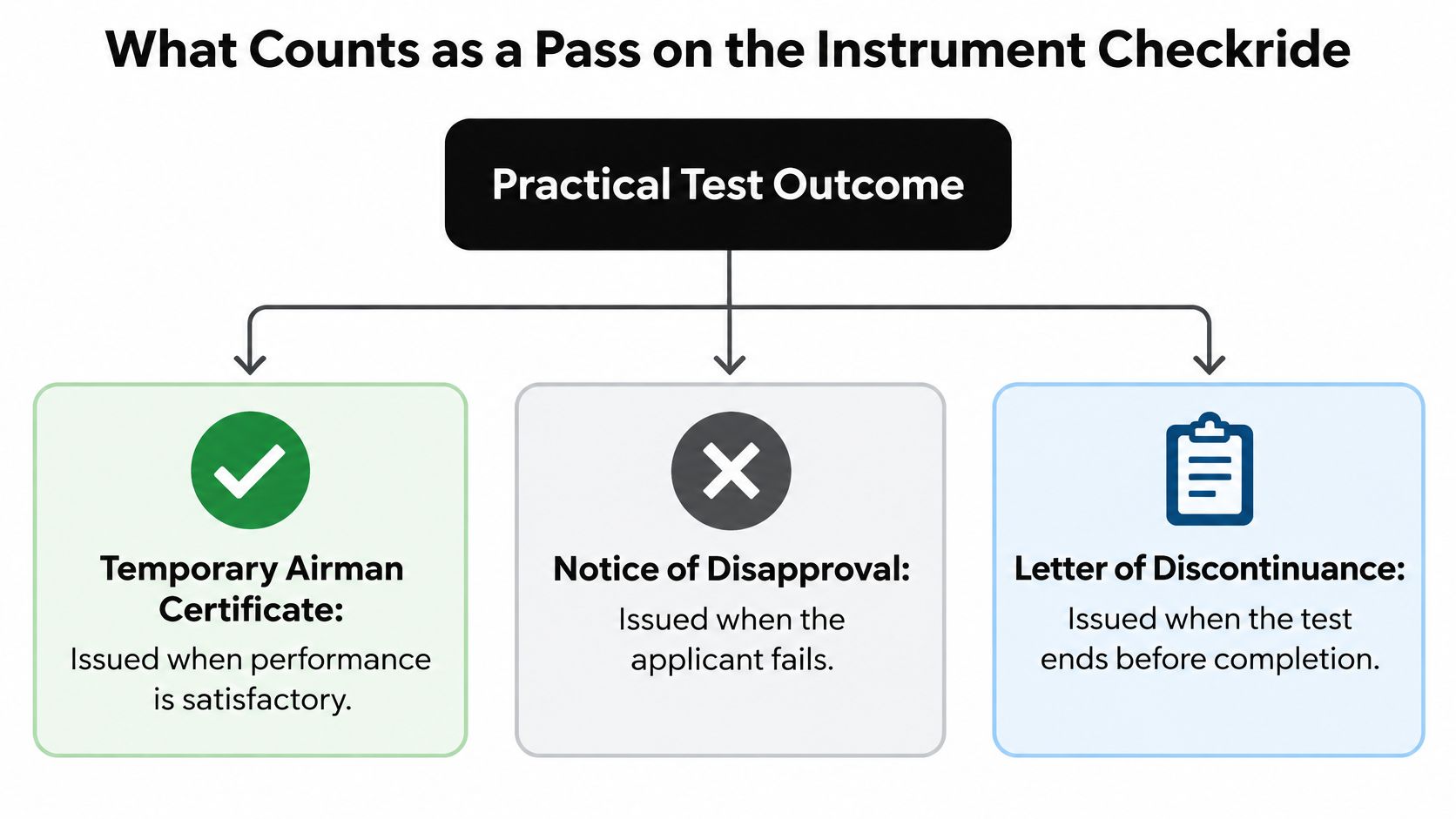
- Temporary airman certificate: Issued when performance is satisfactory.
- Notice of Disapproval: Issued when the applicant fails.
- Letter of Discontinuance: Issued when the test stops before completion, such as because of weather or an aircraft problem. A discontinuance pauses the test rather than recording a failure.
The ACS is your preparation checklist
The Airman Certification Standards, usually shortened to ACS, organizes the evaluation into areas of operation and tasks. Within each task, the examiner judges knowledge, risk management, and practical skills. The standard is binary at the task level: every required task must come back satisfactory for the certificate to issue.
Suppose you can fly an accurate approach but can't explain whether your planned alternate qualifies. A knowledge deficiency that makes the applicable task unsatisfactory ends the test regardless of how well the airplane was flown. The oral evaluation counts as part of the practical test, and a weak answer can fail the related task before the flight portion begins.
For someone new to aviation, understanding what a checkride involves helps put that standard in context. You demonstrate that you can apply your training independently, with the examiner observing rather than coaching.
Start an ACS worksheet now. List each area of operation and mark whether you could explain or demonstrate its tasks to someone who hasn't taught you. Mark unfamiliar material candidly, because each empty box becomes a training assignment with a deadline attached.
Factors That Move Your Odds
Your preparation includes more than aircraft handling. The conditions around training determine whether you arrive able to demonstrate what you've learned.
Use your study environment to rehearse decisions, not just collect completed assignments.

Compare the stronger and weaker setup
Training continuity versus repeated rebuilding. With regular practice, your instructor can develop new skills while reinforcing established ones. After long gaps, plan to verify your scan, procedures, and aircraft control before assuming you're ready to progress. Don't confuse an old logbook entry with current proficiency.
Explained decisions versus memorized answers. A stronger flight plan connects weather, fuel, destination conditions, and escape options. A weaker plan contains correct-looking entries that the applicant can't justify when the examiner changes the scenario. Practice explaining your reasoning aloud, then verify it against the applicable rules and planning information.
Panel familiarity versus button recognition. Know the test airplane's navigation sources, mode indications, autopilot behavior, and available approaches. If you change airplanes, rehearse the workflow on the actual installation rather than assuming similar-looking equipment operates identically.
Control what you can before test day
Manageable conditions versus avoidable overload. A view-limiting device restricts outside visual references; actual cloud adds a different sensory and weather context. Neither replaces the need for preparation, rest, and an honest discussion with your instructor about suitable test conditions.
Standard-based preparation versus examiner predictions. Examiners may differ in conversational style and scenario selection, but your preparation should follow the ACS. Studying only an examiner's rumored favorite questions leaves you exposed when the scenario changes.
An appropriately selected training device can help rehearse navigation setup, holds, and failure procedures without spending the entire exercise repositioning the airplane. Our explanation of FAA-approved flight simulators distinguishes useful practice from assumptions about what training may be credited.
Ask yourself which condition would hurt your performance most today: interrupted practice, shallow planning, unfamiliar equipment, fatigue, or dependence on rehearsed questions.
Change that condition first. Buying more undirected flight time won't necessarily fix a problem that begins with planning or equipment knowledge.
Common Failure Points and Their Tolerances
Disapproval on the instrument practical usually traces to a short list of recurring errors: drifting in the hold, descending below minimums, chasing needles, and fixating when a display fails. Each has a measurable standard behind it, and each has a mechanism worth isolating before test day.
Common failure points and tolerance cues
| Failure point | Typical error | Tolerance cue |
|---|---|---|
| Holding pattern | Altitude and course drift from poor wind correction | Maintain the assigned altitude and published or assigned holding procedure within the applicable task standard |
| Instrument approach descent | Descending below DA or MDA without authorization to continue | Representative altitude cue approximately +100/-0 feet where the applicable task standard requires it |
| Localizer or RNAV tracking | Overcontrolling course or glideslope indications | Representative course cue within three-quarter-scale deflection |
| Circling approach | Losing position, clearance, or the required visual reference | Respect circling minimums and maintain a position permitting a normal landing |
| Missed approach | Delayed or incorrect execution | Begin at the proper point and follow the applicable published or assigned procedure |
| Partial-panel flight | Control breakdown and fixation on the failed display | Maintain control using the remaining usable instruments and appropriate procedures |
The representative approximately +100/-0-foot altitude and three-quarter-scale course-deflection cues come from the FAA's instrument rating Airman Certification Standards. Use them as preparation targets; the task-specific ACS standard governs on the test, so your instructor should identify the exact tolerance for each task you fly.
Decision altitude and minimum descent altitude serve different purposes
DA and MDA describe different procedures with different rules for continuing the approach. A shorthand tolerance never authorizes descent below a published minimum, and it never replaces knowing where the missed-approach point sits.
An unauthorized descent below minimums is a serious deficiency that fails the task regardless of how accurate the rest of the approach looked. During circling, maintaining the required visual reference and a safe position matters as much as remembering the altitude.
Before flying, identify the approach type, minimums, navigation source, missed-approach point, and missed-approach instructions. Learning how to read approach plates helps you extract those details before workload increases.
Diagnose the mechanism behind the deviation
Treat a moving needle as information and make small, deliberate corrections. Overcorrecting can send you across the desired path, prompting another correction while altitude and airspeed deteriorate. Your instructor should separate a poor aircraft-control technique from a navigation-setup error.
Suppose a candidate chases the glideslope and repeatedly ends up well above the intended path. Repeating complete approaches may only rehearse the same mistake. Isolate pitch and power control, establish a stable configuration, then reintroduce tracking and communications.
Holding errors deserve the same diagnosis. If you don't establish wind correction, you may spend each circuit repairing the previous circuit's drift. If altitude changes while you adjust timing or course, practice dividing attention without abandoning aircraft control.
Partial-panel failures reveal another pattern: staring at the failed display instead of using the remaining instruments. The fix is a deliberate scan of the usable instruments plus a practiced reversion procedure.
Diagnostic test: When the same error returns across successive flights, treat it as a skill gap to isolate and train.
How to Prepare Until Every Task Holds Its Tolerance
Build your preparation around observable performance. A lesson marked complete tells you what was covered; a readiness record should show what you can do without instructor intervention.
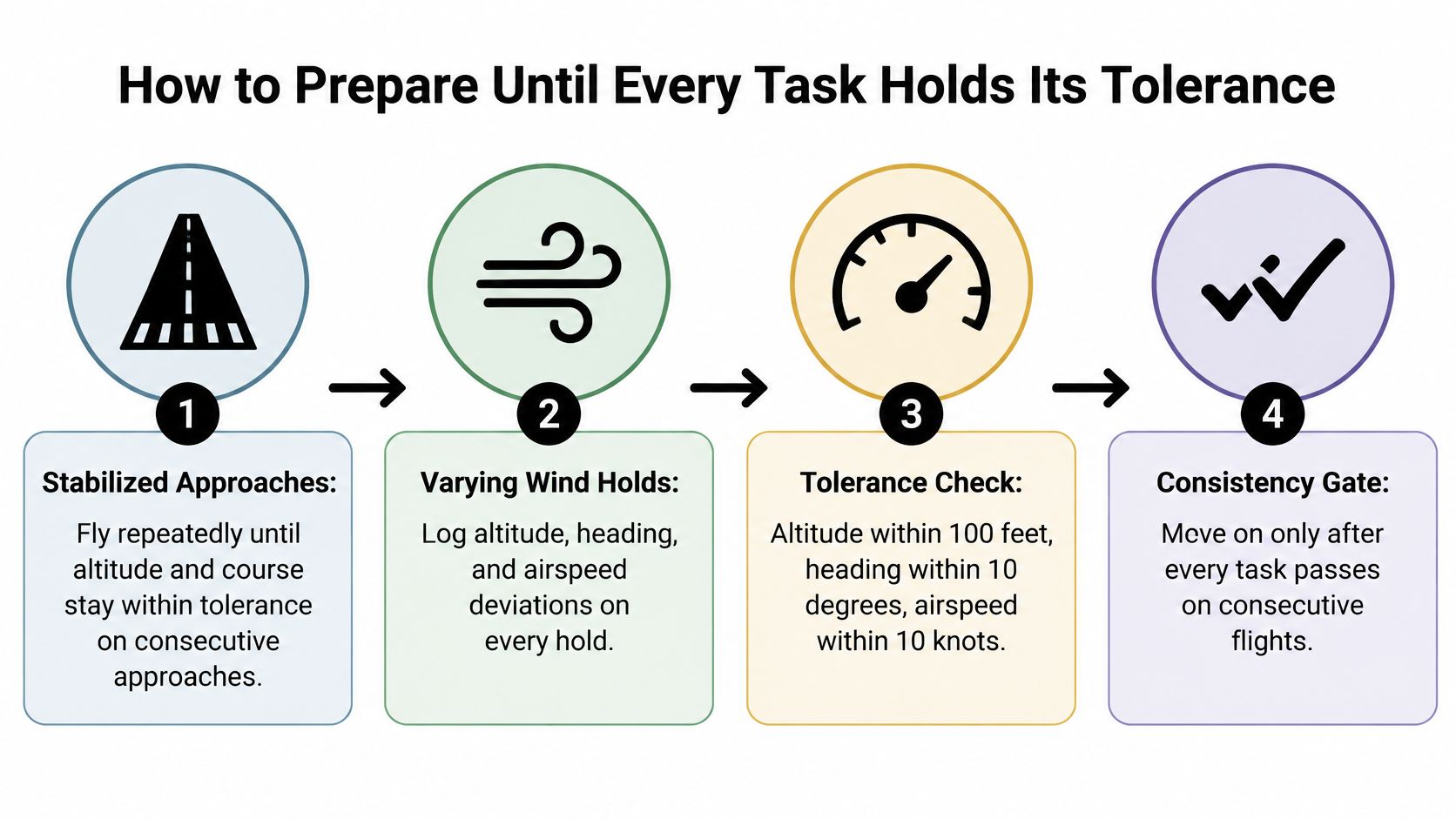
Use the visual sequence as an organizing aid, with your instructor applying the task-specific ACS standards rather than treating any generic tolerance as universal.
Build measurable readiness gates
Stabilize the approach before adding complexity. Repeat approaches until configuration, altitude, course, and airspeed remain controlled on consecutive attempts. Record whether you needed coaching, because an instructor's timely reminder can hide a weakness you'll face alone on the test.
Vary the wind in holding practice. Log altitude and course excursions, along with the correction you applied. The goal isn't to memorize a familiar pattern but to recognize drift and correct it while maintaining control.
Rehearse the transition to the missed approach. Begin the appropriate action at the correct point and follow the published or assigned instructions. Include configuration, power, navigation, and communications so the exercise tests the complete transition rather than a memorized callout.
Practice usable-instrument scanning. In partial-panel scenarios, identify what information remains reliable and fly using it. Have your instructor introduce the failure during another task so you must manage attention rather than anticipate a demonstration.
Defend a complete flight plan aloud. Work through fuel, alternate selection, lost communications, equipment failures, and weather changes without reading a prepared script. Then check your reasoning against the governing references; confident delivery doesn't make an incorrect answer acceptable.
Complete a full mock practical test. Have your instructor cover every applicable ACS area without routine coaching. Include the ground discussion, aircraft preparation, flight tasks, and debrief so unresolved weaknesses don't disappear between separate lessons.
Schedule only after demonstrated consistency. Ask your instructor to document which tasks are ready and what evidence supports that judgment. This readiness record supports training decisions; it doesn't replace any required endorsement.
An instrument-rating course syllabus helps connect those exercises to a progression instead of a collection of practice flights. For a beginner, that structure also explains why learning navigation procedures and developing basic instrument control must support each other.
Make the debrief specific
After each exercise, write down the task, the deviation or decision error, its likely cause, and the next drill. Replace “approaches need work” with an actionable entry such as “verify navigation source before intercept, then monitor course while configuring.”
Use this video alongside your instructor-led preparation.
A successful practice flight is encouraging. It isn't enough evidence to schedule if your performance falls apart when the wind, approach, or equipment scenario changes.
What to Do After a Failed Instrument Checkride
A failed instrument checkride doesn't permanently prevent certification. It does require corrective preparation and the proper authorization before another attempt, rather than booking an unrestricted retry.
The FAA instrument-rating ACS retest provisions identifies 14 CFR § 61.49 as the governing rule and calls for the applicable failed-test report and an authorized-instructor endorsement. That endorsement confirms additional training or review and readiness to retest; it isn't merely a replacement signature.
Turn the notice into a training record
Start with the Notice of Disapproval, not your memory of the most uncomfortable moment. Review every listed deficiency with your instructor and distinguish the observed error from its underlying cause.
A course deviation, for example, might result from incorrect navigation setup, poor control technique, or distraction during configuration. Each requires a different correction. Repeating the whole flight without identifying that cause can leave the original problem intact.
- Identify the deficient tasks. Match each listed item to the applicable ACS area and describe what satisfactory performance requires.
- Agree on corrective training. Select exercises that address the cause, then practice under conditions that test whether the correction holds.
- Document the work. Record the training and review with your instructor so you can explain what changed.
- Obtain the required endorsement. Your authorized instructor must determine that you're prepared for another attempt.
- Prepare the retest documents. Bring the applicable test report and endorsement, and confirm the remaining administrative requirements before arriving.
Keep discontinuance separate from failure
A Letter of Discontinuance means the test stopped before completion. Don't assume it requires the same corrective-training process as a Notice of Disapproval, and don't assume every unfinished item has been satisfied.
Ask the examiner why the test stopped, which portions remain incomplete, and what paperwork applies when you return. If the interruption involved an aircraft problem, resolve the equipment issue before choosing another date.
Keep a personal record of each deficiency and the exercise that corrected it. That record is useful beyond the retest: it identifies the conditions under which you need deliberate practice as your instrument experience grows.
Confirm Eligibility and Choose Your Next Step
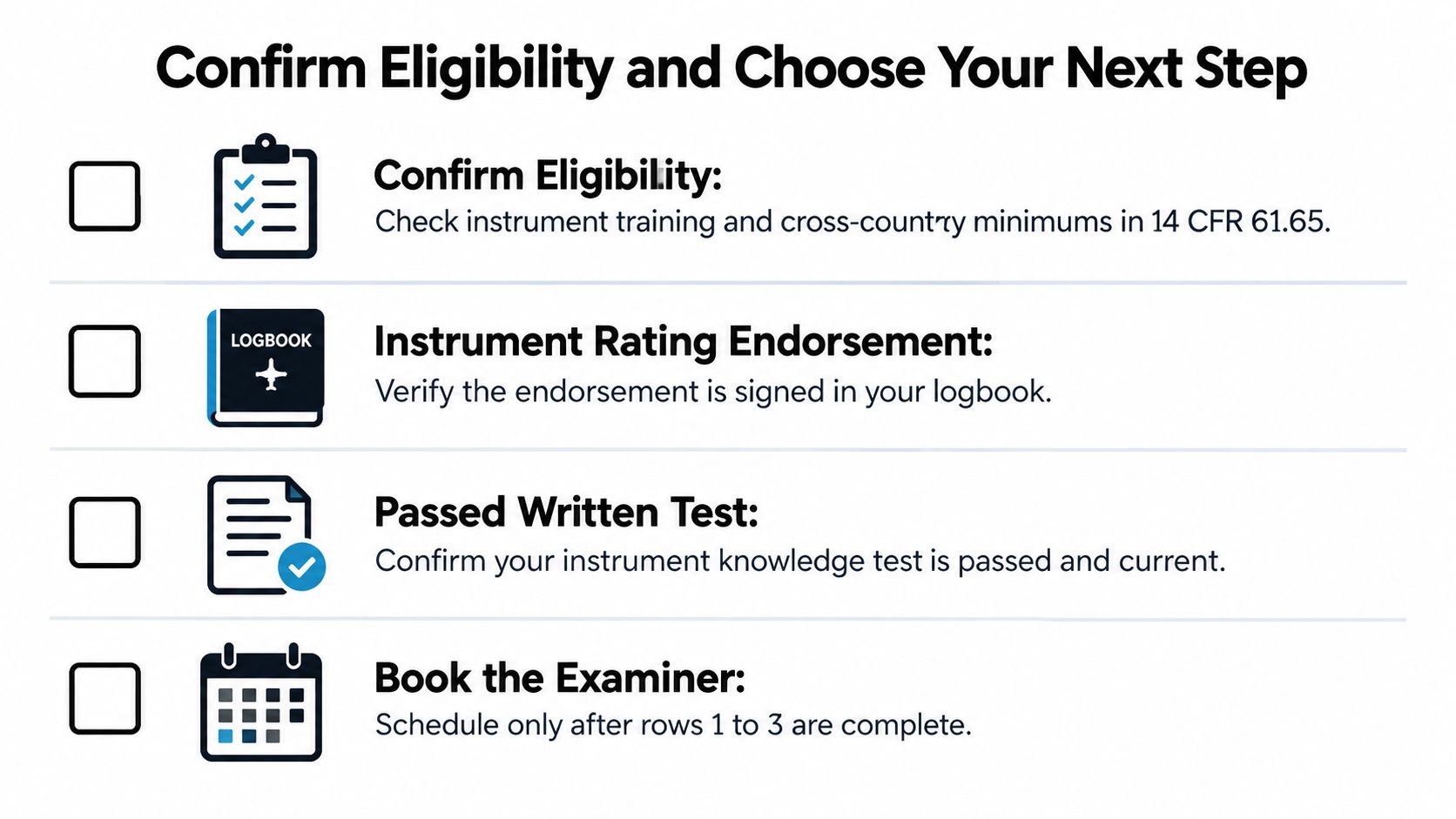
Eligibility and proficiency are separate checks. Review the instrument-training and cross-country requirements in 14 CFR § 61.65, your required logbook endorsements, and the practical-test prerequisites in 14 CFR § 61.39 with your instructor. Confirm that your passed knowledge test was taken within the preceding 24-calendar-month period that 14 CFR § 61.39 sets for the practical test.
Use this checklist alongside that review, not instead of the full eligibility requirements.
Check the training commitment as carefully as the test
Verify your readiness record covers approaches, wind-corrected holds, missed approaches, partial-panel work, flight-planning explanations, and a satisfactory mock test. For budgeting, use our instrument-rating cost guide and request a written total identifying aircraft rental, instructor time, knowledge-test charges, and examiner fees.
We recommend asking every school, including ours, about airplane age, students per airplane, instructor turnover, Part 61 versus Part 141 training, and whether you can fly before committing.
If you haven't flown, start with a discovery flight. For a full pathway, our Career Track offers fixed $89,000 tuition, about nine months from zero time to CFII and multi-engine, 282 total hours, and six certificates and ratings, based in Riverside, Long Beach, and Corona in Southern California. It includes FAA-examiner checkride scheduling, written-test preparation for every rating, textbooks, study guides, exam prep, and a portal with lessons, quizzes, stage checks, and a logbook. Examiner fees are extra everywhere, including at CFII.
Compare that scope with your budget and availability. Eligibility gaps are cheapest to find early: an expired knowledge test or a missing endorsement discovered during enrollment costs you a delay, while the same gap discovered on checkride morning costs you the examiner fee and the date.
CFII offers a structured zero-to-CFII pathway with written-test preparation, study resources, and coordinated checkride scheduling. Visit CFII to discuss the training sequence and costs, and ask how your progress will be assessed against practical-test standards rather than an advertised pass-rate percentage.
Planning to fly for a living?
See what the path from zero to a pilot career looks like, what it costs and how long it takes.
Learn to fly in Riverside
We train at Riverside Municipal Airport in modern airplanes with a parachute built in. Start with a one hour discovery flight, no experience needed.