

On this page
- The PAR Knowledge Test at a Glance
- What You're Actually Booking
- The Two Catches Students Miss
- Score Targets That Beat a Bare Pass
- Why the Low 80s Are Not Good Enough for You
- The Number That Gets You Booked
- Question Types the ACS Actually Weights
- What Those Weights Mean in Practice
- One Trap Worth Studying Closely
- FAA Books and the Endorsement You Need
- The Signature Is a Separate Checkpoint
- How to Run an ACS Study Loop
- The Five Steps
- What Your Error Log Should Hold
- A Schedule That Fits the Loop
- Practice Strategies for Charts and Weather
- Work in Two Passes
- Three Traps to Drill Until They're Boring
- Sort the Damage Afterward
- Book the Test Once the Margin Holds
Forget the most popular advice on this test. Don't drill a question bank until the answers look familiar and then call yourself ready. Good private pilot written test prep works the other way. You learn the rule, the chart, and the calculation first. Then you prove you can use them on a fresh scenario, under a timer, without help. If you're a zero-time career student, that's your standard from day one.
The PAR Knowledge Test at a Glance
What You're Actually Booking
The PAR is the FAA Private Pilot Airplane knowledge test: 60 questions, a 70 percent passing score, and a minimum test age of 15, according to the FAA Airman Knowledge Testing Matrix. The test allows 2.5 hours for 60 questions. At 2.5 minutes per question, a four-minute chart costs you a point you could have banked. Confirm the time on the current testing matrix when you schedule.
| Item | Figure | Why it matters |
|---|---|---|
| Test code | PAR | Private Pilot Airplane, not a short quiz |
| Questions | 60 multiple choice, one correct answer | Broad knowledge, not one subject |
| Allotted time | 2.5 hours (150 minutes) | About 2.5 minutes per question; confirm on the current testing matrix at booking |
| Passing score | 70 percent (42 correct) | FAA minimum, not the training target |
| Minimum age for PAR | 15 | Separate from solo at 16 and the private certificate at 17 |
| Order of tests | Knowledge test before the practical test | A pass does not replace the checkride |
| Endorsement | 14 CFR § 61.35 when required | Instructor certifies ground or home study and readiness |
The Two Catches Students Miss
You can take PAR at 15, before flying solo or earning the certificate. There is no minimum age for lessons; students can fly solo at 16 and hold a private pilot license at 17. That makes the written test an option to complete early on a career timeline.
A first-time applicant needs an authorized instructor endorsement under 14 CFR § 61.35 when required; see FAA Books and the Endorsement You Need for the details.
Booking rule: 70 percent is the FAA floor. It is not the score you train for, and it is never the score that tells you to book.
Pass the knowledge test before the practical test. The checkride still requires you to explain and apply the material in a flight context.
Score Targets That Beat a Bare Pass
National results look comfortable and still leave a thin cushion. The FAA 2024 test statistics report recorded 46,132 applicants who took the Private Pilot Airplane knowledge test in 2024, with 91.90 percent passing and an average score of 82.89 percent, while the comparable 2023 figures were 45,820 tests, a 90.30 percent pass rate, and an 82.05 percent average score. In 2025, the FAA CY2025 AKT Volume Report recorded 44,657 Private Pilot Airplane knowledge-test attempts with an 89.56% pass rate and an average score of only 81.64%, just 11.64 percentage points above the 70% passing threshold.
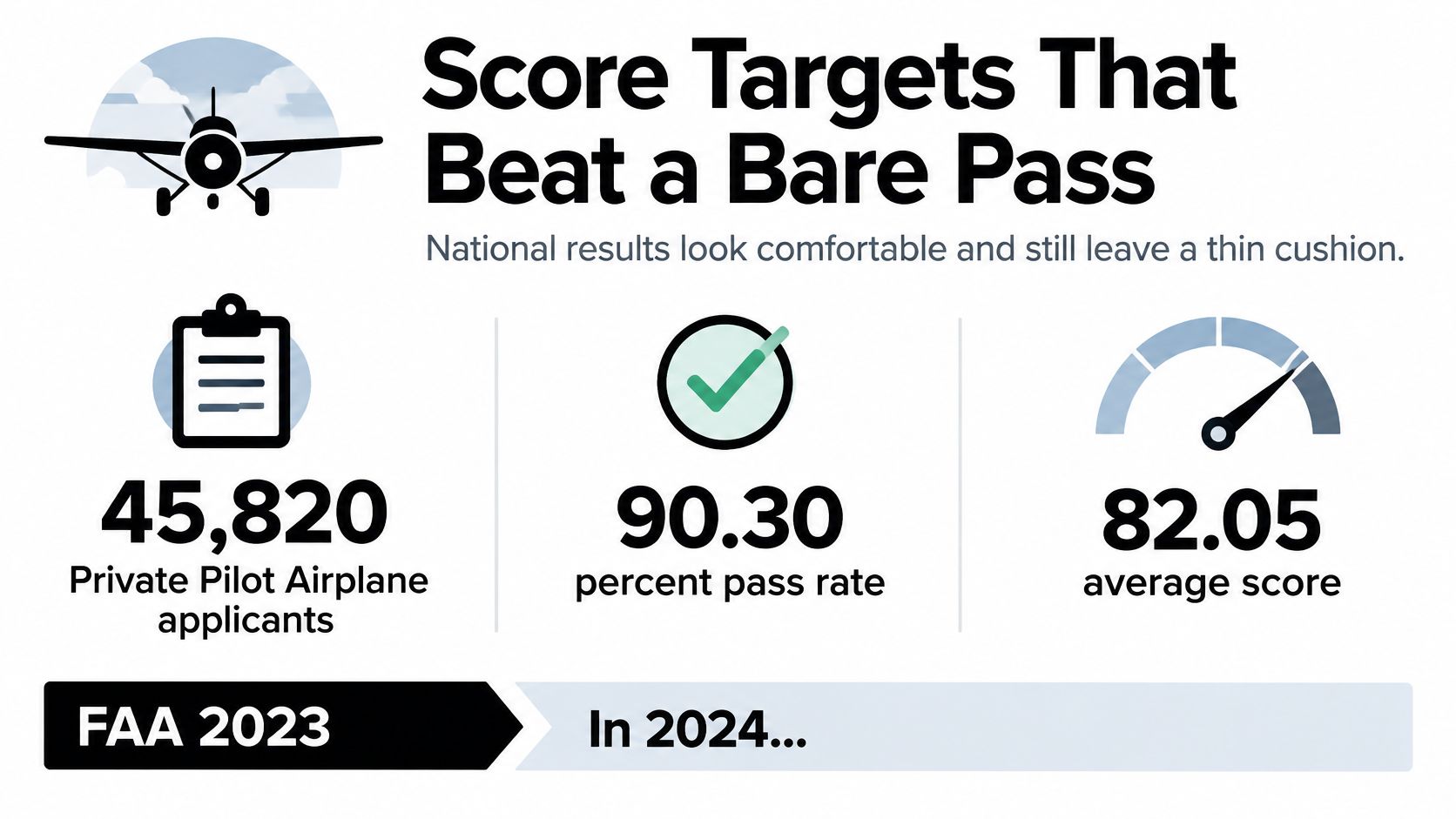
| Year or target | Volume | Pass rate | Average or goal | Margin over 70 |
|---|---|---|---|---|
| 2023 applicants | 45,820 | 90.30% | 82.05% | 12.05 points |
| 2024 applicants | 46,132 | 91.90% | 82.89% | 12.89 points |
| 2025 attempts | 44,657 | 89.56% | 81.64% | 11.64 points |
| Booking target | Repeated timed 60-question sets | Not the goal | 85 to 90% | 15 to 20 points |
Why the Low 80s Are Not Good Enough for You
A pass rate near 90 percent sounds reassuring. It shouldn't decide your test date. An average in the low 80s means the typical passing student walked out with roughly 12 points of margin. That's a population number, not your personal safety net. It can hide a failed weather block, a blown weight and balance set, or airspace answers you guessed correctly once and would miss with different wording.
Say your practice set comes back at 82. You nailed regulations. You also guessed on three chart items and got lucky on two. Your real knowledge on that day was closer to the mid-70s. Book the official test on that score and unfamiliar wording takes the luck away. You're now below the line, or barely above it, with weak areas an examiner will find later anyway.
The Number That Gets You Booked
Don't book because a practice bank usually clears 70. Don't book because you hit 85 once on a set you'd partly seen before. Use repeated timed 60-question sets. Wait until you hold 85 to 90 percent across more than one sitting, with every miss and every guess explained out loud.
That 15 to 20 point margin is what absorbs a bad morning, a confusingly worded stem, and one chart that takes longer than planned. It's also the gap between passing and proficiency. A career student who can explain why a weather product kills a flight, why a center of gravity is out of limits, and why a regulation applies to a specific scenario is building checkride knowledge. A student who recognizes answer patterns is borrowing points.
If you do fail, treat the report correctly. An FAA failure report lists deficient learning statement codes. Those codes are a repair map. You fix the named areas with your instructor, retest those ideas in scenarios, and stop wasting weeks restarting material you already know.
If your score needs lucky guesses to clear 80, you don't have a score yet. You have a warning.
Question Types the ACS Actually Weights
The Airman Certification Standards (ACS) shows where the written test puts its weight. The FAA Private Pilot Airplane ACS assigns question-weight ranges to areas such as regulations, accident reporting, performance charts, radio communications, weather, density-altitude performance, weight and balance, aerodynamics, aircraft systems, stalls and spins, decision-making, and preflight actions. Most listed areas represent about 5 to 10 percent of a test; some regulatory and accident-reporting categories may reach 15 percent.
| Knowledge area | Share of a test | Drill this |
|---|---|---|
| Regulations | Up to about 15% | Apply a rule to a flight scenario |
| Accident reporting | Up to about 15% | Identify what must be reported and when |
| Performance charts | About 5 to 10% | Find takeoff, landing, and climb performance |
| Radio communications | About 5 to 10% | Choose the right call for the airspace and flight phase |
| Weather | About 5 to 10% | Read a product and make a go or no-go decision |
| Safe and efficient operations | About 5 to 10% | Choose the safer operational option |
| Density-altitude performance | About 5 to 10% | Calculate density altitude and its performance effect |
| Weight and balance | About 5 to 10% | Calculate weight, arm, and moment, then check limits |
| Aerodynamics | About 5 to 10% | Explain how and why the airplane responds |
| Powerplants and aircraft systems | About 5 to 10% | Identify a fault and choose the next action |
| Stalls and spins | About 5 to 10% | Explain recognition, cause, and recovery |
| Aeronautical decision-making | About 5 to 10% | Make a risk-based choice in a realistic scenario |
| Preflight actions | About 5 to 10% | Identify required planning before departure |
What Those Weights Mean in Practice
Regulations deserve serious study, but a strong score requires breadth. Weather, performance charts, and weight and balance each occupy a smaller share. Together, those areas can expose major gaps if you leave them until last.
Expect scenarios, not isolated trivia. You may need to apply a regulation to a particular flight, decide whether an accident is reportable, choose a radio call, interpret weather, or respond to a system fault. Learn the decision behind each answer.
One Trap Worth Studying Closely
A question gives you a warm day, a high field elevation, and a short runway, then asks for takeoff distance. Calculate density altitude before using the performance chart. Enter the chart with the calculated value, interpolate between printed lines, and state what the result means for the takeoff. A miscalculated density altitude gives you a runway you can't use.
Weight and balance demands the same methodical work. Write weight, arm, and moment in a column for every item. Add the moments, divide by total weight, and check the result against the limits before looking at the answer choices. Mental arithmetic makes it easy to swap an arm, omit baggage, or choose a distractor built around that mistake.
For sectional work, use this guide to read sectional charts, then practice identifying airspace, its floor and ceiling, nearby obstacles, and a usable checkpoint. Apply each answer to an operational decision. For every miss, name the ACS task and the operational consequence. That is how private pilot written test prep builds knowledge you can use in the airplane.
FAA Books and the Endorsement You Need
Build your library from FAA sources first. Give each resource a specific job, and use a question bank to test what you have learned.
- Private Pilot Airplane ACS: Your task list. It shows what the FAA expects you to know, manage, and do.
- Pilot's Handbook of Aeronautical Knowledge: Your textbook for aerodynamics, aircraft systems, performance, and flight planning.
- Aviation Weather Handbook: Your reference for weather theory, charts, and forecast products.
- Airplane Flying Handbook: Use it when a written question covers a flying skill, such as stalls, and you need to connect the concept to control inputs and recovery.
- Learning Statement Reference Guide: Use it to turn a missed question or an official score-report code into a topic to study.
A current question bank works best as a drill after you learn the underlying idea. Answer a set, identify gaps, return to the FAA material, then test yourself again. Memorizing old question wording leaves you unprepared when a scenario changes.
The Signature Is a Separate Checkpoint
Under 14 CFR § 61.35 in Part 61, an applicant needs an authorized instructor's endorsement when required by the regulation. The endorsement certifies that the applicant completed the required ground training or an acceptable home-study course and is prepared for the test.
Use the signature as a checkpoint. Bring your error log and ask your instructor to quiz you on your weakest ACS codes before signing. If you cannot explain your most-missed areas without notes, keep studying. Verify that the endorsement is properly recorded before test day.
Instructor check: If your instructor hesitates to sign after quizzing you, take that as a reason to study more before booking.
Part 61 and Part 141 students take the same PAR test. The difference is how ground lessons are structured and how the syllabus is approved. For the broader certification sequence, use this guide to flight training requirements.
Choose one primary study path and finish it. Switching between half-completed courses wastes time on repeated introductions and leaves harder material unfinished.
How to Run an ACS Study Loop
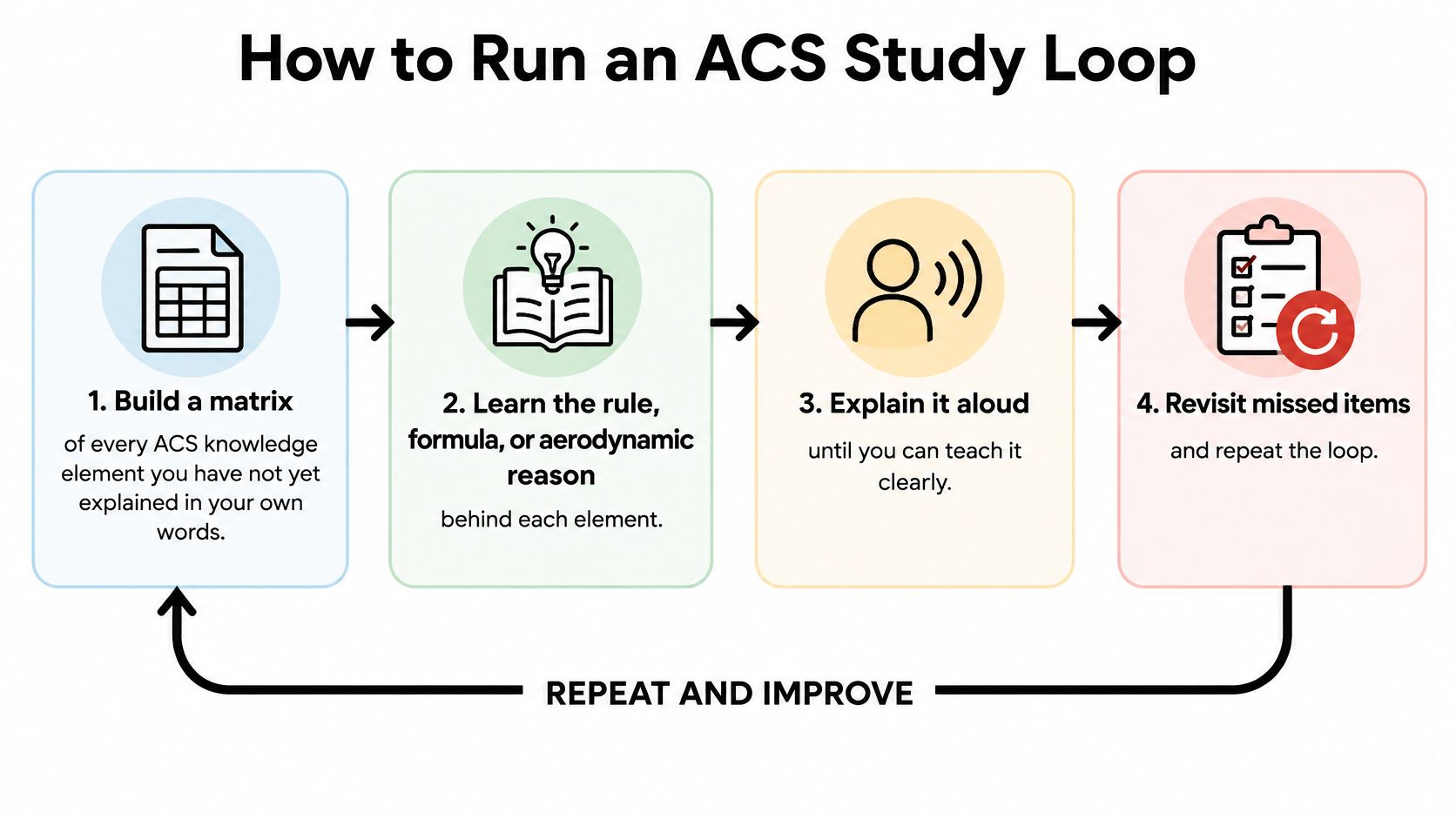
Run one closed loop. Rereading a bank until answers feel familiar isn't a loop. It's a circle. The FAA Private Pilot Airplane ACS maps tested content across domains including regulations, weather, performance charts, communications, density altitude, weight and balance, systems, stalls, aeronautical decision-making, and preflight actions, and the practical workflow it supports is to build a study matrix from every ACS knowledge element, learn the underlying rule or principle, solve a representative scenario without aids, explain why each distractor is wrong, and log errors by ACS code.
The Five Steps
- Build the matrix. List every ACS knowledge element you can't yet explain in your own words. If you can't teach it in two plain sentences, it goes on the list. No exceptions for topics you find boring.
- Learn the reason. Go to the Pilot's Handbook of Aeronautical Knowledge or the Aviation Weather Handbook and learn the rule, formula, or aerodynamic principle. Don't learn it from an answer key. Answer keys tell you which letter won. They rarely teach you why.
- Solve it closed-book. Take one fresh scenario with the book shut and a timer running. Compute the moment. Read the chart. Pick the radio call. Struggle a little. That struggle is where retention comes from.
- Kill the distractors. Write why each wrong choice is wrong. This is the step students skip and the step that matters most, because FAA distractors are built from real errors like swapped units, wrong airspace floors, and standard-day assumptions on a hot afternoon.
- Log and repair. Record the miss by ACS code. Fix that code before you add new material. A log full of old, unrepaired weather misses is just a diary.
What Your Error Log Should Hold
Keep it to one page per week. Four columns are enough.
- ACS code: The exact area the miss belongs to.
- The mistake: What you did wrong, in plain words.
- Consequence in the airplane: What that error causes on a real flight.
- Clean retest date: The day you solved a fresh version correctly without help.
A student strong in regulations and weak in performance charts should spend the next week on charts. Another mixed quiz that averages the hole away feels productive and teaches almost nothing. This is also where scenario-based training pays off, because a repaired concept should survive inside a realistic flight decision, not just inside a quiz.
A Schedule That Fits the Loop
Pace it steadily. Weeks one and two, build the ACS matrix and cover regulations and preflight actions. Weeks three and four, work weather, performance charts, and weight and balance, since those reward slow, repetitive calculation practice. Week five, add density altitude, systems, stalls, and aeronautical decision-making. In the final weeks, run full timed 60-question sets and repair only the ACS codes still showing up in your log.
Adjust the calendar to your life, but keep the order. Concepts first. Scenarios second. Full timed sets last. Students who start with full practice exams spend their best energy discovering gaps they could've found in the matrix on day one. High-value practice in those final sets means density altitude and performance calculations, weight and balance moment arithmetic, wind correction reasoning, sectional interpretation, and regulation application. Recognition of memorized wording doesn't make the list.
You don't need more questions. You need fewer unexplained answers.
Practice Strategies for Charts and Weather
A 90 percent pass rate still leaves the average score only about 12 points above the 70 percent passing mark. Train for an 85 to 90 percent margin, and learn to use the material in the airplane. Charts and weather can consume time, so give them a repeatable process.
Work in Two Passes
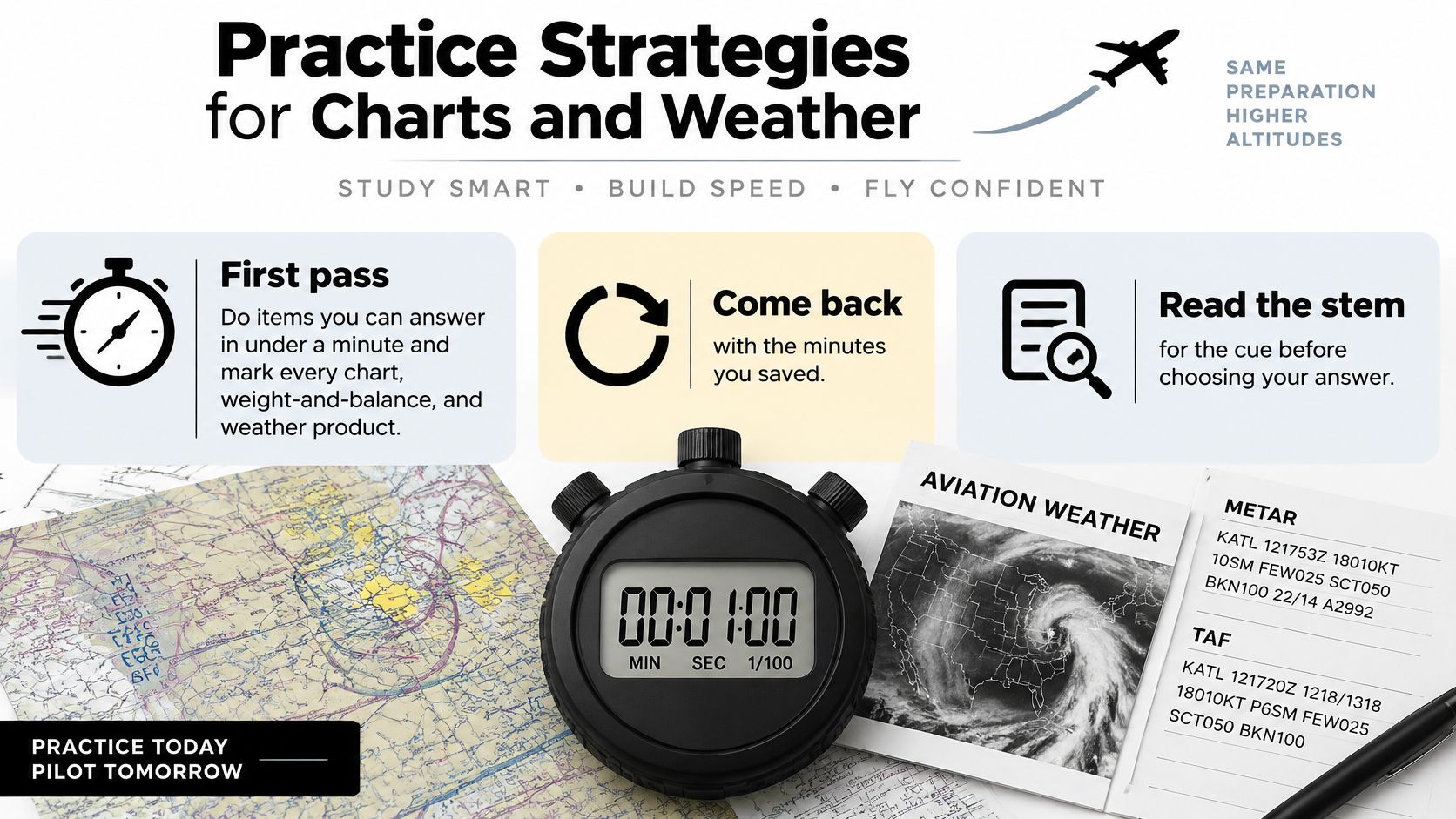
On a timed set, answer items you can solve in under a minute first. Mark chart problems, weight-and-balance calculations, and weather products for the second pass. That leaves more time for the questions that need careful work.
Before using a figure, identify exactly what the question asks for. Pressure altitude, density altitude, takeoff distance, and landing distance can appear close together in charts and answer choices. Underline the requested quantity on your scratch pad, then find it in the chart.
Convert units before entering a chart. Keep your inputs beside each calculation so you can check your work quickly if you return to the problem.
Three Traps to Drill Until They're Boring
- Weight and balance: A swapped arm can send the calculation off course. Set up the problem so each item's weight and arm stay paired, then check the total.
- Airspace on a sectional: Identify the floor, ceiling, and VFR weather minimum before looking at the choices. Start with what the chart shows, not an answer that merely sounds familiar.
- Weather products: Decode a report in a fixed order, then make a go or no-go decision. Practice the steps in this guide to reading METARs and TAFs. A decoded report without a decision leaves the question unfinished.
For a focused drill, set a timer and decode one METAR or TAF from start to finish. Then explain what the report means for a flight decision. When two choices sound right, choose the one that accounts for a condition stated in the question. Change an answer only when you can name what you misread.
Sort the Damage Afterward
After each timed set, sort missed questions into four groups: calculation, chart reading, regulation, and decision-making. Work on the group with the most errors, then retest with fresh problems of that type. That beats repeating mixed quizzes while the same weak spot persists.
Book the Test Once the Margin Holds
Book when your timed scores show a reliable margin and your instructor is ready to provide the required endorsement under 14 CFR § 61.35. One strong practice session is not enough. Your result should hold across separate sittings.
A passed knowledge test remains valid for the practical test for 24 calendar months under 14 CFR § 61.39. Keep using the material in flight lessons after you pass. The private pilot checkride prep guide explains how written-test knowledge carries into the practical test.
If you have not flown, start with a discovery flight. You will meet an instructor, preflight the airplane together, and take the controls in the air, with no prior experience needed. If your goal is a career path, the Career Track program includes six certificates and ratings, 282 training hours, and about nine months from zero experience to CFII and multi-engine at a fixed tuition of $89,000.
Keep your error log in rotation. A passing score is the entry point; the standard is explaining the answer and applying it in the airplane.
Planning to fly for a living?
See what the path from zero to a pilot career looks like, what it costs and how long it takes.
Learn to fly in Riverside
We train at Riverside Municipal Airport in modern airplanes with a parachute built in. Start with a one hour discovery flight, no experience needed.