
On this page
- Checkride Timeline From Endorsement to Test Day
- Work backward from demonstrated readiness
- Paperwork and Eligibility Audit Before You Book
- Confirm the applicant is eligible
- Confirm the aircraft and equipment
- Oral Exam Topics Examiners Ask First
- Practice decisions rather than definitions
- Build answers from the actual flight
- Flight Maneuvers and Tolerances to Drill
- Drill the standard and the correction
- Match checklist use to the task
- Examiner Judgment and the Stacked Mock Run
- Prepare the mock before flying it
- Run the test without coaching
You're comparing training schedules, trying to understand the paperwork, and wondering how anyone gets from a first flight to sitting beside an FAA examiner. If you're aiming for a flying career, the private pilot checkride can feel distant and expensive to get wrong.
Good private pilot checkride prep starts before the final lessons. Treat the practical test as a document review, an oral examination, and a demonstration of judgment under workload, not merely a flight where you perform familiar maneuvers.
Checkride Timeline From Endorsement to Test Day
A student chooses a test date from memory, assumes the instructor's endorsement is handled, and then discovers the signature isn't there. Avoid that scheduling mistake by making instructor approval a readiness gate, not an administrative afterthought.
The FAA's standardized framework is FAA-S-ACS-6C, effective May 31, 2024, which connects aeronautical knowledge, risk management, and flight proficiency. Organize preparation around its areas of operation and task criteria, rather than a generic lesson list, using the FAA's current Airman Certification Standards.
Work backward from demonstrated readiness
Use this as a proposed preparation schedule, not an FAA-mandated countdown or a promise that a beginner will finish training within these windows. Treat the windows as minimum planning allowances; stretch them whenever weather, lesson gaps, or unfinished training interrupt progress.
| When | Focus | Finished when |
|---|---|---|
| 12 weeks out | Eligibility and paperwork audit, including knowledge-test validity | Knowledge test report and medical certificate in hand |
| 8 weeks out | ACS task matrix for every area of operation | Each task has notes on regulations, limits, weather, and navigation |
| 6 weeks out | Oral sessions twice a week using the checkride aircraft's POH and charts | You answer without notes and explain each decision |
| 4 weeks out | Maneuver stage checks against ACS tolerances | Zero instructor prompts on required maneuvers |
| 2 weeks out | Stacked cross-country, diversion, and simulated failure scenarios | Full plan completed under realistic time pressure |
| 1 week out | Full mock checkride with an evaluator who doesn't coach | Written debrief with every miss logged |
| 3 days out | Document and aircraft audit | Nothing expired, missing, or unsigned |
| Test day | Same-day verification | Documents, aircraft, and kit confirmed before departure |
The knowledge-test validity window is a regulatory requirement, unlike the proposed study intervals. Use the eligibility audit below to confirm that your report remains usable on the planned practical-test date.
Keep the sequence visible while you prepare.
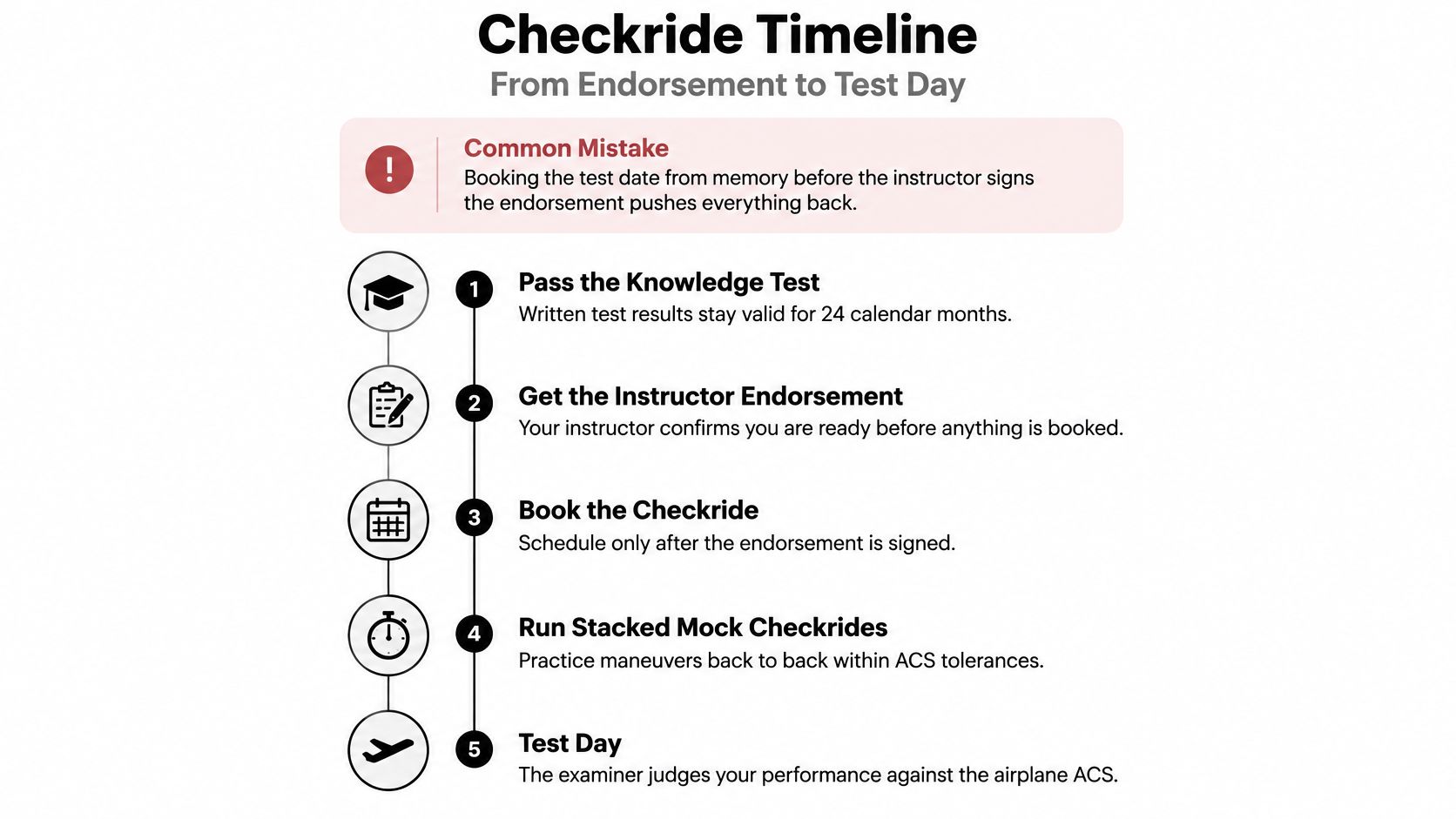
If you haven't started training, use the private flight lessons guide to understand how regular lessons build toward these checkpoints. Don't mistake this final-preparation schedule for the entire journey from zero experience.
Readiness signal: You can explain why an action is appropriate, identify what would change your decision, and perform the task without an instructor supplying the next step.
A reserved appointment shouldn't become a reason to accept unresolved weaknesses. Finish the training, confirm the endorsement, and let the evidence determine whether the date stays.
Paperwork and Eligibility Audit Before You Book
A missing endorsement, unusable knowledge-test report, or aircraft maintenance discrepancy can stop the practical test before you demonstrate any flying skill. Audit the blockers with your instructor while there's still time to correct them.
Confirm the applicant is eligible
For an airplane private pilot certificate, you must be at least 17, meet the English-language requirements, and satisfy the applicable eligibility provisions in 14 CFR § 61.103. Confirm medical eligibility separately, including whether an applicable alternative is available.
For the conventional student-pilot airplane pathway, obtain a third-class FAA medical certificate from an aviation medical examiner before solo. You can take a discovery flight and initial lessons beforehand; our FAA medical guide explains that early planning decision.
Review the test prerequisites under § 61.39, including the 24-calendar-month knowledge-test window, alongside the FAA's practical-test preparation requirements. Don't rely on remembering when you passed.
- Application and recommendation: Have the completed FAA Form 8710-1 and the instructor's recommendation ready.
- Training record: Check the logbook against the applicable cross-country, night, solo, and other experience requirements in § 61.109. Confirm that required endorsements are signed and dated.
- Personal documentation: Assemble the satisfactory knowledge-test report and required medical and student-pilot documentation.
Confirm the aircraft and equipment
The aircraft must be airworthy, suitable for the required tasks, and equipped with functioning dual controls and appropriate altitude- and airspeed-indicating systems. An aircraft you regularly train in still needs a fresh records review.
- Aircraft records: Locate registration, airworthiness certificate, operating limitations or approved flight manual, equipment list, maintenance records, and applicable airworthiness-directive compliance information.
- Navigation materials: Prepare current charts, airport diagrams, the Aeronautical Information Manual, a plotter, and flight-plan forms.
- Personal kit: Check the view-limiting device and any equipment you'll need to complete the planned tasks.
Distinguish documents required aboard from records you must review to establish airworthiness. Maintenance records and airworthiness-directive compliance information aren't interchangeable with the certificates carried in the airplane.
Conduct the formal audit several days before the appointment, then verify the documents, aircraft status, and equipment again before departure. A previous inspection of your preparation packet doesn't establish that nothing has changed.
Oral Exam Topics Examiners Ask First
The FAA recorded 44,657 Private Pilot Airplane knowledge tests in 2025, with an 89.56% pass rate, meaning roughly one in ten attempts didn't pass, according to its airman knowledge-test statistics. Those are written-test results, not oral-exam or complete checkride pass rates.
Use weak written-test areas to direct remediation, not to predict your practical-test outcome. A correct multiple-choice answer doesn't prove you can explain a weather decision while an examiner changes the destination or passenger load.
Practice decisions rather than definitions
The questions below are practice prompts, not a guaranteed examiner script or ranked list. A strong answer connects the governing requirement, aircraft information, and operational decision.
| Topic | Typical examiner question | Strong answer includes |
|---|---|---|
| Weather | Decode this METAR and TAF and decide go or no-go | Each field decoded, followed by applicable minimums and conditions that would trigger a diversion |
| Airspace | Where is the Class E floor on this sectional? | Floor altitude, applicable VFR visibility, and cloud-clearance minimums |
| Aircraft documents | What must be aboard and current for this flight? | Required onboard certificates and operating information, distinguished from maintenance and AD records reviewed for airworthiness |
| Weight and balance | Is this load legal, and where is the CG? | Actual loaded weights checked against the aircraft's current data and CG envelope |
| Performance | How much runway do you need at this density altitude? | Correct POH chart inputs, calculated requirements, and a stated operating margin |
| Fuel | What reserve do you carry for this trip? | Applicable day or night VFR reserve under § 91.151, calculated at normal cruising speed, plus any additional planning margin |
| Navigation and emergencies | What if you are lost or the engine quits? | A decision trigger, suitable landing option, heading or route, and communication plan |
Don't substitute remembered sample-aircraft values for the airplane you'll fly. Work through a weight-and-balance calculation with its current records, actual occupants, baggage, and planned fuel.
An examiner-style follow-up should change something meaningful. Add baggage, move a passenger, revise the wind, or close the intended runway, then explain whether the original plan still works.
An acronym is a retrieval aid. It isn't a complete answer until you apply it to the aircraft and the proposed flight.
Build answers from the actual flight
Use the checkride aircraft's POH or approved flight manual, current weight-and-balance records, avionics information, sectional chart, and weather briefing. Keep those references organized so you can distinguish what you know immediately from what needs verification.
For weather, explain more than the coded observation. Describe how the conditions affect terrain clearance, available airports, route selection, and your willingness to continue.
For navigation, update your position and arrival estimate rather than defending the original plan after its assumptions stop matching reality. For emergency-field selection, discuss suitability and obstacles instead of pointing toward the nearest open-looking surface.
During practice, answer directly, then support the answer. Don't bury uncertainty beneath a long recital of unrelated regulations, and don't guess when an aircraft-specific limitation needs checking.
Protect sleep before the test. If heavy work or family demands leave you exhausted, discuss changing the appointment rather than trying to compensate with last-minute studying.
Flight Maneuvers and Tolerances to Drill
Steep turns, slow flight, stalls, soft-field and short-field operations, crosswind landings, and emergency approaches deserve deliberate practice. Don't assign them imaginary point values: the practical test evaluates whether performance meets the applicable standard.
Use the current ACS task wording, not a remembered summary. For steep turns, the specified bank is 45 degrees, maintained within 5 degrees, with altitude within 100 feet and rollout heading within 10 degrees, as detailed in the Private Pilot Airplane ACS.
Drill the standard and the correction
The table is a practice guide, not a replacement for the full task criteria. Several rows summarize technique rather than reproduce every tolerance.
| Maneuver | Key tolerance or standard | Common miss |
|---|---|---|
| Steep turns | Meet the bank, altitude, and rollout tolerances stated above; review the complete task | Losing altitude when back pressure is added late |
| Slow flight | Maintain the required airspeed condition while controlling altitude, heading, and coordination | Chasing the airspeed indicator instead of setting attitude |
| Power-off stall | Recognize indications and recover at the point specified for the task, with prompt angle-of-attack reduction | Delayed recovery or excess bank at the break |
| Soft-field takeoff and landing | On takeoff, lift off at the lowest appropriate speed and accelerate in ground effect; on landing, protect the nosewheel | Letting the nosewheel dig in or bouncing |
| Short-field landing | Use a stabilized approach and meet the ACS touchdown-location requirement | Carrying extra speed over the obstacle |
| Crosswind landing | Maintain runway alignment and centerline with drift corrected through touchdown | Leaving the crab uncorrected at touchdown |
| Emergency approach | Select a suitable field and manage the approach to support a safe outcome | Choosing a field with an obstacle on final |
| Navigation | Maintain the planned course, track time, and update position and arrival estimates | Leaving time drift and heading errors uncorrected |
Don't conceal an altitude loss by climbing abruptly after the maneuver. Recognize the deviation, make an appropriate correction, and identify why the error developed during the debrief.
Stall practice needs equally precise language. Recognizing an approaching stall isn't permission to end a task early when a full stall is required; rehearse the applicable sequence using the stall recovery procedures guide with your instructor.
Match checklist use to the task
At CFII, we teach read-and-do for rare or high-stress tasks and do-then-confirm for routine flying. Read-and-do uses the checklist to guide the sequence; do-then-confirm uses a practiced flow followed by verification against the checklist.
That distinction doesn't eliminate aircraft-specific immediate actions. During emergency practice, follow the approved procedure, complete required immediate actions, and use the checklist as appropriate without sacrificing aircraft control.
Set a recurring stage check rather than repeating only the maneuvers you enjoy. Log the task, deviation, recognition point, correction, and whether the instructor intervened.
A pass without a useful debrief teaches less than a clearly documented miss. Your next lesson should address the recorded weakness, not merely repeat the entire maneuver list.
Examiner Judgment and the Stacked Mock Run
The checkride tests more than maneuver tolerances. The examiner is assessing whether you can manage the documents, explain your decisions, and operate safely when the plan changes. If the examiner must intervene to correct your control or decision-making, that can make the performance unsatisfactory even if the airplane later reaches the intended point.
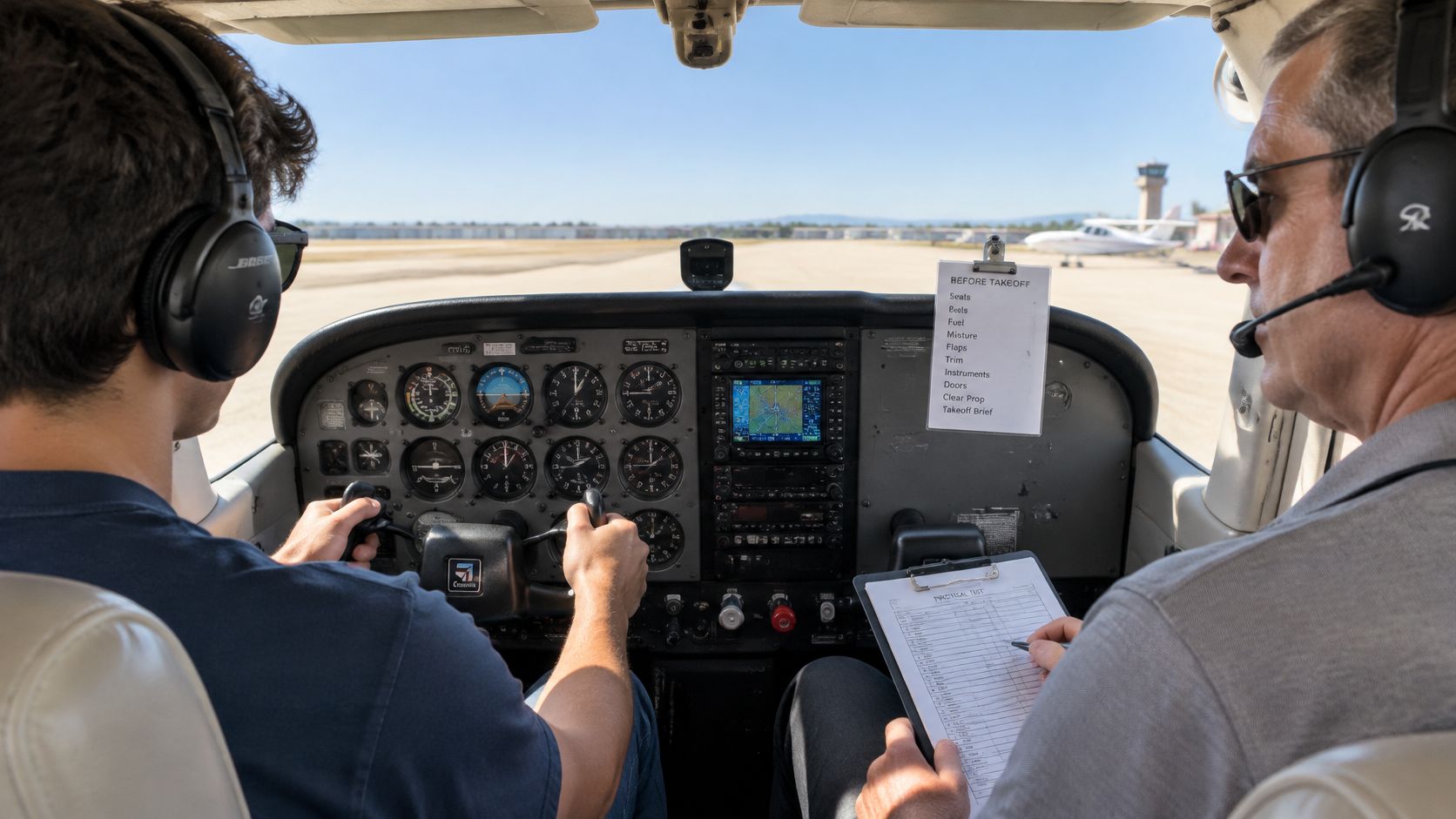
A maneuver practiced in isolation tells you little about how you'll perform after a diversion, an unfamiliar radio call, or a revised landing plan. The FAA practical-test guidance provides historical context for navigation and workload expectations. Use the current airplane ACS for the applicable standards.
Combine pilotage, dead reckoning, electronic navigation, diversion decisions, and a loss-of-position scenario. Call out visual checkpoints, compare elapsed time with your plan, and state what you'll do when the ground picture doesn't match your expectations. Your judgment under changing conditions is part of the test.
Prepare the mock before flying it
Build an ACS readiness matrix for the final rehearsal. For each task, list the relevant regulations, aircraft limitations, performance references, weather information, and navigation resources.
Rehearse risk decisions involving deteriorating weather, fuel concerns, runway conditions, and navigation loss. Then answer oral questions using the actual aircraft documents and charts before you fly without coaching.
Use scenario-based training to practise connected decisions under realistic workload. Change the problem enough to force a decision; do not add distractions that compromise safety.
Run the test without coaching
Agree on the scenario and safety boundaries beforehand. The evaluator remains responsible for intervening when needed, but should not give hints that hide an unfinished skill.
- Use the paperwork audit from the previous section. Bring the required applicant documents and verify the aircraft records for the airplane you'll fly.
- Start with the oral. Answer initial questions without study notes, then handle follow-ups. Consult operational references when appropriate and explain what you're checking.
- Fly the required maneuvers. Use the intended checkride aircraft. The evaluator records deviations without supplying control inputs or procedural reminders.
- Stack the navigation workload. Start the planned cross-country, then receive a diversion at a preselected point. Revise the route, assess fuel, and update the landing plan.
- Add a simulated equipment failure. Apply the aircraft procedure and rehearse the appropriate communication. Never create an actual unsafe condition or transmit a false emergency.
- Debrief every miss. Compare the performance with the applicable tolerance. Identify the decision point that led to the error and specify what needs practice.
- Use the instructor's approval gate to set the booking date. The stacked run should show consistent checklist use, sound decisions, and clear explanations without coaching before the instructor approves scheduling.
Separate an execution error from a judgment error during the debrief. A heading deviation calls for aircraft-control and navigation practice. Continuing toward worsening conditions without reassessing calls for work on risk decisions.
Distinguish appropriate reference use from dependence on prompts. Looking up an aircraft limitation is reasonable; waiting for the evaluator to remind you that it applies points to a preparation gap.
If the mock exposes a weakness, assign a specific correction and repeat the affected scenario under comparable workload. A good landing afterward doesn't erase a poor decision.
If you haven't flown before, CFII offers a discovery flight, a first flight with an instructor before you commit to lessons. The Career Track includes checkrides scheduled with FAA examiners, written-test preparation for every rating, and study materials such as textbooks, study guides, exam preparation, and a training portal with lessons, quizzes, stage checks, and a logbook.
Polished maneuvers alone don't demonstrate checkride readiness. Set the booking date after a stacked mock shows you can manage the documents, explain the flight, and carry out the plan without coaching.
Planning to fly for a living?
See what the path from zero to a pilot career looks like, what it costs and how long it takes.
Learn to fly in Riverside
We train at Riverside Municipal Airport in modern airplanes with a parachute built in. Start with a one hour discovery flight, no experience needed.