
On this page
- What Is a Flight Training Device
- The useful question behind “simulator hours”
- The Official FAA Definition
- The parts of the definition
- Why the category matters
- FTD Qualification Levels Explained
- How to read the progression
- What to ask a school
- FTD vs Full Flight Simulator
- Why a fixed-base device can still be useful
- FTD vs Aviation Training Devices
- Check the device, aircraft, and course
- How FTD Hours Count Toward Certificates
- Credit limits depend on the pathway
- Training time and experience time aren't the same
- What to Verify Before Logging Simulator Time
- Ask for a specific answer
- FTDs in Your Career Training Path
- Treat level claims as claims to verify
- Frequently Asked Questions About FTDs
- Does FTD time count toward the 1,500-hour airline requirement?
- Can I use an FTD for private pilot training?
- How can I tell whether a school's simulator is an FAA-qualified FTD?
- Is FTD training as effective as flying an airplane?
- What's the practical difference between FTD and ATD time?
A flight training device (FTD) is an FAA-qualified replica of aircraft instruments, equipment, panels, and controls, with the hardware and software needed to represent aircraft systems in ground and flight conditions. Unlike a full flight simulator, an FTD doesn't require motion or an out-of-cockpit visual system, and its qualification and approved use, not its appearance or advertised hours, determine what training credit may be available.
If a school tells you that its program includes “simulator time,” what does that promise mean for your certificates and ratings? As a new pilot, you'll want to separate practice that helps you improve from training time that can count toward a specific requirement. Those aren't automatically the same thing.
What Is a Flight Training Device
You're comparing flight schools, and one says its students train in a simulator. The cockpit looks convincing. You might reasonably wonder whether time in it counts toward your instrument rating, commercial certificate, or eventual professional goals.
The word simulator alone doesn't answer that. In FAA rules, an FTD is a specific regulatory category, not a casual name for any computer connected to flight controls. Its qualification depends on what aircraft equipment and systems it represents and what the FAA has approved it to do. A desktop program or unqualified cockpit trainer doesn't become an FAA-qualified FTD just because it looks realistic.
That distinction matters because simulator sessions can be useful even when they don't replace aircraft time. An instructor might use a device to help you practise instrument procedures, learn cockpit flows, or understand how aircraft systems work. Whether that session can also be logged for a particular certificate or rating depends on the device, the applicable training rules, the course, and the instructor's authorization.
The useful question behind “simulator hours”
When you hear a school advertise simulator hours, ask what kind of device those hours involve and what training credit applies. A useful answer identifies the device category, its FAA qualification level, the aircraft or class it represents, and the approved tasks or training scope. A total in a brochure or logbook doesn't tell you those details.
Practical rule: Treat a simulator's training value and its regulatory credit as two separate questions. Ask about both before you build your training plan around the hours.
You're not choosing between “real” training and “fake” training. Ground-based simulation can support learning, but only the applicable rules and the device's approval determine whether that experience satisfies a regulatory requirement. The practical question is what the device is approved to do for the training you're taking.
The Official FAA Definition
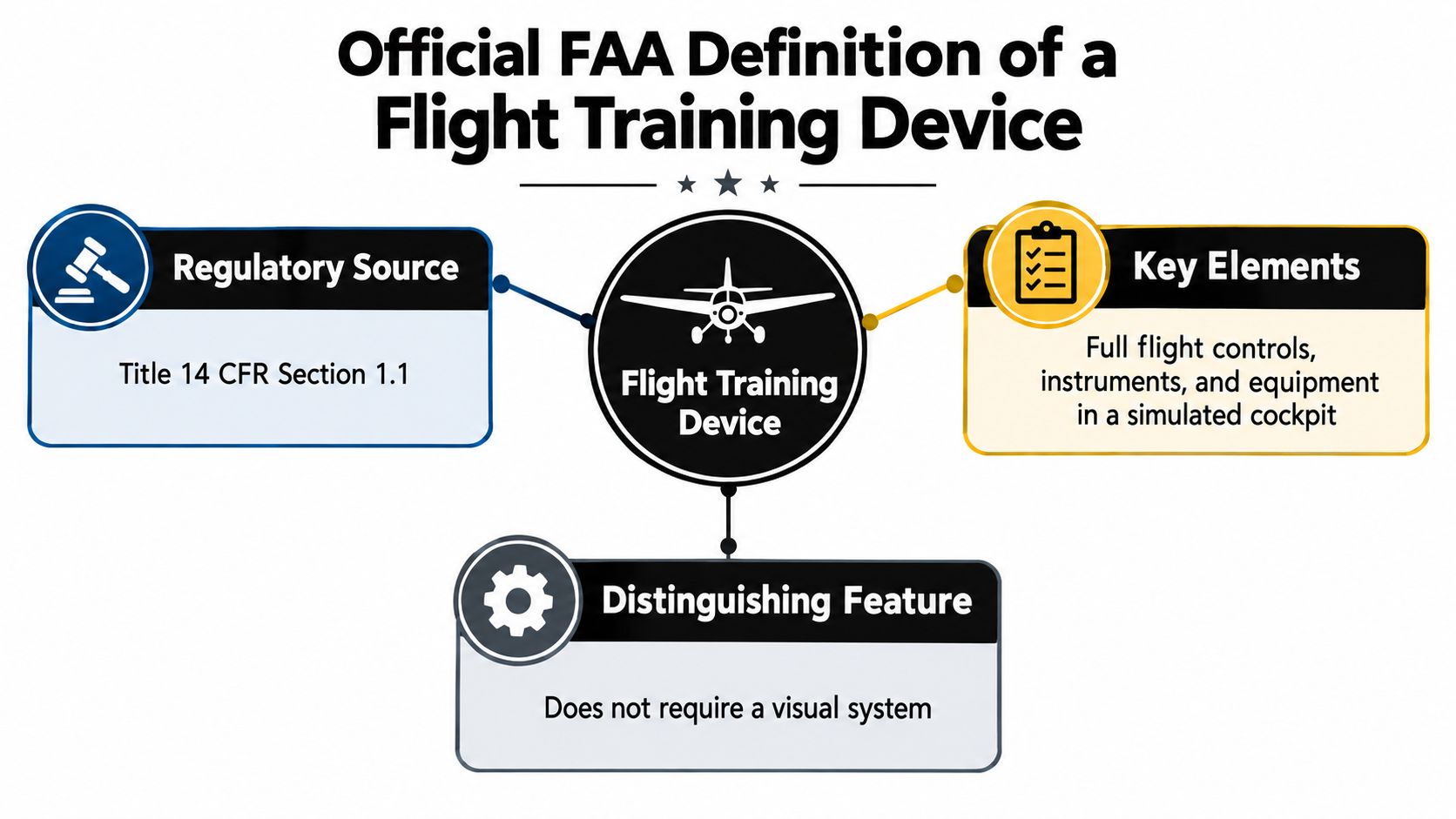
The definition of an FTD in Title 14 CFR §1.1 has several parts. Each one helps distinguish a regulated device from a trainer that merely resembles a cockpit.
The parts of the definition
First, an FTD replicates aircraft instruments, equipment, panels, and controls. Those components may be arranged in an open flight-deck area or inside an enclosed cockpit replica. The definition is about the equipment and its representation, not the shape of the room around it.
Second, the device includes the associated equipment and computer programs needed to represent an aircraft, or a set of aircraft, in ground and flight conditions. In other words, the cockpit controls must work with a system that represents aircraft operation. A realistic-looking panel by itself isn't enough to establish that the device meets the definition.
Third, an FTD must reproduce the full range of capabilities of the systems installed in that device and comply with the applicable qualification performance standard for its specific level. This is why an FTD is hardware-and-software-specific. Its credibility rests on the aircraft systems and controls it represents, rather than on visual appearance alone.
Why the category matters
An FTD belongs to the broader family of flight simulation training devices, but it isn't the same category as a full flight simulator. It's also distinct from less extensive training technologies such as basic or advanced aviation training devices. FAA advisory guidance repeats the definition and places FTDs within that wider family.
For a student, the important point is straightforward: the device's formal category and approval determine what credit may be available. A logbook entry showing simulator time doesn't, on its own, establish that the time meets a certificate or rating requirement. Check the device's approval and the rules for your course before treating those hours as regulatory credit.
FTD Qualification Levels Explained
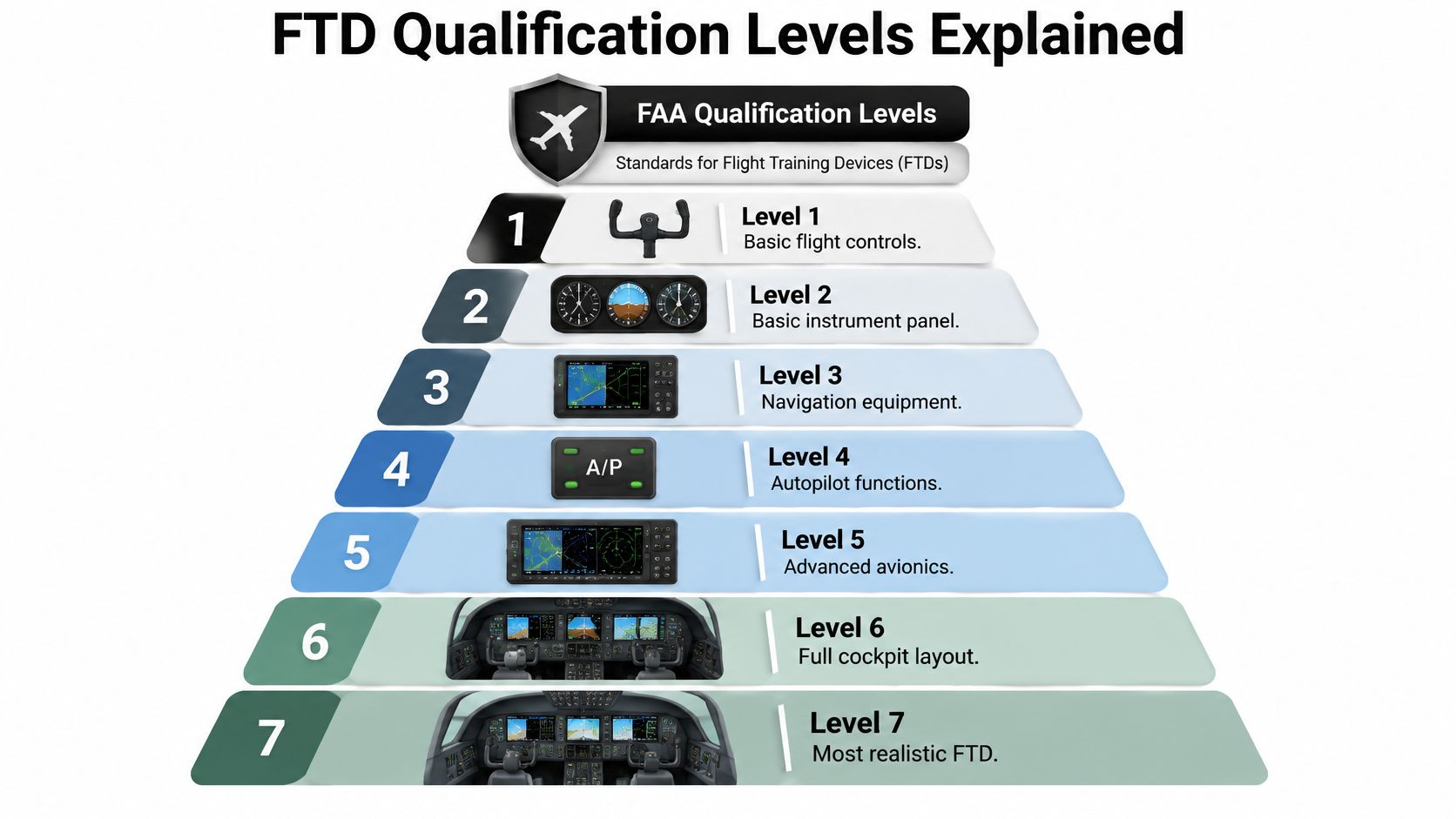
What does a “Level 6” placard on a school's simulator tell you? The FAA framework has included seven historical airplane FTD levels, from Level 1 through Level 7, with Level 7 representing the highest sophistication. The progression reflects how closely a device reproduces aircraft controls, spatial relationships, systems, and performance, and how much qualification documentation supports it.
Part 60 spells out the requirements for each level. Treat the number as an approval category: it describes what the device represents and how specifically it is qualified.
How to read the progression
Lower levels provide more limited representation. As the level rises, the standards call for increasingly accurate controls, system functions, aircraft-specific details, aerodynamic data, and supporting documentation. One caution: no number maps to a simple, universal checklist of features. The device's approved scope and qualification records tell you what it can support.
Two levels show how the standard shifts. Level 5 represents an aircraft class, such as single-engine or multiengine aircraft, and requires a qualification and approval guide containing FTD design criteria. Level 6 must be accurate to the aircraft being flown, including spatial relationships and actual functions, and uses detailed aerodynamic data.
The scale's history adds one wrinkle. Approval for Level 3 devices was discontinued under the FAA's flight simulation device qualification standards; older examples could remain in use, while comparable newer training technologies were treated as advanced aviation training devices. Older records and descriptions may therefore cite level references that don't match the current Part 60 categories.
What to ask a school
“Simulator time” is not a standardized product, so ask the school to name the device category, qualification level, the aircraft model or class represented, and its approval basis. Those details let you judge whether the device fits your lesson and whether the school's credit claim is supported.
A device advertised as a high-level FTD must still be evaluated and approved under the applicable standards. The number alone doesn't establish what training, testing, or checking is authorized.
FTD vs Full Flight Simulator
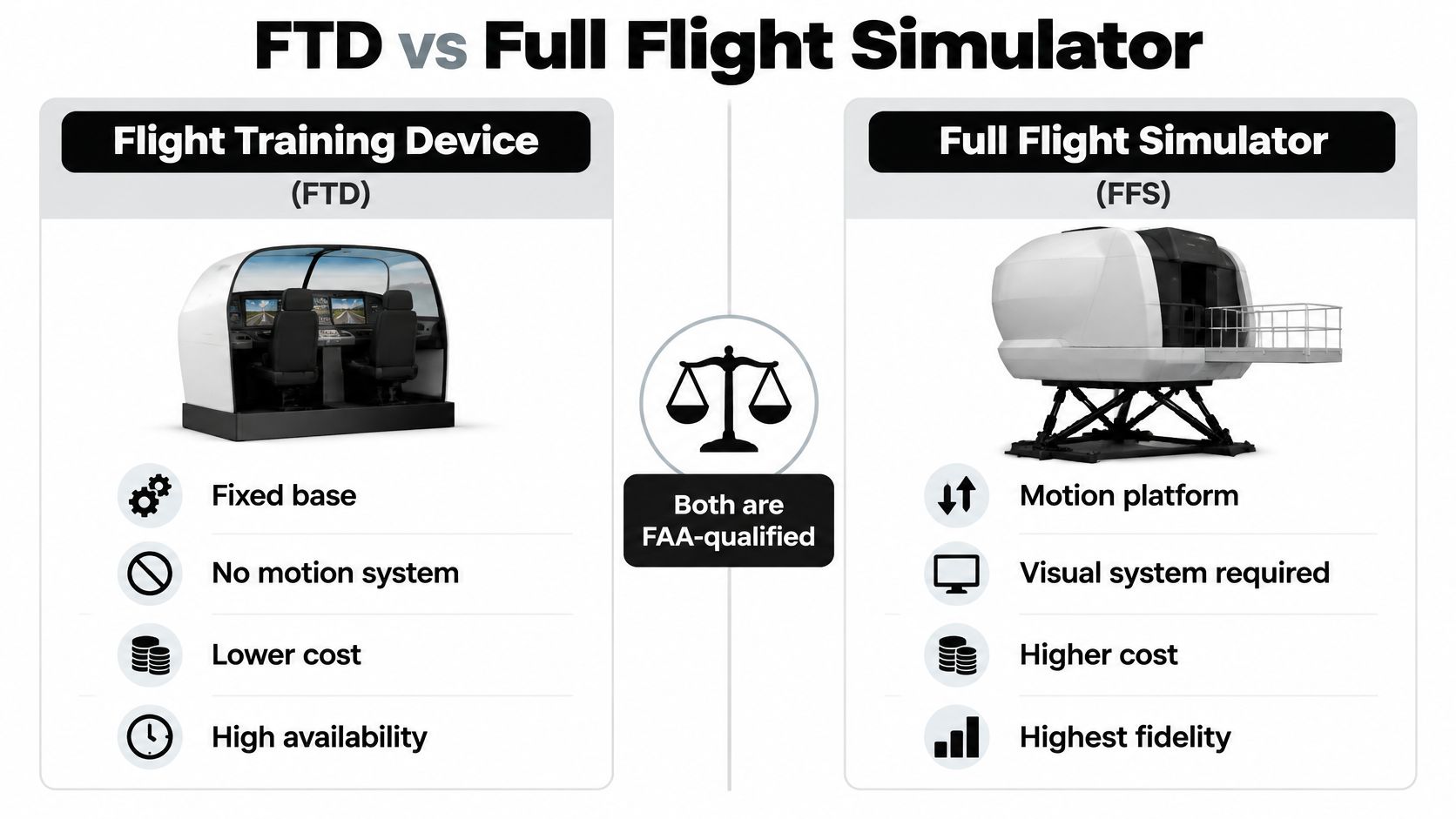
An FTD and a full flight simulator are both regulated types of simulation equipment, but they aren't interchangeable. The clearest design distinction is that an FTD doesn't require motion cueing or an out-of-cockpit visual system. A full flight simulator is built to reproduce a complete aircraft cockpit with specified visual and motion capabilities.
| Feature | Flight training device | Full flight simulator |
|---|---|---|
| Motion system | Not required | Specified motion capabilities are part of the category |
| Out-of-cockpit visuals | Not required | Specified visual capabilities are part of the category |
| Part 60 qualification levels | Levels 4–7 | Levels A–D |
| Training use | Depends on the device's qualification and approved tasks | Depends on the simulator's qualification and approved tasks |
The FAA's National Simulator Program guidance describes the qualification structure and the formal approval framework. For FTDs, the modern Part 60 categories are Levels 4 through 7; full flight simulators use Levels A through D. A Statement of Qualification identifies the approved device level and may specify qualified tasks.
Why a fixed-base device can still be useful
No motion or external visual system doesn't automatically make an FTD unsuitable. A school may use one to practise procedures, work with aircraft systems, or build cockpit familiarity. Whether you can receive credit for a particular event depends on the device's qualification and the approved program, not on whether the session feels immersive.
A full flight simulator may be used when its additional capabilities and qualification suit the training objective. A school can use more than one device type across a program, but the hours don't become equivalent because they appear under the same "simulator" heading. For a broader overview of how these categories fit into training, see aircraft flight simulation.
FTD vs Aviation Training Devices
A marketing label isn't an FAA approval. A school might call its equipment a simulator, an advanced simulator, or a glass-cockpit trainer, but those terms alone don't establish that the device is a qualified FTD or that its time is creditable toward your goal.
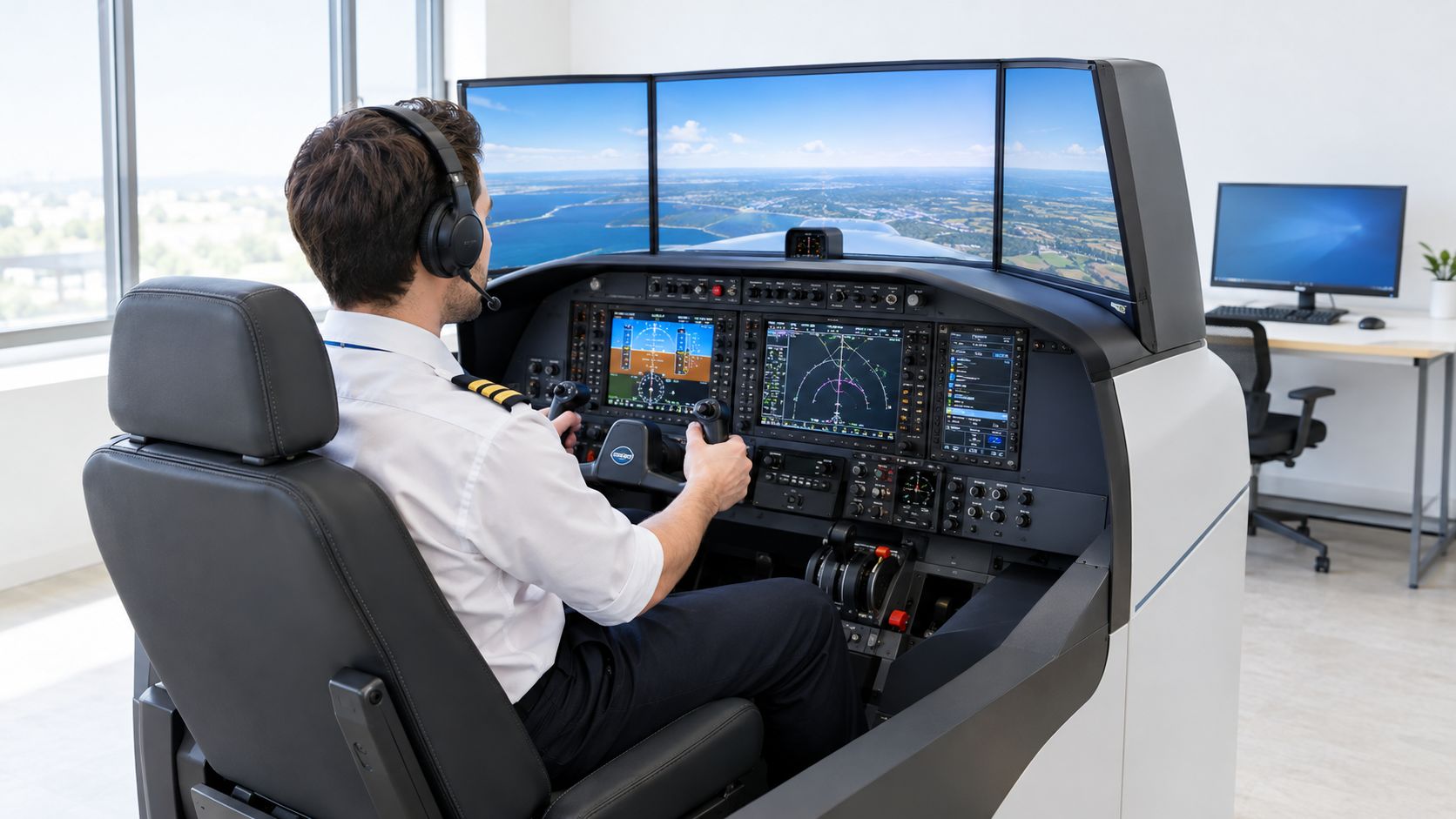
An FTD must represent aircraft instruments, equipment, panels, controls, operating conditions, and the capabilities of the systems installed in it, at a specific qualification level under Part 60. An aviation training device, or ATD, is a separate category. The applicable rules and approval determine what training credit is available for either type.
Check the device, aircraft, and course
Before relying on simulator hours, get clear answers to three questions:
- What is the device's Part 60 qualification? Ask for the qualification level and documentation, rather than relying on a sign or brochure.
- What aircraft does it represent? Confirm that its approved scope matches the aircraft category and configuration relevant to your training.
- Does your course permit the credit? The training pathway and instructor authorization matter as well as the device.
For instrument training, the allowed credit depends on the regulatory pathway. The supplied regulatory guidance describes a general limit of up to 20 hours outside Part 142 and up to 30 hours under Part 142 when the training is provided by an authorized instructor. Check the rule that applies to your course; don't assume the larger limit applies to every student.
Simulator practice can still help you prepare even when it doesn't count toward a particular requirement. If you're working toward instrument privileges, compare your school's explanation with the goals in an instrument rating course syllabus. Ask the school to distinguish training benefit from loggable credit.
How FTD Hours Count Toward Certificates
There isn't one universal conversion from FTD hours to airplane hours. The answer depends on your certificate, the approved course structure, the device's qualification, and whether your training follows Part 61, Part 141, or Part 142 rules.
One example shows why it's important to check the specific pathway. Under the FAA's Part 141 ATP course rules, an FTD may replace no more than 25% of the applicable flight-training requirement. A qualifying full flight simulator may receive up to 50% credit. Combined use remains capped at 50%, while the FTD portion still cannot exceed its separate 25% limit.
Credit limits depend on the pathway
| Training pathway | FTD credit limit | Full flight simulator credit | Combined cap |
|---|---|---|---|
| Part 141 ATP course | No more than 25% of the applicable flight-training requirement | Up to 50% | 50%, with the FTD portion limited to 25% |
| Other certificates and ratings | Depends on the applicable rule, course, and device approval | Depends on the applicable rule and approval | Verify the specific pathway |
| Instrument training under Part 142 | Up to 30 hours, subject to the applicable conditions | Depends on the applicable rule and approval | Verify the specific pathway |
| Instrument training outside Part 142 | Generally up to 20 hours, subject to the applicable conditions | Depends on the applicable rule and approval | Verify the specific pathway |
The instrument-training limits shown above apply when training is provided by an authorized instructor. They aren't a general allowance for every flight-training program or a guarantee that the time satisfies any other requirement.
Training time and experience time aren't the same
A device can support useful training without satisfying a specific aeronautical-experience requirement. The limits for an approved course also shouldn't be confused with airline-hour experience rules. Your course may allow some simulator credit toward its training requirement while still requiring real-aircraft experience for another purpose.
Ask a school to show the credit calculation, not just the number of simulator hours it delivers. A clear explanation identifies the hours provided, the hours loggable for your goal, the regulatory authority, any instructor requirement, and the airplane requirements that remain. For questions about the airline training pathway, review the ATP requirements overview, then verify which rule applies to your own program.
What to Verify Before Logging Simulator Time
Under 14 CFR §61.4, an FTD can provide FAA-creditable training, testing, or checking only when the Administrator has specifically qualified and approved it for the intended use. The approval must cover the relevant maneuvers, procedures, or crewmember functions, and the device must represent the applicable aircraft category and class, type, variation, or approved set of aircraft. The regulation makes the approved scope central to the credit question.
Use this checklist before you rely on a simulator session in a logbook or training record:
- Request the current Statement of Qualification. It identifies the approved level and may list tasks the device is qualified to support.
- Confirm the aircraft scope. Check the make and model or representative aircraft scope, and confirm that it matches the training you intend to do.
- Review the approved task list. Verify that the specific maneuver, procedure, or crewmember function is covered.
- Check your training rule. Confirm whether your certificate or rating pathway allows the intended credit.
- Confirm instructor authorization. For instrument training, verify that the instructor and course meet the applicable conditions.
- Record what the approval permits. Don't assume that every hour in an approved device counts toward every requirement.
Ask for a specific answer
A school should be able to explain not just that its equipment is FAA-qualified, but what the device is approved to do and how that relates to your course. If the answer relies only on how realistic the cockpit looks, keep asking. Physical appearance doesn't establish qualification or allowable credit.
Before enrolling, use the same care when reviewing a school's training structure and approvals. This guide to FAA-approved flight schools can help you organize the questions you want answered. Your own course documents and the applicable FAA rules remain the basis for deciding what you may log.
FTDs in Your Career Training Path
For a career pilot, an FTD is one tool in a larger training plan. It can support procedure practice, systems learning, and cockpit familiarization, but the school should be able to explain which device it uses, what aircraft or class it represents, and what the approval allows. That information helps you judge how the simulator fits the syllabus without mistaking device time for airplane time.
When comparing programs, ask the school to show how each simulator session connects to a lesson and how it records any regulatory credit. A useful program description separates time delivered from time that can be applied to a specific requirement. It should also make clear which requirements still call for an aircraft.
Treat level claims as claims to verify
The historical airplane FTD scale runs from Level 1 through Level 7, while modern Part 60 FTD categories are Levels 4, 5, 6, and 7. FAA materials on flight simulation device qualification explain the modern categories and the historical context. A Level 7 label isn't proof on its own; the device must be evaluated and approved, and the approval must identify the training, testing, or checking it supports.
That distinction matters when you compare programs for a zero-to-CFII pathway. Strong procedural practice may help you arrive better prepared for aircraft lessons, while the school's approved course structure determines what simulator time can count. Don't judge a program only by its simulator-hour total; ask how the hours fit the syllabus and what aircraft requirements remain.
If you're planning a structured career route, review the pilot training program overview and compare its stages with your goals. CFII's Career Track lists a fixed $89,000 tuition, takes about nine months from zero time to CFII and multi-engine, includes 282 total hours and six certificates and ratings, and is based in Southern California, with training locations in Riverside, Long Beach, and Corona. Before making a decision, ask how its simulator sessions are documented and which requirements those sessions may satisfy.
Frequently Asked Questions About FTDs
Does FTD time count toward the 1,500-hour airline requirement?
Don't assume it does. An FTD session can improve your proficiency, but whether time applies to a specific aeronautical-experience requirement depends on the rule and the device approval. Check the requirement you're working toward rather than treating simulator time as a direct substitute for airplane time.
Can I use an FTD for private pilot training?
An FTD may support training, but that doesn't mean every hour can be credited toward every private-pilot requirement. Your course, the device approval, and the applicable rule determine what may count. Ask your instructor to identify the specific requirement the session is intended to satisfy.
How can I tell whether a school's simulator is an FAA-qualified FTD?
Ask for the device's current Statement of Qualification, approved level, aircraft scope, and task list. Then check that the approval covers your intended training and that your course permits the credit.
Is FTD training as effective as flying an airplane?
It can be useful for practising procedures and learning systems, but it doesn't replace every part of aircraft training. The right question is whether the device suits the lesson and whether the experience complements the airplane work you still need.
What's the practical difference between FTD and ATD time?
They're distinct device categories, and the credit available depends on the applicable approval and training rule. Don't rely on a school's use of the word “simulator”; ask what the device is classified as and what your course allows you to log.
CFII's Career Track combines structured flight and ground instruction with a defined route from zero experience to CFII and multi-engine training. If you're comparing simulator claims with the rest of a career-training syllabus, visit CFII to review the program and ask how its simulator time fits your training requirements.
Planning to fly for a living?
See what the path from zero to a pilot career looks like, what it costs and how long it takes.
Learn to fly in Riverside
We train at Riverside Municipal Airport in factory-new airplanes with a parachute built in. Start with a one hour discovery flight, no experience needed.