

On this page
- Which Medical Class You Need and How Long It Lasts
- Read the certificate against your training calendar
- Choosing Your Medical Route Before You Train
- Choose the path that matches your history
- Paperwork and Condition Inventory
- Build an inventory before submitting
- Request the evidence before booking the examination
- Preparing to Meet the Standards
- Make your medication list usable
- Organize for review rather than volume
- What Happens During the Exam, Step by Step
- Follow the appointment sequence
- Leave with a defined next action
- What Each Outcome Means After Your Exam
- Separate referral from rejection
- Start Your Medical Before Tuition
- Separate exploration from commitment
- Make an enrollment decision you can support
You're comparing flight schools, working out how to pay for training, and wondering whether an old prescription or a diagnosis from years ago could stop you from becoming a pilot. The FAA medical exam can feel like the appointment that decides everything, especially when you haven't even logged your first flight.
For a career-track student, the smart approach is to resolve medical eligibility before making major financial commitments. The physical matters, but documentation and accurate disclosure often determine whether your application moves forward or needs additional review. Prepare the file as carefully as you prepare for the appointment.
Which Medical Class You Need and How Long It Lasts
Match your medical class to the privileges you plan to exercise, not just your first lesson. First class is generally the target for airline transport operations, second class supports commercial pilot privileges, and third class supports private pilot operations, as explained in the FAA's medical-class guidance.
FAA medical class, typical privileges and validity
The following durations follow 14 CFR 61.23, summarized in the FAA's medical-certificate validity guidance, and use your age on the examination date.
| Class | Typical privileges | Valid under 40 | Valid at 40 or older |
|---|---|---|---|
| First class | Airline transport operations | Rest of issue month plus 12 calendar months | Rest of issue month plus 6 calendar months |
| Second class | Commercial pilot privileges | 12 calendar months | 12 calendar months |
| Third class | Private pilot operations | 60 calendar months | 24 calendar months |
The second- and third-class periods also run through the end of the applicable calendar month. These are validity periods for the privileges listed, not a statement that every privilege disappears when the highest-class period ends.
Read the certificate against your training calendar
A first-class certificate can continue supporting lower-level privileges after its first-class period expires, provided you still meet the applicable requirements. That distinction matters when you're planning training rather than already exercising airline privileges.
Say you obtain a first-class medical before starting an intensive program. You might need to renew its first-class privileges before you need those privileges professionally, while it still supports other flying during training. Our guide to FAA medical certificate classes helps separate certificate class from the privileges you're exercising.
For a zero-time student aiming at airline work, I'd consider the first-class examination early. Meeting a lower standard today doesn't establish that you'll meet the standard your intended career requires.
Planning rule: Count backward from your intended flying duties, not forward from the appointment.
You can take a discovery flight and your first lessons before obtaining a medical. For the conventional airplane training path, you need at least a third-class FAA medical from an aviation medical examiner before solo flight.
Before booking, ask yourself: How long until training ends, and which medical privileges must remain valid during that period?
Choosing Your Medical Route Before You Train
BasicMed isn't a first-time shortcut around an FAA medical. Its usefulness depends on your certification history and the flying you intend to do.
The FAA's BasicMed guidance requires a previously held FAA medical certificate issued after July 14, 2006, plus an examination by a state-licensed physician within the previous 48 months. It also requires the FAA checklist, an online education course, and retention of the signed documents in your logbook.
Medical route options for career-track applicants
| Route | Who it fits | Limit for career pilots |
|---|---|---|
| FAA medical certificate, first class for airline goals | Zero-time students and career-track applicants | Requires the AME exam and may need FAA review |
| BasicMed | Recreational pilots who held an FAA medical after July 14, 2006 | Unavailable to applicants with no prior FAA medical application; not a substitute for an airline medical |
| Special issuance | Applicants whose condition is controlled and whose case needs FAA authorization | Requires condition-specific evidence and FAA review |
Choose the path that matches your history
If you're starting from zero, plan on the FAA medical route. If your history raises questions, arrange an aviation medical consultation before proceeding with the formal certification examination. Tell the office you want a consultation so you understand what you're scheduling.
If you already hold a private pilot certificate, BasicMed may suit eligible recreational flying. It doesn't establish that you can obtain the medical needed for your intended professional duties. Separate the route that lets you fly recreationally from the route that supports your career plan.
If you've had an adverse medical action, resolve that history before assuming an alternative is available. A prior denial, suspension, revocation, or withdrawal can affect BasicMed eligibility. Bring the actual correspondence to an AME rather than summarizing it from memory.
BasicMed can reduce recurring certification friction for an eligible recreational pilot. It can create an expensive sequencing mistake for a career student who treats it as evidence of airline medical eligibility.
Other entry routes also have distinct medical rules and operating privileges. Our sport pilot license guide is useful if you're comparing recreational options, but don't confuse a different certificate pathway with clearance for professional flying.
The right pre-enrollment question isn't whether you can fly an airplane. It's whether your medical route supports the work you intend to pursue.
Paperwork and Condition Inventory
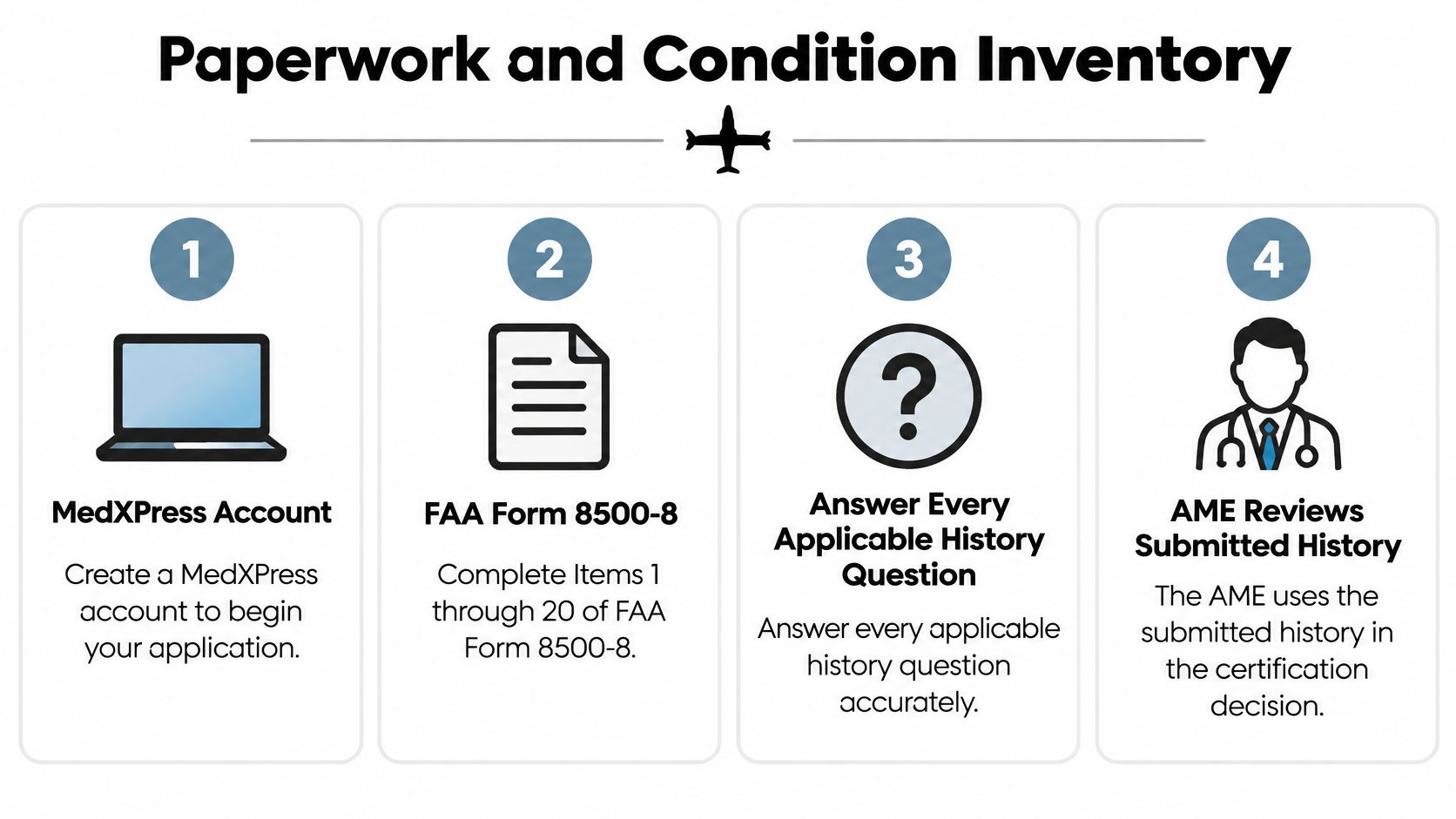
Start by building a complete history, not by trying to predict which answers the examiner wants. The FAA MedXPress user guide explains that MedXPress collects Items 1 through 20 of FAA Form 8500-8, which the AME uses alongside your history and examination to assess the applicable medical standards.
Build an inventory before submitting
Create your MedXPress account and work through every applicable question carefully. Inventory diagnoses, hospitalizations, surgeries, prescriptions, counseling and mental-health treatment, plus driving-related arrests, convictions, and license actions.
Include older events when the question asks about your history. Don't replace a diagnosis with your own conclusion that it was minor, temporary, or unrelated to flying. Use records to establish what happened and ask the AME how to explain an uncertain entry accurately.
Certain histories deserve early discussion. The FAA's medical-certification FAQ identifies angina pectoris, bipolar disorder, cardiac-valve replacement, clinically significant coronary heart disease, diabetes requiring hypoglycemic medication, unexplained disturbance of consciousness, and epilepsy as potentially disqualifying or requiring special evaluation.
These aren't interchangeable conditions with a single outcome. Certification may be possible in some cases when the condition is adequately controlled and the required documentation or periodic reports are supplied. The applicable standard, functional effects, and FAA review requirements matter.
Request the evidence before booking the examination
Ask each relevant treating practice for records, including specialist assessments, discharge summaries, treatment history, and current status where appropriate. Ordinary primary-care notes and remote counseling records can become certification evidence.
For a complicated history, consult the AME about the required documents before submitting the formal application. Requesting an entire chart without asking what's needed can leave you with a large file that still lacks the decisive report.
Keep your medical application separate from your student pilot certificate. They serve different purposes, so completing one doesn't complete the other.
Printable pre-visit checklist
- Application: Every applicable MedXPress history question is answered accurately.
- Condition inventory: Diagnoses, treatment, medications, surgeries, and relevant driving actions are accounted for.
- Supporting records: Requested records are received, readable, and organized.
- AME instructions: The office has confirmed whether anything should be sent ahead.
- Identification: Government photo identification is ready.
- Confirmation: The MedXPress confirmation number is accessible.
- Appointment: The appropriate examination or consultation is booked.
Preparing to Meet the Standards
Prepare to demonstrate your actual medical status, not to produce an unusually good result on appointment day. Changing treatment or withholding information makes the examiner's job harder and can create a separate safety problem.
Bring the glasses or contacts you use. Have them accessible rather than packed somewhere you can't reach during testing, and tell the examiner what correction you normally wear.
Make your medication list usable
A list of drug names alone leaves unanswered questions. Include the dose, frequency, reason for use, prescribing clinician, and any recent changes.
- Include nonprescription products: Record medicines you buy without a prescription as well as prescribed treatment.
- Explain the underlying condition: A medication review also requires understanding why you take it.
- Document changes: Note when treatment started, stopped, or changed and who directed that change.
- Keep treatment decisions medical: Don't start, stop, or alter medication solely to improve your chances at the appointment. Discuss changes with your treating doctor and disclose them.
If a condition is recent or changing, ask your treating clinician for a current status report before the visit. Ask the AME what that report should address so the clinician doesn't supply a general reassurance letter when a detailed assessment is needed.
A useful report explains the diagnosis, treatment, current status, and relevant functional effects. A statement that someone is healthy may not answer the certification question.
Organize for review rather than volume
Put records in a dated folder with a brief index. Group related documents together so the examiner can follow a condition from diagnosis through treatment to current status.
Keep a copy of the exact application you submitted. If you discover an error or omission, raise it with the AME rather than hoping it won't matter.
Answer history questions from records whenever possible. If you're unsure whether an event belongs on the application, disclose the uncertainty and ask how to report it accurately.
There's no preparation trick that replaces meeting the applicable standard. Your goal is to arrive with the corrective equipment you use, a reliable treatment history, and records that let the examiner assess your case without guessing.
What Happens During the Exam, Step by Step
You arrive with identification, your MedXPress confirmation number, and an organized record folder. The visit generally feels like a clinical appointment, but the examiner also has a defined certification decision to make.
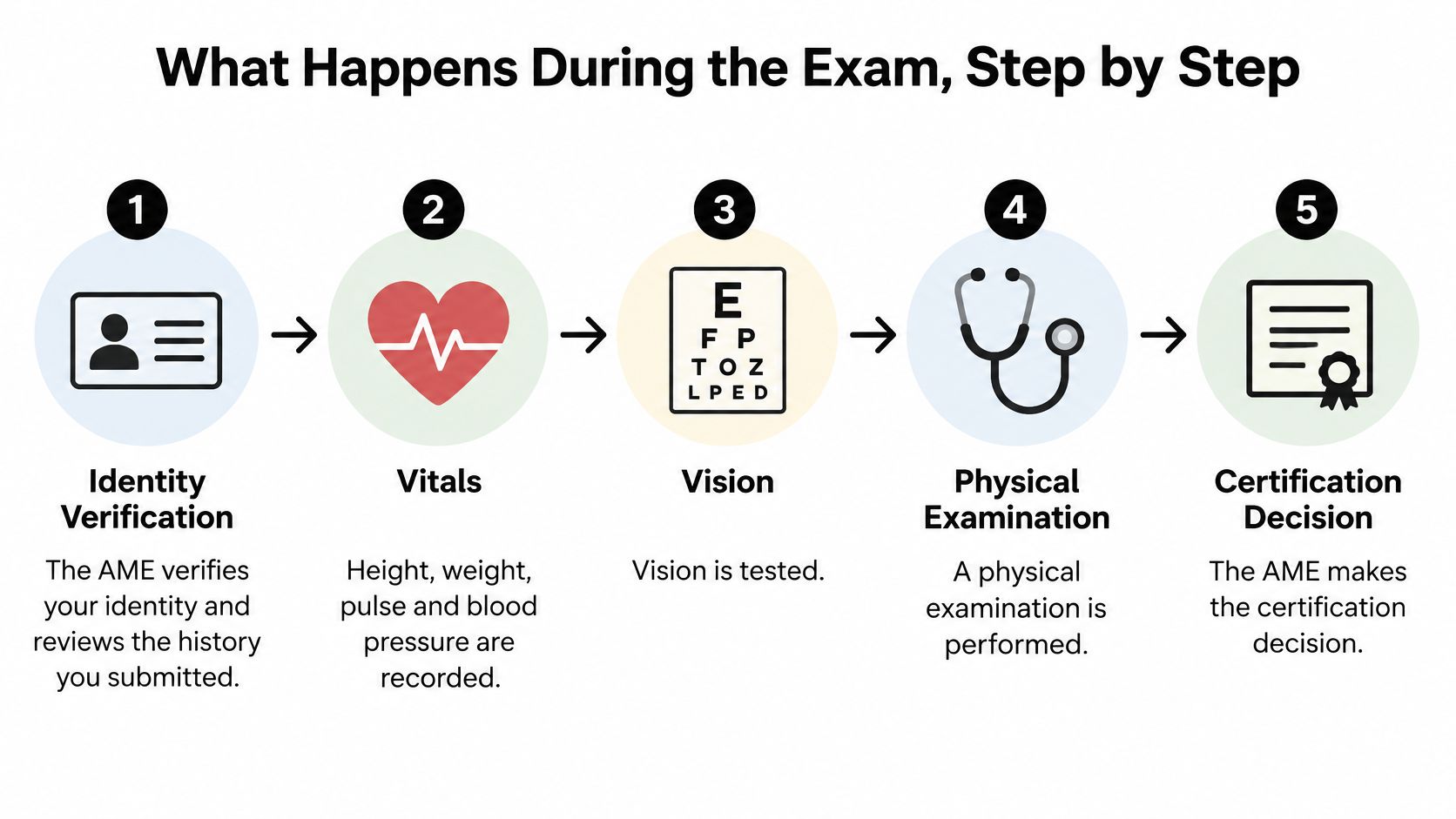
The FAA's AME application-review guidance requires the examiner to issue, deny, or defer the application and transmit the examination to the FAA within 14 days. The AME evaluates the application and findings against 14 CFR Part 67, rather than whether you appear healthy.
Follow the appointment sequence
- Identity and history review. The examiner verifies who you are and discusses your submitted history. Be ready to clarify dates and explain supporting records.
- Vital measurements. Height, weight, pulse, and blood pressure are recorded. An unexpected finding may require clarification rather than an immediate assumption about the outcome.
- Vision assessment. Testing evaluates relevant visual functions, including acuity, color vision, and depth perception as applicable. Tell the examiner about the correction you use.
- Hearing assessment. The examiner assesses hearing against the applicable standard. Raise any known hearing issue rather than leaving the examiner to infer your history.
- Urine specimen. Expect to provide a sample as part of the medical evaluation. This is a routine part of the visit, not something to improvise around.
- Physical examination and treatment review. The AME evaluates your physical findings, medications, and prior conditions. A prescription can prompt questions about both the medicine and the diagnosis.
- Certification decision. The examiner determines whether issuance is permitted, denial is appropriate, or FAA review is required.
The surprise for many first-time applicants is that a normal-feeling examination doesn't necessarily mean immediate issuance. Missing records, an incomplete evaluation, uncertainty about meeting the standards, or a policy-directed referral can require deferral.
Leave with a defined next action
Ask what the outcome is before leaving. If additional documents are needed, get a specific list rather than a vague instruction to obtain medical clearance.
Confirm where documents must go and when the examination will be transmitted. Don't assume the office can hold an incomplete application indefinitely while you gather records.
Our aviation medical examiner guide can help you prepare questions for the office. Carry out a clear understanding of the decision, the requested evidence, and the expected transmission date.
What Each Outcome Means After Your Exam
The overall benchmark is reassuring: FAA medical-certification guidance reports that more than 90% of applicants pass the physical examination and receive certification at the examination, while approximately 96% of applicants whose qualifications are initially questioned are ultimately certifiable through additional review or resolution. Those are broad outcomes, not a promise of same-day issuance for your case.
AME outcomes and the next action for each
| Outcome | What it means | What to do next |
|---|---|---|
| Issued at the appointment | The AME finds the applicant meets the Part 67 standard | Keep the certificate and copies of all submitted records |
| Deferred to the FAA | The case needs FAA review, usually for missing records or unclear compliance with standards | Answer FAA requests promptly and keep a dated log of each |
| Denied | The standard is not met; the AME must give a signed written explanation | Read the reason, follow reconsideration instructions, and check whether special issuance applies |
| Special issuance | A condition needs documented evaluation and specific FAA authorization | Gather condition-specific records, specialist reports, and requested periodic status reports |
Separate referral from rejection
A deferral isn't a denial. It means the examiner hasn't issued the certificate and the FAA must evaluate the case. It's a defined referral, not an informal promise that approval will arrive after routine processing.
Special issuance is also not a fourth decision an AME can freely substitute for the ordinary outcomes. It is an authorization pathway under 14 CFR 67.401, addressed in the FAA guidance linked above, for cases requiring condition-specific evidence and FAA authorization.
If you receive a denial, read the actual stated reason before ordering tests or submitting an argument. Follow the reconsideration instructions and seek condition-specific advice about whether additional evidence or special issuance may apply.
File-management habit: Keep exactly what you sent, when you sent it, and confirmation that it was delivered.
Incomplete or inaccurate disclosure is an avoidable problem. A past condition may require evaluation, but leaving it unexplained prevents the reviewer from assessing it properly.
Maintain a dated log of FAA correspondence and requested actions. Record every deadline, retain complete submission copies, and answer the request made rather than sending unrelated material.
Start Your Medical Before Tuition
Resolve the medical route before committing tuition. You don't need to postpone every aviation experience, but you should distinguish trying flight training from committing to an intensive career program.
A consultation that identifies needed records is useful progress, even if it doesn't produce a certificate. It lets you make enrollment, relocation, and work decisions with a clearer understanding of what remains unresolved.
Separate exploration from commitment
If you haven't flown, our one-hour discovery flight requires no experience and gives you a first flight with an instructor before committing. For readers ready to evaluate the full path, our Career Track has fixed $89,000 tuition, takes about nine months from zero time to CFII and multi-engine, includes 282 total hours and six certificates and ratings, and is based in Riverside, Long Beach, and Corona in Southern California.
Treat the training schedule and the medical decision as separate matters. An accelerated training plan doesn't accelerate FAA review, and a school's enrollment process doesn't establish medical eligibility.
Use our flight training requirements guide to distinguish the administrative requirements from the flying milestones. The practical decision is whether you're ready to make the commitment, not whether you can collect the remaining paperwork after training starts.
Make an enrollment decision you can support
Before paying, establish these points:
- Career suitability: Your chosen medical class addresses your intended professional privileges.
- Case status: You understand whether issuance is complete or further FAA review remains necessary.
- Scheduling flexibility: You haven't made irreversible commitments based on an assumed approval date.
- Responsibility: You understand that the AME and FAA, not the flight school, decide medical certification.
A certificate is stronger evidence than an expectation that you'll qualify. If review remains open, decide deliberately how much financial and scheduling risk you're willing to accept.
I'd rather see a student begin with a resolved medical question and a realistic calendar than rush enrollment while waiting for essential records. Start the medical work early enough that your training decision rests on facts.
CFII offers a first flight with an instructor and a structured zero-to-CFII training path for aspiring career pilots. Visit CFII to explore your next step, and resolve your medical eligibility before making a major training commitment.
Planning to fly for a living?
See what the path from zero to a pilot career looks like, what it costs and how long it takes.
Learn to fly in Riverside
We train at Riverside Municipal Airport in modern airplanes with a parachute built in. Start with a one hour discovery flight, no experience needed.