

On this page
Most advice about the commercial pilot written test says to keep taking practice exams until you pass. That's a weak target. A score just over the minimum can conceal gaps in the knowledge you'll need for training and the practical test. Use practice questions to find those gaps, then study the FAA knowledge elements behind them.
Test Format, Passing Score and Eligibility
The FAA Commercial Pilot Airplane knowledge test, known by test code CAX, has 100 questions, a 2.5-hour time limit, a 70 percent passing score, and a minimum applicant age of 16, according to the FAA testing matrix. The matrix also notes that validation questions aren't scored, so the visible question count and the number of questions affecting your score may differ.
Treat 70 percent as the floor, not the goal. I'd aim to score 80 percent or higher in timed practice before booking. That gives you room for a difficult question, a calculation error, or a topic you haven't mastered yet. The knowledge test is one step in commercial certification, not the certificate itself.
| Commercial written test at a glance | Value | Source or note |
|---|---|---|
| Questions | 100, some are unscored validation questions | FAA testing matrix |
| Time limit | 2.5 hours per FAA testing matrix; some ACS-based materials cite 3 hours | Confirm on current testing matrix |
| Passing score | 70 percent | FAA testing matrix |
| Minimum age to sit the test | 16 | FAA testing matrix |
| Minimum age for commercial certificate | 18 | 14 CFR 61.123 |
| Knowledge test before practical test | Required | 14 CFR 61.35 |
| Report validity | 24 calendar months from the month of passing | FAA Airman Knowledge Test Report rule |
| Retest after failure | Instructor endorsement required | 14 CFR 61.49 |
There's a time-limit discrepancy worth catching before you schedule: some ACS-based materials cite three hours, while the current FAA testing matrix lists 2.5 hours. Check the matrix when booking rather than relying on an older study guide. A candidate may sit the test at 16, but 14 CFR 61.123 sets the minimum age for a commercial pilot certificate at 18, and 14 CFR 61.35 requires passing the knowledge test before the practical test.
Before scheduling, confirm:
- The current testing matrix figures.
- Eligibility under 14 CFR 61.35 and the applicable age rules.
- Whether your practical-test plan fits the report's validity window.
For the broader progression of certificates and ratings, see FAA flight training requirements.
Subject Areas and What Each One Tests
The test isn't a collection of disconnected facts. It checks whether you can connect rules, aircraft limits, weather, and planning to sound decisions. Use these nine groups to organize study, but let the ACS knowledge-element list determine what you need to cover.
Regulations. Know the relevant parts of 14 CFR parts 61 and 91, including commercial privileges and limits under 61.133. These questions test whether you understand what a commercial pilot may do and which rules apply to the operation. Start with the Pilot's Handbook of Aeronautical Knowledge (PHAK), then use the regulation itself to verify exact requirements.
Aerodynamics and performance. Work through lift, drag, stalls, climb and cruise performance, and landing distance. A chart answer changes when conditions such as density altitude change, so practise reading the chart with the question's exact inputs. Use the PHAK for aerodynamic principles and the Airplane Flying Handbook for performance and flight-operation concepts.
Weight and balance. Calculate loading, moments and center of gravity, then check whether the result stays within limits. Use the Aircraft Weight and Balance Handbook and work problems on paper until you can catch unit and arithmetic errors.
Weather. Decode METARs and TAFs, recognize frontal weather, and assess icing and thunderstorm hazards. The PHAK covers weather theory and interpretation. The aim isn't just to identify a condition, but to understand what it means for a flight decision.
Navigation. Read sectional charts, plan routes using VOR or GPS concepts, and solve time-speed-distance and wind-correction problems. Use the PHAK and the sectional chart user guide; keep a chart and flight computer in hand during practice.
Airspace. Identify classes, special-use airspace, chart depictions, and communication requirements. The Aeronautical Information Manual (AIM) is useful for procedures and radio topics. For additional context on procedures and rules, review instrument flight rules.
Aeromedical factors. Understand hypoxia, spatial disorientation, fatigue, and medication limits. The PHAK's aeromedical material connects human physiology to the decisions a pilot must make.
Aircraft systems. Study engine, fuel, electrical, and pitot-static systems. The PHAK provides the foundation; connect each system's function to what a pilot would notice if it malfunctioned.
Risk management and commercial operations. Practise aeronautical decision-making and think through the pressures that can accompany flying for compensation. The ACS and PHAK help connect sound judgment to practical operating scenarios.
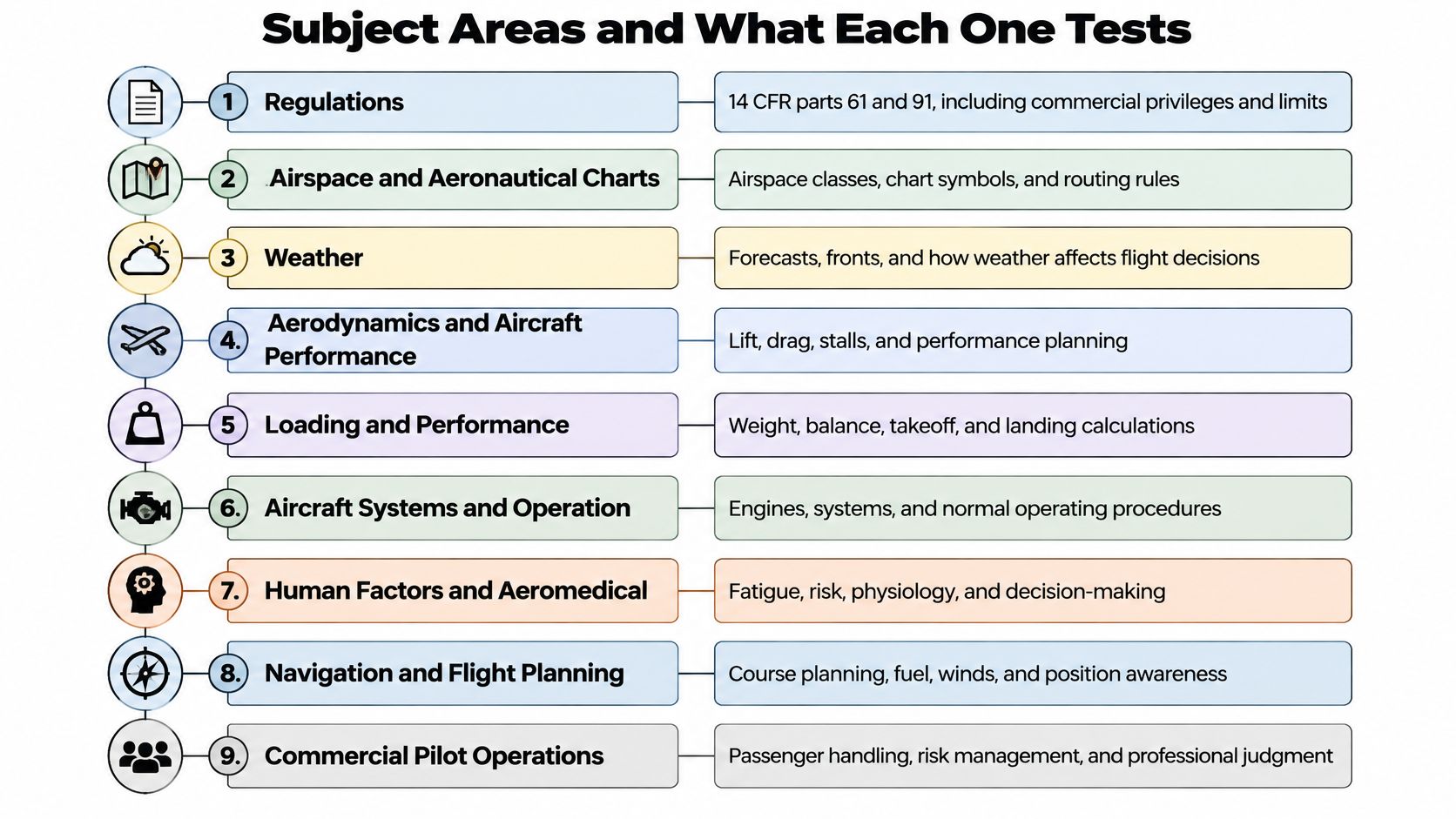
Use the ACS knowledge-element list as your coverage checklist. No single handbook covers every element the test samples, so match each missed concept to the relevant ACS item and then to the right reference.
A Week-by-Week Study Timeline
| Phase | Weeks | Focus | Daily study time |
|---|---|---|---|
| Foundation | Weeks 1–2 | Regulations, airspace, aeromedical factors | 45–90 minutes |
| Performance and weight and balance | Weeks 3–4 | Performance charts, CG and loading calculations | 60 minutes |
| Weather and navigation | Weeks 5–6 | METAR and TAF, sectional charts, flight computer | 60 minutes |
| Systems and risk management | Week 7 | Aircraft systems, ADM, commercial operations | 45–90 minutes |
| Full timed practice | Weeks 8–9 | Full 100-question sets, missed-element log | 90 minutes |
| Review and test readiness | Week 10 | Weak-area drills, light review, rest | 30 minutes |
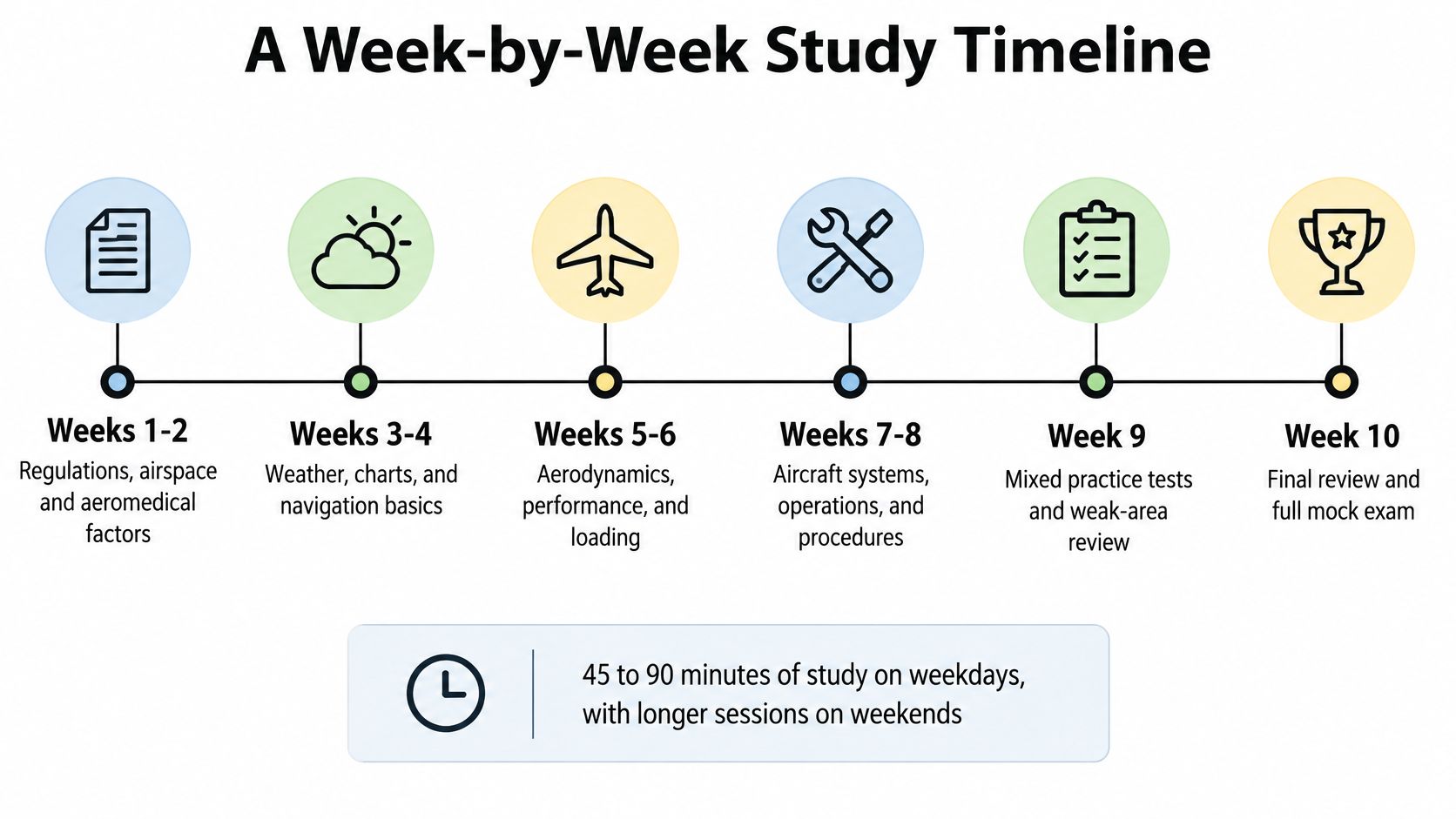
The first two weeks build a base in regulations, airspace, and aeromedical factors. These subjects reward careful reading and regular review. If you already hold a private certificate, compress this phase and spend the saved time on performance and weather.
Weeks three and four are for calculations. Work performance-chart questions and weight-and-balance problems repeatedly. Read each prompt for the actual conditions it gives you, then check the arithmetic before moving on. A missed density-altitude correction and a missed regulation cost the same points on the score report, so both get the same treatment in your log.
In weeks five and six, decode METAR and TAF reports, work with a sectional chart, and use a flight computer for time-speed-distance and wind-correction problems. Students with little or no flight time may need more time here: navigation and performance concepts feel abstract until you tie them to how a flight is planned and flown. If you're preparing for an earlier certificate too, this private pilot written-test preparation guide can help you establish study habits.
Use week seven for aircraft systems, aeronautical decision-making, and commercial operations. Then, in weeks eight and nine, take full 100-question timed sets. Record both your score and the ACS elements behind every missed answer. Week ten belongs to weak-area drills and light review.
Losing a week is normal. When weather, work, or a family obligation wipes out five sessions, keep the phase you are in and push the start of timed practice back by one week. Doubling daily hours to catch up does not restore the material, because retention follows sessions, not total minutes. If the lost week lands in the timed-practice block, cut the review week to three days and protect one full-length test; sitting a 100-question set while tired is the condition you are preparing for.
A simple spreadsheet with the date, score, and missed ACS elements turns practice into a diagnostic record you can re-test against.
At the close of every session, log the ACS element codes behind each miss, then open the next session by re-testing those same codes.
Study Resources Worth Using
The question bank you pay for shapes your study more than the ground school brand does, because it decides whether a wrong answer teaches you anything. Judge one on four points before you spend money:
- Maps questions to ACS elements. You can trace any mistake back to the exact knowledge area it came from.
- Explains the distractors. Strong material says why a wrong choice looks plausible and where that reasoning breaks down.
- Explains incorrect answers. A bank that only marks the right letter is a pacing tool.
- Lets you filter by subject. Focused drills beat another mixed test when one topic keeps failing.
I would pay only for a bank that clears all four. Anything less turns practice into a memory drill, which is the habit that fails the day the FAA rewords a question you thought you knew.
| Resource | Use it for | How to use it |
|---|---|---|
| Airman Certification Standards for commercial airplane (FAA-S-ACS-7) | The exact wording of every knowledge element | Look up the element behind a missed question before drilling it |
| Pilot's Handbook of Aeronautical Knowledge | Weather, aerodynamics and aeromedical topics | Chapter-level reference for the elements you miss |
| Airplane Flying Handbook | Performance and commercial maneuvering concepts | Open it when performance elements keep failing |
| Aeronautical Information Manual | Airspace, procedures and radio | Keep it on the desk during airspace and communication drills |
| Aircraft Weight and Balance Handbook | Center of gravity and loading | Work sample problems for each loading element, chart in hand |
| Sectional chart user guide | Chart symbols and navigation | Use it with a current sectional spread out beside you |
| Paid question bank | Timed practice and drills | Score under exam conditions, then review every miss the same day |
Paper references do the explaining the bank skips. When a question goes wrong, open the Pilot's Handbook of Aeronautical Knowledge chapter that covers that element, read to the end of the relevant passage, and close the book. Then return to questions on that element while the material is fresh. Handle the rest of the shelf the same way: three loading problems in the Aircraft Weight and Balance Handbook with the chart in front of you, and the sectional chart user guide open beside a current chart while you decode symbols.
For a wider set of questions to drill against, this guide to FAA written exam practice tests covers where to find practice sets and how to score them under exam conditions. Bring anything you miss back to the reference material rather than to the answer key.
Ask your instructor which handbook chapters they use for the same elements, so ground study and flight lessons reinforce each other instead of running in parallel.
Pitfalls That Sink Otherwise Strong Candidates
A high overall pass rate can hide a weak spot. In the FAA's quarterly ACS-code data for July 2024 to June 2025, one Commercial Pilot Airplane element, CA.VII.E.K2, was missed by 78 percent of applicants, according to the FAA's frequently missed ACS codes report. That result is a reason to study element by element, not proof that a passing score shows balanced mastery.
Decode the code before drilling it: CA.VII.E.K2 reads as Commercial Airplane, area VII, task E, knowledge element K2. Find that area and task in the commercial ACS, write the element as a question in your own words, then build a drill around what it asks and how it affects a decision.
Memorizing answer keys. A familiar question can feel easy until the FAA changes its wording or gives a different scenario. After reviewing an explanation, rewrite the principle in your own words and explain why the distractors don't fit.
Stopping at 70 percent. A passing score isn't a strong practice target. Aim for consistent results of 80 percent or higher in timed sets, then check whether the same topics keep appearing in your mistakes.
Avoiding performance math. Calculation questions don't improve through recognition alone. Do five flight-computer problems a day, and show each step so you can spot whether the error came from setup, chart reading, or arithmetic.
Treating validation questions as optional. You won't know which questions are unscored during the test. Answer every item as if it counts.
Skipping regulations because they feel dull. Include 14 CFR questions in every study session. Rules become easier to retain when you apply them to a concrete operation rather than reread them passively.
Cramming at the end. A last-minute review can't reliably replace spaced practice. Keep returning to difficult concepts throughout the ten-week schedule.
Practise under the same timer you'll face on test day. That makes pacing part of your routine instead of an unfamiliar pressure.
Reading Your Score Report and the Retake Loop
The Airman Knowledge Test Report (AKTR) is a diagnostic sheet. It lists a code for every missed question, and each code points to a specific area, task, and element in the commercial airplane standards. An instructor can use those codes to locate the exact ACS element and teach to the gap, as the FAA's ACS FAQ explains.
If you don't pass, rebuild only the elements named on the report. The 70 percent mark is the floor. The AKTR is what turns that floor into a study plan.
- Read every missed code. List each element. Do not collapse five misses into “performance” and move on.
- Locate the ACS element. Match the code to its area, task, and element in the commercial airplane standards.
- Teach the gap. Work with a flight instructor using explanations, worked examples, and scenario questions. Answer memorization will not survive a reworded item.
- Get the retake endorsement. Under 14 CFR 61.49, you need an instructor endorsement before you test again.
- Compare reports. After the retake, place the new AKTR beside the old one. Confirm the weak elements are gone and check whether any new code appeared.
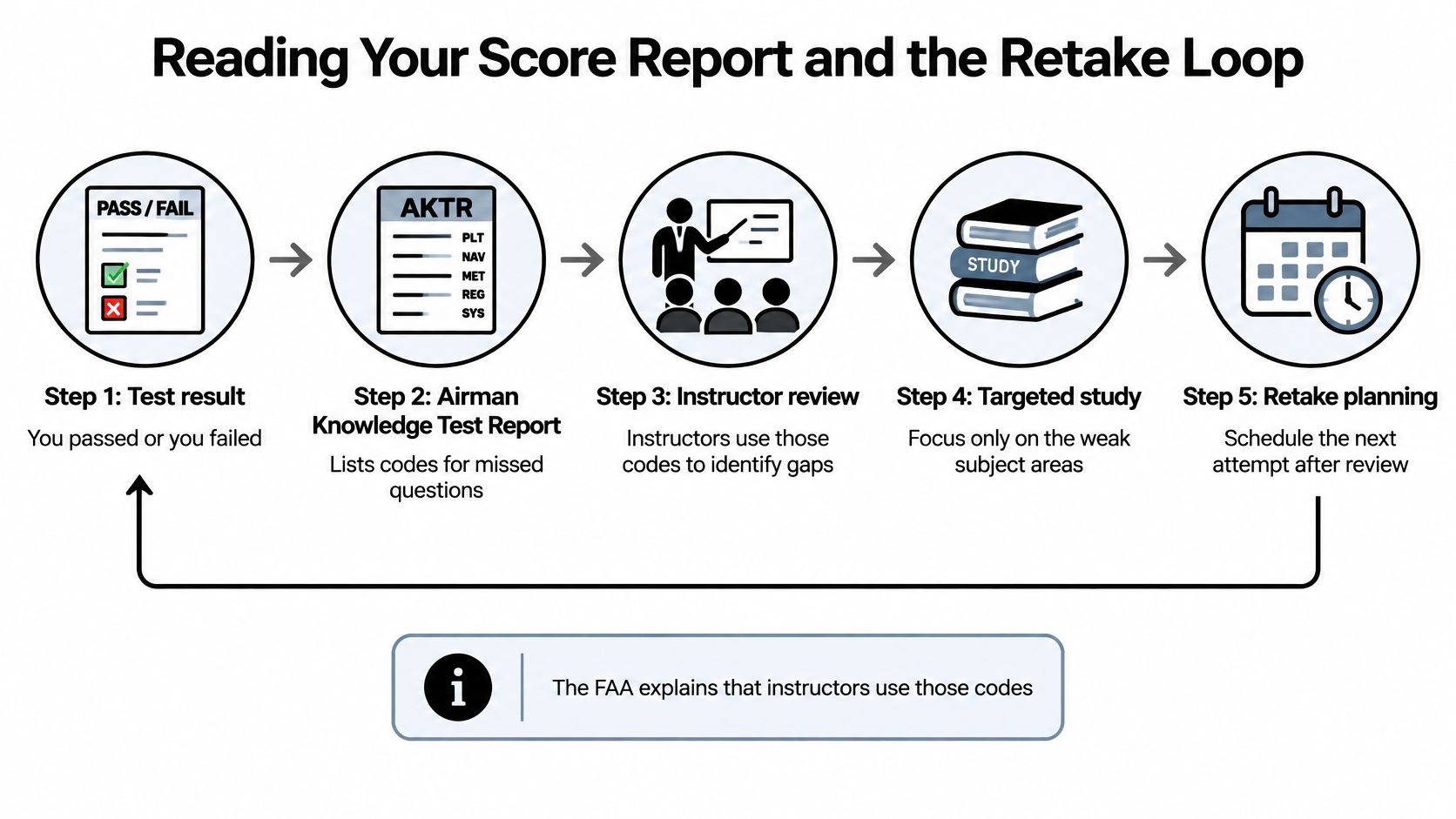
If you pass, the report still has use before the practical test. Pull the codes for missed elements that an examiner can probe in the oral, especially performance and limitations, weight and balance, weather, and regulations, and bring that short list to your oral prep. Ask your instructor to quiz you on those elements until you can explain the underlying principle and apply it to a flight scenario.
Book Your Written Test Within the Two-Year Window
Treat the 24-month validity window as a planning boundary. It should not push you into the test early. Book when three consecutive timed practice sets clear 70 percent with enough cushion that a weaker set still passes, and every ACS element you have missed in practice has been retaught and rechecked. If your practical test is more than 24 months out, keep training and delay the written. A test date earns its place only when it creates a deadline you can meet.
The FAA states that a passing AKTR expires 24 calendar months from the month you complete the knowledge test. If the commercial-certification application process isn't completed before that period ends, you must retake the test, according to the FAA's knowledge-test validity notice. You can sit the knowledge test before your first flight lesson. If you have not flown yet, the discovery flight is lesson one and requires no prior experience.
When you are ready to book, choose an authorized testing center that is close enough to reach without adding a stressful drive, and check its appointment availability before you set a study deadline. Pick a date that leaves room for a retake before your planned practical test, not just a date that feels soon. The practical sequence for selecting a center and locking a slot is in how to schedule the FAA written exam. After you pass, put the AKTR expiration date on your calendar and work backward from it. If you fail, put the retake date on your calendar instead and follow the score-report loop.
If you want the written-test sequence handled alongside flight training, CFII's Career Track includes prep for every rating, study materials, and checkrides scheduled with FAA examiners in a fixed $89,000, nine-month, 282-hour path from zero time to CFII and multi-engine, with six certificates and ratings in Southern California. Review CFII for the full pathway.
Planning to fly for a living?
See what the path from zero to a pilot career looks like, what it costs and how long it takes.
Learn to fly in Riverside
We train at Riverside Municipal Airport in modern airplanes with a parachute built in. Start with a one hour discovery flight, no experience needed.