On this page
- The Person Who Signs Your Certificate
- What the Examiner Is Allowed to Do
- The airplane has to match the paper
- The grade is the standard, not a mood
- How Examiner Scheduling Really Works
- What to ask before you pay for the trip
- What Happens on Checkride Day
- When the Checkride Does Not Happen
- One morning for each row
- What to fly while you wait
- Myths That Stretch a Pilot's Timeline
- The examiner is not your instructor's boss
- A commercial certificate does not make an examiner
- More examiners are not an instant fix
- Choose a First Flight or a Full Path
You have not taken a lesson yet, and you are already hearing about the stranger who will decide your private pilot checkride. Your instructor can teach you and sign your logbook. That instructor does not issue the certificate. A designated pilot examiner does, and only inside a narrow slice of FAA authority.
That slice is what moves a new pilot's calendar. The wrong airplane, a long drive, or a morning that gets cancelled can add weeks even when the flying itself is going fine. Pass or fail is the last line of the day, not the thing that sets the date.
The Person Who Signs Your Certificate
Say you are still deciding whether to start. A friend who is halfway through private pilot training tells you the instructor will recommend you, and then someone you have never flown with will climb into the right seat. That person is not a backup instructor filling in for the day.
A designated pilot examiner is an individual the FAA appoints under 14 CFR § 183.23 to conduct the oral exam and the practical flight test and, when the applicant meets the standard, to issue the airman certificate. The FAA designee page states that the examiner must meet the qualification standards in FAA Order 8000.95 and must hold the aircraft category, class, and, when they apply, type ratings for the practical tests being given. The appointment is a privilege, not a school title. The FAA may rescind it at any time when the Administrator considers that action appropriate.
New pilots mix up three different people.
- The flight instructor trains you and writes the endorsements that say you may attempt the test.
- An aviation medical examiner issues the medical certificate. That document is about your health, not your pilot certificate.
- The designated pilot examiner tests you and, if you meet the standard, issues the temporary airman certificate.
Private, instrument, commercial, and flight instructor certificates each end in a practical test. Those tests are the normal finish line, and designated examiners, not FAA inspectors, are the people who give nearly all of them. You can be progressing through the flight training requirements on schedule and still lose weeks because the examiner's authority, location, or calendar does not match the ride you need.
A late or mismatched examiner moves the whole career clock even when the flying is going well.
The designation is limited on purpose. The useful next step is to see exactly which tests and airplanes that limit covers.
What the Examiner Is Allowed to Do
Authority starts with the appointment and stops where the paperwork stops. A flight school can employ a talented instructor. It cannot grant examiner powers, and it cannot keep them if the FAA takes the designation back.
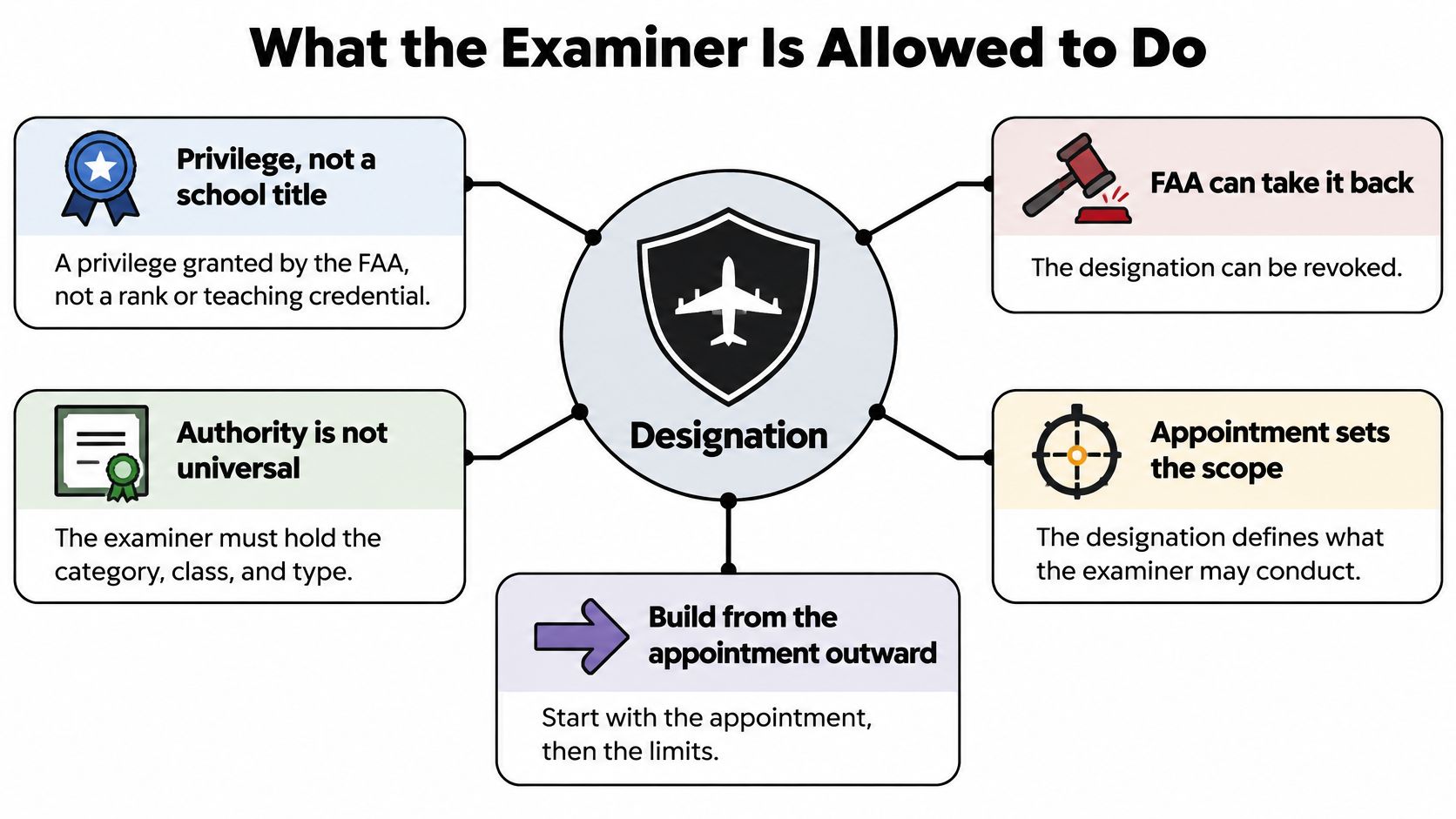
Before you treat a date as real, read the limits a zero-time student can check.
| Question | Answer | Rule or policy |
|---|---|---|
| Who appoints the examiner | The FAA, not the flight school | 14 CFR § 183.23 |
| Is the designation permanent | No. The FAA may rescind it | FAA designee policy |
| What the examiner administers | Oral exam and practical flight test | 14 CFR § 183.23 |
| Who sets the passing standard | ACS or PTS tasks and tolerances, not personal taste | FAA practical test standards |
| Which aircraft | Only aircraft inside the Certificate of Authority | FAA Order 8900.2 |
| Certain multiengine airplanes and helicopters | The examiner, not the student, needs at least 5 hours PIC in that make and model | FAA Order 8900.2 |
The airplane has to match the paper
FAA Order 8900.2 makes the authority aircraft-specific and designation-specific. The examiner must hold the pertinent category, class, and type ratings for each aircraft covered by the designation. The Certificate of Authority names that scope. A practical test may not be conducted in a specific aircraft outside it.
For your first ride, that usually means a single-engine land airplane and a private pilot test. An examiner who only tests helicopters cannot give that ride, even if the airport is close and the calendar is open. Later, a multi-engine commercial test needs its own slice of authority. For certain multiengine airplanes and helicopters, the same order requires the examiner to have logged at least 5 hours as pilot in command in each make and model used for the tests. That five-hour figure qualifies the examiner. It is not a minimum you must log before the ride.
This is also why one region can have "plenty of examiners" and still have no legal date for your airplane. Availability by itself does not make the test legal.
The grade is the standard, not a mood
The examiner does not pass you because the school likes you, and does not fail you because the landing felt different from the instructor's style. Each required task is judged against the Airman Certification Standards, or the Practical Test Standards where those still apply, including the written tolerances for altitude, heading, and airspeed. The Airman Certification Standards are the sheet you should study, because that is the sheet on the kneeboard in spirit even when nobody reads it aloud.
Oversight watches the designee's technical work, paperwork, currency, and compliance with the rules. You are not graded by a private club. If you cannot read, speak, write, and understand English, the test stops. That is a hard stop, not a style preference.
Three checks make a date real.
- The designation is current for this certificate and rating.
- The airplane and its avionics sit inside that authority.
- No limitation on the appointment blocks the test you planned.
If any one of those fails, you do not have a checkride. You have a conversation that still needs a legal examiner.
How Examiner Scheduling Really Works
The planning aim and the waits people live with are not the same number. Put them side by side before you buy a ticket or reserve a hotel.
| Situation | Figure | What it means |
|---|---|---|
| Access target for wait | No more than seven days | A planning aim, not a guaranteed date |
| Access target for travel | No more than 100 nautical miles | Long drives are a system problem |
| Typical reported wait | About six weeks to start | Common before the first appointment |
| After weather, illness, or maintenance | Up to several months | A cancellation can restart the queue |
| Tightest demand called out | California, Nevada, Arizona, and Utah | Year-round training fills examiner calendars |
| Examiner can decline | Aircraft, avionics, or category mismatch | Availability alone does not make a legal test |
FlightGlobal's account of the U.S. examiner system describes availability as especially strained in California, Nevada, Arizona, and Utah, where year-round training creates heavy demand. Reported student waits can begin around six weeks and extend to several months when weather, illness, or maintenance forces a new date. FAA-related guidance in that same account sets a target that applicants ideally should not wait more than seven days or travel more than 100 nautical miles.
Those targets are a planning aim. They are not a promise that a nearby examiner has an open morning.
A long wait is a system access problem. It is not proof that you trained badly. The examiner is usually an independent designee with a private calendar, not a desk inside the school. The school requests a date. The examiner accepts only when authority, aircraft, and schedule match. A decline is legitimate when the airplane, the avionics, or the category sits outside the appointment.
What to ask before you pay for the trip
Ask these four things before you commit money to travel.
- Certificate and aircraft. Which certificate, rating, and exact airplane can this examiner test?
- Distance. How far is the airport from where you train, in nautical miles, not in a hopeful driving estimate?
- A busted morning. If weather or a maintenance squawk cancels the slot, what is the written policy?
- The new date. Is the replacement days away, or does it send you to the back of a queue measured in months?
Year-round flying in the Southwest piles students onto the same small set of matching examiners. A school that says it will "schedule the checkride" has not answered those four questions. Part of how to choose a flight school is whether someone will match the airplane to a current designation before you are told you are ready.
Book only after your instructor says the ACS tasks are ready. Then protect the date. While you wait, compare free printable calendar sites and mark the original slot, the backup week, and the short list of tasks you still need to fly so a delay does not turn into random extra hours.
What Happens on Checkride Day
Test day is a sequence, not a vibe check. Picture a first private pilot applicant who has the tasks ready and still needs to know what happens between the parking lot and the signature.
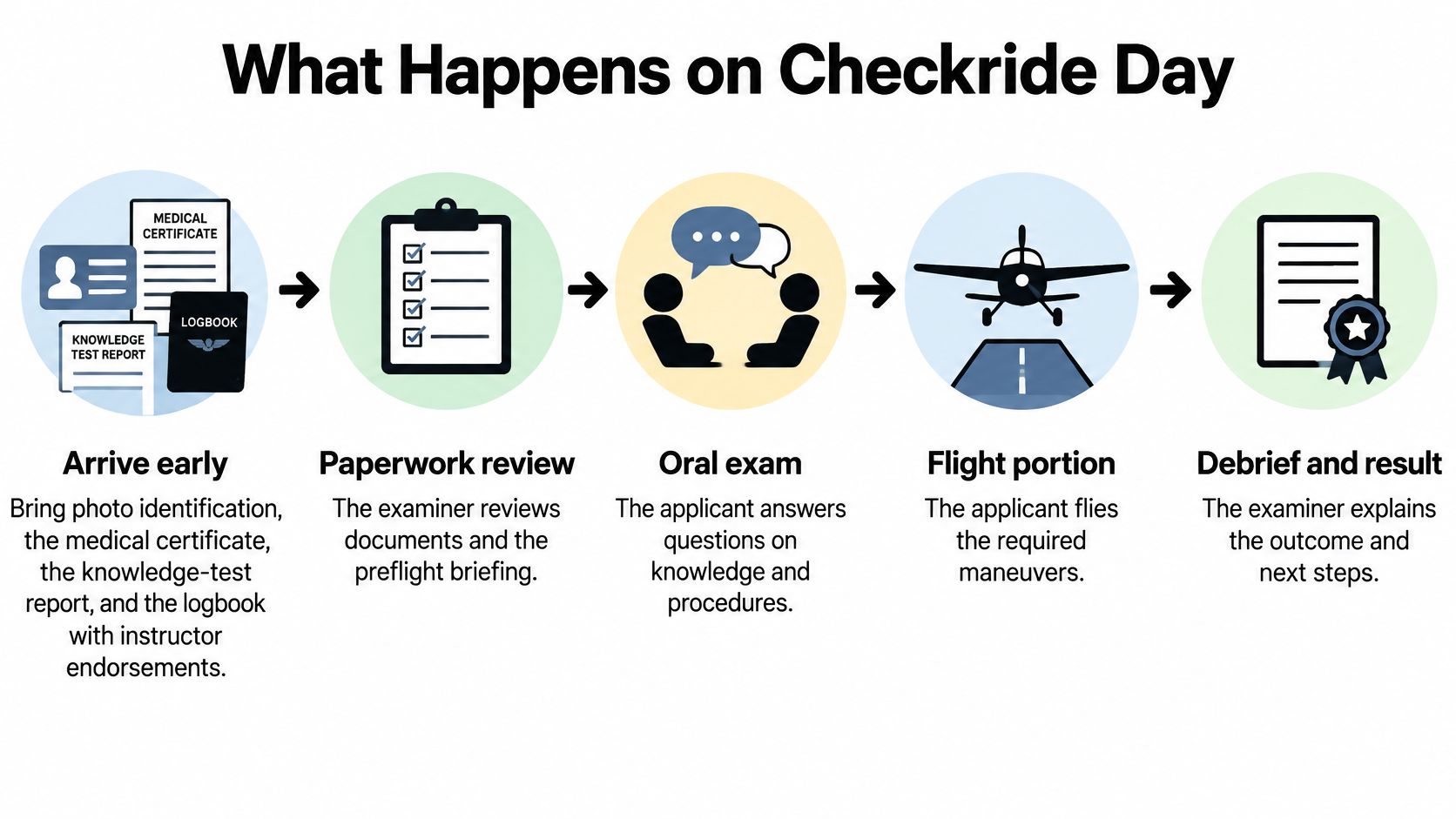
- Arrive early with the packet. Bring a government photo ID, the medical certificate, the knowledge-test report, and the logbook with the instructor endorsements required by 14 CFR § 61.39. Bring the aircraft documents and the maintenance records the examiner will review. You do this early because a missing endorsement found at the table can end the day before anyone talks about weather.
- Eligibility and the airplane get checked. The examiner confirms who you are, that you are eligible that day, and that the aircraft and its equipment match the test. This is the moment a glass panel or a missing inspection becomes a scheduling problem instead of a flying problem.
- The oral follows a plan of action. It is built from the ACS and usually uses a scenario, not a stack of trivia. Expect weather, airspace, aircraft limits, and the flight you planned. The point is to hear how you decide, not how many facts you can recite in order.
- The preflight is part of the test. You use the checklist and you decide whether the airplane is airworthy. Finding a bad instrument and stopping is a pass on judgment. Hoping the examiner did not notice is not.
- The flight samples the required tasks. You fly them to ACS tolerances. The examiner is not booking an airshow. A normal landing inside the standard beats a theatrical one that misses it.
- The debrief names the result. You hear pass or disapproval, and you hear the tasks. "You did fine" is not the record. The tasks are.
- A pass produces a temporary airman certificate. A disapproval produces a notice. It is not the end of the certificate. It is a list of what must be trained and retested.
The FAA practical test guidance requires the examiner to judge knowledge and skill against defined tolerances and task objectives, while oversight watches the designee's technical performance, paperwork, currency, and compliance. The same guidance requires English sufficient to read, speak, write, and understand. If you cannot meet that standard on the day, the examiner must terminate the practical test and refer the matter to the supervising Flight Standards District Office. That stop happens before the flight becomes the story.
Total hours are a weak proxy for readiness. Map your study to tasks instead. Finish the ground lessons, rehearse a scenario oral, fly the navigation or instrument procedures the certificate requires, and know the limits of the specific airplane. If you want the shape of the day in one place before you build that map, read what a checkride includes and then rehearse it.
The standard to rehearse is simple. Do a full mock oral and a full mock flight against the current ACS before the actual appointment. If the mock finds a soft task, fix that task. Do not add an unstructured hour and call it preparation.
When the Checkride Does Not Happen
Most lost days are predictable. Treat the bad morning as a decision table, not as a surprise personality test.
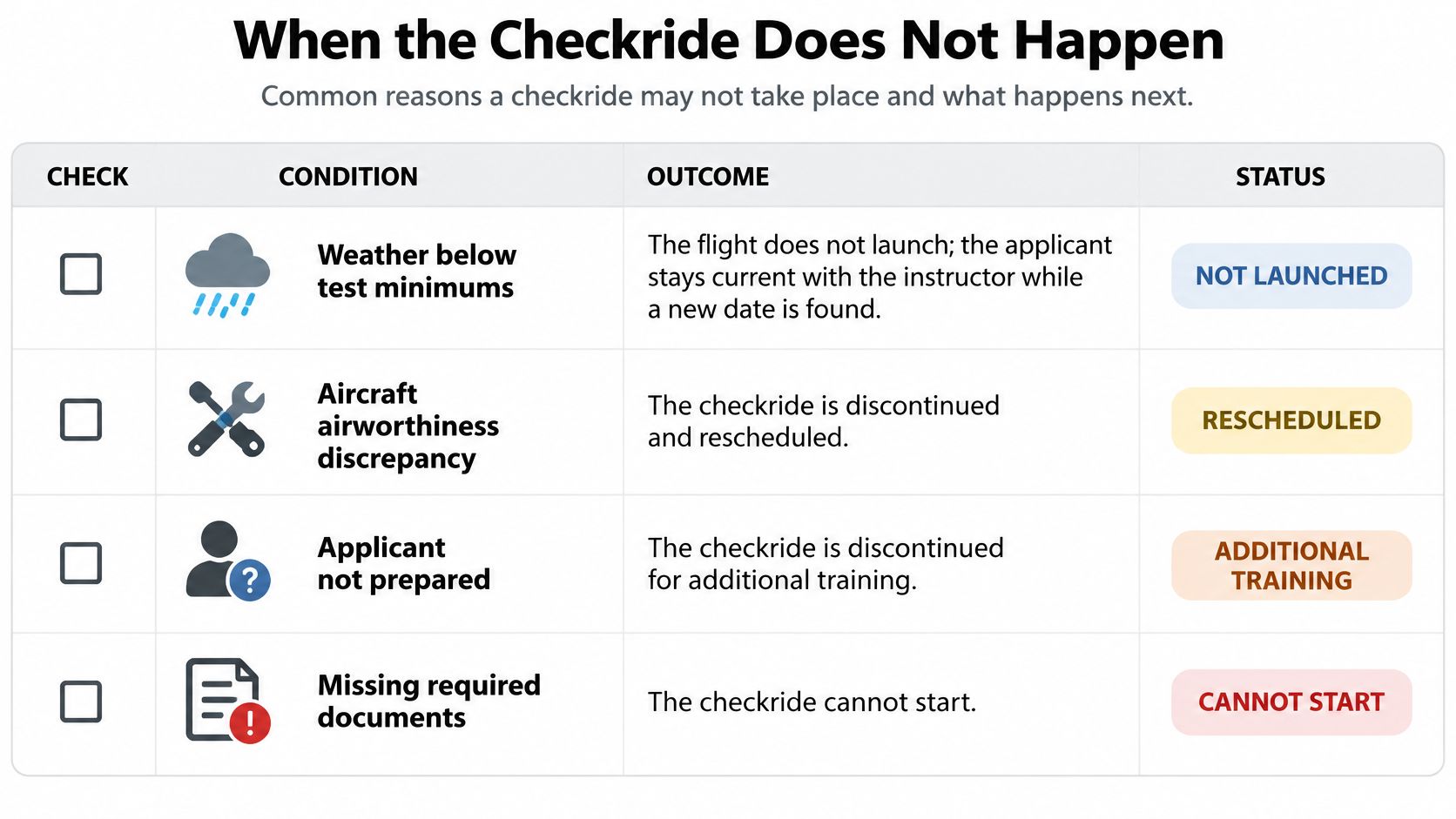
| Problem | What the examiner does | What you do next |
|---|---|---|
| Weather below minimums | Does not launch the flight | Stay proficient with the instructor and take the new date |
| Airplane or avionics not acceptable | Declines that aircraft | Use a backup still inside the Certificate of Authority |
| Expired knowledge test or medical | Applicant is not eligible that day | Renew the medical or retake the knowledge test, then book again |
| English not adequate | Ends the test and refers it to the FSDO | Build plain aviation English before reapplying |
| Task not to ACS standard | Issues a notice of disapproval | Train the failed tasks, get a new endorsement, and retest under 14 CFR § 61.49 |
One morning for each row
Weather. Coastal morning fog is still below the test minimums when the appointment starts, and it will not burn off in time. The flight does not launch. You stay current with your instructor on the tasks that rust first, and you take the new date instead of treating the fog as a personal failure.
The airplane. On preflight, the attitude indicator fails its check. The examiner can refuse that airplane. A backup only helps if that second airplane is still inside the same Certificate of Authority. A different panel, or a twin the examiner is not authorized to test, is not a save.
Eligibility. Run 14 CFR § 61.39 the week before, not in the parking lot. A knowledge-test report older than its 24-calendar-month window, a missing practical-test endorsement, or a lapsed medical means the test should not start. You fix the document, then you look for another date.
English. If English is not adequate for the test, the examiner stops it and sends the matter to the FSDO. More pattern work does not fix that stop. Plain aviation English does, before you reapply.
A failed task. The oral and the other landings meet the standard, and the short-field landing is soft and outside tolerance. That is a disapproval, not a erased logbook. Under 14 CFR § 61.49 you get additional training on the failed area, a new instructor endorsement, and a retest aimed at those tasks. There is no mandatory waiting period to invent. Areas you already passed can be credited within the rule, so you do not automatically repeat the entire ride.
What to fly while you wait
Keep a small proficiency plan. Fly the tasks most likely to rust, such as slow flight, the landing that failed, and the diversion math from the oral. Do not buy random hours to feel busy.
The cheapest save is catching eligibility problems before the examiner opens the plan of action.
A reprint of a knowledge-test report costs less than a lost day of airplane, examiner time, and travel. Check the dates on the medical, the knowledge test, and every endorsement while the airplane is still in the hangar.
Myths That Stretch a Pilot's Timeline
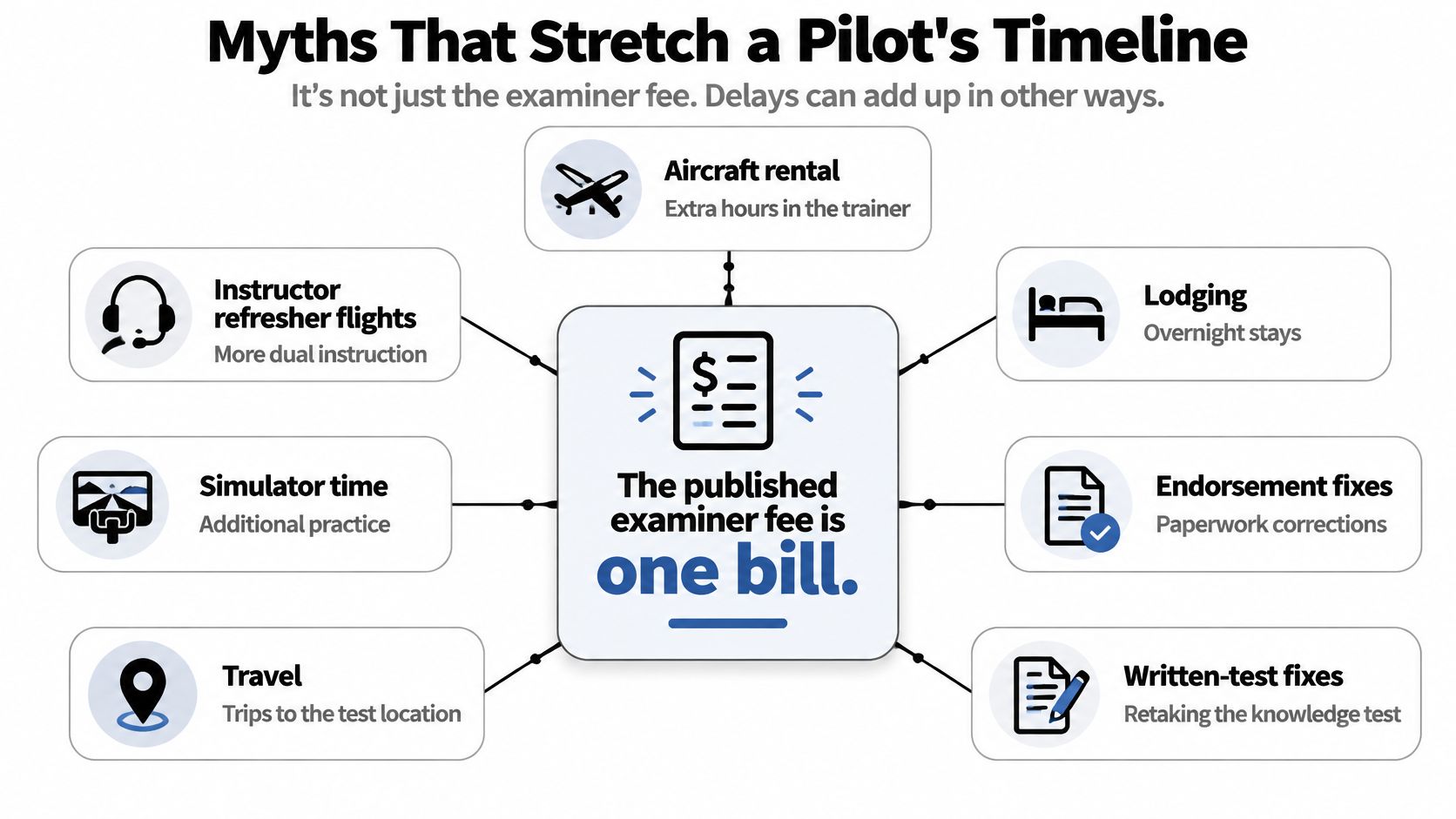
The bill people remember is the examiner's fee. That fee is one bill. Delay can add aircraft rental, instructor refresher flights, simulator time, travel, lodging, fixes to an endorsement or a written test, and tuition or benefits lost when a course deadline expires. You pay those while you wait. The examiner does not.
The examiner is not your instructor's boss
ACS or PTS tolerances are the standard. School loyalty is not. A friendly instructor cannot widen a tolerance, and a strict one cannot invent a new one. If you want a sober look at how a later ride is graded, start with instrument checkride results and what they measure and then compare that sheet to your own weak tasks. Hours that never touched the oral, the tasks, or the paperwork do not prove you are ready.
A commercial certificate does not make an examiner
That path comes later, not next. The FAA requires certificates and ratings sufficient to give instruction in the category, class, and type, plus the experience for that specific designation. FAA Order 8900.2A also requires the applicable currency in 14 CFR §§ 61.56 and 61.57, and a revoked airman certificate makes the candidate ineligible. Examiner selection standards add a minimum age of 21, a good record on accidents, incidents, and violations, and a bar on anyone whose pilot certificate was revoked for falsification or forgery. Accurate records are a career requirement for that job. They are not a bonus line on a résumé.
More examiners are not an instant fix
A 2025 study in the International Journal of Aviation, Aeronautics, and Aerospace found that 91% of responding flight schools considered checkride availability an operational issue, while schools reported an average wait of about five weeks. That account also reported that the FAA appointed only about 29% of qualified DPE applicants on average over the preceding five years, while examiner departures averaged 58 a year, and it describes FAA Order 8100.15C, which lets qualifying Part 141 schools conduct practical tests through an approved organization. Extra capacity is possible. The tradeoff is real too. School-based testing can raise questions about examiner independence, standardization, conflicts of interest, and whether students from outside that school get the same access.
While a date sits weeks out, build focus without rigid schedules so the wait becomes short, repeatable sessions on the tasks you still miss. A pile of unfocused hours is the expensive version of the same delay.
Choose a First Flight or a Full Path
You do not need an examiner to find out whether you want this. You need the right next hour.
If you have never flown, the useful step is one discovery flight with an instructor, not a hunt for a test date. A discovery flight is a first flight before any commitment. You meet the instructor, walk the airplane with a checklist card, and take the controls in the air. No experience is required. A third-class medical is required before you fly solo. The discovery flight and the early lessons can happen before you have that medical.
If you already want the certificates that lead to paid flying, the Career Track is a fixed $89,000 tuition, about nine months from zero time to CFII and multi-engine, 282 total hours, and six certificates and ratings, based in Southern California at Riverside, Long Beach, and Corona. Checkrides are scheduled with FAA examiners. Written-test prep is included for every rating, along with study materials, textbooks, study guides, exam prep, and a training portal with lessons, quizzes, stage checks, and a logbook. You are not left to find each examiner alone. Examiner fees are extra everywhere, including here. No pass rate, job, or hiring outcome is promised.
Before you commit, walk the hangar, sit in a cockpit, and meet the instructors. If you want a simple way to keep lessons, quizzes, and weak tasks in one place while you decide, look at student workflows with BromeAI. Then pick one path. Take the discovery flight if the goal is still a question. Take the Career Track if the goal is the full certificate sequence.
CFII trains aspiring pilots through the practical tests a designated pilot examiner signs, and the Career Track coordinates those checkrides with FAA examiners while you prepare every written test along the way. If you want that path laid out before you spend months chasing a date, start with a discovery flight or the full certificate sequence. Visit CFII and see which one matches the hour you are ready to fly.
Planning to fly for a living?
See what the path from zero to a pilot career looks like, what it costs and how long it takes.
Learn to fly in Riverside
We train at Riverside Municipal Airport in modern airplanes with a parachute built in. Start with a one hour discovery flight, no experience needed.