
On this page
- What an Aspiring Career Pilot in California Is Really Choosing
- Start with your actual constraints
- How Big the California Flight Training Market Is
- The FAA Rule Stack That Governs Every California Program
- Instrument training comes with prerequisites
- Commercial eligibility requires more than finishing a syllabus
- ATP eligibility comes later
- Comparing the Three California Training Models
- The modular route gives flexibility, not a guaranteed total
- Fixed tuition makes sense when predictability is worth the commitment
- What a California Pilot Career Path Actually Costs in 2026
- Build a budget in scenarios, not promises
- Include the costs that don't appear in an hourly rate
- Why Checkride Scheduling and Examiner Logistics Matter
- Matching the Right Program to the Right Student
- Ask how the school measures safety and readiness
- Recommendation and Next Steps for California Pilots
You've opened a stack of flight-school pages, compared hourly rates, and still can't tell how much money or time it'll take to become employable. That's the point where many new students choose on the wrong basis: they treat the advertised minimum as a budget and assume a busy schedule guarantees a fast finish.
For a career pilot, the right choice depends on the whole route: which certificates you need, whether Part 61 or Part 141 suits your circumstances, how you'll handle costs beyond flight hours, and whether a fixed-price program is worth the upfront commitment. Here's how to compare flight schools in California by the things that shape your actual progress.
What an Aspiring Career Pilot in California Is Really Choosing
When I talk with career changers, the first conversation usually starts with a simple question: “Which school should I pick?” It's too early for that question. First, decide what path you're buying into. A zero-time student needs a sequence of certificates and ratings, while someone with a private pilot certificate may need only the remaining instrument, commercial, and instructor training.
The next choice is the training framework. Part 61 can make sense for a student who needs flexibility around work or family. Part 141 offers an FAA-approved curriculum and a more structured course environment. Neither label, by itself, tells you how consistently you'll fly, whether aircraft will be available, or how quickly practical tests can be arranged.
Then decide whether you want to assemble the training one rating at a time or commit to an accelerated program with a defined scope and price. Modular training can reduce the upfront commitment, but the student has to manage the transitions between stages and absorb the cost of delays. A fixed-price route makes the financial commitment clearer, but it asks you to commit more at the outset and follow an intensive schedule.
Start with your actual constraints
A career changer willing to relocate may be able to train more consistently than someone trying to fit lessons around a full-time job and a long commute. A student who hasn't obtained a medical certificate should check eligibility before committing significant money. A pilot who already holds a private certificate should compare only the remaining ratings and time-building plan, not pay for a zero-to-career package that duplicates completed training.
The time cost includes more than flying. You'll need room in your schedule for ground study, weather disruptions, practical-test preparation, and the ordinary work of living near your training base. For a plain-language overview of the certificate sequence, use this guide to becoming a pilot.
The useful questions are concrete: What certificates and ratings are included? How many hours are logged in each category? What's excluded from tuition? Who coordinates tests, and what happens if training pauses? Ask those before comparing slogans or hourly rates.
How Big the California Flight Training Market Is
California supports one of the deepest pilot-training markets in the country. FAA-derived figures published in 2024 report 65 FAA-approved pilot schools, 25,562 student pilots, and 10,353 flight instructors statewide. Divide the reported students by the reported instructors and you get roughly 2.47 students per instructor. That ratio deserves more attention than the school count, because instructor availability is the constraint that decides how often you fly.
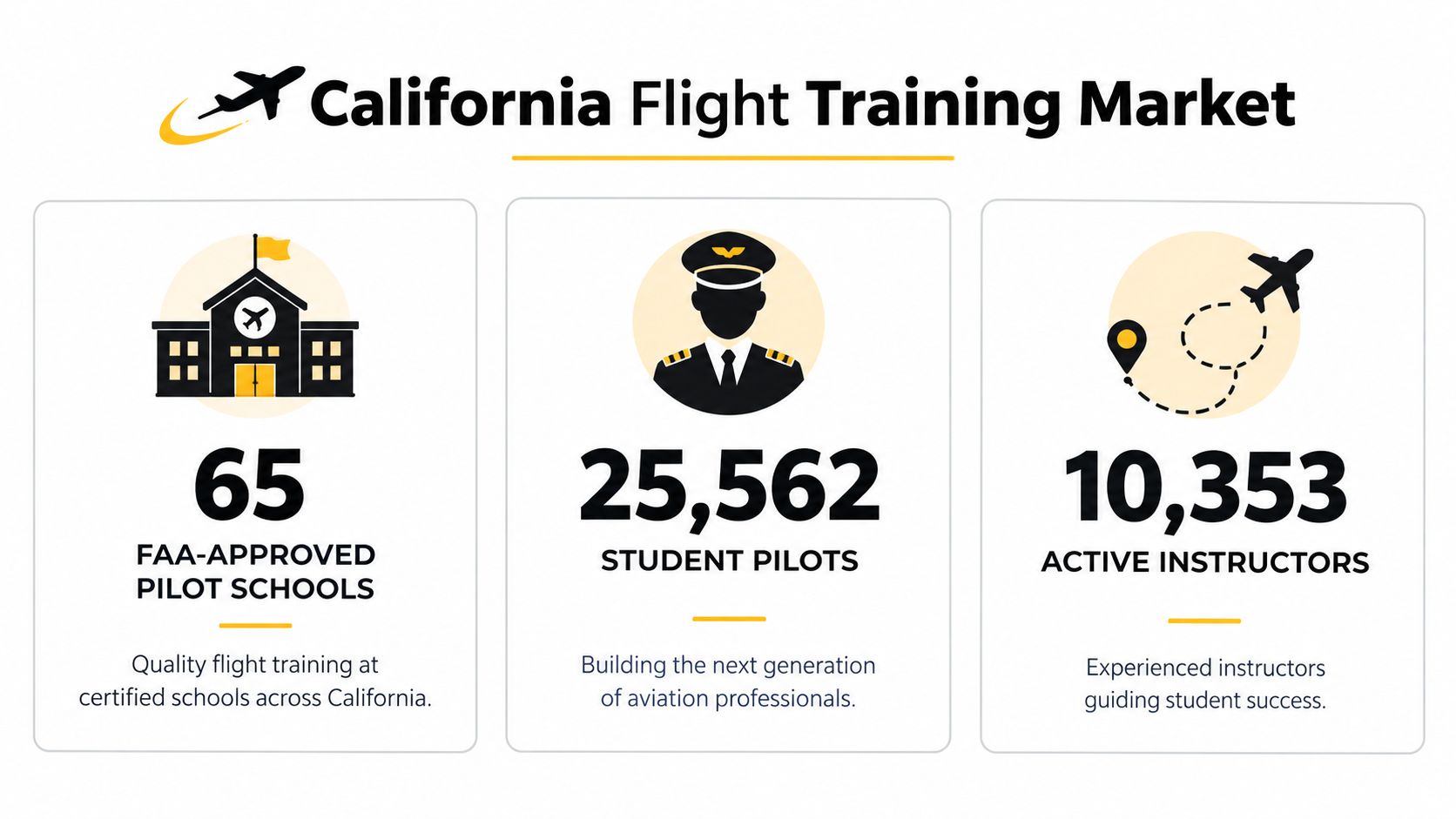
The same FAA-derived compilation identifies 64 certificated Part 141 school locations operating under 60 air-agency certificates, which places California third among states and territories by location count. The locations cluster rather than spread: six in San José, four each in Long Beach and Riverside, and nearly 76.6% of the listed locations sit within one mile of a public-use airport.
Training capacity concentrates around a handful of Southern California and Bay Area airports, so a statewide school count tells you very little about your daily training experience. Check how many schools operate from the field where you would train, how many aircraft each one keeps airworthy, and whether its instructor roster can support the schedule it advertises. A school surrounded by competitors can still leave you waiting weeks for a plane if its own fleet is thin.
Big market, real bottleneck. Visit your shortlisted schools on a weekday afternoon and count how many trainers are on the line versus sitting in maintenance. California gives you options, and those options only help if the specific operation behind the brochure has the planes and instructors to keep you moving.
The FAA Rule Stack That Governs Every California Program
A career path is a chain of FAA certificates and ratings, not one “airline pilot” course. Before signing up, ask a school to map its syllabus and logged hours to the rules that govern each step. A guide to FAA-approved flight schools can help clarify the difference between approval and a marketing label.
Instrument training comes with prerequisites
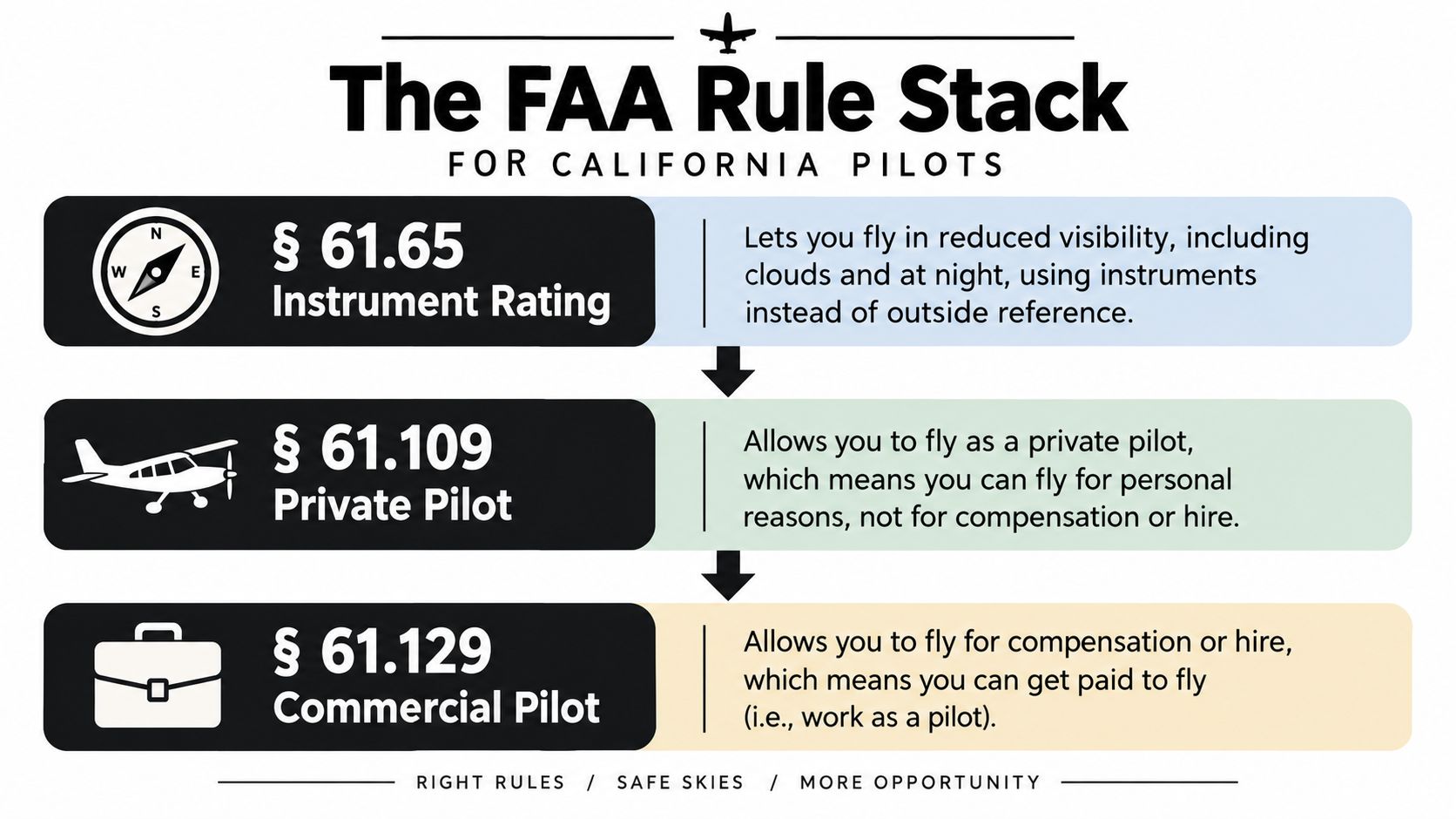
Under 14 CFR § 61.65, an instrument-rating applicant must hold, or apply concurrently for, a private pilot certificate with the appropriate aircraft rating. The rule requires aeronautical knowledge training and logged instructor-led training or qualifying simulator/device training. It covers instrument flight, navigation systems, and instrument approach procedures. Simulator access can support training, but a school should explain how its simulator time fits the actual requirements and proficiency goals.
Commercial eligibility requires more than finishing a syllabus
For an airplane single-engine commercial certificate, 14 CFR § 61.129 generally requires 250 hours of total pilot time. The hour structure includes 100 hours in powered aircraft, 100 hours as pilot in command, at least 50 hours in airplanes, and 50 hours of cross-country time, including at least 10 hours in airplanes.
The rule also specifies commercial training, including instrument instruction and experience in a complex airplane, turbine-powered airplane, technically advanced airplane, or qualifying combination. It includes required cross-country flights and recent practical-test preparation. The headline total alone doesn't tell you whether a program's hours satisfy the required categories.
ATP eligibility comes later
For the standard airplane-category ATP path, 14 CFR § 61.159 requires 1,500 hours of total pilot time, including 500 hours of cross-country time. Some graduates of authorized higher-education aviation programs may qualify for restricted privileges, but that doesn't erase the 1,500-hour requirement for full privileges.
That's why “zero to airline” should never be read as “finish training and start at an airline.” Private, instrument, commercial, and instructor qualifications are separate milestones. Most new pilots need instructing or another lawful time-building route after training. Compare any promised program total against the required hour categories, not just the certificate names.
Comparing the Three California Training Models
The right training model depends on whether your priority is flexibility, structured oversight, or predictable scope and pace. Part 61 and Part 141 describe training frameworks. A fixed-price Career Track is a program design, so ask separately which FAA rules apply to its courses.
| Dimension | Part 61 modular | Part 141 structured | Career Track fixed-price |
|---|---|---|---|
| Training rule | Part 61 training, often arranged rating by rating | FAA-approved curriculum and structured oversight | Fixed-scope pathway; confirm the applicable training framework for each stage |
| Cost structure | Pay by stage or training activity; total depends on hours and pace | Depends on school and program scope | $89,000 fixed tuition |
| Time to CFII | Varies with availability, schedule, and progress | Varies by curriculum and student pace | About nine months from zero time to CFII and multi-engine |
| Hours and training mix | Depends on logged hours and the sequence chosen | Set by curriculum and student completion | 282 total hours across six certificates and ratings |
| Simulator access | Depends on the school | Depends on the school and approved course | Included in the program's stated hour total |
| Likely fit | Students who need flexibility and can manage a modular plan | Students who prefer a structured syllabus | Students ready for an intensive, defined program and upfront tuition |
The modular route gives flexibility, not a guaranteed total
Part 61 can suit someone who must keep earning while training or who already has some certificates. You can progress in stages instead of committing to a full pathway immediately. The risk is scope creep: gaps between lessons, aircraft availability, weather, and repeated training can stretch the total time and cost.
Part 141 may suit a student who wants an organized curriculum and the structure of an approved course. But the label alone doesn't tell you the actual pace, cost, instructor access, or practical-test plan. Ask how the school schedules lessons and what happens when you fall behind the planned sequence. For the regulatory distinction, see this Part 61 and Part 141 comparison.
Fixed tuition makes sense when predictability is worth the commitment
CFII's Career Track is based in Southern California, including Riverside, Long Beach, and Corona. Its published structure is $89,000 fixed tuition, about nine months from zero time to CFII and multi-engine, and 282 total hours across six certificates and ratings. That defined scope helps a student compare the full pathway with a modular plan, but it doesn't remove the need to check what tuition includes, what it excludes, or whether the schedule fits their life.
A fixed-price program is most compelling for a student who can train intensively, relocate if needed, and values a coordinated sequence over the flexibility to pause between ratings. A modular path is often more practical for someone with a private certificate, a limited training budget at the outset, or a schedule that can't support full-time study. Don't pick based on the word “accelerated.” Ask how the plan handles instruction, aircraft access, simulator work, and examiner coordination.
What a California Pilot Career Path Actually Costs in 2026
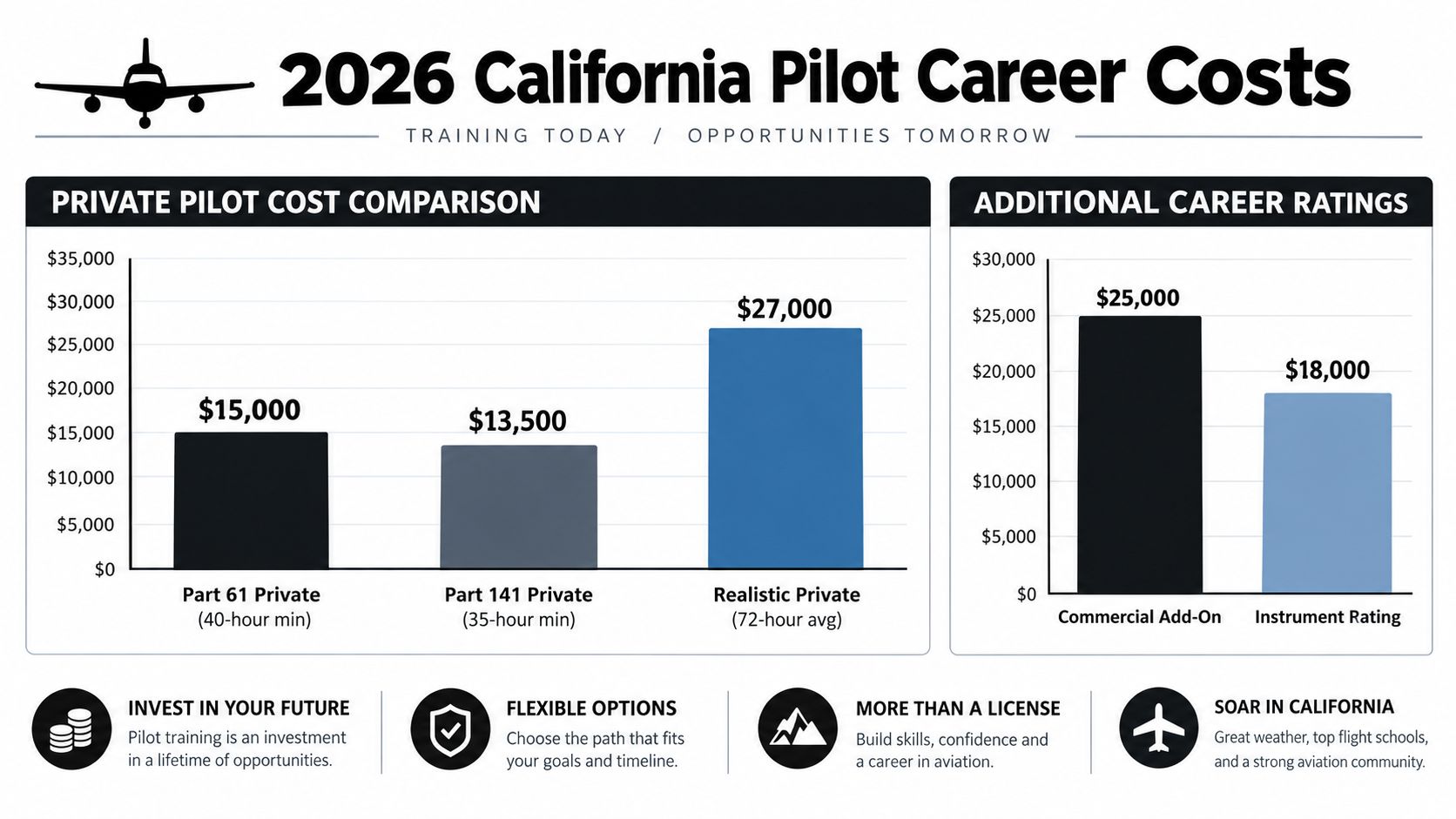
The FAA's private-pilot minimum is a regulatory threshold, not a reliable estimate of what a student will spend. Under Part 61, the minimum is 40 flight hours; under Part 141, it's 35 hours. An independent 2026 estimate places typical private-pilot completion at about 72 hours and $15,500 to $20,500.
Build a budget in scenarios, not promises
Use three cases when planning: minimum, typical, and slower-than-average. The minimum case shows the rule's floor, not what you should expect to pay. The typical case should reflect a realistic completion estimate, while the slower case should allow for weather cancellations, aircraft downtime, repeated lessons, and delayed testing.
The available typical-completion estimate covers private training. Don't treat it as the price of a commercial certificate or the entire path to instructor qualifications. For each later stage, ask the school for the planned hours, aircraft and instructor charges, simulator allocation, and the conditions that would add cost. This flight-training cost guide can help you make a detailed comparison.
Include the costs that don't appear in an hourly rate
A modular budget should list aircraft rental and instructor time separately, then account for written exams, medical certification, checkride and examiner fees, and potential retests. Add housing, transportation, and financing carry cost if you'll move or borrow to train. Those costs don't disappear because a school advertises a low hourly rate.
CFII's Career Track provides a different budgeting structure: $89,000 fixed tuition for the stated program. The published student-housing option near its Riverside base is $1,300 per month, and the program's financing information describes a 12-month payment deferral through its financing arrangement. Confirm current eligibility, terms, and what each amount covers directly before making a commitment.
Budgeting rule: Compare total expected spending through your target certificate, not the hourly rate or the private-pilot minimum. If a school can't explain what's included and what could push the total higher, you don't yet have a usable budget.
Why Checkride Scheduling and Examiner Logistics Matter
A student can finish the flying and still lose time before a practical test. Paperwork errors are one preventable cause: the FAA notes that a mismatch between an applicant's full name in IACRA and the name on the medical certificate or knowledge-test report can delay testing. The FAA is also required under the 2024 reauthorization law to evaluate examiner deployment, regional wait times, testing activity, utilization, and retest rates. (FAA checkride delay and examiner information)
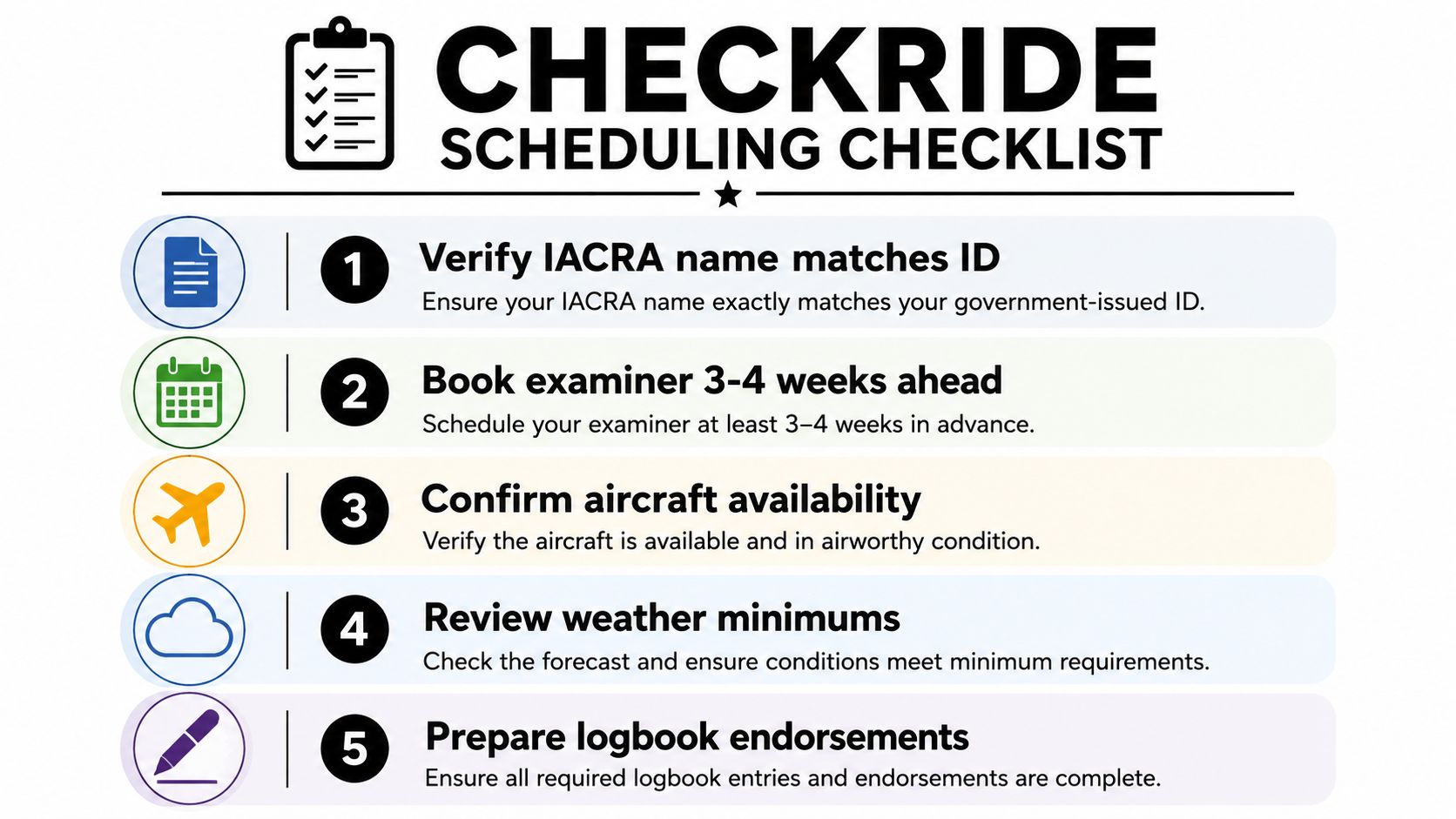
Before you book, work through this checklist:
- Verify identity fields: Make sure IACRA, your medical certificate, and your knowledge-test report show matching information.
- Confirm records: Check that the required medical and knowledge-test documents are available and current for your application.
- Gather aircraft documents: Ask what records the examiner needs and confirm the aircraft will be ready and available.
- Plan for weather: Reserve a realistic window and ask how the school handles weather or maintenance cancellations.
- Clarify fees and backup plans: Confirm cancellation terms, who arranges the examiner, and whether a backup examiner is available.
A checkride preparation guide can help you understand the practical-test process, but your school should also tell you who handles each administrative step. In Southern California, complex airspace and busy operations can make a coordinated plan especially useful. Ask for specifics, not reassurance: when the school starts arranging the test, how it protects the booking, and what happens if the aircraft or examiner becomes unavailable.
Matching the Right Program to the Right Student
A program should fit your starting point and constraints, not just your ambition. The FAA recorded 82,437 active airmen in California in 2025, including 36,587 private pilots, 20,089 commercial pilots, 12,171 airline transport pilots, and 12,980 flight instructors. Nationally, the Bureau of Labor Statistics projects 7% employment growth for airline and commercial pilots from 2025 to 2035, with about 16,400 annual openings on average. (FAA 2025 active airmen dataset and BLS pilot employment outlook)

For a career changer with no flight time who can relocate and train intensively, a defined zero-to-CFII program may be a better match than building the route one rating at a time. A private pilot who needs instrument, commercial, and instructor qualifications should compare the remaining stages and avoid paying for training already completed. Someone who can't leave work or relocate may prefer modular training, even if the calendar runs longer.
If becoming an instructor is the priority, ask whether the plan helps you qualify for paid instructing work and what is guaranteed in writing. CFII's optional Work with Us add-on is a $15,000 instructor bootcamp plus 175 guaranteed paid instructing hours at $30 per hour, with a stated minimum of 480 total hours by month 18. Treat those as program terms to verify directly, not as an airline hiring promise.
Ask how the school measures safety and readiness
Safety should show up in instruction and review, not just in the brochure. FAA instructional guidance reports that 60% of stall/spin accidents occurred during takeoff or landing, and that instructors were onboard in 37% of the accidents examined. A separate analysis found loss of control in flight represented 54% of fatal instructional accidents; the fatal training-accident rate fell from 0.49 per 100,000 training hours in 2000–2004 to 0.26 in the most recent five-year period studied. (FAA flight-instruction safety guidance)
Ask whether stage checks track recurring weaknesses, whether simulators are allocated for abnormal-procedure practice, and how instructors standardize approach, go-around, and checklist expectations. A school's equipment matters, but its operating discipline matters more. Ask how often the school reviews student performance and what it changes when the same errors keep appearing.
Recommendation and Next Steps for California Pilots
If you haven't flown, start with a discovery flight before paying for a full program. If you're ready to commit to an intensive zero-to-CFII route, review the Career Track program: $89,000 fixed tuition, about nine months to CFII and multi-engine, 282 total hours, and six certificates and ratings, based in Southern California.
FAQ
- Is Career Track a Part 141 program? Confirm the applicable training framework and approvals for each stage directly with the school.
- What happens after CFII? You still need to build experience toward ATP eligibility, commonly through instructing or another lawful time-building route.
- How does financing deferral work? The published terms describe a 12-month payment deferral; confirm eligibility and the full agreement before enrolling.
- What does typical private completion mean? The cited estimate is about 72 hours and $15,500 to $20,500, not the FAA minimum and not the cost of the full career path.
CFII offers a structured Southern California pathway from zero experience through CFII and multi-engine, with defined tuition, hours, and training scope. If you're comparing flight schools in California, visit CFII to review the program details and decide whether the schedule fits your career plan.
Planning to fly for a living?
See what the path from zero to a pilot career looks like, what it costs and how long it takes.
Learn to fly in Riverside
We train at Riverside Municipal Airport in factory-new airplanes with a parachute built in. Start with a one hour discovery flight, no experience needed.