
On this page
- What a Commercial Pilot School Actually Does
- More Than Airplane Rental
- What the School Is Not
- The Certificate Path from Zero Time to Commercial Pilot
- The Four Milestones You'll Hit First
- Details Inside the Commercial Step That Trip Students Up
- Part 61 vs Part 141 and the Hour Question
- Why Fewer Hours Isn't Automatically Cheaper
- What Commercial Pilot Training Really Costs
- The Components Brochures Merge Together
- Fixed Price Versus Hourly Billing
- Academy, University, and Independent Training Compared
- Accelerated Academies
- University Aviation Degrees
- Independent Part 61 and Part 141 Schools
- Key Questions to Ask Before You Enroll
- Fleet, Simulator, and Instructors
- Checkrides, Housing, and What Comes After
- From Commercial Certificate to Airline Eligibility
- How Pilots Close the Gap
- Your Decision Checklist for Choosing a Commercial Pilot School
You're sitting at a kitchen table with a dozen flight school tabs open, each promising a fast track to the airlines, and none of them agreeing on hours, price, or timeline. You're not shopping for a hobby. You're trying to choose the regulated path that turns zero flight time into paid, professional flying, and the choices you make now decide how long and how expensive that road gets.
What a Commercial Pilot School Actually Does
You're in the left seat for the first time, instructor beside you, runway ahead, hands a little shaky on the yoke. That short introductory flight feels like pure fun. What you're sampling is the first step in a federal licensing system, and a commercial pilot school exists to move you through that system in order, without wasted hours or missing paperwork.
If you haven't flown yet, starting with a discovery flight for first-time students lets you test whether you enjoy the cockpit before you commit to anything larger. One flight won't tell you if you'll love studying weather theory at midnight, but it'll tell you quickly whether being airborne feels like work you want to do daily.
More Than Airplane Rental
A flying club rents you an airplane and wishes you well. A commercial pilot school does something different. It sequences ground instruction, flight lessons, simulator sessions, stage checks, written test preparation, and practical test preparation so each lesson builds toward a specific FAA certificate or rating.
- Sequencing matters: You can't log time randomly and hope it adds up. Each certificate requires specific kinds of experience, logged in specific ways.
- Documentation matters: Your logbook becomes your professional record. Future employers and examiners read it closely.
- Standards matter: Every checkride is flown to published FAA standards, not to an instructor's personal opinion.
Think of the school as a compliance system that also teaches you to fly. The teaching gets you skilled. The compliance gets you legally employable.
What the School Is Not
A commercial pilot school isn't an airline, and it can't hand you an airline job at graduation. It also isn't a single course. The phrase describes a training organization built around a sequence of certificates, because professional aviation doesn't issue one all-purpose license. You earn privileges step by step, and each step opens the next.
That framing changes how you should judge any school. You're not buying flight hours by the pound. You're buying an organized route through federal requirements, with instructors who sign off each stage, aircraft and simulators scheduled reliably enough that you don't lose skills between lessons, and records that'll stand up when an examiner or employer reviews them years from now.
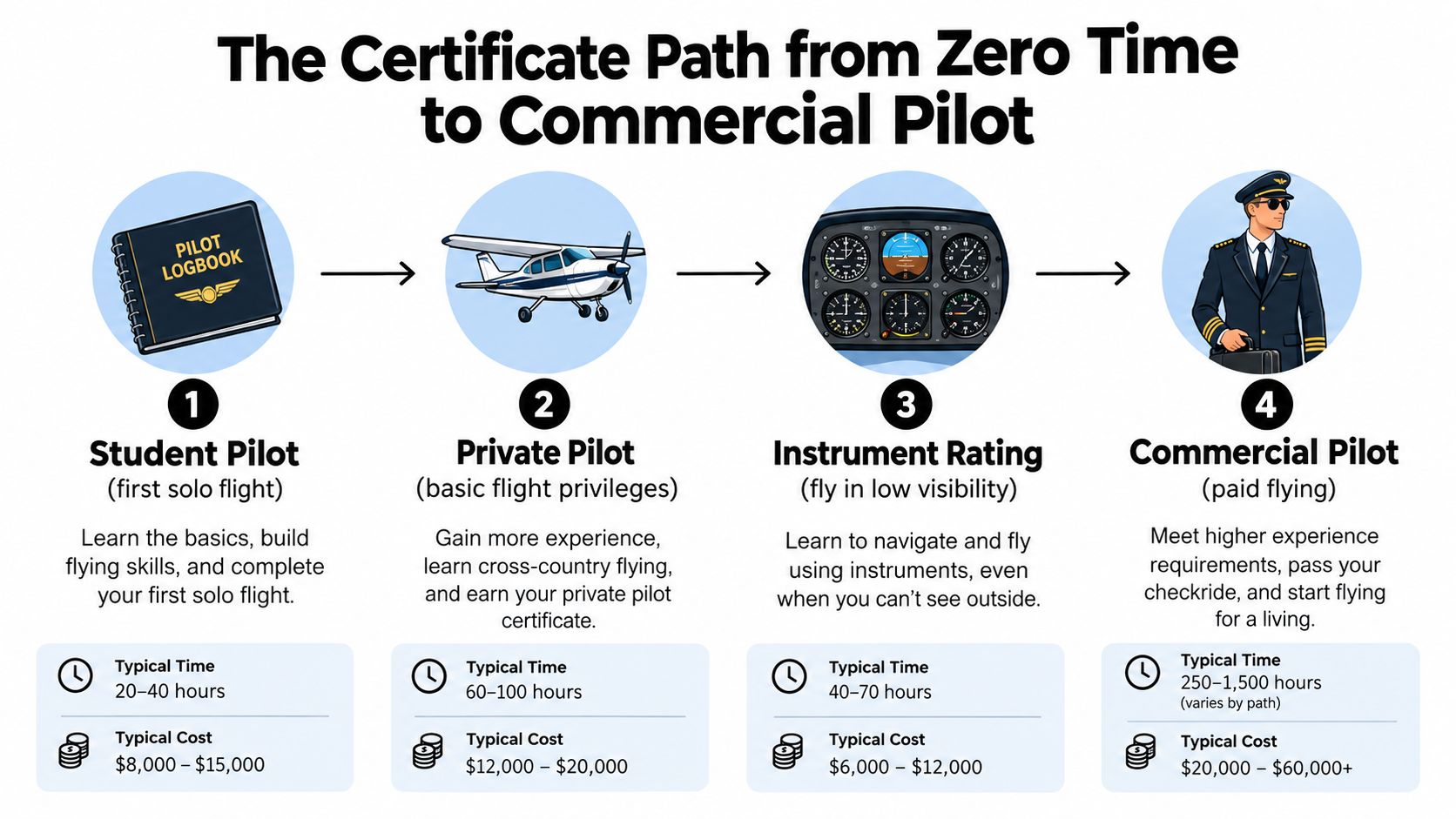
The Certificate Path from Zero Time to Commercial Pilot
Draw this sequence on a napkin and you'll understand the next several years of your life. The typical progression runs from student pilot certificate to private pilot, then instrument rating, commercial pilot, and multi-engine rating, as laid out in the Bureau of Labor Statistics overview of airline and commercial pilot careers. Instructor certificates and the airline transport pilot certificate usually follow for career pilots.
The Four Milestones You'll Hit First
1. Student pilot. This is your learner's permit. You train with an instructor, then earn solo privileges in the training aircraft once your instructor endorses you.
2. Private pilot certificate. You can now carry passengers and fly for personal purposes, but you can't be paid to fly. This step teaches foundational aircraft control, navigation, and decision making.
3. Instrument rating. You learn to fly by reference to instruments alone, in clouds and low visibility. Airlines and professional operators require this, because scheduled flying doesn't stop for weather.
4. Commercial pilot certificate. This is the regulatory turning point. You may now be compensated for flying, and training tightens to professional precision standards.
Details Inside the Commercial Step That Trip Students Up
Commercial training under Part 61 includes 20 hours of training in the required areas of operation, including 10 hours of instrument training covering attitude instrument flying, partial panel skills, unusual attitude recovery, and navigation system interception and tracking under FAA regulation 14 CFR 61.129 on commercial pilot aeronautical experience. Students often assume instrument work ends with the instrument rating. It doesn't.
There's also a 10-hour solo or supervised pilot in command requirement, and it's an either or rule. You must fly all 10 hours solo, or all 10 hours performing pilot in command duties with an authorized instructor aboard. Splitting five and five doesn't satisfy the rule, as explained in FAA legal guidance interpreting section 61.129(a)(4).
Practical rule: Ask your instructor early which of the two options your syllabus uses, then log it that way from the first hour.
After commercial, most career students add a multi-engine rating, then flight instructor certificates so they can teach while building experience. If you want the fuller map of how each stage connects, this guide to pilot certification training from first solo to professional ratings walks through the sequence in detail.
Part 61 vs Part 141 and the Hour Question
Every commercial pilot school trains under one of two FAA frameworks, and the difference isn't quality. It's structure, oversight, and how many hours the FAA requires before your commercial checkride.
Under Part 61, you generally need 250 hours of flight time for an airplane commercial certificate. Training is flexible, paced around you and your instructor, which suits students balancing work or family. Under Part 141, a school follows an FAA approved curriculum with standardized lessons and stage checks, and graduates may qualify with as little as 190 hours, according to FAA material on pilot certification and qualification requirements. That same material describes a further reduced pathway, a commercial certificate with instrument rating at 150 hours under certain approved Part 141 courses.
| Element | Part 61 | Part 141 |
|---|---|---|
| Commercial minimum hours | 250 hours | 190 hours, with a 150 hour approved course variant |
| Curriculum | Instructor paced, flexible sequence | FAA approved syllabus, fixed sequence |
| Stage checks | At instructor discretion | Required at defined points |
| Best fit | Part time students, irregular schedules | Full time, career focused students |
Why Fewer Hours Isn't Automatically Cheaper
That 60-hour gap between 250 and 190 hours is a 24% reduction from the Part 61 baseline, which sounds like an obvious saving. It can be. But minimums aren't guarantees. Students in either framework may need extra lessons to reach checkride standards, and a rigid syllabus that doesn't fit your learning style can cost you rechecks and repeated stage checks.
Ask two direct questions before you assume a low advertised number applies to you. First, is the school certificated under Part 141, with an approved syllabus for the specific course you're enrolling in? Second, what's the school's typical student completion time, not the regulatory floor? A plain explanation of how Part 141 flight schools are approved and structured helps you verify claims before signing anything.
Choose flexibility if your life demands it. Choose structure if you're training full time toward an airline career and want every lesson audited against a syllabus. Either route produces the same certificate. The road feels very different.
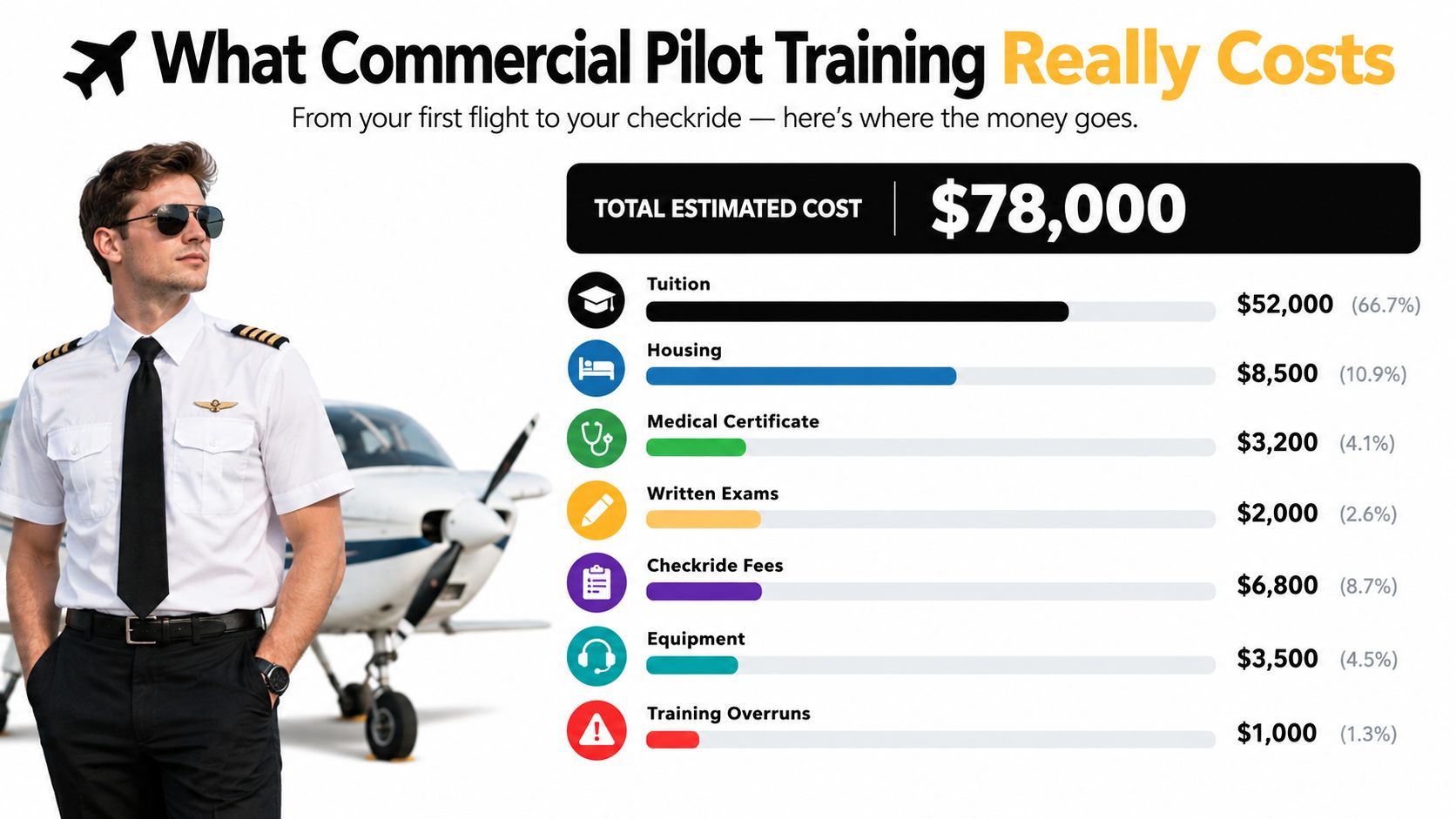
What Commercial Pilot Training Really Costs
The brochure number is never your full cost. Separate the bill into its real parts before you compare schools, because each part behaves differently when training runs long.
The Components Brochures Merge Together
- Tuition and flight fees: Aircraft time, instructor time, ground school, and simulator sessions.
- Housing and living costs: Rent, food, and transportation for every month you're training, including delay months.
- Medical certification: You must hold the appropriate FAA medical certificate, and discovering a medical issue late is far more expensive than discovering it early.
- Testing: Written exams for each certificate, plus practical test fees paid around each checkride.
- Equipment: Headset, charts, study materials, and required supplies.
- Overruns: Extra lessons, repeated stage checks, and any failed checkride that requires retraining and retesting.
This isn't hypothetical. A U.S. Government Accountability Office review of collegiate aviation programs found programs often charged more than $50,000 in flight training fees on top of tuition, exceeding the federal aid cap available to eligible students, and identified training cost as a major barrier to recruiting and retaining students.
Fixed Price Versus Hourly Billing
With hourly billing, you pay for every extra hour caused by weather cancellations that erode your skills, aircraft maintenance downtime, instructor turnover, or checkride scheduling delays. Model your budget at 10%, 25%, and 50% over the quoted hours and ask yourself whether you could still finish. With fixed price tuition, more of that overrun risk shifts to the school, which can make a higher headline price the more predictable choice.
A lower advertised price with uncapped hourly billing can cost more than a higher fixed price. Predictability is a financial feature, not a luxury.
Also plan for the gap after graduation. Loan payments don't pause while you're building experience at entry level pay. If you're still working out the basics of per lesson pricing, this breakdown of how much flying lessons cost and what drives the price gives you a starting frame before you scale up to full program costs.
Academy, University, and Independent Training Compared
You'll encounter three broad formats, and each one is a legitimate route. The right choice depends on your timeline, budget, need for a degree, and willingness to relocate. There isn't a universally correct answer, despite what any single brochure implies.
Accelerated Academies
Academies train you full time through multiple certificates in a compressed calendar. You fly frequently, which protects skill retention and usually reduces repeated lessons. The trade-off is intensity. You likely can't hold a job alongside daily flying and study, and you may need to relocate and pay for housing near the school.
University Aviation Degrees
A university program pairs flight training with a degree, spread across an academic calendar. That matters if you want the credential for long term flexibility inside or outside aviation. Qualifying graduates of authorized aviation degree programs may also access restricted airline transport pilot exceptions, which lowers the experience threshold discussed later in this article. The trade-offs are calendar length and layered cost, since flight fees typically sit on top of regular tuition, as the GAO finding in the section above illustrates.
Independent Part 61 and Part 141 Schools
Independent schools, often based at a local airport, offer the most scheduling flexibility and let you live at home. That can dramatically reduce living costs. The watch-outs are aircraft availability, instructor continuity, and whether the school offers the full sequence through commercial, multi-engine, and instructor training, or whether you'll need to change schools midstream and hope your logged experience transfers cleanly.
- Judge every format on the same criteria: Total published cost, calendar length, hours at graduation, and simulator access.
- Check the instructor model: One assigned instructor builds continuity. A rotating pool can slow your progress.
- Weigh post-training support: Logbook reviews, interview preparation, and any instructor employment bridge matter more than lobby furniture.
Match the format to your actual constraints. A career changer with savings and no degree ambitions needs something different from an eighteen year old who wants both a degree and a structured campus life.
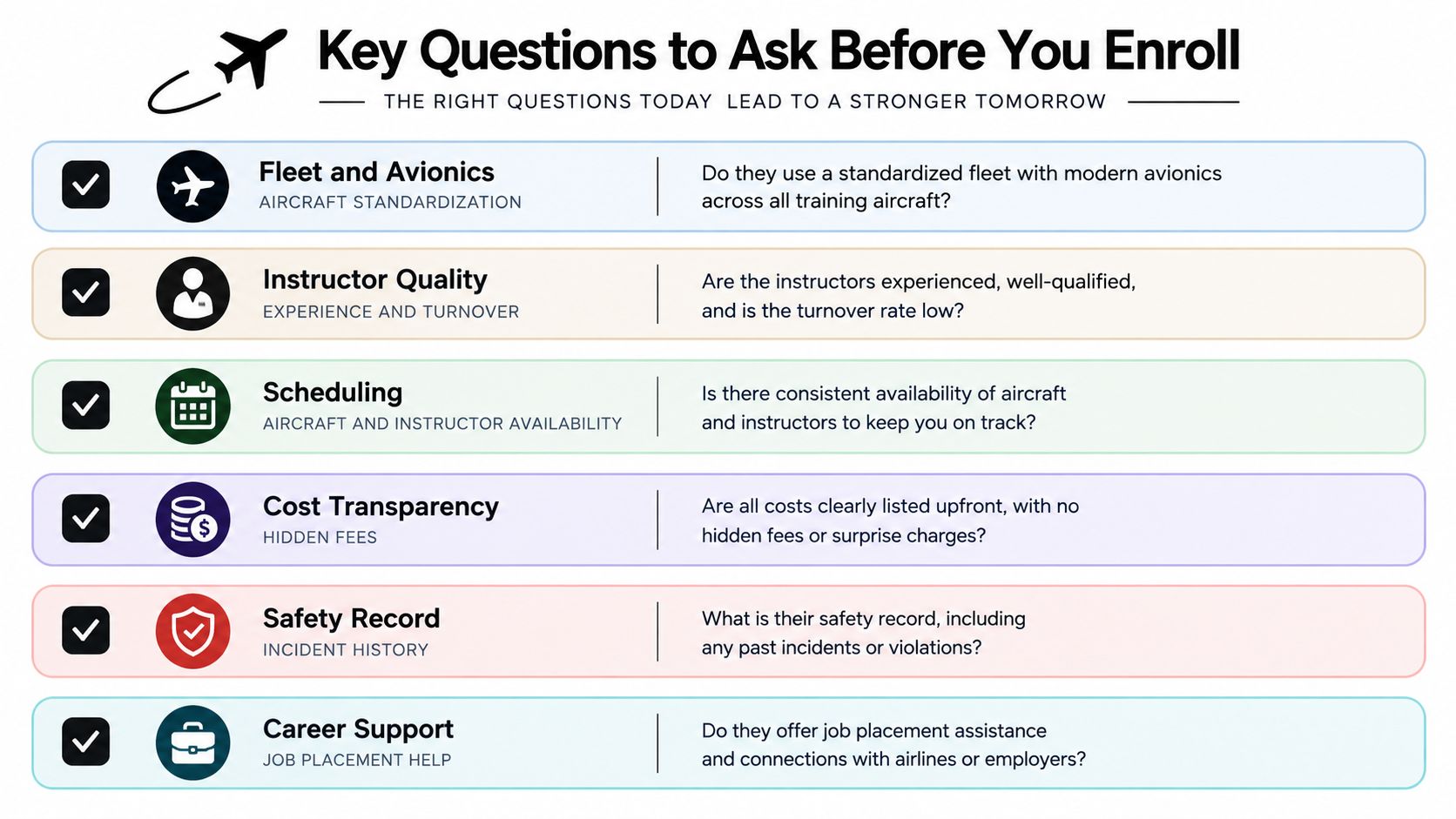
Key Questions to Ask Before You Enroll
Bring written questions to every school visit and write down the answers. A school that answers clearly before enrollment usually communicates clearly during training.
Fleet, Simulator, and Instructors
- Fleet and avionics: How standardized are the training aircraft, and will you learn on the glass cockpit systems used in modern professional flying? Jumping between mismatched cockpits wastes lessons relearning switch locations.
- Simulator credit: Is the device FAA qualified, and exactly how many of your hours are simulated versus flown? FAA rules limit how much instrument experience can be credited from simulators and training devices depending on the device and framework, so you want a transparent breakdown of aircraft, simulator, and device hours, not one blended number.
- Instructor model: Will you train one on one with an assigned instructor, and what happens if that instructor leaves? High turnover mid-rating costs you repeated evaluation flights.
Checkrides, Housing, and What Comes After
Examiner availability largely controls many timelines. Ask who schedules your practical tests, how far out examiners book, and what a delayed checkride does to your cost and currency. A school that coordinates examiners for you removes a bottleneck you can't fix on your own.
If you're relocating, ask whether housing is available, what it costs monthly, and how far it is from the flight line. A long commute eats study time daily. Finally, ask about post-training support in writing. Resume help and interview preparation are useful, but a paid instructor bridge that lets you earn while building hours changes your finances materially.
Verifying the basics matters too. Confirm the school's actual FAA certification status rather than trusting marketing language, and use this overview of FAA approved flight schools and what approval really means as a reference while you compare answers.
Red flag test: If a school can't separate its price into included and excluded items on one page, don't expect clarity later.
From Commercial Certificate to Airline Eligibility
Earning your commercial certificate feels like the finish line. For airline hopefuls, it's closer to the halfway point.

The FAA notes that airlines commonly set experience thresholds of 1,000 to 2,000 hours or more, far above the commercial minimum, depending on carrier requirements and labor market conditions, as stated on the FAA page explaining how to get a commercial pilot certificate. The long term benchmark for most airplane applicants is the 1,500-hour airline transport pilot threshold. Demand supports the effort. Employment of airline and commercial pilots is projected to grow 7% from 2025 to 2035, with about 16,400 openings annually on average, per labor data summarized in EBSCO research starters on flight schools.
How Pilots Close the Gap
Most graduates build time by flight instructing, which deepens their own skills while logging pilot in command and instructional hours. Others fly for charter or cargo operators once they qualify. Either way, judge a school partly on what happens the month after your checkride. A school offering only certificate preparation can leave you holding a license and a large, unfunded time building problem.
As one structured example, CFII's Career Track runs from zero time to CFII and multi-engine in about nine months at a fixed $89,000 tuition, covering six certificates and ratings and 282 total hours, based in Southern California at Riverside, Long Beach, and Corona. Readers comparing full zero to instructor pathways can review the career track program details and certificate sequence alongside this guide on how to become a pilot from first lesson to airline eligibility.
The short video below shows what daily accelerated training looks like, which helps set expectations before you commit to that pace.
Your Decision Checklist for Choosing a Commercial Pilot School
Run any school you're considering against this list before you pay a deposit. Write the answers down, side by side, and the right choice usually becomes obvious.
- FAA framework: Does the school train under Part 61 or Part 141, and is that status verified rather than assumed?
- Hour pathway: How many total hours will you hold at each certificate, and how many count toward your long term airline transport pilot goal?
- Pricing model: Is tuition fixed or hourly, what's excluded, and what does a realistic overrun do to your total?
- Fleet and simulator transparency: Are aircraft standardized, is the simulator FAA qualified, and are simulated hours disclosed separately?
- Instructor and examiner coordination: Will you keep one instructor, and who books your checkrides?
- Housing and financing: What will you pay monthly to live and borrow, and when do loan payments begin?
- Post-training bridge: Is there paid, supervised flying after graduation, or do you solve time building alone?
History offers a useful reminder here. Pilot schools have been career institutions since the Civilian Pilot Training Program launched in 1939 with $4 million in congressional funding across more than 400 colleges, and the model has stayed tied to employment outcomes ever since. Judge your school the same way, by where its graduates end up.
If you still haven't flown, your next step is a single introductory flight, not a contract. If you already know you want an accelerated career path, compare structured programs on the criteria above and pick the one whose numbers still make sense on a bad month, not just a perfect one.
If you're ready to move from researching commercial pilot school options to a concrete plan, CFII offers an accelerated Career Track in Southern California that takes you from zero experience through commercial, multi-engine, and flight instructor instrument certificates on a fixed price timeline. Visit the site to review the full program structure, check the certificate sequence against your checklist, and book the first step that fits where you are today.
Planning to fly for a living?
See what the path from zero to a pilot career looks like, what it costs and how long it takes.
Learn to fly in Riverside
We train at Riverside Municipal Airport in modern airplanes with a parachute built in. Start with a one hour discovery flight, no experience needed.