

On this page
- Airline Transport Pilot Requirements at a Glance
- Turn the rules into a personal eligibility file
- Age, English and Other Eligibility Rules
- Standard eligibility and restricted privileges
- English and application readiness
- Building the 1,500 Hours by Category
- Categories overlap, but each must be met on its own
- Credit a simulator only for the rule it actually meets
- Medical Class Needed for ATP Privileges
- Records for the exam
- How the Knowledge and Practical Tests Fit Together
- Complete training and knowledge testing
- Demonstrate practical readiness
- A Realistic Training Path to ATP Eligibility
- Establish the foundation
- Build experience with a purpose
- Checkride Delays and How to Plan Around Them
- Pick Your First Step Toward ATP Eligibility
- Ask questions before making a payment
You can reach 1,500 hours and still be ineligible for an airline transport pilot certificate. The FAA requires specific experience within that total, including cross-country, night, instrument, and pilot-in-command time, under 14 CFR Part 61, Subpart G. A logbook with a large total but a missing category doesn't establish eligibility.
For someone starting with little or no flight time, that changes how you should plan training. The objective isn't to accumulate hours. It's to earn the right certificates, build the required kinds of experience, and preserve records that show exactly how you qualify.
Airline Transport Pilot Requirements at a Glance
The airline transport pilot certificate, usually shortened to ATP, is the highest level of pilot certification in the United States. It's the credential for serving as pilot in command in air-carrier operations, subject to the aircraft qualifications and operating rules that apply.
For the standard airplane pathway, the FAA combines personal eligibility, prior qualifications, experience, and testing. 14 CFR Part 61 establishes the requirements summarized below, including the standard minimum age of 23 and the restricted pathway available at 21 for eligible applicants.
ATP requirements at a glance, airplane category
| Requirement | Standard rule | Regulation |
|---|---|---|
| Minimum age | At least 23 years old | 14 CFR 61.153(a)(1) |
| Restricted ATP age | 21 for eligible graduates or qualifying military pilots | 14 CFR 61.160 |
| English language | Read, speak, write and understand English | 14 CFR 61.153 |
| Prior certificate | Commercial pilot certificate with an instrument rating | 14 CFR 61.153(d)(1) |
| Knowledge test | Pass the ATP aeronautical knowledge test | 14 CFR 61.35 and 61.153 |
| Practical test | Pass the ATP practical test | 14 CFR 61.39 and 61.153 |
| Training program | ATP Certification Training Program for multiengine or type-rated ATP | AC 61-138A and 14 CFR 61.156 |
| Aeronautical experience | Hours in each required category | 14 CFR 61.159 |
Read the table as a checklist, not a training sequence. Passing an examination doesn't replace experience, and holding a commercial certificate doesn't establish that you meet the medical requirements for an airline assignment.
Turn the rules into a personal eligibility file
Create a folder for your certificates, ratings, test reports, training endorsements, medical documents, and logbook summaries. Keep the experience summary separate from your training completion records, because completing a course and satisfying an ATP experience requirement aren't necessarily the same thing.
- Identify your route. Establish whether you're planning for the standard ATP or can document restricted ATP eligibility.
- Separate prerequisites from milestones. A commercial certificate is a training milestone, while age and medical eligibility are separate gates.
- Verify the current wording. Confirm every checklist item against the current eCFR before committing to a training or testing schedule.
An ATP also isn't an airline job offer. Certification establishes qualifications; an employer's selection process, aircraft training, and operating requirements remain separate.
Age, English and Other Eligibility Rules
Age is independent of flight experience. Under 14 CFR 61.153, the standard airplane ATP applicant must be at least 23, satisfy the English-language requirement, demonstrate good moral character, and generally hold a commercial pilot certificate with an instrument rating.
Consider a hypothetical 21-year-old with 1,500 hours. Even with an otherwise complete logbook, that pilot hasn't met the standard age requirement. More flying can improve proficiency, but it can't remove an age restriction.
Standard eligibility and restricted privileges
The restricted ATP provisions in 61.160 offer a different route for qualifying military pilots and eligible graduates of authorized aviation degree programs. Don't assume that any aviation degree, college attendance, or military flying background automatically qualifies.
Before planning around that route, identify the exact regulatory provision and the documentation you'll need. For a graduate, that means confirming the program's authorization and your qualifying coursework and flight training. For a military applicant, it means checking the applicable service qualifications and records.
A restricted ATP isn't interchangeable with an unrestricted certificate. Understand its limitations before building a career schedule around it, particularly if your eventual objective is airline command.
English and application readiness
The English requirement covers reading, speaking, writing, and understanding. It matters during ground study, radio communication, oral examination, and flight operations, not just when completing an application.
If you struggle with written technical material, address that early. Work through weather reports, aircraft limitations, and approach briefings with an instructor, then explain them aloud without relying on memorized phrases.
Good moral character is also part of the FAA's eligibility assessment. Answer application questions accurately and resolve any uncertainty about disclosures before the practical-test appointment.
The normal progression is private pilot certificate, instrument rating, then commercial pilot certificate. The instrument qualification is a rating, not a separate pilot certificate, a distinction that helps when reading the regulations.
Use this self-check before treating yourself as an ATP applicant:
- Age and route. Can you identify the provision under which you qualify?
- English. Can you understand and explain operational information clearly?
- Prior qualifications. Do your private, instrument, and commercial records show the necessary progression?
- Application integrity. Are your disclosures and supporting records complete and accurate?
Flight hours alone don't answer any of those questions.
Building the 1,500 Hours by Category
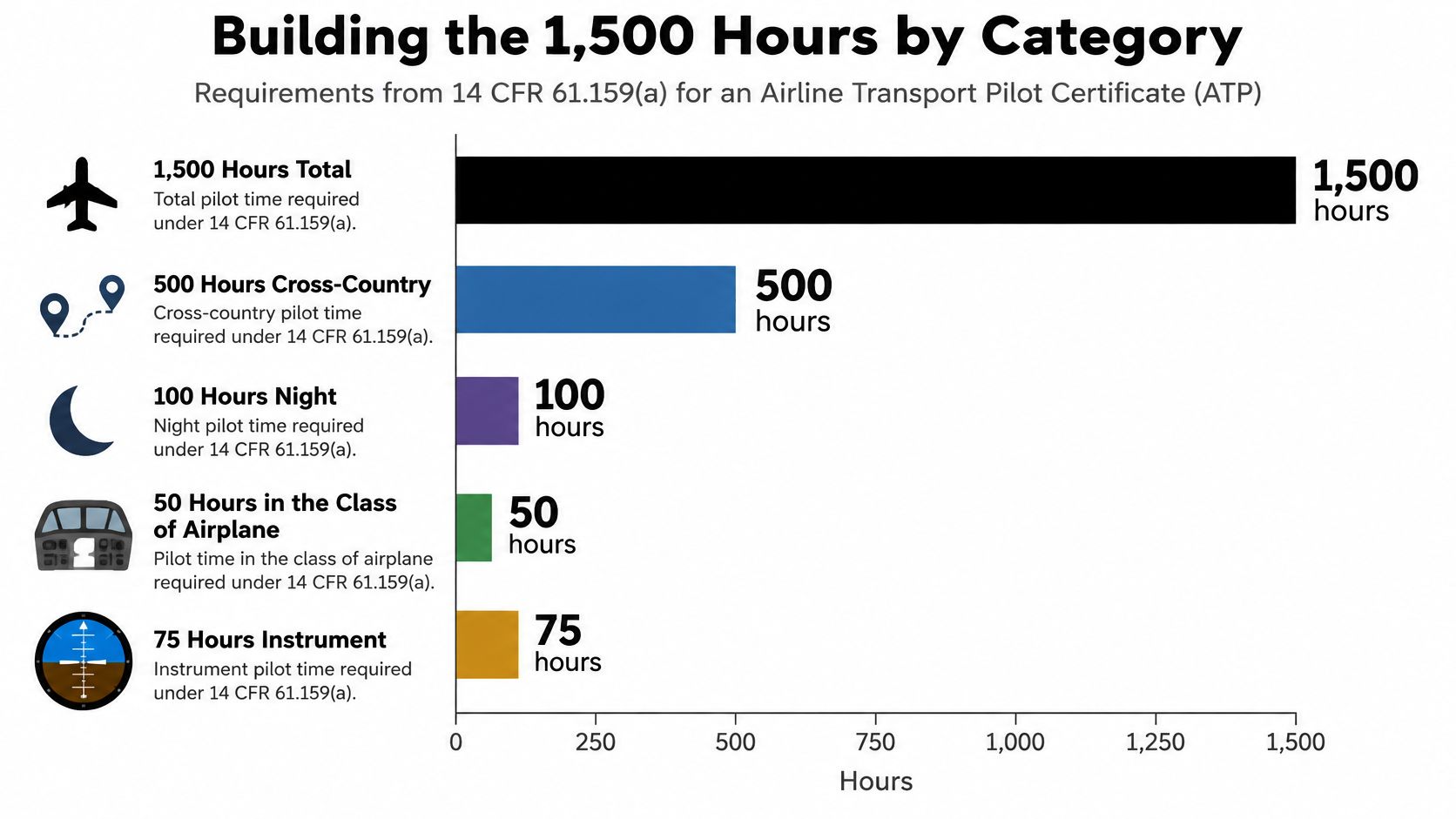
A logbook showing 1,600 total hours and 80 night hours still misses an airplane ATP. That pilot needs 20 more qualifying night hours. The extra total time does not patch the night column.
14 CFR 61.159(a) requires at least 1,500 hours of total pilot time, and inside that total it also requires 500 cross-country, 100 night, 50 in the airplane class sought, 75 instrument, and 250 pilot-in-command or qualifying supervised PIC hours. Further conditions sit inside those categories.
ATP hour categories and how each one counts
| Category | Minimum | Rule or note |
|---|---|---|
| Total pilot time | 1,500 hours | 14 CFR 61.159(a) |
| Cross-country | 500 hours | 14 CFR 61.159(a) |
| Night | 100 hours | 14 CFR 61.159(a) |
| Airplane class | 50 hours | Class of airplane for the rating sought |
| Instrument | 75 hours | Tracked within the total, subject to 61.159 |
| Pilot in command | 250 hours | PIC or qualifying supervised PIC time |
| Full-flight simulator | Up to 25 hours | Toward the airplane-class requirement, only in an approved Parts 121, 135, 141 or 142 course |
| Flight training or aviation training device | 0 hours | Cannot satisfy that particular airplane-class requirement |
The table summarizes 61.159. It does not replace the regulation's detailed conditions. The simulator rows describe credit toward the airplane-class requirement only. They are not a universal limit on every kind of simulator credit.
Categories overlap, but each must be met on its own
A qualifying night cross-country can enter both the night column and the cross-country column. If you are also legally logging PIC, that same flight can enter the PIC column as well. You still count the flight once toward total pilot time. Adding the category minimums together would invent hours you never flew.
A surplus in one column leaves a hole in another. The 1,600-hour logbook with 80 night hours is the pattern: extra day flying does not stand in for the missing 20 night hours.
PIC needs its own reading, because acting as PIC and logging PIC aren't always identical. Use our explanation of pilot-in-command time before you assign entries to the 250-hour column.
Credit a simulator only for the rule it actually meets
A simulator session can be useful training and still miss the experience provision you hoped to use. Record the device type, approval, course, instructor, and claimed credit. Do not enter every session as generic flight time.
The full-flight simulator line allows up to 25 hours toward the airplane-class requirement, and only in an approved Parts 121, 135, 141, or 142 course. A flight training device or aviation training device cannot fill that particular credit, even when the cockpit looks realistic.
Logbook rule: Loggable training time and legally creditable ATP experience are different questions.
A monthly eligibility audit works like matching a bank balance to the individual receipts:
- List total time. Reconcile the logbook summary with the underlying entries.
- Tag each flight. Identify cross-country, night, instrument, class, and PIC time.
- Total each category. Check definitions and endorsements with your instructor.
- Calculate the remaining requirement. Subtract qualifying experience from the applicable minimum.
- Flag simulator entries. Confirm the approval and regulatory basis before claiming credit.
Also check the conditions nested inside each category, especially qualifying PIC. The logbook has to prove each required category, not merely display a large total.
Medical Class Needed for ATP Privileges
A 38-year-old starting commercial training should book a first-class exam before paying for the next rating. At that age the certificate is still in the younger validity band under 14 CFR 61.23. A condition that needs extra records or a special issuance is better found now than after months of further ratings.
Medical class by privilege
| Privilege | Medical class |
|---|---|
| Solo flight as a student pilot | Third class |
| Commercial pilot privileges | Second class |
| ATP pilot in command, air carrier operations | First class |
| Second in command, Part 121 operations | First class for ATP privileges, subject to the applicable regulatory exceptions |
14 CFR 61.23 sets the medical class by the privileges you exercise on that flight. The certificate in your wallet and the qualification a particular operation requires are separate questions. The medical works like a license printed for one kind of driving: a lower class does not cover a higher operation.
For ordinary student airplane training, a third-class FAA medical certificate from an aviation medical examiner is required before solo flight. A discovery flight and the first lessons can be taken before you obtain one. Commercial privileges step up to second class. ATP privileges as pilot in command of an air carrier operation require first class. A second in command in Part 121 operations also needs first-class qualification when exercising ATP privileges, subject to the exceptions in 61.23.
First-class validity is shorter for pilots 40 and older than for younger pilots. Ask the examiner which duration applies to your age and which privileges remain as the certificate ages. Read the distinctions in this guide to FAA medical certificate classes before the appointment.
Records for the exam
Bring an accurate medication list and the relevant history. If a condition may matter, call the office first. Ask which physician reports, test results, or treatment summaries to gather before you submit the application, how long the exam may take, and whether the FAA may need more time before it issues the certificate.
Do not stop a prescribed medication or leave history off the form to make the application look simpler. Your treating clinician and the aviation medical examiner should agree on a documented approach. If the first-class exam shows a limit, fit the rest of the training spend to that finding.
How the Knowledge and Practical Tests Fit Together
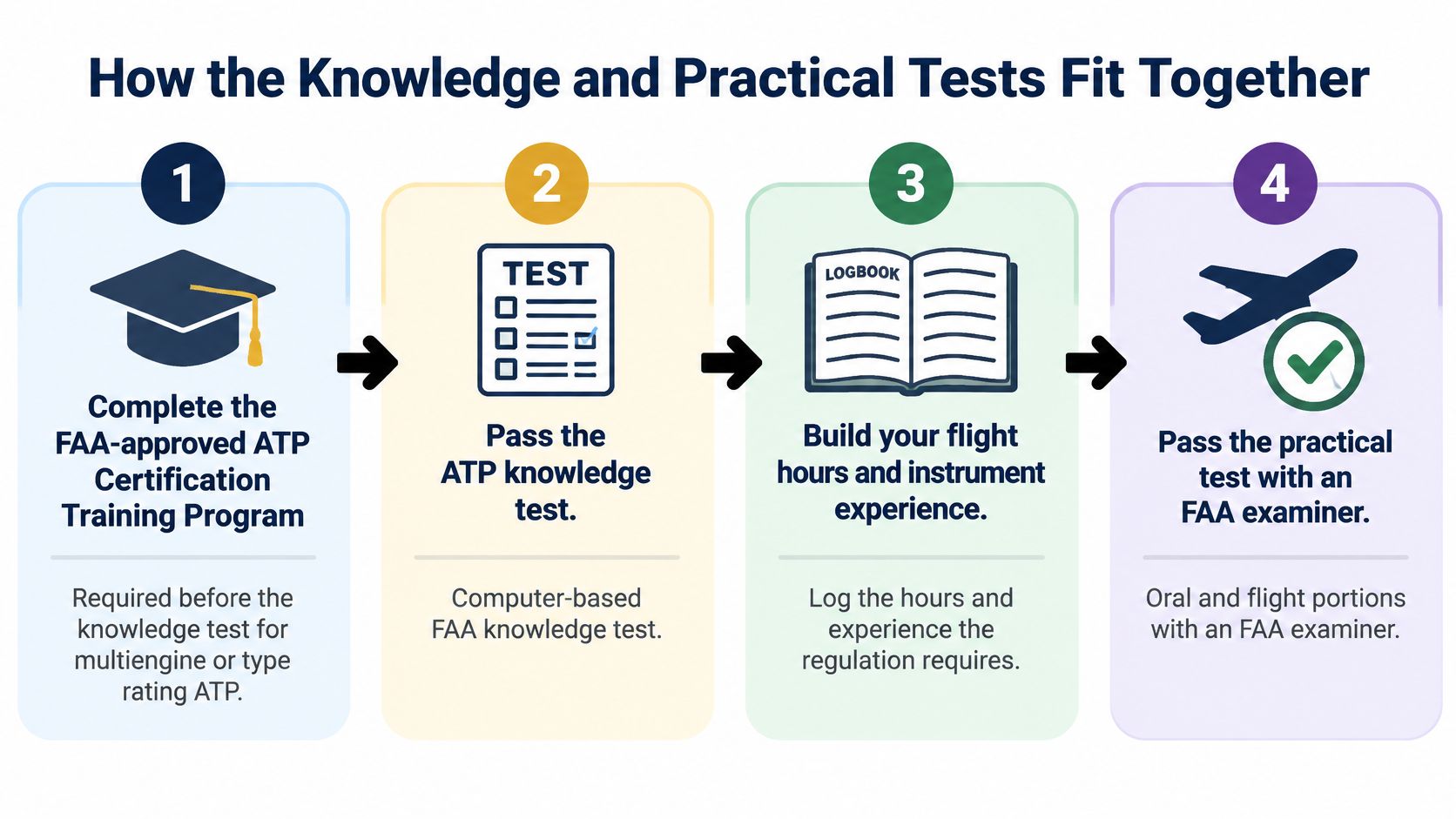
An ATP certificate is two proofs in a fixed order: you can explain the operation, and you can fly it to the standard an examiner applies. The FAA's Airline Transport Pilot and Type Rating for Airplane Category ACS, FAA-S-ACS-11A, became effective May 31, 2024. It organizes the practical test around knowledge, risk management, and flight skills. Those three threads should already be in your stage checks before anyone schedules the ride.
You may keep building experience while you study. The practical test still cannot happen until the applicable prerequisites are met.
Complete training and knowledge testing
1. Complete ATP-CTP when required.
For an airplane multiengine ATP, or an ATP issued at the same time as an airplane type rating, finish the FAA-approved ATP Certification Training Program before the knowledge test. AC 61-138A describes the program as training for airline-style work, including crew coordination and operational decisions. That is a wider task than preparing for written items.
A pilot who treats the course as a weekend of practice questions can recognize a familiar stem and still be unsure why a crew would decline a clearance. Review the ATP-CTP requirements so the course stays in its place in the certification sequence, separate from initial multiengine training.
2. Pass the ATP aeronautical knowledge test.
The knowledge test comes before the practical test. Study until you can state a principle and then choose an operational action from it. On the ride, the examiner can ask for that same application inside a scenario.
Closing the books the week you pass is how the material fades before the cockpit questions arrive. The ACS still expects that knowledge later. For a general method of spacing review and practicing retrieval, Zemith's guide to effective exam studying can sit beside the FAA material. It does not replace aviation instruction or the ACS.
Demonstrate practical readiness
3. Meet the practical-test prerequisites.
Check 14 CFR 61.39 and 61.153, then match the logbook to 61.159. Ask your instructor to review the application, the required endorsements, and the evidence for each experience category. Simulator time counts only in the form the regulation allows, so each entry should name the device, the instructor's role, and the exact credit claimed.
Showing up with solid flying and a logbook nobody can audit is how a ready candidate loses the appointment. Keep aircraft time, device type, instructor involvement, instrument conditions, category and class, and the simulator credit in a breakdown another person can follow.
4. Pass the practical test.
The practical test joins aircraft control to decisions. Practice instrument procedures, abnormal situations, emergency responses, and operational risk as one sequence, the way a line flight unfolds.
Polishing a maneuver until it looks smooth leaves the judgment untested. On an approach, be ready to say what would make you discontinue it, how you would manage a system failure, and which alternative is still available.
5. Receive and review the certificate.
Read the ratings and limitations on the certificate before you use its privileges. A completed test does not, by itself, define the boundary of what you may do.
Two ATP certificates can sound identical in a debrief and differ on the document: category, class, type, and any limitation. Use the printed certificate, not a verbal summary.
Carry the ACS Areas of Operation into stage checks throughout preparation. Ask the instructor to change the weather, the system status, and the options available, so each decision has to be defended rather than recited from a script.
A Realistic Training Path to ATP Eligibility
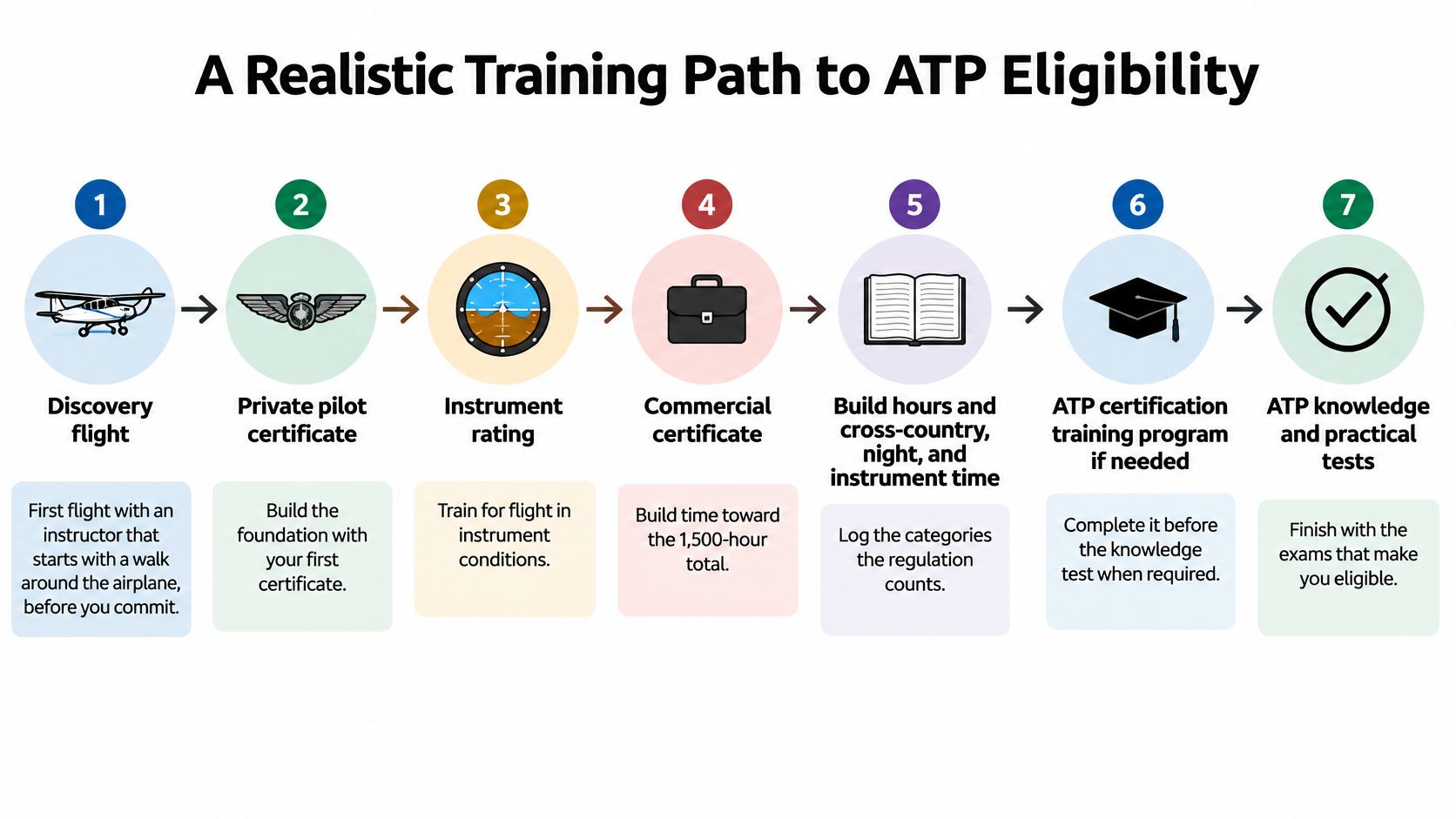
A student who can fly only two or three lessons per week should plan the training sequence around each certificate and rating, not just a target number of months. A discovery flight is a practical first step: at CFII, it begins with an instructor-led walkaround and a checklist card before the flight.
If you haven't flown, book a discovery flight before committing to a career program. Use the flight to assess the workload and ask about the study routine and daily demands of training.
Establish the foundation
Most career paths begin with the private pilot certificate. Students build aircraft control, flight preparation, and judgment for the privileges they are earning. A useful checkpoint is whether you can plan a flight, explain the aircraft's limitations, and recognize when conditions exceed your ability.
The instrument rating adds instrument procedures and disciplined management of the flight. Keep actual instrument conditions, simulated instrument conditions, and training-device sessions distinct in your records. They are different categories, not interchangeable entries in one general training total.
Next come the commercial certificate and multiengine qualification. Commercial privileges don't authorize every kind of paid flying, and a multiengine qualification is one part of the experience record, not a substitute for it. The pilot career path guide explains how these qualifications fit into a broader training sequence.
Build experience with a purpose
After commercial training, pilots may pursue instructor qualifications and teach, or seek other flying work they are qualified to perform. Flight instruction can build communication and aircraft-handling skills. Track the hours by category as they are logged, rather than treating elapsed time in a program as a measure of progress.
- Private checkpoint. Confirm the certificate and supporting records are complete.
- Instrument checkpoint. Verify the rating and record each type of instrument experience separately.
- Commercial checkpoint. Confirm the privileges earned and the aircraft qualifications held.
- Experience checkpoint. Track qualifying pilot-in-command time and other required categories as actual logged experience.
CFII's Career Track takes students from zero experience to flight instructor in about nine months full time. It includes six certificates and ratings, 282 hours of training, and one-on-one instruction. The hours comprise 204 single-engine, 25 multi-engine, and 53 simulator hours. That structure organizes training; the eligibility calculation still depends on the pilot's qualifications and documented experience.
A course completion date describes the training course. ATP eligibility depends on the required qualifications and documented experience.
Plan for the ATP-CTP and examination stages, while keeping the immediate focus on proficiency at the current training stage and accurate records for the next one.
Checkride Delays and How to Plan Around Them
Finishing the syllabus does not set the certificate date. FlightGlobal reported that U.S. pilot candidates may wait several weeks to several months for checkride appointments, including a cited student wait of six weeks.
Hours in the logbook and a practical-test appointment are different problems. You can complete the planned lessons and still need a designated pilot examiner, an airworthy aircraft, suitable weather, and current proficiency on the same day. A reservation works like a gate slot: the airplane can be ready, and the flight still does not leave until the slot, the crew, and the weather line up together.

Checkride delays, causes and actions
| Delay or problem | Why it happens | What to do |
|---|---|---|
| Examiner availability | Limited designated pilot examiners in busy training markets | Ask for the earliest date and book a backup window |
| Weather cancellation | Low ceilings or strong wind on the test day | Ask for a flexible slot and keep a standby date |
| Aircraft maintenance | Training airplane out of service before the checkride | Ask how a suitable substitute aircraft is arranged |
| Failed practical test | Scenario or ACS area below standard | Establish the retest window and added instruction cost |
| Test booked too early | Stage checks not yet complete | Book the test only after the ACS stage checks pass |
Name the person who books the examiner before a date slips. That person may be you, your instructor, or a training administrator, and only one of them should confirm both the examiner and the aircraft reservation. Ask how many weeks ahead that booking starts, and what happens if the examiner cancels. A backup window helps only when the same airplane and instructor can be there.
Read the test format before you pick a date. Our explanation of what a checkride involves separates paperwork, the oral, and the flight so a delay in one area does not get mistaken for unreadiness in the others. The Airman Certification Standards set the areas the examiner samples. Stage checks built on those standards are the signal that a date is worth taking.
A gap between the last lesson and the test often means refresher flying. Agree on which tasks that flying covers, such as a weak maneuver or an oral topic, so the wait does not turn into an open-ended string of extra flights. Put cancellation charges in writing: aircraft, instructor, and examiner fees do not always follow the same rule when an appointment moves. Do the same for a retest, including how much added instruction is expected and who schedules the second attempt. If your training price is fixed, ask which of those costs stay inside the quote and which ones sit outside it.
Book the earliest suitable appointment after the ACS stage checks are passed, and keep a standby date. An open slot is not a reason to test early, and a long examiner queue is not a reason to stop flying the tasks you still miss.
Pick Your First Step Toward ATP Eligibility
Choose the next step you can evaluate, not the distant cockpit you hope to reach. If you haven't flown, take an introductory flight before committing; if you already hold a private certificate, bring your logbook and training records to a structured planning conversation.
For readers seeking the full career sequence, our Career Track has fixed tuition of $89,000 and runs about nine months from zero time to CFII and multi-engine, with 282 total hours and six certificates and ratings. We're based in Riverside, Long Beach, and Corona in Southern California.
Those are initial professional-training milestones, not an ATP certificate or an airline hiring promise. You'll still need to establish your own eligibility through the applicable experience, medical, age, and testing requirements.

Ask questions before making a payment
We recommend asking every flight school, including us, questions that reveal how the training schedule will work:
- Airplane age. How old are the aircraft, and how are maintenance interruptions handled?
- Aircraft access. How many students share each airplane?
- Instructor continuity. How often do instructors turn over, and how are handovers managed?
- Written price. What is the total price, what's included, and what remains your responsibility?
- Training framework. Is the program conducted under Part 61 or Part 141?
- Firsthand evaluation. Can you fly before committing?
Don't infer restricted ATP eligibility from a school's training framework alone. Obtain documentation supporting the specific route you intend to use, and keep proficiency-building simulator time separate from any legally claimed experience credit.
Your decision should be concrete: choose the first flight or training assessment, confirm your medical plan, and establish an accurate logbook process. Start tracking the relevant experience categories from the first lesson instead of trying to reconstruct them when an ATP application is approaching.
CFII offers introductory flying and a structured pathway from zero experience toward professional pilot qualifications, the foundation for later ATP experience-building. Visit CFII to discuss your starting point, review the training sequence, and choose your next step toward ATP eligibility.
Planning to fly for a living?
See what the path from zero to a pilot career looks like, what it costs and how long it takes.
Learn to fly in Riverside
We train at Riverside Municipal Airport in modern airplanes with a parachute built in. Start with a one hour discovery flight, no experience needed.