

On this page
- What Is Visual Flight Rule and Why It Matters
- Why this matters early in training
- Core Components of VFR Operations
- Weather, airspace, and equipment work together
- A simple way to think about it
- VFR Versus IFR - Understanding the Difference
- Why the transition matters
- VFR Weather Minimums by Airspace Class
- The minimums change with the airspace
- How to read the rule without getting lost
- Legal Minimums Versus Personal Minimums
- Why the legal floor can still be a bad idea
- Build your own buffer
- Putting VFR Knowledge Into Practice
- A practical preflight flow
- Training habits that make the rules stick
You're on a warm Southern California morning, sitting in a single-engine airplane with the engine off and the weather briefing open on your phone. The ceiling looks workable, visibility seems fine, and the temptation is to treat it as a simple yes-or-no call. That's where a lot of new pilots get tripped up, because visual flight rule flying is never just “nice weather flying,” it's a structured way of operating an aircraft when you can keep visual reference with the outside world.
What Is Visual Flight Rule and Why It Matters
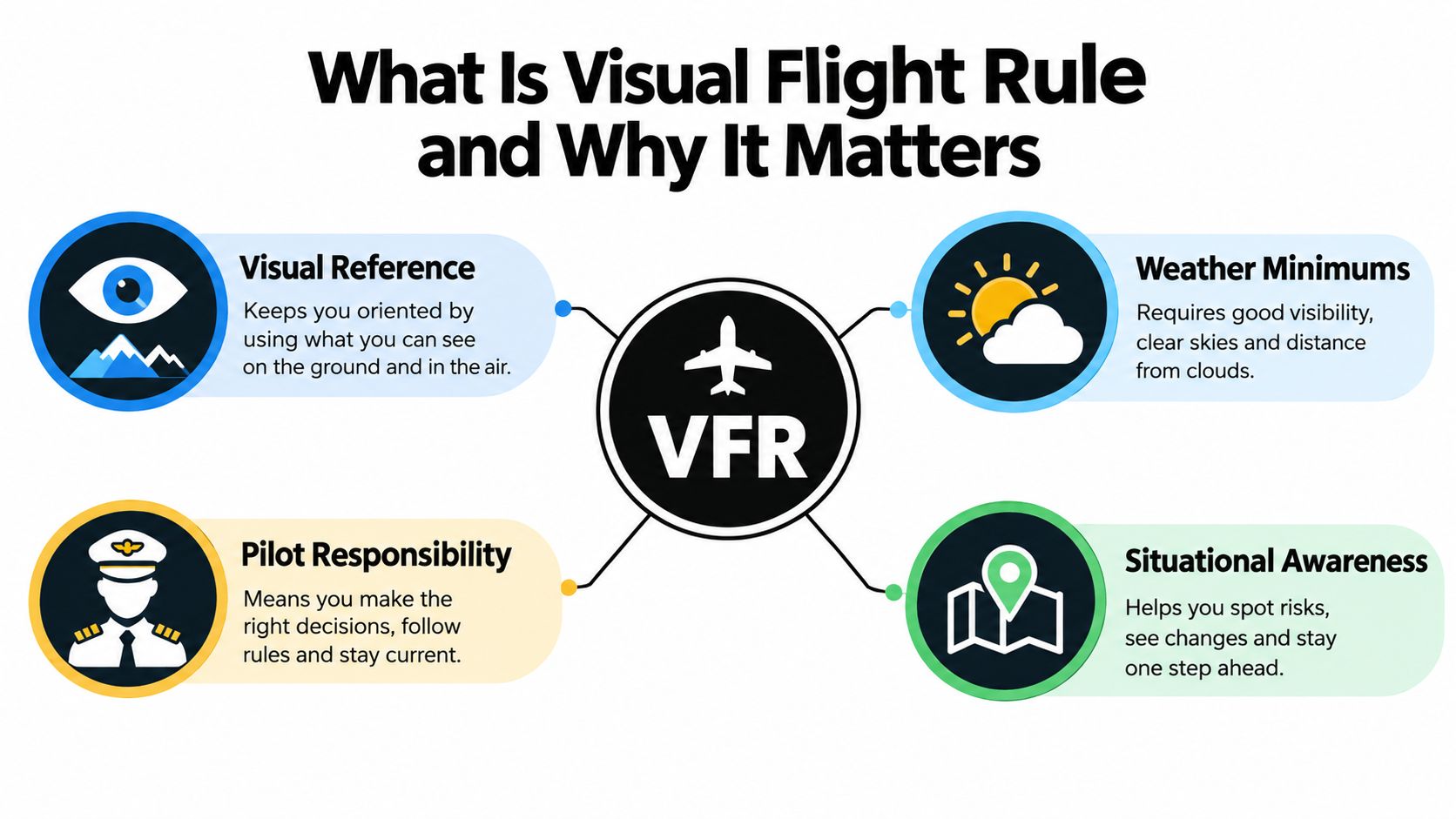
Visual flight rules are the internationally recognized rules for flying when pilots can keep sight of the horizon, terrain, traffic, and other outside references. ICAO's Annex 2, Rules of the Air formed the modern international foundation, with the Council adopting it on April 15, 1948, and it becoming effective on September 15, 1948, after the framework was developed in the postwar period. That matters because VFR is not a casual habit, it's a regulatory operating system with defined responsibilities, just like rules of the road for aviation. ICAO's Annex 2 overview makes that foundation clear.
In the U.S., the FAA uses VFR to describe procedures for flight under visual conditions, and the term can also describe weather that meets the applicable minimums or the type of flight plan filed. The key point is simple, VFR is a legal framework first, and a weather description second. A pilot who treats it as “good enough weather” can miss the underlying issue, which is whether the flight can remain legal and safe in the airspace, altitude, and conditions ahead.
Why this matters early in training
A student pilot often learns VFR first because it teaches the habits that make every later rating easier. You learn to divide attention between the cockpit and the outside environment, to judge weather beyond a single ceiling number, and to understand that the pilot, not the autopilot or the radio, carries the responsibility for staying visual.
Practical rule: If you can't explain what keeps the flight legal from takeoff to shutdown, you don't yet have a full VFR decision.
That's why VFR matters even for pilots who eventually move into instrument flying. The foundation still shapes how you plan, launch, divert, and communicate. If the visual side of flying is shaky, instrument training becomes harder because the pilot hasn't built the baseline judgment that tells you when visual flying is the right choice and when it isn't.
Core Components of VFR Operations
Think of VFR like driving on a road with three things to watch at once. First, the road has weather-related rules about when you're allowed to go. Second, different lanes have different access rules. Third, your car has to meet the safety requirements for the trip. Aviation works the same way, except the “road” changes with airspace and altitude.
Weather, airspace, and equipment work together
The weather side of VFR is usually the part students notice first, but it's only one piece. Under 14 CFR 91.155, minimum flight visibility and cloud clearance vary by airspace class, altitude, and, in Class G, whether it's day or night. A route that looks fine at one altitude can become a problem at another, which is why a pilot has to think in terms of the whole flight, not just the departure airport.
The airspace side is where a lot of confusion starts. A pilot may be legal in one place and not legal in another, even on the same day with the same weather. Controlled airspace introduces more structure because aircraft are mixing with heavier traffic and tighter procedures, and that's why it helps to understand how airspace works before you start chasing weather assumptions. A useful overview of that relationship is discussed in controlled airspace guidance.
A simple way to think about it
VFR minimums are the minimum legal floor, not a suggestion. Visibility lets you see threats early enough to react. Cloud clearance gives you time and space to keep separation. Airspace class tells you which version of those limits applies, and altitude can change the whole picture.
Instructor habit: Don't ask only, “Is the weather good?” Ask, “Is this route legal at this altitude in this airspace, and do I have enough room to make a clean decision if it changes?”
That's the mental model that keeps VFR from becoming guesswork. Once you understand that weather, airspace, and operating requirements all interact, the regulations stop looking like a memorization exercise and start making operational sense.
VFR Versus IFR - Understanding the Difference
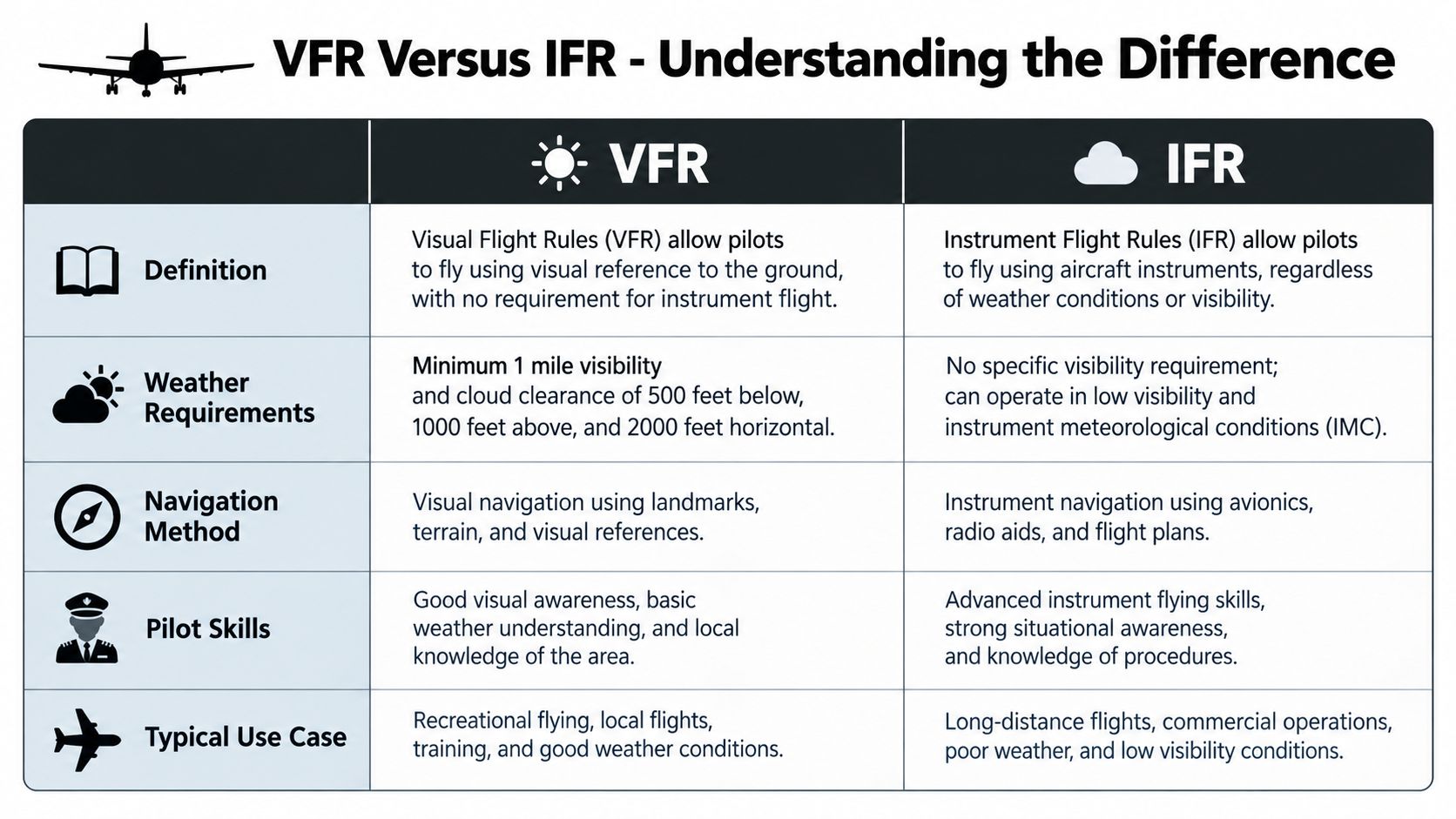
VFR and IFR are not rival systems, they're two different ways of managing risk. VFR depends on visual reference and the pilot's ability to see and avoid. IFR depends on instruments and air traffic control structure when the outside world is no longer reliable enough to fly by sight.
| Topic | VFR | IFR |
|---|---|---|
| Definition | Flight conducted with outside visual reference | Flight conducted primarily by instruments and ATC guidance |
| Weather use | Requires visual conditions within the legal minimums | Can be used when conditions fall below VFR minimums |
| Navigation | Ground references, outside scan, and pilot judgment | Instruments, clearances, and procedural structure |
| Pilot skill | See-and-avoid discipline, visual planning, and weather judgment | Instrument scan, precision, and workload management |
| Typical use | Day-to-day flying in visual conditions | Flying through weather that is not suitable for VFR |
Why the transition matters
For many pilots, the hardest part isn't learning the instrument scan, it's learning when to stop thinking like a VFR pilot. A good visual pilot may be tempted to press on because the departure looked fine or the destination “should clear up.” IFR exists because weather changes and visibility can collapse faster than a pilot wants to admit.
That's why accelerated training programs often weave the two together. A student needs to see how the systems complement each other. VFR teaches sight picture, airspace awareness, and judgment. IFR teaches precision, structure, and discipline when the outside cues disappear.
A pilot doesn't “graduate out” of VFR. Even instrument-rated pilots still rely on visual flying whenever conditions permit, because the skill set remains central to everyday operations. The difference is not which system is better, it's which system fits the conditions you're facing.
VFR Weather Minimums by Airspace Class
The legal heart of VFR flying sits in 14 CFR 91.155. The rule is simple in concept, but the details change with airspace and altitude, so a pilot cannot treat every route the same way after a quick weather check.
The minimums change with the airspace
In Class B airspace, VFR flight requires at least 3 statute miles visibility and the aircraft must remain clear of clouds. In Class C and Class D, the visibility requirement stays at 3 statute miles, but the cloud rule becomes 500 feet below, 1,000 feet above, and 2,000 feet horizontal separation. In Class E below 10,000 feet MSL, the same 3 statute miles visibility with 500 feet below, 1,000 feet above, and 2,000 feet horizontal cloud clearance applies.
At 10,000 feet MSL and above in Class E, the rules tighten to 5 statute miles visibility, with 1,000 feet below, 1,000 feet above, and 1 statute mile horizontally from clouds. That makes practical sense, because aircraft usually cover ground faster at higher altitudes, which leaves less room to spot and avoid traffic.
A clear summary of the VFR weather table is available in FAA VFR minimums guidance. The table matters less than how it changes your route decision. A cruise altitude may be legal in one band, while a small climb, descent, or airspace change puts the flight outside the minimums.
How to read the rule without getting lost
Ceiling gets attention, but it does not tell the whole story. Visibility, cloud separation, altitude, and airspace class all have to line up before the flight is legal.
Field rule: Before you fly, check the route, not just the airport. A departure, en-route segment, and arrival can each live under different VFR requirements.
VFR planning is a route-level problem as much as a weather problem. One leg may be legal while the next is not, especially when the route crosses controlled airspace or climbs into a different altitude band. A pilot who reviews the whole route first avoids finding the limit after the wheels are already turning.
Legal Minimums Versus Personal Minimums
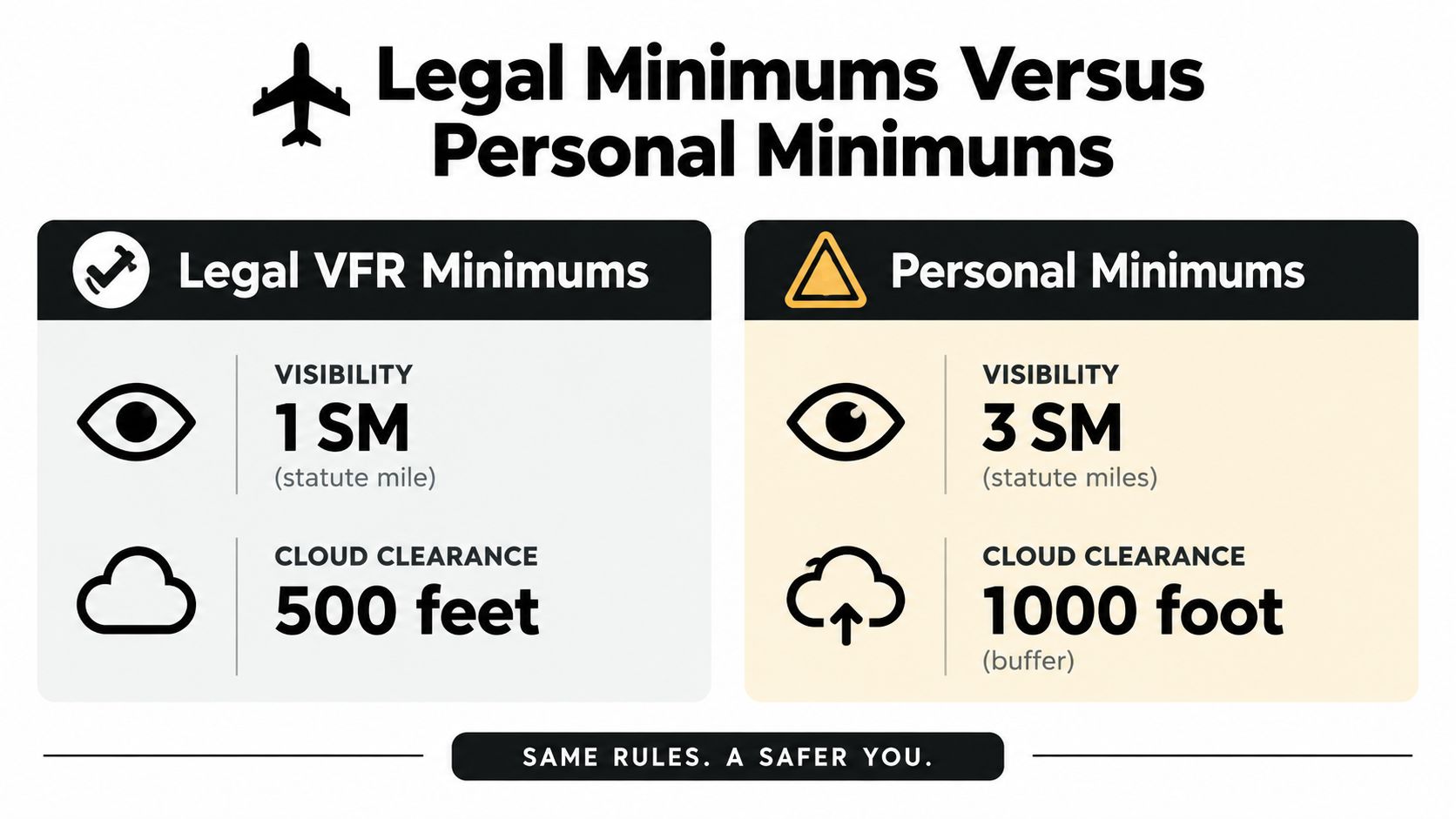
A flight can be legal and still be a poor choice. That gap matters most for newer pilots, especially when haze, traffic, terrain, and changing light all compete for attention.
Why the legal floor can still be a bad idea
The rule sets the floor, not the comfort level. FAA guidance in the Personal Minimums Checklist (FAA-P-8740-56) encourages pilots to set more conservative limits for themselves, such as a 3,000-foot ceiling for daytime VFR pilots with 100 to 200 hours and 5,000 feet for night VFR. Those higher limits give a pilot more room to see, decide, and correct.
Real flying rarely stays neat. Haze can flatten depth perception, sun angle can hide traffic, and busy training airspace can push workload higher than the weather report suggests. A pilot may meet the numbers and still be too close to the edge for safe handling.
Build your own buffer
Personal minimums work best when they match the actual flight, not a generic number copied from a checklist. Terrain, equipment, traffic density, pilot experience, and diversion options all change the answer. A pilot crossing open country with good outs has a different margin than a student departing a busy airport under a layer of haze.
Practical rule: If you need perfect luck to stay VFR, your personal minimums are too loose.
Accelerated training can make this harder to spot. A student can move through ratings quickly and still have limited exposure to marginal weather, especially at night and in changing conditions. That is why the best habit is to set personal minimums above the legal floor and review them before each flight, while there is still time to choose a different plan.
Putting VFR Knowledge Into Practice
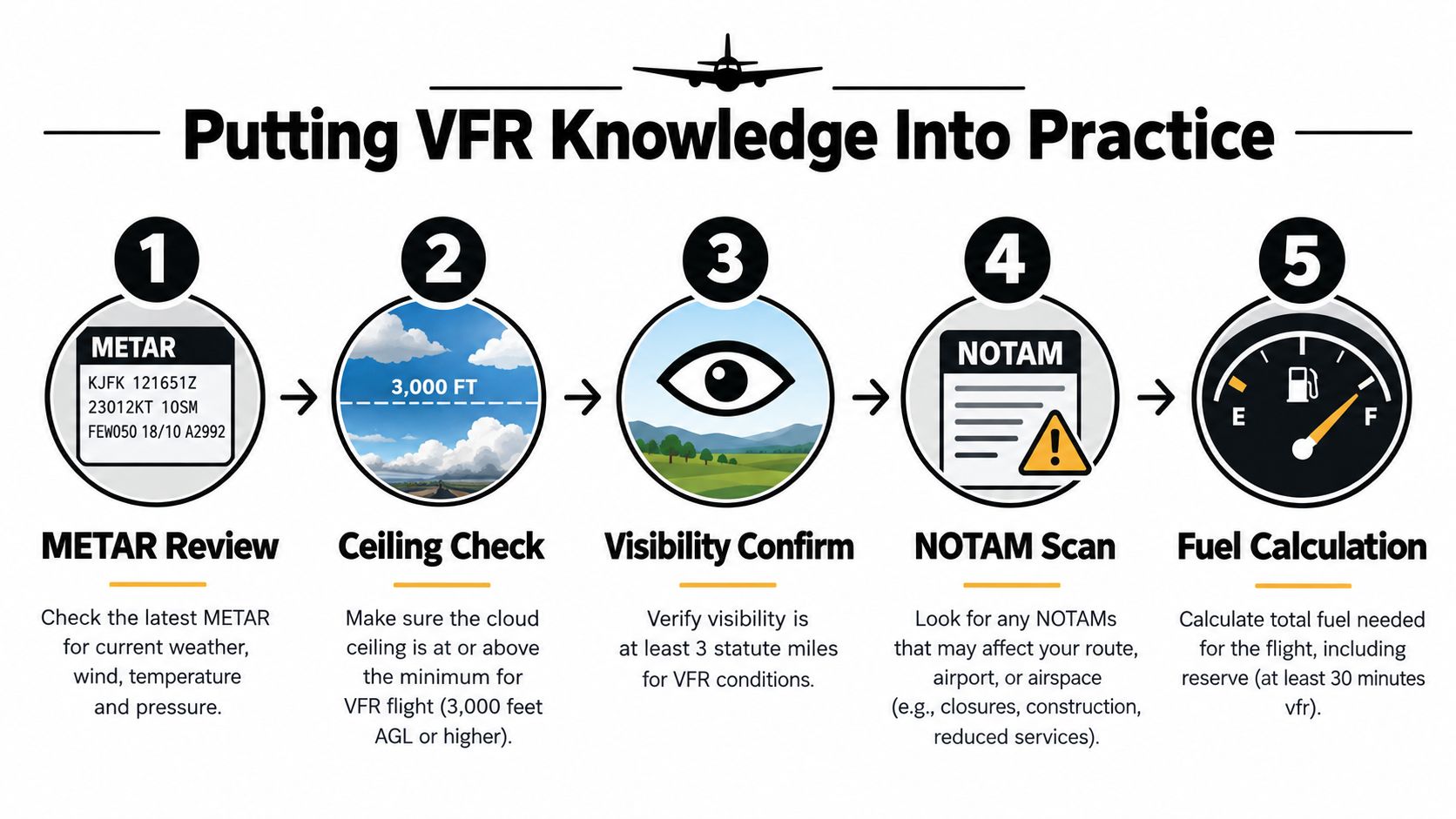
VFR decision-making gets safer when it becomes a routine, not a mood. The preflight should answer one question clearly, can this flight stay legal and manageable from engine start to shutdown? If the answer depends on hope, the planning isn't finished yet.
A practical preflight flow
- Review the METAR. Check both visibility and ceiling, because a number that looks acceptable in one place may not hold along the route.
- Confirm the ceiling trend. A workable ceiling that's falling fast is not the same as a stable one.
- Verify visibility along the route. Local conditions can differ from what's reported at the departure airport.
- Scan NOTAMs and TFRs. Airspace restrictions can change the flight even when the weather looks acceptable.
- Check fuel and diversion options. VFR decisions go wrong when a pilot has no easy escape if conditions erode.
Practical risk controls also include the arrival airport, airspace boundaries, and a diversion airport before engine start, along with conservative personal minimums above the legal floor. Under 14 CFR 91.155, VFR operations in the lateral boundaries of designated airport surface areas must meet the visibility rules, and takeoff, landing, or entering the traffic pattern at Class B, C, D, or designated Class E airports generally requires at least 3 statute miles reported ground visibility unless a specific exception applies. FAA airport visibility requirements are where the legal floor becomes an operational decision, not just a rule in a book.
Training habits that make the rules stick
A student who learns VFR well develops a habit of asking better questions. Can I stay visual all the way through the route? What happens if the destination drops below the floor? Where's my out if the weather shifts? Those questions matter just as much in a private pilot lesson as they do later in commercial or instrument training.
If you want structured help turning the rules into real-world judgment, CFII's Southern California program teaches flying with one-on-one instruction, coordinated checkrides, and a training path that includes both visual and instrument work. A solid reference on how to request and manage VFR flight following is CFII's flight following guidance, because communication is part of staying ahead of the airplane.
The bigger lesson is simple. VFR is not the easy option, it's the foundation. When you understand the rules, respect the margins, and build personal minimums that match your skill level, you make better decisions every time you taxi out.
If you want to turn VFR theory into confident cockpit judgment, CFII can help you build that habit with structured instruction and a training path that ties weather, airspace, and real-world planning together. Visit CFII to see how its Southern California training environment supports pilots who want to learn VFR the right way and keep progressing with purpose.
Planning to fly for a living?
See what the path from zero to a pilot career looks like, what it costs and how long it takes.
Learn to fly in Riverside
We train at Riverside Municipal Airport in factory-new airplanes with a parachute built in. Start with a one hour discovery flight, no experience needed.