

On this page
- FOI Test Format Score and Time Limit
- A score is not a certificate
- The Six Topics and the Instructor Eligibility Line
- Who may hold the certificate
- How to Study for the FOI in Four Cycles
- 1. Preparation
- 2. Presentation
- 3. Application
- 4. Assessment
- Test Day Tactics for Tricky Wording
- Slow down on the word that flips the item
- A student who freezes on the radio
- Use the pass rate as a personal bar
- Sample Questions and How to Reason Through Them
- What a Passing Score Still Leaves Open
- Four moves an oral actually grades
- Turn the score report into a five-minute brief
- Book a First Flight Before Instructor Ground School
The fundamentals of instruction test is 50 questions in 1.5 hours, with a 70 percent minimum passing score, and the minimum age to take it is 16.
In the FAA's 2023 Airman Knowledge Test Statistics, 12,929 Fundamentals of Instructing tests were given, and 98.58 percent of reported results were passing. That sits above the 91.05 percent aggregate pass rate across 256,801 airman knowledge tests the same year. 90.53 percent were first-attempt passes, 8.05 percentage points under the overall FOI pass percentage.
A written result that high does not mean you can teach. People who reach the testing center have usually drilled the ideas. An examiner on a practical test is watching whether you can diagnose a stuck student, pick a method, and give a critique that names the error and the fix. If you have little or no flight time, study each idea as a short lesson you could give, not as a card you can recite.
FOI Test Format Score and Time Limit
You can book the fundamentals of instruction test as a stand-alone knowledge exam. The FAA testing matrix sets it at 50 questions, a 1.5-hour limit, a 70 percent minimum, and a minimum age of 16.
| Requirement | FAA figure | What it means on test day |
|---|---|---|
| Questions | 50 | Plan on the full bank, not a short quiz |
| Time limit | 1.5 hours | A steady pace is under two minutes per item |
| Passing score | 70 percent | 35 correct answers clear the line |
| Minimum age to sit the FOI | 16 | Younger readers can prepare but cannot test yet |
Thirty-five right answers is the floor, not a comfortable margin. Ninety minutes for 50 items is about 1.8 minutes each if you never pause. That pace is manageable once mixed practice already hits it. It is tight if you are still translating definitions while the clock runs.
A score is not a certificate
This sitting only proves the knowledge test inside a larger instructor certificate. 14 CFR § 61.185 still requires you to receive and log ground training in the instructional process before you can teach. Official sample items are study material, not a copy of the live form, so a perfect run on one free quiz is not proof you are ready.
Booking target: On mixed practice sets you have not memorized, finish inside 90 minutes and score about 85 percent or higher before you pay for the real sitting.
If a practice set is built from items you just reread, the score flatters you. Mix areas, close the book, and keep the same time box you will have at the center.
The Six Topics and the Instructor Eligibility Line
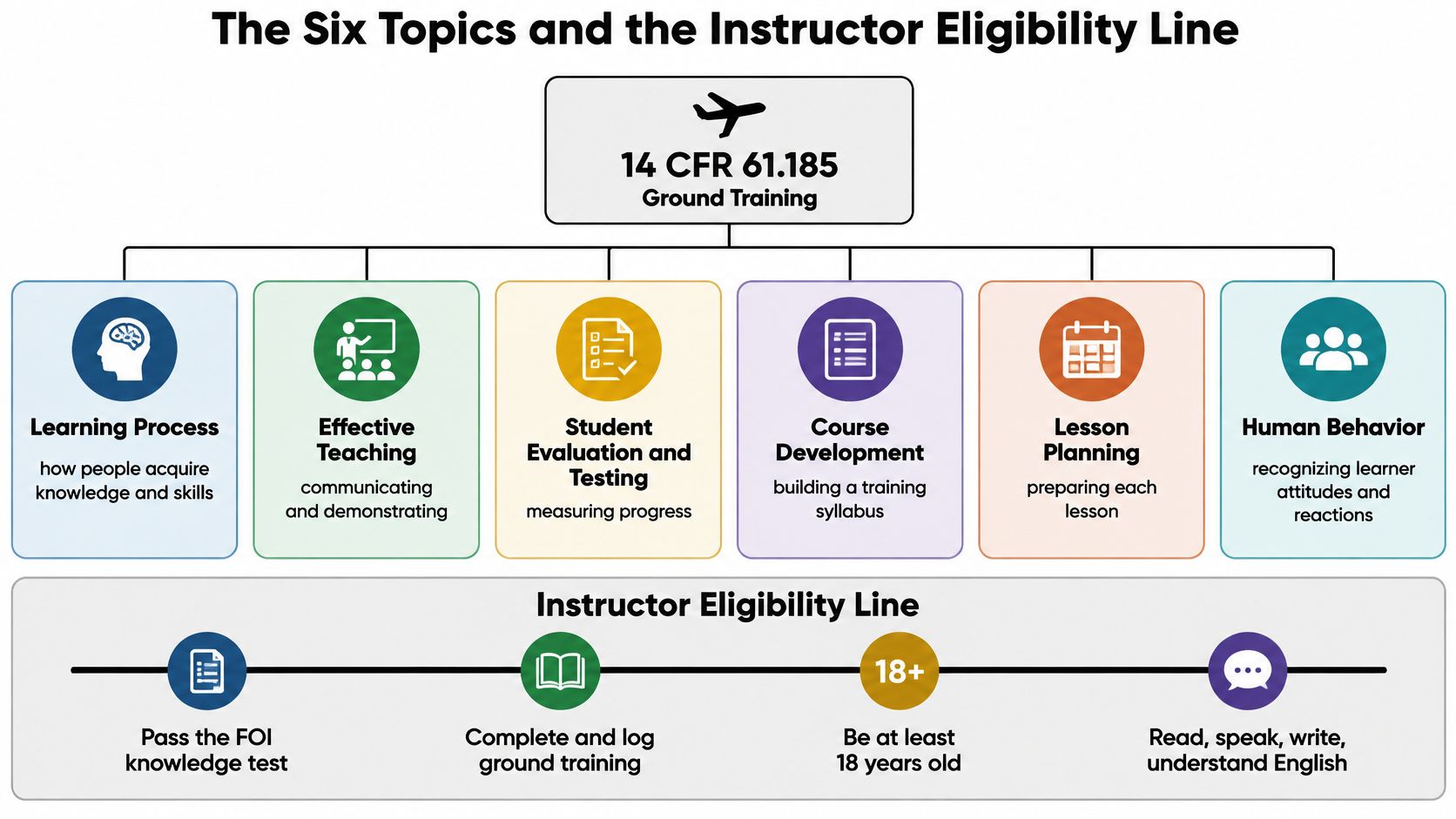
14 CFR § 61.185 is the ground-training list an instructor applicant has to receive and log. The test samples that list. The certificate has a separate eligibility line.
| Knowledge area | Flight-training use |
|---|---|
| Learning process | Explain why reciting a maneuver is not the same as flying it |
| Effective teaching | Brief the sight picture, demonstrate, then let the student try |
| Student evaluation and testing | Tell a knowledge gap from a skill gap |
| Course development | Order lessons so basics come before pattern work |
| Lesson planning | Set one objective, one standard, and one risk item |
| Classroom training techniques | Keep the briefing short and check understanding |
Say a student can recite slow flight and still balloons the landing. That is the learning process: words stored in memory are not the same skill as timing a flare. Effective teaching is three beats you can picture with zero hours: say the sight picture, show it, then let the student try. Evaluation asks which gap you are looking at. If the student cannot say what the flare is for, review the idea. If the student can say it and still balloons, stop lecturing and fly a short practice set.
Course development is the order of the book, not a single lesson. Straight-and-level and airspeed control come before you send someone into the traffic pattern. Lesson planning is narrower: one objective, one completion standard, and one risk item. A steep-turns plan might say "roll into a 45-degree bank, hold altitude within 100 feet, and watch for overbanking." Classroom technique is the briefing before you walk to the airplane. Five focused minutes with a check question beats a lecture that runs until the fuel truck arrives.
Who may hold the certificate
Passing this exam does not make you a flight instructor. Under 14 CFR § 61.183, an applicant generally must be at least 18, be able to read, speak, write, and understand English, and hold a commercial pilot certificate or an airline transport pilot certificate with the right aircraft category and class. An instrument rating, or the right instrument privileges, is also required when you apply for the airplane flight-instructor rating that needs it.
Age 16 lets you sit the knowledge test. Age 18 is the certificate line. You can study the FOI while you are still building private, instrument, and commercial experience. You cannot skip those ratings and teach on the strength of a written score.
If the rating you want includes instrument-instructor privileges, the same ground-training rule also expects the recreational, private, and commercial pilot subjects, plus the instrument knowledge areas tied to those privileges. The practical test then checks whether you can teach those subjects, which is why the Airman Certification Standards matter more than a stack of definitions.
Study the weakest row first. If scenario items about evaluation keep missing, that row is your next study block, not another pass through material you already explain cleanly.
How to Study for the FOI in Four Cycles
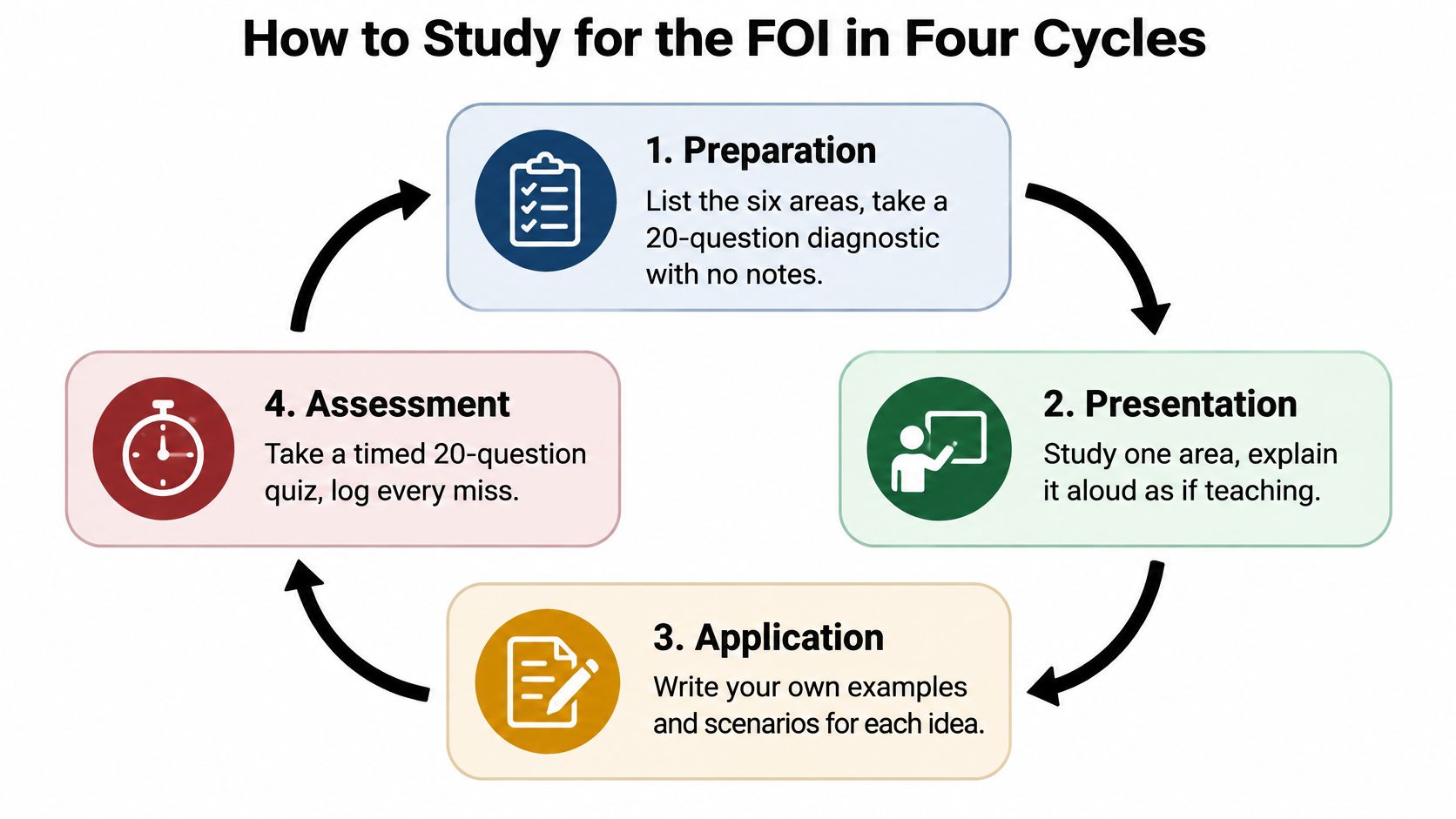
Rereading a glossary feels like progress and rarely survives a scenario. The Aviation Instructor's Handbook chapter on the learning process treats the work as preparation, presentation, application, and assessment. Use that same order on yourself. The handbook ties retention to frequent and recent use, depth of understanding, and study that is spread out, so two short cycles a week beat one weekend cram.
1. Preparation
List the six areas on one page. Take a 20-question diagnostic with no notes. Mark each miss by the principle, not by the letter you picked.
The slip here is treating a familiar stem as proof you know the idea. If you remember that "B" was right last week, you have not prepared. You have recognized a pattern. If you want a way to shorten the sitting without skipping the hard part, TiedSiren's guide to studying faster is a useful companion for cutting rereads that do not change what you can do.
2. Presentation
For each miss, read only the matching part of the handbook. Then explain the idea aloud in about one minute, as if a student had asked on the ramp.
Talking forces order. A definition you can only recognize on a page often falls apart when you have to start with the student's problem. The slip is leaving the student out and reciting a textbook sentence.
3. Application
Rewrite the item around a person. Make the student anxious, unmotivated, or overconfident, then choose a method that fits that person.
An overconfident student who rushes the before-landing checklist needs a tighter completion standard, not a pep talk about motivation. An anxious student who freezes on the first radio call needs a short script and a calm rep, not a longer lecture on phraseology. The slip is picking the method you like instead of the method that student needs.
4. Assessment
Two days later, answer five new scenario items on that area with the book closed. Score them against the objective: could you name the gap, the method, and the result?
Assessment is continuous, before, during, and after the study block, not a single quiz at the end. The slip is scoring yourself on whether the letter matched, then moving on. If you missed it, say which principle failed.
Each practice item becomes a mini lesson.
- Objective: what the instructor is trying to change.
- Principle: the learning or teaching idea in play.
- Student situation: who is in the airplane and what just went wrong.
- Result: what you would watch on the next attempt.
Repeat the four moves twice a week. Stop when closed-book scenario sets stay near 85 percent inside the exam's time pace. A single open-book review of the FAA knowledge test format will not get you there. Three traps keep showing up: treating a memorized definition as mastery, skipping the learner in the example, and studying the letter of the answer.
Test Day Tactics for Tricky Wording
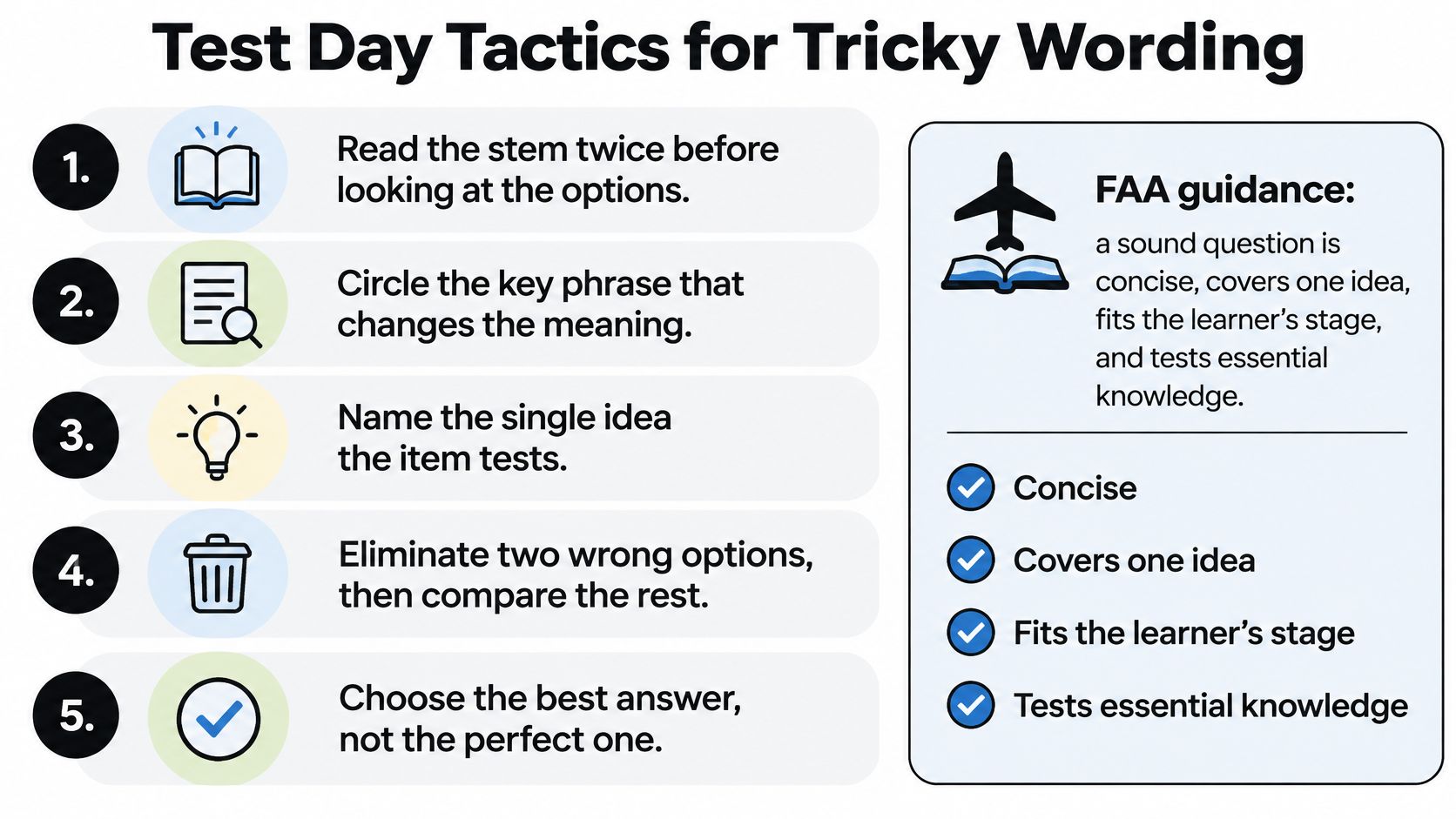
A test item can be short and still ask you to make a careful decision. FAA guidance says a sound question should address one idea, suit the learner's stage, and test important knowledge rather than trivia. Treat unusually narrow choices as clues to examine the stem, not as proof that the answer is wrong.
Slow down on the word that flips the item
Read the stem twice when it says not, except, or least. Each word changes what the question asks you to identify. Give always and never a second look too. If a stem includes two ideas, identify which one the item is assessing.
Name the behavior the question wants, then identify its topic. Is it a learning domain, or a part of preparation, presentation, application, or assessment? If the stem asks what an instructor should do next, a choice that only repeats a definition may not answer it.
If two choices both sound right, favor the one that completes the teaching sequence rather than the one that only names a term.
A student who freezes on the radio
The student knows the frequency and call format but goes silent at the hold-short line. Consider three responses: punish the mistake, give a longer lecture on radio procedure, or practice a short script with calm feedback.
The script turns known information into a coached action. The student says the call on the ground; the instructor listens and corrects one phrase. This choice connects the answer to a lesson behavior you can observe and critique, rather than to recall alone.
Use the pass rate as a personal bar
The FAA's 2025 Airman Knowledge Test report records 14,846 Fundamentals of Instructing exams, a 99.07 percent pass rate, and a 92.13 percent average score. Set your own readiness bar above passing. A practice score of 70 percent is well below that reported average.
Before booking, explain each practice answer aloud and why the alternatives do not fit. Then connect the principle to an instructor action, a critique, or a behavior you could observe during a lesson. A high written score is a weak signal of teaching readiness if you cannot make that connection.
Sample Questions and How to Reason Through Them
Work these three items in prose. They are original practice, not a copy of an official form. Say the reasoning before you look at a key.
Student evaluation. A student can explain the landing flare and still balloons every time. Is this a knowledge gap or a skill gap?
It is a skill gap. The explanation is already there, so another written review will not change the landing. The next step is a demonstration and a short set of targeted landings, with one cue you both agree to watch.
Negative wording. Which of these is NOT an element of a lesson objective: the performance you want, the standard that says the lesson is complete, or the student's favorite color of headset?
Circle NOT before you read the choices. The domain is lesson planning. A performance and a completion standard belong in the objective. The headset color does not. If you cannot name the knowledge area before you see the choices, reread the stem.
Lesson planning. A steep-turns lesson needs one objective, one completion standard, and one risk item. Which choice names the risk item: "become a safer pilot," or "losing altitude while fixated on the turn"?
The risk item is the concrete hazard, losing altitude while fixated on the turn. "Become a safer pilot" is a slogan, not something you can brief, watch, and debrief on that flight. Overbanking is the same kind of concrete hazard if the choices offer it instead.
After each item, say the reasoning aloud. The next day, score a fresh set of three with the book closed. That habit is the same one a CFI checkride oral rewards: you name the area, you pick an action, and you can defend it without a key in your lap.
What a Passing Score Still Leaves Open
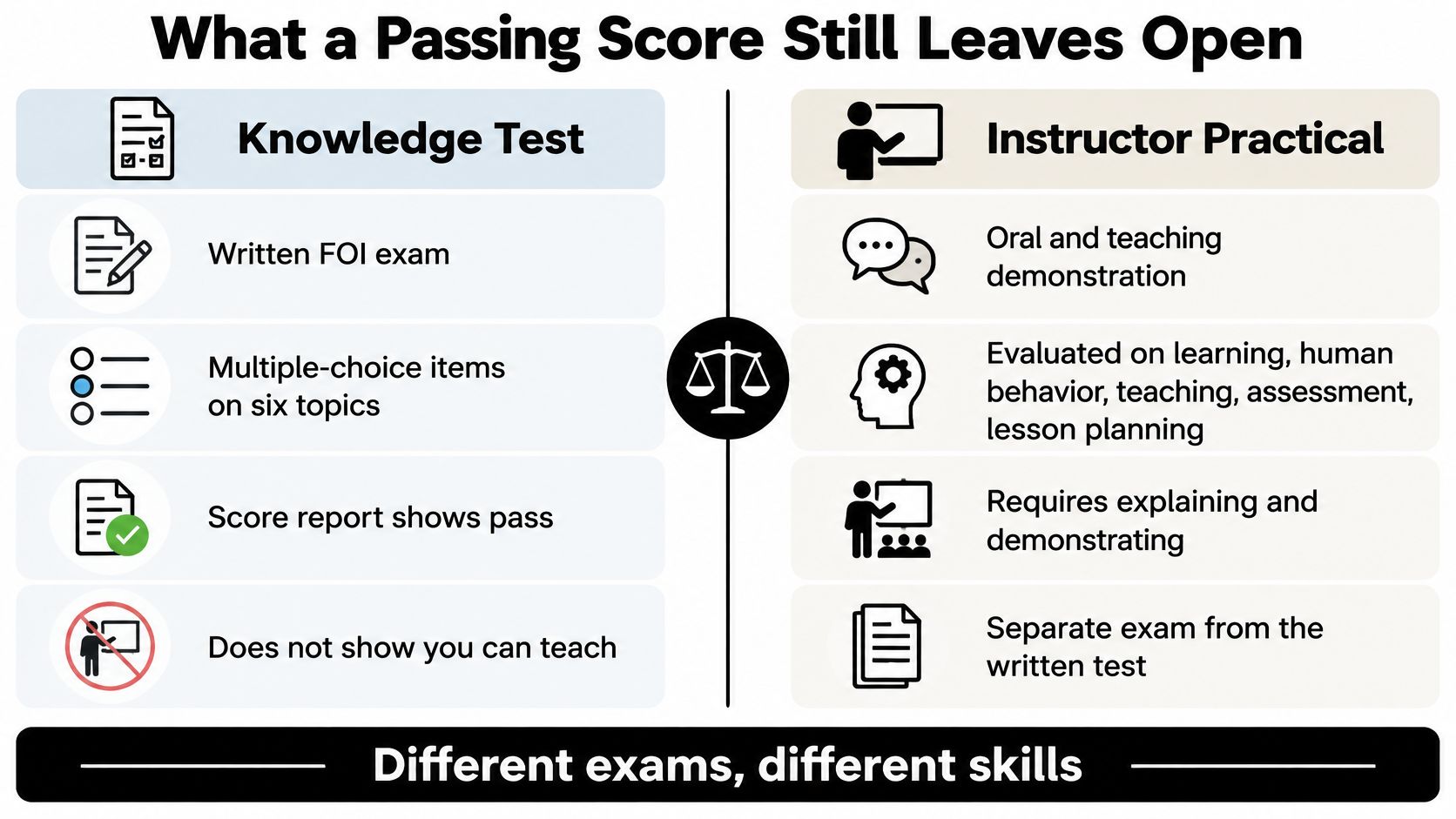
A practical test grades whether you can teach. Examiners watch learning, human behavior, teaching, assessment, professionalism, instructional technique, and risk management as actions you perform with a student in front of you.
A written score works like a map of items you recognized on a screen. The oral asks you to drive that route: name the problem, pick a method, and show the result would hold for one real learner.
Four moves an oral actually grades
A short look at four oral moves shows the gap between a high knowledge-test score and a lesson that would fly.
- Diagnose why the student is stuck. A student who freezes on the first radio call may be overloaded by too many new tasks, rather than "lacking motivation."
- Choose a method. One demonstration and three patterns may fit. Another ground lecture may not.
- Give a critique that names the error and the fix. "You leveled off high and then dropped it in. Next time, hold the picture until the mains settle."
- Adjust when the student is anxious or bored. Shorten the brief for the anxious student. Raise the completion standard for the bored one who is already accurate.
An oral is judged on whether that plan would work with that student. A matching flashcard leaves the examiner without a teaching sample.
Turn the score report into a five-minute brief
FAA sample-question guidance states that learning-statement codes on the Airman Knowledge Test Report help identify missed knowledge areas. A high group pass rate still hides individual holes. One weak code can sit under a score that looks strong on paper.
For a failure or a thin pass, wait before you retest. Find the code, reread that part of the Aviation Instructor's Handbook, and teach the idea in a five-minute mock briefing to a friend or instructor. Write down what was weak and which lesson fixed it. The same gap can return on the flight-instructor airplane knowledge test and on the oral.
Teach the missed idea until you can brief it without the answer key.
You use the report to find the hole. A short brief shows whether you can fill it in front of another person. That loop is the useful part of a flight instructor course.
Book a First Flight Before Instructor Ground School
Instructor privileges come after private, instrument, and commercial training. The fundamentals of instruction test asks whether you can teach. A strong written score only shows you picked the keyed choice. It does not show you can brief a nervous student or critique a landing an examiner will watch.
Book the airplane before the question bank. On a CFII discovery flight you meet the instructor, preflight the airplane together, and take the controls, with no prior experience needed. Treat that hour as a sample lesson: the instructor talks you through one task, then you fly it. Students who already have time can use the same first lesson to learn something new in CFII's aircraft instead of repeating a standard intro.
For the full path to instruct, one plan beats a stack of ratings with no end date. CFII's Career Track is a fixed $89,000 tuition, about nine months from zero time to CFII and multi-engine, 282 total hours, and six certificates and ratings. Training is one-on-one in Southern California, including Riverside, Long Beach, and Corona. It includes checkrides scheduled with FAA examiners, written test prep for every rating, and study materials: textbooks, study guides, exam prep, and a training portal with lessons, quizzes, stage checks, and a logbook. FOI prep belongs there, after you are already flying. Tie each study step to a lesson, a critique, or a practical-test behavior.
Ask for the total price in writing, and ask whether you can fly before you commit. CFII recommends those questions of every flight school, including itself, along with airplane age, students per airplane, instructor turnover, and Part 61 versus Part 141. A fixed syllabus can clarify the calendar. It cannot promise a job, a pass, income, or airline hiring.
This week, book the discovery flight and use that hour to decide if the right seat is the job you want.
CFII trains career pilots one-on-one in Southern California, from a first flight through the certificates and ratings that lead to instrument instructor, including the ground training and written-test work the FOI sits inside. If you want that path laid out before you start stacking lessons on your own, visit CFII and look at how the course is built.
Planning to fly for a living?
See what the path from zero to a pilot career looks like, what it costs and how long it takes.
Learn to fly in Riverside
We train at Riverside Municipal Airport in modern airplanes with a parachute built in. Start with a one hour discovery flight, no experience needed.