

On this page
- What the CFI Checkride Tests, Part by Part
- The practical test at a glance
- Know which instructor rating you're pursuing
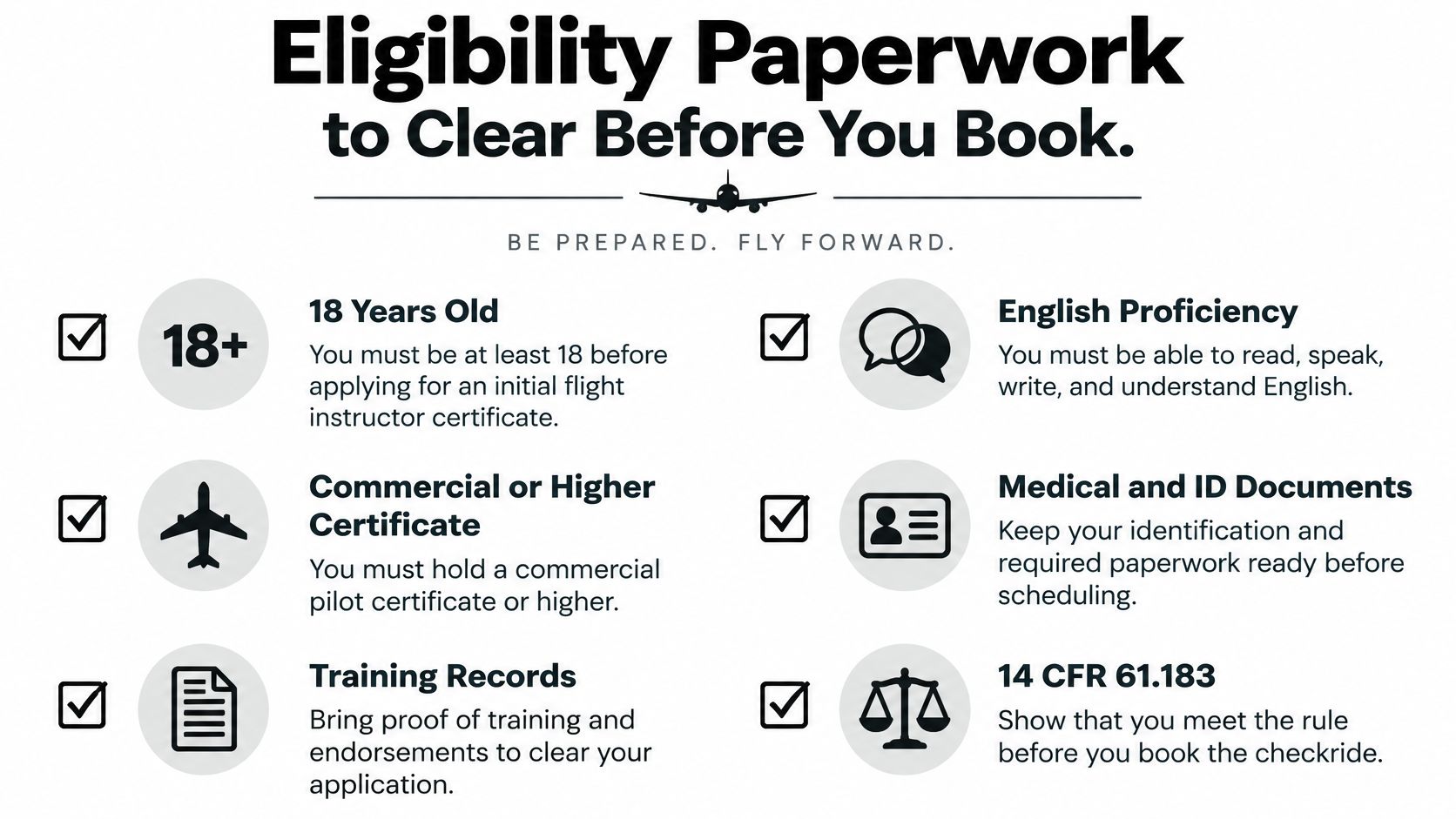
- Eligibility Paperwork to Clear Before You Book
- Build an eligibility packet
- Put the written test in perspective
- Oral Exam Topics and How to Answer Them
- Use an answer that a student can follow
- Prepare connected topics, not isolated definitions
- Required Maneuvers and the Standards to Teach Them
- Translate the standard into a lesson
- A steep-turn lesson in practice
- Keep abnormal procedures technically honest
- Lesson Planning Demo Under Examiner Pressure
- Deliver the lesson in four passes
- Prepare concise corrections under pressure
- Scheduling Risk, Retests and the Go or No-Go Decision
- Treat examiner availability as an operational constraint
- Build a practical recovery plan
- Choose the next step that matches your experience
You're looking at a pilot training roadmap, and the initials start piling up: private, instrument, commercial, CFI, CFII. You might not have flown yet, but you can already see that becoming an instructor means more than learning to handle an airplane. Eventually, someone will ask you to explain a procedure to a student who misunderstands it, while you keep the flight safe.
That's the central challenge of the CFI checkride, the practical test for a flight instructor certificate. You're demonstrating that you can fly, explain, observe, and correct. Understanding that expectation early helps you build the right habits from your first lesson.
What the CFI Checkride Tests, Part by Part
A candidate flies a clean stall demonstration, recovers smoothly, and returns to level flight. Then the examiner asks why that demonstration belongs at the beginning of this particular student's lesson. The candidate freezes.
The missing skill isn't airplane control. It's instructional judgment: deciding what the learner needs, choosing a useful demonstration, and explaining how it supports the lesson objective.
The CFI checkride evaluates flying and teaching together. The examiner needs to see someone who can recognize a misunderstanding and help a learner work through it, not repeat a polished explanation.
The practical test at a glance
CFI checkride parts and what examiners evaluate
| Part | What the examiner evaluates | How to rehearse |
|---|---|---|
| Eligibility review | Certificates, ratings, endorsements, and knowledge test results | Assemble originals and logbook pages for each requirement |
| Oral exam | Regulations, aerodynamics, systems, weather, risk management, and teaching theory | Answer aloud to a mock examiner who interrupts |
| Flight demonstration | Required maneuvers and how you teach each one to a learner | Teach each maneuver as if a student were flying it |
| Lesson plan | Objective, completion standard, delivery, and error correction | Present a full lesson with a timer and record it |
| CFII instrument portion | Instrument procedures and how you teach them, including degraded scenarios | Rehearse partial-panel and automation-failure briefings |
These are preparation categories, not necessarily separate appointments or a rigid test-day sequence. A lesson presentation can lead into oral questions, and questions can continue during flight.
For a beginner, a plain-language explanation of what a checkride is helps distinguish a practical test from an ordinary training lesson. Your instructor prepares you; the examiner evaluates whether you meet the certification standard.
Know which instructor rating you're pursuing
CFI commonly describes an airplane flight instructor. CFII means a flight instructor with instrument instructional privileges, not a different name for the same test.
The FAA's instructor certification standards framework identifies the documents applicable to different ratings. For airplane instructor testing, use the current Airman Certification Standards, or ACS, and check the applicable single-engine or multiengine tasks. Instrument instructor testing has a separate Practical Test Standards document, or PTS.
The preparation mistake to avoid is treating this as another commercial-pilot test. Rehearsing maneuvers without practicing explanations leaves the teaching half unfinished.
First preparation task: Make a one-page sheet listing each test component, the document or drill you'll use, and the date you'll first rehearse it aloud.
Eligibility comes first administratively. Your flying, oral answers, and lesson delivery should develop together.
Eligibility Paperwork to Clear Before You Book
Under 14 CFR § 61.183, an initial flight instructor applicant must be at least 18, read, speak, write, and understand English, and hold a commercial or airline transport pilot certificate with the appropriate category and class ratings. An airplane instructor applicant also needs the applicable instrument rating or instrument privileges.
These are entry requirements, not loose ends to finish after arriving for the test.
Build an eligibility packet
Confirm your pilot certificate and ratings. Check the actual certificate against the instructor rating sought. A training milestone in your logbook isn't a substitute for an issued certificate or rating.
Verify your instrument qualification. Separate holding an instrument rating from being current to exercise instrument privileges. Don't assume unclear currency entries prove eligibility or operational readiness; have your instructor review both questions.
Obtain the required instructional endorsements. Include the fundamentals-of-instructing endorsement when applicable, along with the other required training and practical-test endorsements. An unsigned entry or an endorsement promised for after the appointment doesn't establish readiness.
Complete the required knowledge tests. Initial airplane applicants generally need the Fundamentals of Instructing and Flight Instructor Airplane tests. A qualifying teaching certificate may support an exemption from the fundamentals requirement, not a blanket exemption from all instructor testing.
Organize identification and training records. Mark the logbook pages supporting your training and endorsements. Confirm the application, aircraft records, and any medical documentation applicable to your planned role with your instructor and examiner.
Use the flight instructor requirements guide to organize the pathway, then verify your own packet against the regulation.
Put the written test in perspective
The FAA's 2024 Airman Knowledge Test statistics report that 95.05% of 13,682 Flight Instructor Airplane applicants passed, with an average passing score of 88.35%. Focused written preparation is achievable, but those results aren't practical-test pass rates.
The added-rating population is much smaller and shouldn't be treated as equivalent to initial instructor applicants. Don't let a strong written score substitute for a complete eligibility review, and don't commit to a test booking until the required items are in hand.
Oral Exam Topics and How to Answer Them
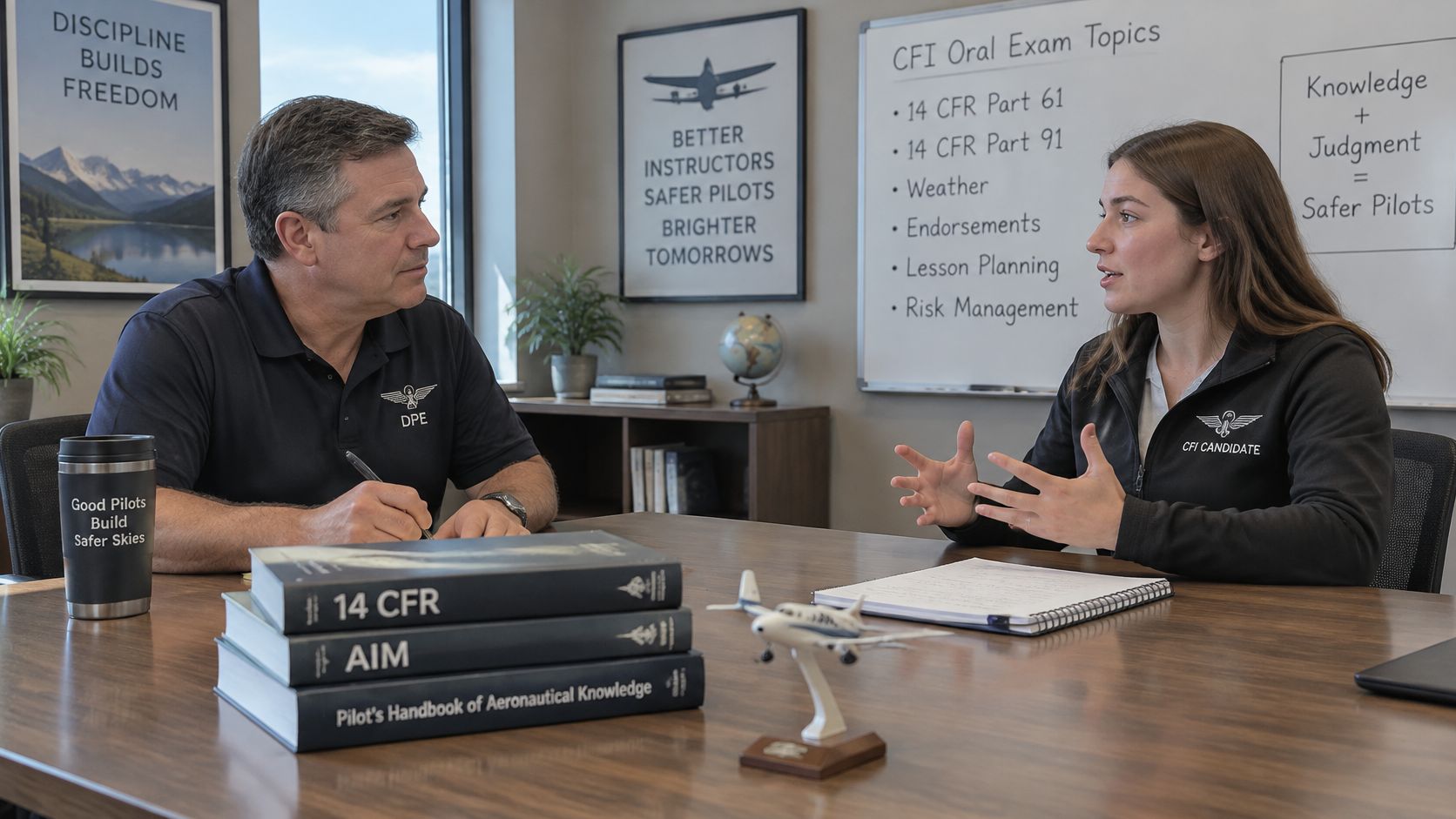
The oral exam is a conversation with an instructional purpose. The examiner may begin with a straightforward knowledge question, then change the hypothetical learner's experience or introduce an incorrect answer.
Your job is to remain accurate without becoming impatient or burying the student in details. A correct answer isn't yet a complete lesson.
Use an answer that a student can follow
Build your response around a direct answer, its regulatory or aerodynamic basis, and how you'd teach its application. Keep the initial response short enough that the examiner can ask a useful follow-up.
Consider a day-VFR weather question. Under 14 CFR § 91.155, for an airplane operating in Class G airspace at or below 1,200 feet above the surface during the day, the basic minimums are 1 statute mile visibility and clear of clouds.
Then explain the teaching problem. A student might apply controlled-airspace cloud clearances automatically, without first identifying the airspace and altitude. Have the student locate the aircraft on a sectional, identify the airspace, establish the height above the surface, and distinguish daytime from nighttime conditions before selecting the minimums.
Finally, separate legal minimums from a sensible training decision. Meeting a visibility minimum doesn't settle whether the conditions are appropriate for that learner, terrain, or lesson.
Prepare connected topics, not isolated definitions
Keep your study list compact, but practice applying each topic:
- Regulations and endorsements. Use Parts 61 and 91 to distinguish pilot qualifications, instructor privileges, and operating rules.
- Airspace and weather. Connect chart interpretation, visibility, cloud clearance, and weather information to an actual flight decision.
- Aerodynamics. Explain stalls, spin awareness, load factor, and angle of attack with a sketch or model airplane.
- Systems and performance. Trace a system's operation, describe a failure indication, and use the aircraft handbook rather than guessing.
- Weight and balance. Explain what the result means for controllability and performance, not just how to finish the arithmetic.
- Risk management and teaching theory. Describe how you assess experience, set objectives, and respond to frustration or overconfidence.
An objective should describe observable performance. Understanding landings is vague; explaining a learner's approach assessment and go-around decision gives you something you can evaluate.
When the learner makes an error, first determine whether it's a knowledge gap, a missed cue, or an execution problem. A verbal prompt may be enough, but you must take control when safety requires it.
Don't bluff to protect your credibility. Identify what you need to verify, select the appropriate reference, and explain the confirmed answer.
Use the Pilot's Handbook of Aeronautical Knowledge for foundational explanations and the Aeronautical Information Manual for operational guidance. Check regulations in the regulation itself. For daily practice, answer five random questions aloud with a timer while a mock examiner interrupts or changes the scenario.
Required Maneuvers and the Standards to Teach Them
The maneuver list starts with the applicable FAA standard, not with whatever your last instructor happened to emphasize. The FAA's instrument instructor Practical Test Standards distinguish instrument instructor testing and explain how other applicable pilot standards can enter an instructor evaluation.
For airplane instructor preparation, use the current airplane ACS. Don't choose an older PTS because a lesson binder references it.
Translate the standard into a lesson
Maneuver standards and what to teach for each
| Maneuver | Standard the examiner holds | What you must teach |
|---|---|---|
| Steep turns | Applicable tolerances in the current airplane ACS | Nose and wing reference points, and load-factor effects on altitude control |
| Power-off stall | Recognize the stall and recover according to the applicable standard and aircraft procedure | Warning cues, possible wing drop, angle-of-attack reduction, and recovery sequence |
| Slow flight | Applicable altitude, heading, airspeed, and coordination standards | Angle-of-attack awareness and the effects of configuration changes |
| Partial-panel approach | Applicable instrument instructor PTS and referenced instrument standards | Reliable raw-data cross-checks and exclusion of failed indications |
| Emergency landing without power | Suitable landing-area selection and a controlled, safe approach setup | Glide management, decision points, field selection, and simulated-training termination criteria |
The table is a preparation guide, not the complete required-task list. Copy tolerances from the current applicable document, then confirm how they apply to your rating and task.
For every maneuver, prepare the entry conditions, configuration, references, completion criteria, and likely errors. Write down what you expect a beginner to misunderstand. That last step turns a flying outline into an instructor's lesson.
A steep-turn lesson in practice
Before entry, establish the assigned altitude and airspeed, clear the area, and identify a usable outside reference. Explain how the airplane's nose and wing relate to the horizon from the instructor's seating position.
As bank increases, the lift vector tilts. Maintaining altitude requires sufficient vertical lift, so the pilot increases total lift through coordinated control inputs and manages power as appropriate. Don't tell a learner that load factor directly sets altitude; explain the connection between bank, lift, pitch, drag, and airspeed.
If the learner loses altitude, diagnose the sequence. Did the nose position change? Did bank increase unnoticed? Was the learner staring inside instead of cross-checking the horizon?
Coach the cause rather than calling out a number repeatedly. Then ask the learner to explain what changed and demonstrate a corrected entry.
Keep abnormal procedures technically honest
For stalls, teach the aircraft's approved recovery procedure and emphasize reducing angle of attack. Avoid suggesting that preserving altitude takes priority over breaking the stall. A stall recovery procedures review can help organize the explanation before flight practice.
For instrument work, partial-panel preparation means identifying which information remains trustworthy. A failed flight director isn't a usable command reference, but other independent indications may remain available. Explain the failure, select reliable references, and simplify the workload.
During a simulated engine-out landing, brief when the exercise will end while power remains available. During a real engine failure, a go-around may not be possible.
Rehearse each maneuver while narrating it to a learner. Silence can conceal a teaching gap even when the airplane stays within tolerance.
Lesson Planning Demo Under Examiner Pressure
A useful lesson has a visible beginning, demonstration, and learner-performance phase. The examiner should be able to tell what you intend to teach and how you'll determine whether the learner can do it.
The FAA's Flight Instructor for Airplane Category ACS makes instructional effectiveness part of the evaluation alongside knowledge, risk management, and flight proficiency. A technically accurate monologue isn't enough if you never notice that the learner has misunderstood.
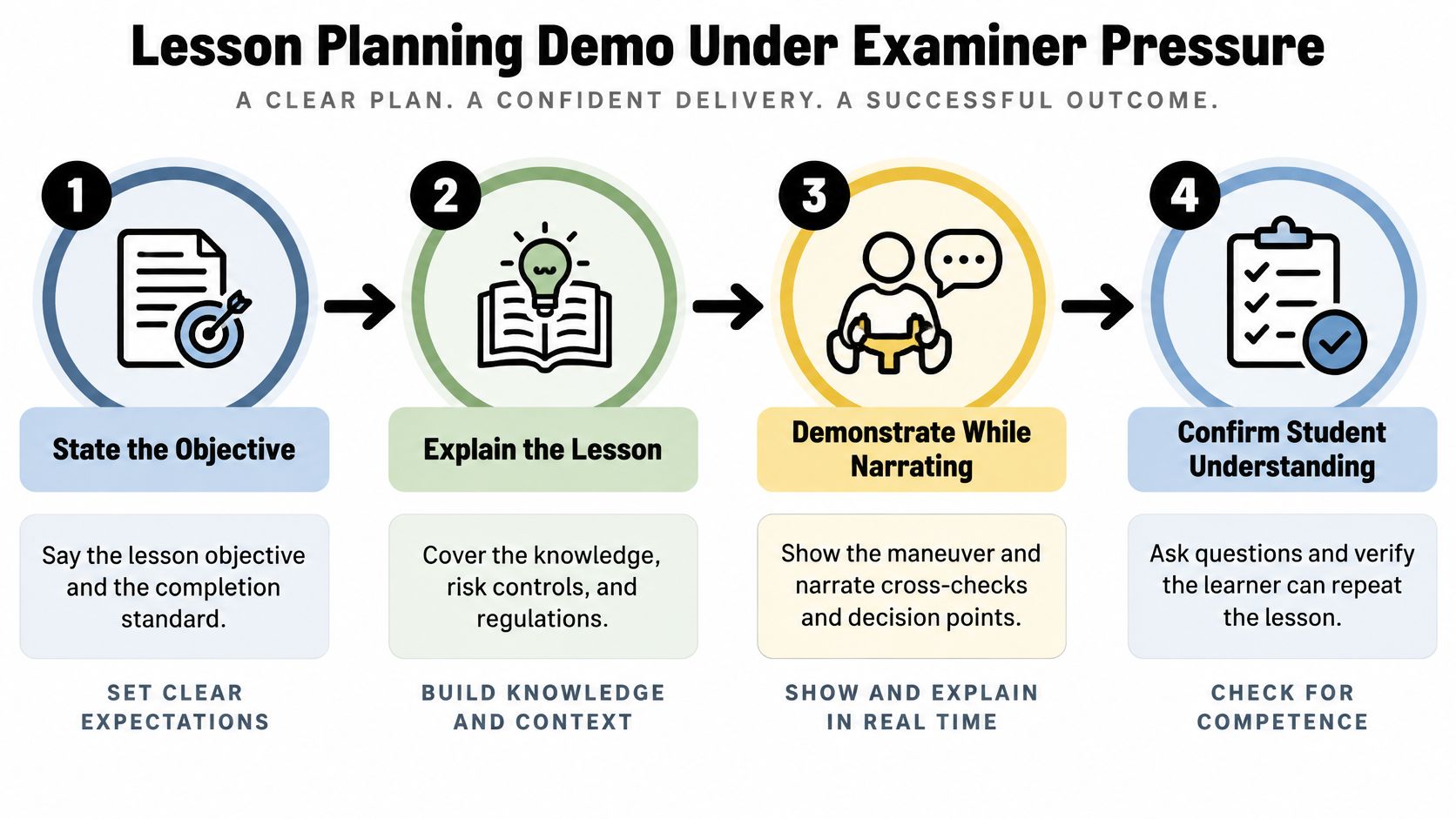
Deliver the lesson in four passes
State the objective and completion standard. For a crosswind landing lesson, describe a stabilized approach, appropriate wind correction, runway alignment, and directional control through rollout. Ask about the learner's previous crosswind experience before choosing the explanation's depth.
Explain knowledge, risk controls, and applicable rules. Use a runway sketch to distinguish heading from ground track. Explain drift, crab, sideslip, aircraft limitations, and the conditions that would make you discontinue the approach.
Demonstrate while narrating. Identify the cues you're using: runway alignment, centerline position, airspeed, sink rate, and changing control requirements. Explain decisions as they become relevant rather than reciting the whole lesson during final approach.
Transfer control, observe, and correct. Use a positive control exchange. If the learner drifts after touchdown, identify whether they relaxed the wind correction, lost directional awareness, or applied an inappropriate input, then coach the specific correction.
The learner's explanation matters, but it doesn't replace demonstrated performance. Ask what they noticed, then watch whether they can apply the correction.
At CFII, we teach read-and-do checklists for rare or high-stress tasks and do-then-confirm for routine flying. Neither method overrides aircraft-specific memory actions or the approved procedure. Explain which method you're using so the learner understands when the checklist directs action and when it verifies completed actions.
Prepare concise corrections under pressure
Instrument scenarios require the same organized teaching, applied to a different task. Practice prompts such as these without turning them into rigid cockpit speeches:
- Altitude deviation. Identify the trend, guide the correction, then diagnose the scan or control input that caused it.
- Wrong automation mode. Verify the active mode and aircraft response. Revert to a simpler supported mode or hand-fly when appropriate.
- Unstable approach. Recognize the condition and execute the appropriate go-around or missed approach rather than trying to rescue the demonstration.
- Disorganized missed approach. Prioritize aircraft control and the required flight path before secondary programming.
- Lost situational awareness. Establish a safe flight condition, verify position using reliable information, and seek assistance when needed.
Use scenario-based training to vary the learner's mistake, not merely the wording of your explanation.
Safety boundary: Let the learner work through an error only while you retain a safe margin to intervene.
Examiners watch for unsafe conditions requiring intervention, inadequate clearing, failure to meet applicable flight standards, and ineffective instruction. Instrument instructor candidates must meet the applicable instrument skill requirements while teaching.
Film a practice lesson lasting about 20 minutes. Review whether you stated an objective, explained the important risks, demonstrated clearly, and gave the learner a meaningful opportunity to perform. Cut unnecessary narration before adding more material.
Scheduling Risk, Retests and the Go or No-Go Decision
An examiner cancels on the morning of your CFI checkride. Your aircraft slot is lost, and your next available date may be weeks away. A readiness decision should account for that possibility: book after a full mock checkride shows you can manage the oral, selected maneuvers, and lesson delivery without coaching. Have your eligibility paperwork and backup plan ready before you commit.
Expect small deviations. What matters is catching them early and continuing to teach without prompting.
Treat examiner availability as an operational constraint
The 2026 Federal Register notice concerning examiner management records concerns about certification delays and limits the one-per-day restriction to complete initial CFI tests, allowing retests or continuations on the same day. That permission does not guarantee an examiner, aircraft, or suitable weather will be available when you need them.
Some applicants need more training or another test attempt. Treat that possibility as a reason to keep time and money in reserve, not as a prediction of your own result.
Checkride outcomes and what to plan for each
| Outcome | What it means | What to plan |
|---|---|---|
| Unsatisfactory task | The failed task is recorded, and its associated area may be affected | Confirm the recorded deficiencies and remaining requirements before leaving |
| Retest | Unsatisfactory work is reevaluated, with the scope established under applicable rules and examiner guidance | Complete corrective training and schedule practice before the retest |
| Continuation | An incomplete test resumes later after a discontinuance; it is not a failure by itself | Preserve the discontinuance paperwork and confirm what remains |
| Weather or cancellation | The planned appointment is lost or testing cannot be completed | Keep a backup aircraft slot and an alternate date available |
A Notice of Disapproval documents an unsuccessful practical test. A Letter of Discontinuance documents a test stopped for a reason other than unsatisfactory performance, such as weather or an aircraft problem.
Use the examiner's documentation and applicable requirements to establish what remains after a continuation or retest. A continuation may have no failed areas; a retest's scope depends on the recorded deficiencies and applicable requirements.
Build a practical recovery plan
Make each contingency specific enough that someone could act on it:
- Weather. Set a decision time with the examiner and instructor. Separate unsuitable weather from pressure to protect an expensive booking.
- Examiner cancellation. Identify who coordinates rescheduling and how you'll maintain proficiency during the delay.
- Aircraft unserviceability. Hold a backup slot where practical, but verify equipment, records, and your familiarity before switching aircraft.
- Unsatisfactory performance. Reserve instructor time for diagnosis and retraining. Budget for additional preparation and another examiner appointment without assuming a particular fee.
Keep stage-check sheets, mock-checkride notes, and recorded ground lessons together. For each issue, record the error, its cause, the corrective drill, and evidence that you can correct it without prompting.
“Altitude control needs work” gives an instructor little to act on. “Late pitch correction during steep-turn entry” identifies a specific problem to address. The CFI training cost guide can help you organize cost categories without confusing tuition with every possible expense.
Choose the next step that matches your experience
A one-hour discovery flight offers a first flight with an instructor before you commit to training. CFII's Career Track includes coordinated FAA-examiner checkrides, written-test preparation for every rating, study materials, and a training portal with lessons, quizzes, stage checks, and a logbook.
Before committing, ask every flight school specific questions:
- Aircraft access. How old are the airplanes, and how many students share each airplane?
- Instructor continuity. What is instructor turnover like, and how are training handovers handled?
- Written price. What is the total price, and what is excluded?
- Training structure. Is the training under Part 61 or Part 141, and what does that mean for your schedule?
- Firsthand evaluation. Can you fly with an instructor before committing?
Choose a pathway you understand well enough to explain back. Checking assumptions before accepting an appealing summary is useful in both training decisions and instruction.
CFII is a Southern California flight training organization offering a structured path from first flight through instrument instructor training, with written-test preparation and coordinated checkride scheduling. Before choosing any program, review its training scope and how it fits your goals.
Planning to fly for a living?
See what the path from zero to a pilot career looks like, what it costs and how long it takes.
Learn to fly in Riverside
We train at Riverside Municipal Airport in modern airplanes with a parachute built in. Start with a one hour discovery flight, no experience needed.