

On this page
- Choosing the Right Los Angeles Flight School
- Identify what you actually need
- Compare the whole training arrangement
- Understanding the Los Angeles Pilot Training Market
- Infrastructure is an advantage, not a guarantee
- Separate career opportunity from lesson reliability
- Comparing Programs, Training, and Student Support
- Los Angeles Flight School Decision Matrix
- Interpret the answers rather than counting features
- Reviewing CFII Career Track for Career Pilots
- Evaluate the structure against your circumstances
- Request an individualized training explanation
- Keep employment arrangements separate
- Verifying Cost, Schedule, and Training Reliability
- Verify the experience categories
- Request records and terms before paying
- Matching Flight School Options to Your Goal
- If you're starting from zero
- If you've soloed or already hold a private certificate
- If your priority is building time
- If you want to become an instructor
- Making a Confident Enrollment Decision
- Approve the plan, not just the destination
- Keep airline ambitions grounded
What good is a low hourly rate if you can't book an airplane, your lessons keep getting postponed, or you finish your certificates without a workable plan to build experience? For an aspiring career pilot, those questions matter more than a school's fleet photographs or advertised completion date.
Compare flight schools in Los Angeles by operational reliability and career fit, not just proximity or price. You're choosing a training environment, a financial commitment, and a route toward professional flying. Those decisions deserve separate scrutiny.
Choosing the Right Los Angeles Flight School
The nearest school isn't automatically the most practical, and the cheapest airplane doesn't automatically produce the lowest training bill. Your starting point determines what you should buy. A complete beginner needs a coherent foundation, while an experienced student may need only a targeted rating or dependable access to hour-building aircraft.
Start by identifying your immediate objective and your eventual career endpoint. Don't let an admissions conversation collapse those into the same thing. Completing a training program and becoming competitive for professional employment are different milestones.
Identify what you actually need
- No flight experience: Prioritize clear instruction, a sequenced syllabus, realistic study expectations, and a schedule you can sustain.
- Private pilot seeking advanced training: Ask how the school evaluates existing proficiency and integrates previous experience into the next rating.
- Time-building pilot: Concentrate on aircraft access, dispatch restrictions, useful flying opportunities, and total operating cost.
- Prospective instructor: Investigate teaching preparation, instructor selection, and access to paid assignments after certification.
Then assess your constraints. Can you train during the working day? Would you relocate, or must you commute? Do you need housing and financing, and could you cover living expenses if training takes longer than expected?
Practical rule: Choose the program you can reliably attend and afford through disruption, not the program with the most attractive ideal-case timeline.
Compare the whole training arrangement
Ask each school to connect its certificate scope, published timeline, aircraft and simulator access, instructional schedule, and examiner coordination. Housing, transportation, financing, and post-training experience belong in that conversation from the beginning.
For a zero-time applicant, CFII's Southern California Career Track is an option to investigate as a complete pathway through instructor qualifications and multi-engine training. It shouldn't be treated as the default choice for someone who already holds certificates or needs occasional lessons.
My recommendation is straightforward: define your training objective before requesting a quote. Otherwise, you risk comparing a complete career-oriented program with a basic certificate estimate and mistaking the difference in scope for a difference in value.
Understanding the Los Angeles Pilot Training Market
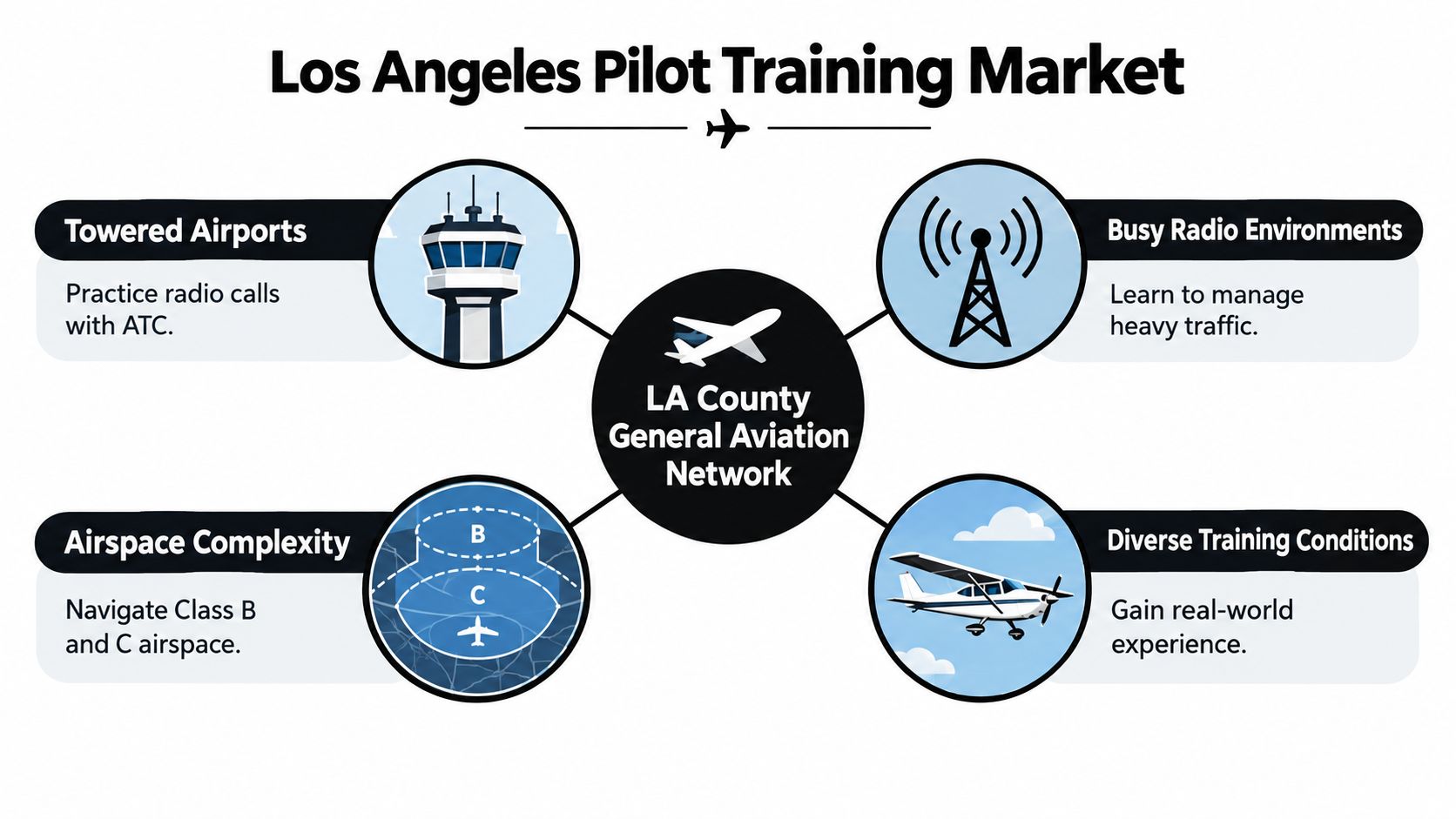
Los Angeles offers a substantial aviation environment, but a busy region doesn't automatically give every student a productive lesson. Los Angeles County operates five general-aviation airports, collectively handling more than 500,000 annual takeoffs and landings, supporting more than 1,500 based aircraft, and hosting over 60 aviation-related businesses, according to the county's general-aviation airport overview.
That infrastructure gives students opportunities to encounter varied airport users, radio workloads, and operating conditions. It also creates an important trade-off: time spent waiting for departure or traveling to a practice area isn't interchangeable with time spent practicing the lesson's objective.
Infrastructure is an advantage, not a guarantee
Brackett Field illustrates the region's long-established training ecosystem. The airport began in 1940, and its educational role expanded in 1953 with approval of a college aviation program, as documented in the county's Brackett Field history.
For your decision, the practical question is how a school uses that ecosystem. Ask whether dispatch staff can adjust departure times, whether instructors plan alternatives, and whether students can access suitable aircraft when the original airplane becomes unavailable.
The regional network provides context for evaluating those answers.
Separate career opportunity from lesson reliability
The metropolitan area employed an estimated 5,750 airline pilots, copilots, and flight engineers in May 2023, with a mean annual wage of $279,870, according to the Bureau of Labor Statistics occupational table. Those figures describe an advanced occupational group, not entry-level instructor pay or a graduate employment promise.
Weather requires equally careful interpretation. A published analysis of airport observations found that Van Nuys met basic VFR conditions on 363 of 364 days, but only 40% of June observations at 7 a.m. met its stricter student-training criteria, compared with 93% at 11 a.m., according to the Los Angeles training-weather analysis.
Use those findings as a scheduling prompt, not a forecast for every airport or lesson.
- Commuting students: Ask what happens when morning conditions don't meet the lesson's requirements.
- Relocating students: Confirm which base you'll use before choosing housing.
- Career changers: Map the California pilot-training pathway against your available study and attendance time.
Comparing Programs, Training, and Student Support
A useful comparison separates documented program facts from matters that require an enrollment agreement. An unanswered question isn't proof that a service is unavailable, but it is a reason not to budget as though that service were included.
Los Angeles Flight School Decision Matrix
The documented option below is CFII's Career Track, published as a fixed $89,000 tuition pathway lasting about nine months, from zero time to CFII and multi-engine, with 282 total hours and six certificates and ratings, based in Riverside, Long Beach, and Corona.
| Decision criterion | Documented CFII option | Question for any Los Angeles flight school |
|---|---|---|
| Training scope | Zero time to CFII and multi-engine | What is included, and what requires a separate agreement? |
| Published schedule | Approximately nine-month program framing | What student commitments and operational assumptions support the timeline? |
| Hours | Published total shown above | How are airplane, simulator, dual, solo, and other experience categories allocated? |
| Locations | Southern California bases listed above | Which base will handle each phase, and can assignments change? |
| Tuition | Fixed published tuition shown above | What exclusions, extra-hour charges, and repeat-attempt terms apply? |
| Aircraft access | Request current operational details | Which aircraft can students actually reserve, and what substitutes are available? |
| Simulator role | Request device and credit details | Which device is used, and what requirements can its time satisfy? |
| Instruction and study | Request current instructional arrangements | How are ground lessons, written preparation, digital tools, and stage checks delivered? |
| Practical tests | Request scheduling procedures | Who coordinates examiner availability and resolves delays? |
| Housing and financing | Request current written terms | What commitments, living costs, borrowing costs, and cancellation provisions apply? |
| Post-CFI experience | Request a separate written explanation | How are instructors selected, assigned students, and paid? |
Interpret the answers rather than counting features
Curriculum continuity matters more than a long menu of ratings. Ask how a student moves from private-pilot training into instrument work, commercial preparation, instructor qualifications, and multi-engine training. The useful answer identifies prerequisites, evaluation points, and responsibility for coordinating the next phase.
Fleet configuration deserves similar attention. Request the aircraft types and cockpit configurations used for your assigned course, then ask how the school handles substitutions. A fleet photograph doesn't establish that an appropriate airplane will be available during your training window.
Simulator access should come with an instructional purpose. Ask which lessons use the device, how instructors evaluate performance, and how the school documents credit. Don't accept a combined hour total as a substitute for that explanation.
- Written preparation: Request the study sequence and the point at which instructors expect you to be test-ready.
- Stage checks: Ask who conducts them, how deficiencies are addressed, and whether additional preparation changes your bill.
- Examiner support: Establish who handles scheduling, aircraft reservations, document review, and recovery after a postponement.
- Financial disclosure: Obtain the rules for unused balances, withdrawal, operational changes, and training beyond the agreed scope.
Use the pilot training program guide to prepare your curriculum questions, then request answers tied to your actual enrollment. A clear written boundary is more useful than a reassuring verbal summary.
Reviewing CFII Career Track for Career Pilots
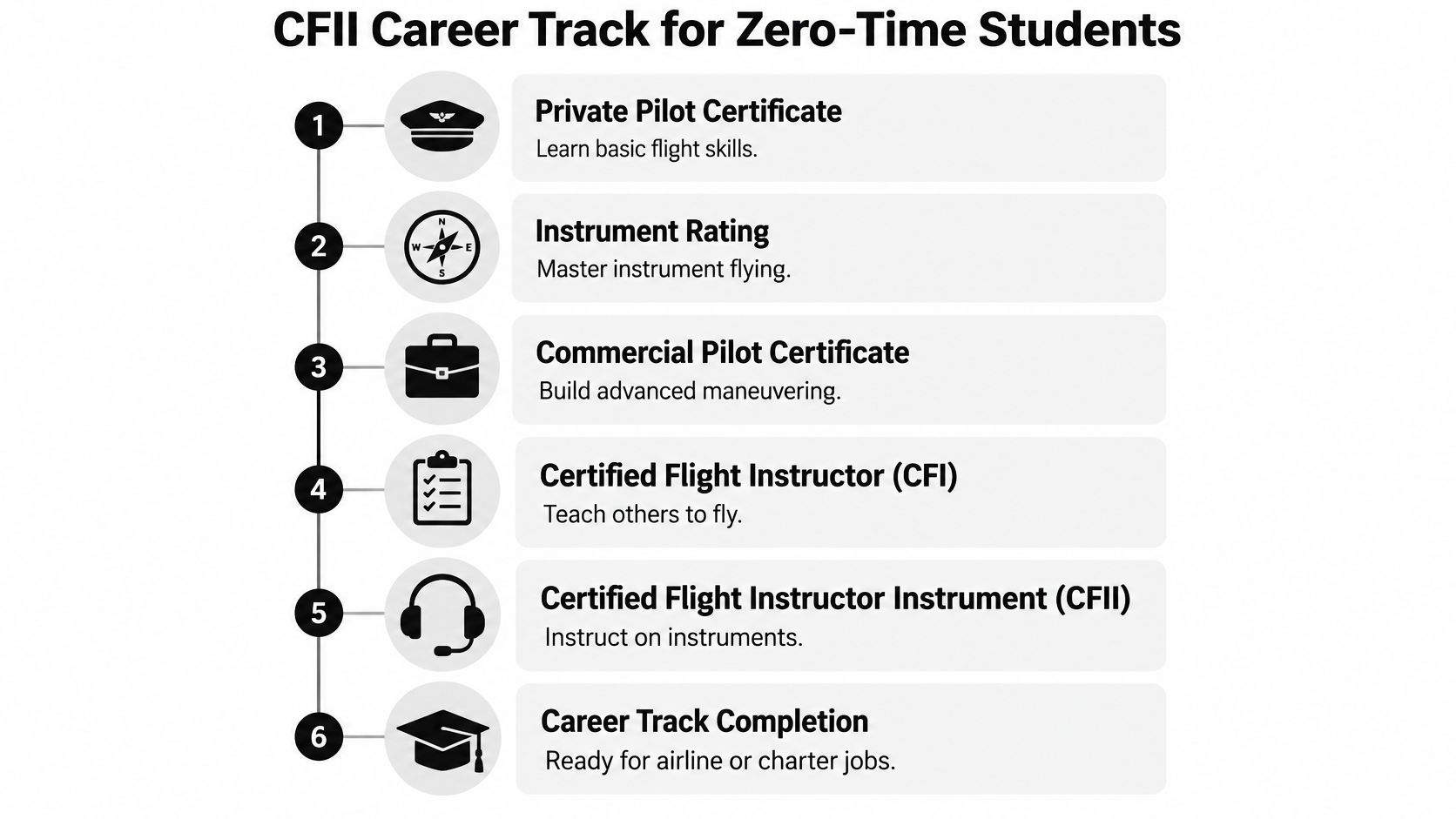
CFII's Career Track is most relevant to someone starting without flight experience who wants an integrated route through instructor qualifications. Its published endpoint makes it a training pathway, not a promise of airline employment.
The distinction matters when reading any career-path illustration. Certificate milestones help organize training, but they don't establish that a graduate meets a particular employer's experience requirements.
Use the progression below as an orientation to training stages, not as an eligibility determination.
Evaluate the structure against your circumstances
For a beginner, the appeal of an integrated program is organizational. Instead of arranging each phase independently, you can evaluate a proposed route from initial training through advanced qualifications. Your job is to determine whether the actual attendance requirements, study expectations, and financial terms fit your life.
An applicant who already holds a private certificate needs a different conversation. Don't assume that a zero-time package automatically provides an appropriate price or entry point for prior experience. Ask for an individual evaluation and written explanation of any proposed changes.
A pilot who primarily needs additional experience should be more selective still. Another broad certificate package may not address the immediate need for useful flight time.
A fixed tuition figure answers a pricing question. It doesn't, by itself, answer an aircraft-access, living-expense, or employment question.
Request an individualized training explanation
Ask admissions staff to describe what your ordinary training week would involve. Request clarity on flight and ground instruction, independent study, progress reviews, written-test preparation, and practical-test readiness.
The accelerated flight training discussion is a useful starting point for evaluating pace. Follow it with questions about your assigned location, expected availability, and the procedure when progress differs from the original schedule.
Use the program video to prepare questions for a direct conversation.
Keep employment arrangements separate
Treat any proposed Work with us add-on as a separate arrangement requiring its own current written terms. Don't include anticipated instructing income in your essential living budget until you understand eligibility, obligations, assignment procedures, payment conditions, and what happens if circumstances change.
- Training scope: Request the exact certificates, ratings, and experience categories in your agreement.
- Learning support: Verify instructor continuity, study resources, assessment procedures, and examiner coordination.
- Living arrangements: Ask about housing availability, transportation needs, and responsibility for relocation costs.
- After graduation: Distinguish instructor certification from selection for paid instructional work.
My assessment is that a full zero-time pathway deserves consideration when you want a coordinated training commitment and can sustain its demands. It's a less obvious fit if your primary need is flexible attendance, recognition of substantial prior experience, or flight time without additional certificates.
Verifying Cost, Schedule, and Training Reliability
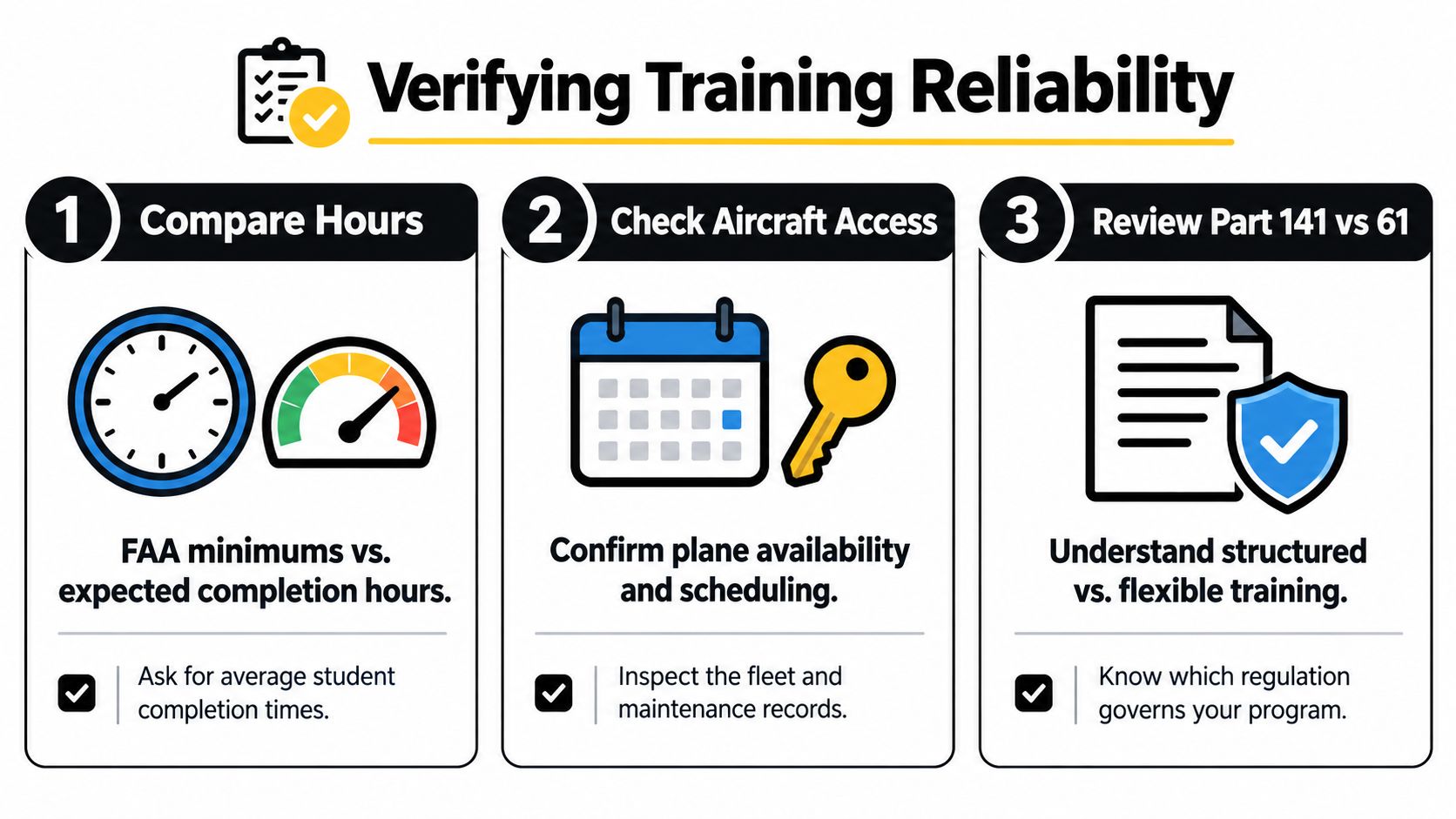
Start with the difference between legal minimum experience and a reasonable completion budget. For a Part 61 airplane private pilot certificate, the FAA specifies 40 hours, including at least 20 hours with an authorized instructor and 10 hours of solo training, while reporting an average completion point of approximately 75 hours, in its private-pilot hourly requirements explanation.
That gap is why an estimate based only on regulatory minimums is a weak financial plan. Ask the school which assumptions it uses and how it prices training beyond the contracted scope.
The reliability checks below help connect the advertised program to the training you can receive.
Verify the experience categories
Commercial training requires structured experience, not merely completion of private-pilot lessons. Under 14 CFR § 61.129, commercial single-engine applicants generally need prescribed pilot-in-command, cross-country, training, and solo or supervised-PIC experience, including 3 hours of recent test preparation within the preceding 2 calendar months.
Simulator time also needs careful classification. The FAA's instrument-rating guidance describes device-credit limits and instructor-certification requirements under the applicable rules. Ask the school to identify the device approval and explain exactly how each category of time applies to your course.
Don't let anyone describe simulator time as unrestricted airplane flight time. Request a projected logbook breakdown and have the school explain the governing regulation.
Request records and terms before paying
Ask for recent, anonymized examples of scheduled versus completed lessons. Have the school distinguish weather cancellations from maintenance, instructor availability, and examiner delays.
- Aircraft utilization: Request completed flights per available aircraft, not just the number of aircraft on the roster.
- Cancellation recovery: Ask how students receive replacement lessons and whether alternative training is appropriate.
- Testing delays: Establish who pays for proficiency flying while waiting for a practical test.
- Total cost: Identify tuition exclusions, extra hours, repeated tests, medical certification, equipment, housing, and transportation.
- Financing: Review interest accrual, payment deferral, withdrawal consequences, and prepayment conditions.
- Prepaid funds: Obtain the refund schedule and unused-balance policy before transferring money.
Use the flying-lesson cost guide to organize your questions, then request a personalized budget with a delay scenario.
Budget test: If additional training or a postponed checkride would force you to stop, revise the funding plan before enrolling.
Matching Flight School Options to Your Goal
Your current logbook should determine your questions. Don't judge beginner training, advanced ratings, aircraft rental, and instructor preparation as though they were interchangeable products.
If you're starting from zero
Choose an environment where instructors can explain how each lesson contributes to the next qualification. You need more than an available airplane: you need a manageable learning sequence and a clear expectation for preparation.
Observe how an instructor explains an unfamiliar task. Ask what you should study before the next lesson and how the school determines readiness to move forward. A beginner should leave an admissions conversation understanding the work involved, not just the advertised endpoint.
- Learning fit: Look for explanations you understand and feedback you can act on.
- Personal capacity: Match the proposed attendance requirements to your work and family commitments.
- Decision point: Investigate the full Career Track only if you want its complete zero-time pathway.
If you've soloed or already hold a private certificate
Bring your logbook, training records, and a candid account of recent flying. Ask for a proficiency assessment before accepting a completion estimate.
Your next objective may be instrument, commercial, multi-engine, or instructor training. Request a course-specific proposal rather than assuming that a broad package is necessary.
The central issue is recognition of existing experience without overlooking gaps. You want credit for what you've accomplished and a clear explanation of what still needs work.
If your priority is building time
Buy access that serves a defined purpose. Ask which aircraft you can reserve, what checkout is required, what rental restrictions apply, and whether the proposed flying addresses your intended next qualification.
Don't purchase another certificate merely because it appears in a career package. Decide whether the added qualification supports your employment plan or increases your training bill.
- Useful access: Confirm actual reservation opportunities and operating restrictions.
- Experience planning: Ask how proposed flights meet relevant logbook categories.
- Professional feedback: Arrange periodic review rather than treating accumulating hours as the only objective.
If you want to become an instructor
Evaluate the transition from performing a maneuver to teaching it. Ask how candidates practice explanations, recognize student errors, manage workload, and demonstrate sound judgment.
Then investigate the business side of instructing. Request the selection process, assignment policies, compensation terms, logbook-review expectations, and approach to professional preparation.
My recommendation is to assess instructional readiness and access to work separately. Passing an instructor practical test establishes a qualification. It doesn't establish how soon you'll receive students or whether the resulting income will support your expenses.
Making a Confident Enrollment Decision
Choose the school whose written arrangement fits your starting point, available time, financial resilience, and career objective. A nearby airport can still be inconvenient if its workable lesson times conflict with your job. A complete program can still be the wrong purchase if you only need a specific rating.
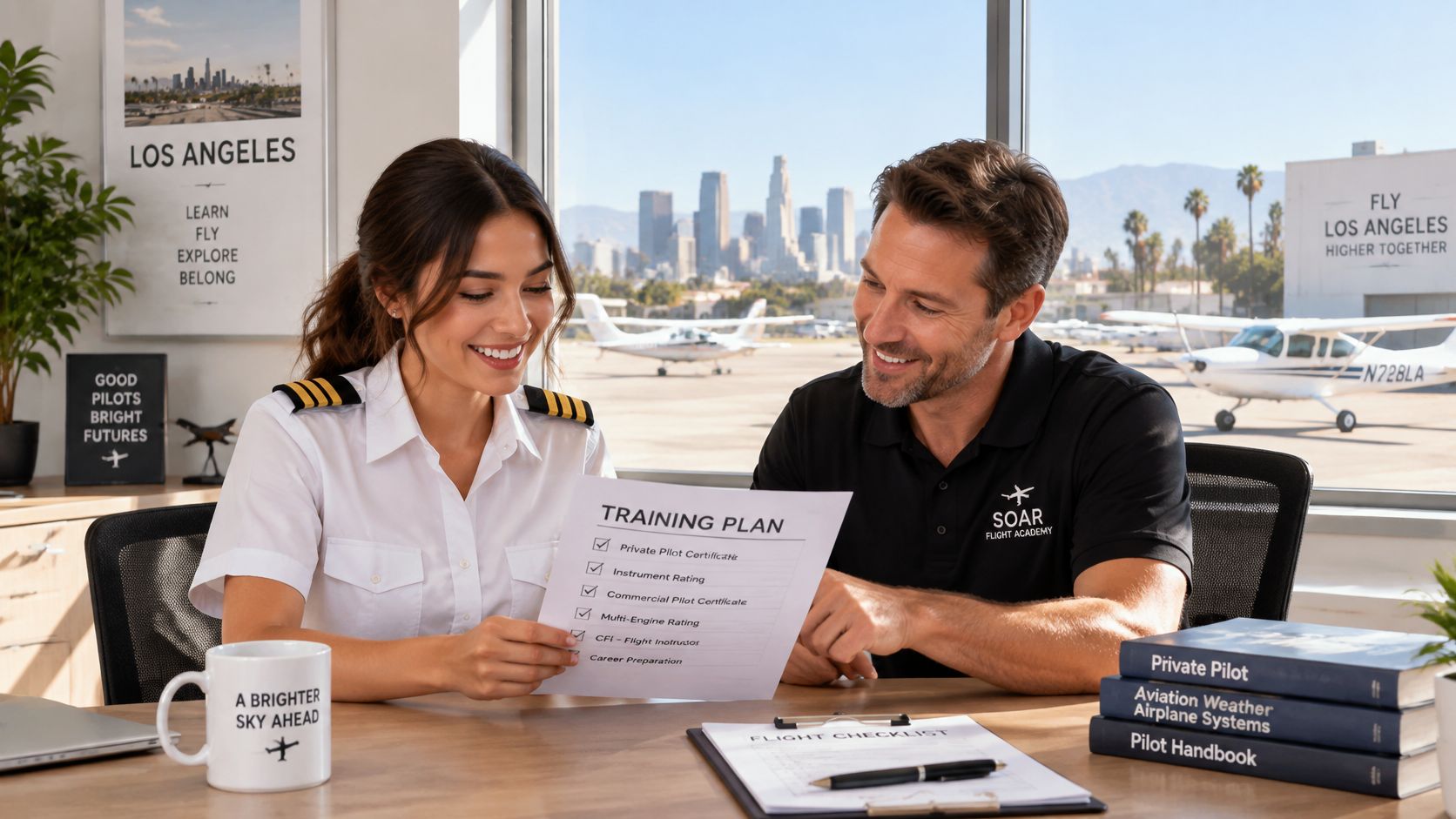
Before signing, put the proposed training plan beside your personal budget and calendar. Check whether you can sustain the arrangement when conditions aren't ideal.
Use the enrollment discussion to review the plan together, rather than confirming a start date.
Approve the plan, not just the destination
- Training agreement: Confirm scope, governing rules, exclusions, and withdrawal terms.
- Personal logistics: Resolve housing, transportation, work commitments, and study time.
- Career transition: Establish what happens after the final practical test and how you'll fund the next stage.
Use the FAA-approved flight school guide to prepare questions about the school's regulatory framework. A description of approval or structure shouldn't replace review of the actual course and agreement you'll enter.
Keep airline ambitions grounded
The FAA states that 250 total hours is the regulatory minimum for a commercial pilot certificate, but airlines may require 1,000, 2,000, or more hours, depending on their standards and market conditions, in its commercial-pilot certification explanation. A commercial certificate is not an airline hiring threshold.
If you've never flown, investigate the discovery-flight option before committing to a full program. If you want the complete Southern California route, review Career Track and request an enrollment conversation focused on your budget, availability, and intended progression.
The right decision isn't the school with the strongest promise. It's the training arrangement you understand well enough to fund, attend, and evaluate.
CFII offers a Southern California Career Track from zero experience to CFII and multi-engine training. Visit CFII to investigate the pathway, discuss your starting point, and request the written program details you need to compare flight schools in Los Angeles confidently.
Planning to fly for a living?
See what the path from zero to a pilot career looks like, what it costs and how long it takes.
Learn to fly in Riverside
We train at Riverside Municipal Airport in factory-new airplanes with a parachute built in. Start with a one hour discovery flight, no experience needed.