
On this page
- The Truth About CFI Renewal Requirements
- The Three Compliance Pathways
- What the FAA accepts
- Understanding the 24-Month Cycle
- Endorsing Students for Your Own Renewal
- What this route rewards
- Choosing Between Testing and Refresher Courses
- Practical test versus FIRC
- How to Calculate Your Pass Rate
- Recordkeeping for a Current Certificate
- What belongs in your renewal folder
- Reinstatement After a Missed Deadline
The FAA no longer prints an expiration date on newly issued flight instructor certificates, but you still have to re-establish recent experience every 24 calendar months to legally teach. The card may stay valid, yet your instructional privilege goes inactive if you stop meeting the current rule.
Most advice still treats CFI renewal like a paper chase for a new plastic certificate. That mental model is outdated now, and it leads people to track the wrong thing, then scramble when the deadline is already past.
The Truth About CFI Renewal Requirements
A lot of instructors still ask the wrong question, which is, “When does my certificate expire?” The better question is, “Have I stayed current under 14 CFR § 61.197?” Since December 1, 2024, the FAA no longer prints an expiration date on newly issued flight instructor certificates, including instrument-instructor certificates such as the CFII, and the system now depends on a recurring recent-experience requirement instead of a simple card date (FAA Safety Team guidance on the no-expiration change).
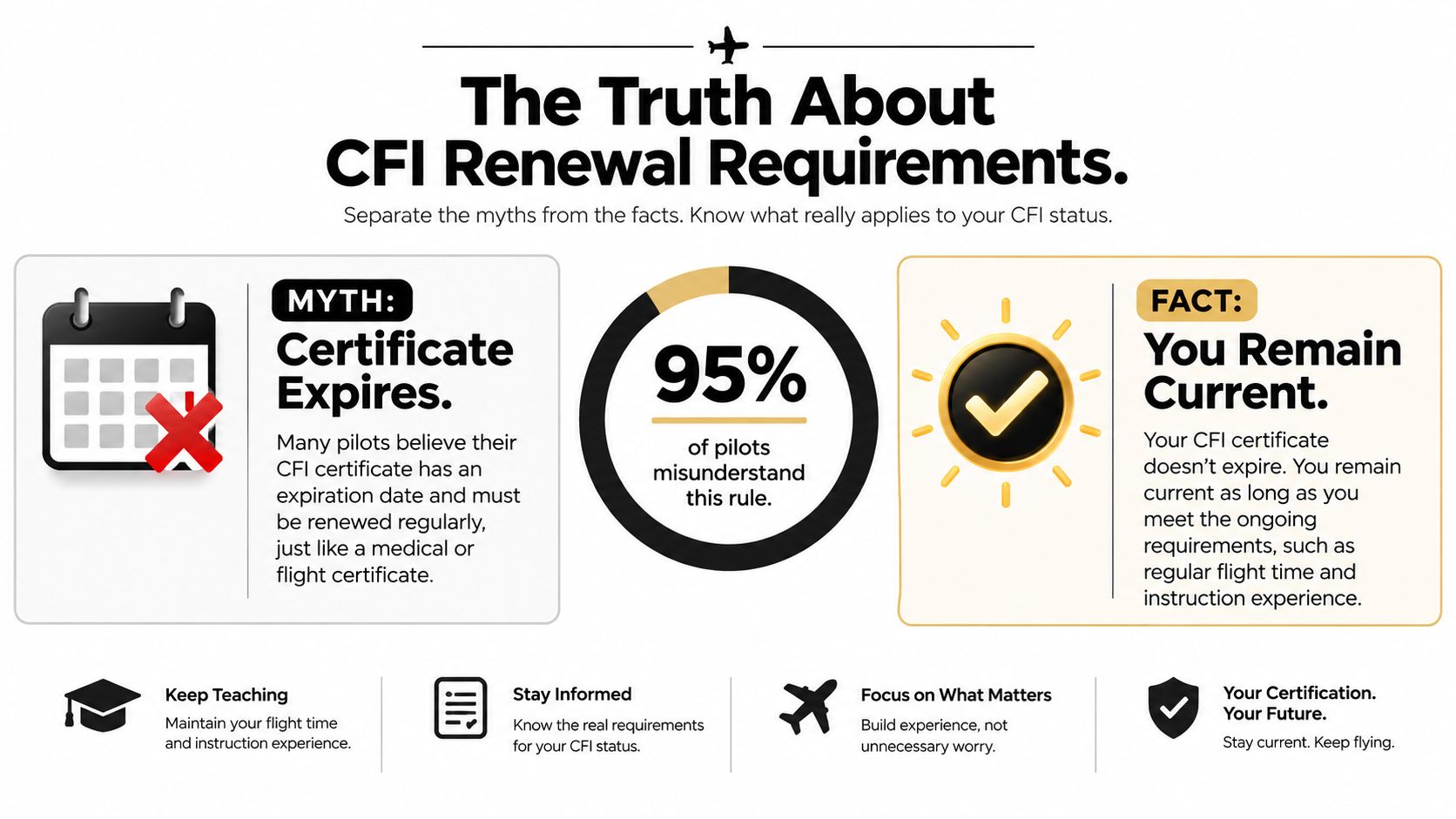
The practical difference matters. Your certificate can remain legally valid, but your authority to instruct depends on showing qualifying activity and filing the right FAA paperwork. That is why the old habit of glancing at a card and assuming you are good for another two years can get you in trouble.
Practical rule: track your recency, not the plastic.
If you're building a career around instruction, that shift changes your workflow immediately. You need a calendar system, a record folder, and a clear sense of which recent-experience path you plan to use before the deadline hits. For a deeper rundown of the broader instructor-standard framework, keep this CFI requirements guide close while you organize your records.
The biggest mistake is assuming that an unexpired-looking certificate automatically authorizes instruction. It doesn't. The FAA's current model separates certificate validity from operational currency, and CFII planning has to follow that split from day one.
The Three Compliance Pathways
The FAA gives you more than one way to stay current. Under the revised framework, a flight instructor can satisfy the 24-calendar-month recent-experience requirement through an approved Flight Instructor Refresher Course (FIRC), the student-endorsement route, or a qualifying test-based or proficiency-based option set out in the rule (AOPA summary of the rule change).
What the FAA accepts
| Pathway | Key Requirement | Best For |
|---|---|---|
| Practical test route | Pass a practical test for an instructor rating already on the certificate, or for an additional instructor rating | Instructors adding a rating or already preparing for a checkride |
| Student-endorsement route | Endorse at least five applicants for practical tests and reach at least 80% first-attempt passes | Active instructors with clean records and strong student outcomes |
| FIRC route | Complete an approved refresher course within the required window | Instructors who want a structured classroom-style reset |
The practical-test option is the cleanest choice for someone already planning a new rating, because the same event can also satisfy renewal when it is completed correctly. The student-endorsement route rewards steady teaching, but only if your paperwork and your students' outcomes both hold up. The refresher-course option works well for instructors who want a renewal path that does not depend on their recent student mix.
The rule removed older workload conditions from the endorsement pathway, including the old requirement to provide 400 hours of flight training and serve in an FAA-approved course, so the current structure is narrower and focused on documented outcomes (14 CFR Part 61).
A practical way to think about it is simple. Choose the path that fits the flying you already do, then keep your logbook, endorsement records, and renewal paperwork lined up before the window closes.
Understanding the 24-Month Cycle
The deadline is tied to the end of a calendar month, not to a rolling count of days from your last lesson. That detail matters because people often misread the rule and think “24 months” means the same day number two years later. FAA guidance is clear that renewal timing runs on calendar months, and if you renew within the three calendar months before the current certificate's expiration month, the renewed certificate gets an additional 24 calendar months beyond the existing expiration date (14 CFR Part 61).
Start by finding the month tied to your current recent-experience period. Then count backward from the end of that month, not from the day you happened to complete your last instructional event. That simple shift prevents the most common calendar mistake I see from new instructors.
If you renew early, you do not lose the remaining validity you still had. You just lock in the next cycle before the window closes. That is one reason organized instructors try to finish their paperwork during the allowed early window instead of waiting until the last week.
A clean way to approach it:
If the month ends, your planning window changes with it.
Keep a note of three dates, the last qualifying activity, the end of the current cycle month, and the date you submit the renewal packet. That trio tells you whether you are renewing on time, renewing early, or slipping into reinstatement territory.
Later, when you submit the application through the FAA process, the timing and the documentation have to line up together. If one is missing, the other does not save you.
Midway through the paperwork side, the FAA still expects the renewal application to be processed correctly, and that's where a lot of instructors get sloppy. A course completion certificate or a practical-test result is only useful if it matches the current calendar window and the supporting form is filed the way the FAA accepts it.
Endorsing Students for Your Own Renewal
The endorsement route works best for instructors who are actively teaching, because your renewal depends on what your students do after you sign them off. Under § 61.197(a)(2)(i), you must endorse at least five students for a practical test during the preceding 24 calendar months, and at least 80% of those students must pass on the first attempt (FAA Order guidance on the endorsement method).
The math matters. Five endorsements by itself is not enough if the pass rate is weak. If you endorse exactly five applicants, you need four first-time passes to meet the threshold. If the numbers slip, this pathway stops working even if you have been busy all year.
A clean tracking ledger helps here. Record the student's name, the date you gave the endorsement, the practical test date, and the result. Review that list against the end of your 24-month window, not just against your memory. Missed entries are common, and they usually surface only when renewal is already urgent.
What this route rewards
- Accurate endorsements. Sloppy logbook entries create sloppy renewal evidence.
- Student outcomes. The FAA is looking at teaching results, not just time in the airplane.
- Routine tracking. You should be able to see who was endorsed, when they tested, and whether they passed on the first try.
If you are working toward your first instructing job, CFII's CFI training pathway is a useful reference for where instructor development fits in the larger training sequence.
The trade-off is simple. This route is efficient for instructors who teach often and keep clean records. If your student volume is low, or your first-try pass history is thin, it may not be available to you. In that case, it makes more sense to plan another renewal path before the cycle closes.
Update the record the same day you give the endorsement. Waiting invites gaps, and gaps are what make a valid certificate look unusable when the paperwork is reviewed.
Choosing Between Testing and Refresher Courses
The practical-test route and the FIRC route solve the same compliance problem, but they serve different people. A practical test fits instructors who are already preparing for another rating, while a FIRC fits instructors who want a structured review without adding a new checkride to their calendar. The key difference is that the refresher course has a tighter timing rule, because the instructor must complete the approved course within the preceding three calendar months and present the graduation certificate when applying for renewal (FAA advisory circular on instructor renewal).
Practical test versus FIRC
| Feature | Practical Test Route | FIRC Route |
|---|---|---|
| Main advantage | Can renew while adding or demonstrating a rating | No flight test required |
| Best use case | You already need the test for another reason | You want a classroom-style compliance reset |
| Timing pressure | Depends on test scheduling | Must fit the three-month course window |
The FIRC route is attractive when your student record doesn't quite reach the endorsement threshold. It also works well if you want a fresh review of regulations, teaching methods, and administrative expectations before your next cycle. The practical-test route, by contrast, is stronger when you're already in evaluation mode and want one event to do two jobs.
CFII's flight-training courses page is a useful place to see how structured training can support both skill-building and paperwork discipline without turning renewal into a scramble.
Choose the path that matches your real schedule, not the one that sounds simplest today.
That last point matters because the easiest route on paper is often the one that gets delayed the longest. If you know your next 24 months will be busy, pick the option you can reliably complete on time.
How to Calculate Your Pass Rate
The endorsement route lives or dies on clean math. Start with every student you endorsed for a practical test during the preceding 24 calendar months, then count only the ones who passed on the first attempt. That first-pass rate has to clear 80%. If you endorsed five applicants, four first-time passes meets the standard, and three does not.
Track the outcome on the day the checkride ends, not after the fact. A retest still helps the student, but it does not count as a first-attempt pass for this calculation.
Use a ledger that separates three items with no guesswork:
- Students you endorsed.
- Students who sat for the practical test.
- Students who passed on the first try.
Then divide first-time passes by total endorsements and compare the result to 80%.
A common mistake is counting every signed endorsement as if it automatically qualified. It does not. The standard looks at both activity and results, so your records have to show who was endorsed, who tested, and who passed first time.
That is the hidden difference between certificate validity and operational currency. A current certificate is only part of the job. If you want the endorsement method to hold up, your paperwork should make the 24-month window easy to audit, with each outcome tied to a specific checkride date and each pass or fail recorded while the event is still fresh.
Recordkeeping for a Current Certificate
The FAA doesn't want a vague memory, it wants auditable evidence. Under 14 CFR § 61.197, the instructor must retain records such as applicant endorsements, practical-test outcomes, employment records, FIRC completion documentation, or program records, and then submit the required application and supporting paperwork in a form the FAA accepts (Cornell's text of 14 CFR § 61.197).

What belongs in your renewal folder
- Endorsement records. Keep the date, student name, and purpose clear enough to verify later.
- Practical-test outcomes. Save what proves the first-attempt result.
- Course completion documents. Keep the FIRC graduation certificate if you use that path.
- Employment or program records. Retain anything that supports an alternate qualifying role.
The best system is boring and consistent. I like a digital folder for scans, a paper backup for the critical originals, and one running checklist that shows which pathway I'm currently using. That way, if an FAA inspector asks for proof, you are not rebuilding your history from memory.
The application itself also matters. The FAA expects the renewal paperwork to be filed through the proper process, and that is where tools like IACRA come in. If your documents are scattered across email, a logbook, and a glovebox, you've already made the job harder than it needs to be.
Reinstatement After a Missed Deadline
A new CFII once missed the deadline by a few weeks because he assumed the card date was still what matters. It wasn't. Once the recent-experience period ends, instructional privileges stop, and the FAA's three-calendar-month reinstatement window becomes the next question, not the old renewal path. The CFI reinstatement overview lays out that timing clearly.
That short window still has a real job. Within it, you must act fast and complete the FAA's reinstatement process that fits your status, usually by passing the required practical or proficiency event that restores recent experience. Wait past that point, and you are no longer correcting a missed deadline, you are back in full renewal territory.
The practical lesson is simple. If you are close to the end of your cycle, do not assume “sometime next month” will be fine. Build your compliance ledger early, because the paperwork gets stricter once the deadline has passed.
A missed deadline is usually a scheduling problem long before it becomes a regulatory problem.
For a new instructor, that ledger should show the current 24-month window, the last qualifying event, and the date the reinstatement clock starts. If the entries are clean, you can see the problem early and avoid guessing when your authority to instruct ends.
If you want to stay current, treat the 24-month cycle as part of the job, not an afterthought. Build the ledger, choose your pathway early, and verify your records before the window closes.
Planning to fly for a living?
See what the path from zero to a pilot career looks like, what it costs and how long it takes.
Learn to fly in Riverside
We train at Riverside Municipal Airport in factory-new airplanes with a parachute built in. Start with a one hour discovery flight, no experience needed.