
On this page
- What an FAA Certified Flight Instructor Is
- Understanding the names
- Eligibility Rules Under Part 61
- What the checklist means in practice
- Training proof is more than test preparation
- The Path From Zero Time to CFII
- Build the pilot qualifications first
- Turn flying skills into teaching skills
- Choose a workable training structure
- Who a New Instructor Can Teach
- Instrument privileges don't remove the experience gate
- Read the student level in a job advertisement
- How Instructor Currency Works
- Distinguish current rules from older renewal language
- Choose the route you can document
- The First Instructor Job and Daily Limits
- A rolling limit shapes the schedule
- What the first role involves
- Frequently Asked Questions
- Can I become a CFI with no flight time?
- What is the difference between CFI and CFII?
- Can a commercial pilot give flight instruction without a CFI?
- What should I ask a flight school before signing up?
- What is a discovery flight, and who is it for?
- Choose a First Flight or Full Path
- Match the commitment to the qualifications
- Settle practical questions before relocating
An FAA certified flight instructor holds a Part 61 teaching credential, not a private-pilot add-on: applicants must be at least 18, hold a commercial or airline transport pilot certificate, and pass knowledge and practical tests. Even after qualifying, a new instructor isn't automatically eligible to train future instructors, and holding the certificate doesn't by itself keep teaching privileges current.
The FAA's instructor eligibility regulation establishes the professional qualifications behind that credential. The important distinction is between knowing how to operate an airplane and being able to explain, demonstrate, and evaluate someone else's operation of it.
For a career pilot starting with little or no flight time, that distinction helps put training in perspective. Your first task is learning to fly safely; teaching comes after you've built the underlying pilot qualifications.
What an FAA Certified Flight Instructor Is
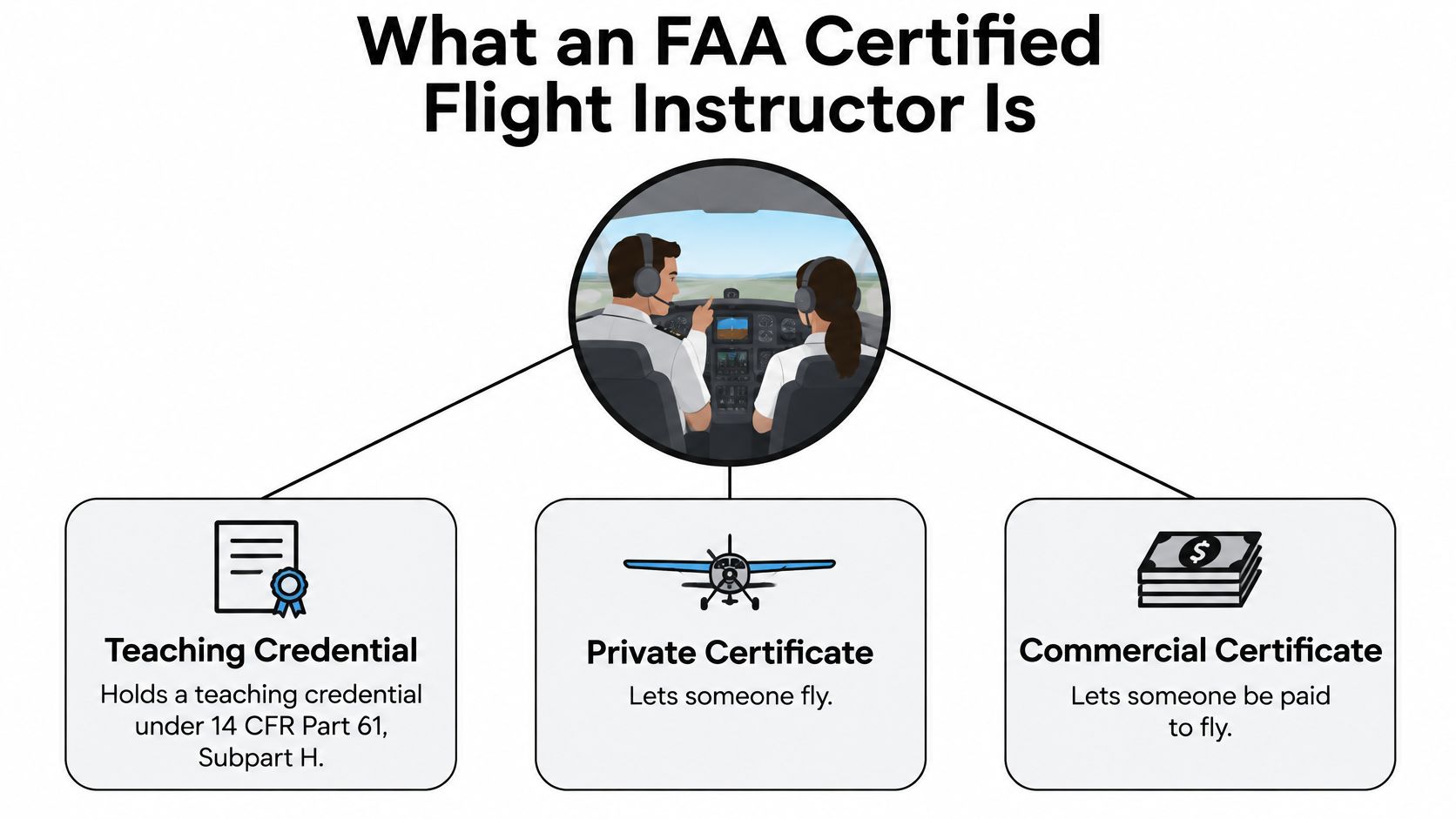
An FAA certified flight instructor holds a teaching credential under 14 CFR Part 61, Subpart H. A private certificate lets someone fly within private-pilot privileges; a commercial certificate establishes qualifications for paid flying, subject to the operating rules. The instructor certificate authorizes training and the logbook endorsements students need, within the instructor's qualifications.
Think of the commercial certificate as a license to do the job of flying and the instructor certificate as a license to teach that job. The different types of pilot licenses serve different purposes.
Understanding the names
CFI means Certified Flight Instructor, although pilots commonly use it as shorthand for an airplane single-engine instructor. CFII, Certified Flight Instructor–Instrument, identifies instrument-instruction authority; a multi-engine instructor rating is separate.
In the FAA's 2024 active civil airmen statistics, the listed flight-instructor certificate grouping recorded 12,531 active certificates, not a count of every working instructor nationwide. Instructors provide much of the dual flight and ground training that prepares private, instrument, commercial, and instructor applicants.
Instructing is also a common first paid flying job for career pilots. Before choosing that path, understand who may apply, how the earlier qualifications fit together, which students a new instructor may teach, and what keeps teaching privileges legally usable.
Eligibility Rules Under Part 61
This is the application checklist established by 14 CFR 61.183 in the FAA's flight-instructor regulations.
Part 61 eligibility for an FAA flight instructor certificate
| Requirement | Standard | Where it lives |
|---|---|---|
| Age | At least 18 years old | 14 CFR 61.183 |
| Language | Able to read, speak, write, and understand English | 14 CFR 61.183 |
| Pilot certificate | Commercial or ATP with the category and class of the instructor rating | 14 CFR 61.183 |
| Instrument privileges | Required for airplane single-engine, airplane multiengine, and instrument instructor ratings | 14 CFR 61.183 |
| Pilot-in-command time | At least 15 hours PIC in that category and class | 14 CFR 61.183 |
| Instruction endorsement | Authorized-instructor endorsement for fundamentals of instructing, unless exempt | 14 CFR 61.183 |
| Tests | Required knowledge tests plus an FAA practical test | 14 CFR 61.183 |
What the checklist means in practice
The age requirement applies to the instructor application, not to the first flight lesson. A younger student can begin learning without yet being eligible to become an instructor.
English proficiency includes reading, speaking, writing, and understanding. In practical terms, an instructor needs to interpret regulations, communicate with air traffic control, explain procedures, and write accurate endorsements.
The pilot certificate requirement is more specific than holding a commercial certificate. Category identifies the broad aircraft group, such as airplane; class distinguishes aircraft such as single-engine land and multiengine land. The qualifications must match the instructor rating sought.
Instrument privileges are another separate requirement. A commercial airplane pilot without the required instrument qualification can't proceed into the airplane instructor ratings or CFII. Commercial flying competence doesn't replace the ability to operate and teach within the instrument environment.
Pilot-in-command experience must also match the category and class. A logbook full of single-engine PIC entries doesn't satisfy the multiengine category-and-class requirement. Before applying, review the actual entries rather than relying on your overall total time.
Training proof is more than test preparation
The fundamentals of instructing cover how people learn, how instructors organize lessons, and how they evaluate performance. Certain teaching credentials recognized by the regulation can provide an exemption from the fundamentals-of-instructing requirement, but that isn't a blanket exemption from instructor preparation.
Your authorized instructor also needs to document the prescribed preparation and readiness for testing. Keep endorsements legible, dated, and connected to the training they certify.
The practical test evaluates teaching as well as flying. For example, you might need to explain why an airplane stalls, demonstrate the maneuver, and identify a student's misunderstanding without letting the explanation distract you from aircraft control.
Application checkpoint: Meeting the eligibility requirements lets you seek the credential. It doesn't mean you've completed the training needed to teach safely.
Treat the table as the application gate, not the training syllabus. An instructor applicant still needs organized lesson plans, demonstration skills, risk-management judgment, and practice explaining procedures in plain language.
The Path From Zero Time to CFII
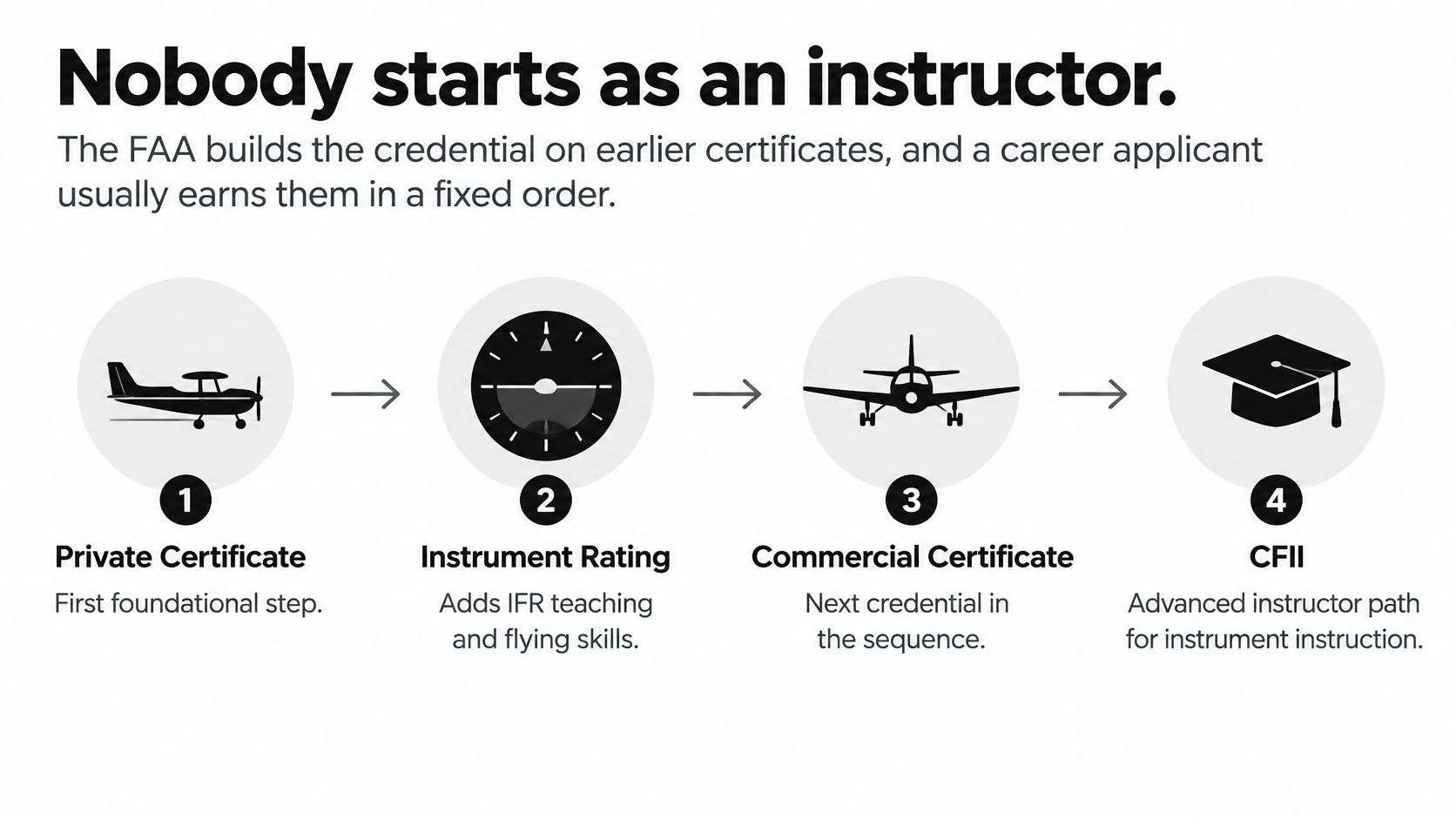
Nobody starts as an instructor. The FAA builds the credential on earlier pilot qualifications, and career applicants usually follow a sequence that develops flying competence before teaching competence.
The diagram gives the broad progression; the steps below separate pilot ratings from instructor ratings.
Build the pilot qualifications first
Arrange your medical assessment. For the conventional airplane career path, obtain a third-class FAA medical certificate from an aviation medical examiner before solo. You can take a discovery flight and initial lessons before obtaining it.
Earn your student and private pilot certificates. You'll learn aircraft control, takeoffs, landings, navigation, and decision-making in visual conditions. The private knowledge test and practical test establish the foundation for later training.
Add the instrument rating. Learn to control the airplane by reference to instruments and operate within the instrument flight rules system. An instrument pilot rating authorizes instrument flying; it doesn't itself authorize instrument instruction.
Earn the commercial pilot certificate. Develop more precise aircraft handling and professional judgment in the category and class you intend to teach.
Turn flying skills into teaching skills
Review your logbook for the category-and-class PIC eligibility requirement. Don't assume a large total automatically satisfies every rating-specific requirement.
Complete fundamentals-of-instructing preparation, required knowledge testing, flight-instructor training, and the CFI practical test. Practice teaching aloud while demonstrating, not merely describing a maneuver after landing.
Add the instrument instructor rating. CFII preparation focuses on teaching instrument procedures, interpreting student errors, and managing workload while the student flies by reference to instruments.
Add multiengine commercial privileges as the syllabus requires. If teaching multiengine students is your goal, pursue the separate multiengine instructor rating and aircraft-specific qualifications too.
The ordering of some add-ons can differ between syllabi. The essential point is that a pilot rating and an instructor rating aren't interchangeable.
This video provides another way to approach the training sequence.
Choose a workable training structure
Part 61 provides the baseline certification structure used in much individual training. Part 141 uses an FAA-approved school syllabus that can have different hour minimums; neither structure eliminates the need to demonstrate competence.
A part-time path can stretch over years when weather, money, and aircraft availability widen the gaps between lessons. Full-time structured training can compress the sequence into months, provided you can sustain the flying and study schedule. Use a pilot certification training overview to identify the milestones before arranging work or relocation.
Your first lesson doesn't need to wait for the medical certificate. Solo does, so resolve medical questions early rather than after committing substantial time and money.
Who a New Instructor Can Teach
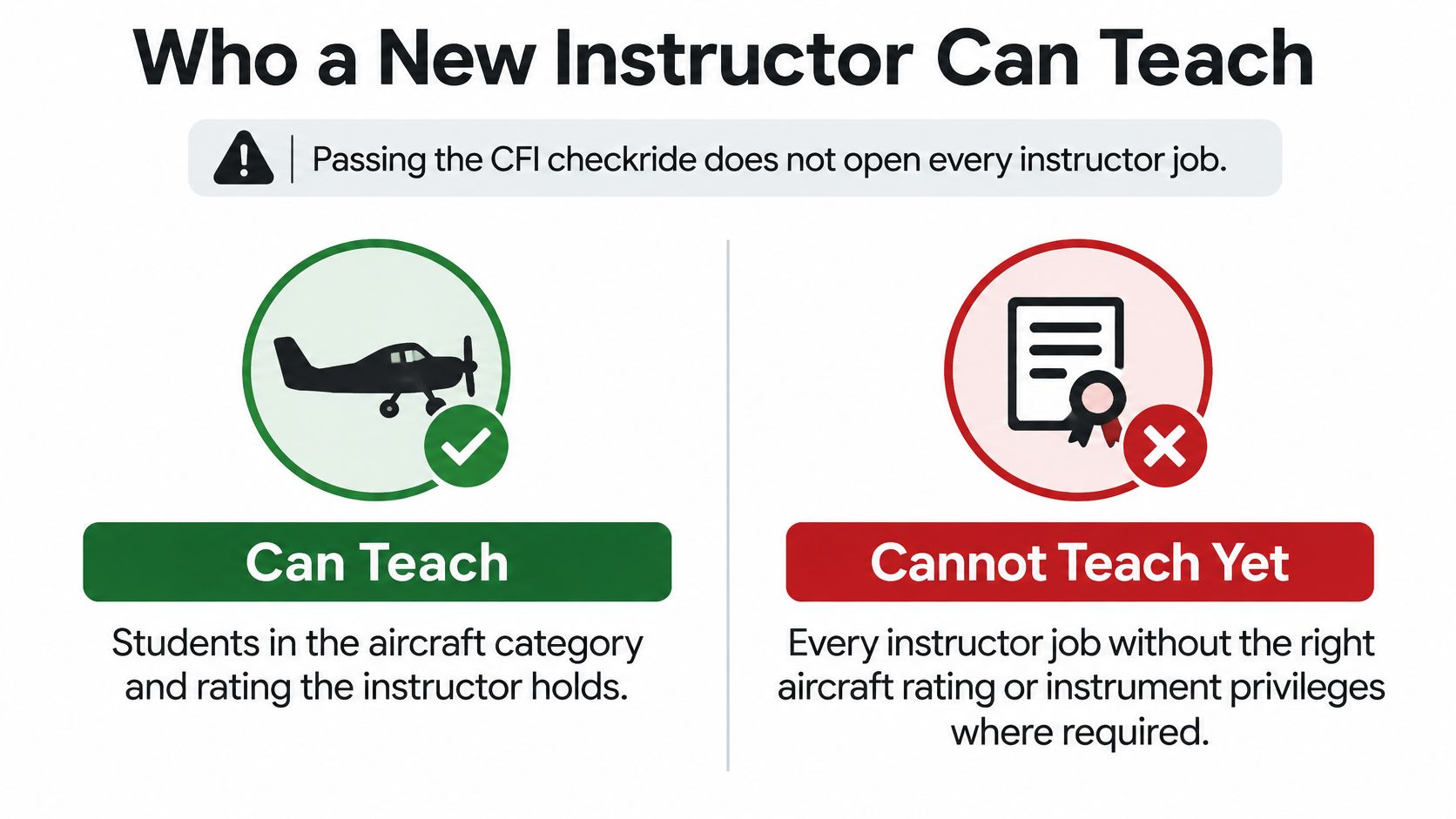
A new CFI certificate covers a wide range of students on day one. The assignment that stays out of reach at the start is training someone else to become an instructor.
The FAA's Part 61 rules for training initial instructor applicants generally require the qualifying instructor to have held a flight instructor certificate for at least 24 calendar months and given at least 200 hours of flight training. Two alternatives exist for instructors who don't meet that combination: a qualifying record built on five practical-test applicants with an 80 percent first-attempt pass rate, or an FAA-approved enhanced qualification program. Each route carries its own conditions, so check the provision that applies to you rather than treating a strong pass record as permission on its own.
What a new CFI may teach
| Student goal | New CFI eligible | Extra rule |
|---|---|---|
| Private pilot applicant | Yes, with the matching category and class | Instructor must be qualified in the aircraft used |
| Instrument rating applicant | Yes, if the instructor holds CFII or otherwise legal instrument-instruction privileges | Underlying instrument privileges required |
| Commercial pilot applicant | Yes, within the ratings held | Category and class must match the training |
| Initial flight instructor applicant | Not automatically | Generally 24 calendar months and 200 hours of flight training, or the qualifying five-applicant/80-percent route, or an FAA-approved enhanced program |
| Multi-engine required training | Only with aircraft-specific experience | At least 5 hours PIC in that make and model under 14 CFR 61.195 |
Every hour of dual instruction you log during those first two years counts toward the 200-hour requirement, so the gate opens through ordinary teaching rather than through a separate course.
Instrument privileges don't remove the experience gate
CFII authorizes instrument instruction when the instructor holds the required underlying qualifications. It doesn't override the separate requirements for initial instructor training.
Say you've just earned CFI and CFII. You may qualify to teach an instrument student how to fly an approach, yet still not qualify to provide the initial instructor training for a commercial pilot seeking a CFI certificate. Both lessons draw on instrument knowledge, and Part 61 places them under different eligibility rules.
Read the student level in a job advertisement
A first instructor role commonly involves primary, instrument, or commercial students. An advertisement for an initial CFI course or instructor academy deserves a closer read, because the school may need an instructor who already meets one of the qualification provisions above.
Before accepting an assignment, identify:
- Student goal: Is the student seeking a pilot certificate, an instrument rating, or an initial instructor certificate?
- Aircraft qualifications: Do your pilot and instructor ratings cover the aircraft and lesson?
- Experience evidence: Can your logbook and applicant records establish the qualifications the assignment requires?
Time away from instructing leaves the certificate in place, but the logbook stops building instructional hours during that period. An instructor who pauses for a year can reach the 24-calendar-month mark without the 200 hours of flight training the advanced assignments require, because the two requirements run on separate tracks.
How Instructor Currency Works
Under 14 CFR 61.197, the FAA's recent-experience regulation, flight instructor privileges run on a 24-calendar-month cycle. The rule gives you several ways to renew, and each one leaves a different paper trail behind it.
Ways to renew flight instructor privileges
| Route | What you show | Timing |
|---|---|---|
| Flight instructor refresher course | Graduation from an FAA-approved FIRC | Within the preceding 3 calendar months |
| Additional or repeat practical test | Pass a practical test for a new instructor rating or one already held | Used as the renewal event |
| Applicant pass record | Records showing qualifying endorsement activity, commonly five practical-test applicants with an 80 percent first-attempt pass rate | Activity inside the 24-calendar-month cycle |
| Evaluation role | Records of eligible instructor, check-pilot, chief-instructor, or pilot-evaluation duties | Activity inside the 24-calendar-month cycle |
| Early renewal | Any valid route completed in the 3 calendar months before the applicable expiration or recent-experience end month | Generally preserves the existing cycle and extends it another 24 calendar months |
Distinguish current rules from older renewal language
Older guidance often describes renewing an expiring instructor certificate. The FAA's Advisory Circular 61-65E describes a three-calendar-month early-renewal window that generally preserved the existing expiration month and extended it another 24 calendar months.
When you apply, cite the current regulation and meet its recent-experience requirements on their own terms. Early completion inside that window preserves your established calendar cycle instead of moving the deadline forward.
Record the applicable end month and check the submission requirements before choosing a course date.
Choose the route you can document
An instructor who teaches steadily may be able to maintain the qualifying applicant record. An instructor who plans to move, pause teaching, or endorse few practical-test applicants should consider an approved flight instructor refresher course, commonly called a FIRC.
Don't rely on memory when an application asks for evidence. Preserve:
- Endorsement records: Copies or clear records of qualifying applicant endorsements and test outcomes.
- Course documents: FIRC completion records and the associated application paperwork.
- Evaluation records: Documentation establishing eligible duties or practical-test completion.
If recent experience lapses, stop exercising instructor privileges and determine the applicable reinstatement process. A missed deadline isn't always handled by submitting ordinary renewal paperwork.
Our CFI renewal requirements guide walks through the paperwork for each route. The practical habit is to manage currency before the deadline, so you never discover a lapse while preparing to endorse a student.
The First Instructor Job and Daily Limits
Paid instructing builds logged experience beside a student while the airline seat remains a later step with its own requirements. The work is narrower and more demanding than the name suggests: you are responsible for a learner's progress and for recognizing when practice is becoming unsafe.
Under 14 CFR 61.195, the FAA's instructor limitations rule, a flight instructor may give no more than 8 hours of flight training in any consecutive 24-hour period. The same rule establishes aircraft qualification requirements, including the corresponding type rating when instructing in an aircraft that requires one. It also limits when an instructor may train an initial flight-instructor applicant, so a first job does not automatically include teaching the next CFI.
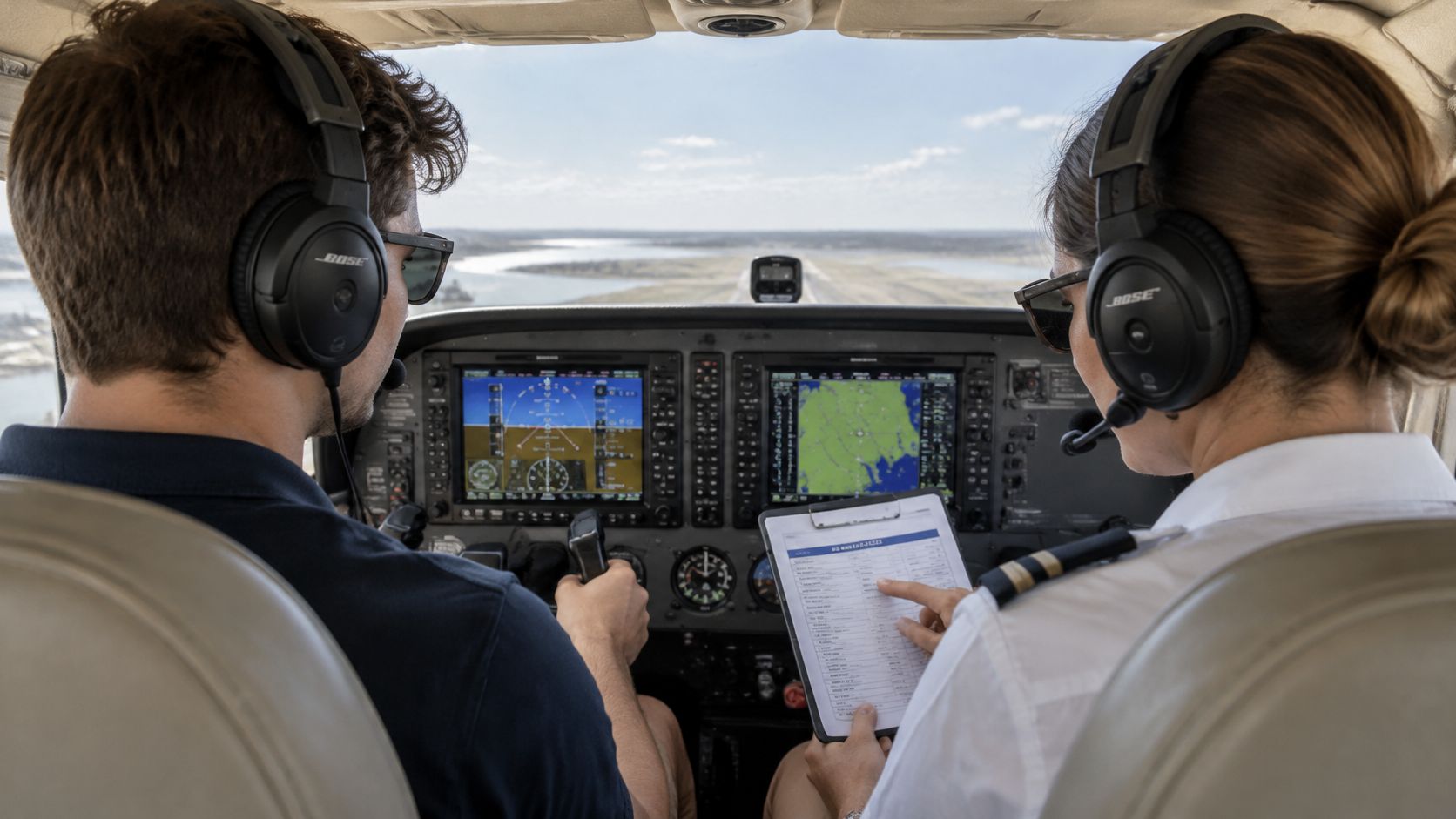
The cockpit work rests on preparation before flight.
A rolling limit shapes the schedule
The flight-training limit is measured across the preceding consecutive period, not reset by a new calendar date. Teach late in the evening, and the early morning still counts against the same 24-hour window.
A training manager can't recover every weather cancellation by extending one instructor's flying day. Additional qualified instructors and available aircraft may be necessary, and maintenance, student readiness, and safe weather still control whether a lesson happens.
Scheduling habit: Check your recent flight-training entries before accepting another flight, especially when evening lessons are followed by early starts.
Briefings, debriefings, and ground teaching also occupy the workday. The regulatory cap counts flight training; it does not declare the rest of the day sensible just because it is legal. Fatigue can erode demonstration quality before a legal limit is reached.
What the first role involves
Each lesson is built around a defined objective and evidence of progress.
- Before departure: Review the objective, weather, aircraft condition, and the student's preparation.
- During flight: Demonstrate when needed, let the student practice, and distinguish a learning error from a situation requiring intervention.
- After landing: Debrief specific actions, assign preparation, record training accurately, and issue endorsements only when justified.
Instructors can build qualifying flight experience while being paid, but cancellations and nonflying work mean progress is slower than a simple multiplication of available days. An airline pilot career plan should account for the kinds of experience required, not just total time.
Southern California's busy airspace provides useful practice in radio communication and traffic awareness. It also requires deliberate lesson planning so the student's workload remains manageable.
The certificate starts an ongoing compliance habit. Currency, aircraft qualifications, accurate records, assignment limits, and the 24-hour schedule remain part of the job.
Frequently Asked Questions
Can I become a CFI with no flight time?
No. Under 14 CFR 61.183, you must already hold a commercial or airline transport pilot certificate with the appropriate category and class ratings before applying. Starting from zero means finishing the underlying pilot training first. The instructor certificate is the final credential on that path, not the first one.
What is the difference between CFI and CFII?
CFI is the general flight-instructor credential, and in everyday airplane training it usually means the single-engine instructor rating. CFII adds instrument-instructor authority and requires the appropriate instrument qualifications. Whichever you hold, you may only teach in the aircraft category and class your ratings cover.
Can a commercial pilot give flight instruction without a CFI?
No. A commercial certificate lets you fly for compensation or hire. Teaching students for pay requires instructor privileges under Part 61, which is why many commercial pilots earn the CFI next. It is the credential that turns flying experience into paid teaching experience.
What should I ask a flight school before signing up?
Ask about airplane age, how many students share each airplane, instructor turnover, the total price in writing, whether training runs under Part 61 or Part 141, and whether you can fly before committing. Those answers reveal scheduling pressure, hidden costs, and program structure in a way a brochure rarely does.
What is a discovery flight, and who is it for?
A discovery flight is a first flight with an instructor before you commit to training. At CFII it runs about an hour, requires no experience, and begins with a walk around the airplane with an instructor and a checklist card. You can take one before holding the third-class FAA medical that solo flying requires, so it works as a low-commitment way to find out whether the cockpit suits you.
Choose a First Flight or Full Path
If you've never flown, take a first flight with an instructor before making a major commitment. Our discovery flight offers that starting point: a chance to experience the cockpit, ask questions, and decide whether you want to continue.
If you already want the complete career sequence, our Career Track has fixed $89,000 tuition, takes about nine months from zero time to CFII and multi-engine, and provides 282 total hours and six certificates and ratings. Training is based in Southern California at Riverside, Long Beach, and Corona.
Match the commitment to the qualifications
That sequence develops the private, instrument, and commercial qualifications before instructor certification. CFII builds on the instructor credential and instrument privileges; it isn't a shortcut around the underlying pilot requirements. Multiengine pilot privileges also shouldn't be confused with a multiengine instructor rating.
The program includes checkrides scheduled with FAA examiners, written-test preparation for every rating, and study materials. Those resources include textbooks, study guides, exam preparation, and a training portal with lessons, quizzes, stage checks, and a logbook.
Our become-a-CFI overview can help you focus on the teaching stage rather than treating it as another flying test.
Settle practical questions before relocating
Before committing, make the decision concrete:
- Medical timing: Arrange the aviation medical assessment early enough to resolve questions before solo.
- Written price: We recommend obtaining the total price in writing, including a clear understanding of what's included and excluded.
- First flight: We invite prospective students to visit the hangar, sit in a cockpit, and meet instructors before committing. Confirm whether you can fly before relocating.
- Study availability: Make room for ground preparation as well as flight appointments. Teaching preparation requires explanation and practice, not just memorization.
Choose the next step that matches your certainty. Book a discovery flight if you need to test the cockpit experience, or review the full training path if your goal is already zero time to CFII.
CFII offers a first flight with an instructor and a structured path toward FAA flight-instructor qualifications. Visit CFII to discuss where you're starting and whether an introductory flight or the full career sequence fits your goal.
Planning to fly for a living?
See what the path from zero to a pilot career looks like, what it costs and how long it takes.
Learn to fly in Riverside
We train at Riverside Municipal Airport in modern airplanes with a parachute built in. Start with a one hour discovery flight, no experience needed.