

On this page
- Start With Your Pilot Training Goals
- Choose the destination before the package
- Map the Pilot Career Training Pathway
- Build skills before chasing the next credential
- Understand what remains after initial training
- Compare Pilot Course Options Side by Side
- Pilot course comparison by training scope
- Demand comparable information
- Evaluate the CFII Career Track
- Read the scope behind the headline
- Evaluate predictability rather than speed alone
- Assess Training Delivery and Support
- Look for evidence of learning
- Make equipment serve the syllabus
- Choose a Course for Your Specific Situation
- If you're a beginner or already hold a private certificate
- If you're relocating or changing careers
- If your goal is paid instruction
- Make a Confident Pilot Course Decision
- Use a written decision standard
- Make the next commitment proportionate
You've got flight-school tabs open, a list of unfamiliar certificates, and a question that sounds simpler than it is: which pilot course should you buy? One program advertises a short timeline, another starts with private training, and neither headline tells you clearly what happens when the training ends.
The right course for pilot training depends on where you're starting and what you need next. Choose around the qualification, the financial commitment, and the next realistic employment milestone, not the shortest advertised graduation date.
Start With Your Pilot Training Goals
If you've never flown, you're making a different decision from someone who has already soloed. You're still testing whether you enjoy the work itself: preparation, procedures, cockpit workload, and the responsibility of making decisions. A private pilot comparing instrument courses has already answered some of those questions.
Start by describing your situation without using a school's marketing language. You might be a beginner exploring a career, a private pilot seeking advanced qualifications, or a commercial pilot preparing to teach. Those starting points belong in different conversations.
| Your current stage | Sensible course category | Decision to resolve first |
|---|---|---|
| No flight experience | Discovery flight, then private or integrated career training | Do you want the daily work of learning to fly? |
| Solo experience | Private-certificate completion | How will existing training fit the syllabus? |
| Private pilot certificate | Instrument and commercial progression | What experience and qualifications remain? |
| Advancing toward instruction | Instructor training | How will you demonstrate teaching readiness and find paid work? |
Choose the destination before the package
A beginner who wants recreational flying shouldn't buy a professional pathway just because it includes more credentials. Conversely, an aspiring career pilot shouldn't judge a private-only course as though it covers the entire professional journey.
Before comparing offers, write down your intended work, available study time, spending limit, and willingness to relocate. Then ask each school to explain credentials, duration, delivery format, included hours, total financial exposure, and the next employment milestone in those terms.
- Starting experience: Have an instructor review your logbook rather than assuming previous lessons transfer neatly.
- Time commitment: Decide whether you can organize work and family responsibilities around training.
- Location: Evaluate the practical consequences of commuting or moving, not just the airport's appeal.
- Career intention: Separate learning to fly from preparing to teach or pursuing airline employment.
If you haven't flown, a discovery flight is a sensible way to examine that first decision before committing to a full pathway.
Practical rule: Buy the course that fits your next verified milestone. Don't buy a career outcome that the course itself cannot deliver.
Completing training and qualifying for airline employment are separate achievements. Keep both on your planning sheet, with a distinct plan for the period between them.
Map the Pilot Career Training Pathway
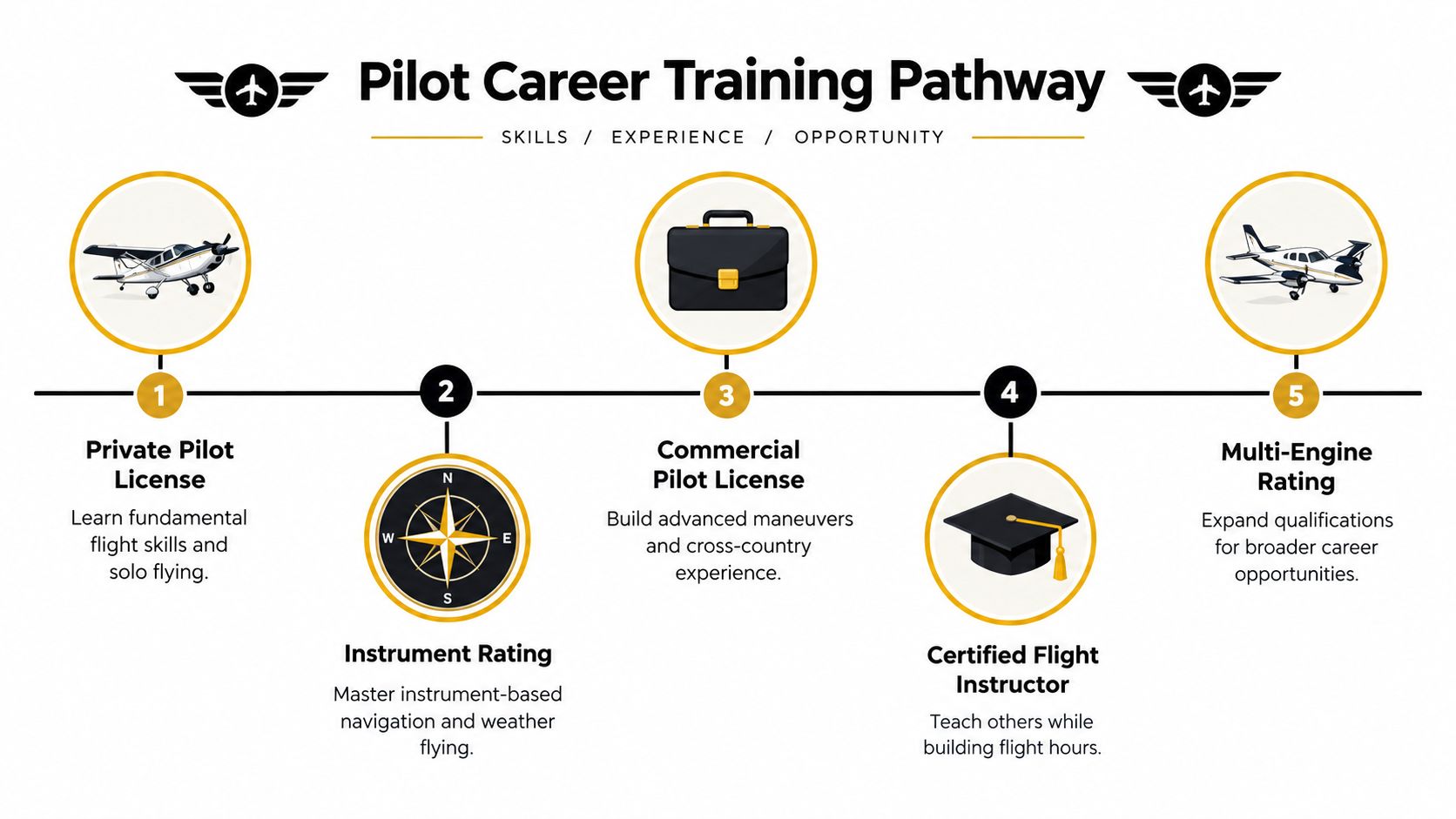
Treat professional training as a sequence of capabilities, not a collection of abbreviations. Each stage should prepare you for the demands of the next, while your experience record develops alongside your certificates.
This pathway illustrates the main training stages, although your precise sequencing should follow your prerequisites and approved training plan.
Build skills before chasing the next credential
Private training establishes fundamental aircraft handling, preparation, navigation, and judgment. Instrument training develops procedural flying and instrument-based decision-making. Commercial training builds the proficiency and experience needed for the applicable commercial qualification.
The experience requirements matter as much as the course titles. For an airplane single-engine commercial certificate under the cited Part 61 provision, the FAA generally requires 250 hours, including specified pilot-in-command, cross-country, instrument, aircraft-training, and night experience, so completing private and instrument courses alone doesn't establish commercial eligibility under that route (14 CFR § 61.129).
Instructor preparation changes the task again. You must be able to explain, demonstrate, assess, and correct, not just perform a maneuver yourself. Multi-engine training adds another aircraft qualification, but it shouldn't be mistaken for a substitute for teaching readiness.
Use this accompanying video as another introduction to the training journey.
Understand what remains after initial training
The FAA's airline-pilot qualification rule generally requires an unrestricted ATP applicant to be at least 23 years old with 1,500 hours of total pilot flight time and prescribed experience; qualifying university pathways can support restricted ATP eligibility at 1,000 or 1,250 hours, subject to the applicable conditions (FAA pilot certification and qualification rule).
That framework makes the bridge after training economically important. Instructor qualifications can support an application for paid teaching work, but you still need an actual position, suitable flying activity, and qualifying experience.
- Initial qualification: Complete the applicable training and certification requirements.
- Instruction readiness: Develop teaching competence and satisfy the requirements for the instruction you intend to provide.
- Experience progression: Build and document the experience needed for your intended operation.
The FAA also identifies formal ATP Certification Training Program requirements within the relevant ATP pathway (FAA ATP training guidance). Use the broader guide to becoming a pilot to organize your questions, then have your proposed route checked against your actual records.
Compare Pilot Course Options Side by Side
A private course and an integrated career pathway aren't competing versions of the same purchase. They solve different problems. Compare them by what they include and what you must arrange afterward.
Pilot course comparison by training scope
| Course Type | Best Starting Point | Training Scope | Delivery and Schedule Questions | Best-Suited Student | Key Limitation |
|---|---|---|---|---|---|
| Private-only | Beginner or student completing initial training | Foundational flight training toward the private certificate | How are lessons, ground study, and interruptions handled? | Someone testing long-term commitment or pursuing private flying | Doesn't cover the professional pathway |
| Instrument | Pilot meeting the course prerequisites | Instrument procedures, navigation, and decision-making | How are aircraft and simulator sessions integrated? | A pilot progressing beyond visual flying | Doesn't replace commercial or instructor preparation |
| Commercial | Pilot with appropriate prior qualifications and experience | Commercial proficiency and required experience | Who audits the logbook and identifies missing experience? | A pilot pursuing professional qualifications | Certificate completion isn't a job offer |
| Instructor | Pilot meeting the relevant instructor-course prerequisites | Teaching preparation, demonstrations, and assessment | How much practice teaching and feedback are included? | A prospective flight instructor | Teaching qualifications don't establish workload or income |
| End-to-end career pathway | Beginner seeking a connected professional syllabus | Multiple certificates and ratings under a coordinated plan | What happens when progress or testing falls behind schedule? | A student ready for sustained training | Requires substantial commitment and a separate post-training plan |
Demand comparable information
There's no universal price, duration, or included-hour total for these categories. Ask for the school's actual syllabus and written terms rather than filling missing fields with an assumed industry average.
For a modular route, require a quote for the next stage and a realistic explanation of what follows. For an integrated route, require a credential-by-credential scope so you can see whether the package includes the qualifications you need.
Delivery deserves equal attention. A school might offer flexible booking, a tightly organized training calendar, or a combination of independent study and scheduled instruction. None is automatically right for you, so ask how the proposed arrangement fits your availability.
The Part 61 versus Part 141 comparison can help you frame questions about the training structure. Don't choose solely from the regulatory label; examine the actual course and the requirements that apply to you.
- Scope and hours: Request aircraft time and simulator time separately, with the intended purpose of each.
- Price boundaries: Ask which expenses sit outside tuition and what happens when additional training is necessary.
- Scheduling responsibility: Establish who arranges aircraft, instructors, assessments, and practical tests.
- Next milestone: Ask what qualification or employment application the course prepares you to pursue.
More certificates aren't automatically better value. A well-matched instrument course can be a better purchase for an existing private pilot than a beginner package containing training they don't need.
During school outreach, scrutinize the delivery questions and key limitations most closely. Those columns reveal whether the school has explained the difficult parts, not just the appealing endpoint.
Evaluate the CFII Career Track
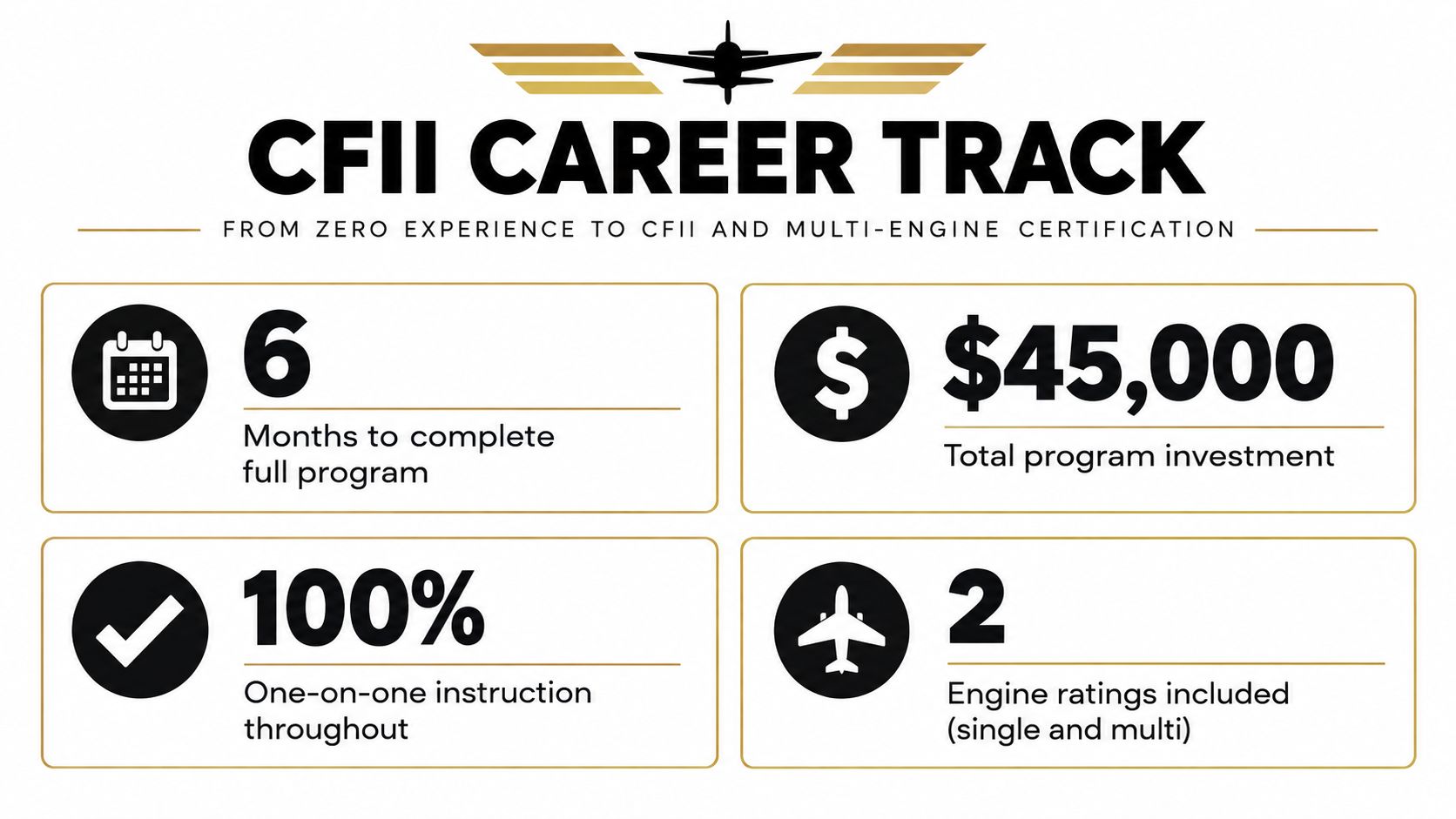
If you are starting from zero and want one connected syllabus instead of buying ratings one at a time, CFII's Career Track is the package to benchmark against the modular route. The Career Track program lists fixed tuition of $89,000, approximately nine months from zero time to CFII and multi-engine, 282 total training hours, and six certificates and ratings, with Southern California bases in Riverside, Long Beach, and Corona.
Read the scope behind the headline
The listed credentials run from private through instrument, commercial single-engine and multi-engine, and on to flight instructor and instrument instructor. The last two ratings are what make this a career track. They qualify you to instruct for pay, which turns post-graduation hour-building from an expense into income.
The published hour allocation is 204 single-engine hours, 25 multi-engine hours, and 53 simulator hours, according to the published Career Track hour breakdown. Treat those as three separate categories. Airlines and examiners weigh aircraft time against simulator time differently, and the total describes training completed. You will still need further logged experience before airline applications are realistic.
Ask for a sample completion record showing how aircraft and simulator activity will be documented. The number that matters for your next step is the logged experience a hiring pipeline can read.
The program graphic below contains older price and duration figures that conflict with the current published terms stated above. Do not use its price or timeline to budget or plan enrollment.
Evaluate predictability rather than speed alone
A fixed tuition figure is useful only when you understand the agreement behind it. Get the boundaries in writing before treating that number as your complete career-training budget.
- Included instruction: Confirm the flight, ground, study, and assessment support covered by tuition.
- Testing expenses: Establish how written tests, examiner charges, repeat tests, and associated retraining are handled.
- Interrupted progress: Ask what happens after an extended absence or a stage that requires additional work.
- Completion conditions: Clarify the student responsibilities attached to the published schedule.
Optional housing and financing deserve separate decisions. Request current availability and terms, then weigh living expenses, repayment obligations, and the cost of a delayed move into paid flying.
A fixed training price can make tuition easier to compare. It doesn't make every living expense, financing obligation, or post-graduation outcome fixed.
For a realistic picture of what a compressed schedule demands, read the accelerated flight-training discussion before you commit. My recommendation: choose this format only if you can protect the time for both scheduled training and independent preparation, and only after the written boundaries above are in hand.
Assess Training Delivery and Support
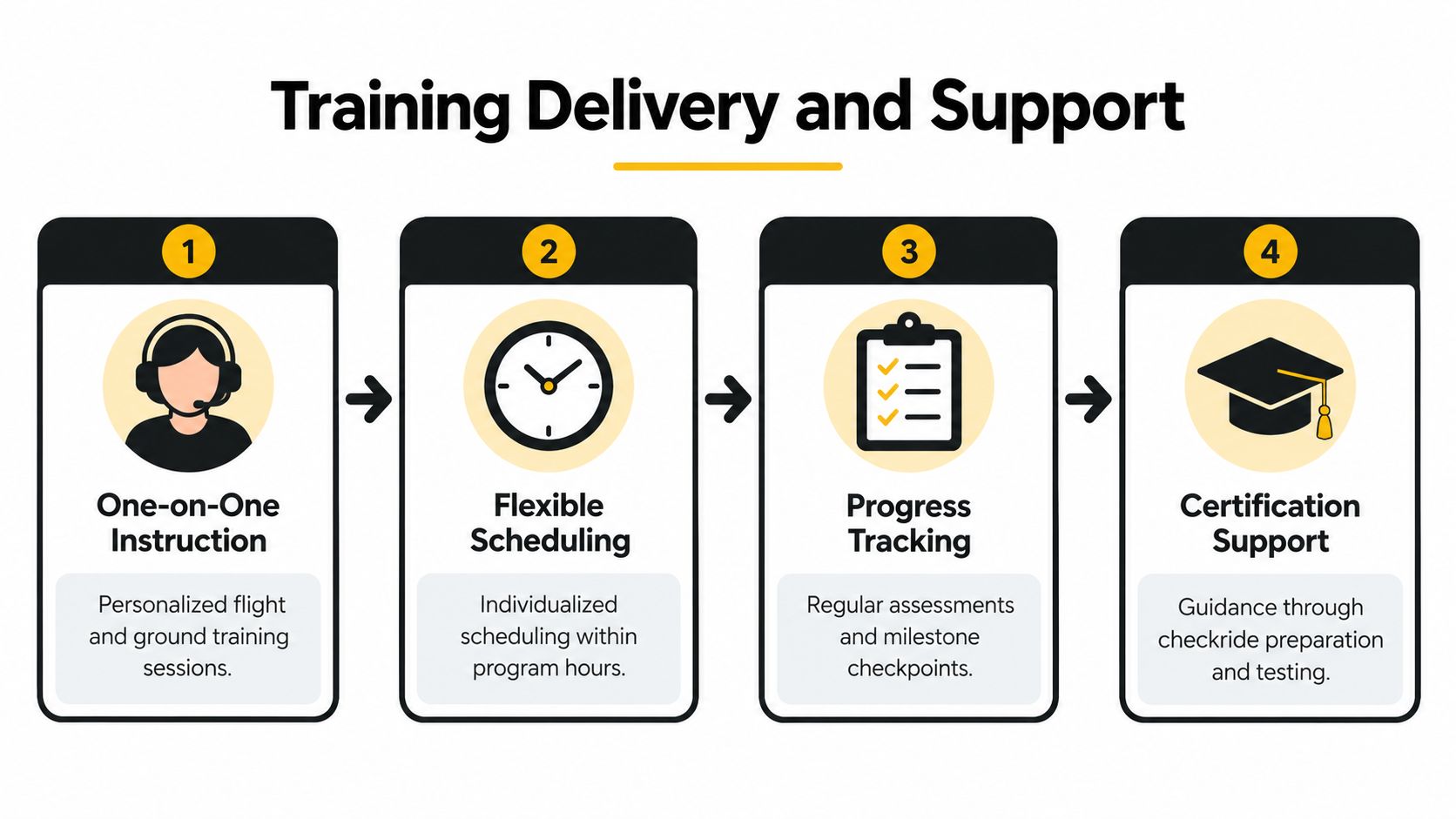
A school should be able to explain how it recognizes a struggling student before that student reaches a practical test. Attractive aircraft and a full calendar aren't enough. Ask to see the teaching process, assessment criteria, and remediation plan.
The featured program describes individualized flight and ground instruction, cohort-based intake, and daily scheduling adapted to student progress. Verify how those arrangements work together: a shared intake date shouldn't mean every student must progress at an identical pace.
This process graphic highlights the support functions to examine during your school visit.
Look for evidence of learning
A training portal can organize lessons, quizzes, written-test preparation, stage checks, and a digital logbook. Its value depends on what instructors do with the information.
Ask an instructor to explain the response to a student who passes a quiz but struggles to apply the same knowledge in flight. A credible answer should describe diagnosis, targeted practice, reassessment, and documentation rather than just assigning the lesson again.
- Before the lesson: Identify the standard and what the student should prepare.
- During practice: Distinguish a knowledge gap from an aircraft-handling or workload problem.
- After the lesson: Record what met the standard and what needs further work.
- Before advancement: Use a stage check to test readiness beyond lesson completion.
Make equipment serve the syllabus
Ask to inspect the aircraft and simulators you would use. For a modern glass-cockpit fleet, discuss how instructors teach automation management, basic instrument skills, and emergency decision-making without allowing equipment familiarity to stand in for judgment.
The supplied research on virtual training supports a cautious conclusion: reported conceptual understanding, procedural familiarity, and confidence are useful preparation signals, but they aren't proof of cockpit competence (peer-reviewed virtual-training research).
Use simulator sessions for defined objectives such as instrument procedures, radio work, checklist discipline, and emergency rehearsal. Then ask how the instructor checks whether that practice transfers to aircraft performance; the aircraft flight-simulation guide provides useful context for that conversation.
Checkride coordination deserves the same scrutiny. Ask who handles examiner scheduling, what readiness evidence is required before booking, and what happens if an appointment changes.
Coordination is administrative support, not a promise of first-attempt success. A responsible school should be willing to delay a test when the student hasn't demonstrated readiness.
Choose a Course for Your Specific Situation
A course that fits a full-time career starter can be the wrong purchase for a private pilot funding lessons around a day job. The right choice depends on which trade-offs your situation can absorb: time, money, relocation, and how you plan to build hours after graduation.
If you're a beginner or already hold a private certificate
Start smaller than your ambition. A true beginner should book discovery flying and gauge the workload of private training before buying advanced qualifications; you can evaluate the career pathway without committing to all of it.
If you've soloed, hand the school your logbook and ask for a written review. What can be credited, what must be reassessed, and how will unfinished training fold into their syllabus?
A private pilot faces a different problem: sequencing instrument and commercial work without paying twice. Have the school map your missing experience against the applicable requirements, then ask whether a targeted course or a broader package closes those gaps at a fixed price.
- Beginner priority: Test fit and understand the workload.
- Student-pilot priority: Establish a defensible completion plan.
- Private-pilot priority: Avoid paying for duplicated scope while leaving experience gaps unresolved.
If you're relocating or changing careers
The schedule that matters isn't graduation day. It's the stretch between your first payment and your first professional flying paycheck, a period you must fund without assuming airline income.
Ask how daily training is scheduled and whether outside work is realistically compatible with the expected preparation. If you're relocating to Southern California, price out housing, transportation, family obligations, and access to your assigned training base before signing anything.
Keep tuition, living costs, and financing obligations in separate budget categories. The flight-training cost guide can help structure that review, but your decision should rest on your own written terms and cash-flow plan.
If your goal is paid instruction
The optional Work with us add-on carries a $15,000 price, a 25-hour instructor bootcamp, 175 guaranteed paid instructing hours at $30 per hour, and a stated minimum of 480 total hours by month 18, per the Career Track program terms described earlier. Read that as a specific contractual proposition to investigate, not a standing offer of employment.
Ask what makes a participant eligible, when paid instruction begins, how assignments are scheduled, and what happens during interruptions. Clarify which activities are paid, how the employment is structured, and which records support the stated experience total.
Evaluate the paid-hour agreement separately from the training agreement. You need to understand both before relying on either.
The work you intend to pursue matters too. Federal operating rules distinguish 500-hour pilot-in-command requirements from 1,200-hour IFR pilot-in-command requirements for certain operations, with additional experience conditions (14 CFR Part 135). Finishing a course gets you certificates; it does not by itself make you eligible for every paid flying job, so have your instructor identify which rules govern the job you want.
Make a Confident Pilot Course Decision
You've already done the hard part: mapping the pathway, comparing programs, and checking what each course includes. Now the decision comes down to one test. Pick the course whose written commitments match your starting point, available time, and financial capacity. If you can't explain the purchase in plain terms without quoting marketing language, you aren't ready to sign.
Two applicants can evaluate the same program and reach opposite conclusions. A zero-time student and a private pilot with 120 hours need different scope, different pricing, and different next steps. Your written goals from the first section are the measuring stick here, not the school's pitch.
Use a written decision standard
Bring the same questions to every course discussion so you can compare answers fairly.
- Eligibility: Has someone checked your existing certificates, experience, and prerequisites?
- Scope: Are the intended certificates and ratings named explicitly?
- Preparation: Are written-test study, practical-test preparation, and stage assessments explained?
- Access: Can the school describe how aircraft, simulators, and instructors are assigned?
- Financial terms: Are inclusions, exclusions, additional-training conditions, and cancellation terms documented?
- Personal logistics: Can you sustain the proposed attendance, commute, or relocation?
- Post-course plan: Is any paid flying arrangement supported by specific terms rather than an implication?
Ask for a written response to a difficult scenario, too. For example, what happens if you need additional instruction just before a scheduled practical test? The answer should spell out the academic decision, scheduling responsibility, and financial consequences. A school that answers confidently in writing is a safer bet than one that reassures you verbally.
Make the next commitment proportionate
Match the size of your commitment to what you know today. For someone seeking the complete zero-to-instructor route, the full Career Track terms, linked in the evaluation section above, are the appropriate next document to review. For someone who hasn't flown, the introductory-flight decision should come before a large training commitment.
Don't treat accelerated completion as an employment guarantee. Evaluate the training endpoint and the subsequent experience-building plan separately, then decide whether both are credible for your circumstances. Finishing fast helps only if the hours afterward are funded, scheduled, and structured.
My recommendation is straightforward: choose the narrowest course that fully serves your next goal, or an integrated pathway whose entire scope you need. Prefer clear prerequisites, documented costs, measurable progress standards, and a believable post-training plan over a more exciting headline.
CFII offers a connected Career Track for aspiring professional pilots who want to evaluate a zero-time-to-instructor pathway rather than assemble every stage separately. Visit CFII to discuss your starting experience, request current enrollment terms, and decide whether a discovery flight or full career-training consultation is the right next step.
Planning to fly for a living?
See what the path from zero to a pilot career looks like, what it costs and how long it takes.
Learn to fly in Riverside
We train at Riverside Municipal Airport in factory-new airplanes with a parachute built in. Start with a one hour discovery flight, no experience needed.