

On this page
- Finding Out Your CFI Has Lapsed
- The Two-Tier Reinstatement System
- The deadline that controls your options
- The Short-Lapse Route Through a FIRC
- What to do, in order
- The Long-Lapse Route Through a Practical Test
- Choose the route that matches your goal
- What the Reinstatement Practical Test Actually Tests
- Study like an instructor, not just a pilot
- Common Scenarios and Judgment Calls
- A few judgment calls worth making early
- Getting Back in the Air and Staying Current
You probably found this the hard way. A flight school wants an active CFI, a former student asks for a sign-off, or you check your records and realize your recent experience window is gone while the certificate still looks fine in the drawer. That's the trap: a certificate can look valid while your instructional privileges are already dead.
If you need cfi reinstatement requirements, stop thinking in terms of “expired paper” and start thinking in terms of the last month of recent experience. That date decides whether you can use a refresher course or whether you're headed to a practical test. The wrong assumption costs time, money, and credibility.
Finding Out Your CFI Has Lapsed
The first thing to do is stop calling it a renewal problem. Under the FAA rules, the key question is whether you can still exercise flight-instructor privileges, and that depends on the recent-experience clock, not the plastic in your wallet. A valid-looking certificate does not give you permission to teach if the recency requirement has fallen off.

The date that matters is the month your recent experience ended, not the date you noticed the problem. If you're trying to recover privileges, you need to know whether you're still inside the short reinstatement window or already past it. That is the decision that drives everything else.
Practical rule: if you can't identify the last month of recent experience immediately, you're not ready to pick a reinstatement path yet.
Use the FAA's status inquiry, your logbook entries, and any old instructor records to pin that month down. The label “lapsed” is too sloppy to be useful. The FAA treats this as a privilege problem, not a paperwork cleanup, and the distinction matters because you can be grounded even while holding the certificate itself. For a broader refresher on baseline instructor requirements, review the CFI requirements overview.
The Two-Tier Reinstatement System
The FAA runs cfi reinstatement requirements on two tracks, and the split is straightforward once you stop treating lapse as the same thing as expiration. Under 14 CFR § 61.197, you may exercise flight-instructor privileges only if, within the preceding 24 calendar months, you have met an approved recent-experience pathway. Miss that cycle, and the certificate alone does not keep you instructing. The regulation text makes that 24-month cycle explicit
The deadline that controls your options
The dividing line is the three-calendar-month threshold. If no more than three calendar months have passed since the last month of your recent-experience period, a Flight Instructor Refresher Course can still restore your standing. Once you are beyond that point, a FIRC by itself will not do the job, and you are into the practical test route. The reinstatement rule lays out that split directly
That distinction matters even more now that newer flight-instructor certificates no longer carry the old routine expiration date. The card can still look valid while the privilege has already fallen away. For some older unexpired certificates issued before December 1, 2024, the transition rule still ties renewal to the old expiration month if the instructor wants to avoid reinstatement.
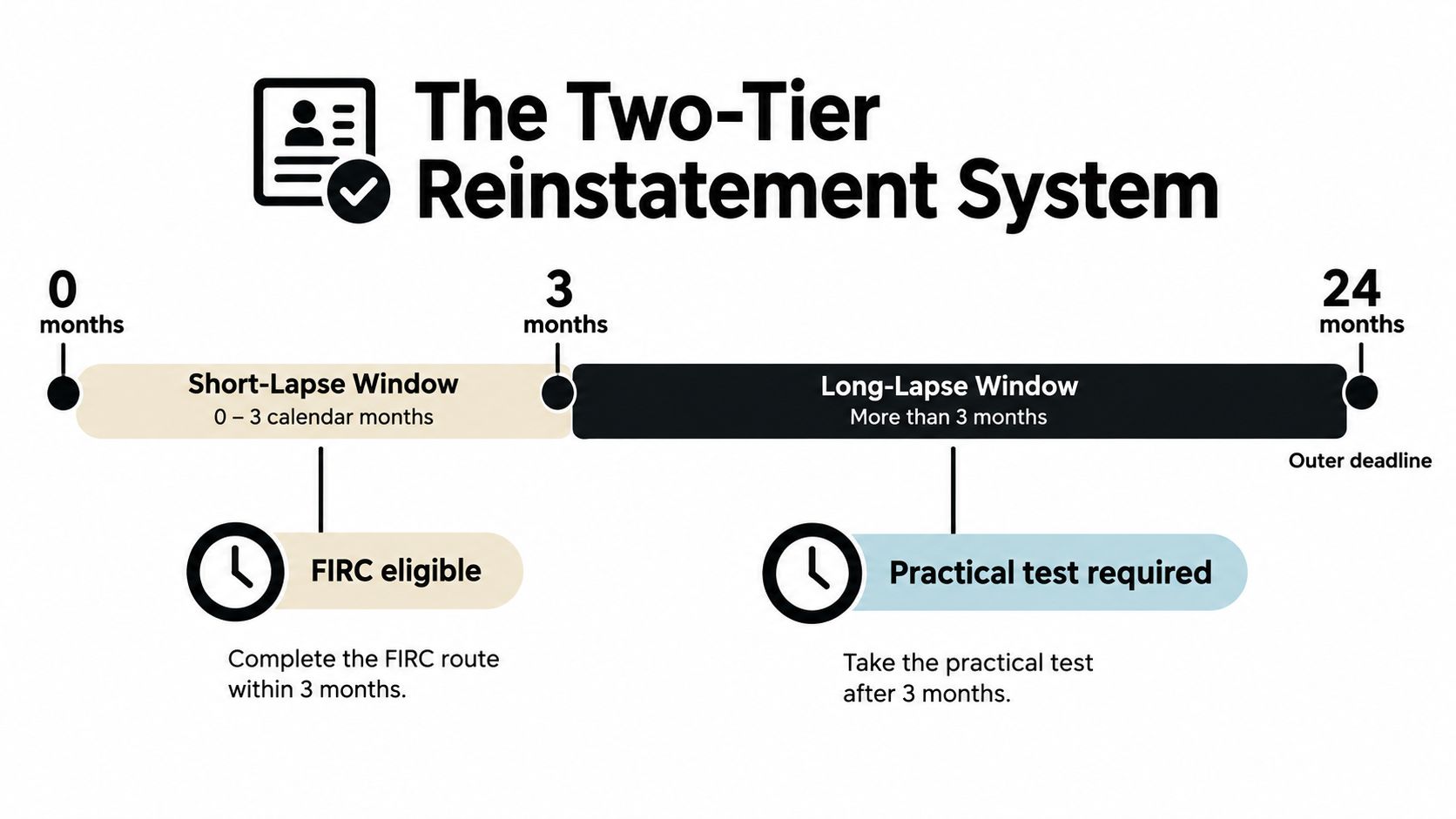
Recent experience first, certificate status second. If the privilege has lapsed, the date controls the route.
For training providers, that split decides the next move. A former instructor either goes to refresher training or starts preparing for a practical test. Telling someone to retake the checkride while the FIRC window is still open wastes time and money.
The Short-Lapse Route Through a FIRC
If you're still inside the three-calendar-month window, don't waste time chasing a practical test unless you have another reason to take one. An approved Flight Instructor Refresher Course is the clean route when the lapse is short, and the rule allows ground training, flight training, or both. The point is to reestablish recent experience, not to punish you for letting the calendar slip.
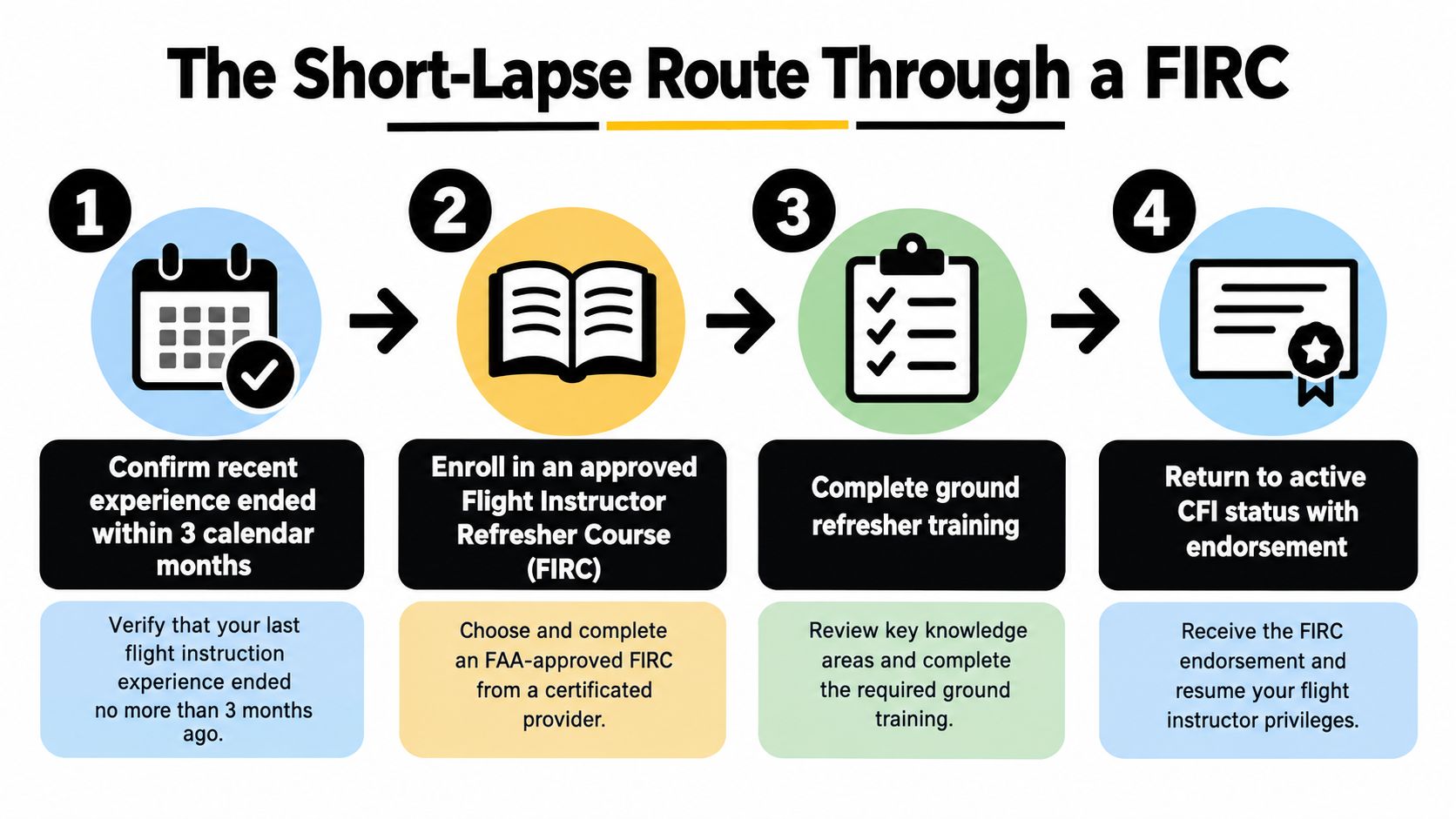
What to do, in order
Pick a real approved course, not a marketing page that sounds like one. You want a provider that issues the completion record needed for FAA processing. The course should line up with the kind of instruction you've been away from, especially if your comfort is weak on current regs, endorsements, or practical teaching methods.
Complete the refresher work seriously. A FIRC is not a box-checking webinar, and the FAA treats it as a structured reinstatement method for short lapses. If you treat it like a passive lecture, you'll probably miss the chance to clean up the exact weaknesses that got you stale in the first place.
Then make sure the completed and signed application is ready to go with the course record. The rule is about reinstating privileges, so the paperwork has to line up with the training result. A school, examiner, or qualified FAA process holder still has to validate the package before you can teach again.
Operational advice: don't assume you can instruct just because your application is in motion. The safe move is to verify active status before you put your name on another endorsement.
If you want a practical comparison point for choosing training formats, CFII's renewal-requirements guide shows how a structured training environment handles instructor currency and paperwork coordination.
The Long-Lapse Route Through a Practical Test
Once you're past the three-calendar-month window, stop shopping for a shortcut. The FIRC alone is no longer enough, and the FAA wants a flight-instructor practical test. You can do that for a rating you already hold, or you can do it as the practical test for an additional instructor rating if that makes more sense for your certificate plan.
Choose the route that matches your goal
If you only need to restore what you already had, the practical test for a rating already held is the direct path. If you're using the lapse as an excuse to add another instructor privilege, then the additional-rating route may make more sense. Either way, you're no longer in refresher-course territory.
Paperwork has to be tight. Have the application signed, your logbook entries clean, and your ratings history easy to follow. Examiners don't want to dig through a messy timeline to figure out whether you're eligible, and neither does the FAA.
Scheduling matters too. Don't wait to find an examiner until your materials are half-ready. A practical test route takes coordination, and the sooner you line up the availability, the less likely you are to drift into a longer delay that only compounds the problem.
The critical mindset shift is simple. After three months, you're not “renewing” in the casual sense anymore. You're proving competence under the FAA's reinstatement framework, and that means preparing like a checkride candidate, not like someone filling out a form.
What the Reinstatement Practical Test Actually Tests
The FAA does not treat reinstatement as a courtesy review. FAA guidance says the examiner may require all or any portion of the applicable test needed to determine competence, and failure produces a notice of disapproval, not reinstatement. That's the level of seriousness you should bring to prep. The FAA's CFII testing guidance spells that out.
Study like an instructor, not just a pilot
Your oral prep needs to cover the stuff that drives instruction. That means instrument-airplane regulations, weather, instrument procedures, alternate requirements, aircraft systems, avionics, teaching techniques, endorsements, and scenario-based instruction. If you can perform a hold but can't teach one, you're not ready.
Your flight prep has the same standard. The examiner is watching whether you can explain, correct, and teach, not just fly a clean profile. That's a different skill from personal proficiency, and instructors often get tripped up by confusing the two.
| Reinstatement Practical Test Preparation Checklist | What to Prepare | Why It Matters |
|---|---|---|
| Current certificate data | Verify ratings and privileges on the certificate | The examiner needs a clean eligibility picture |
| Experience timeline | Document the last month of recent experience | This controls the reinstatement path |
| Signed application | Complete the FAA paperwork accurately | Bad paperwork slows or blocks processing |
| Logbook endorsements | Bring organized, readable entries | The record has to support your story |
| Oral prep | Review regs, weather, systems, and teaching scenarios | The test includes instruction, not just knowledge |
| Flight prep | Practice approach explanation, failures, and corrections | Competence has to show in both handling and teaching |
| Coordination | Set aircraft and examiner details early | Scheduling gaps create avoidable delay |
There's a hidden rule instructors miss all the time. FAA testing guidance says renewing or reinstating one rating on a Flight Instructor Certificate renews or reinstates all privileges existing on that certificate. That helps you, but it doesn't lower the standard. You still have to satisfy the eligibility and testing requirements that apply to your case.
For a deeper look at what a checkride really feels like from the applicant side, review the checkride overview.
Common Scenarios and Judgment Calls
A lot of instructors lose money because they react to the wrong problem. The most common one is the CFI who pays for a practical test while still inside the short-lapse window. That's an expensive mistake, because a FIRC may still have been legally available.
Another common error is the CFII who thinks the instrument privilege lapsed separately from the rest of the certificate. It doesn't work that way. The privilege analysis has to be done against the instructor certificate as a whole, which is why sloppy assumptions create bad advice.
If you're instructing abroad or your employer is checking your status, the distinction between holding the certificate and being allowed to exercise privileges becomes important fast. A physical certificate can look fine while the legal authority to teach is gone. That's not a semantic issue, it's a scheduling and compliance issue.
A few judgment calls worth making early
- Check the last valid month first: That date decides whether a FIRC is still available.
- Do not teach on assumptions: Verify active privilege status before accepting students.
- Treat logbook endorsements carefully: If your privileges are suspended, casual signing is the wrong move.
- Don't confuse reinstatement with ordinary renewal: They're different legal routes with different consequences.
The right response is usually boring and disciplined. Find the date, choose the legal route, and stop improvising. Instructors who do that usually recover faster than the ones who keep asking whether a shortcut exists.
Getting Back in the Air and Staying Current
Once reinstatement is approved, verify that the FAA airman inquiry reflects active status before you resume teaching. Then tell your flight school, students, and anyone else who relies on your instructor authority. If you skip that step, you can create confusion even after the FAA side is done.
A good way to think about the next 24 months is to build a system, not a hope. Set reminders tied to the month your recent experience window will come due again, and keep your records clean enough that you can answer the status question in seconds. That's the difference between being current and merely having once been current.
Structured training environments do this well. A program like CFII combines one-on-one instruction, coordinated checkrides, study resources, and an integrated training portal, which is the model instructors should copy when they rebuild their own currency habits. Not because you need the same product, but because you need the same discipline around scheduling, documentation, and proficiency.
If you want to stay out of lapse territory, use the same logic on yourself that you'd use with a student. Keep the timeline visible. Keep the paperwork ready. Keep the next deadline in front of you instead of behind you.
- Confirm the date: Find the last month of recent experience.
- Pick the route: FIRC if you're still inside the short window, practical test if you're not.
- Gather the paperwork: Application, logbook, and any supporting records.
- Schedule early: Don't wait for examiner or course availability to become your excuse.
- Set the reminder now: Put the next 24-month window on your calendar before you fly another lesson.
If your CFI has slipped out of recent experience, CFII can help you map the right path back without guessing. Use CFII to compare structured training options, then get the paperwork, prep, and scheduling lined up before the lapse turns into a longer problem.
Planning to fly for a living?
See what the path from zero to a pilot career looks like, what it costs and how long it takes.
Learn to fly in Riverside
We train at Riverside Municipal Airport in factory-new airplanes with a parachute built in. Start with a one hour discovery flight, no experience needed.