

On this page
- Understanding the Difference Between FAA Certificates and Master Designations
- Legal privilege and professional recognition are separate
- Why the confusion keeps showing up
- How to Become a Certified Flight Instructor Instrument
- What the FAA expects before the checkride
- What makes CFII the real starting point
- Master CFI Pathways MCFI vs MFI Explained
- Side-by-side comparison
- MICEP Credit Hour Requirements and Categories
- The required activity categories
- Why the documentation burden matters
- Renewal keeps the standard live
- Documentation Standards for Professional Accreditations
- Build the portfolio before you need it
- Ethics and leadership belong in the file too
- Maintaining FAA Recent-Experience Compliance
- The FAA pathways you can use
- Why printed dates stopped being enough
- Career Timeline for Aspiring Master Instructors
- A practical progression
- Choosing the Right Certification Track for Your Goals
- Compare the two main decision factors
- What flight schools should tell applicants
- Required Documentation and Activity Checklist
- Keep the right evidence in one place
- Don't confuse quantity with readiness
The Master Certificated Flight Instructor and Master Flight Instructor paths are not the same as a CFII, and they both sit on top of FAA instructor privileges, not inside them. In practice, the master-level path usually starts after you've already held a valid instructor certificate for 24 to 48 calendar months, depending on which program you're pursuing, and that's where most advice goes wrong.
Understanding the Difference Between FAA Certificates and Master Designations
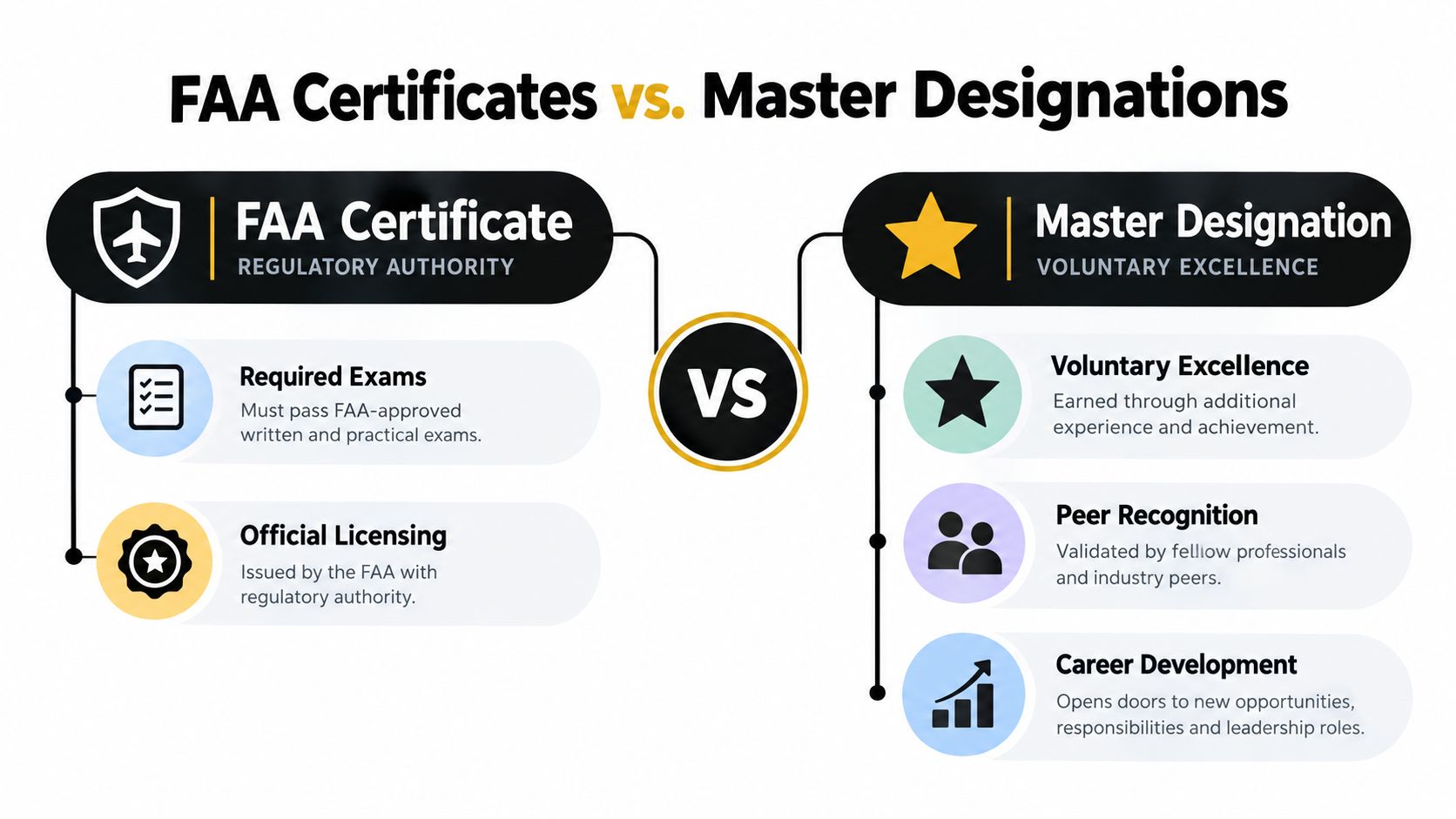
A lot of pilots search for master CFI requirements as if there's one FAA rulebook that covers everything. There isn't. The FAA controls the legal authority to instruct, while master-level designations are professional accreditations awarded by outside organizations, so the paperwork, timelines, and renewal rules are different from the start.
Legal privilege and professional recognition are separate
An FAA instructor certificate gives you the right to exercise instructor privileges when you meet the regulatory requirements in Part 61. A master designation, by contrast, recognizes sustained teaching, continuing education, service, and professional participation, and it does not replace the FAA's operating rules.
Practical rule: If you lose FAA recent-experience compliance, a master designation doesn't let you keep teaching legally.
That distinction matters because some instructors treat the credential as a single ladder. It isn't. You can be professionally impressive and still be out of compliance with FAA recency requirements, or you can be current with the FAA and still not qualify for a master designation.
Why the confusion keeps showing up
The terms sound similar, and schools often blur them in casual conversation. A CFII, a master instructor, and a master certificated flight instructor all sound like “higher-level CFI” to new instructors, but only one of those is an FAA regulatory rating. The others are evidence-based recognitions of professional standing.
That's why the safest mental model is simple. FAA certificate first, master designation second. If you keep those layers separate, the requirements become much easier to track and explain.
How to Become a Certified Flight Instructor Instrument
A CFII isn't a master designation. It's the instrument-instructor add-on that lets an instructor teach instrument flying under FAA rules, and it sits much earlier in the career path than any voluntary accreditation. If you're building toward a master credential, the CFII step is still the point where your teaching career becomes real and marketable.
The FAA's baseline eligibility for instructor privileges includes being at least 18 years old, being able to read, speak, write, and understand English, holding the appropriate pilot certificate, and completing the required knowledge testing and endorsements. The instruction path also includes the practical side of learning to teach, not just learning to fly well yourself. For a practical overview of instrument training fundamentals, many instructors start with instrument rating training resources.
What the FAA expects before the checkride
The applicant has to show instruction-ready knowledge, not just flight skill. That means knowing the teaching side of instrument flying, understanding lesson flow, and being able to explain procedures clearly while managing aircraft control. The practical test is where those skills get tested together.
A student often expects the biggest hurdle to be stick-and-rudder precision. In reality, the harder part is teaching clearly while staying ahead of the airplane. That's why lesson plans and oral preparation matter so much.
What makes CFII the real starting point
The CFII stage matters because it creates the instructional foundation the master pathways build on later. The master designations don't substitute for initial instructor credentials, and they don't shortcut the need to earn and maintain FAA privileges in the first place. The professional ladder only starts after you've already proven you can teach to the FAA standard.
In plain terms, the sequence is easier to remember this way:
- Earn the FAA instructor credential.
- Build real instructional experience.
- Keep FAA privileges current.
- Assemble the professional record needed for the master track.
That order is the one people get backwards most often.
Master CFI Pathways MCFI vs MFI Explained
The two main advanced tracks are the Master Certificated Flight Instructor (MCFI) and the Master Flight Instructor (MFI). They're both voluntary professional accreditations, and both sit on top of FAA instructor privileges. The difference is mainly in who administers them and how they evaluate your work.
Side-by-side comparison
| Designation | Issuing Organization | Experience Requirement | Renewal Cycle |
|---|---|---|---|
| MCFI | MICEP | Generally 48 calendar months of holding a valid FAA- or ICAO-issued flight instructor certificate, with an alternate pathway for 24 calendar months with Gold Seal qualification | 24 calendar months |
| MFI | NAFI | 24 calendar months of holding a valid FAA/ICAO flight-instructor certificate, plus documented instructional experience and professional activity | 24 calendar months |
MCFI is tied closely to the Master Instructor Continuing Education Program. That matters because the program uses a quantified activity system, so it's not enough to say you've been teaching a long time. You have to show a documented pattern of instruction, contribution, and continuing development.
MFI, administered by NAFI, is built more directly around professional standing within the instructor community. The emphasis is still on sustained instructional expertise, ethics, and ongoing development, but the application logic is framed around NAFI membership and a broader professional portfolio.
A useful way to compare them is this, MCFI leans harder into measured activity, while MFI leans harder into documented professional engagement.
If you're deciding between them, don't ask which one sounds more prestigious. Ask which organization's standards fit the way you work, teach, and document your teaching.
MICEP Credit Hour Requirements and Categories
The MICEP pathway is the most exacting of the two, because it uses a credit-hour structure that turns your professional life into auditable evidence. The headline requirement is 500 creditable hours accumulated during the 24 calendar months before application or issuance, and the categories are intentionally balanced across teaching, service, media, education, and participation. The program also requires that hours be recorded as whole numbers and rounded down, so fractional hours don't inflate an application.
The required activity categories
The minimum distribution includes 250 hours as an educator, 30 hours serving the aviation community, 30 hours creating media, 30 hours in continuing education, and 30 hours as a participant in aviation activities. Applicants generally need at least two qualifying activities in each category, with a minimum of 10 hours assigned to each activity.
That adds up to 370 hours in the published category totals, which means the remaining hours must come from additional qualifying activity under the program's rules. The point is not just to “fill buckets.” The point is to show depth, variety, and sustained professional contribution.
Why the documentation burden matters
Many instructors underestimate the process. A strong teaching record still has to be proven with evidence, and the program requires supporting documentation for claimed activity. That makes the MICEP process much closer to building a professional portfolio than passing a test.
Key point: High activity without proof doesn't help you.
A good way to think about it is this, MICEP wants to see that you've been active as an educator, contributor, and professional participant over time. It's not a logbook contest. It's a record of ongoing professional work.
Renewal keeps the standard live
MCFI accreditation must be renewed every 24 calendar months. That renewal cycle tells you what the credential really measures. It's not historical experience alone, it's continuing participation and current professional engagement.
Documentation Standards for Professional Accreditations
The work in a master application is building an auditable portfolio. NAFI's MFI guidance treats this as a serious professional file, and that's the right way to approach it whether you're pursuing MFI or preparing for an MCFI application. The stronger your records, the easier it is to show that your instruction is consistent, current, and credible.
Build the portfolio before you need it
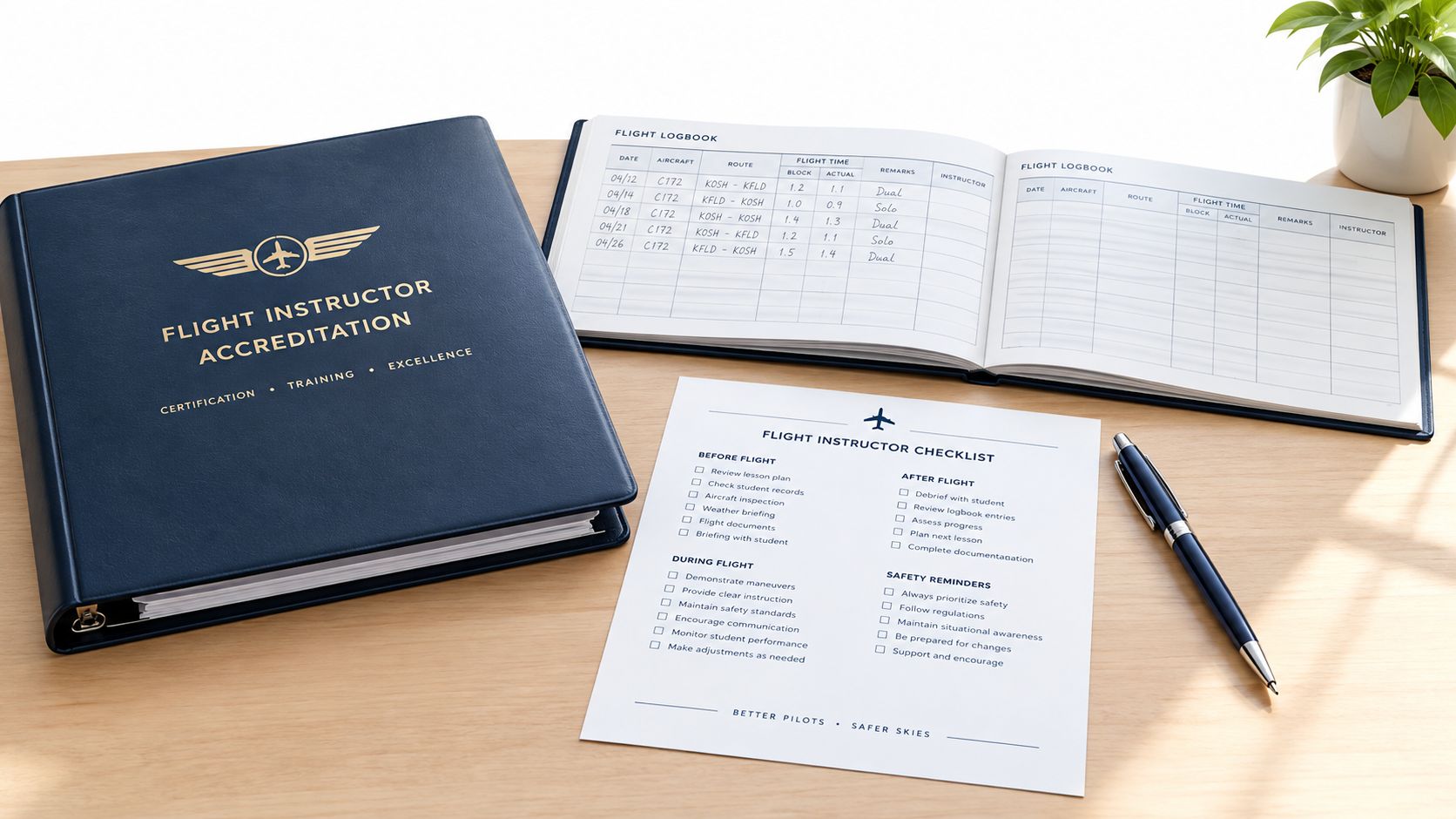
Start with the obvious items, then go deeper. You want instructional records, syllabi or lesson materials, safety and professional-development activity, learner outcomes, and evidence of ongoing engagement. If you've led seminars, mentored instructors, written training material, or participated in aviation community work, keep proof of it.
A logbook alone won't tell the whole story. The reviewers need to see what kind of teacher you are, not just how long you've been in the cockpit. That's why lesson plans, course outlines, and student progress records matter so much.
Ethics and leadership belong in the file too
NAFI's published materials also emphasize membership in good standing and adherence to its code of ethics. That pushes the credential beyond raw experience. It's a professional standard, not a paperwork formality.
Keep these items together in one place:
- Instructional records, so you can show what you taught.
- Lesson materials, so your teaching method is visible.
- Professional-development records, so you can prove continuing learning.
- Community and leadership evidence, so your contribution goes beyond paid flight time.
- Student outcome documentation, so your instruction can be evaluated as teaching, not just activity.
That portfolio mindset is the part many applicants miss. High flight time helps, but it's not the same thing as documented instructional quality.
Maintaining FAA Recent-Experience Compliance
FAA recency is separate from master accreditation, and the separation matters more now that newly issued instructor certificates no longer show printed expiration dates. The FAA's recent-experience rules still apply on a rolling 24-calendar-month basis, so instructors have to track compliance actively instead of relying on the card in their wallet. For a renewal-focused overview, see flight instructor renewal requirements.
The FAA pathways you can use
Under the FAA's current framework, an instructor must qualify through an accepted path within the preceding 24 calendar months. That can include passing a practical test for an existing or additional instructor rating, endorsing at least five applicants for practical tests with at least 80% passing on the first attempt, serving in an eligible check-pilot or instructional role, or completing an FAA-approved flight-instructor refresher course within the preceding three calendar months.
The important lesson is simple. A master designation doesn't preserve your legal right to instruct. It may reflect professional achievement, but the FAA still expects recent-experience compliance for the actual privilege of teaching.
Why printed dates stopped being enough
The FAA transition away from printed expiration dates removed an easy visual shortcut. That change doesn't relax the rule, it makes recordkeeping more important. If you don't have a system for tracking your recency window, you can end up assuming you're current when you aren't.
Keep your renewal evidence where you keep your endorsements, not in a separate folder you'll forget to open.
If your recency lapses, the remedy depends on how long it's been. A FIRC can restore privileges when the lapse is no more than three calendar months, while a longer lapse requires a practical test under the FAA's framework. That's why flight schools should track FAA recency and professional accreditation separately.
Career Timeline for Aspiring Master Instructors
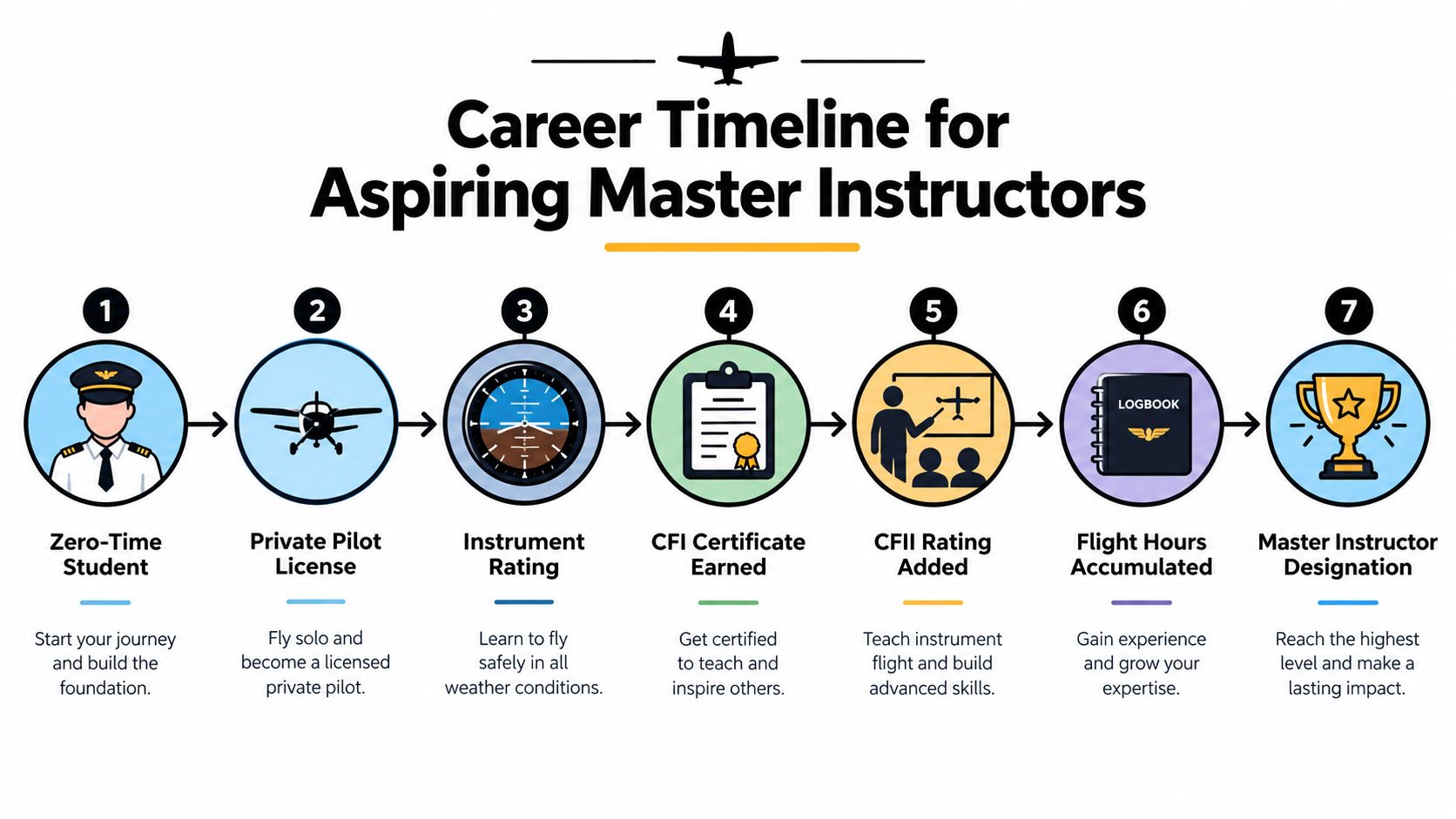
Most instructors don't jump from student pilot to master designation in a straight line. The progression is usually slower, and that's normal. The useful way to view it is as a sequence of credentials, experience, and documentation, each one supporting the next.
A practical progression
A new pilot starts with primary training, then adds the instrument side of the skill set, then earns instructor privileges, and only after that begins to look like a master-designation candidate. The early years are about building the technical base. The later years are about proving you've become a sustained educator.
A simple sequence looks like this:
- Student training, where the focus is on basic flying skill.
- Instrument competence, where procedures and precision start to matter more.
- FAA instructor privileges, where teaching becomes the job.
- Ongoing instructional work, where your record begins to accumulate.
- Portfolio building, where you collect proof of teaching and service.
- Professional accreditation, where the master application becomes realistic.
For a closer look at the instructor side of that path, how to become a flying instructor is the natural next read.
The timeline is not about rushing. It's about making sure every step creates evidence for the next one. That mindset keeps the process from feeling random.
Choosing the Right Certification Track for Your Goals
The best track depends on what you want your instructor career to prove. If you want a cleaner regulatory baseline, you focus on FAA compliance and recency. If you want peer-recognized professional standing, you choose the accreditation path that matches how you teach and document your work.
Compare the two main decision factors
Choose MICEP if you want:
- A more quantified activity model, with explicit hour categories and evidence standards.
- A portfolio built around continuing education and contribution, not just instruction count.
- A system that rewards broad professional participation, including media and community work.
Choose NAFI's MFI if you want:
- A membership-based professional track, with a strong emphasis on standing in the instructor community.
- A documented instructional portfolio, including records, materials, outcomes, and engagement.
- A designation that clearly sits on top of FAA privileges, rather than replacing them.
The strictest mistake is to think one path is “better” because it sounds more official. They're different tools for different career stories. Some instructors want their record to show measured instructional activity, while others want a broader professional credential tied to community involvement and teaching quality.
What flight schools should tell applicants
A school should be honest about the difference between “current to instruct” and “eligible for accreditation.” Those are not the same question. One is legal, the other is professional.
If you're advising students or junior instructors, frame the decision around evidence. What can they document, what kind of teaching do they perform, and which organization's standards reward that work most fairly? That's a much better filter than chasing a title.
Required Documentation and Activity Checklist
A strong master application lives or dies on documentation. If you want to qualify, start collecting proof long before you're ready to submit, because the process rewards instructors who treat their career like a file system, not a memory exercise. The cleaner your records, the easier it is to show consistent professional growth.
Keep the right evidence in one place
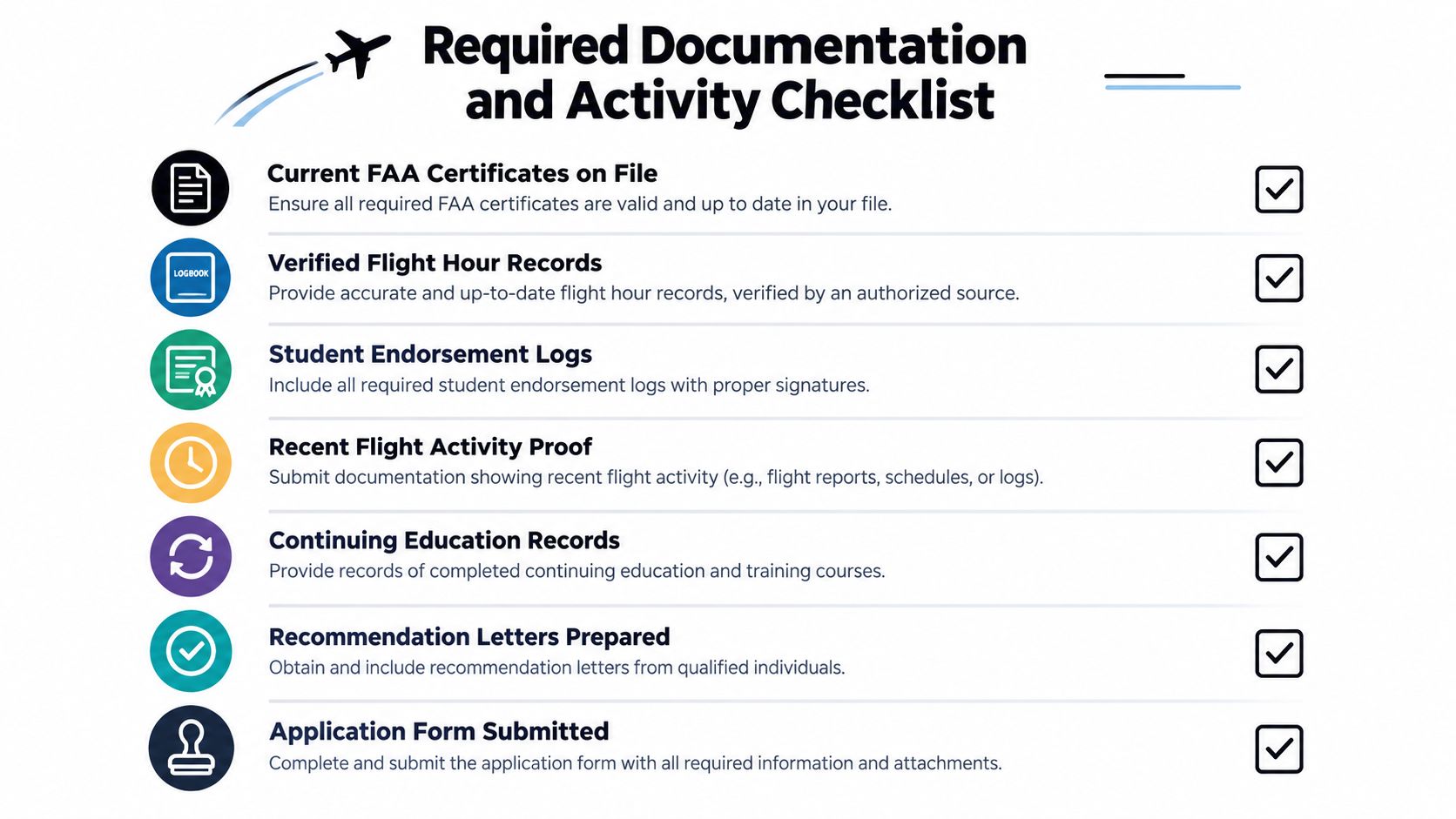
Build one folder, digital or physical, that contains your core credentials and your supporting proof. That folder should be easy to update after every class, seminar, endorsement cycle, or professional event. If you wait until the application window opens, you'll spend days reconstructing what should have been obvious.
Your checklist should include:
- Current FAA certificates on file, so your instructor status is always easy to verify.
- Verified flight hour records, so your experience can be checked without guesswork.
- Student endorsement logs, so your teaching activity is documented clearly.
- Recent flight activity proof, so FAA recency doesn't become a surprise problem.
- Continuing education records, so you can show professional development over time.
- Recommendation letters prepared, when the program calls for outside validation of your work.
- Application form submitted, only after the rest of the file is clean and complete.
Don't confuse quantity with readiness
The best applications show a pattern, not just a pile of paperwork. Reviewers want to see a working instructor, a professional ethic, and evidence that you stay current. That's why service, leadership, and teaching materials matter alongside flight activity.
If you're building toward this credential now, treat every month as part of the application. Save your lesson plans, keep your endorsements organized, and track recency before it becomes urgent. That habit is what turns a loose instructor record into a credible master-level file.
If you want a structured path from instructor training through advanced teaching credentials, CFII can help you understand where the FAA requirements end and where professional growth begins. Visit CFII to explore a training approach that fits this career track and supports the next step in your instructor journey.
Planning to fly for a living?
See what the path from zero to a pilot career looks like, what it costs and how long it takes.
Learn to fly in Riverside
We train at Riverside Municipal Airport in factory-new airplanes with a parachute built in. Start with a one hour discovery flight, no experience needed.