

On this page
- The Certificate Ladder From First Lesson to Airline Cockpit
- Build the Plan Around Separate Milestones
- Separate Checkride Readiness From the Legal Floor
- How to Get Your Medical Before You Spend Money
- Prepare Before the Appointment
- Treat a Deferral as an Unresolved Decision
- Medical Renewal Windows After 40
- Schedule for the Privilege You'll Exercise
- Paying for Training While You Change Careers
- Separate Training Costs From Household Costs
- Compare Cash Flow, Not Just the Advertised Price
- Relocating for Training or Flying Part-Time
- Test the Schedule Against Ordinary Life
- Evaluate the Airport, Not Just the Address
- Career Paths and the Flying Years You Have Left
- Model the Career in Phases
- Keep More Than One Paid-Flying Outcome Viable
- Decide Whether to Book a Discovery Flight First
- Find Out Whether You Enjoy the Work
- Match the Full Path to Your Available Time
Six months is the medical-planning window that can change your airline timeline: under 14 CFR 61.23, a first-class medical used for certain airline transport pilot privileges has that validity period when you're examined at age 40 or older. That doesn't mean you need to rush through training. It means your medical calendar belongs beside your training calendar from the beginning.
You can become a pilot at 40, but earning certificates and reaching airline employability are different projects. A useful plan connects every certificate to the next job opportunity, accounts for income you'll give up, and leaves room for hiring delays rather than assuming the first available cockpit will be yours.
The Certificate Ladder From First Lesson to Airline Cockpit
The FAA doesn't set a general maximum age for earning pilot certificates. At this stage, the useful questions are what comes next, what experience counts, and how consistently you can train.
Professional flying in middle age isn't unusual. In 2022, pilots aged 40–44 held 19,842 active Airline Transport Pilot certificates, while those aged 45–49 held 19,890, with each group representing about 11% of active ATP holders, according to the Government Accountability Office's aviation workforce report. Those figures show participation, not how many people started training at your age, so don't mistake them for a career-change success rate.
Build the Plan Around Separate Milestones
FAA minimums for the main pilot certificates and ratings
| Certificate or rating | FAA minimum | What it lets you do |
|---|---|---|
| Private Pilot Certificate | Meet the applicable flight-experience and proficiency requirements of 14 CFR 61.109 | Fly for personal use and carry passengers |
| Instrument Rating | Meet the applicable instrument-experience and proficiency requirements of 14 CFR 61.65 | Fly under instrument rules in clouds and low visibility |
| Commercial Pilot Certificate | 250 total hours on the standard airplane pathway under 14 CFR 61.129, unless an applicable exception applies | Fly for compensation in paid roles that require a commercial certificate |
| Airline Transport Pilot Certificate | Meet the applicable ATP experience requirements, including any qualifying restricted-ATP provisions | Serve as a pilot in airline operations, subject to applicable qualifications |
For the standard single-engine commercial route, that regulation also specifies 100 hours in powered aircraft, including 50 in airplanes, and 100 hours as pilot in command. The required experience includes 50 hours of cross-country pilot-in-command time, including 10 in airplanes.
Don't add every training requirement together as though each represents completely separate flying. Some experience can satisfy more than one requirement when it's planned and logged correctly. Other requirements concern a particular kind of experience, so a large total-time number alone won't prove eligibility.
Our guide to flight training requirements can help you organize the sequence before discussing a syllabus with an instructor.
Separate Checkride Readiness From the Legal Floor
The private certificate develops aircraft control, judgment, navigation, and passenger-carrying responsibility. Instrument training adds disciplined procedures and flying by reference to instruments. Commercial training requires greater precision, but a commercial certificate isn't blanket permission to sell any flight you choose.
Instructor qualifications create another possible employment route. Teaching requires its own preparation and evaluation, not just being comfortable flying the airplane yourself.
For our hobby students taking two or three lessons per week, the private pilot checkride typically comes in four to six months, with lessons paid individually. That's a pace benchmark, not a promise for someone whose work travel repeatedly interrupts training.
Beside each certificate, record:
- Experience already logged, separated into total time, pilot-in-command, cross-country, and instrument categories.
- Requirements still missing, including knowledge tests and practical-test preparation.
- Calendar constraints, such as work travel, aircraft access, and examiner availability.
Legal minimums aren't a completion forecast. Private, instrument, and commercial qualifications can follow a planned sequence, but the experience-building period after initial certification needs its own calendar and employment strategy.
How to Get Your Medical Before You Spend Money
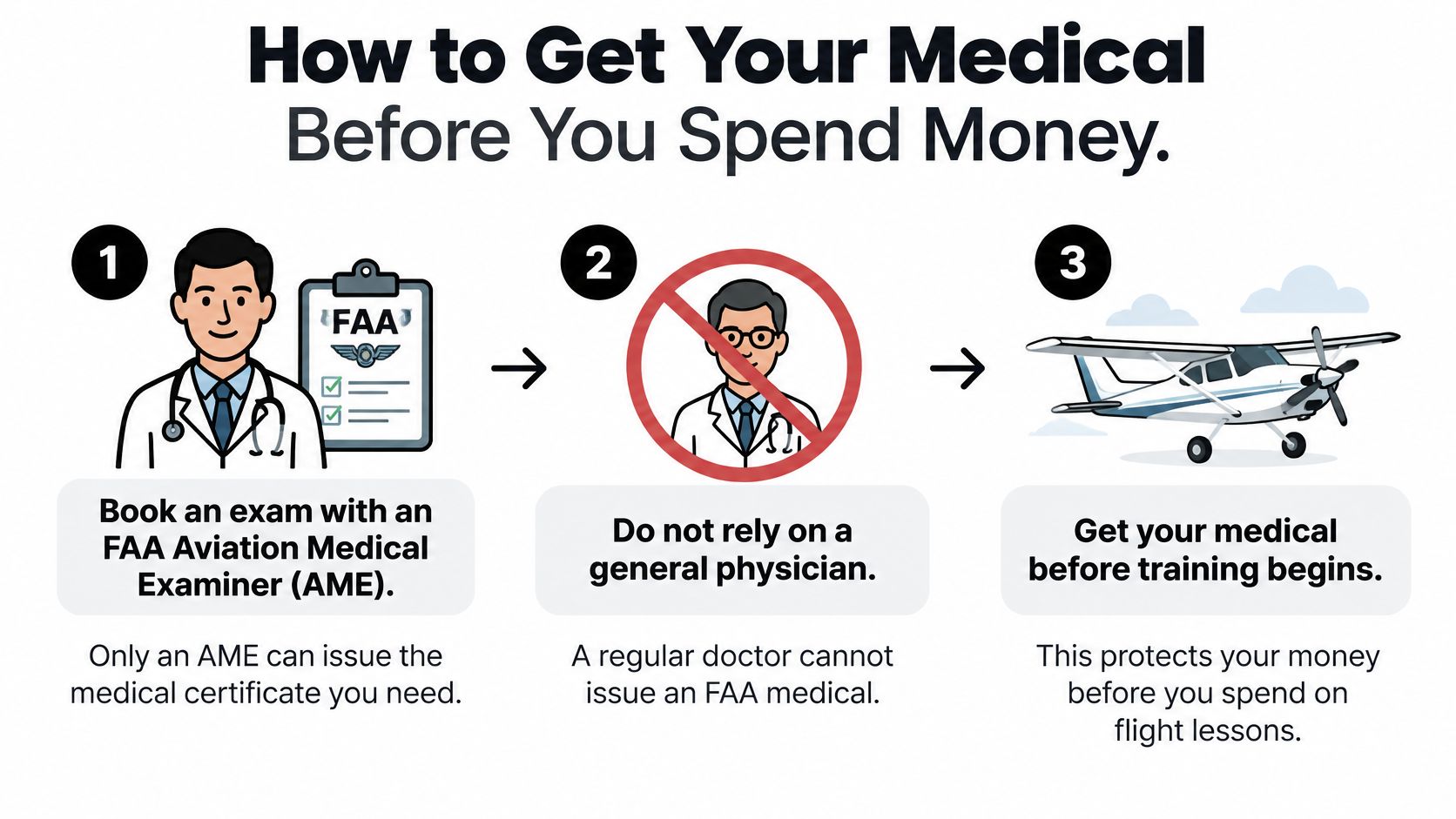
Before you commit to career training, book an aviation medical examiner (AME) appointment for the certificate level your intended job requires. Pick the AME exam for the job you want, because a private-pilot medical won't cover airline work. At 40, the timing of that decision matters: medical review can affect when you can train and how much time remains to build a career before the airline age limit.
Prepare Before the Appointment
- Find an FAA Aviation Medical Examiner. Your regular physician can help assemble records, but the FAA examination must be conducted by an AME. Read this guide to aviation medical examiners to understand the examiner's role.
- Make a complete medical inventory. List prescriptions, nonprescription medications, diagnoses, hospital stays, and relevant treatment history, including cardiovascular, blood-pressure, blood-sugar, mental-health, and sleep concerns.
- Choose the class for your intended work. Airline goals call for a first-class evaluation; commercial-only work generally calls for second class, while private flying generally calls for third class.
- Ask what records you need before submitting your application. If your history is complicated, arrange a consultation with the AME. Disclose your history accurately, and don't stop prescribed medication to try to improve an application.
For first-class certification, the FAA medical standards specify distant vision of 20/20 in each eye, corrected or uncorrected, and near vision of 20/40. They also set hearing requirements and call for an ECG at age 35 and annually after age 40. Corrective lenses can meet the vision standard.
Treat a Deferral as an Unresolved Decision
The FAA gives particular scrutiny to conditions including psychosis, bipolar disorder, significant coronary disease, myocardial infarction, and diabetes requiring hypoglycemic medication. A diagnosis alone does not settle the outcome. Some cases require FAA review or a special-issuance process.
If the FAA defers your application, find out what records, testing, and review remain before you commit to accelerated training. A pending decision is not a medical certificate.
Protect your budget: Resolve medical uncertainty before committing to tuition, relocation, or leaving your current job.
For private-pilot training, a third-class FAA medical is required before solo flight. You can take a discovery flight and initial lessons before obtaining one, but that flexibility does not replace early screening for airline-level eligibility.
Keep the examination date and the privileges you intend to exercise with your calendar reminders. Track the relevant renewal window for each privilege, rather than relying on a single reminder that says only “medical expires.”
Medical Renewal Windows After 40
Say your first-class examination takes place in March. For the relevant airline transport privileges, it remains valid through the end of September, not merely until the corresponding day in September: 14 CFR 61.23 counts through the sixth month after the examination month for an applicant aged 40 or older.
The regulation gives an applicant under 40 a 12-month period for the corresponding first-class privileges. It also establishes 12 months for commercial privileges and generally 24 months for private or student privileges at age 40 and older.
Medical class validity for pilots age 40 and older
| Medical class | Privileges it supports | Valid at age 40 and up |
|---|---|---|
| First-class | Relevant airline transport pilot privileges | Through the sixth month after the examination month |
| Second-class | Commercial pilot privileges | 12 months |
| Third-class | Private, student, and flight instruction when acting as required pilot flightcrew | 24 months |
Schedule for the Privilege You'll Exercise
A first-class certificate doesn't become worthless when its airline-level validity ends. It may remain usable for lower-level privileges within their applicable periods.
For example, suppose you pass the examination in March and complete commercial training in November. Your airline-level window has ended, but that doesn't automatically prevent you from exercising commercial privileges. You need to match the certificate's remaining validity to the operation you'll conduct.
Flight instruction also needs careful wording. A flight instructor certificate doesn't always require the instructor to hold a medical, but acting as pilot in command or another required flightcrew member can create that requirement.
Use a calendar with separate entries for:
- Privilege deadlines, rather than just the medical certificate's class.
- AME appointments and records, including any testing the examiner needs.
- Checkrides and employment milestones, so paperwork doesn't interrupt an otherwise workable plan.
The annual ECG requirement isn't the same as an ECG at every medical renewal. Ask your AME which examination needs the tracing, and keep the testing schedule separate from the certificate-validity schedule.
Choose renewal timing around the milestone you'll test or work for. Don't renew unnecessarily early because training pauses, but don't wait until a lapse prevents a scheduled flight either.
Paying for Training While You Change Careers
A career change at 40 puts two costs on the same calendar: flight training and the income you may give up while completing it. Budget for both before choosing a pace or committing to tuition.

Separate Training Costs From Household Costs
List aircraft rental and flight lessons separately from ground instruction, ground school, knowledge tests, practical tests, medical examinations, and equipment. Add transportation, lodging if you relocate, and household expenses that continue during training.
Lost income needs its own line. Account for benefits you may need to replace and the cash available if returning to paid work takes longer than expected. Keep a contingency for extra proficiency training; an advertised minimum may not leave enough room for additional practice before a checkride.
Ask every school, including CFII, about:
- Price and scope: Get the total in writing and identify exclusions.
- Training structure: Ask whether the course operates under Part 61 or Part 141.
- Aircraft access: Ask about airplane age and the number of students per airplane.
- Instructor continuity: Find out how instructor turnover is handled.
- Fit before commitment: Ask whether you can fly before enrolling.
Compare Cash Flow, Not Just the Advertised Price
Paying lesson by lesson can preserve flexibility and make it easier to keep earning. The trade-off is that interruptions may mean paying for review flights before you can move ahead.
For a career changer who can commit to full-time training, CFII's Career Track costs $89,000 for six ratings and certificates, 282 hours, and all instruction, with financing available for the full amount. It is designed to take students from zero experience to commercial pilot and flight instructor in about nine months. Compare that schedule with your income needs and the terms of any financing.
Check the terms on additional training, interruptions, and withdrawal before signing. The guide to how to pay for flight school offers a framework for comparing borrowing options, including interest, repayment deferrals, and prepayment rules.
Before committing, ask: Can you fund the next certificate and the one after it without relying on money reserved for a later stage? If not, adjust the pace or build savings before taking on more debt.
Relocating for Training or Flying Part-Time
Full-time training and local part-time lessons solve different problems. Intensive training protects study time and reduces the gaps between lessons. Local training protects your existing income and home arrangements, but requires you to defend recurring airport time against everything else.
Neither option works if you choose it based only on the advertised course duration.
Test the Schedule Against Ordinary Life
Consider a hypothetical career changer with a fixed work schedule, a free weekday evening, and a reliable weekend morning. Local lessons may work well if the airport commute is manageable and those slots regularly produce completed flights.
Now change the circumstances. The evening slot ends after darkness when the student needs daylight practice, the weekend is frequently lost to weather, and work calls interrupt ground study. The nominal part-time schedule exists, but the usable training schedule doesn't.
Before choosing a base, compare the operational details:
| Decision factor | Local part-time training | Relocated full-time training |
|---|---|---|
| Employment | Can preserve current earnings | Requires leave, remote-work compatibility, or an income transition |
| Lesson continuity | Vulnerable to work and family interruptions | Easier to make training the primary commitment |
| Housing | Usually preserves existing arrangements | Requires temporary housing and possibly duplicate household costs |
| Exit plan | Easier to pause close to home | Needs a return-home and unfinished-training plan |
Evaluate the Airport, Not Just the Address
Check the actual commute at lesson times, seasonal weather interruptions, aircraft access, and instructor availability. Busy airspace can provide useful radio practice, but you should also understand how much lesson time you'll spend reaching the practice area.
If relocating, compare furnished shared housing with renting alone. Include deposits, transport, lease terms, and what happens if you must leave before completing training.
Our discussion of why relocate for flight school can help frame those trade-offs without treating relocation as the automatic answer.
Choose the base where you can fly consistently through ordinary working weeks, not the one with the shortest course on paper.
Track completed lessons rather than booked lessons before making a major schedule change. The difference tells you whether your plan survives weather, maintenance, commuting, and the job you still have.
Career Paths and the Flying Years You Have Left
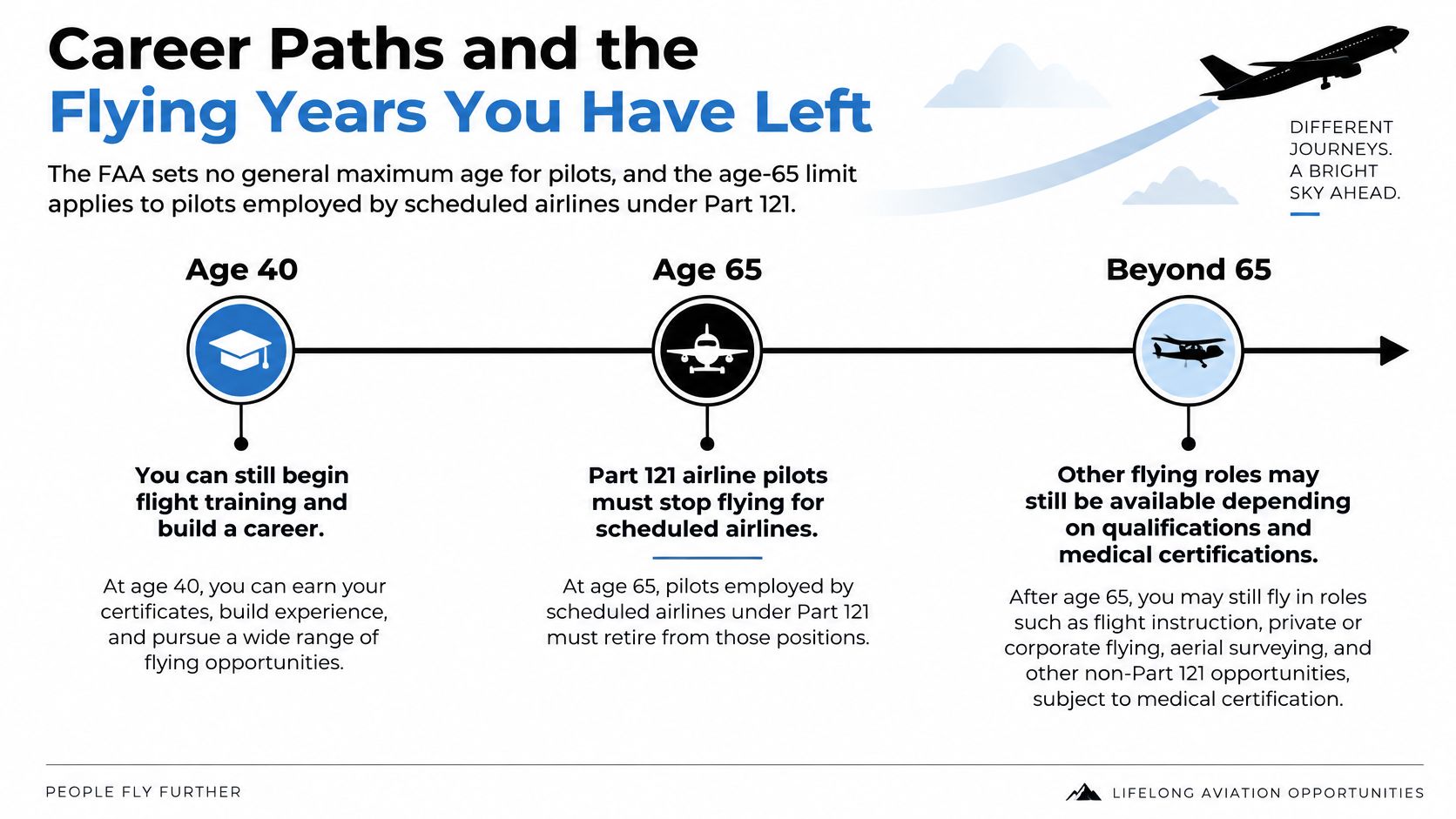
Pilots cannot serve in Part 121 airline operations after reaching 65. The FAA's maximum-age guidance sets that limit, leaving someone who starts at 40 a maximum 25-year window before the airline cutoff.
Treat those 25 years as the outer limit for airline work, and plan training, hiring, and seniority within it. The time needed to earn certificates, build experience, secure a job, and progress at an airline all uses part of that window.
Model the Career in Phases
Set out the likely milestones: earn certificates through commercial and any instructor qualifications, build experience through work you can realistically obtain, then apply to airlines and complete employer training.
Seniority affects what follows. Getting hired does not guarantee your preferred base, schedule, aircraft, or upgrade timing. Assess the investment against the earnings and working conditions you could expect early in an airline career, not only those of a more senior pilot.
Use milestone dates to test the plan:
- Certificate phase. When could you earn the qualifications needed for your intended first paid role?
- Employability phase. What experience might employers expect, and how would you build it?
- Hiring phase. What income would support you if recruiting slows or your preferred employer does not call?
- Progression phase. Would the career still suit you if advancement takes longer than planned?
The airline pilot career guide can help you assess the airline goal separately from the initial training phase.
Keep More Than One Paid-Flying Outcome Viable
Flying careers and their age rules
| Career path | FAA age rule | Entry requirement |
|---|---|---|
| Airline flying under Part 121 | Mandatory upper age limit of 65 | Airline transport pilot qualification and applicable airline requirements |
| Charter and on-demand flying | No general FAA maximum age | Commercial certificate plus applicable operating-rule and employer experience requirements |
| Corporate flying | No general FAA maximum age for many operations | Commercial certificate plus operator hiring standards |
| Flight instruction | No general FAA maximum age | Flight instructor certificate with appropriate ratings |
A commercial certificate makes you eligible for certain work; it does not guarantee immediate employment with a charter or corporate operator. Operating rules, insurance, aircraft qualifications, and employer standards may require additional experience.
Flight instruction is another professional path. Consider whether you want to brief lessons, diagnose student errors, prepare learners for tests, and take responsibility for their progress.
Build the plan around qualifications you can earn, work you would accept, and finances that leave room to respond if hiring takes longer than expected. Decide what would prompt a change of direction, such as a medical restriction, slower hiring, family location needs, or a preference for another kind of flying.
Decide Whether to Book a Discovery Flight First
CFII's one-hour discovery flight requires no prior experience. You meet the instructor, preflight the airplane together, then take the controls in the air. It gives you a practical first look at flying before you commit to a career program.
Find Out Whether You Enjoy the Work
Treat the discovery flight as lesson one, not a sightseeing trip. Notice how you respond to following a checklist, correcting small errors, listening to radio calls, and concentrating on unfamiliar tasks. Initial nerves are normal; what matters is whether you want to learn the work.
Bring questions about preparation and scheduling. If you already have flight experience, the instructor can tailor the lesson to help you learn something new while getting familiar with CFII's aircraft. You can also visit the hangar, sit in a cockpit, and meet instructors before deciding.
Match the Full Path to Your Available Time
CFII's Career Track takes students from zero experience to flight instructor in about nine months. The fixed $89,000 price includes six certificates and ratings, 282 hours of training, and all one-on-one instruction. Training takes place across Southern California, including Long Beach, Corona, and Riverside.
Completing the program sets a training timeline, not an airline hiring date. Consider whether the day-to-day work suits you and whether the training schedule fits your life. For questions about medical timing and funding, use the plans you developed earlier rather than starting those decisions over.
At 40, the discovery flight helps answer an immediate question: do you want to learn to fly? Your medical renewal schedule and years before the airline age limit remain part of the larger career decision.
CFII offers discovery flights and a zero-to-instructor pathway for people considering a career change. Discuss your starting point and available training time with CFII.
Planning to fly for a living?
See what the path from zero to a pilot career looks like, what it costs and how long it takes.
Learn to fly in Riverside
We train at Riverside Municipal Airport in modern airplanes with a parachute built in. Start with a one hour discovery flight, no experience needed.