

On this page
- Which Medical Class You Need and How Long It Lasts
- How the 42-year-old example plays out
- What the Examiner Checks at Your Exam
- Functional performance, not bare eyesight
- Conditions That Can Disqualify You
- Why each cluster is on the list
- How Special Issuance and Deferral Work
- The sequence, in order
- How often deferral becomes a denial
- Sleep Apnea and Medication After You Are Certified
- What you actually keep in the folder
- Medications after the certificate is in your wallet
- How to Prepare and Find an Aviation Medical Examiner
- A checklist you can finish before the appointment
- What a useful examiner does
- Confirm Your Medical Class Before You Commit to Training
You're staring at a training calendar, maybe a loan estimate, and a note from your instructor that you'll need a medical before you fly solo. You have little flight time, or none, and the aviation medical exam already feels like a gate you might fail for a reason you can't see.
That worry usually aims at the wrong target. The eye chart matters, but most delays come from paperwork: which class you book, what you disclose, and whether the records arrive with you.
The system is large. The FAA's 2024 Aerospace Medical Certification Statistical Handbook recorded 639,044 medically certified airmen aged 16 and older as of December 31, 2024. 6.2% of issued certificates required a special issuance, and hypertension treated with medication was the most frequently reported condition, affecting 5.7% of that population.
A routine history is common. A same-day certificate is not the only path. If you're building a career, treat the exam as an evidence problem you can prepare for.
Which Medical Class You Need and How Long It Lasts
Say you're 42, changing careers, and you book the exam before the first lesson. Your real question isn't "Can I pass today?" It's "Will this certificate still be valid when I'm ready to solo, and will it cover the flying I plan to do next year?"
Age on the exam date sets the clock. The FAA's 2024 statistical handbook summarizes the rule this way: under 40, a first-class certificate is generally valid for 12 months, a second-class certificate for 12 months, and a third-class certificate for 60 months. If you are 40 or older on the examination date, first-class validity drops to 6 months, second-class validity stays 12 months, and third-class validity becomes 24 months. The FAA introduced the under-40 extensions on July 24, 2008. A special issuance can shorten that duration.
| Class | Privileges supported | Valid if under 40 | Valid at 40 or older |
|---|---|---|---|
| First class | Airline transport pilot privileges | 12 months | 6 months |
| Second class | Commercial pilot privileges | 12 months | 12 months |
| Third class | Private and recreational flying | 60 months | 24 months |
How the 42-year-old example plays out
At 42, a first-class certificate supports airline transport pilot privileges for six months. A second-class certificate supports commercial pilot privileges for a full year. If your next twelve months are training, solo, and early commercial work, the second-class piece is the one that matches paid flying. First class is a planning choice when an airline seat is the goal, not a legal requirement for commercial work.
The medical class is separate from the pilot certificate. Under 14 CFR 61.23, a pilot who expects to exercise commercial privileges generally needs at least a second-class medical. Passing the exam doesn't give you permission to fly. It establishes eligibility to use particular privileges once you hold the right pilot certificate. A deeper walk-through of how the classes step against privileges sits in our guide to FAA medical certificate classes.
Practical rule: Match the class to the highest privilege you expect to use in the next 12 months. Book first class if an airline career is the plan. Book second class if commercial flying is the near-term job.
What the Examiner Checks at Your Exam
A pilot walks into a first-class exam with sharp distance vision, sits down for the near-vision card, and realizes the reading glasses are still on the kitchen counter. That one forgotten pair can stall the whole appointment, because the exam grades what you see with the correction you fly with. Under 14 CFR Part 67, the Aviation Medical Examiner (AME) reviews your medical history and physical fitness, then issues, defers, or denies the certificate. For professional flying, the usual benchmark is the first-class standard.
The FAA certification standards set the first-class figures the AME measures against:
| Exam component | What the AME checks | First-class benchmark |
|---|---|---|
| Distant vision | Acuity in each eye, with or without correction | 20/20 or better in each eye |
| Near vision | Reading acuity at close range | 20/40 or better in each eye |
| Intermediate vision | Mid-range acuity at 32 inches, for applicants aged 50 or older | 20/40 or better |
| Hearing | Conversational speech test or audiometry | Normal speech at six feet, or 70% speech discrimination in one ear at no more than 65 dB |
| Blood pressure and urinalysis | Standard clinical measurements recorded during the exam | Clinical readings recorded for review; no numeric first-class cutoff is published in the class standards |
Read the table as a map of cockpit tasks. Near vision covers the chart on your kneeboard. The intermediate check, which applies only from age 50, sits at 32 inches, roughly the distance to many panel displays. Blood pressure and the urine sample get recorded without a pass/fail number in the class standards, and an ECG is sometimes added based on age and history.
Functional performance, not bare eyesight
The standards measure corrected vision, so ordinary glasses or contact lenses do not block certification when the corrected result meets the line. Bring the current prescription and the lenses you fly with, so the AME is testing the setup you will use rather than guessing which pair lives in the flight bag.
Hearing offers two routes to the same outcome. You can repeat normal conversational speech in a quiet room, or you can qualify through audiometry. Either way, the AME is checking that radio calls and checklist readbacks come through clearly.
If sleep symptoms are already on your chart, it helps to arrive already understanding your AHI score so a sleep-study number isn't a mystery on exam day.
Then bring a short packet:
- Lens prescription: the current glasses or contact prescription, plus the lenses you fly with.
- Specialist records: letters that state the diagnosis, treatment, and whether you're stable.
- Medication list: every prescription and over-the-counter drug, with dose and reason.
- Prior diagnoses: the names you will type into the application, matched to the paper in the folder.
The physical rarely decides the outcome on its own. Incomplete paper is a common reason an otherwise routine exam gets deferred, and a deferred file can cost weeks that healthy eyes and ears never would.
Conditions That Can Disqualify You
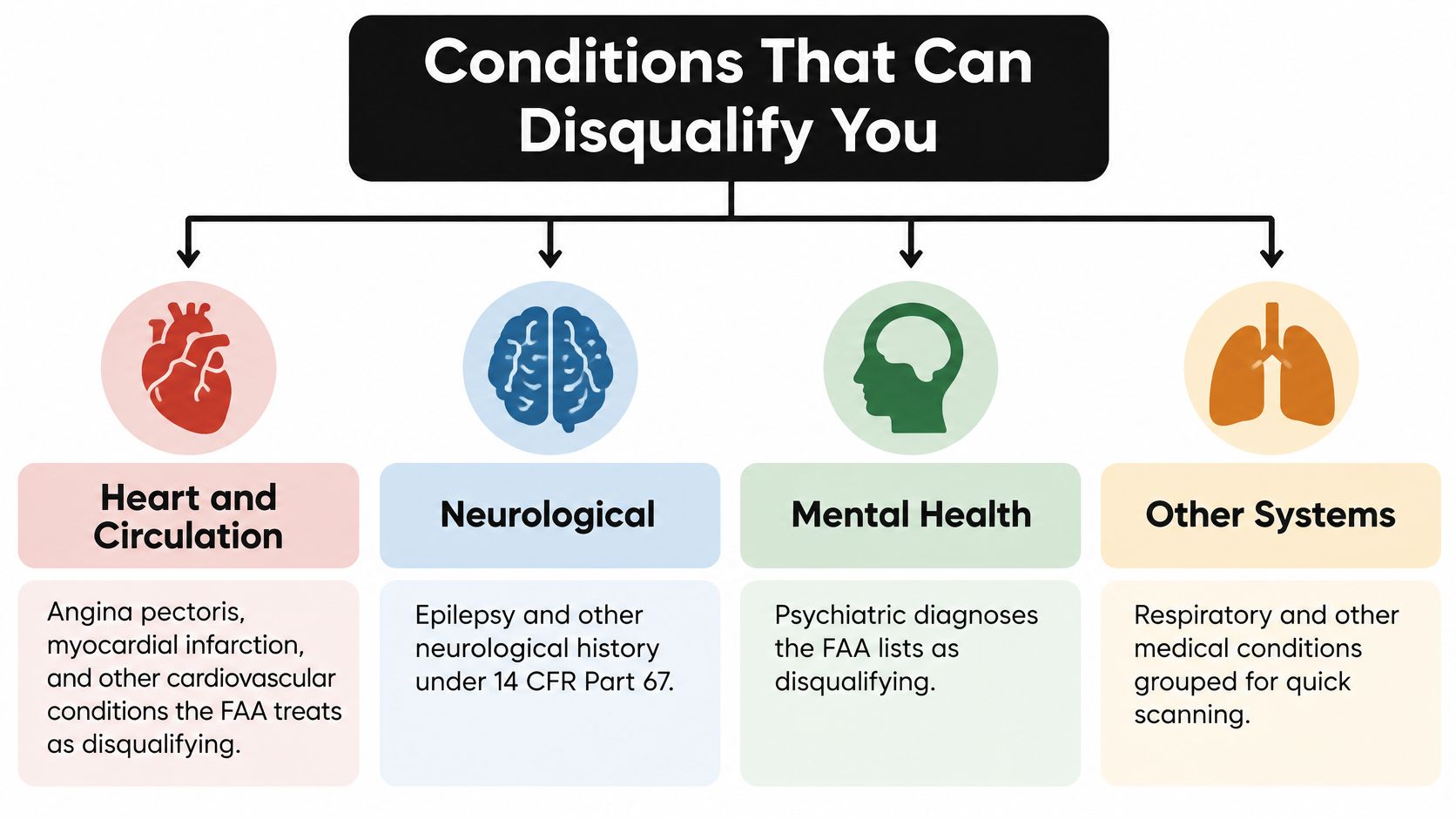
The FAA AME decision guidance lists conditions that are specifically disqualifying under 14 CFR Part 67. A listing is a flag for review, not a permanent lock on the career. The FAA may consider an Authorization for Special Issuance under 14 CFR 67.401, and the AME may need to defer the file to the Aerospace Medical Certification Division or a Regional Flight Surgeon instead of issuing that day.
| Cluster | FAA-listed conditions | Operational reason |
|---|---|---|
| Heart and circulation | angina pectoris; myocardial infarction; clinically significant coronary heart disease; cardiac-valve replacement; permanent cardiac pacemaker | risk of reduced blood flow under workload |
| Brain and consciousness | epilepsy; unexplained disturbance of consciousness; unexplained transient loss of nervous-system control | risk of sudden incapacitation |
| Mental health and substances | psychosis; bipolar disorder; overtly manifested personality disorder; alcoholism; substance abuse or dependence | risk of impaired judgment |
| Metabolic | insulin-treated diabetes or diabetes requiring medication for control | risk of medication-related incapacity |
Why each cluster is on the list
Heart and circulation covers angina pectoris, myocardial infarction, clinically significant coronary heart disease, cardiac-valve replacement, and a permanent cardiac pacemaker. Ischemic disease can limit blood flow when workload and stress rise, which is a poor match for a cockpit.
Brain and consciousness covers epilepsy, an unexplained disturbance of consciousness, and unexplained transient loss of nervous-system control. A seizure or a blackout can incapacitate you without warning.
Mental health and substances covers psychosis, bipolar disorder, an overtly manifested personality disorder, alcoholism, and substance abuse or dependence. The concern is judgment and reliability. Histories in this cluster often need a HIMS AME rather than a routine office exam.
Metabolic covers insulin-treated diabetes or diabetes requiring medication for control. The review looks at glucose stability and the chance a medication could incapacitate you in flight.
Disclosure beats omission. Leaving a condition off the application is a worse problem than sending the FAA a thick folder.
If a standard medical path isn't realistic yet, read how a sport pilot license uses a different medical route, and don't treat that route as a substitute for airline or commercial eligibility.
How Special Issuance and Deferral Work
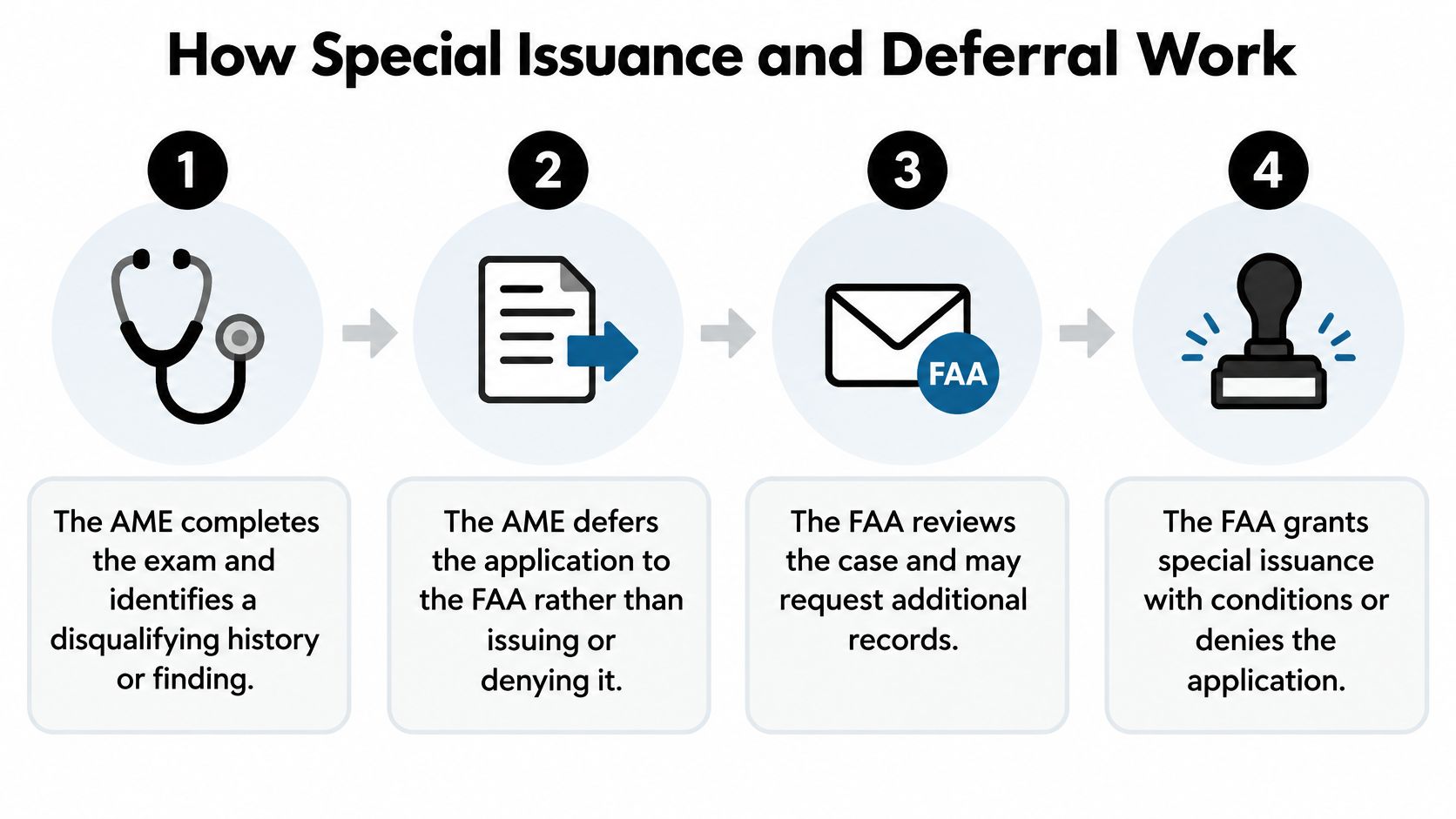
Deferral is a request for records, and the FAA letter that follows lists what it needs. The question behind it is narrow: whether a condition or medication could reasonably be expected, during the maximum validity period of the certificate you asked for, to leave you unable to perform the duties or exercise the privileges. That standard is why two applicants carrying the same diagnosis can walk out of the process with different outcomes.
The sequence, in order
- The AME finishes the exam and finds a disqualifying history or a finding that can't be issued on the spot.
- The AME defers the application to the FAA rather than issuing or denying it. For a first-time special issuance, deferral is the required move when FAA review applies.
- The FAA considers an Authorization for Special Issuance under 14 CFR 67.401 and asks for records, specialist evaluations, testing, a stability period, and any ongoing reports.
- You send exactly what was requested, on time, in the form the letter describes. A portal summary often isn't enough when they asked for a physician narrative.
- If the authorization is granted, an examiner may later reissue the certificate once you meet the follow-up criteria and remain otherwise qualified, as the special issuance rules for all classes describe.
Thresholds live in the worksheets, not just in disease names. The FAA examiner guide directs deferral for chronic kidney disease at an eGFR of 34 or less, or when specified complications are present. Milder ranges can follow a worksheet instead of an automatic deferral.
How often deferral becomes a denial
The FAA's fact check on medical myths reported an initial deferral rate around 20% for applicants disclosing mental-health diagnoses, and a final denial of only about 0.1% to 0.2% among applicants who disclosed a health issue and completed the process.
Deferral is common. A final denial, once you finish the process, is rare, and the wait between them is administrative work with a shape you can plan around. A 41-year-old applicant whose history flags a cardiac item, for example, may be asked for a cardiology letter backed by a stress test before the FAA decides. If that timeline sounds like yours, read what becoming a pilot at 40 involves and build the medical into the same plan as the flight schedule.
Sleep Apnea and Medication After You Are Certified

A certificate doesn't freeze your health on the exam date. Sleep apnea is the clearest example of a condition that becomes a year-round evidence file.
FAA guidance on the operational side of fitness advises a sleep-medicine evaluation when you have relevant symptoms, a neck circumference above 17 inches for men or 16 inches for women, or a BMI above 30. For treated obstructive sleep apnea, the file can include the sleep-study report, a current treating-physician status report, and cumulative PAP data. The cited target is PAP use during at least 75% of sleep periods and an average of at least six hours per sleep period.
What you actually keep in the folder
- Sleep study: the original report, not a one-line diagnosis.
- Status letter: a current note from the treating physician.
- Machine data: a download that shows the 75% and six-hour pattern across the reporting window.
- Travel setup: a second portable PAP machine is specifically contemplated, so a trip doesn't create a gap you can't document.
Oxygen desaturation is part of how severity gets read. A plain-language look at oxygen levels and apnea severity makes those report pages easier to discuss with the AME.
Medications after the certificate is in your wallet
Sedating or sleep medicines have to be documented by name, dose, frequency, and purpose. Under 14 CFR 91.17, you may not act as a crewmember while using a drug that affects your faculties in a way contrary to safety. Most effective treatments can be acceptable, but you don't fly on an unapproved medicine that affects faculties and sort it out later.
Before each renewal, put a reminder on the calendar, download the PAP data a few weeks ahead, and call the AME before you fly if therapy has been interrupted. A missed week of treatment is a fitness question, not a paperwork detail you mention after the flight.
How to Prepare and Find an Aviation Medical Examiner
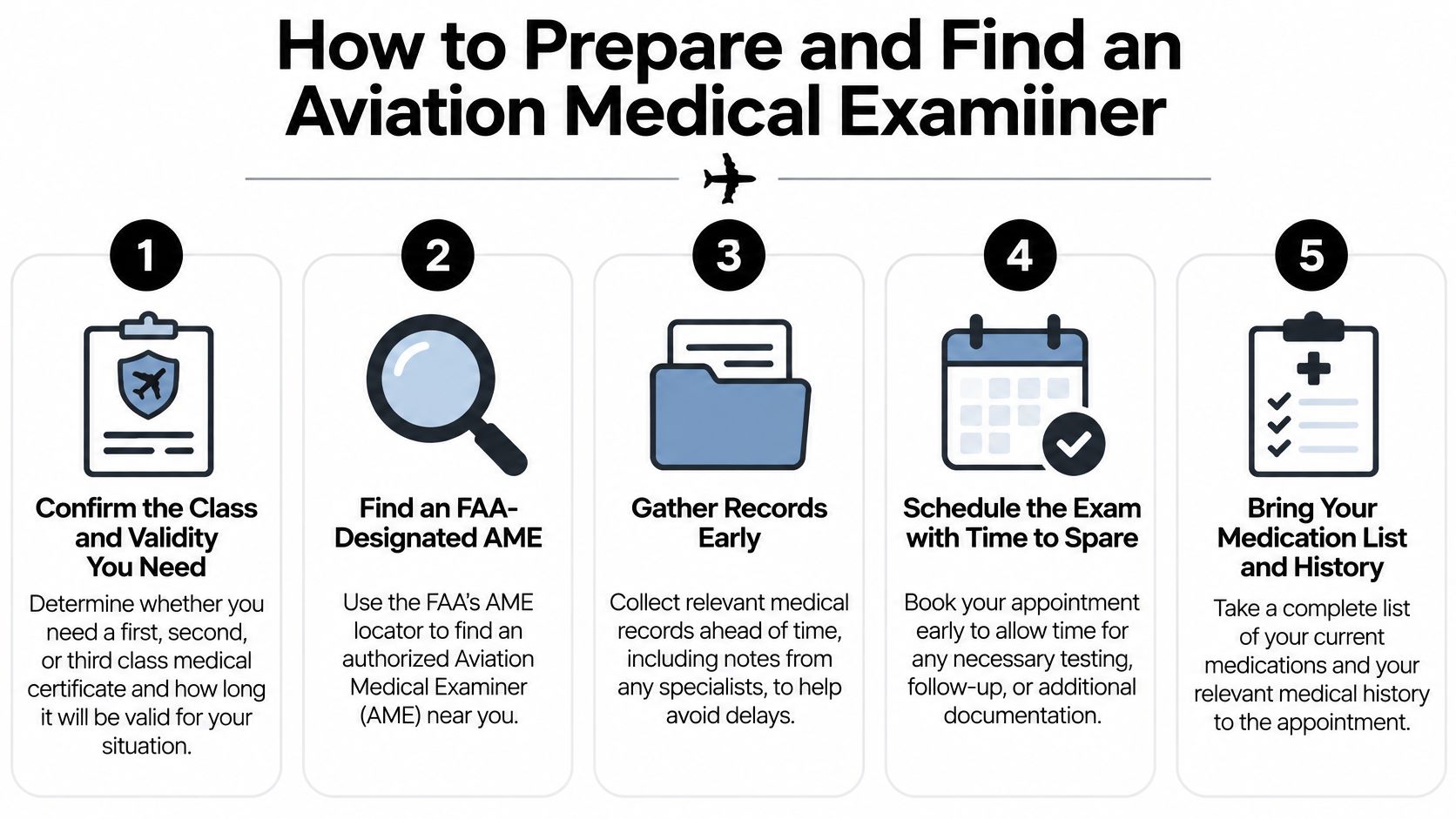
An applicant can pass every part of the physical and still leave the office without a certificate, because the certification decision happens in the file review that surrounds the exam. FAA guidance on getting a medical certificate says the AME must personally review your history and the examination. Once you answer "yes" to a history question, the live issue is which documents, specialist visits, monitoring, or waiting period the FAA will want. Asking that before you submit MedXPress beats hoping a missing line goes unnoticed.
A checklist you can finish before the appointment
- Confirm the class and the validity you need for the privileges you'll use, using your age on the exam date.
- Find an FAA-designated AME with the FAA's AME locator, and book far enough ahead that a deferral won't collide with solo.
- Gather records early: specialist letters, prior diagnoses, prescriptions, and your corrective-lens prescription.
- Complete MedXPress accurately before the visit. Disclose every condition and medication. You get a confirmation number. The AME needs it.
- Call the AME first and ask whether they do many pilot exams and whether any part of your history is likely to be deferred. If your history could need a HIMS-qualified examiner, ask whether this office handles such cases or which AME in your area does.
- Bring the packet on exam day: glasses or contacts, the medication list, and the records. Don't rely on memory for drug names.
What a useful examiner does
A helpful AME knows pilot standards, tells you which papers to bring, and explains the deferral path if one applies. Volume of pilot exams matters more than a convenient parking lot. An examiner who only sees an occasional applicant may be excellent clinically and still unsure which worksheet the FAA wants.
Most treatments can be acceptable when they work. The files that stall are the ones missing a prescription entry or carrying a thin specialist letter.
A third-class medical from an AME is required before you fly solo. A discovery flight and the first dual lessons can happen before you hold one. Pair that timing with the student pilot certificate, a separate application you also carry once you fly alone.
Consider an applicant treated for depression three years ago. The condition may well be acceptable now, but the packet has to show it: the records from treatment, a current letter from the treating clinician describing status and stability, and every medication listed by name and dose, including any that were stopped. Assemble that before the appointment and the exam stays on schedule. Walk in with a bare "yes" on the history form, and the same file can sit in deferral for weeks while documents a phone call would have produced get requested one at a time.
Confirm Your Medical Class Before You Commit to Training
Get the aviation medical exam before you sign a large training contract or a loan. A deferral after you've paid for months of flying is an expensive way to learn that a specialist letter was missing. The physical is one morning. The file you build around it is what keeps the schedule honest.
If you haven't flown yet, start with a discovery flight and the first lessons while the medical application moves. You don't need the certificate in hand to sit in the airplane with an instructor. You do need it before solo, so book the AME early enough that a records request doesn't stall that lesson.
If you're ready for a full path, our Career Track is fixed $89,000 tuition, about nine months from zero time to CFII and multi-engine, 282 total hours, and six certificates and ratings, based in Southern California at Riverside, Long Beach, and Corona. Those 282 hours break down as 204 single-engine, 25 multi-engine, and 53 in the simulator, with one-on-one instruction included. See how that sequence lines up with flight training requirements so the medical class you book matches the privileges each stage uses.
Write the class on a note before you call the AME. Gather the records this week. Then put the appointment on the calendar, ahead of any financing decision.
CFII trains career-minded beginners from first lesson through instructor certificates, and the medical is one of the first gates we help you time before solo. If you want the class, the paperwork, and the training plan in one place, start with a discovery flight or a look at the Career Track. Visit CFII and tell us where you are in the medical process.
Planning to fly for a living?
See what the path from zero to a pilot career looks like, what it costs and how long it takes.
Learn to fly in Riverside
We train at Riverside Municipal Airport in modern airplanes with a parachute built in. Start with a one hour discovery flight, no experience needed.