

On this page
- Accreditation and Part 61 vs Part 141 Explained
- Part 61 vs Part 141 for flight training
- Verify the course, not just the label
- Programs and Certificates You Can Earn
- Certificates and ratings by program stage
- Why career training doesn't end at an airline cockpit
- Fleet and Simulator Hours That Count
- Instructor Model and Who Will Teach You
- Ask who owns your progress
- Total Cost, Housing and Interruption Risk
- Read the extension clause before the price
- Interruption risk checks before enrolling
- Career Outcomes and Hiring Timing
- Plan for more than one hiring environment
- Request outcomes you can interpret
- Choose Your First Step Before You Enroll
- Arrive with a decision checklist
You've probably opened several aviation flight school pages, compared tuition, and wondered whether you could leave your current job and be training in a cockpit soon. The certificates sound straightforward. The harder question is whether the school can keep you flying consistently enough to finish on the schedule you're budgeting for.
Execution risk matters as much as headline tuition. An unavailable airplane, an instructor departure, or a long gap before a practical test can change both your completion date and your living costs. Choosing well means understanding the FAA pathway, then checking how a school handles the ordinary interruptions that can derail it.
Accreditation and Part 61 vs Part 141 Explained
There isn't a single accreditation label that tells you everything about a flight school. Academic accreditation, FAA school certification, and an individual instructor's qualifications answer different questions. For flight training, start by identifying which regulatory framework governs your course.
Part 61 establishes individual pilot certification requirements. An instructor can adapt the lesson sequence and schedule to your availability while ensuring you meet the applicable requirements. A Part 141 school holds an FAA pilot school certificate and delivers an approved course with documented progression and stage checks.
Part 61 vs Part 141 for flight training
| Feature | Part 61 | Part 141 |
|---|---|---|
| Governing rule | Individual certification under 14 CFR Part 61 | School certification under 14 CFR Part 141 |
| Private pilot minimum | 40 hours | 35 hours in an approved course |
| Instrument rating minimum | 40 hours of actual or simulated instrument time | Approved instrument-course requirements |
| Commercial minimum | 250 total hours under the standard airplane route | Approved commercial-course requirements |
| Curriculum | Set between instructor and student | FAA-approved syllabus with stage checks |
| Schedule | Flexible, lesson by lesson | Structured course with set progression |
| Progress records | Logbook and instructor endorsements | Syllabus tracking and stage-check records |
| Best fit | Students who need flexible scheduling | Students who want a structured, checkable progression |
Read the table from the top down. School approval isn't the same as an individual certificate, and reduced course minimums aren't a promise that every student will finish at the minimum. Instrument time also isn't interchangeable with total flight time, so don't compare those rows as though every hour measures the same thing.
Curriculum and scheduling affect your daily experience most directly. A flexible course still needs a clear lesson plan; an approved syllabus still needs available aircraft and instructors. Our Part 61 vs Part 141 comparison can help you frame that choice.
Verify the course, not just the label
Ask these questions before paying:
- School authority: If you operate under Part 141, what's your FAA pilot school certificate number?
- Course approval: Is the specific course I'm enrolling in approved for the certificate or rating I want?
- Progress evidence: Can you show me how completed lessons, deficiencies, endorsements, and stage checks are recorded?
Keep airplane training separate from other aviation qualifications. If your interests also include unmanned aircraft, Ace Aviation Aerospace Academy provides a separate resource to explore remote pilot qualifications, rather than an alternative route to airplane certification.
A well-run Part 61 school can be an excellent choice. Choose the structure you can sustain and the progress records you can inspect, not the label that sounds more prestigious.
Programs and Certificates You Can Earn
A career pilot earns a sequence of credentials, not a single license that grants access to every flying job. Start with a discovery flight, an introductory lesson that lets you experience the cockpit before committing to a course. Then work toward each certificate or rating in a deliberate order.
Before your first solo, you'll need a student pilot certificate and, for the standard training pathway described here, a third-class FAA medical. For the airplane private pilot certificate, the minimum age is 17, and 14 CFR 61.103 requires applicants to read, speak, write, and understand English, complete the required preparation and experience, obtain endorsements, and pass the knowledge and practical tests.
Certificates and ratings by program stage
| Program | Certificate or rating | Minimum flight time | What it allows |
|---|---|---|---|
| Discovery flight | None, trial lesson | One introductory lesson | Decide whether to keep training |
| Private pilot | PPL | Part 61 private-pilot minimum or approved Part 141 course minimum | Fly for personal use and carry passengers, subject to restrictions |
| Instrument rating | IR | Part 61 instrument-time requirement or approved Part 141 course requirements | Fly under instrument flight rules when appropriately qualified and current |
| Commercial pilot | CPL | 250 total hours under the standard Part 61 airplane route; approved-course requirements under Part 141 | Fly for pay within applicable privileges and operating rules |
| Flight instructor | CFI | No separate blanket total-hour minimum; commercial certificate and instrument rating are prerequisites for this airplane pathway | Teach students toward private and commercial certificates with appropriate ratings |
| Airline transport pilot | ATP | Generally 1,500 total hours for an unrestricted airplane ATP | Establish certificate eligibility for airline captain service, with other qualifications required |
The commercial certificate's 250-hour standard Part 61 minimum comes with specific experience categories, not just a total to reach, under 14 CFR 61.129. Your training plan must account for pilot-in-command, cross-country, instrument, and other required experience.
Why career training doesn't end at an airline cockpit
Private training develops basic aircraft control, judgment, and operating skills. Instrument training adds disciplined flying by reference to instruments, while commercial training develops the precision and knowledge expected of a professional pilot. A commercial certificate doesn't independently authorize every kind of paid operation.
Instructor training adds another responsibility: explaining, demonstrating, recognizing errors, and supervising someone else's learning. Instrument-instructor training then extends that teaching role into instrument operations.
The FAA's pilot certification final rule establishes the general 1,500-hour ATP threshold, while recognizing restricted-privileges pathways for qualifying applicants. That's why career programs commonly finish with instructor qualifications, followed by a separate period of experience-building.
Use our flight training requirements guide to prepare your enrollment questions. Match your intended endpoint to the quoted program, and make sure every included certificate, rating, and practical test is identified.
Fleet and Simulator Hours That Count
A training aircraft's age, cockpit equipment, and availability affect how often you can fly and what you can practice. A newer glass-cockpit airplane, for example, gives you experience with that panel, while a busy sharing schedule can make it harder to book lessons. Ask about the fleet and the simulator before comparing advertised hours.

For instrument training, the applicable credit depends on the device's FAA approval, the course, the instruction provided, and the tasks logged. Under 14 CFR 61.65, the limits include up to 10 hours in an approved BATD and 20 hours in an approved AATD, subject to the applicable requirements.
| Device | Maximum credit toward instrument time | Conditions |
|---|---|---|
| Basic aviation training device (BATD) | Up to 10 hours | Authorized instructor and FAA-approved instrument tasks |
| Advanced aviation training device (AATD) | Up to 20 hours | Authorized instructor and FAA-approved instrument tasks |
| Full-flight simulator, flight-training device or aviation training device, combined | Generally 20 hours, or up to 30 hours in an approved Part 142 course | Applicable device approvals, course requirements, and correctly logged training |
The combined limit does not let you add every device's individual allowance together. Ask the school to identify the provision that applies to your course and show how the hours will be recorded.
For a separate example, 14 CFR 61.159 allows up to 25 hours toward the applicable class experience requirement in a qualifying full-flight simulator under specified approved courses, and up to 100 hours toward total aeronautical experience in qualifying simulators or training devices. Those provisions depend on the applicable approvals and requirements; they do not make ordinary desktop practice count as logged training.
Before enrolling, ask to see the device's approval and identify its category. Confirm who provides instruction, which tasks the session covers, and what entry will appear in your training record. The guide to FAA-approved flight simulators explains the device terminology.
Then ask for each training airplane's make, model, year, and panel avionics, along with the typical number of students sharing it. These details help you judge whether the fleet suits your training and whether aircraft access could interrupt your schedule. Request an hour ledger that separates airplane time, device time, and instruction, with any overlapping categories clearly identified.
Instructor Model and Who Will Teach You
Say you change instructors three times and lose several weeks repeating radio procedures and approach setups. Each instructor may be capable, but without a clear handover, each needs to establish what you can do before moving forward. That hypothetical delay belongs in your budget as an instructor-transition risk.
One-on-one instruction with an assigned instructor supports continuity. Rotating or cohort arrangements can provide coverage, but they need consistent lesson records and teaching standards.
The FAA's flight-instructor practical-test guidance sets an initial airplane instructor applicant's minimum age at 18 and identifies commercial or ATP certification, appropriate aircraft ratings, and instrument-rating prerequisites.
Ask who owns your progress
- Continuity: What's instructor tenure like, and how often do students change teachers?
- Workload: How many students does each instructor carry?
- Authority: Who evaluates readiness and signs endorsements?
- Departure plan: Who takes over if your assigned instructor leaves?
We recommend asking every school, including ours, about instructor turnover, airplane age, students per airplane, written total price, the training framework, and whether you can fly before committing.
Practical rule: A substitute instructor needs a usable training record, not just an introduction.
Total Cost, Housing and Interruption Risk
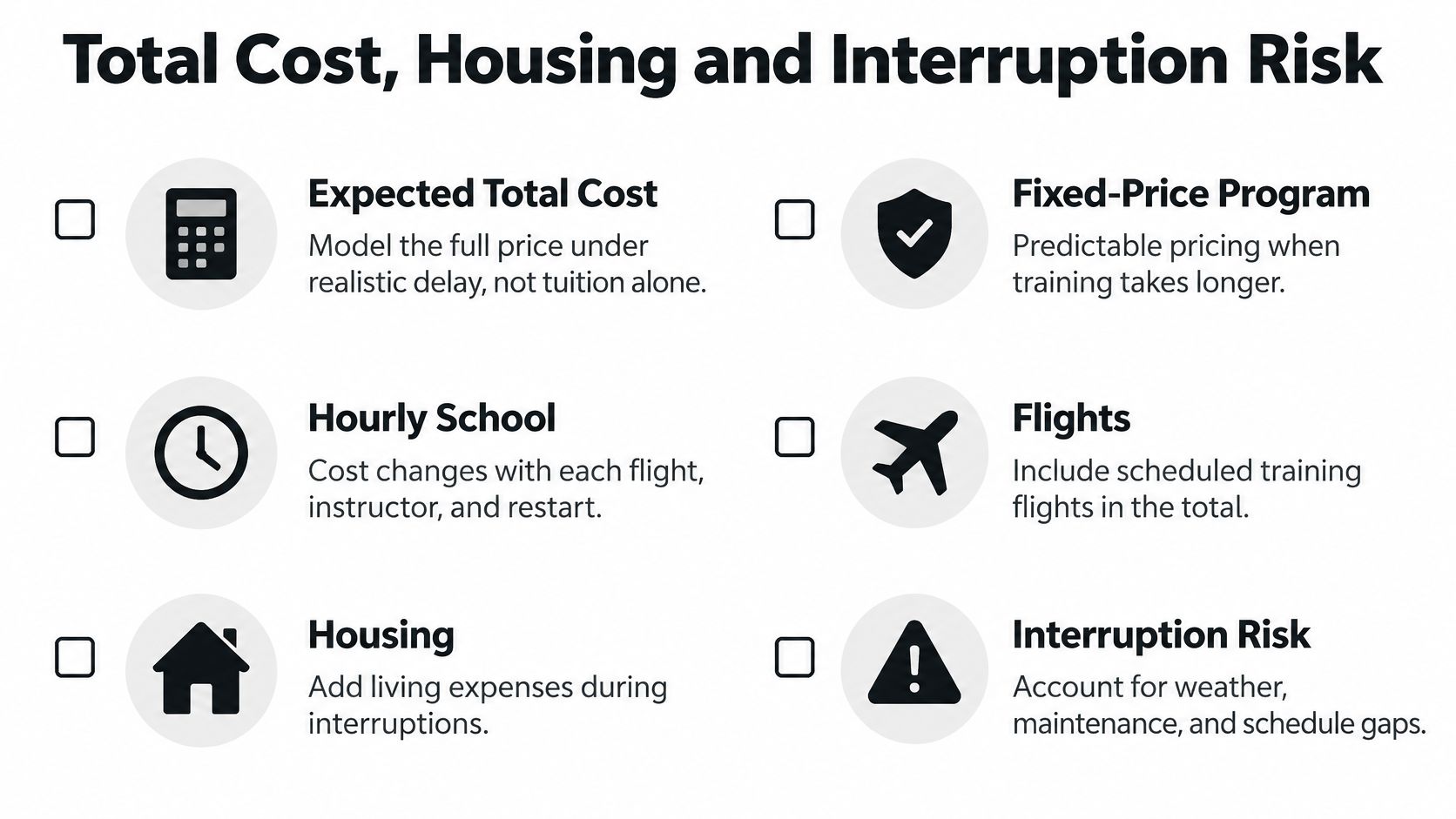
A student paying $1,300 a month for shared housing near the Riverside base who finishes two months late owes $2,600 that no tuition quote contains. Expected total cost under realistic delay is the number worth comparing between schools. A fixed-price contract caps extra training charges within its written scope; rent, transport, and the income paused while you wait fall outside it.
A 2025 FAA Safety presentation, drawing on a survey of more than 1,000 student pilots, identifies cost, scheduling conflicts, instructor turnover, and aircraft maintenance as major completion barriers. Each of those is an operational question to settle before enrollment, while the answers are still free.
Read the extension clause before the price
Compare offers under identical assumptions about weekly flying, weather cancellations, maintenance, and your own availability. Then run one stress test: add two months to the advertised timeline and ask what happens to tuition, proficiency flights, housing, and your return to paid work.
Fixed-price contracts handle that pause differently. One school may set a completion deadline after which additional training bills at hourly rates. Another may extend the fixed price only for documented maintenance or weather events, charging you for delays caused by your own absences. Look for a clause that states in writing what happens if a nine-month program reaches month eleven, and whether the deadline counts calendar time or completed training events.
Interruption risk checks before enrolling
| Risk factor | What to request in writing | Warning sign |
|---|---|---|
| Weekly flying frequency | Target flying hours per week and what happens when it is missed | No target, or the school cannot state one |
| Backup aircraft and instructors | Identified backup arrangements for each aircraft and instructor | One aircraft and one instructor with no backup plan |
| Maintenance downtime | Out-of-service policy and lesson-rebooking procedure | Students learn of downtime on lesson day |
| Weather make-up | Cancellation procedure, fees, and make-up arrangements | Full charges with no make-up option |
| Checkride scheduling | Who books the examiner and the typical wait | No scheduling support or clear responsibility |
| Refund and extension rules | Written refund terms and time-extension policy | Verbal assurances only |
| Tuition exclusions | Complete list of costs outside the quoted price | Exclusions mentioned only in conversation |
Ask for an itemized breakdown covering tuition, aircraft rental, instructor time, examination and checkride fees, materials, headset, medical costs, housing, and living expenses. Confirm whether quoted aircraft rates include fuel and whether ground instruction sits inside the price.
For housing, check occupancy, deposits, lease length, transport, and what the lease requires if training pauses. For financing, examine the payment-deferral period, when interest begins accruing, prepayment penalties, and whether underwriting weighs circumstances beyond a credit score. The questions in our paying for pilot training guide map to those contract points.
Run a three-number comparison with your own figures on every offer:
- Training cost: Quoted tuition plus excluded fees. CFII's Career Track quotes $89,000 covering six ratings, 282 hours, and all instruction, so the items to add are things like the third-class FAA medical exam and personal gear such as a headset.
- Living cost: Monthly housing, insurance, food, and transport multiplied by realistic completion months. Nine months at $1,300 is $11,700; eleven months is $14,300.
- Income forgone: Your current monthly earnings multiplied by those same months.
On CFII's own numbers, training plus housing comes to $100,700 at the published pace and $103,300 with a two-month pause, before income forgone enters the arithmetic. Add the three figures for each offer under identical delay assumptions and compare the totals, because a cheaper headline price with weaker scheduling support can land above that line.
Career Outcomes and Hiring Timing
A graduate can finish every certificate on schedule and still wait months for a first airline interview. Training runs on the school's clock. Hiring runs on the industry's. A school organizes instruction toward checkrides; class dates, staffing needs, and interview invitations belong to the airlines.
The FAA's 2025–2045 aerospace forecast says the pilot shortages that constrained expansion during the pandemic have largely been resolved, though senior regional-captain shortages may persist in the near term. For a student planning a career change, that means hiring continues on the airlines' schedule, with timing that varies by carrier and by year. Boeing's 2025 Pilot and Technician Outlook projects demand for 660,000 new pilots globally between 2025 and 2044, a worldwide figure across two decades that says nothing about when a specific U.S. carrier will call you.

Plan for more than one hiring environment
Flight instruction can provide paid experience-building, and the pace depends on student demand, aircraft availability, weather, and your assigned workload. An instructor certificate qualifies you to teach. The size of your schedule depends on how many students the school has enrolled and how many aircraft are flying each day, and low utilization stretches the hours you still need to log.
Non-airline commercial work may offer another route, subject to the operator's requirements and your experience. Regional first-officer opportunities require more than reaching a logbook total: qualifications, selection, training capacity, and class availability all matter. A slower hiring environment may mean continuing your current flying job longer than you expected.
Our pilot career path guide helps separate training decisions from employment milestones. For organizing applications and follow-up habits, Eztrackr's guide on how to find your first job in 2026 covers general job-search guidance.
Request outcomes you can interpret
Ask each school for:
- Paid instruction outcomes: How many graduates obtain paid instructor roles, with the graduating group clearly defined?
- Waiting time: What is the median time to the first paid flying hours?
- Utilization: How much flying do working graduates log in a typical month?
- Attrition: Who leaves training, and who is excluded from published outcomes?
- Slowdown results: What happened to graduates when hiring weakened?
Then run the conservative version of your own plan: a nine-month program that finishes on time, first paid flying arriving around month 12, and hours that accumulate slowly after that. A budget that survives the slow timeline handles the fast one too.
Choose Your First Step Before You Enroll
The first ten minutes tell you more than any brochure. You meet the instructor at the airplane, read a laminated checklist card at the wing, and walk the preflight together, touching each item as you call it out. Then you climb in and take the controls in the air, with the instructor beside you. No prior experience is needed, and the flight counts as lesson one.
Pay attention to how the work feels from inside it. Can you listen, follow a checklist, and accept correction while managing sensations you have never experienced before? Students who already have flight time can request a personalized lesson that teaches something new while introducing the school's aircraft.
A third-class FAA medical certificate from an aviation medical examiner is required before you fly solo, but the discovery flight and your first lessons can come before it. Book the medical early so a paperwork delay cannot stall training you have already paid for.
Arrive with a decision checklist
The interruption-risk questions in the Total Cost section still apply to every school you visit. Add these enrollment-specific items:
- Instructor continuity: your primary instructor arrangement, the progress-record system, and the handover procedure if that instructor leaves.
- Access before commitment: whether you can walk the hangar, sit in a cockpit, and fly before signing anything.
- Medical timing: when the school expects you to hold your third-class certificate, and what happens to your schedule while you wait for it.
For readers ready to look at the full pathway, our Career Track runs from zero experience through CFII and multi-engine at a fixed tuition, with training based in Riverside, Long Beach, and Corona. Review the full zero-to-CFII Career Track against your availability and written budget. Ask what happens to cost and scheduling if you finish slower than the advertised pace, since interruptions, instructor changes, and aircraft downtime affect the timeline more than the headline figure does.
If you haven't flown yet, book a discovery flight and bring the checklist. Use the visit to judge whether you are comfortable asking questions and whether the answers are specific enough to support a major commitment.
CFII offers discovery flights and a full career-training pathway for aspiring professional pilots. Visit CFII to arrange your first flight or discuss the Career Track, and bring your questions about scheduling, instructor continuity, and written costs before you enroll.
Planning to fly for a living?
See what the path from zero to a pilot career looks like, what it costs and how long it takes.
Learn to fly in Riverside
We train at Riverside Municipal Airport in modern airplanes with a parachute built in. Start with a one hour discovery flight, no experience needed.