
On this page
- California Pilot Training Routes Compared
- Schedule Freedom or Set Milestones
- Where the Full-Time Route Fits
- Hour Minimums From First Lesson to Airline Eligibility
- From Instrument to Commercial
- Instructor and Airline Thresholds
- Why California Works for Year-Round Flying
- What a Crowded Pipeline Does to Your Schedule
- Weather and Airspace You'll Actually Meet
- What Pilot Training Really Costs Beyond Tuition
- Build the Budget by Month
- Fixed Price Does Not Mean Fixed Total
- Housing and Relocation Near California Training Bases
- Commute Cost in Time and Fatigue
- What to Check Before You Move
- Book a Discovery Flight Before You Commit
- Questions to Ask Every California Flight School
- If You Want the Full Career Path
California counted 58,901 active pilots on December 31, 2015, including 12,482 student pilots and 9,670 flight instructors, according to FAA airman records. That scale reframes Pilot Training California as a capacity and cash flow decision, not just a school choice. You're entering a large training market where instructor time, aircraft, and checkride slots shape how fast you can reach paid flying. The headline tuition matters less than how long you can fund yourself before instructing income starts.
California Pilot Training Routes Compared
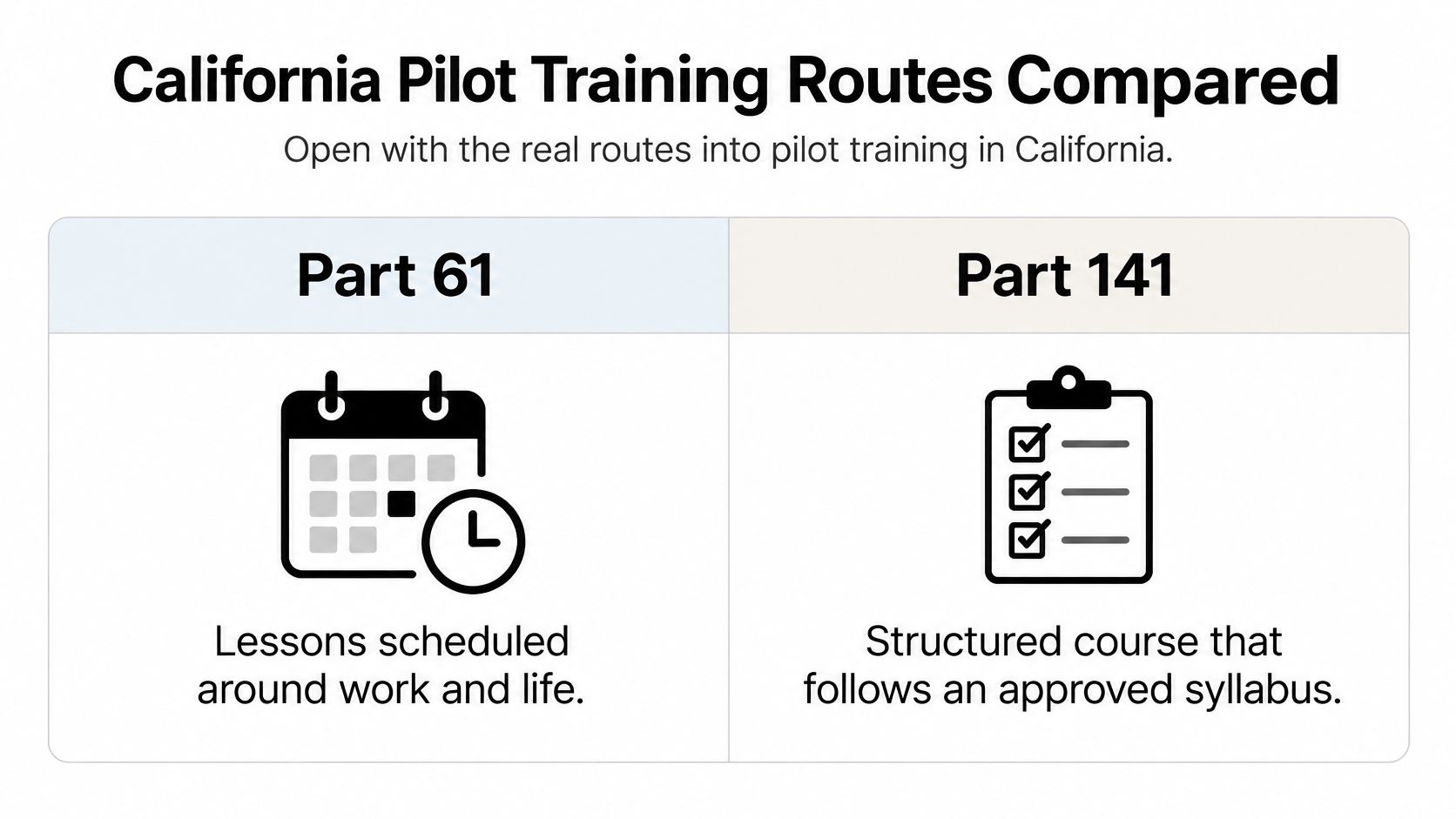
The route you pick sets how long you pay for training before any instructing income starts.
| Route | Typical pace | Cash-flow shape | Best fit |
|---|---|---|---|
| Part 61 flexible program | Lessons scheduled around your life | Slower weekly spend, longer wait for paid flying | Students who want control over pace and schedule |
| Part 141 structured course | Fixed syllabus with set milestones | Steadier spend if you hold the syllabus pace | Students who want a standardized, syllabus-driven course |
| Discovery flight and intro lessons | Single flights or a short series | A small outlay before any certificate budget | Readers who have not flown yet |
| Full-time career program | Intensive weekday training, with a relocation | Months without outside income, then a shorter wait for instructing pay | Career changers who can train full time and relocate |
Schedule Freedom or Set Milestones
Part 61 lets you and your instructor set the order and pace of lessons. You can train around work, pause when money gets tight, or stay on a weak maneuver until it is solid. The risk is drift. Long gaps force review flights, so you pay again for work you already bought. Those extra hours push the first paid flying job further out.
Part 141 follows an FAA-approved syllabus with set milestones and stage checks. You can tell whether you are meeting the published standard, and students who respond to fixed deadlines waste fewer lessons. You lose room to rearrange flying around a job or family calendar. The guide to Part 61 and Part 141 training shows how that split changes a normal week.
Where the Full-Time Route Fits
A full-time career program stacks private, instrument, commercial, and instructor training into the shortest calendar you can fly. Daily lessons do not survive a job plus a long drive. CFII's Career Track is full time, and the commute from Orange County or Los Angeles is long enough that most career students live in shared housing near Riverside Municipal Airport while they train. You trade months of wages for an earlier start in paid instructing. That unpaid stretch, more than the tuition line alone, decides whether the route fits your cash.
A discovery flight is one flight or a short series of intro lessons. You find out whether a small airplane feels right, how you handle radio chatter and motion, and whether the cockpit workload stays manageable. Use it before you price a certificate or sign onto a syllabus.
Quick test: If you can only train on weekends, pick the flexible route. If you can train most weekdays and relocate, the intensive route fits.
The private certificate still starts from a legal hour floor. Most students need more flight time than that floor before an examiner signs the practical test, because proficiency decides the sign-off. Plan money for test readiness and for the months you will not be earning.
Hour Minimums From First Lesson to Airline Eligibility
An unrestricted airline transport pilot certificate takes 1,500 total flight hours, the threshold FAA ATP guidance sets for most traditional airline routes. That page also describes a restricted-privileges ATP for certain graduates of authorized colleges and universities, which can allow copilot service before 1,500 hours while the restriction remains until the required experience is logged. The certificates below are the gates between a first lesson and that hour total.
| Certificate or rating | FAA minimum | Governing rule | What it enables |
|---|---|---|---|
| Instrument Rating (airplane) | 40 hours instrument training | 14 CFR 61.65 | Flying in clouds under instrument rules |
| Commercial Pilot Certificate (single-engine) | 250 total flight hours | 14 CFR 61.129 | Paid flying, required before instructing |
| Certified Flight Instructor (airplane) | Commercial or ATP plus instrument privileges and 15 hours PIC | 14 CFR 61.183 | Paid instruction and time building |
| Airline Transport Pilot (unrestricted) | 1,500 total flight hours | 14 CFR 61.159 | Airline first officer eligibility |
Read the table top to bottom. Each certificate is a prerequisite for the next. Your pilot career path follows that order whether you train part time or full time. A later job title does not remove an earlier certificate.
From Instrument to Commercial
Private training covers basic handling, navigation, and solo judgment. The instrument rating then adds scan discipline, procedure flying, and workload control in clouds and busy airspace. Commercial and instructor standards assume you can already fly accurately by reference to instruments.
The commercial step is where the totals jump. 14 CFR §61.129 requires at least 250 hours of flight time as a pilot for an airplane single-engine commercial rating, including at least 100 hours in powered aircraft, of which at least 50 hours must be in airplanes. A zero-time pathway has to run private, instrument, commercial, and instructor preparation as one continuous build.
Instructor and Airline Thresholds
To instruct, you must already hold a commercial or ATP certificate with the right category and class, hold instrument privileges, and meet the PIC requirement under 14 CFR §61.183, which includes a minimum of 15 hours of pilot-in-command time in the appropriate category and class. The practical test covers teaching, not only flying. Required training and endorsements still sit in front of the first paid lesson you give.
CFII's Career Track logs 282 hours over nine months of full-time training: 204 single-engine, 25 multi-engine, and 53 in the simulator, and it ends with the flight instructor certificates. That is the first point where the hours can be paid. 1,218 hours still separate that logbook from an unrestricted ATP.
Do the division before you treat nine months as the whole timeline. At 50 instructing hours a month, 1,218 hours takes about 24 months. At 75 hours a month, about 16 months. At 25 hours a month, the same gap runs past four years. The months before the instructor certificate are unpaid training. After it, the airline date moves only as fast as a school will schedule you.
Simulator time helps most with procedural work. Aircraft time proves you can handle the airplane.
A meta-analysis of flight-simulation research reviewed 247 publications and identified 26 experiments suitable for statistical analysis, finding that combining simulator training with aircraft training consistently improved jet-training outcomes compared with aircraft-only training. Assign simulator hours to instrument scans, avionics workflows, abnormal procedures, radio navigation, and checklist discipline. Keep aircraft time for takeoffs, landings, tactile handling, and proving the skill transfers.
Check logging rules before you count an hour toward a goal. Simulator time and instructing time may count differently toward each certificate and toward airline qualification. The hours that change the airline date are the paid ones you can book after you are legal to instruct, not the commercial floor of 250.
Why California Works for Year-Round Flying
California had 64,334 total pilots in 2019, including 20,449 student pilots and 10,001 flight instructors, in FAA civil airmen statistics. Student pilots rose from 12,482 to 20,449, an increase of about 63.8% since 2015, while flight instructors increased from 9,670 to 10,001, or about 3.4%. That mismatch is the planning point.
What a Crowded Pipeline Does to Your Schedule
More students chasing a slowly growing instructor pool means busier practice areas and more competition for instructors and checkride slots. Ask any school how it manages instructor capacity, how far ahead checkrides are booked, and what happens to your schedule if your instructor leaves. A cheap lesson rate doesn't help if you can't get on the schedule often enough to stay proficient.
These FAA counts describe certificate holders by category. They describe the market, not any school's throughput or pass rate. Use them to judge pressure on capacity, not to rank individual programs.
Weather and Airspace You'll Actually Meet
Coastal and inland bases offer long stretches of good visual conditions, so you can log VFR hours steadily through much of the year. That consistency is California's real advantage for Pilot Training California students on a tight timeline. Fewer weather gaps mean fewer review lessons after long breaks.
It isn't uninterrupted sunshine. Marine layer fog can delay morning departures near the coast, afternoon winds can cancel pattern work, and desert heat reduces aircraft performance inland. Build cancellation days into your calendar even in a mild climate.
Controlled airspace around Los Angeles and San Diego gives you daily practice with radio calls, sequencing, and clearances that quieter regions may not provide. Mountains and desert around the basin teach density altitude and terrain planning in real conditions, not as textbook examples. You'll graduate more comfortable in complex airspace, but you'll also spend lesson time transiting and sequencing that a rural student might spend on maneuvers.
Plan for weather cancellations and busy frequencies from day one. A timeline with no slack breaks at the first foggy week.
The practical takeaway is simple. California compresses good flying days and complex airspace into one training environment, but demand for instructors and examiners can still slow you down. Capacity, not climate alone, sets your finish date.
What Pilot Training Really Costs Beyond Tuition
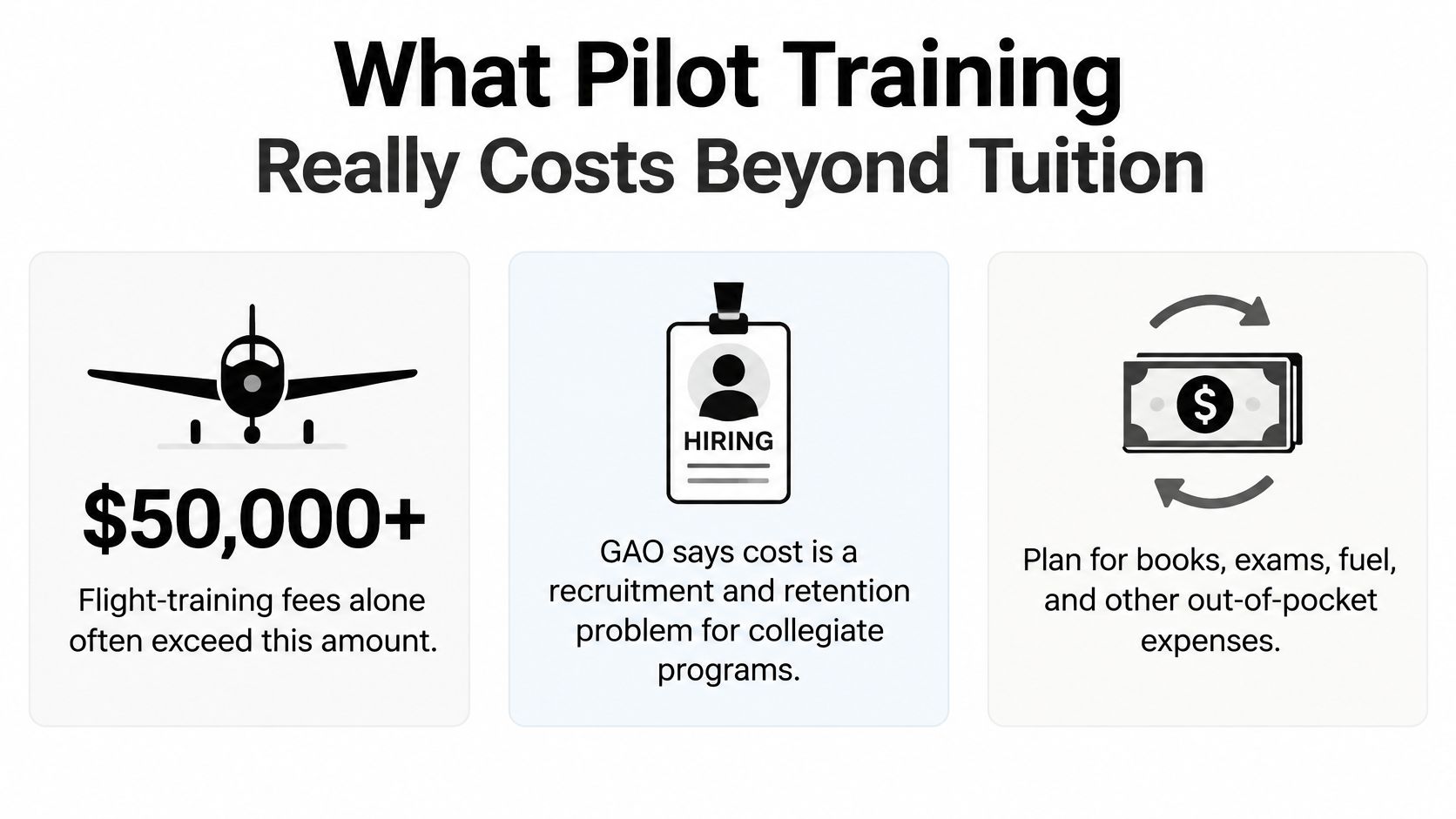
The GAO report on pilot workforce and training costs found that flight-training fees alone often exceed $50,000 and that nearly all interviewed collegiate aviation programs viewed training cost as a moderate or major recruitment and retention challenge. The same report put average 2021 costs at $85,745 for an in-state four-year aviation degree plus flight-training lab fees and $138,511 for out-of-state students. Tuition is the starting point, not the total. Our breakdown of flight training cost helps you separate program charges from everything around them.
| Cost item | When it hits | What to confirm in writing |
|---|---|---|
| Tuition or program fee | Monthly or in one lump sum | Whether ground school, checkrides and simulator time are included |
| Aircraft rental and fuel | Per hour flown | Whether weather cancellations and aircraft downtime are billed |
| Aviation medical exam | Before first solo flight | Examiner fee, which varies, and whether you can book early |
| FAA knowledge and practical test fees | Each test attempt | Whether retests are priced separately |
| Housing and transportation | Monthly for the full training period | Lease length and commute to the base |
| Loan interest and payments | Often starts before any paycheck | Deferral length and whether interest accrues |
| Living costs during unpaid hour building | Monthly until instructing pays | How many months of reserve you need |
Build the Budget by Month
Early months carry tuition deposits, the aviation medical exam, first knowledge test fees, and heavy aircraft rental as lesson frequency rises. Housing and transportation run every month whether you fly or sit out weather. If you borrow, interest can accrue and payments can begin before any instructing paycheck arrives.
Add a retest contingency before you enroll. A failed practical test adds another examiner fee, extra aircraft time to fix the weak area, and a rebooking wait. In a busy California market that wait can stretch your timeline, which adds another month of rent even if tuition doesn't change.
- Count lost income: Full-time training usually means you can't hold a regular job, so savings have to cover living costs, not just school bills.
- Separate fixed from excluded: Ask whether examiner fees, extra aircraft time, study materials, and simulator hours sit inside or outside the quoted price.
- Map the loan start date: Write down when payments begin and compare that date with your realistic first instructing paycheck.
Fixed Price Does Not Mean Fixed Total
A fixed tuition figure can still produce an unpredictable total if exclusions, failed checkrides, aircraft downtime, housing, and financing interest aren't disclosed. Read the exclusion list line by line and price each excluded item yourself. If a school can't tell you what's outside the price, you don't have a fixed cost. You have a partial quote.
The question isn't what flight school costs. The question is how much liquid cash and borrowing capacity you need before your first dependable aviation paycheck.
Answer that question with a month by month sheet before you sign. Include tuition, living costs, test fees, a retest reserve, and the gap between graduation and steady instructing hours. Students who run out of money mid-course lose proficiency during the pause, then pay again for review flights. Cash flow planning protects both your wallet and your logbook.
Housing and Relocation Near California Training Bases
Full-time training forces a housing decision early. You either live near the training base or commute from home, and that choice affects your fatigue, your study time, and how often you can accept an early or rescheduled lesson. It's a training decision, not just a rent decision.
We train at Riverside Municipal Airport (KRAL), about 45 minutes inland from Irvine and an hour from Long Beach. Our Career Track requires training full time, which is a long commute from Orange County or LA. Most career students live in shared housing near Riverside Municipal Airport while they train, and you can review student housing options before you decide whether relocating beats driving.
Commute Cost in Time and Fatigue
A base 45 minutes to an hour away adds one to two hours to every training day. That drive comes out of sleep, study, or rest before the next lesson, and it adds fuel and vehicle costs that never appear in a tuition quote. Housing near the base usually trades higher rent for shorter days and easier rescheduling when weather shifts a lesson by a few hours.
Say you fly five days a week. A one hour each way commute consumes ten hours weekly, roughly a full study day, before you've opened a textbook. Over a nine month program, that lost time compounds into slower written test preparation and less rest between checkride practices.
What to Check Before You Move
- Lease length: Match the term to your planned finish date, with a buffer for weather or a retest.
- Furnished or unfurnished: Furniture costs money and time to move twice for a short stay.
- Distance to the flight line: Minutes matter when lessons move for fog or wind.
- Parking and quiet: You need reliable parking and a room where you can sleep before early flights.
- End date alignment: Confirm whether housing ends when training ends or runs on a fixed calendar.
Time the move carefully. Note deposit dates, and consider whether to relocate before or after your medical certificate is issued, since a medical delay can push solo and every later milestone. Ask who holds the lease, whether you can break it early, and what happens if you finish early or late. Get those answers before you sign anything.
Book a Discovery Flight Before You Commit
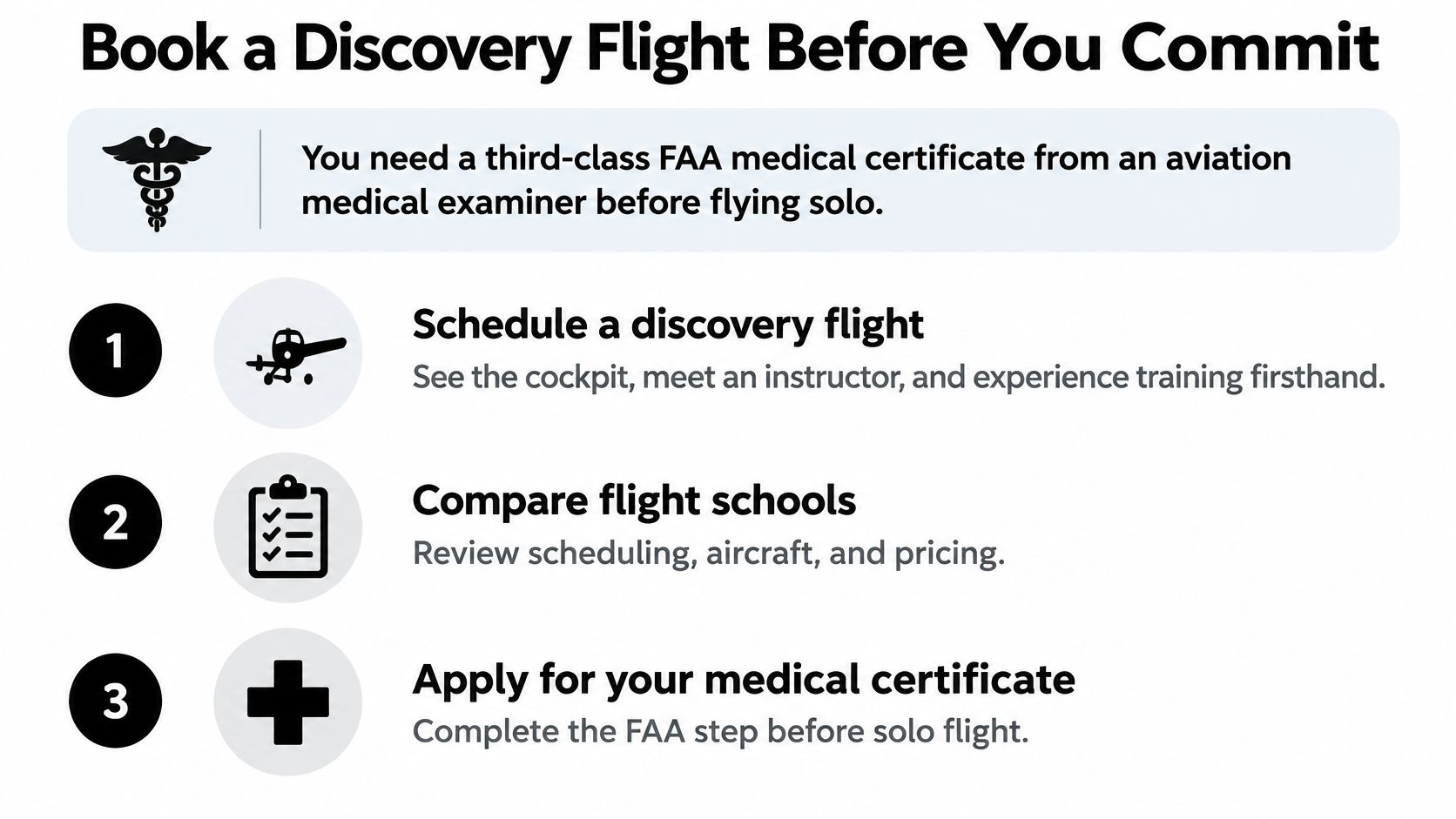
You need a third-class FAA medical certificate from an aviation medical examiner before flying solo. You don't need one to start. A discovery flight and first lessons can be taken before obtaining one, so you can test your interest early without committing to a full program. If you haven't flown yet, book a discovery flight and treat it as a working interview with the cockpit, the instructor, and yourself. Check discovery flight pricing so that first step fits the budget you've already built.
Get the medical scheduled soon after that flight if you plan to continue. A medical issue that needs extra FAA review can delay solo for months, and you'd rather learn that before you've signed a lease or quit a job. Sequence matters: fly first, confirm medical eligibility early, then commit money.
Questions to Ask Every California Flight School
We recommend asking every flight school, including us, the same questions so you can compare answers line by line.
- Airplane age: How old is the fleet you'll fly, and how standardized are the cockpits?
- Students per airplane: How many students share each aircraft, and how many flight slots can you realistically book each week?
- Instructor turnover: How often do instructors leave, and who takes over your training record if yours goes?
- Total price in writing: What's included, what's excluded, and how are extra hours and retests billed?
- Part 61 vs Part 141: Which structure governs your course, and how do stage checks work?
- Fly before committing: Can you take a discovery flight or intro lessons before paying a large deposit?
Put two offers side by side using that list. Compare weekly flight availability next to price, because a cheaper program that flies you twice a week can cost more in rent and lost income than a pricier one that flies you daily. Compare what's excluded, not just what's included. Examiner fees, retests, and extra hours are where totals separate.
Compare on one page: Price in writing, exclusions, flight slots per week, instructor stability, and months of living costs until paid instructing. If a school won't answer one row, that silence is your answer.
If You Want the Full Career Path
For readers ready for a complete zero to CFII route, our Career Track program is a fixed $89,000 tuition, about nine months from zero time to CFII and multi-engine, with 282 total hours and six certificates and ratings, based in Southern California at Riverside, Long Beach, and Corona. Financing is available for the full amount. Those figures still sit inside the larger budget you've built for housing, living costs, test contingency, and time before steady instructing income.
Don't let any program's finish date substitute for your own plan to reach airline eligibility. Certificates get you to paid instructing. Consistent instructing hours, currency, and recurrent evaluations get you toward the ATP threshold. Ask how you'll build hours after graduation and what your fallback is if instructing work starts slowly.
Do one thing this week. Book the discovery flight, then sit down the same day and write your total budget, including living costs and months without a paycheck. You'll know more about your real readiness for Pilot Training California from those two steps than from another month of comparing headline tuition figures.
If you're ready to move from research to a real training plan, explore a Southern California path from zero time to CFII and multi-engine with fixed tuition and structured daily flying. Visit CFII to book a discovery flight, review the Career Track, and build your budget around the full cost of reaching paid instructing.
Planning to fly for a living?
See what the path from zero to a pilot career looks like, what it costs and how long it takes.
Learn to fly in Riverside
We train at Riverside Municipal Airport in modern airplanes with a parachute built in. Start with a one hour discovery flight, no experience needed.