
On this page
- Starting From the Cockpit Seat
- Clear the medical question early
- What the FAA Actually Requires for a Private Pilot
- Track the experience, not just the total
- Choosing a Flight School Without Burning the Budget
- Compare the whole training environment
- Building a Training Schedule That Actually Gets You There
- Treat weather cancellations as training days
- The Milestones That Mark a Real Pilot
- Solo is authorization, not a graduation
- Why Solo Is the Starting Line, Not the Finish
- Your Next Step and Common Questions Answered
- Common questions
You're probably looking at flight-school websites, trying to work out whether learning to fly is a realistic career move or an expensive gamble. The honest answer is that the FAA's minimum hours are only part of the calculation. Consistent training, weather disruptions, instructor availability, and access to a checkride can shape your timeline just as much as the syllabus.
If you're serious about becoming a professional pilot, plan for proficiency, not the smallest number of hours you can legally log. Then choose a training path that helps you keep flying, keep learning, and keep moving through each milestone.
Starting From the Cockpit Seat
On a discovery flight, an instructor will introduce you to the airplane, explain what you're seeing, and let you handle the controls when it's safe to do so. Pay attention not only to how flying feels, but also to how the school prepares you: Are the instructions clear? Do you feel comfortable asking questions? Does the instructor take safety and your concerns seriously? Treat the flight as an introduction to aviation and an interview with the people you may trust with your training.
If you haven't flown before, start by booking an instructor-led discovery flight. It's a practical way to find out whether you enjoy being in a small airplane before committing to a full course. A good first flight doesn't need to convince you that flying is effortless. It should help you understand what training involves and whether you want to continue.
Clear the medical question early
For airplane students, you don't need a student pilot certificate to begin lessons, but you do need one before solo. A third-class medical is the normal class for student, recreational, and private pilots, and you'll need a medical certificate before solo except in limited sport-pilot situations. The FAA advises aspiring commercial pilots to consult an Aviation Medical Examiner early and consider applying for the highest class they expect to need, so a medical issue doesn't surface after you've invested heavily in training. Check the FAA's guidance on student pilot medical certificates and arrange a conversation with an Aviation Medical Examiner before making a major financial commitment.
Airplane applicants generally must be at least 16 and able to read, speak, and understand English. The FAA allows applications through IACRA and other authorized channels. Review the student pilot certificate application process, then ask your instructor which steps they can help you complete.
Your first week should be straightforward: take the discovery flight, get medical guidance, talk through costs and scheduling with the school, and start the certificate application. Don't let paperwork become a mystery you put off until the moment you're ready to solo.
What the FAA Actually Requires for a Private Pilot
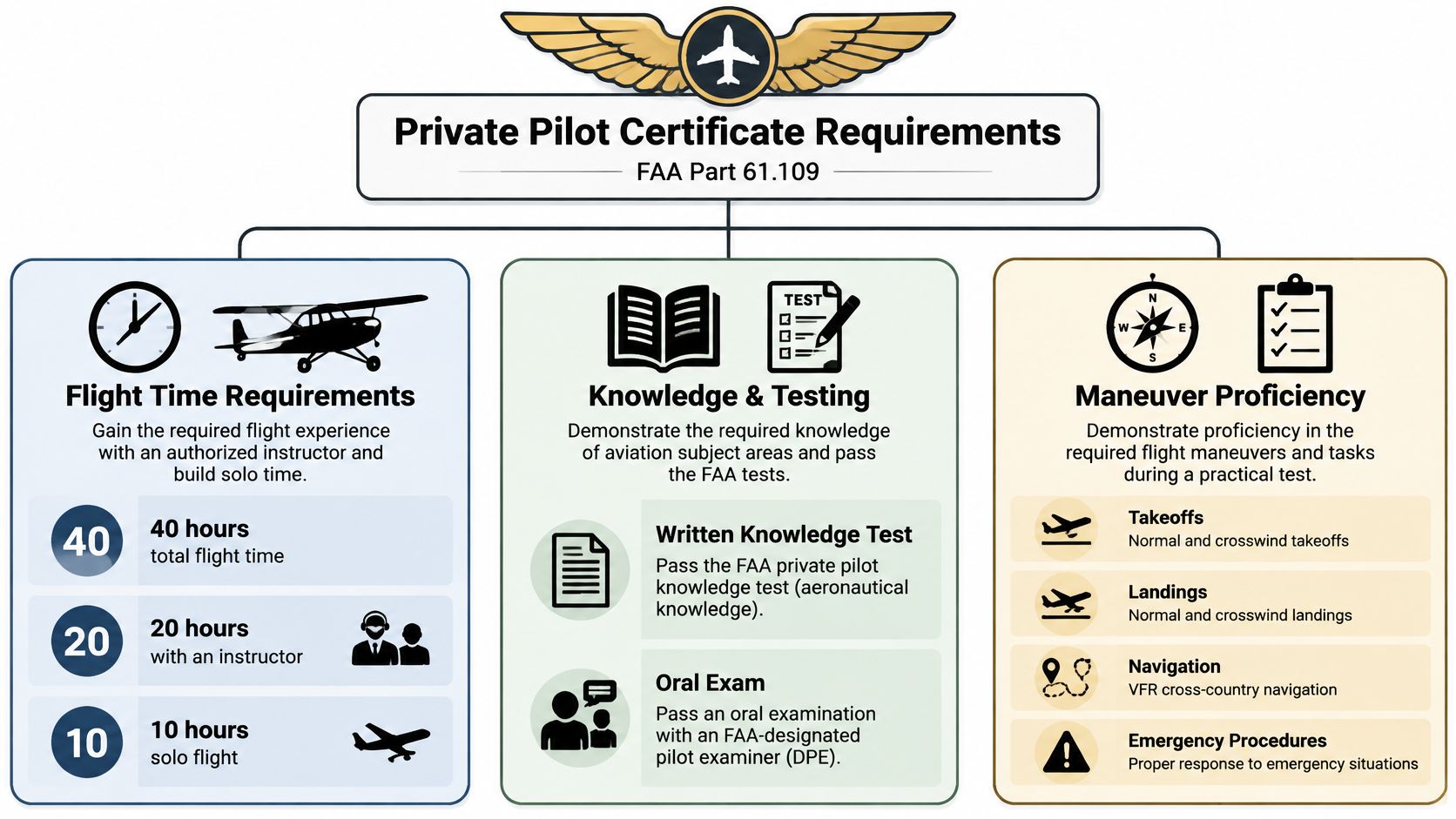
A private pilot certificate is not a 40-hour course. Under 14 CFR § 61.109, the FAA's Part 61 minimum for an airplane private pilot certificate is 40 hours of flight time, including at least 20 hours of training with an authorized instructor and 10 hours of solo flight. The required experience also includes specific training in cross-country flying, night operations, and instrument reference. Check the regulation and keep its categories visible as you train, rather than treating the total-hour figure as the whole syllabus.
Here's the number that should shape your expectations: the FAA reports that pilots without hearing impairment who complete the private-pilot requirements average approximately 75 hours. Approved schools may operate under a 35-hour minimum, but most students still need roughly 60 to 75 hours. Those are not competing versions of the rules. The minimum is a legal threshold; the average reflects the practice many people need to demonstrate consistent proficiency. The FAA's private pilot hourly-requirement guidance puts the distinction plainly.
Track the experience, not just the total
Ask your instructor to review your logbook regularly. You should know which required categories you've completed, what remains, and where you still need practice. A student who only watches the total climb can discover late in training that the necessary solo, navigation, night, or instrument-reference experience isn't complete.
The certificate also requires more than handling the airplane. You'll study for a knowledge examination, prepare for the oral portion of the practical test, and demonstrate that you can make sound decisions as well as fly maneuvers. Your instructor should be connecting those parts from the start.
Instructor's rule: Don't budget for the minimum and hope you'll be the exception. Budget for the proficiency you need, then use your logbook and instructor's feedback to make progress visible.
That mindset will make conversations about cost and timing more useful. Instead of asking only how quickly you can reach the minimum, ask what the school does when a student needs additional practice and how it keeps training on track.
Choosing a Flight School Without Burning the Budget
The lowest advertised aircraft rate doesn't tell you what your training will cost or how long it will take. If flights get cancelled, you can't get the same instructor consistently, or checkrides are hard to schedule, a low hourly price may not translate into a lower all-in bill.
Part 61 and Part 141 describe different regulatory frameworks for flight training. Neither label, on its own, tells you whether the school's schedule, instruction, or cost structure fits your needs. Compare the actual syllabus and operating plan. Ask how training is sequenced, how progress is evaluated, and what happens when a student needs more time than the published course outline assumes. For a practical overview of FAA-approved flight-school considerations, focus on what the school can explain clearly, not just how it describes itself.
Compare the whole training environment
Pay-as-you-go training can suit students who need flexibility, but the total cost depends on how steadily they fly and how many hours they need. A fixed-price program can make the tuition easier to understand, but read what's included and what could cost extra. In either case, get direct answers about aircraft availability, instructor continuity, simulator access, written-test preparation, stage checks, cancellation policies, and examiner scheduling.
Industry data submitted to the FAA found that training costs increased 76.6% since 2020. The average path through commercial multi-engine training and CFI certification cost $65,750 and took more than 72 weeks; the same report found 55% of flight-training organizations and 83% of designated pilot examiners were over capacity or very busy. Those figures describe the wider training environment, not a quote for your local school. They're a reason to ask how a provider plans around interruptions and checkride availability. See the FAA-submitted flight-training industry data.
| Criterion | What to ask | Red flag |
|---|---|---|
| All-in cost | What does tuition cover, and what costs extra if I need more training? | The school discusses only an hourly aircraft rate. |
| Timeline | How often can I expect to fly, and what can delay completion? | No one will explain scheduling assumptions. |
| Aircraft access | What happens when an airplane is unavailable for maintenance? | There's no clear plan for cancellations. |
| Instructor continuity | How will the school keep my training coordinated if my instructor is unavailable? | You're expected to restart or re-explain your progress repeatedly. |
| Checkrides | How does the school manage examiner availability? | The answer is simply that you'll have to find out later. |
Choose the school that can explain the whole path and the likely bottlenecks. You're not buying an hourly rate; you're building a training schedule that has to survive real-world interruptions.
Building a Training Schedule That Actually Gets You There
A training plan needs a dependable rhythm. A lesson should not be an isolated event that you forget between flights. Before each session, review the lesson objective, aircraft limitations, and risks. Afterward, write down what you did well, what needs work, and what you'll practice next. That simple loop turns flight time into directed training.
The FAA Airman Certification Standards, or ACS, make a useful progress matrix from the beginning of training. Each task connects what you must know, which risks you must recognize and manage, and what you must demonstrate in the airplane. Study the applicable task and operating limitations before a lesson; brief the objective and risk assessment; fly the exercise with instructor coaching; then debrief errors, decision points, and a specific remedial exercise. The FAA's ACS training guidance reflects an important point: the practical test evaluates judgment and risk management along with aircraft handling.
Treat weather cancellations as training days
AOPA's survey reported that approximately 60% of people who obtain a student pilot certificate don't progress to a higher pilot certificate. The estimated overall dropout rate, including people who leave before getting a student certificate, was 70–80%. Those figures describe attrition, not checkride pass rates. The practical lesson is that students need a plan to stay engaged when training gets inconvenient. The AOPA flight-training experience survey also notes that schools and instructors should adapt to the student's motivation.
When weather grounds you, don't let the cancellation become an open-ended break. Chair-fly the cockpit flows, rehearse checklists, review the next maneuver, and ask the school about a make-up session. If you're training toward a career, reserve study time just as deliberately as you reserve flight time.
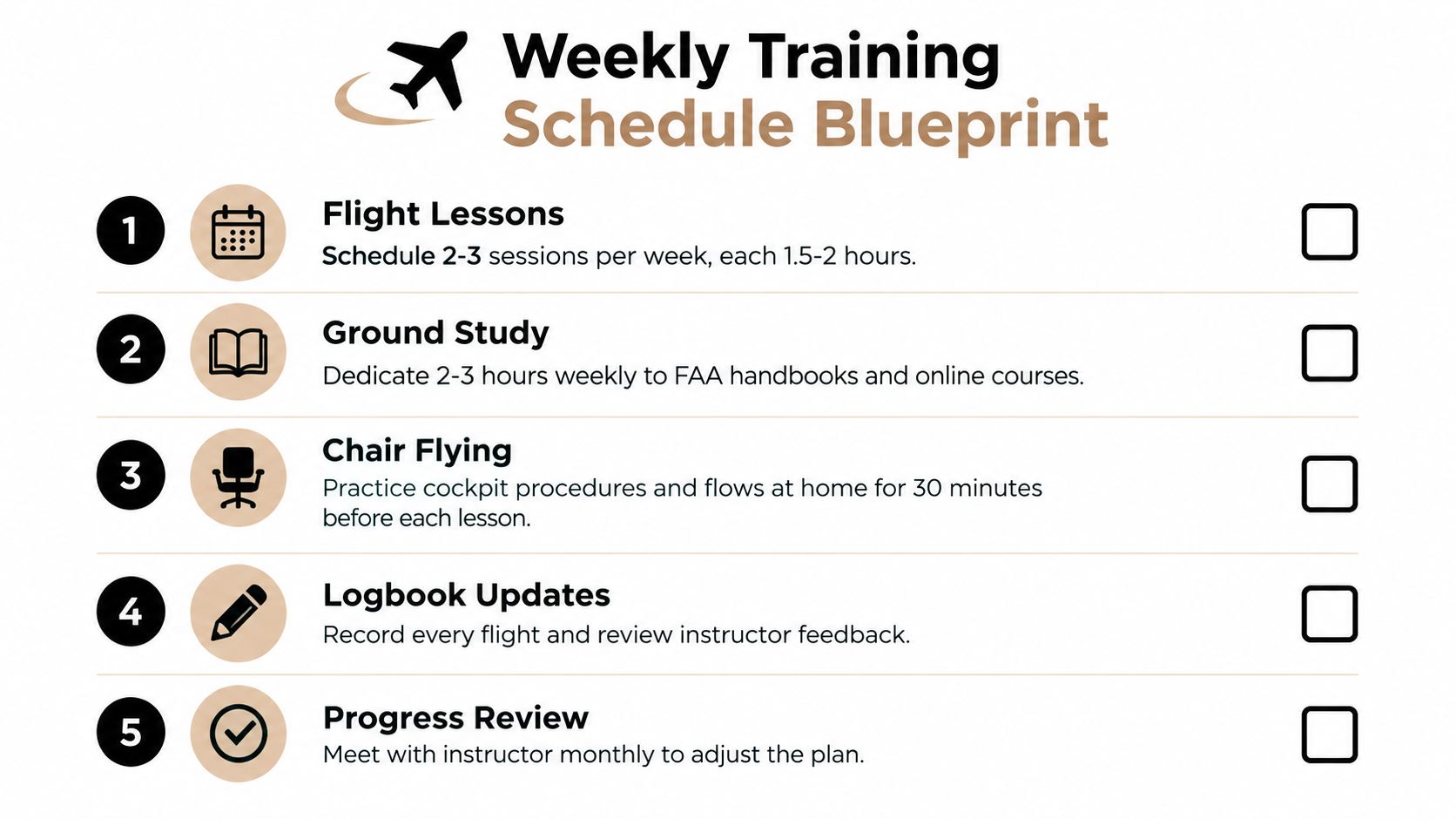
A useful weekly routine includes a flight lesson, focused ground study before the next flight, a short chair-flying session, and a review of instructor feedback. If you have to miss a lesson, set the replacement date promptly. After every debrief, leave with a written next-lesson plan; “practice until it feels better” is not a plan.
The private-pilot accelerated-training overview can help you think through the differences between a flexible pace and a concentrated schedule. Whichever approach you choose, don't confuse logged hours with readiness. Advance when you can perform consistently, explain the risks, and make good decisions without waiting for your instructor to prompt you.
The Milestones That Mark a Real Pilot
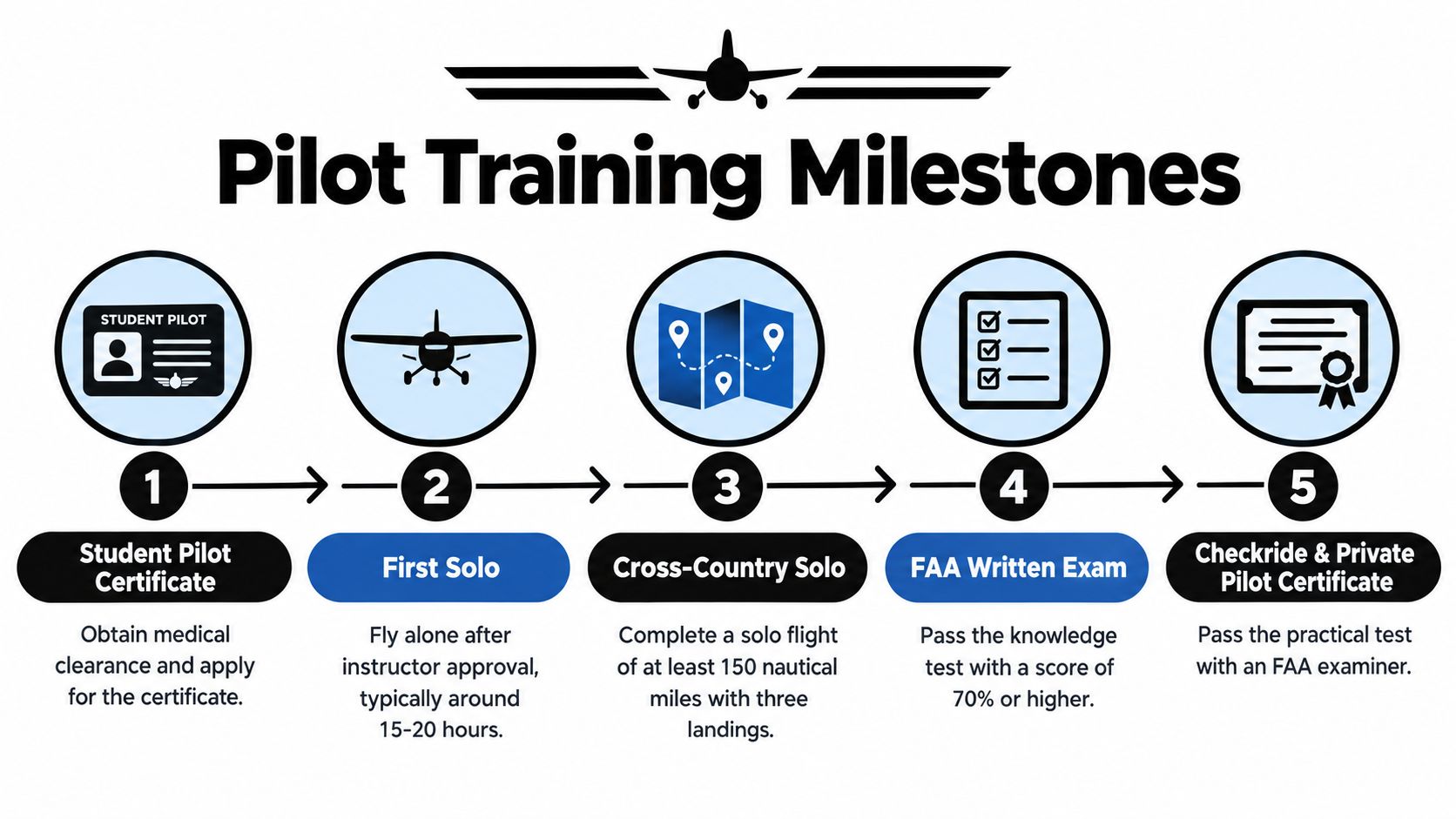
Your training should move through milestones that unlock new capabilities, not just add entries to a logbook. Start with the student pilot certificate and medical requirements, then build the knowledge and aircraft proficiency your instructor needs to see before authorizing solo. After solo come cross-country experience, the knowledge test, and the private pilot practical test. The checkride overview is a useful reminder to prepare for both the ground discussion and the flight evaluation.
Solo is authorization, not a graduation
Before solo flight, 14 CFR § 61.87 requires a student to demonstrate aeronautical knowledge on a test covering relevant rules, local airspace and procedures, and the aircraft's characteristics and limitations. The student must receive and log pre-solo training, demonstrate safe proficiency in required maneuvers, and obtain the applicable instructor endorsements. The authorization is aircraft-specific, and an authorized instructor must have provided relevant training and evaluated the student within the preceding 90 days. Read the solo-flight regulation, 14 CFR § 61.87. Solo is a carefully documented safety decision, not a reward for reaching a particular hour count.
After the private certificate, a career-focused student commonly continues into instrument training, commercial training, multi-engine experience, and instructor certificates. Each step adds knowledge and responsibility. Instrument training develops the ability to operate by reference to instruments under the applicable rules; commercial training adds more demanding standards; instructor certificates prepare you to teach and build experience while instructing.
For an airplane commercial certificate under Part 61, the FAA requires at least 250 total flight hours, including specified experience and commercial-level training. Airlines may set additional experience requirements beyond the FAA certificate minimum. The commercial pilot experience requirements in 14 CFR § 61.129 show why the path is a sequence of training and time-building, not one course that ends at the private certificate.
Use each milestone as a readiness check. If your knowledge, risk management, or aircraft performance is weak, address it before moving on. A certificate matters, but so does the foundation you carry into the next phase.
Why Solo Is the Starting Line, Not the Finish
The first solo is memorable, but it doesn't make you a career pilot. It means your instructor has judged you ready to fly the airplane alone under the conditions of your authorization. The larger challenge comes afterward: completing private training, adding advanced ratings and certificates, and gaining the experience required for professional flying.
The quality of your instruction after the private certificate matters. A good instructor will help you understand not only how to perform a maneuver, but why it matters, how to recognize risk, and how to make decisions when conditions change. When evaluating a program, ask how it supports students through instrument, commercial, multi-engine, and instructor training, rather than focusing only on the first certificate.
CFII's Career Track is a fixed $89,000 tuition program based in Southern California, with training in Riverside, Long Beach, and Corona. The program describes a path from zero time to CFII and multi-engine in about nine months, with 282 total hours and six certificates and ratings. Those are program details, not a promise that every student's career will follow the same timeline. Before committing, confirm what the tuition includes, what costs extra, and whether the pace and location work for you.
A school should be able to explain how it prepares students for each stage and what support it provides when scheduling gets difficult. Don't pick a program because the first milestone sounds fast. Pick it because the full training sequence is clear, the instruction is structured, and you understand the conditions you'll need to meet as you progress.
Your Next Step and Common Questions Answered
If you haven't flown, book a discovery flight and use it to assess both the experience and the school. If you already know aviation is your career goal, compare full training paths using their scope, schedule, cost, instructor structure, and approach to checkride coordination. Keep your medical and certificate requirements in view from the beginning, and ask for a clear plan for each milestone.
Common questions
Can I start lessons without a medical? Yes. A student pilot certificate and medical aren't required just to begin flight lessons, but you'll need the required certificate and medical before solo, subject to limited exceptions. Resolve the medical question early, especially if you plan to pursue commercial privileges.
What should I do if I plateau on a maneuver? Ask your instructor to identify the specific error, demonstrate or explain a correction, and set a focused exercise for the next lesson. Review the relevant ACS task and rehearse the sequence on the ground. Don't keep repeating the same attempt without changing the practice.
Do airline pilots need a college degree? Don't assume every airline has the same hiring criteria. Check the requirements of the employers you may target, and ask your training advisor how your education plans fit your intended career.
How long does it take to reach a regional airline cockpit from zero time? There's no dependable single timeline. Training pace, additional experience requirements, weather, aircraft and instructor availability, and examiner access all affect how quickly you progress. Ask any program to explain its assumptions and what happens if your training takes longer than planned.
CFII offers a structured Career Track from zero flight time to CFII and multi-engine, with fixed tuition and training in Southern California. If you're ready to compare that path with your own career plan, visit CFII and ask for the details behind the schedule, included training, and costs.
Planning to fly for a living?
See what the path from zero to a pilot career looks like, what it costs and how long it takes.
Learn to fly in Riverside
We train at Riverside Municipal Airport in modern airplanes with a parachute built in. Start with a one hour discovery flight, no experience needed.