
On this page
- The Truth About JAA Conversion in 2026
- Converting Your FAA Private Pilot License to EASA
- What to gather first
- How the privileges usually translate
- Why Commercial License Conversion Is Completely Different
- PPL and CPL side by side
- Why the gap matters in real life
- Understanding EASA Theory Examination Requirements
- How the exam logic differs
- What that means for preparation
- Choosing the Right National Authority for Your Application
- What to check before you start
- What differences actually matter
- Planning Your Conversion Timeline and Next Steps
- A practical decision order
- What usually takes longest
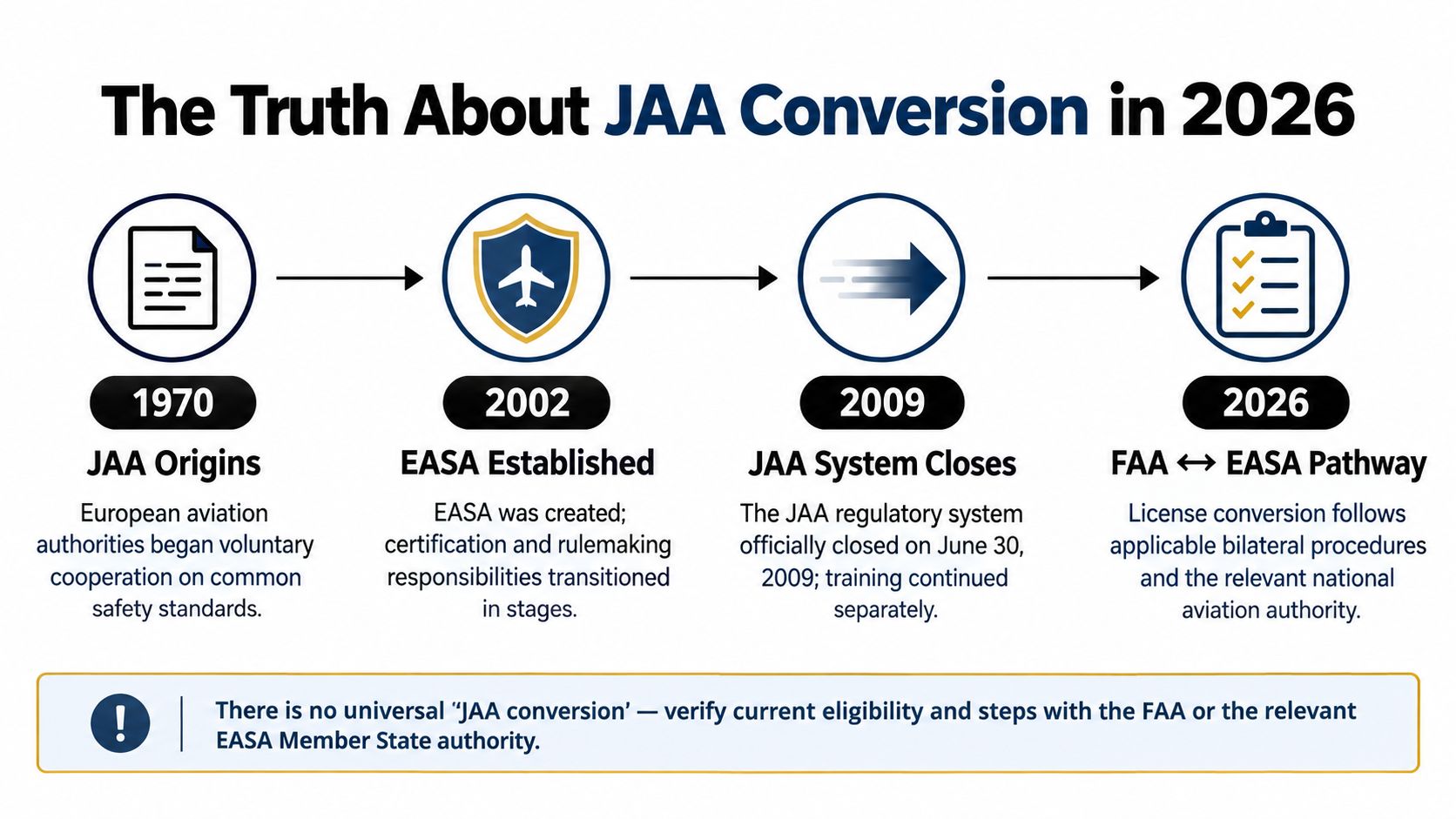
Most pilots asking about converting FAA to JAA are chasing a framework that no longer exists. The key question in 2026 is how to move from an FAA certificate into an EASA Part-FCL licence through the right national aviation authority, with the right expectations for private, commercial, or airline-level privileges.
That distinction matters because the European path is not one universal conversion. The old FAA-JAA harmonization work already showed the systems were built differently, with the U.S. leaning on practical qualification standards and the European framework putting heavier weight on standardized theory training, which is why the FAA-to-Europe process has never been a simple admin swap FAA Licensing Harmonization Working Group record.
The Truth About JAA Conversion in 2026
JAA is obsolete. Pilots still search for “converting FAA to JAA,” but the live route now runs through EASA and the national aviation authority that will handle the file. The licence title matters less than the privileges that authority is willing to recognize.
That distinction becomes real fast once the paperwork starts. A pilot who assumes there is one central European conversion desk can waste time collecting the wrong documents, or begin training with the wrong target in mind.
The confusion comes from history. The late-1990s harmonization work compared U.S. Federal Aviation Regulations with the emerging JAR-FCL system and showed that the two structures were built differently. The U.S. framework generally relied on practical qualification standards, while the JAA side placed heavier weight on standardized theoretical training, including the 750 hours of theory required under the JAA Airline Transport Pilot Licence framework FAA harmonization notice.
For private flying, the path can still be fairly direct if the paperwork is clean and the authority accepts the credit. For professional flying, the burden rises quickly, and the file starts to look less like a simple conversion and more like a compliance exercise.
EASA's own FAQ framework makes the point clearly. Pilot licences are issued by the Member States, not by a central EASA office, and the rules sit under Commission Delegated Regulation (EU) 2020/723. That is why the authority you choose can change the result as much as the licence you already hold EASA FAQ.
Converting Your FAA Private Pilot License to EASA
For many pilots, the cleanest route is the FAA PPL to EASA PPL(A) pathway. Under the FAA-EU BASA arrangement, the authority normally checks verified licence details, a valid FAA certificate and ratings, medical evidence, language-proficiency evidence, and proof of pilot-in-command privileges before deciding what credit to grant Transportstyrelsen FAA conversion guide.
What to gather first
A clean file matters. If your FAA certificate is current, your ratings are valid, and your logbook supports the privileges you want recognized, the authority can assess the conversion instead of chasing missing basics.
Usually that means:
- Verified licence data, so your certificate details match the record exactly.
- A valid FAA certificate and ratings, because expired privileges slow the file down.
- Medical evidence, since an FAA medical does not automatically satisfy European medical requirements.
- Language proficiency evidence, because the authority still needs proof that you can operate safely in the environment where you will fly.
- Proof of PIC privileges, especially if you want recognition beyond basic private privileges.
If you want a practical sense of what private flying can cover after conversion, the best starting point is what you can do with a private pilot license. That helps keep the target tied to real flying, not just the licence title.
How the privileges usually translate
If the authority accepts the application, it may issue an EASA PPL(A) with corresponding SEP, MEP, instrument, or night privileges where eligible. That detail is where many pilots get surprised. The conversion is not only about the licence category, it is about which privileges the authority is willing to recognize on the back end.
Private conversion can preserve useful flying privileges without sending you back through a full European ab initio course. That is the core advantage. The trade-off is that the same paperwork discipline does not carry over to commercial work, where the requirements are tighter and the file is judged against a different standard.
A video walkthrough can help you see the gap between the certificate in your wallet and the privileges you are legally allowed to exercise.
If you hold a private licence and want to fly for lifestyle, club, or local general aviation use in Europe, this is the pathway to study first. If your goal is income, airline hiring, or instructing under European rules, you are dealing with a different licensing track.
Why Commercial License Conversion Is Completely Different
FAA commercial experience does not carry over into an EASA CPL on a one-to-one basis. A third-country commercial licence cannot be converted directly, and the applicant usually has to assemble a much deeper compliance package than a private pilot does. The European authority is checking professional eligibility, not just comparing credentials. EASA third-country licence guidance
The reason is structural. Commercial licensing in Europe assumes a different theory base, a different examination path, and a different standard of proof, so the authority has to see whether you meet that professional bar before it can issue commercial privileges.
PPL and CPL side by side
| Requirement | PPL Conversion | CPL Conversion |
|---|---|---|
| Licence focus | Private flying privileges | Commercial privileges |
| Authority action | May issue EASA PPL(A) with eligible ratings | Cannot be converted directly; requires a full compliance package |
| Theory burden | More limited pathway | Full EASA CPL or ATPL theory examination |
| Medical | Depends on the pathway and authority | EASA Class 1 medical |
| Language standard | Evidence required | At least Level 4 |
| Practical test | Where required by the authority | EASA CPL skill test |
| Experience standard | Verified for private credit | Must satisfy EASA CPL experience requirements |
The table makes the split obvious. Private conversion can often be handled as a credentials review with some bridging. Commercial conversion is a rebuild of eligibility, and the authority expects the file to show that you can operate to European professional standards before it grants commercial privileges.
The costly mistake is planning a European job hunt around an FAA commercial certificate and discovering later that you still need theory exams, an EASA medical, and a skill test.
Why the gap matters in real life
If you already hold an FAA CPL, you are not starting over, but you are also not holding a ready-made European commercial licence. That changes the order of your next steps, the amount of ground school you need, and which authority you should approach first.
Before you plan the European skill test, revisit what a checkride involves: what is a checkride.
Commercial flying in Europe is not a paperwork upgrade from the FAA version. It is a regulatory migration, and the rules are stricter than private pilot conversion. Your experience, theory knowledge, medical status, and practical test history all have to line up closely enough for the authority to issue a new professional licence.
Understanding EASA Theory Examination Requirements
European theory is where FAA-trained pilots often misjudge the workload. The old JAA framework already showed how seriously Europe treated theory, but the practical lesson for today is simpler. If you are aiming at an EASA licence, written knowledge is not a side task. It is part of the licence itself.
EASA keeps that structure tight. For CPL and ATPL tracks, the theory syllabus is broken into multiple subjects, and candidates usually have to sit separate exams rather than one broad paper. That means your study plan has to match the licence level you want, not just your current FAA experience. The official EASA learning objectives and exam guidance make that expectation clear, and they are the right starting point for any serious conversion plan EASA learning objectives and examination guidance.
How the exam logic differs
European theory tests are built around a syllabus, not around a narrow pass-fail written test. In practice, that changes how you prepare. You need structured ground school, subject-by-subject revision, and enough repetition to stay consistent across the full set of topics.
For an FAA pilot, the common mistake is to treat EASA theory like a harder version of the same thing. It is broader than that. The material reaches into areas that many U.S. pilots have not reviewed in years, so casual self-study usually leaves gaps. A pass depends on knowing the European framework well enough to answer in the way the authority expects.
What that means for preparation
Preparation has to start with the target licence. Private conversion, commercial conversion, and airline-level theory all ask for a different level of depth, and the workload rises fast as the licence gets more professional. A pilot who already flies well can still be underprepared if the study plan is built around memory instead of syllabus coverage.
That is where disciplined ground school pays off. You want a plan that tracks the subject list, builds exam readiness in order, and leaves time for weak areas before test booking. If you try to cover EASA theory with the same habits you used for an FAA knowledge test, you will probably find the gap too late.
Rule of thumb: If your study plan still feels like FAA written-test prep, it is too shallow for EASA.
The practical move is to treat theory as its own project, with its own timeline and standard. Once you accept that, the process becomes more predictable, and you avoid the false confidence that catches a lot of otherwise capable pilots.
Choosing the Right National Authority for Your Application
EASA sets the common rules, but your licence still comes from a specific national authority. That is why two FAA pilots can follow the same broad path and still face different paperwork, timing, and document checks. The authority you choose can change how smooth the conversion feels from the start.
The right filing point is usually the Member State where you reside or intend to work, because that is the authority most likely to handle your third-country conversion and issue the Part-FCL licence you need.
What to check before you start
Before you send a form or pay for training, confirm three things:
- Which authority handles your case, because EASA sets the framework but the Member State issues the licence.
- What documents that authority wants, since national implementation and document lists differ.
- Whether you need to train or test before applying, because some authorities expect contact before training begins.
That last point matters more than many pilots expect. Sweden's Transportstyrelsen publishes a full BASA document checklist online, while some other authorities want a pre-application contact or consultation before you begin training or submit a file. Those differences do not change the licence standard, but they do change how you should sequence the work.
If you skip this step, you can end up with a valid FAA file and the wrong European workflow. The fix is usually not more flying. It is a better administrative decision.
What differences actually matter
Some authorities are more straightforward with private conversions. Others are stricter about document verification, medical evidence, or when they want to see proof that you have started the process. That is the practical difference you need to account for.
The EASA framework is shared, but the way it is applied can vary enough to affect your timeline and costs. EASA FAQ makes the broader point clear, and the national office you deal with will decide how that framework is handled in practice.
Choose the authority based on your real future, not on convenience. If you are moving for work, use the state where that work will happen. If you are relocating long term, use the state where you will live.
Contact the authority before you commit to training. It is cheaper to ask one hard question early than to rebuild a conversion package halfway through the process.
That one habit separates pilots who move efficiently from pilots who keep finding missing requirements after they have already spent time and money.
Planning Your Conversion Timeline and Next Steps
The cleanest way to plan this is by pathway, not by brand name. A private conversion can stay fairly contained. A commercial conversion brings theory, medical, and skill-test work into the same file. Airline ambitions add another layer of pressure because the licensing path gets wider and slower.
If you are deciding whether to train in the U.S. first or start European planning now, the answer depends on where you want to fly. A U.S. licence has value, but it does not remove the EASA compliance work if your goal is European employment. Pilots usually move faster when they choose the market first and build toward that target on purpose.
A practical decision order
Start with the destination authority, then the licence level, then the documents. After that, map the exams and tests you will need, and only then spend money on training or time-building.
For pilots building a longer training plan, flight training course options are worth reviewing early because the structure of your training path affects how easily you can adapt later to another regulatory system.
What usually takes longest
The private path is mostly paperwork alignment and authority processing, assuming your privileges and medical evidence are already in order. The commercial path takes longer because of the theory exam load, the medical standard, and the skill test. Airline-level ambitions take longest of all because the European side expects a much deeper professional profile. The EASA Part-FCL framework sets the basic structure, but the workload still changes by route.
A rough planning guide helps here. Private conversion often moves on an administrative timeline, while commercial conversion usually stretches into a longer training and testing cycle. If airline work is the target, expect a much larger commitment in study, medical review, and flight preparation.
Start with the hardest bottleneck. If theory prep will slow you down, begin there. If your medical or paperwork is messy, fix that before you book anything else.
Best practice: Do not buy training before you know which authority will accept your file. That one decision shapes everything else.
If your goal is European flying, build the route around the European requirement set from the start. If your goal is private recreation, keep the conversion narrow and efficient. If your goal is a commercial seat, approach it as a professional licensing project with its own exam, medical, and skill-test milestones.
Planning to fly for a living?
See what the path from zero to a pilot career looks like, what it costs and how long it takes.
Learn to fly in Riverside
We train at Riverside Municipal Airport in modern airplanes with a parachute built in. Start with a one hour discovery flight, no experience needed.