
On this page
- The End of Printed Expiration Dates
- What changed for existing and new certificates
- The language matters
- Understanding the 2024 FAA Rule Change
- Build the timeline from the recent-experience deadline
- Four scenarios that create operational confusion
- Approved Pathways to Regain CFI Privileges
- Choose the path that matches your evidence
- Use the infographic as a checklist, not authority
- Navigating IACRA and Required Documentation
- A clean submission sequence
- Make your records inspection-ready
- Reinstatement After the Grace Period Ends
- Why waiting creates operational exposure
- Prepare for the practical test like a new evaluation
- Comparing FAA Flexibility with EASA Standards
- The practical contrast
- Strategies for Maintaining Continuous Currency
- Use three layers of protection
- Make student records part of the syllabus
- Quick Reference Guide for CFI Renewal
- The five-item compliance checklist
The most common advice about flight instructor renewal is now outdated: “Check the expiration date on your certificate and renew before it arrives.” That advice worked under the old FAA system. It can mislead you today.
The operational question is no longer just whether the plastic certificate shows a future date. You need to know whether you've satisfied the recent-experience requirements, whether your instructional privileges remain active, and which recovery path applies if your recent-experience period has ended. The FAA's December 1, 2024 rule change made that distinction central to the flight instructor renewal requirements.
The End of Printed Expiration Dates
CFI renewal used to revolve around one thing, a printed expiration date. Find the date, schedule a FIRC or practical test, file the paperwork, and keep teaching. That workflow was easy to follow, and it is now the wrong mental model for newly issued CFI certificates.
For certificates issued on or after December 1, 2024, the FAA removed the printed expiration date and replaced it with a recent-experience framework. The FAA explains the current requirements in Advisory Circular AC 61-65G, which lays out the paths for renewing or restoring flight instructor privileges under 14 CFR §61.197.
The practical consequence is simple. The card itself no longer tells you whether you can instruct. What matters is your documented instructional activity, approved refresher training, practical test history, and the FAA application that supports your status.
Operational rule: Treat your CFI status as an activity-based privilege, not as a piece of plastic with an expiration date.
What changed for existing and new certificates
The transition created a split system. Some instructors still carry older certificates with a printed expiration date. Newly issued certificates may not show one at all. The compliance question is the same either way, Have I met the applicable recent-experience requirement, and can I prove it?
The FAA now uses a 24-calendar-month recent-experience requirement for CFIs issued under the new system, with a three-calendar-month reinstatement window after that period ends. AC 61-65J sets out those timelines and the related recovery paths. This is not an extension of the old expiration-date model. It is a different rule structure.
That shift changes how schools manage instructor oversight. A chief instructor should not rely on the appearance of a valid card alone. A CFI changing employers should not assume that the absence of a printed date means unrestricted authority. Training providers should keep records showing the instructor's qualifying activity and application status.
The language matters
People mix up “expired,” “lapsed,” and “out of compliance.” That creates bad decisions. The FAA framework separates a certificate with no printed expiration date from an instructor whose privileges can no longer be exercised because the recent-experience requirement was not met.
The right response is direct:
- Review the governing rule: Use the current version of 14 CFR §61.197 and FAA guidance, not an old renewal schedule.
- Verify the activity: Identify the qualifying path you completed and keep the supporting record.
- Confirm the filing: Completing a FIRC or another qualifying activity is not the finish line. The FAA application still has to be submitted and processed.
- Stop instructing when required: If your privileges have lapsed, do not provide flight or ground instruction that requires CFI authority until you complete the proper recovery path.
The new system gives CFIs more flexibility, but it also puts the burden on personal record-keeping. The certificate no longer tells the full story. Your records do.
Understanding the 2024 FAA Rule Change
The December 2024 change removed the printed expiration date, but it did not give CFIs open-ended authority to instruct. The controlling question is whether the instructor has met the 24-calendar-month recent-experience requirement and completed the required FAA process. Under the FAA guidance in AC 61-65J, an instructor who misses that requirement may have a three-calendar-month window for administrative recovery, including an approved FIRC when the applicable conditions are satisfied.
That window is where operations departments create the most confusion. It is not a free extension, and it does not let an instructor keep teaching while paperwork catches up. Once recent experience is no longer current, stop exercising CFI privileges until the instructor confirms an available recovery path and meets its requirements.
Build the timeline from the recent-experience deadline
Start with the end of the current recent-experience period. Do not use the date of the last FIRC as a substitute for confirming the actual controlling period. Review the certificate history, FAA records, and qualifying activity, then establish:
- The final month of current compliance.
- The point at which CFI privileges stop being exercisable without further qualifying action.
- The remaining three-calendar-month reinstatement window.
- The records and application materials required for the selected recovery path.
Put those dates and documents in the school's compliance system, not only in the instructor's personal calendar. A chief instructor needs to know whether an instructor can be scheduled, whether a student's lesson can proceed, and whether a submitted application is still awaiting FAA processing.
The terminology also matters. A certificate may have no printed expiration date while the holder is unable to exercise CFI privileges. Another instructor may have missed the active recent-experience period but still qualify for an administrative recovery option. Treat those as separate operational statuses. Do not clear an instructor for duty based on the card alone.
Four scenarios that create operational confusion
Scenario one, you're current. Complete a qualifying pathway before the recent-experience period closes. Submit the application and supporting records through the FAA process. Do not wait for a printed expiration date to force the issue.
Scenario two, you've just missed the recent-experience period. Remove the instructor from CFI assignments immediately. Confirm whether the instructor remains within the three-calendar-month reinstatement window, then select an approved path such as a FIRC if the applicable requirements are met.
Scenario three, you're inside the recovery window but lack records. Treat the missing evidence as a compliance problem. Reconstruct the activity, obtain completion documentation, and check that the application identifies the correct basis for recovery. A completed course without supportable records does not give the chief instructor a defensible basis for scheduling.
Scenario four, the recovery window has ended. Stop looking for a routine administrative fix. The simpler recovery options may no longer apply, and a practical test for an instructor rating becomes the primary route described by FAA guidance.
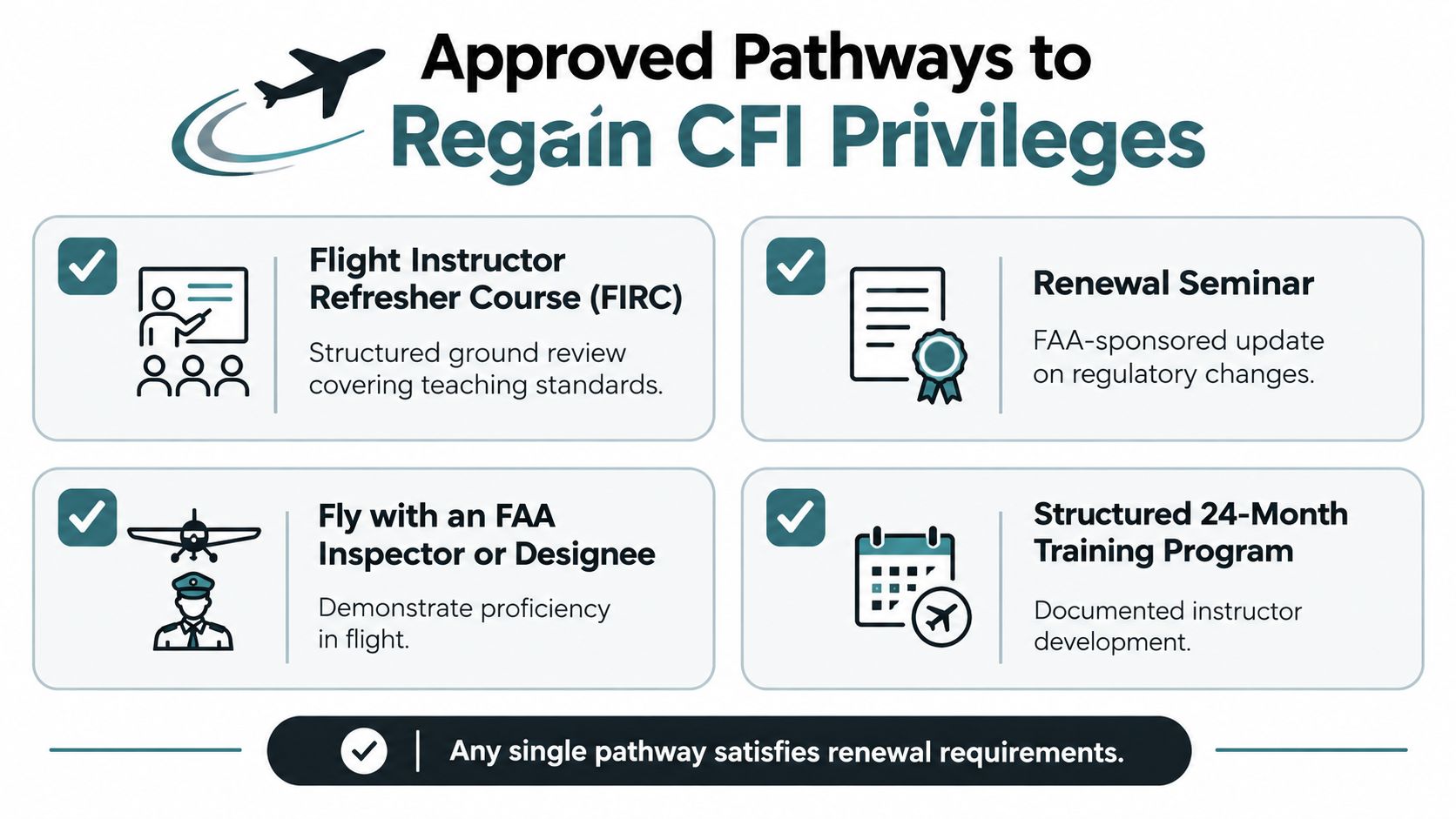
Use the following visual as a planning aid. It summarizes four approved pathway concepts, but it does not replace checking the governing regulation, the instructor's records, and the current FAA processing requirements.
The rule change also makes the training operation's structure relevant. Instructors and chief instructors should know whether the school operates under Part 61 or Part 141, because that distinction affects how training records and endorsements are maintained. The Part 61 versus Part 141 comparison provides useful context, but it does not replace the CFI-specific requirements under §61.197.
The video below provides another visual explanation of the practical issues instructors face when maintaining their privileges.
Set the end of the recent-experience period as a hard compliance deadline. Work backward from it, verify the recovery window before assigning instruction, and require records that support the chosen path. The absence of a printed date is not clearance to teach.
Approved Pathways to Regain CFI Privileges
The absence of a printed expiration date has created a dangerous operational assumption: some instructors treat the certificate as continuously usable. Since the December 2024 FAA rule change, your recent-experience window, records, and actual status matter more than the plastic certificate in your wallet. Stop assigning instruction until you can identify the qualifying activity that supports your privileges.
The FAA provides several approved routes, but they are not interchangeable. Choose based on what you completed, what you can document, whether you are adding an instructor rating, and whether you are still inside the applicable recovery period.
A Flight Instructor Refresher Course, or FIRC, is the cleanest option for an instructor who wants a structured review and does not have a dependable teaching record. Complete an FAA-approved refresher course within the applicable period, retain the completion evidence, and use it as the basis for the required application. This route suits part-time CFIs, instructors between jobs, and pilots who maintained the certificate without building a clear record of qualifying instructional activity.
Choose the path that matches your evidence
A practical test is the most direct proficiency-based route. Use it when you are adding an instructor rating or when an evaluation fits your situation better than a refresher course. It requires preparation and scheduling, but the outcome is clear. You demonstrate the required proficiency to the FAA or an authorized designee.
WINGS credit may support a qualifying renewal route when the completed activity meets FAA requirements. A safety seminar or online completion record is not automatically sufficient. Confirm that the credit applies, retain the supporting record, and ensure the application identifies the correct basis before you stop there.
Student-success records can support instructors with sustained teaching activity. This route reflects work already performed, but it carries a documentation burden. Keep endorsement records, practical-test outcomes, and other evidence required by the applicable rule together. Student claims or informal recollections do not replace an organized record.
Military instructors have a specific option. Under the FAA guidance in AC 61-65G, an official U.S. Armed Forces instructor-pilot or pilot-examiner proficiency check completed within the 12 calendar months before application can satisfy the relevant renewal provision. Obtain the official evidence before submitting the application. Do not wait for a rejection to discover that the record is incomplete.
Use the infographic as a checklist, not authority
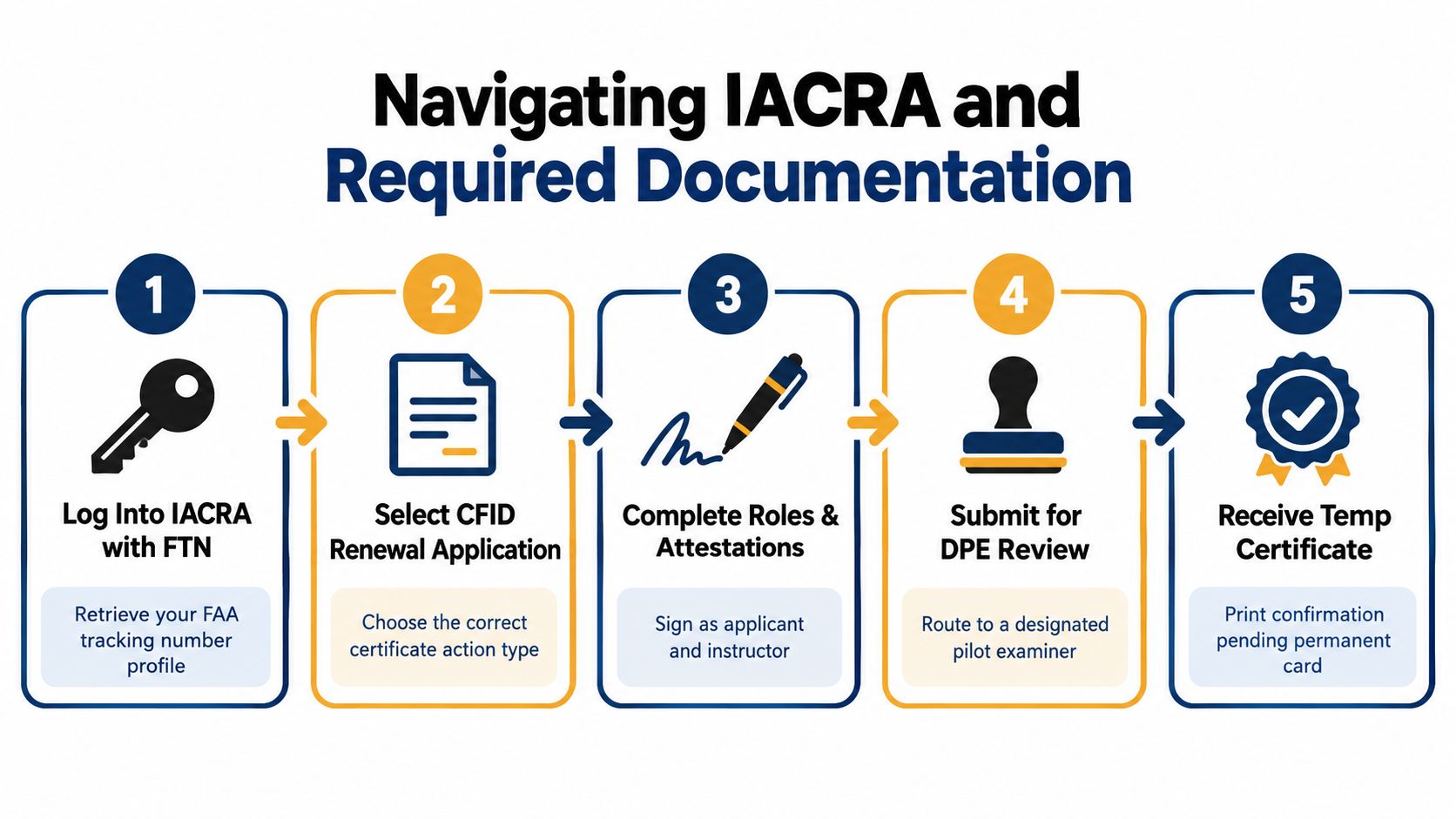
The visual below helps organize the administrative sequence, but it does not establish eligibility. Confirm the path against the regulation, applicable FAA guidance, your records, and the date on which your recent-experience period ended.
Before selecting a route, answer four questions:
- What status do I have today? Am I current, outside the recent-experience window, or beyond the available reinstatement period?
- What can I prove? Do I have FIRC completion, WINGS credit, practical-test results, student-success records, or military proficiency evidence?
- What does the application require? Prepare the FAA Form 8710 submission through IACRA and gather the records needed for review.
- What creates the least operational risk? Choose the route supported by verifiable evidence, not the route that appears quickest.
Treat the qualifying activity and privilege restoration as separate events. Completing a FIRC, earning WINGS credit, passing a practical test, or obtaining a proficiency check does not by itself authorize instruction. Your records must support the selected route, and the required FAA submission must be completed and accepted before you resume teaching.
Use a structured training reference to build sound habits early. The CFII pathway for becoming a CFI can help new instructors establish that foundation, but active CFIs remain responsible for tracking their own recent-experience windows and preserving compliance records.
Navigating IACRA and Required Documentation
A qualifying activity does not restore CFI privileges by itself. The administrative record must match the activity, and the application must identify the correct certificate action. Under the current framework, submit FAA Form 8710 through IACRA, as described in AC 61-65J. The December 2024 removal of printed expiration dates makes this check more important. Do not rely on an old certificate date to decide which recovery process applies.
Open the IACRA profile linked to your FAA tracking number. Check your name, certificate information, ratings, and contact details before creating the application. A mismatch between the profile and supporting records can delay review even when the underlying renewal activity is valid.
A clean submission sequence
- Log in with the correct profile. Use the account connected to your FAA tracking number. Do not create a second profile to solve a basic access problem.
- Select the appropriate flight instructor application. Choose the action that matches renewal or reinstatement. If your status is unclear after a recent-experience lapse, resolve that classification before signing.
- Complete the applicant sections carefully. Review every certification, role, and attestation. Your electronic signature is a regulatory statement, not a routine click.
- Attach or present supporting evidence. Provide the record that matches the selected path, such as approved FIRC completion, WINGS documentation, practical-test evidence, recent-student-success records, or military proficiency documentation.
- Route the application to the correct reviewer. The FAA inspector, designated pilot examiner, or authorized FIRC representative must be able to verify both the application and the qualifying activity.
- Save the confirmation. Keep the temporary certificate or confirmation with your compliance records until the permanent certificate process is complete.
The recurring failure is an evidence gap. An instructor completes a course but cannot find the graduation record. Another has student results split among a paper logbook, an electronic logbook, and a school database. A third selects the wrong application because the old printed-expiration model still guides the decision.
Make your records inspection-ready
Use one digital or physical folder for the entire renewal cycle. Include the date and nature of the qualifying activity, completion evidence, relevant student or military records, the IACRA confirmation, and communications with the reviewing official. Keep these records together before a lapse occurs.
An electronic logbook guidance resource for pilots can help you design a reliable record system. A logbook entry alone may not prove every CFI renewal pathway, so retain the specific document that demonstrates the qualifying activity.
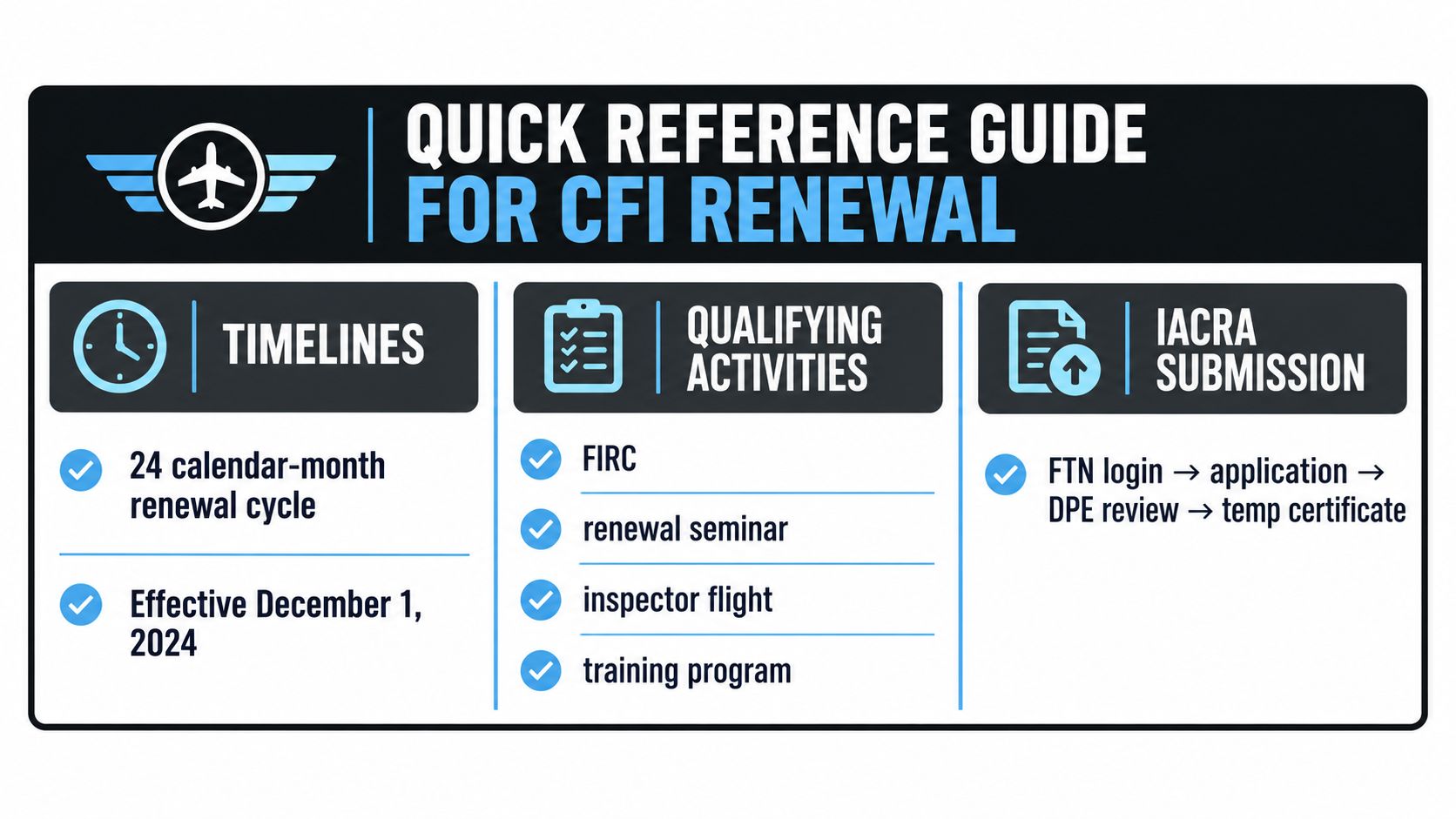
This quick reference visual shows how the timeline, qualifying activities, and IACRA submission fit together.
Before instructing again, verify that the qualifying requirement is complete, the application has been properly submitted, and the relevant authority has processed or accepted it. A course receipt or IACRA draft does not establish active privileges.
Reinstatement After the Grace Period Ends
Once the three-calendar-month reinstatement window has passed, the recovery problem changes. The instructor can no longer rely on the limited administrative route available shortly after the recent-experience period ended. The practical-test route becomes the serious planning issue.
A practical test for an instructor rating is not a paperwork substitute. It is a proficiency evaluation conducted by an FAA inspector or authorized designee. You must prepare for the applicable instructor tasks, arrange an aircraft or other required resources, coordinate an examiner, and complete the application correctly.
Why waiting creates operational exposure
A CFI who notices a lapse immediately may still have an eligible recovery path. A CFI who ignores the issue until the reinstatement window closes has fewer choices and more scheduling pressure. The difference isn't merely administrative. You may have to stop teaching, reschedule students, and absorb the preparation burden associated with a practical test.
Don't continue instructing while telling yourself that the checkride is “already scheduled.” Scheduling isn't reinstatement. Until the applicable process is complete, you can't represent an expected future pass as current authority to provide CFI privileges.
Prepare for the practical test like a new evaluation
Use the applicable FAA standards, review every instructor task, and practice teaching rather than merely reciting knowledge. An instructor practical test examines your ability to explain, demonstrate, manage risk, correct errors, and evaluate a learner. A pilot who has been flying regularly may still be poorly prepared to teach those tasks under examination conditions.
A disciplined preparation plan includes:
- Confirming the rating: Identify the instructor rating involved and the practical-test scope before booking.
- Reviewing standards: Use the current FAA standards and any applicable examiner guidance.
- Auditing endorsements: Make sure your own application and supporting endorsements are complete.
- Selecting the aircraft: Verify that the aircraft, equipment, and records support the planned evaluation.
- Protecting the schedule: Allow time for weather, maintenance, examiner availability, and additional preparation.
A FIRC is often more convenient when it remains legally available. It provides structured review and avoids the practical-test burden, but it can't be treated as a universal solution after the reinstatement window ends. The governing status and timing decide which paths remain open.
If you're already planning to add an instructor rating, the practical test may serve two purposes. If you're not, don't choose a checkride casually. Book it because the regulation requires it or because demonstrating proficiency fits your career plan, not because you underestimated the calendar.
Comparing FAA Flexibility with EASA Standards
The FAA and EASA do not use the same operating model for flight instructor privileges. The FAA's post-2024 framework emphasizes recent experience and provides a limited reinstatement route after a lapse. EASA uses a more time-bound revalidation and renewal structure, with recurring standards that must be met before expiry.
Under the EASA framework described in the FCL.940.FI reference, FI(A) and FI(H) holders can use a recurring standard that includes at least 50 hours of flight instruction, while FI(As) holders can use a standard involving 20 hours. Other routes include refresher training or an assessment of competence completed within the applicable period before expiry.
The difference is operationally important. A European instructor must manage a defined revalidation process tied to the privilege's validity. If the FI certificate has expired, EASA renewal requires refresher training and an assessment of competence completed within the applicable period before the application date. That is more prescriptive after expiry than the FAA's activity-based system.
The practical contrast
| Compliance question | FAA approach | EASA approach |
|---|---|---|
| What drives ongoing validity? | Recent experience and a qualifying pathway | Time-bound revalidation standards |
| What happens after a lapse? | A limited reinstatement route may exist, followed by a practical-test requirement when that route closes | Refresher training and assessment of competence are required under the post-expiry structure |
| What must instructors track? | Qualifying activity, recent-experience status, and FAA documentation | Hours, recurring standards, expiry, and assessment requirements |
| Can national implementation affect timing? | FAA rules and guidance control the certificate framework | National implementation can affect the validity period within the broader EASA framework |
Spain illustrates that final operating details can vary by national implementation. Spain announced that, from April 1, 2026, FI rating revalidation or renewal would become valid for three years instead of two years, as reported in the cited EASA reference. That is a policy change for the relevant market, not a reason to assume every European jurisdiction uses the same period.
For instructors working across jurisdictions, don't carry an FAA assumption into an EASA operation or the reverse. Identify the authority governing the privilege you intend to exercise, then track that authority's exact revalidation and documentation requirements.
Strategies for Maintaining Continuous Currency
The best renewal strategy is not a last-minute FIRC. It's a record system that tells you what you need before the deadline becomes an emergency.
Start with a single compliance dashboard. Record the end of your current recent-experience period, the qualifying activities you may use, the documents already collected, and the person or organization responsible for processing your application. Put the dates in a shared system if you're employed by a flight school, but keep a personal copy. Your certificate is your responsibility even when an employer normally coordinates renewals.
Use three layers of protection
The calendar layer should contain more than one reminder. Create an early review reminder, a decision point for selecting the renewal path, and a final confirmation task. The purpose isn't to generate alerts for their own sake. It's to force a deliberate status check before you enter the final portion of the period.
The logbook layer should capture qualifying activity as it happens. Don't reconstruct student endorsements or test outcomes from memory. After each relevant event, save the record, identify the student or activity, and connect it to the applicable CFI renewal pathway.
The application layer should begin before the last possible moment. Check your IACRA access, verify your FAA tracking number profile, and identify the reviewing official. A system outage, missing certificate, or unavailable examiner is a predictable administrative risk, not an unforeseeable event.
Make student records part of the syllabus
If your intended pathway depends on instructional outcomes, build the documentation into the school's normal workflow. The chief instructor or stage-check process should make it clear who records endorsements, who verifies test results, and where the evidence is stored. The CFI shouldn't have to search through multiple systems at the end of the cycle.
A simple monthly review works well:
- Status check: Confirm whether your privileges remain active.
- Evidence check: Verify that each potential pathway has supporting records.
- Gap check: Identify missing signatures, completion certificates, or test outcomes.
- Decision check: Select the most reliable path rather than waiting for more activity.
- Submission check: Confirm that IACRA and FAA Form 8710 are ready for the selected action.
Don't build your plan around the assumption that a grace period will rescue poor scheduling. Use the reinstatement window as a contingency, not as part of your normal operating calendar. A CFI who plans early preserves options. A CFI who waits may convert a simple administrative task into a practical-test problem.
Quick Reference Guide for CFI Renewal
Use this sequence to determine your next action before you accept another instructional assignment.
If you're current: Choose the qualifying pathway, complete it within the applicable recent-experience period, and submit FAA Form 8710 through IACRA with the required supporting records. Do not wait until the final days to confirm access, signatures, or course completion.
If your recent-experience period ended recently: Stop exercising CFI privileges. Check whether you remain within the three-calendar-month reinstatement window, using the FAA framework in AC 61-65J. If you do, verify that an approved FIRC or another qualifying pathway applies before filing.
If the reinstatement window has ended: Prepare for the practical-test route for the instructor rating. An old FIRC certificate, completed training, or draft IACRA application does not restore privileges by itself.
If your records are incomplete: Rebuild the evidence before signing the application. The FAA requires a defensible record of qualifying activity, including course records, endorsements, test results, or other applicable documentation.
The five-item compliance checklist
- Identify your controlling status. Confirm whether you are current, within the reinstatement window, or beyond it.
- Select an eligible pathway. Review FIRC, WINGS credit, a practical test, qualifying student-success records, or the military instructor route when applicable.
- Collect evidence. Keep activity records, completion certificates, practical-test results, and official military proficiency evidence together.
- Complete IACRA accurately. Use the correct FAA Form 8710 application and verify your FAA tracking number profile.
- Confirm acceptance before teaching. Completing a course or submitting an application does not automatically restore CFI privileges.
The visual below condenses the decision process for flight schools and active instructors.
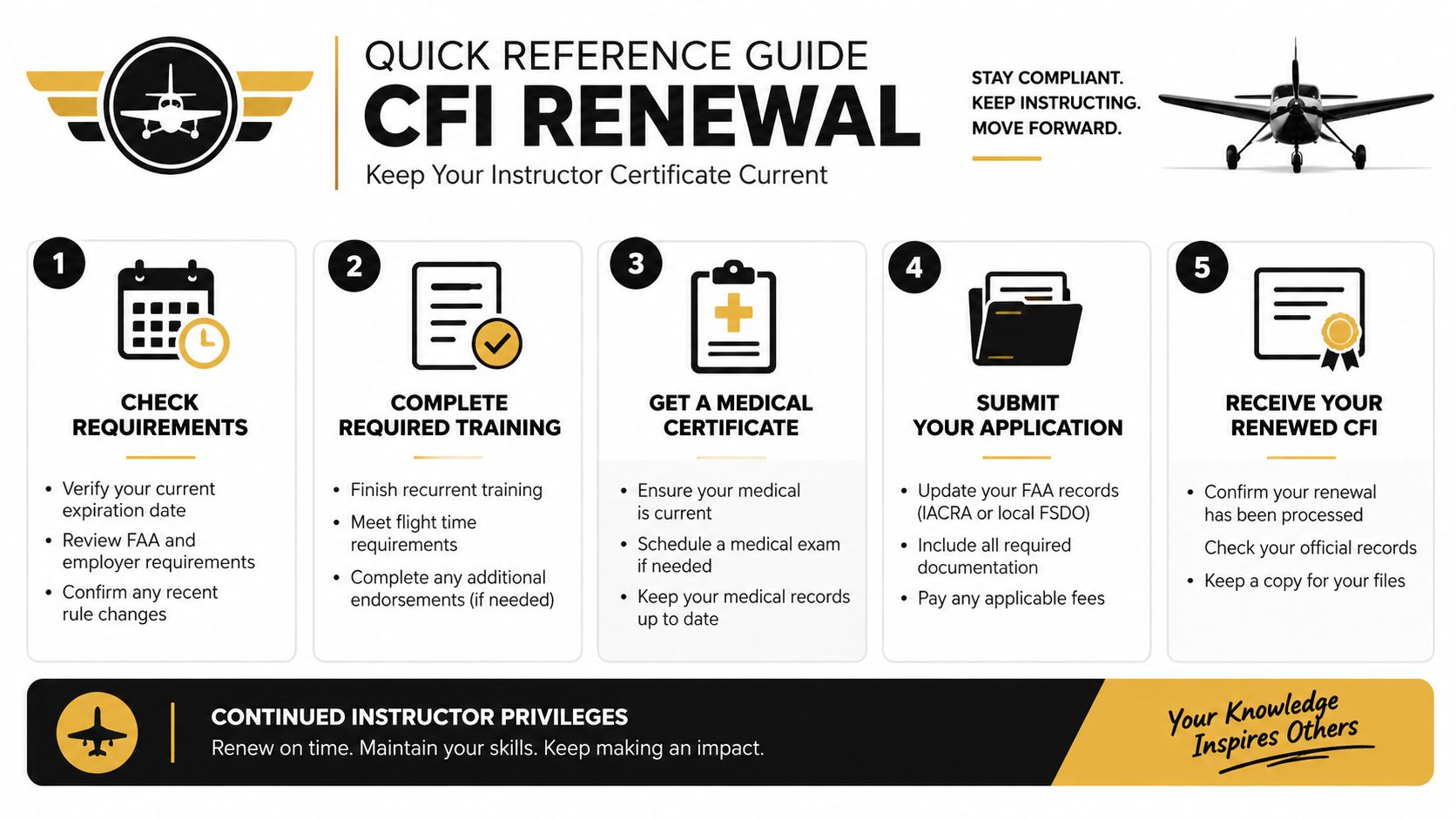
The practical rule is simple: track recent experience, protect your records, file early, and stop instructing when your privileges aren't active. The absence of a printed expiration date does not remove the need to verify status.
CFII helps aspiring instructors build a structured path toward CFI and CFII certification through coordinated training, study resources, checkride scheduling, and an integrated digital logbook. Visit CFII to review the available training path.
Planning to fly for a living?
See what the path from zero to a pilot career looks like, what it costs and how long it takes.
Learn to fly in Riverside
We train at Riverside Municipal Airport in factory-new airplanes with a parachute built in. Start with a one hour discovery flight, no experience needed.