
On this page
- What Best Means Before You Pick a School
- Forecast Demand Does Not Guarantee Hiring
- Five Tests Instead of Popularity
- A Scorecard for the Best Flight Schools
- Fleet and Instruction
- Price, Ruleset, and Proof of Progress
- Match the Syllabus to Commercial Hour Rules
- What 14 CFR 61.129(a) Requires
- How to Read Each Row
- Six Separate Milestones in a Career Syllabus
- Checkride Waits That Change the Timeline
- The Hidden Bill While You Wait
- Five Numbers to Request
- Choose a Path for Your Starting Point
- Zero Time and Unsure
- Already Soloed or Holding a Private Certificate
- Career Changer Who Can Relocate
- Future Instructor
- Price the Training and the Hours After It
- Three Separate Bills
- One Concrete Price to Anchor Your Math
- Book the Flight That Matches Your Goal
- If You Haven't Flown Yet
- If You Already Want the Full Career Sequence
Pick the school with the most five-star reviews and the shortest advertised timeline. That's the popular advice, and it's the wrong place to start.
Reviews tell you who liked the front desk. A slogan tells you nothing about examiner waits, hour categories, or what happens after your commercial checkride. If you want a career, judge the best flight schools by whether their timeline survives real scheduling and whether their syllabus matches the hours the FAA and employers count.
What Best Means Before You Pick a School
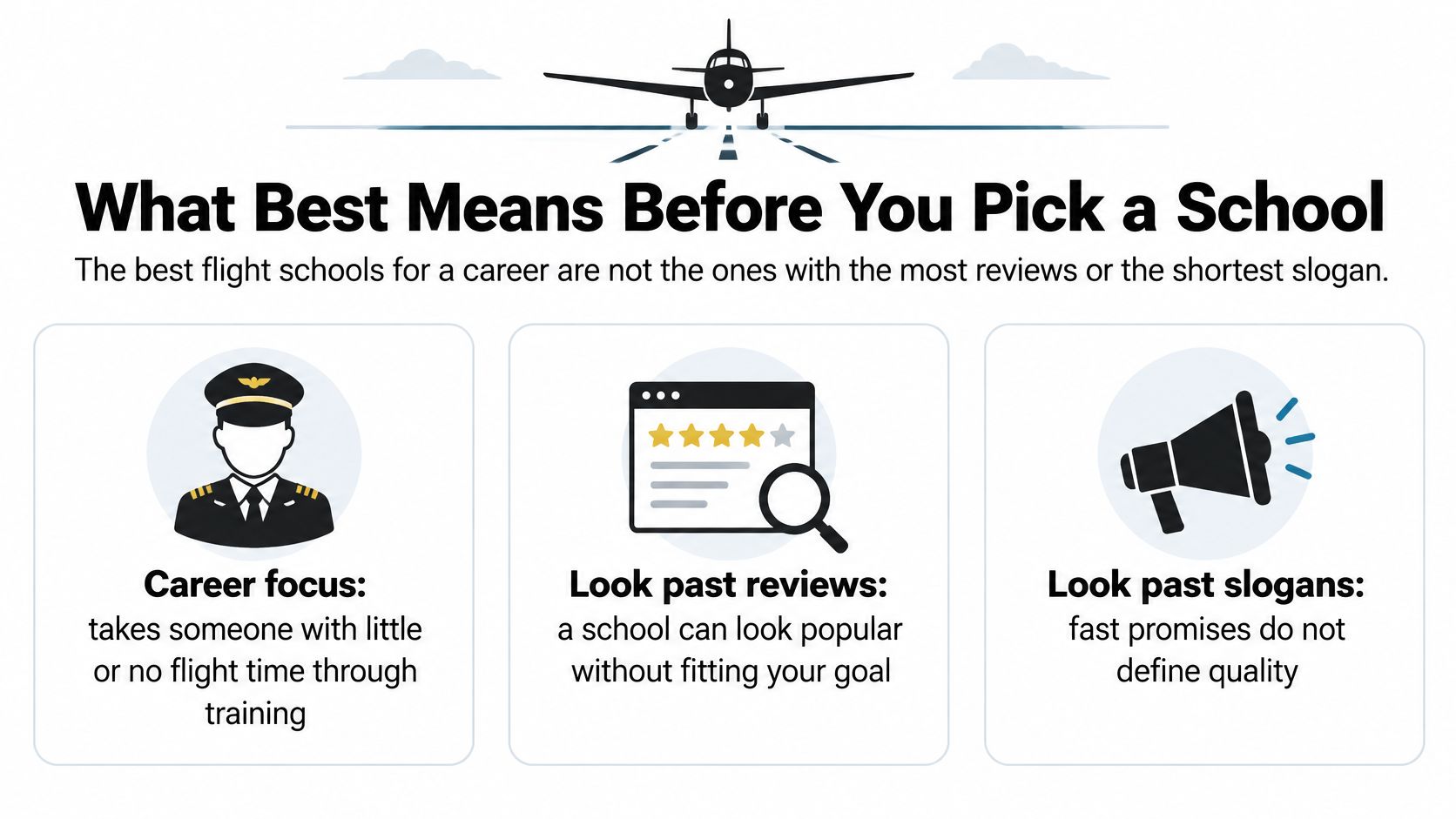
A school's brochure can promise a fast route to the cockpit. The better test is whether its timeline accounts for examiner waits and whether its syllabus shows the hour categories the FAA and employers count.
For a zero-time student, the training should lead through the certificates and ratings needed for the intended goal. Before paying, ask for the total price and schedule in writing. A busy ramp or a new fleet may look reassuring, but neither explains what your training includes.
Forecast Demand Does Not Guarantee Hiring
Boeing's 2025 Pilot and Technician Outlook projects approximately 660,000 new pilots worldwide between 2025 and 2044, roughly 33,000 new pilots annually, including about 119,000 new pilots in North America through 2044. The forecast says roughly two-thirds of new hires replace workers leaving through retirement or resignation, while about one-third support fleet and traffic growth.
Those categories describe different sources of demand, not a hiring calendar. Replacement hiring may continue while growth hiring slows, and neither arrives on a fixed monthly schedule. Aircraft deliveries can slip, retirements can bunch up, and airlines can pause classes. A long-range forecast can point in the right direction while hiring is slow in the year you finish training.
Treat demand as context, not a reason to rush into tuition. Choose a program that still makes sense if hiring is ordinary, and check whether its timeline allows for waits between training and checkrides.
Five Tests Instead of Popularity
Use these five tests when comparing schools:
- Written total price: Ask for one total with exclusions listed. An hourly rate multiplied by optimistic minimums does not show what you may pay.
- Syllabus mapped to FAA categories: Ask how pilot-in-command, cross-country, instrument, and multi-engine time are recorded separately.
- Available, standardized fleet: Find out whether enough similar airplanes are available to keep maintenance from repeatedly disrupting lessons.
- Checkride plan: Ask who coordinates examiners and what the recent local wait has been.
- Time after commercial: Confirm how you can continue building flight hours after earning a commercial certificate.
No single school fits every student. A part-time private pilot student and a full-time career changer have different schedules, budgets, and goals. Use the tests to identify what matters for your own plan, then ask each school to explain its answers during a visit.
A Scorecard for the Best Flight Schools
A polished website cannot tell you how a school handles a delayed lesson or an instructor change. Bring these questions to a campus visit, record the answers yourself, and ask for details in writing.
| Criterion | Ask this | A strong answer |
|---|---|---|
| Fleet | How old are the airplanes, and how many students share each one? | A stated age or factory-new standard, plus a students-per-airplane figure |
| Instruction | What is instructor turnover, and is training one-on-one? | Named instructors and a plan if your instructor leaves |
| Price | What is the total price in writing, and what is excluded? | A written total that identifies included training, materials, and checkride coordination, plus exclusions |
| Ruleset | Is this Part 61 or Part 141? | A plain explanation of which ruleset applies and how it shapes the syllabus |
| Try before you buy | Can I fly or tour before paying program tuition? | A discovery flight or hangar visit, with no experience required |
| Testing | Who schedules checkrides, and what is the recent wait? | The school coordinates with examiners and can describe the local wait |
| Hour mix | How do total hours split across airplane, PIC, cross-country, instrument, multi-engine, and simulator time? | A category breakdown, not only a headline total |
| Progress | How are stage checks and written exams tracked? | Stage checks, quizzes, and progress records the student can review |
Ask every school, including CFII, about airplane age, students per airplane, instructor turnover, the total price in writing, Part 61 versus Part 141, and whether you can fly before committing. If a school will not answer clearly, factor that into your decision.
Fleet and Instruction
Airplane age and standardization affect what you practice and how consistently you practice it. Similar cockpits let you build familiar procedures. If a school uses different panels across its fleet, ask how students prepare for those changes. Also ask how many students share each airplane, since that affects how easily you can reschedule after weather or maintenance delays.
Instructor continuity deserves a direct question. If an instructor leaves during a rating, a new instructor needs to understand your records and progress. Ask who would take over, how the handoff works, and whether another instructor checks your progress along the way.
Instruction quality should outweigh a large content library. In an AOPA survey of 1,000 students, pilots, and instructors, nearly 70% of respondents rated their flight-training experience as "very good". Educational quality accounted for nearly half of the overall assessment, with a 3.0% margin of sampling error at a 95% confidence level. Ask how instructors teach, give feedback, and identify gaps, not just what materials a school provides.
Price, Ruleset, and Proof of Progress
Total price in writing lets you compare what each school includes. Ask whether the quote covers examiner fees, written tests, materials, retest training, and any charges if you stop early. An hourly rate alone does not show what you will pay by completion, so request the assumptions behind any estimate.
Part 61 versus Part 141 describes different regulatory frameworks for flight training. Part 141 schools operate with an FAA-approved school certificate and an approved syllabus. Part 61 training follows the applicable instructor and pilot-certificate rules, and may allow more scheduling flexibility. Neither label by itself shows whether a program fits your needs. Ask how the syllabus is organized and how your training records progress. This guide to FAA-approved flight schools explains what approval means.
Flying before you commit gives you a direct way to assess the experience. Ask whether you can take a discovery flight or visit the hangar before paying program tuition. CFII offers discovery flights and private pilot lessons from John Wayne Airport, including an introductory flight with an instructor for people with no prior experience.
Safety and study systems should make progress visible. Ask whether stage checks, written-test preparation, and training records are built into the program, and whether you can review your own progress. A portal matters when instructors use it to guide lessons and address gaps.
Ask for examples of progression milestones, such as how the school tracks a student from initial lessons toward solo, instrument training, and commercial training. Enrollment totals do not tell you whether students are progressing. You need a clear explanation of how the school monitors training and responds when a student falls behind. A school should be able to describe its process without substituting a busy ramp or a large content library for evidence of individual progress.
Match the Syllabus to Commercial Hour Rules
A program's total hours are only a headline. The categories inside those hours are what the FAA rules measure.
Two syllabi can show the same total and still leave different gaps. One may include plenty of dual instruction but too little pilot-in-command time. Another may log many local flights but fall short on cross-country hours. Ask for the category-by-category breakdown before comparing program totals.
Total hours are a budget. The regulation specifies how those hours must be distributed.
What 14 CFR 61.129(a) Requires
Under 14 CFR § 61.129(a), an airplane single-engine commercial applicant must log at least 250 hours as a pilot. Those hours must include 100 hours in powered aircraft, 100 hours of pilot-in-command time, and 50 hours of cross-country flight, including at least 10 cross-country hours in airplanes.
The rule also requires 20 hours of commercial-pilot training. That includes 10 hours of instrument training using a view-limiting device and 10 hours in a complex airplane, turbine-powered airplane, technically advanced airplane, or combination. Applicants must also complete daytime and nighttime cross-country flights exceeding 100 nautical miles, plus three hours of instructor training within the preceding two calendar months before the practical test.
| Category | FAA minimum | What to verify |
|---|---|---|
| Total pilot time | 250 hours | The program total is at or above 250 and identifies airplane versus simulator time |
| Powered aircraft | 100 hours | The time is in powered aircraft, not solely in a simulator |
| Pilot in command | 100 hours | Solo and PIC time are scheduled, not left for after graduation |
| Cross-country | 50 hours, at least 10 in airplanes | The syllabus names routes and identifies who will be PIC |
| Commercial training | 20 hours | This training block is separate from private-pilot dual |
| Instrument training | 10 hours with a view-limiting device | Hood or view-limiting time is logged in the required category |
| Complex, turbine, or TAA | 10 hours | The airplane or combination that meets the requirement is named |
| Long cross-countries | Day and night flights over 100 nm | Both required dual cross-country flights appear in the syllabus |
| Pre-checkride dual | 3 hours within 2 calendar months | The training is reserved near the practical test, not scheduled too early |
How to Read Each Row
Pilot in command means time when you are the final authority for the flight. Riding along or using a simulator does not replace PIC time. For a zero-time student, ask when the syllabus plans to build it.
Cross-country time develops planning, weather judgment, and navigation beyond the home pattern. The regulation uses distance and landing-point requirements, so a long local practice-area flight may not qualify. Ask how the school plans and logs the required routes.
Instrument training with a view-limiting device teaches you to control the airplane by reference to instruments while your view outside is blocked. It supports instrument skills and commercial training, but the required time must be logged as that specific instruction.
Complex, turbine, or technically advanced airplane time shows that you can manage more capable equipment. Ask which aircraft or combination in the fleet meets the requirement. If the syllabus does not name one, ask the school to map this category before you enroll.
Simulator time can help you rehearse procedures, instrument tasks, and emergencies. Approved devices may count where the rules allow, when the time is logged correctly. Simulator sessions do not replace PIC or cross-country airplane time.
Pay attention to the three hours within two calendar months requirement. If you complete that training too early and then wait for your practical test, you may need more dual instruction close to the test. Ask how the school schedules this block.
Six Separate Milestones in a Career Syllabus
A single-engine commercial certificate does not include multi-engine privileges. The multi-engine class rating is a separate milestone with its own practical test.
A career syllabus aimed at instructing should list six milestones: private pilot, instrument rating, commercial single-engine, commercial multi-engine, certified flight instructor, and certified flight instructor-instrument. Ask for each one by name, rather than relying on a general phrase such as “zero to instructor.”
The ruleset also shapes how training milestones are sequenced. This guide to Part 61 vs Part 141 training explains the structural differences to consider.
Before comparing prices, request the hour split in writing. A syllabus that clearly maps each hour to its required category lets you judge whether its advertised timeline and total meet your training goals.
Checkride Waits That Change the Timeline
Ask how much of the advertised timeline is spent waiting for a practical test. Training can be complete and a student ready, yet the next available designated pilot examiner may still be weeks away.
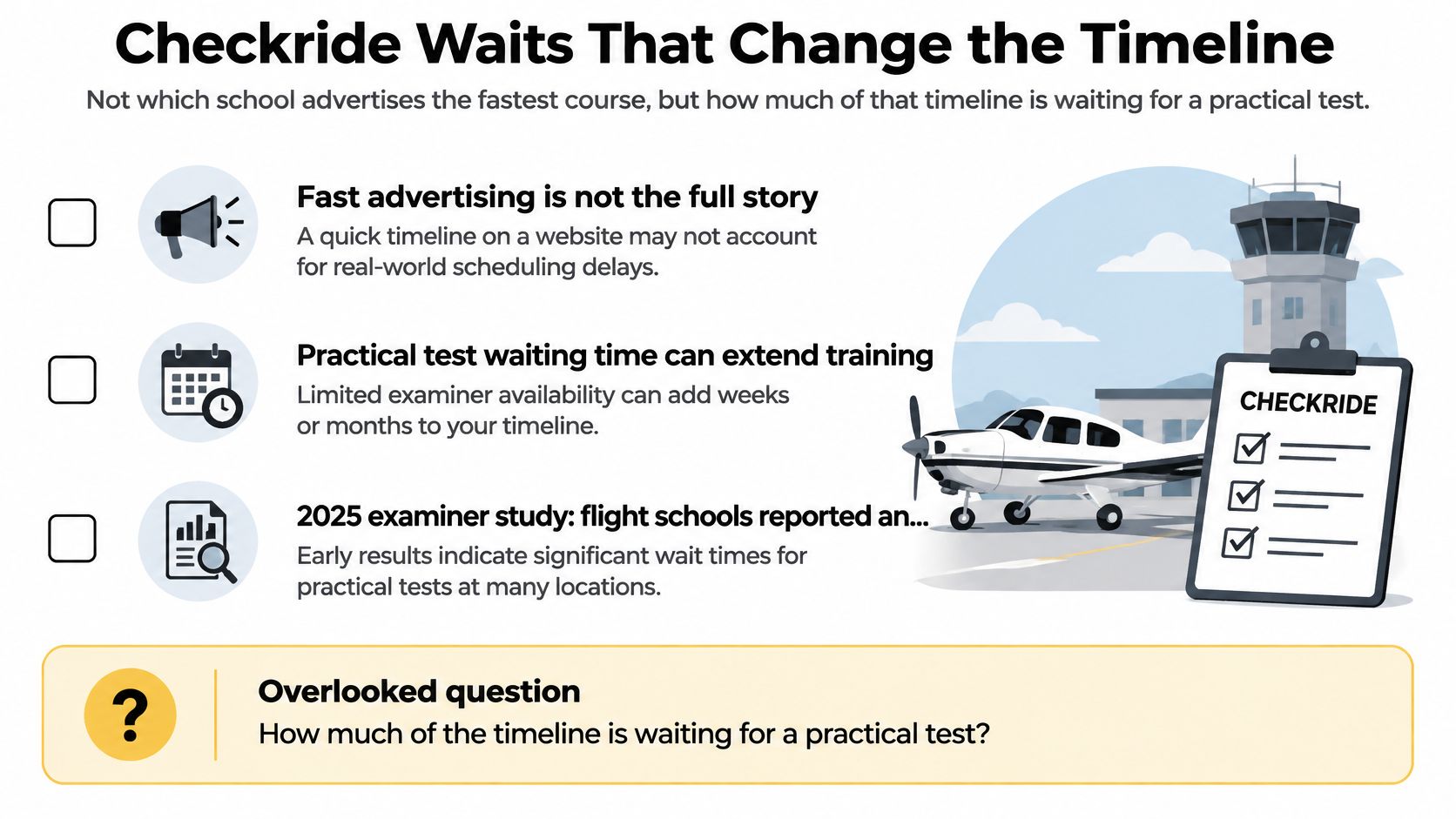
A 2025 study of the U.S. Designated Pilot Examiner system found that flight schools reported an average five-week wait for practical tests, and 91% said checkride availability was an operational problem. The wait can affect the full training timeline, not just the test date.
The Hidden Bill While You Wait
Housing, loan payments, and everyday living costs continue while you wait. Skills can also fade. Maneuvers you flew to standard five weeks ago may need proficiency flights before the test, adding dual-instruction costs. If the pre-checkride training window expires, you may have to repeat lessons.
The advertised months are only realistic if someone manages the scheduling.
Five Numbers to Request
Ask for these figures at the airport where you plan to train. School-wide averages may not describe local scheduling:
- Stage check to checkride: The recent average number of days between completing training and taking the test.
- First-attempt results: The pass rate, if the school shares it.
- Examiner fee: What the examiner charges, and whether that fee is included in the quoted price.
- Retest lead time: How long students typically wait for another attempt.
- Long delays: The share of students delayed more than 30 days.
Accept a school that can show how it tracks scheduling, even without a published pass rate. You need a clear explanation of how it handles examiner availability and communicates delays.
Local examiner availability matters to the timeline. Good weather and new airplanes cannot make up for a full examiner calendar. Ask which airport's scheduling records the school uses and how it plans for waits there. The guide to fast-track pilot training explains how an accelerated pace can still be affected by practical-test scheduling. Add the school's stated checkride wait to its advertised timeline before comparing how quickly you might finish.
Choose a Path for Your Starting Point
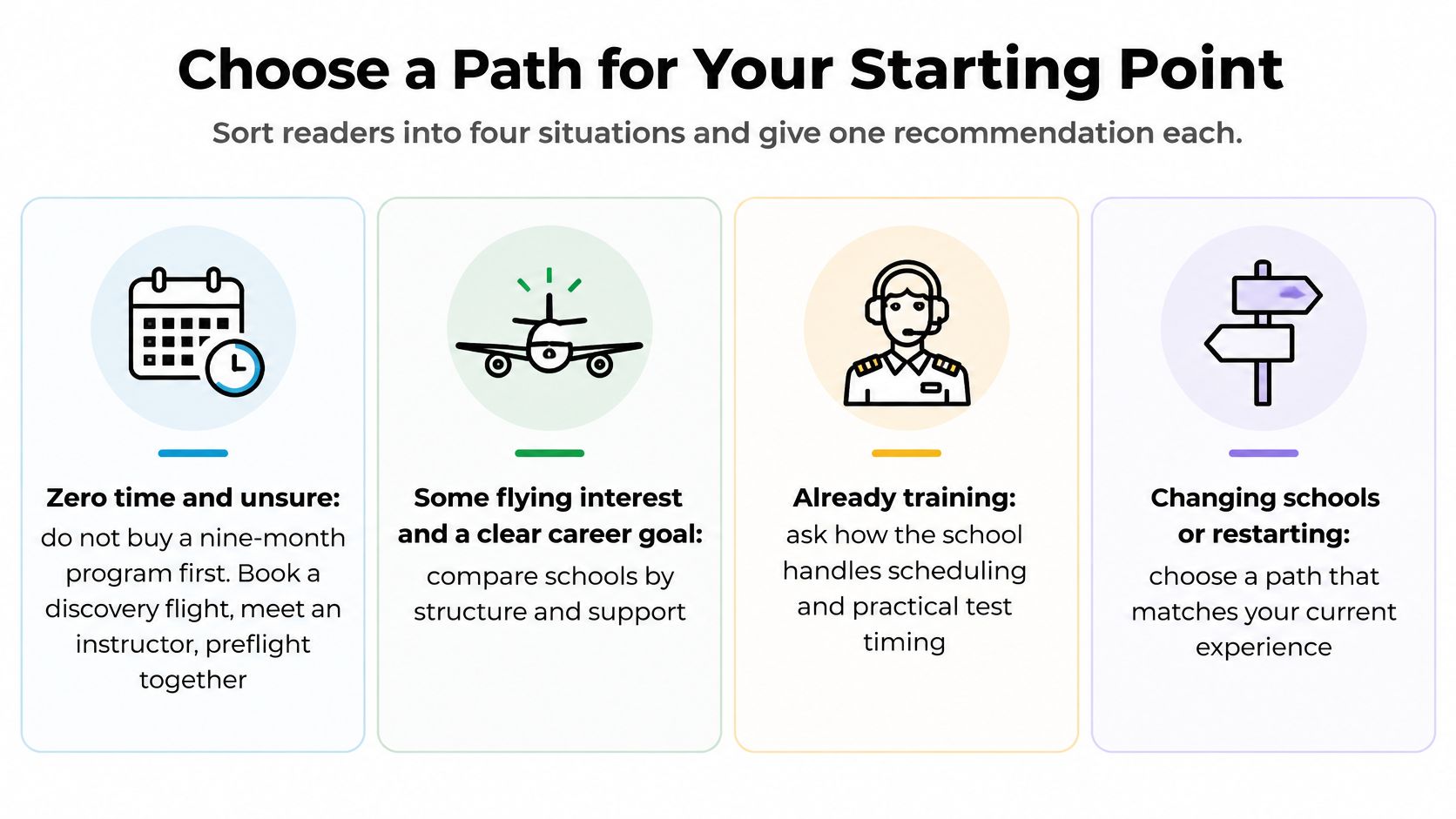
A nine-month program is a costly way to find out you dislike flying small airplanes. Start with a lesson that fits your experience, then choose a training path once you know what you want and what you already have.
Zero Time and Unsure
Book a discovery flight before committing to a longer program. It is lesson one: you meet the instructor, preflight the airplane together, then take the controls in the air. No prior experience is needed.
There is no minimum age for lessons. Students can fly solo at 16 and hold a private pilot license at 17. A third-class FAA medical certificate from an aviation medical examiner is required before flying solo, but you can take a discovery flight and first lessons before obtaining one.
That first lesson gives you a practical feel for airplane motion, radio calls, and checklist routines. If you have flown before, ask whether the instructor can tailor the lesson so you learn something new while getting familiar with the aircraft.
Already Soloed or Holding a Private Certificate
Bring your logbook and identify what remains. Ask the school to review your logged experience against the ratings and hour categories you need, then show you the gap in writing.
Your next lesson should focus on missing tasks in the appropriate airplane, rather than repeating training you have already completed. This makes the starting point specific to your record, not the school's standard sales pitch.
Career Changer Who Can Relocate
A fixed-price accelerated program may fit if you can train most weekdays, live near the airport, and accept that you will still need to build hours after graduation. Ask what certificates and logged hours the program includes, and how examiner scheduling fits the advertised timeline. The calendar matters only if the syllabus covers the flight-hour categories you need.
If work or family commitments prevent full-time training, an accelerated schedule may add stress and cost instead of saving time. Check those constraints before signing.
Future Instructor
The FAA sets specific eligibility requirements. Under 14 CFR § 61.183, an applicant must be at least 18 years old, able to read, speak, write, and understand English, and hold a commercial pilot certificate or airline transport pilot certificate with the appropriate aircraft category and class rating. For an airplane single-engine instructor rating, the applicant also needs the appropriate instrument rating and instructor-specific knowledge preparation, including the fundamentals of instructing.
A CFI certificate is a separate teaching qualification, not an automatic extension of commercial training. You must learn to explain maneuvers and teach another person to fly, with its own knowledge tests and practical test. A single-engine CFI credential does not by itself authorize instruction in multi-engine airplanes.
Check that the program names each rating it includes: private, instrument, commercial single-engine, commercial multi-engine, CFI, and CFII. Match that list to your experience and goal before choosing a package.
Price the Training and the Hours After It
A school quote is only one part of the cost of becoming airline-eligible. Separate the training bill, the cost of living while you study, and the time and expense of building hours afterward.
Three Separate Bills
- Training bill: Instruction, aircraft time, materials, tests, and examiner coordination through commercial and instructor certificates.
- Living bill: Housing, food, transport, and income you give up while training full-time.
- Time-building bill: The money or months needed to log hours after graduation.
The last bill can be easy to overlook. Certificates alone do not make you eligible for an airline job.
The FAA's airline transport pilot guidance explains that a standard airline transport pilot certificate requires 1,500 hours of flight time. Under specified conditions, some pilots may qualify for a restricted-privileges ATP with fewer hours, including 1,000 hours for qualifying graduates with a bachelor's degree in aviation and 1,250 hours for qualifying associate-degree or other specified aviation-degree pathways. The remaining regulatory requirements still apply.
Those reduced totals depend on qualifying aviation education. Completing flight training alone does not reduce the required hours. Ask a school how its graduates plan to build the flight time they still need.
One Concrete Price to Anchor Your Math
CFII's Career Track has fixed tuition of $89,000. Treat the tuition as a training cost, not a promise of a job, hiring outcome, or checkride result.
Before enrolling anywhere, ask what happens if you stop early. CFII's First Milestone Guarantee lets students discontinue for any reason before about 20 hours of flight time, pay only for logged flight time at the discounted rate of $200 per flight hour, and receive additional payments back. Compare the written terms with the total amount you would owe if your plans change.
The cost to get a commercial pilot license is only one piece of the budget. Keep certificate costs separate from living expenses and the later cost of building hours.
After commercial and instructor certificates, graduates still need a lawful way to log pilot-in-command or instructional time toward airline minimums. Flight instruction is a common way to build hours while earning income, though the amount and pace depend on the work available.
A shorter course can cost more overall if loan payments begin before you have a plan for building hours. Compare the full path, from training through the hours you need afterward.
Book the Flight That Matches Your Goal
The next step depends on whether you are still testing the idea of flying or are ready to train for a career. Either way, see how a real lesson works before making a larger commitment.
If You Haven't Flown Yet
Start with a one-hour discovery flight. You meet the instructor, preflight the airplane together, then take the controls in the air. No prior experience is needed, and you can take the discovery flight and first lessons before obtaining a medical certificate. A third-class FAA medical certificate is required before flying solo.
Discovery flights and lessons toward a private pilot license leave from John Wayne Airport in Santa Ana. If you are comparing introductory flights, this guide to discovery flight pricing explains what to consider. You can also book a discovery flight.
If You Already Want the Full Career Sequence
If you are ready for a structured career-training path in Southern California, review the Career Track program and ask how its syllabus maps to the hours you need. The advertised timeline matters only if checkride scheduling and the required hour categories fit the plan.
Before paying any school, walk the hangar, sit in a cockpit, and meet instructors. Ask for the syllabus and checkride process in writing, then use your scorecard to compare the answers. Pay particular attention to how the school tracks hour categories and handles examiner scheduling.
If those answers are vague, keep looking. Choose a discovery flight if you are still testing whether flying suits you; discuss the career path if you are ready to commit.
Visit CFII to book a one-hour discovery flight, tour the Riverside hangar, or learn about its Career Track. Bring your scorecard and ask about hour categories and checkride scheduling before you decide.
Planning to fly for a living?
See what the path from zero to a pilot career looks like, what it costs and how long it takes.
Learn to fly in Riverside
We train at Riverside Municipal Airport in modern airplanes with a parachute built in. Start with a one hour discovery flight, no experience needed.