

On this page
- Aviation Degree Types Compared at a Glance
- Read the credential and the flight syllabus separately
- What a Degree Adds and What It Never Replaces
- What the academic side can add
- What the degree cannot supply by itself
- The 1,500-Hour ATP Requirements Behind Every Path
- Count qualifying experience, not just the headline total
- Work backward from the logbook you'll need
- How Restricted ATP Shortens the Hour Requirement
- Get the eligibility conditions in writing
- An hour reduction is not a calendar guarantee
- Why Graduates Still Face a Hiring Gap
- Separate the milestones
- Budget for the bridge to airline work
- Costs and Earnings Against a Flight-Only Route
- Price the entire route
- Translate the hour advantage into months
- Decide Whether a Degree Fits Your Path
- Make the decision with documents
- Match the next step to your starting point
“Get an aviation degree if you want to fly for an airline” is incomplete advice. So is “skip college and start flying.” Neither tells you what you're buying, which FAA requirements change, or how you'll support yourself between finishing training and becoming competitive for airline work.
An aviation degree is best evaluated as a trade between academic credentials, regulatory hours, tuition, time away from full-time earning, and backup-career value. Start with the job you want, then compare the complete route to it, not just the graduation date.
Aviation Degree Types Compared at a Glance
Aviation degree and flight-only routes compared
| Pathway | Typical length | Flight training included | Effect on hour requirements | Best fit |
|---|---|---|---|---|
| Associate of Applied Science (AAS) in aviation | About 2 years | Usually, through the school's flight program | May qualify for Restricted ATP at 1,250 hours if FAA-authorized | Students who want a shorter, flight-heavy credential |
| Bachelor of Science (BS) in aviation | About 4 years | Often, through a professional-pilot concentration | May qualify for Restricted ATP at 1,000 hours if FAA-authorized | Students who want a degree for airline or management careers |
| Master of Science (MS) in aviation | 1 to 2 years after a bachelor's | Check the curriculum for flight courses | No separate reduction is assumed | Career changers and managers, not a first-seat shortcut |
| Flight-only certificate program | Set by the school's training schedule | Yes, as the core of the program | No degree-based reduction; standard ATP experience requirements apply | Students who want to fly professionally without earning a degree |
Program details differ by school, and any degree-based hour benefit requires the specific FAA authorization explained below. These are planning descriptions, not promises about an individual curriculum.
Read the credential and the flight syllabus separately
An AAS can suit a student who wants a college credential while concentrating on flight training. Check whether its credits transfer toward a bachelor's degree if continuing your education matters to you.
A BS offers more room for general education, aviation science, safety, and business subjects. But a degree titled aviation management may prepare you for airport or airline administration without taking you through professional flight qualifications.
An MS is advanced academic study, not the next pilot certificate after a bachelor's degree. For a career changer, it makes sense only if the graduate coursework serves a separate professional goal. Don't assume that a more advanced academic credential means more advanced flying privileges.
A flight-only program organizes training around certificates and ratings rather than college credit. Its usefulness comes from the training sequence, completion standards, and experience you leave with.
Start with the outcome: A diploma, an instructor certificate, and eligibility for airline employment are different deliverables.
Use the table to identify your likely direction: professional flying, management, or both. Then request the actual course list and flight syllabus. A degree title can describe the subject you study without describing the pilot qualifications you'll earn.
What a Degree Adds and What It Never Replaces
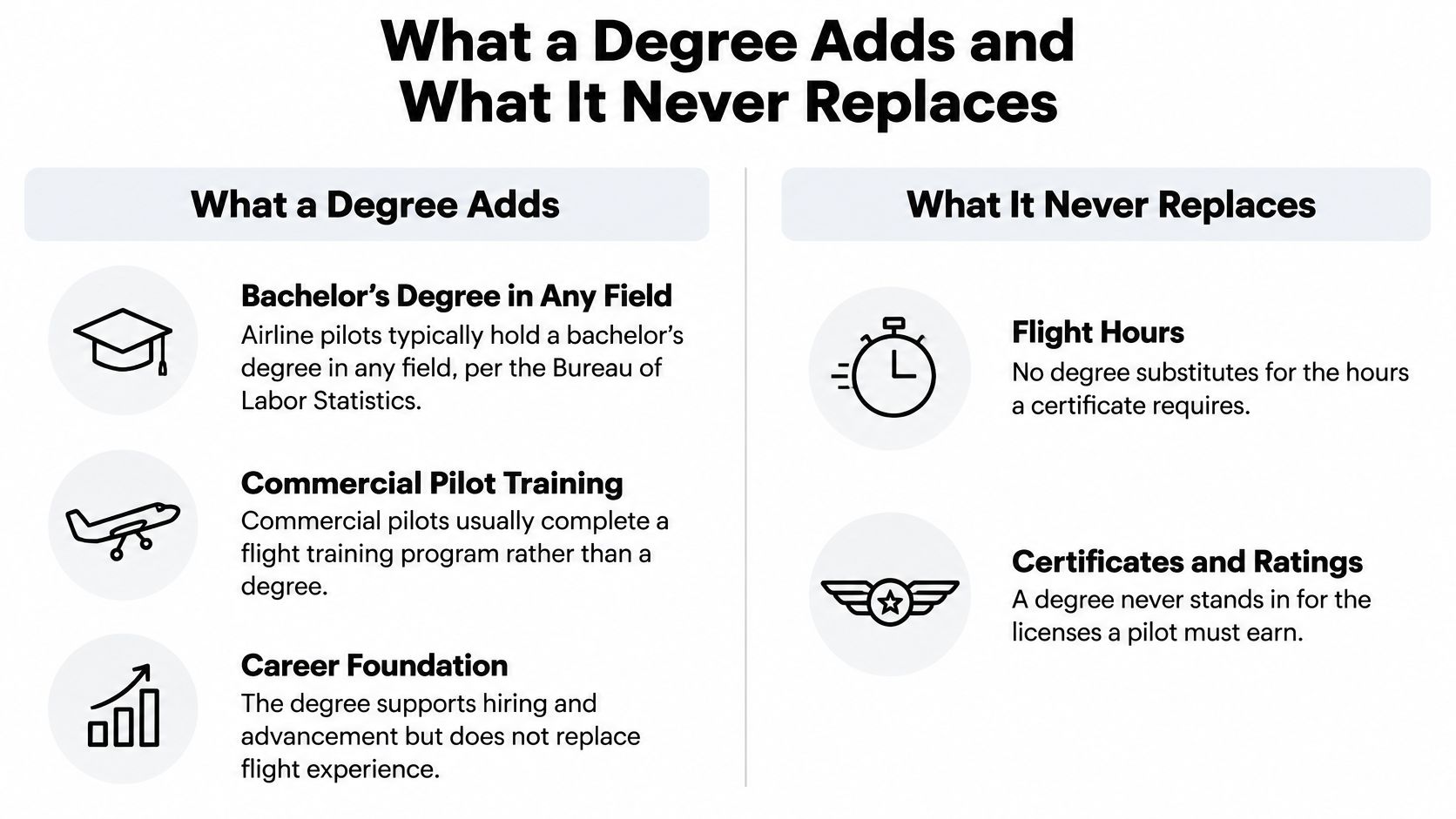
A college degree can add academic depth and broaden your options beyond flying. Its value depends on what you study, what the program costs, and how much time you spend earning the degree instead of working full time.
The U.S. Bureau of Labor Statistics' guide to airline and commercial pilots says airline pilots typically need a bachelor's degree, while commercial pilots generally complete specialized flight training. Airlines set their own degree preferences. The FAA does not require a college degree for pilot certification.
What the academic side can add
A well-matched program can strengthen the knowledge behind operational decisions:
- Weather and aerodynamics: Learn why an airplane behaves as it does and how atmospheric conditions affect performance.
- Safety and management: Study risk assessment, organizational responsibilities, and the business of operating aircraft.
- A broader career foundation: Coursework may support applications for non-flying roles when it develops skills those employers need.
Consider the backup-career value carefully. It matters most when the degree prepares you for work you would realistically pursue, rather than adding a reassuring line to a brochure.
What the degree cannot supply by itself
A diploma does not confer a private pilot certificate, instrument rating, commercial privileges, multi-engine privileges, or ATP certification. Each requires applicable flight training, experience, tests, and endorsements. Logged experience must meet the rules for the qualification you seek.
For example, a graduate with 40 logged hours still needs the applicable flight qualifications before taking a commercial flying job. Academic completion and pilot qualification are separate parts of the path.
Training structure also affects how you plan the flight portion. Reviewing Part 61 and Part 141 flight-training structures can help you compare how a syllabus is organized. Ask for separate written descriptions of academic tuition, flight charges, certificates awarded, and expected logged experience. Those details show how the degree's tuition and time commitment fit alongside the training needed to qualify as a pilot.
The 1,500-Hour ATP Requirements Behind Every Path
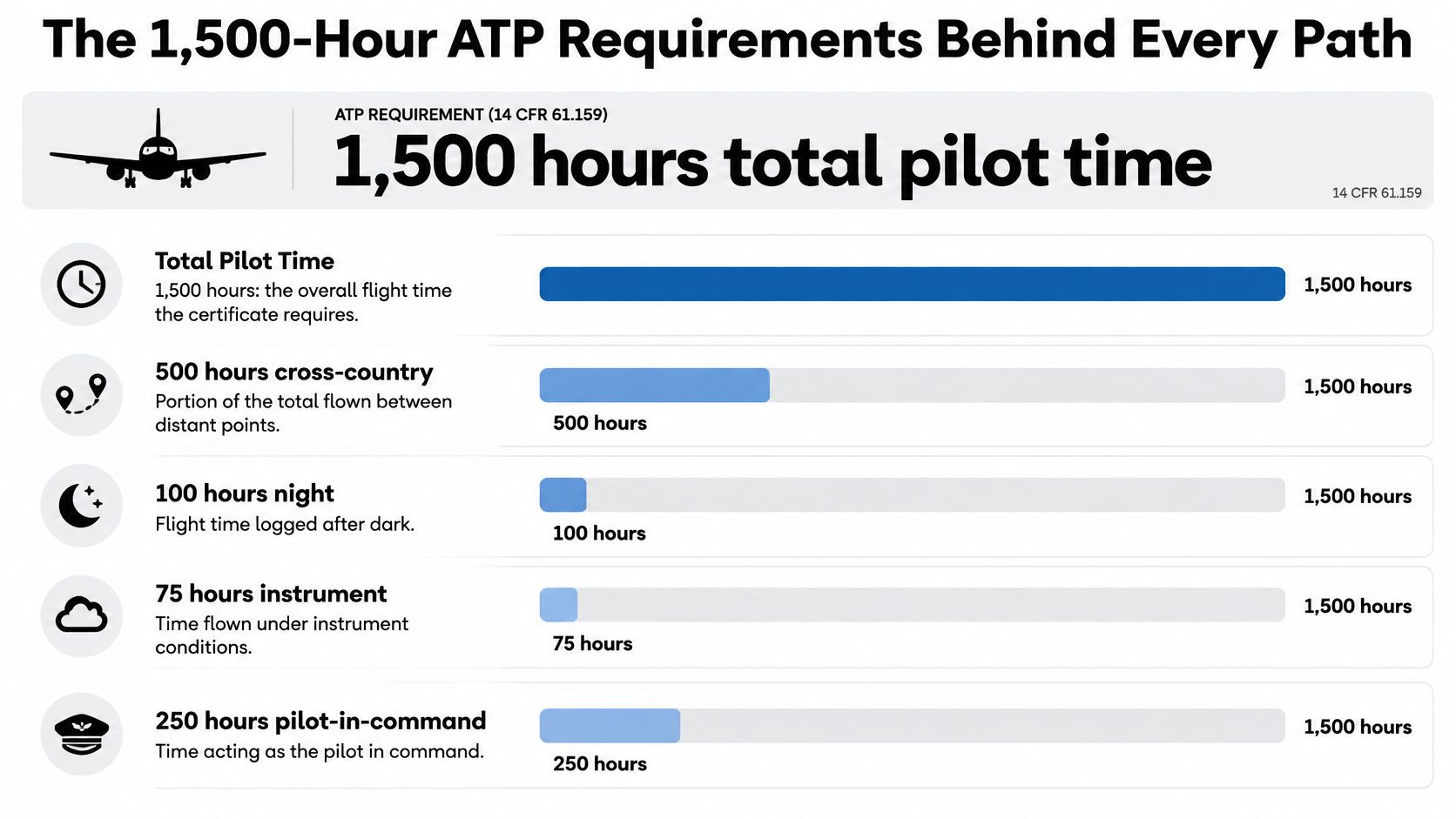
ATP hour requirements under 14 CFR 61.159
The standard airplane ATP regulation, 14 CFR §61.159, sets the experience requirements and simulator-credit limits summarized below.
| Requirement | Hours | What it means |
|---|---|---|
| Total pilot time | 1,500 | Standard unrestricted ATP baseline |
| Cross-country time | 500 | Must be represented within the total |
| Night time | 100 | Must be represented within the total |
| Airplane class time | 50 | In the airplane class for the ATP rating sought |
| Instrument time | 75 | Actual or simulated instrument conditions |
| Simulated instrument credit | Up to 25, or up to 50 in a qualifying Part 142 course | Limits on training-device credit toward the instrument requirement |
| Full flight simulator credit toward total | Up to 25 | Only in approved courses under Parts 121, 135, 141, or 142 |
| Commercial certificate with instrument rating | Required | Foundational qualifications for the standard ATP pathway |
| Commercial pilot certificate minimum | 250 under the standard route | An earlier professional qualification, not ATP eligibility |
The BLS pilot-training overview identifies 250 total hours as the standard commercial-certificate minimum; approved training pathways can have different requirements. Don't confuse that earlier certificate milestone with airline-level experience.
Count qualifying experience, not just the headline total
The categories overlap. A properly logged flight might contribute to total time, cross-country time, night time, and pilot-in-command experience. You don't add every row together to create a separate grand total.
Those categories also have regulatory definitions. A flight that feels like a long trip doesn't automatically qualify for every cross-country purpose, and time in an airplane equipped for instrument flight isn't automatically instrument time.
Training devices require particular care. A flight training device or aviation training device cannot satisfy the general airplane flight-time total under this rule. Simulator work can develop proficiency and receive specified credit without every session becoming interchangeable with airplane flight time.
Work backward from the logbook you'll need
Consider a hypothetical pilot with 300 qualifying logged hours pursuing the standard 1,500-hour route. The arithmetic leaves 1,200 additional hours, but the pilot must also review each required category rather than assume any additional flying will finish the job.
If most subsequent work involves local daytime instruction, total time may increase faster than night or qualifying cross-country experience. The pilot needs a plan for the missing categories, not merely a forecast of when the logbook total will rise.
Use a spreadsheet or digital logbook report with separate columns for total, cross-country, night, instrument, airplane class, and command experience. Keep simulator entries distinguishable from airplane entries and record the basis for any allowable credit.
The broader pilot career path is easier to budget when you connect each qualification to the work it permits. Before enrolling, have the school show how its projected completion logbook maps to each requirement, which categories remain unfinished, and how graduates can reasonably obtain that experience.
How Restricted ATP Shortens the Hour Requirement
A qualifying aviation degree can reduce the flight-time threshold for a Restricted ATP, making the degree's FAA authorization a direct factor in the training-to-airline timeline. The FAA's ATP guidance describes pathways that allow eligibility at 1,000 hours for qualifying aviation bachelor's graduates or 1,250 hours for certain associate-degree and bachelor's pathways, compared with the standard 1,500 hours.
An R-ATP permits a pilot to serve as a co-pilot while building experience toward unrestricted privileges. The reduced threshold applies only when the pilot completes the qualifying, FAA-authorized degree pathway and meets the other applicable qualifications and experience conditions.

Program authorization determines eligibility. A university may offer aviation courses, while only specific degrees or training arrangements qualify for a reduced-hour pathway. Ask the admissions office and flight department to confirm your exact program in writing.
Get the eligibility conditions in writing
Use this checklist when speaking with the school:
- Confirm FAA authorization: Request documentation identifying the institution and qualifying degree program.
- Identify your pathway: Ask which reduced-hour category applies to your planned curriculum.
- Map the flight components: Confirm where the commercial-pilot and instrument training take place and how they fit the authorized pathway.
- Resolve transfer questions: If you have previous flight training, ask how it affects your eligibility.
- Document remaining conditions: Get a written list of experience, testing, and records needed to apply, as well as any requirements for unrestricted privileges.
For a visual introduction to the pathway, use the accompanying video.
An hour reduction is not a calendar guarantee
A lower eligibility threshold changes how many qualifying hours you need. It does not set the date you will reach them. Course scheduling, flight progress, employment opportunities, and the flying available after graduation all affect the timeline.
Compare two schedules: one based on completing the authorized college pathway and building the remaining experience, and another based on focused flight training followed by hour building. The degree's value depends partly on how its tuition and time away from full-time earnings compare with the time and cost of the flight-only route, as well as the backup-career value of the credential.
The reduced threshold applies to the qualifying pathway, not to enrollment. Get confirmation tied to your degree, curriculum, and training history before committing.
Why Graduates Still Face a Hiring Gap
A pilot-shortage headline isn't a job offer for a newly qualified commercial pilot. Employers can need experienced pilots while early-career applicants struggle to obtain the experience those employers prefer.
In its dated pipeline assessment, AOPA's August 2026 workforce article reported 887,519 active U.S. pilots in 2025, including 370,286 student pilots, nearly 42%; it also reported 3,863 major-airline hires through July 2026 and some regional airlines increasing preferred multi-engine experience from roughly 25 hours to 50 or 100 hours. Those are time-specific observations, not permanent hiring standards.
Long-run demand has a different scope. A historical ICAO workforce forecast projected commercially operated aircraft increasing from 61,833 in 2010 to 151,565 by 2030, with average annual pilot-training needs of 52,506 against estimated capacity of 44,360. A global forecast doesn't establish whether a particular airline will hire a particular graduate.
Separate the milestones
| Milestone | What you've achieved | What still needs attention |
|---|---|---|
| Graduation | Completed an academic or training curriculum | Exact certificates, usable experience, and employment readiness |
| Commercial employability | Qualified for work permitted by your certificates and the applicable operating rules | Available jobs, employer standards, and instructor qualifications where relevant |
| Airline competitiveness | Built a record suitable for airline consideration | Multi-engine experience, professional history, training records, and airline-specific screening |
Instructing is an important potential bridge, but earning an instructor certificate and securing regular paid instruction are separate events. Weather, aircraft availability, student demand, and scheduling can affect both logged time and income.
Budget for the bridge to airline work
Suppose you finish training, secure instructing work, and need several months of additional experience before applying for airline positions. Your funding requirement includes any monthly difference between take-home instructing income and living expenses, loan payments, and necessary additional training.
Write that monthly shortfall into the budget. Then test a slower case in which you fly less or hiring takes longer, rather than borrowing against the earliest possible airline start date.
Budgeting safeguard: Use income you can reasonably earn in the next job, not pay associated with the job you hope to reach afterward.
A practical reading of the pilot shortage distinguishes long-term workforce needs from entry-level opportunities. A degree can strengthen eligibility or an application, but airlines still evaluate experience, records, and professional readiness. It doesn't guarantee employment.
Costs and Earnings Against a Flight-Only Route
A degree route trades added tuition and time in school for a possible reduction in the flight hours required for ATP eligibility and a credential that may support other careers. Compare the full cost and timeline, not just the hour threshold.
| Route | Hours to ATP eligibility | Reported debt | Backup career value |
|---|---|---|---|
| Aviation degree with Restricted ATP | 1,000 for qualifying bachelor's graduates or 1,250 for qualifying pathways | $22,614 median for air transportation bachelor's graduates, as reported in the airline degree-requirement overview | Degree credential for non-flying roles |
| Flight training, then hour building | Standard 1,500-hour route | No comparable route-specific figure available* | Mainly aviation-related roles |
| Non-aviation degree plus flight training | Standard 1,500-hour route | No comparable route-specific figure available* | A degree in the selected field |
The overview also reports median earnings for air transportation bachelor's graduates of $55,780 one year after graduation and $85,825 four years afterward. These figures describe graduates in the field, not pilot-specific pay or guaranteed airline earnings, and they do not represent the full cost of pilot training.
*Comparable debt figures for the two flight-training routes are not provided here.
Price the entire route
Tuition alone won't answer the decision. Compare academic charges, flight training, living expenses, borrowing costs, and the time before you can begin paid flying.
Use a flight school cost comparison with equivalent endpoints. A quote ending at a commercial certificate isn't directly comparable with a route that includes instructor qualifications and multi-engine training.
A degree may preserve options with employers that value academic credentials. Flight-only training may let you focus your time and money on professional qualifications.
Translate the hour advantage into months
For a hypothetical calculation, assume you can log 50 qualifying hours per month after training. Saving 500 hours would represent 10 months of hour building at that pace. It is an illustration, not a prediction of how quickly you will progress.
Then estimate the cost of those months. If instructing income falls short of monthly expenses, multiply the shortfall by the months potentially avoided. Consider the value of reaching airline eligibility earlier, while remembering that eligibility does not set a hiring date.
Compare those potential benefits with the degree route's added tuition, borrowing costs, and time before paid instruction begins. A lower hour requirement may not save calendar time if earning the degree delays the start of professional flying.
Backup-career value can change the calculation. If you would pursue aviation operations, safety, business, or another degree-related profession, the credential serves more than a cockpit application. If you already have a useful degree, another one needs a stronger financial and career case.
Hours saved are not automatically dollars saved. The decision is whether the regulatory advantage is worth the additional tuition, time, and financial exposure for your circumstances.
Decide Whether a Degree Fits Your Path
Choose a degree route when its academic credential serves a real career goal, its flight curriculum fits your needs, and its additional time and tuition fit your finances. If you're counting on a reduced-hour pathway, written confirmation of FAA authorization belongs in that decision.
Choose flight-only training when your priority is progressing toward instructing and professional experience, and a degree adds no credential or backup option you currently need. That can be especially relevant if you already hold a degree in another field.
Make the decision with documents
Before paying tuition, collect the materials that determine what you're purchasing:
- Academic and flight curriculum: Identify which certificates and ratings are included and which require separate enrollment.
- Authorization documentation: Confirm any claimed degree-based regulatory benefit for your specific pathway.
- Written cost and completion scope: Separate tuition, training, living expenses, and costs that remain after completion.
- A post-training budget: Plan for the period between earning qualifications and obtaining dependable professional income.
Use realistic pilot salary expectations when estimating repayment capacity. Don't build the budget around senior airline compensation before you've funded the earlier stages.
Match the next step to your starting point
If you haven't flown, take a discovery flight, a first flight with an instructor before committing. Testing your interest in the cockpit is more useful than choosing an academic program solely from a course catalog.
For a full flight-training alternative, our Career Track takes students from zero experience to CFII and multi-engine in about nine months, with six certificates and ratings, 282 total training hours, and fixed tuition of $89,000. We're based in Southern California, including Riverside, Long Beach, and Corona. This is a flight training program, not an aviation degree, so compare its completion outcome with the degree pathways before deciding.
This week, obtain a written curriculum and cost breakdown for your preferred route. Decide what you need to graduate with, what experience will remain, and how you'll finance the transition to paid flying.
We offer discovery flights and a zero-to-CFII Career Track for readers comparing an aviation degree with focused flight training. Visit CFII to explore the training path or arrange your first flight before committing to a longer program.
Planning to fly for a living?
See what the path from zero to a pilot career looks like, what it costs and how long it takes.
Learn to fly in Riverside
We train at Riverside Municipal Airport in modern airplanes with a parachute built in. Start with a one hour discovery flight, no experience needed.