The short answer
Not soon, and not all at once. US law requires two pilots on every airline flight (14 CFR 121.385), and in 2025 Europe's aviation regulator found that flying an airliner with one pilot could not yet be shown to be as safe as flying with two.
Automation is still growing. Airliners have landed themselves since 1965, more than 2,000 small airplanes can land themselves in an emergency, and companies are testing pilotless cargo planes, one of them aiming for FAA certification in 2028.
The likely order is small cargo planes first, then fewer pilots during the cruise part of long flights. Passenger cockpits are likely to keep two pilots the longest.
Meanwhile the outlook for pilots is strong. The Bureau of Labor Statistics expects about 16,400 US pilot job openings a year through 2035, and Boeing forecasts that the world will need 660,000 new commercial pilots by 2044.
What is already automated
A lot more than most people think. The question is no longer whether a computer can fly an airplane. It can. The question is whether it can handle everything that goes wrong without a person there.
| System | What it does | In service since |
|---|---|---|
| Autopilot and autothrottle | Holds course, altitude and speed, and on approach keeps the airplane on the glide path | Paired in airliner autoland since the 1960s |
| Airliner autoland | Flies the approach, flares and lands, with the crew supervising | First passenger flight in 1965, a BEA Trident |
| Garmin Emergency Autoland | Picks an airport, talks to air traffic control and lands if the pilot cannot | First certified in 2020 on the Piper M600 |
| The flight engineer's job | Systems monitoring that once needed a third crew member | Automated away; new aircraft do not need one |
The last row matters. Airliners used to carry three people in the cockpit. The Bureau of Labor Statistics notes that technology automated the flight engineer's tasks and new aircraft do not require one. So the industry has already gone from three to two once. That is the strongest historical argument that it could go from two to one.
Garmin's Emergency Autoland is now on more than 2,000 airplanes, from single-engine Cirrus models to the HondaJet. Its first real-world use came on December 20, 2025, when a King Air lost cabin pressure after leaving Aspen. It landed at Rocky Mountain Metropolitan Airport near Denver with no injuries. The operator says the two pilots were not incapacitated; they chose to let the system fly once they were on oxygen.
What is being tested
| Project | What it is | Status |
|---|---|---|
| Airbus DragonFly | Automated emergency diversion, landing and taxi help, tested on an A350-1000 | Flight tested January 2023; Airbus calls it pilot assistance |
| Airbus and Cathay Pacific, Project Connect | One pilot at the controls in cruise on an A350 | 2021 reports targeted 2025; Cathay said it had not committed as launch customer |
| Reliable Robotics | Uncrewed Cessna Caravan cargo plane, supervised from the ground | Flew with no one aboard in November 2023; company targets FAA certification in 2028 |
| Merlin | Autonomy system for the Cessna Caravan, plus Air Force KC-135 and C-130J work | Caravan flight tests in 2025, with a human safety pilot aboard in 2024 testing |
| Xwing Superpilot | Autonomous system for pilotless cargo flights in a Grand Caravan | Began the FAA certification process in April 2023 |
Military aviation is often cited here too. A drone like the MQ-9 Reaper has no one on board, but it is not pilotless. It is flown by a pilot and a sensor operator in a ground control station. Most "pilotless" flying today means the pilot moved, not that the pilot disappeared.
The case that pilots will be replaced
This side deserves a fair hearing, because parts of it are already happening.
- The technology works in normal conditions. Autoland has existed for six decades, and Emergency Autoland now lands small airplanes with no human input.
- The money is large. A UBS report estimated removing pilots could save the industry more than $35 billion.
- Crews have shrunk before. The flight engineer is gone. Two to one in cruise is the next step manufacturers have studied.
- Industry and governments are pushing. Over 40 countries, including Germany, the UK and New Zealand, asked the UN aviation body ICAO to help make single-pilot flights a "safe reality," according to Bloomberg in 2022. Airbus has worked on reduced-crew cruise with Cathay Pacific.
- Cargo can go first. No passengers means less public resistance. Reliable Robotics has flown an uncrewed Caravan and has a target date for certification.
If you are 18, your career could run 40 years or more. It would be dishonest to say nothing in that span will change.
The case against
- The law. Under 14 CFR 121.385, "The minimum pilot crew is two pilots" on a US airline, one as pilot in command and the other as second in command. Changing that takes rulemaking, not just a software update.
- The regulators' own research. EASA ran a study from 2022 to 2025 on one pilot in cruise. Its finding: "an equivalent level of safety between eMCO and the current two-crew operations cannot be sufficiently demonstrated." Pilot incapacitation, fatigue, sleep inertia and the loss of cross-checking were the problem areas. EASA paused the work in June 2025 until cockpit technology catches up.
- Congress. In July 2025, 45 US senators asked the Transportation Secretary to oppose reduced-crew proposals at ICAO, citing NASA and FAA studies that found significant increases in workload with one pilot. The FAA Reauthorization Act of 2024 left the two-pilot rule in place and instead ordered a task force to review pilot training so pilots have "adequate understanding of automated systems on aircraft."
- Certification of AI itself. The FAA's 2024 roadmap for AI safety says systems that learn rather than being designed are a new challenge for certification. It calls for starting in lower-risk settings such as experimental aircraft and small drones, and says responsibility "rests with the system designer and AI developer, not the AI itself." That is a long road before an AI takes legal command of an airliner.
- Passengers. In a 2018 Ipsos poll of 1,109 US adults, only 15% said they would be comfortable on a completely pilotless airliner. Note that the airline pilots' union, ALPA, commissioned that poll. In a UBS survey of about 8,000 people, 17% said they would fly on one.
- Past predictions. Reports in 2021 had single-pilot A350 cruise starting on Cathay Pacific flights in 2025. It did not happen.
- The pilots' unions. ALPA, the largest US airline pilots' union, says "Safety starts with two." After EASA's pause, its first vice president said in December 2025: "I think it's paused and not over."
Who flies what, and when that might change
| Type of flying | Today | Being tested | Earliest date a credible source has given |
|---|---|---|---|
| US airline passenger jets | Two pilots required by law, heavy automation | Single-pilot cruise (Airbus, eMCO) | None. EASA found in 2025 it cannot yet be shown equally safe |
| Fully pilotless airliners | None in service | Assistance features only, such as Airbus DragonFly | EASA said in 2022: "not likely until well after 2030" |
| Small cargo feeders (Cessna Caravan) | One pilot | Uncrewed, supervised from the ground | 2028, the target Reliable Robotics has set for FAA certification |
| Light and business aircraft | Pilot flies | Emergency Autoland already certified | In service now, as an emergency backup only |
| Military drones | Remote pilot in a ground station | More autonomy, including Merlin's KC-135 work | No firm date published |
What this means for a pilot career
The demand numbers are large and they come from people with no stake in flight schools. Boeing projects 660,000 new commercial pilots needed worldwide from 2025 to 2044, 119,000 of them in North America. The Bureau of Labor Statistics projects 7% growth in US pilot jobs from 2025 to 2035 and about 16,400 openings a year, many of them replacing pilots who leave or retire.
Retirements are fixed by rule. Under 14 CFR 121.383, no one may serve as an airline pilot after their 65th birthday. That does not change with technology.
If you start a career program now, the realistic picture is this: the first jobs to change are likely small cargo flying and, later, the cruise portion of long-haul flights. Passenger airline cockpits are likely to keep two pilots for a long stretch of the career you would be starting, because the law, the regulators' own research and passenger opinion all point that way today. Those three things can change. Watch them. See the pilot salary guide for what each step of that career pays.
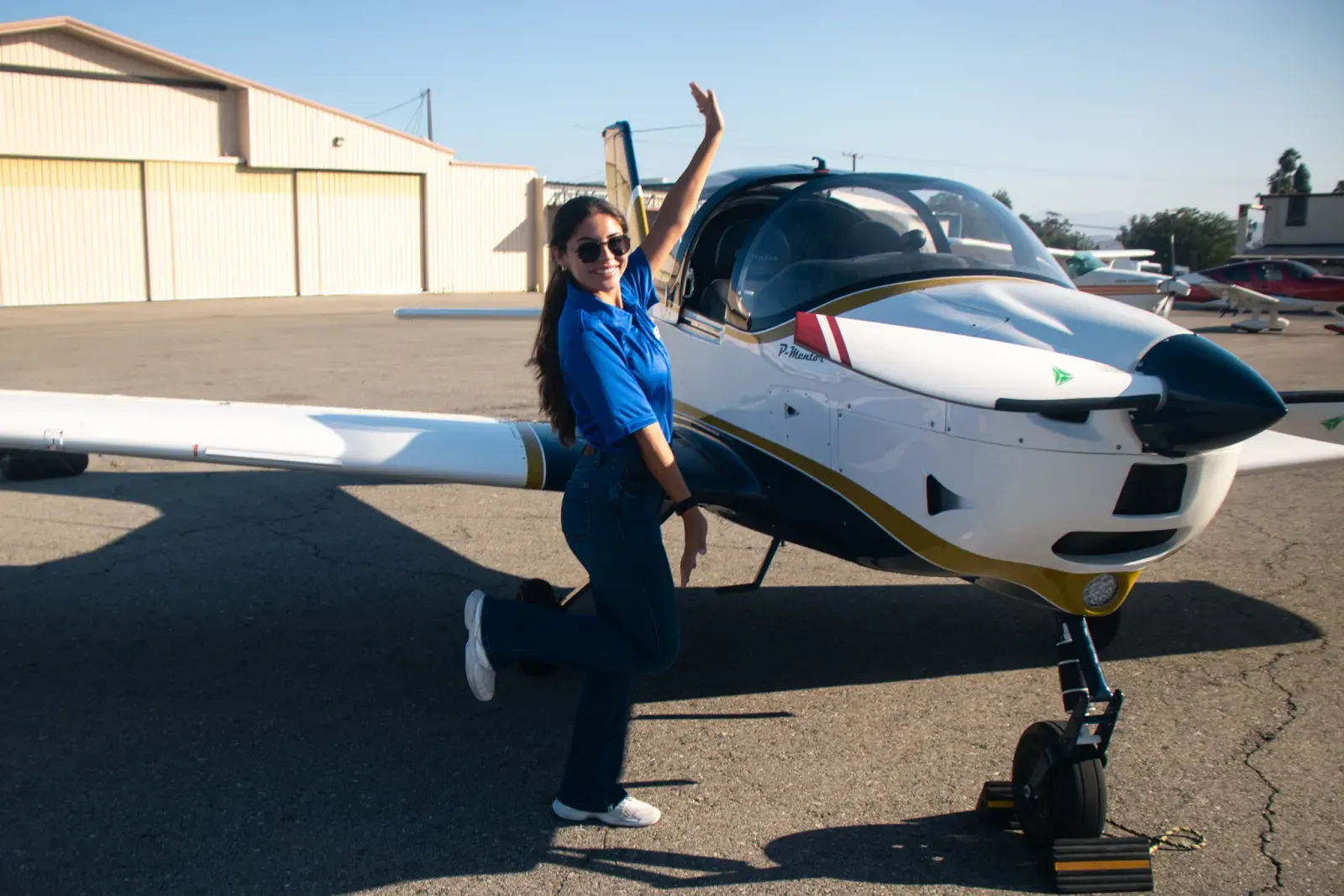
The pilots who do best alongside automation are the ones who understand it. Every plane in our fleet in Riverside is a factory-new Tecnam P-Mentor with a Garmin G3X glass cockpit and a Garmin GFC 500 autopilot, so students learn to manage automation from early lessons, and to fly by hand when it fails.
Questions
Will AI replace airline pilots?
Not in the near term on passenger flights. US law requires two pilots on every airline flight, and Europe's aviation regulator found in 2025 that even one pilot in cruise cannot yet be shown to be as safe as two. Small cargo planes are the most likely place to see pilotless flights first.
What is single pilot operations?
It means one pilot flying an airliner that today needs two. The version studied most, called eMCO in Europe, has one pilot at the controls in cruise while the other rests. EASA paused that work in June 2025.
Are there pilotless planes flying today?
Not carrying passengers. Military drones like the MQ-9 Reaper are flown by a remote pilot in a ground station, and Reliable Robotics flew an uncrewed Cessna Caravan in November 2023 under test conditions. The company is targeting FAA certification in 2028.
Can a plane land itself?
Yes. Airliners have used autoland with the crew supervising since 1965, and Garmin's Emergency Autoland, on more than 2,000 airplanes, can land a small airplane if the pilot cannot. Its first real-world use was in December 2025.
Is being a pilot a good career with AI coming?
Demand projections are strong: Boeing forecasts 660,000 new pilots worldwide by 2044 and the Bureau of Labor Statistics about 16,400 US openings a year to 2035. No one can promise the job will look the same in 30 years, so learn automation well. See how long it takes to become a pilot for the timeline.
Will cargo planes go pilotless first?
Most likely. The leading projects, from Reliable Robotics, Merlin and Xwing, all target cargo in the Cessna Caravan, and flights with no passengers on board are likely to meet less public resistance.
Sources
- 14 CFR 121.385, composition of flight crew (minimum two pilots)
- 14 CFR 121.383, the age 65 limit for airline pilots
- Boeing, 2025 Pilot and Technician Outlook press release, July 2025
- Bureau of Labor Statistics, Occupational Outlook Handbook: Airline and Commercial Pilots
- AIN, emergency autoland reshapes the light aircraft market, June 2026
- AVweb, Garmin Autoland activation was crew decision, December 2025
- Wikipedia, Autoland (first passenger autoland, 1965)
- Airbus, Airbus tests new technologies to enhance pilot assistance (DragonFly), January 2023
- AVweb, Airbus and Cathay Pacific developing single-pilot long-haul system, June 2021
- DroneXL, Reliable Robotics raises $160 million and pushes for FAA certification, April 2026
- AIN, Reliable Robotics raises $160 million for autonomous flight, April 2026
- Merlin, flight test campaign of certification-ready aircraft, May 2025
- AIN, Xwing begins FAA certification process for Superpilot, April 2023
- Wikipedia, General Atomics MQ-9 Reaper (crew and ground control)
- EASA, eMCO-SiPO research project and conclusions
- AIN, EASA pauses its single-pilot operations research, June 2025
- AVweb, EASA pulls back on single-pilot ops, June 2025
- American Journal of Transportation (Bloomberg), airlines push for lone pilot flights, November 2022
- Senator Tim Sheehy, bipartisan letter urging FAA to counter single-pilot proposals, July 2025
- AirlineGeeks, ALPA says single-pilot efforts not finished, December 2025
- FAA Reauthorization Act of 2024, Public Law 118-63 (Sec. 330, human factors task force)
- Military and Aerospace Electronics, FAA lays out roadmap for AI safety in aircraft, August 2024
- Ipsos, few would be comfortable flying on pilotless airliners (poll for ALPA), July 2018
- Scripps News, report says few people would ride pilotless planes (UBS survey)
Last reviewed October 2026. Autonomy projects, certification targets and the single-pilot debate move fast, so check the source for the latest status before you rely on a date here.